CBSE Class 12 Question Paper 2025 Solution History
Finished viewing? Save it for later —
Download CBSE Class 12 Question Paper 2025 Solution History (PDF · 28 pages)About CBSE Class 12 Question Paper 2025 Solution History
CBSE Class 12 Question Paper 2025 Solution History is available here for free download. Published by CBSE for Class 12, this solution can be viewed online or downloaded as a PDF (28 pages). Candidates preparing for Class 12 can use CBSE Class 12 Question Paper 2025 Solution History to understand the exam pattern, the type of questions asked, and the overall difficulty level.
Frequently Asked Questions
How can I download CBSE Class 12 Question Paper 2025 Solution History?
Open this page and click the Download button to save CBSE Class 12 Question Paper 2025 Solution History as a PDF. It is completely free on AglaSem Docs.
Is CBSE Class 12 Question Paper 2025 Solution History free to download?
Yes. CBSE Class 12 Question Paper 2025 Solution History can be viewed online and downloaded as a PDF free of cost on AglaSem Docs.
How many pages does CBSE Class 12 Question Paper 2025 Solution History have?
CBSE Class 12 Question Paper 2025 Solution History contains 28 pages, which you can read online or download together as a single PDF.
Where can I find more Class 12 study material?
You can find more Class 12 question papers, sample papers, syllabus, and answer keys on AglaSem Docs.
CBSE Class 12 Question Paper 2025 Solution History – Text
Read the full text of this solution below — useful to quickly search, copy and reference the content online without downloading the PDF.
📄 View text version (28 pages)
Page 1
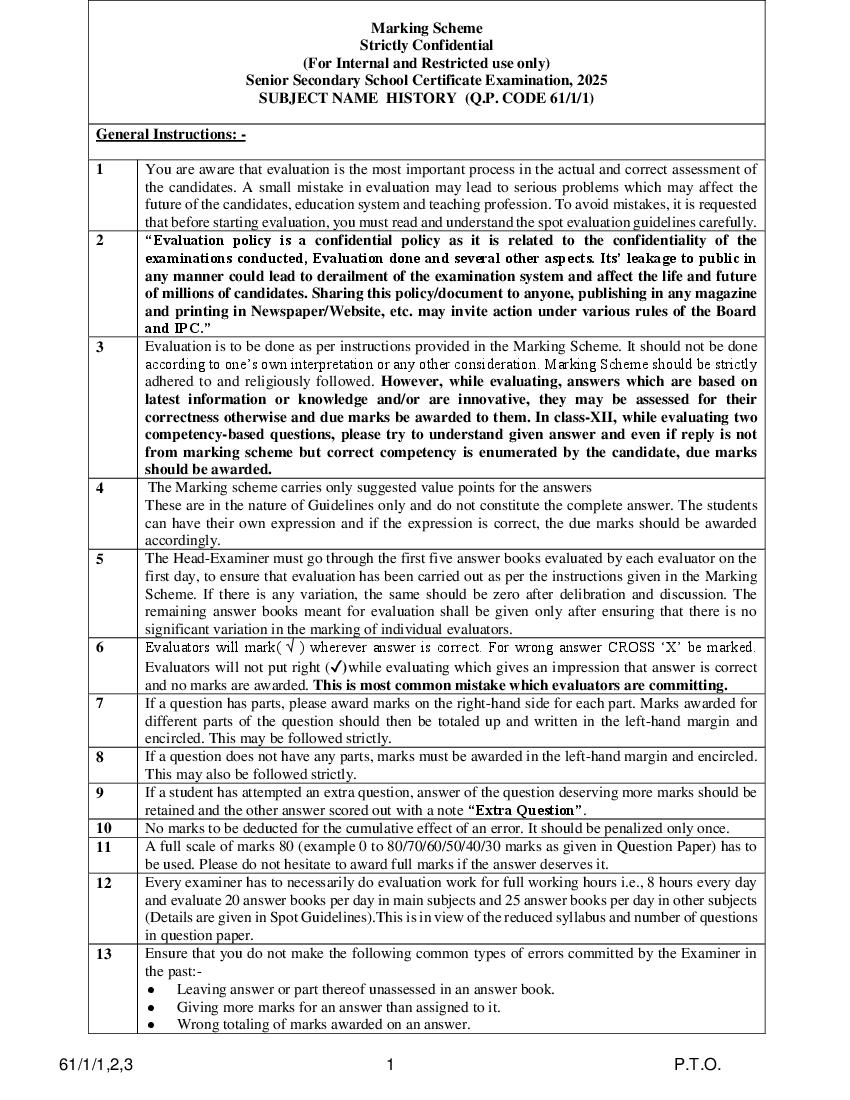
Strictly Confidential
(For Internal and Restricted use only)
Senior Secondary School Certificate Examination, 2025
SUBJECT NAME HISTORY (Q.P. CODE 61/1/1)
General Instructions: -
1 You are aware that evaluation is the most important process in the actual and correct assessment of
the candidates. A small mistake in evaluation may lead to serious problems which may affect the
future of the candidates, education system and teaching profession. To avoid mistakes, it is requested
that before starting evaluation, you must read and understand the spot evaluation guidelines carefully.
2 “Evaluation policy is a confidential policy as it is related to the confidentiality of the
examinations conducted, Evaluation done and several other aspects. Its’ leakage to public in
any manner could lead to derailment of the examination system and affect the life and future
of millions of candidates. Sharing this policy/document to anyone, publishing in any magazine
and printing in Newspaper/Website, etc. may invite action under various rules of the Board
and IPC.”
3 Evaluation is to be done as per instructions provided in the Marking Scheme. It should not be done
according to one’s own interpretation or any other consideration. Marking Scheme should be strictly
adhered to and religiously followed. However, while evaluating, answers which are based on
latest information or knowledge and/or are innovative, they may be assessed for their
correctness otherwise and due marks be awarded to them. In class-XII, while evaluating two
competency-based questions, please try to understand given answer and even if reply is not
from marking scheme but correct competency is enumerated by the candidate, due marks
should be awarded.
4 The Marking scheme carries only suggested value points for the answers
These are in the nature of Guidelines only and do not constitute the complete answer. The students
can have their own expression and if the expression is correct, the due marks should be awarded
accordingly.
5 The Head-Examiner must go through the first five answer books evaluated by each evaluator on the
first day, to ensure that evaluation has been carried out as per the instructions given in the Marking
Scheme. If there is any variation, the same should be zero after delibration and discussion. The
remaining answer books meant for evaluation shall be given only after ensuring that there is no
significant variation in the marking of individual evaluators.
6 Evaluators will mark( √ ) wherever answer is correct. For wrong answer CROSS ‘X’ be marked.
Evaluators will not put right (✓)while evaluating which gives an impression that answer is correct
and no marks are awarded. This is most common mistake which evaluators are committing.
7 If a question has parts, please award marks on the right-hand side for each part. Marks awarded for
different parts of the question should then be totaled up and written in the left-hand margin and
encircled. This may be followed strictly.
8 If a question does not have any parts, marks must be awarded in the left-hand margin and encircled.
This may also be followed strictly.
9 If a student has attempted an extra question, answer of the question deserving more marks should be
retained and the other answer scored out with a note “Extra Question”.
10 No marks to be deducted for the cumulative effect of an error. It should be penalized only once.
11 A full scale of marks 80 (example 0 to 80/70/60/50/40/30 marks as given in Question Paper) has to
be used. Please do not hesitate to award full marks if the answer deserves it.
12 Every examiner has to necessarily do evaluation work for full working hours i.e., 8 hours every day
and evaluate 20 answer books per day in main subjects and 25 answer books per day in other subjects
(Details are given in Spot Guidelines).This is in view of the reduced syllabus and number of questions
in question paper.
13 Ensure that you do not make the following common types of errors committed by the Examiner in
the past:-
● Leaving answer or part thereof unassessed in an answer book.
● Giving more marks for an answer than assigned to it.
● Wrong totaling of marks awarded on an answer.
61/1/1,2,3 1 P.T.O.
Page 2
● Wrong question wise totaling on the title page.
● Wrong totaling of marks of the two columns on the title page.
● Wrong grand total.
● Marks in words and figures not tallying/not same.
● Wrong transfer of marks from the answer book to online award list.
● Answers marked as correct, but marks not awarded. (Ensure that the right tick mark is correctly
and clearly indicated. It should merely be a line. Same is with the X for incorrect answer.)
● Half or a part of answer marked correct and the rest as wrong, but no marks awarded.
14 While evaluating the answer books if the answer is found to be totally incorrect, it should be marked
as cross (X) and awarded zero (0)Marks.
15 Any unassessed portion, non-carrying over of marks to the title page, or totaling error detected by the
candidate shall damage the prestige of all the personnel engaged in the evaluation work as also of the
Board. Hence, in order to uphold the prestige of all concerned, it is again reiterated that the
instructions be followed meticulously and judiciously.
16 The Examiners should acquaint themselves with the guidelines given in the “Guidelines for Spot
Evaluation” before starting the actual evaluation.
17 Every Examiner shall also ensure that all the answers are evaluated, marks carried over to the title
page, correctly totaled and written in figures and words.
18 The candidates are entitled to obtain photocopy of the Answer Book on request on payment of the
prescribed processing fee. All Examiners/Additional Head Examiners/Head Examiners are once
again reminded that they must ensure that evaluation is carried out strictly as per value points for
each answer as given in the Marking Scheme.
61/1/1,2,3 2
Page 3
HISTORY- 61/1/1
NOTE : PAGE NOS MENTIONED IN THE MARKING SCHEME ARE TAKEN FROM THE LATEST
NCERT E-BOOK
S.No Value Points P No. Marks
SECTION –A
Question number 1-21 are Multiple Choice type questions, carrying 1 mark each.
1 (C) This script has not been deciphered so far. 15 1
2 (C) Banawali and Cholistan. 3 1
3 (A) Both A and R are true and R is the correct reasoning of A. 94 1
4 (C) I, II and IV 88 1
5 (C) III, IV, I, II 30 1
6 (D) Daughter of Chandragupta-II and Wife of Vakataka king 40 1
7 (B) Kailashnatha Temple 107 1
For Visually Impaired Candidates :
(C) Maharashtra
8 (D) Document Indian culture 117 1
9 (B) Cultural Competencies and Skills 119 1
1
10 (A) I,II,and III 170
1
11 (B) II, III, I, IV 176
1
12 (C) Important Chronicle – The Ain- e- Akbari 197
1
13 (B) The zamindars collected revenue on behalf of the state. 211-212
1
14 (D) Seeking simple connection with the divine. 161-162
1
15 (D) Heavy taxes and land annexation 242
1
16 (D) The Deccan Riots Commission 255
1
17 (B) III, IV, I, II 262-263
1
18 (B) II, IV, III and I 290,300,
303,304
1
19 (D) Protection of Native territory by British 266
1
20 (B) Union Powers Committee – Pandit Jawaharlal Nehru. 320
61/1/1,2,3 3 P.T.O.
Page 4
21 (D) Rajendra Prasad 320
SECTION – B
(Short Answer Type Questions) 3 x6 = 18
22. (a) “Ashokan inscriptions are the most significant sources to understand the 32-34 3
administration of Ashoka”. Explain the statement.
i. Ashoka’s messages have been inscribed on stone surfaces- natural rock
polished pillars.
ii. Five major political centres of administration have been mentioned.
iii. Same messages found in all the inscriptions from the North west to Orissa.
iv. He used the inscriptions for propagating his idea of Dhamma.
v. This included respect to elders, generosity to Brahmins etc.
vi. He instructed to treat slaves and servants kindly.
vii. Promoted respect for all religions and traditions.
viii. Mentions appointment of Pativedakas to report to the king.
ix. Most inscriptions were in Prakrit, , Greek and Kharosthi were used in the
northwest.
x. Any other relevant point.
(Any three points to be assessed)
OR
(b) “The history of Mauryan empire has been constructed on the variety of 32 3
sources”. Explain the statement.
i. Archaeological finds like sculptures, monasteries.
ii. Contemporary works like Kautilya’s Arthashastra.
iii. Account of Megasthenes.
iv. Buddhist literature.
v. Jaina works.
vi. Puranic literature.
vii. Sanskrit literary works.
viii. Inscriptions of Ashoka—edicts and pillars.
ix. Asokavadana.
x. Punch marked coins.
xi. Any other relevant point.
(Any three points to be assessed)
23. “The mid-first millennium BCE is considered as a significant turning point in 29 & 84 3
the course of World History”. Justify the statement.
i. Emergence of thinkers like Zarathustra in Iran / Kong Zi in China /
Socrates/Plato/Aristotle in Greece / Mahavira and Gautama Buddha in
India.
ii. Emergence of new kingdoms and cities.
iii. Changes in social and economic life.
iv. Growth of diverse systems of thought.
v. Rise of Mahajanapadas.
61/1/1,2,3 4
Page 5
vii. Punch marked Coins.
viii. Development of agriculture.
ix. Any other relevant point.
(Any three points to be assessed)
24 (a)Analyse the Causes that led to the ruin of Vijayanagara empire. 173-174 3
i. .After the death of Krishnadeva Raya, strains began to appear within the
imperial structure.
ii.His successors were troubled by rebellious Nayaka or military chiefs.
iii. Military ambitions of the rulers of Vijayanagara and those of the Deccan
Sultanates resulted in shifting alignments.
iv. Rama Raya became the Chief Minister of Vijayanagara.
v.Rama Raya led the army against the sultans of Bijapur and Golconda.
vi. Battle of Talikota.
vii.Rama Raya was defeated and the city of Vijayanagara fell into ruins.
viii.Any other relevant point
( Any three points to be assessed)
OR
(b) Analyse why was Amara nayaka system considered as a major political
175 3
innovation of the Vijayanagara empire.
i. Many features of the Amara nayaka system were derived from the
Iqta system of Delhi Sultanate
ii. Amara nayakas were military commanders who were given some
territory to govern.
iii. They collected taxes and other dues from peasants, craftsperson
and traders.
iv. They retained part of the revenue for personal use.
v. They also maintained a contingent of horses and elephants, which
were used by the king as a fighting force.
vi. Amara nayakas sent tributes to the king annually.
vii. They personally appeared in the royal court with gifts to express
their loyalty.
viii. Any other relevant point.
( Any three points to be assessed)
25. Examine the role of Panchayat in advocating for the rights of common people 203-205 3
during the Mughal era.
i. Panchayats were an assembly of elders.
ii. It was a heterogeneous body.
iii. Decisions made by the Panchayats were binding on the members.
iv. Funds collected as contributions from individuals was used for
community welfare activities.
v. Panchayat ensured that caste boundaries among the various
communities were upheld.
vi. Marriages were held in the presence of the mandal or headman.
61/1/1,2,3 5 P.T.O.
Page 6
viii. They could inflict more serious forms of punishment – expulsion.
ix. Gram and jati panchayats settled disputes on land.
x. Panchayats received petitions from the common people including
women.
xi. The decisions of the Panchayat were respected by the state.
xii. Any other relevant point.
( Any three points to be assessed)
26. “The rebellion of 1857 was seen as a war in which both Hindus and Muslims 271 3
had equally to lose or gain.” Analyse the statement.
i. All sections of Indian population took part in the revolt of 1857.
ii. The rebel proclamations repeatedly appealed to all the people to join
the struggle.
iii. The ishtahars harked back to the pre-British Hindu-Muslim past and
glorified the coexistence of different communities under the Mughal
Empire.
iv. Muslim Princes also addressed the sentiments of the Hindus.
v. The proclamation that was issued under the name of Bahadur Shah
appealed to the people to join the fight under the standards of both
Muhammad and Mahavir.
vi. The Hindu Muslim unity could not be broken by the British.
vii. Activities of the Christian missionaries to convert Hindus and
Muslims led to fear of loss of caste and religion.
viii. Any other relevant point
(Any three points to be assessed)
27 Describe the role of Dr.B. R. Ambedkar in the Constituent Assembly. 301, 320- 3
321 , 335
i. B.R. Ambedkar, a very important member of the Assembly was a
lawyer and an economist.
ii. He joined the Union Cabinet as law minister.
iii. He was the Chairman of the Drafting Committee of the Constitution.
iv. He had the responsibility of guiding the Draft Constitution through the
Assembly.
v. He spoke in favour of a strong centre.
vi. No longer supported separate electorate.
vii. He presided over the discussion of the Hindu Code Bill.
viii. Any other relevant point.
(Any three points to be assessed)
SECTION-C
( Long Answers Type Questions) 8x3=24
28. (a) There were specific features of the familial relationship during the 55-60, 8
65,76
Mahabharata period.” Explain the statement with examples.
61/1/1,2,3 6
Page 7
relatives.
ii. Familial ties are often regarded as “natural” and based on blood but
they are defined in many different ways.
iii. Some societies regard cousins as being blood relations, whereas others
do not.
iv. The Mahabharata describes a feud over land and power between two
groups of cousins, the Kauravas and the Pandavas, who belonged to a
single ruling family.
v. The Pandavas emerged victorious and they proclaimed patrilineal
succession.
vi. While Patriliny had existed before the feud of Kauravas and Pandavas,
the story of Mahabharata reinforced the ideal of patriliny.
vii. Under patriliny, sons could claim the resources (including the throne
in the case of kings) of their fathers when the latter died.
viii. Most of the ruling dynasties from 6th Century BCE claimed to follow
this system.
ix. There were variations in practicing patriliny.
x. In some situations, brothers succeeded one another.
xi. Sometimes other kinsmen claimed the throne.
xii. In exceptional circumstances, women inherited the throne or ancestral
property , e.g Prabhavati Gupta.
xiii. The Brahmins laid down the codes of social behaviour.
xiv. The Brahmanical prescription was not followed by everybody.
xv. Many common people followed these rules.
xvi. There were eight different kinds of marriages – e.g. Draupadi’s
marriage, Bhīma’s marriage to Hidimba.
xvii. Gotra rules were not followed by all ruling dynasties – e.g.
Satavahanas.
xviii. Mothers had an important place in the family. But their advice was not
always upheld - eg Kunti and Gandhari.
xix. Respect was shown on the basis of hierarchy- caste and gender.
xx. Any other relevant points.
(Any eight points to be assessed)
OR
(b) “The political power or kingship was rarely dependent on birth as 62-63 8
Kshatriyas but also open to anyone who could muster support and resources.”
Explain the statement with the examples from sixth century BCE onwards.
i. According to Dharmashastras and Dharmasutras only Kshatriyas could
be the kings.
i. The Brahmanical prescription was not followed universally.
ii. Several important ruling lineages probably had different origins.
iii. There are several examples where the people of other caste and even
low origin became the rulers.
61/1/1,2,3 7 P.T.O.
Page 8
Kshatriyas, while Brahmanical texts describe them as being of “low”
origin.
v. The Shungas and Kanvas who ruled were Brahmins.
vi. Shakas who came from Central Asia were regarded as Mlechchhas.
vii. Some powerful mlechchhas were familiar with Sanskritic traditions.
viii. The Satavahana dynasty claimed to be Brahmanas-- for e.g Gotami
Puta Siri Satakani claimed to be a unique Brahmin and a destroyer of
the pride of the Kshatriyas.
ix. All this shows that anyone who could muster support can be a king.
x. Any other relevant point.
(Any eight points to be assessed)
29. (a) Explain the main beliefs and teachings of Guru Nanak Dev. 163 8
i. The message of Baba Guru Nanak is spelt out in his hymns and teachings.
ii. He advocated a form of nirguna bhakti.
iii. He repudiated the external practices of the religions.
iv. He rejected sacrifices, ritual baths, image worship, austerities and the
scriptures of both Hindus and Muslims.
v. The Absolute or “rab” had no gender or form.
vi. He proposed a simple way to connect to the Divine by remembering and
repeating the Divine Name.
vii. He expressed his ideas through hymns called “shabad”.
viii. He organised his followers into a community.
ix. He set up rules for congregational worship (sangat) involving collective
recitation.
x. He appointed one of his disciples, Angad, to succeed him as the preceptor
(guru).
xi. Any other relevant point.
(Any eight points to be assessed)
OR
(b) Explain the major beliefs and teachings of Chistis during medieval India.
i. A group of Sufis who migrated to India in the late 12th century were the 155-157 8
Chistis.
ii.They successfully adapted to Indian environment and traditions.
iii.The Khanqah was the centre of their social life.
iv. Shaikh Nizamuddin appointed several spiritual successors and deputed them
to set up hospices.
v. Pilgrimage to tombs of Sufi saints ( Ziyarat) is prevalent all over the Muslim
world.
vi. Most of the Chistis visit the tomb of Khwaja Moinuddin at Ajmer.
vii. Sultan Ghiyasuddin Khalji and Akbar visited Ajmer several times.
viii. A part of Ziyarat is the use of music or Qawwali at the tomb.
ix. In the khanqah, there was an open kitchen (langar), run on futuh (unasked-
for charity)
x. People from all walks of life were welcome.
xi. Chistis practiced bowing before the Shaikh.
61/1/1,2,3 8
Page 9
xiii. They had to shave the heads of initiates.
xiv. They practiced yogic exercises.
xv. The Sufis remember God by reciting the zikr (the Divine Names).
xvi. They evoked His Presence through sama.
xvii. Any other relevant point.
(Any eight points to be assessed)
30. (a)Analyse the impact of national movement in India from 1915 to 1931 on the 287-297 8
Indian masses.
i. Gandhiji became the undisputed leader of the masses.
ii. Major Satyagraha movements like –Champaran, Kheda and
Ahmedabad.
iii. Idea of Satyagraha gained momentum.
iv. Mass participation in Rowlatt Satyagraha.
v. Non-Cooperation Movement.
vi. Civil Disobedience Movement.
vii. Increase in the participation of people from different regions.
viii. Participation of people from different religious traditions.
ix. Promoted indigenous handicraft industries.
x. Khadi and Charkha became the symbol of national movement among
masses.
xi. Participation of women on a large scale.
xii. Ideas of self-reliance / Swadeshi gained strength.
xiii. Boycott of British goods and institutions.
xiv. Promoted Hindu Muslim unity.
xv. There was mass resignation from British offices and institutions.
xvi. Nonpayment of taxes.
xvii. Any other relevant point.
(Any eight points to be assessed)
OR
(b) Analyse the role of Gandhiji after Independence of India. 305-306 8
i. Gandhiji was not present at the festivities in the capital on 15 August 1947.
ii. On 15th August 1947, Gandhiji was in Kolkata.
iii. He spent the day fasting for 24 hrs.
iv. He did not attend any national function.
v. Gandhiji visited hospitals and refugee camps.
vi. He consoled the distressed people.
vii. He appealed to the Sikhs, Hindus and Muslims to forget the past and live in
harmony.
viii. After bringing peace in Bengal, he shifted to Delhi.
ix.In Delhi, Gandhiji appealed to all to live peacefully.
x. Any other relevant point.
(Any eight points to be assessed)
61/1/1,2,3 9 P.T.O.
Page 10
( Source Based Questions) 3x4=12
31. The most ancient system yet discovered 7
(31.1)Analyse the possible reason behind the uniformity in the drainage system 1
across the Harappan cities.
(a) Urban planning and engineering skills.
(b) Possible presence of central authority.
© Any other relevant point.
(Any one point to be assessed) 1
(31.2) Analyse the implications of finding little heaps of material, mostly sand,
alongside drainage channels.
(a) Harappan Civilization had established regular maintenance practices for
their drainage system, but the debris was not always carted away when the
drain was cleared.
(31.3)Assess the impact of Harappan drainage system.
(a) The advanced Harappan drainage system suggests a highly organised 2
society with strong emphasis on public health and cleanliness.
(b)The integration of every house into the drainage network implies a relatively
egalitarian approach to urban amenities, where sanitation services were
accessible to all residents.
(c )The infrastructure likely improved the quality of life by reducing waste
related health issues and promoting a cleaner living environment.
(d) Any other relevant point.
(Any two points to be assessed)
32. A warning for Europe 132
(32.1)Mention any one prominent contribution of Bernier. 1
(a) He wrote a book on India ‘Travels in the Mughal Empire ‘.
(b) Made a comparative study of the east and the west.
(c ) Any other relevant point.
(Any one point to be assessed) 1
(32.2)How did Bernier describe the difference between European kingdom and
the Mughal territories?
(a) Bernier describes European Kingdoms as well cultivated, rich populous,
polite and flourishing, in contrast to what he perceives as the desolate and
neglected state of Mughal territories.
61/1/1,2,3 10
Page 11
would fall into ruin.
(c) Any other relevant point.
(Any one point to be assessed)
(32.3)Explain Bernier’s views on the socio economic status of 2
the people under
Mughal rule.
(a) The absence of private property in land prevented the emergence of the
class of “improving” landlords
(b) Uniform ruination of agriculture, excessive oppression of the peasantry and
a continuous decline in the living standards of all sections of society, except
the ruling aristocracy.
(c) The people were reduced to beggars and barbarians, showing a significant
decline in socio-economic status and overall quality of life.
(d) The artisans had no incentive to improve the quality of their manufactures,
since profits were appropriated by the state.
(e) There was the existence of a prosperous merchant community, who were
engaged in long-distance exchange.
(f) Any other relevant point.
(Any two points to be assessed)
33. On clearance and settled cultivation 245
(33.1)How did Buchanan describe the view of the lower Rajmahal hills? 1
(a)Buchanan described the view as exceedingly fine, with narrow valleys of rice
winding in all directions, clear lands with scattered trees and rocky hills.
(33.2) Why did Buchanan believe that the area had high potential for improved
cultivation?
(a) Forest land could be cleared for cultivation. 1
(b) The land was fertile and fit for agriculture.
(c ) Any other relevant point.
(Any one point to be assessed)
(33.3)How did Buchanan propose utilizing the land for economic benefits?
2
(a) Proposed utilizing the land by replacing wood with valuable plantations like
Asan and palas, for silk and lac production.
(b) Land under forest could be cleared and brought under cultivation.
(c) Land not fit for cultivation could be used to rear Palmira and Mowa.
(d) Any other relevant point.
(Any two points to be assessed)
SECTION –E
( Map Based Question) 5
61/1/1,2,3 11 P.T.O.
Page 12
appropriate symbols :
(i) Kalibanga – a mature Harappan site 1
(ii) Amravati – a Buddhist site 1
(iii) (a) Amber− a territory under the Mughals 1
OR
(iii) (b) Bijapur – an important town of medieval India 1
(34.2) On the same outline map of India, two places have been marked as A and B,
as the centres of the Revolt of 1857. Identify them and write their correct names on 2
the lines drawn near them.
Note : The following questions are for the Visually Impaired Candidates only,
in lieu of Q. No. 34 :
1
(34.1) Mention any one mature Harappan site in India.
1
(34.2) Mention any one Buddhist site in India.
(34.3) (a) Name any one territory under the Mughal.
1
OR
(b) Name the capital of the Vijayanagara empire.
1
(34.4) Write any two important centres of the Revolt of 1857.
2
61/1/1,2,3 12
Page 13
Page 14
Strictly Confidential
(For Internal and Restricted use only)
Senior Secondary School Certificate Examination, 2025
SUBJECT NAME HISTORY (Q.P. CODE 61/1/1)
General Instructions: -
1 You are aware that evaluation is the most important process in the actual and correct assessment of
the candidates. A small mistake in evaluation may lead to serious problems which may affect the
future of the candidates, education system and teaching profession. To avoid mistakes, it is requested
that before starting evaluation, you must read and understand the spot evaluation guidelines carefully.
2 “Evaluation policy is a confidential policy as it is related to the confidentiality of the
examinations conducted, Evaluation done and several other aspects. Its’ leakage to public in
any manner could lead to derailment of the examination system and affect the life and future
of millions of candidates. Sharing this policy/document to anyone, publishing in any magazine
and printing in Newspaper/Website, etc. may invite action under various rules of the Board
and IPC.”
3 Evaluation is to be done as per instructions provided in the Marking Scheme. It should not be done
according to one’s own interpretation or any other consideration. Marking Scheme should be strictly
adhered to and religiously followed. However, while evaluating, answers which are based on
latest information or knowledge and/or are innovative, they may be assessed for their
correctness otherwise and due marks be awarded to them. In class-XII, while evaluating two
competency-based questions, please try to understand given answer and even if reply is not
from marking scheme but correct competency is enumerated by the candidate, due marks
should be awarded.
4 The Marking scheme carries only suggested value points for the answers
These are in the nature of Guidelines only and do not constitute the complete answer. The students
can have their own expression and if the expression is correct, the due marks should be awarded
accordingly.
5 The Head-Examiner must go through the first five answer books evaluated by each evaluator on the
first day, to ensure that evaluation has been carried out as per the instructions given in the Marking
Scheme. If there is any variation, the same should be zero after delibration and discussion. The
remaining answer books meant for evaluation shall be given only after ensuring that there is no
significant variation in the marking of individual evaluators.
6 Evaluators will mark( √ ) wherever answer is correct. For wrong answer CROSS ‘X’ be marked.
Evaluators will not put right (✓)while evaluating which gives an impression that answer is correct
and no marks are awarded. This is most common mistake which evaluators are committing.
7 If a question has parts, please award marks on the right-hand side for each part. Marks awarded for
different parts of the question should then be totaled up and written in the left-hand margin and
encircled. This may be followed strictly.
8 If a question does not have any parts, marks must be awarded in the left-hand margin and encircled.
This may also be followed strictly.
9 If a student has attempted an extra question, answer of the question deserving more marks should be
retained and the other answer scored out with a note “Extra Question”.
10 No marks to be deducted for the cumulative effect of an error. It should be penalized only once.
11 A full scale of marks 80 (example 0 to 80/70/60/50/40/30 marks as given in Question Paper) has to
be used. Please do not hesitate to award full marks if the answer deserves it.
12 Every examiner has to necessarily do evaluation work for full working hours i.e., 8 hours every day
and evaluate 20 answer books per day in main subjects and 25 answer books per day in other subjects
(Details are given in Spot Guidelines).This is in view of the reduced syllabus and number of questions
in question paper.
13 Ensure that you do not make the following common types of errors committed by the Examiner in
the past:-
● Leaving answer or part thereof unassessed in an answer book.
● Giving more marks for an answer than assigned to it.
● Wrong totaling of marks awarded on an answer.
61/1/1,2,3 1 पीटीओ
Page 15
● Wrong question wise totaling on the title page.
● Wrong totaling of marks of the two columns on the title page.
● Wrong grand total.
● Marks in words and figures not tallying/not same.
● Wrong transfer of marks from the answer book to online award list.
● Answers marked as correct, but marks not awarded. (Ensure that the right tick mark is correctly
and clearly indicated. It should merely be a line. Same is with the X for incorrect answer.)
● Half or a part of answer marked correct and the rest as wrong, but no marks awarded.
14 While evaluating the answer books if the answer is found to be totally incorrect, it should be marked
as cross (X) and awarded zero (0)Marks.
15 Any unassessed portion, non-carrying over of marks to the title page, or totaling error detected by the
candidate shall damage the prestige of all the personnel engaged in the evaluation work as also of the
Board. Hence, in order to uphold the prestige of all concerned, it is again reiterated that the
instructions be followed meticulously and judiciously.
16 The Examiners should acquaint themselves with the guidelines given in the “Guidelines for Spot
Evaluation” before starting the actual evaluation.
17 Every Examiner shall also ensure that all the answers are evaluated, marks carried over to the title
page, correctly totaled and written in figures and words.
18 The candidates are entitled to obtain photocopy of the Answer Book on request on payment of the
prescribed processing fee. All Examiners/Additional Head Examiners/Head Examiners are once
again reminded that they must ensure that evaluation is carried out strictly as per value points for
each answer as given in the Marking Scheme.
61/1/1,2,3 2 पीटीओ
Page 16
अंक योजना 2025
इतिहास(027)
अंक योजना में उल्लिल्लिि पृष्ठ संख्या नवीनिम एनसीईआरटी ई-बुकसे ली गई हैं
अतिकिम अंक : 80
क्र.सं. मूल्य अं क पृ ष्ठ अं क
एक िंड
(बहुतवकल्पीय प्रकार के प्रश्न)
1 (C) इस लिलि को अभी तक िढ़ा नहीीं ज़ा सक़ा है । 15 1
2 (C) बऩाविी और चोलिस्त़ान 3 1
3 (A) (A) और (R) दोनोीं सही हैं और (R) , (A) की सही ब्य़ाख्य़ा करत़ा है 94 1
4 (C) I, II और IV 88 1
5 (C) III, IV , I, II 30 1
6 (D) चींद्रगुप्त लितीय की िुत्री और व़ाक़ाटक ऱाज़ा की ित्नी 40 1
7 (B) कैि़ाशऩाथ मीं लदर 107 1
दृलिब़ालित अभ्यलथि योीं के लिए :
1
(C)मह़ाऱािर
8 (D) भ़ारतीय सींस्कृलत क़ा दस्त़ावेजीकरण करऩा 117 1
9 (B) स़ाींस्कृलतक योग्यत़ा और कौशित़ा 119,126 1
1
10 (A) I,II,और III 171
1
11 (B) II, III, I, IV 176
1
12 (C) आइन-ए-अकबरी , ऱाजवींश क़ा महत्विूणि इलतह़ास 197,220
1
13 (B) ऱाज्य की ओर से वे ऱाजस्व एकत्र करते थे 211-212
1
14 (D) ईश्वर के स़ाथ सरि सींबींि की खोज। 161-162
1
15 (D) भ़ारी कर और भूलम अलिग्रहण 242
1
16 (D) दक्कन दीं ग़ा आयोग 255
1
17 (B) III, IV, I, II 262-263
1
18 (B) II, IV, III और I 290,300,
303,316
61/1/1,2,3 3 पीटीओ
Page 17
19 (D) अींग्रेज़ोीं ि़ाऱा दे शी क्षेत्र की सुरक्ष़ा 266
1
20 (B) सींघ शक्ति सलमलत – िींलित जव़ाहरि़ाि ने हरू 320
1
21 (D) ऱाजें द्र प्रस़ाद 320
खीं ि – ख
(िघु उत्तरीय प्रक़ार के प्रश्न) 6x3=18
22. (a) “अशोक के प्रशासन को समझने के तलए अशोक के अतिलेि सबसे 32-34 3
महत्वपू र्ण स्रोि हैं ”। इस कथन की व्याख्या कीतजये ।
i. अशोक के सींदेश ित्थर की सतहोीं- प्ऱाकृलतक चट्ट़ान, िॉलिश लकए गए स्तींभोीं
िर अींलकत लकए गए हैं ।
ii. प्रश़ासन के ि़ााँच प्रमु ख ऱाजनीलतक केंद्रोीं क़ा उल्ले ख लकय़ा गय़ा है ।
iii. उत्तर िलिम से उडीस़ा तक सभी लशि़ािे खोीं में एक जै से सींदेश ि़ाए ज़ाते
हैं ।
iv. उन्ोींने िम्म के अिने लवच़ार क़ा प्रच़ार करने के लिए लशि़ािे खोीं क़ा उियोग
लकय़ा।
v. इसमें बडोीं क़ा सम्म़ान, ब्ऱाह्मणोीं के प्रलत उद़ारत़ा आलद श़ालमि थे ।
vi. उन्ोींने द़ासोीं और नौकरोीं के स़ाथ दय़ािु त़ा से िेश आने क़ा लनदे श लदय़ा।
vii. सभी िमों और िरीं िऱाओीं के प्रलत सम्म़ान को बढ़ाव़ा लदय़ा।
viii. ऱाज़ा को सुचऩा दे ने के लिए िलतवेदकोीं की लनयुक्ति क़ा उल्लेख है ।
ix. उत्तर-िलिम में प्ऱाकृत, ग्रीक और खरोष्ठी में अलिक़ाींश लशि़ािे खोीं क़ा उियोग
लकय़ा गय़ा थ़ा।
x. कोई अन्य प्ऱासींलगक लबींदु।
(लकन्ीीं तीन लबींदुओीं क़ा मू ल़्ाींकन)
अथवा
(b) “मौयण साम्राज्य का इतिहास तवतिन्न स्रोिों पर आिाररि है ”। इस
32 3
कथन की व्याख्या कीतजये।
i. मू लतिय़ााँ, मठ जै सी िुऱात़ाक्तत्वक खोजें ।
ii. कौलटल् के अथि श़ास्त्र जै सी समक़ािीन रचऩाएाँ ।
iii. मे गस्थनीज क़ा लववरण।
iv. बौद्ध स़ालहत्य।
v. जै न रचऩाएाँ ।
vi. िौऱालणक स़ालहत्य।
vii. सींस्कृत स़ालहक्तत्यक रचऩाएाँ ।
viii. अशोक के लशि़ािेख- अलभिेख और स्तीं भ।
61/1/1,2,3 4 पीटीओ
Page 18
x. अींलकत लसक्के।
xi. कोई अन्य प्ऱासींलगक लबींदु।
(लकन्ीीं तीन लबींदुओीं क़ा मू ल़्ाींकन)
23. “ईसा-पू वण प्रथम सहस्राब्दी का काल तवश्व इतिहास में एक महत्वपू र्ण मोड़ 29,84 3
माना जािा है ”। इस कथन को न्यायसंगि ठहराइये ।
i. ईऱान में जरथुस्त्र / चीन में कोींग लज़ / ग्रीस में सोक्रेटस / प्लेटो / एररस्टोटि
/ भ़ारत में मह़ावीर और गौतम बुद्ध जै से लवच़ारकोीं क़ा उदय।
ii. नए ऱाज्योीं और शहरोीं क़ा उदय ।
iii. स़ाम़ालजक और आलथि क जीवन में िररवतिन।
iv. लवलवि लवच़ारि़ाऱाओीं क़ा लवक़ास।
v. मह़ाजनिदोीं क़ा उदय।
vi. िोहे क़ा उियोग।
vii. िींच लचलित लसक्के।
viii. कृलि क़ा लवक़ास।
ix. कोई अन्य प्ऱासींलगक लबींदु।
(लकन्ीीं तीन लबींदुओीं क़ा मू ल़्ाींकन)
24. (a ) उन कारर्ों का तवश्लेषर् कीतजये तजनके कारर् तवजयनगर साम्राज्य 173 -174 3
का पिन हुआ ।
i. कृष्णदे व ऱाय की मृ त्यु के ब़ाद, ऱाजकीय ढ़ााँचे में तऩाव उत्पन्न होने िग़ा।
ii. उनके उत्तऱालिक़ाररयोीं को लवद्रोही ऩायक य़ा सैन्य प्रमु खोीं से िरे श़ानी थी।
iii. लवजयनगर और दककन सल्तनत के श़ासकोीं की स़ामररक महत्व़ाक़ाींक्ष़ाओीं
के क़ारण गठबींिन में बदि़ाव आय़ा।
iv. ऱाम ऱाय लवजयनगर के मु ख्यमीं त्री बने।
v. ऱाम ऱाय ने बीज़ािुर और गोिकुींि़ा के सुल्त़ानोीं के क्तखि़ाफ सेऩा क़ा ने तृत्व
लकय़ा।
vi. त़ािीकोट़ा की िड़ाई।
vii. ऱाम ऱाय की ह़ार हुई और लवजयनगर शहर खीं िहर में तब्दीि हो गय़ा।
viii. कोई अन्य प्ऱासींलगक लबींदु।
(लकन्ीीं तीन लबींदुओीं क़ा मू ल़्ाींकन)
अथवा
61/1/1,2,3 5 पीटीओ
Page 19
िोज क्ों मानी जािी है ? तवश्लेषर् कीतजये । 175 3
i. अमर ऩायक प्रण़ािी की कई लवशे ित़ाएाँ लदल्ली सल्तनत की इि़ा प्रण़ािी से
िी गई थीीं।
ii. अमर ऩायक सैन्य कम़ाींिर थे लजन्ें श़ासन करने के लिए कुछ क्षे त्र लदए गए
थे ।
iii. वे लकस़ानोीं, लशल्पक़ारोीं और व्य़ाि़ाररयोीं से कर और अन्य शुल्क वसूिते
थे ।
iv. वे ऱाजस्व क़ा कुछ लहस्स़ा लनजी इस्ते म़ाि के लिए रखते थे।
v. वे घोडोीं और ह़ालथयोीं की एक टु कडी भी रखते थे , लजसक़ा इस्ते म़ाि ऱाज़ा
एक िड़ाकू बि के रूि में करते थे ।
vi.अमर ऩायक स़ाि़ाऩा ऱाज़ा को कर भेजते थे।
vii वे अिनी वफ़ाद़ारी व्यि करने के लिए उिह़ारोीं के स़ाथ व्यक्तिगत रूि से
श़ाही दरब़ार में उिक्तस्थत होते थे ।
viii.कोई अन्य प्ऱासींलगक लबींदु।
(लकन्ीीं तीन लबींदुओीं क़ा मू ल़्ाींकन)
25 . मुगल काल के दौरान आम लोगों के अतिकारों की वकालि करने में पं चायि 202-204 3
की िूतमका की परि कीतजये ।
i. िींच़ायतें बुजुगों की एक सभ़ा थीीं।
ii. िींच़ायत में भी लवलवित़ा ि़ाई ज़ाती थी।
iii. िींच़ायतोीं ि़ाऱा लिए गए लनणिय सदस्ोीं िर ब़ाध्यक़ारी थे।
iv. व्यक्तियोीं से योगद़ान के रूि में एकत्र िन क़ा उियोग स़ामु द़ालयक कल़्ाण
गलतलवलियोीं के लिए लकय़ा ज़ात़ा थ़ा।
v. िींच़ायत ने सुलनलित लकय़ा लक लवलभन्न समु द़ायोीं के बीच ज़ालत की सीम़ाओीं को
बरकऱार रख़ा ज़ाए।
vi. मीं िि य़ा मु क्तखय़ा की उिक्तस्थलत में लवव़ाह आयोलजत लकए ज़ाते थे।
vii. िींच़ायतोीं को जु म़ािऩा िग़ाने क़ा भी अलिक़ार थ़ा।
viii. वे अलिक गींभीर प्रक़ार की सज़ा दे सकते थे जै से लनष्क़ासन।
ix. ग्ऱाम और ज़ालत िींच़ायतें भू लम सींबींिी लवव़ादोीं क़ा लनिट़ाऱा करती थीीं।
x. िींच़ायतोीं को मलहि़ाओीं सलहत आम िोगोीं की य़ालचक़ाएाँ प्ऱाप्त होती थीीं।
xi. ऱाज्य ि़ाऱा िींच़ायत के लनणियोीं क़ा सम्म़ान लकय़ा ज़ात़ा थ़ा।
xii. कोई अन्य प्ऱासींलगक लबींदु।
(लकन्ीीं तीन लबींदुओीं क़ा मू ल़्ाींकन)
61/1/1,2,3 6 पीटीओ
Page 20
और मुसलमानो दोनों का नफ़ा -नु कसान बराबर था ।” इस कथन का
तवश्लेषर् कीतजये ।
i. 1857 के लवद्रोह में भ़ारतीय आब़ादी के सभी वगों ने भ़ाग लिय़ा।
ii. लवद्रोही घोिऩाओीं ने ब़ार-ब़ार सभी िोगोीं से सींघिि में श़ालमि होने की अिीि
की।
iii. इश्तह़ारोीं ने अींग्रेज़ोीं से िहिे के अतीत की य़ाद लदि़ाई और मु गि स़ाम्ऱाज्य
के तहत लवलभन्न समु द़ायोीं के सह-अक्तस्तत्व क़ा गौरवग़ान लकय़ा।
iv. मु क्तिम ऱाजकुम़ारोीं ने भी लहीं दुओीं की भ़ावऩाओीं को सींबोलित लकय़ा।
v. बह़ादु र श़ाह के ऩाम से ज़ारी की गई घोिण़ा ने िोगोीं से मु हम्मद और मह़ावीर
दोनोीं की दु ह़ाई दे ते हुए िड़ाई में श़ालमि होने की अिीि की।
vi. लहीं दू मु क्तिम एकत़ा को अींग्रेज नहीीं तोड सके।
vii. लहीं दू और मु सिम़ानोीं को िम़ाांतररत करने के लिए ईस़ाई लमशनररयोीं की
गलतलवलियोीं ने ज़ालत और िमि के नु कस़ान क़ा िर िैद़ा लकय़ा।
viii. कोई अन्य प्ऱासींलगक लबींदु।
(लकन्ीीं तीन लबींदुओीं क़ा मू ल़्ाींकन)
27 संतविान सिा में डॉ. बी.आर. अंबेडकर की िूतमका का वर्णन कीतजये । 301, 3
320-321,
i. बी.आर. अींबेिकर, सभ़ा के एक बहुत ही महत्विूणि सदस्, एक वकीि 335
और अथि श़ास्त्री थे।
ii. वे क़ानू न मीं त्री के रूि में केंद्रीय मीं लत्रमीं िि में श़ालमि हुए।
iii. वे सींलवि़ान की प्ऱारूि सलमलत के अध्यक्ष थे।
iv. लवि़ानसभ़ा के म़ाध्यम से सींलवि़ान के मसौदे को लनदे लशत करने की लजम्मेद़ारी
उन िर थी।
v. उन्ोींने एक मजबूत केंद्र के िक्ष में ब़ात की।
vi. वे िृथक लनव़ािलचक़ा के िक्ष में नहीीं थे ।
vii. उन्ोींने लहीं दू कोि लबि की चच़ाि की अध्यक्षत़ा की।
viii. कोई अन्य प्ऱासींलगक लबींदु।
(लकन्ीीं तीन लबींदुओीं क़ा मू ल़्ाींकन)
िंड-ग
(दीर्ण उत्तरीय प्रकार के प्रश्न) 3x8=24
28. (क) महािारि काल के दौरान पाररवाररक ररश्ों की कुछ ख़ास तवशेषिाएँ 55-60, 8
होिी थी ं। इस कथन की व्याख्या उदाहरर्ों सतहि कीतजये । 65,76
i. िररव़ार एक बडे समूह क़ा लहस्स़ा होते हैं लजन्ें हम सम्बीं िी कहते है ।
61/1/1,2,3 7 पीटीओ
Page 21
है िे लकन उन्ें कई अिग-अिग तरीकोीं से िररभ़ालित लकय़ा ज़ात़ा है ।
iii. कुछ सम़ाज चचेरे भ़ाइयोीं को रि सींबींिी म़ानते हैं जबलक अन्य नहीीं।
iv. मह़ाभ़ारत में चचेरे भ़ाइयोीं के दो समू होीं, कौरवोीं और ि़ाींिवोीं के बीच भू लम
और सत्त़ा को िे कर झगडे क़ा वणिन है , जो एक ही श़ासक िररव़ार से सींबींलित
थे ।
v. ि़ाींिव लवजयी हुए और उन्ोींने लितृवींशीय उत्तऱालिक़ार की घोिण़ा की।
vi. कौरवोीं और ि़ाींिवोीं के बीच युद्ध से िहिे भी लितृवींश क़ा अक्तस्तत्व थ़ा,
िे लकन मह़ाभ़ारत की कह़ानी ने लितृवींश के आदशि को और मजबूत लकय़ा।
vii. लितृवींश के तहत, बेटे अिने लित़ा की मृत्यु के ब़ाद उनके सींस़ािनोीं
(ऱाज़ाओीं के म़ामिे में लसींह़ासन सलहत) क़ा द़ाव़ा कर सकते थे ।
viii. छठी शत़ाब्दी ईस़ा िूवि से अलिक़ाींश श़ासक ऱाजवींशोीं ने इस प्रण़ािी क़ा
ि़ािन करने क़ा द़ाव़ा लकय़ा।
ix. लितृवींश के अभ्य़ास में लभन्नत़ाएाँ थीीं।
x. कुछ क्तस्थलतयोीं में , भ़ाई एक-दू सरे के उत्तऱालिक़ारी बनते थे ।
xi. कभी-कभी अन्य ररश्ते द़ार लसींह़ासन क़ा द़ाव़ा करते थे ।
xii. अस़ाि़ारण िररक्तस्थलतयोीं में , मलहि़ाओीं को लसींह़ासन य़ा िैतृक सींिलत्त लवऱासत
में लमिती थी।
xiii. ब्ऱाह्मणोीं ने स़ाम़ालजक व्यवह़ार के लनयम बऩाए।
xiv. ब्ऱाह्मणोीं क़ा दृलिकोण स़ाविभौलमक कद़ालि नहीीं थ़ा।
xv. कई आम िोग इन लनयमोीं क़ा ि़ािन करते थे ।
xvi. लवव़ाह के आठ अिग-अिग प्रक़ार थे – उद़ाहरण स्वरुि द्रौिदी क़ा
लवव़ाह, भीम क़ा लहलिम्ब़ा से लवव़ाह।
xvii. सभी श़ासक ऱाजवींशोीं ि़ाऱा गोत्र लनयमोीं क़ा ि़ािन नहीीं लकय़ा ज़ात़ा थ़ा -
जै से स़ातव़ाहन।
xviii. िररव़ार में म़ात़ाओीं क़ा महत्विूणि स्थ़ान थ़ा। िे लकन उनकी सि़ाह हमे श़ा
नहीीं म़ानी ज़ाती थी: जै से कुींती और ग़ाींि़ारी।
xix. िद के अनु स़ार- ज़ालत और लिीं ग के आि़ार िर सम्म़ान लदय़ा ज़ात़ा थ़ा।
xx. कोई अन्य प्ऱासींलगक लबींदु।
(लकन्ीीं आठ लबींदुओीं क़ा मू ल़्ाींकन)
अथवा
(b) “राजत्व क्षतिय कुल में जन्म लेने पर शायद ही तनिणर करिा था
62-63 8
बल्लि यह हर उस ब्यल्लि के तलए होिा था जो समथणन और संसािन जुटा
सके ।” इस कथन की व्याख्या छठी शिाब्दी ई. पू . के बाद के उदाहरर्ों
सतहि कीतजये ।
i. िमि श़ास्त्रोीं और िमि सूत्रोीं के अनु स़ार केवि क्षलत्रय ही ऱाज़ा हो सकते थे।
61/1/1,2,3 8 पीटीओ
Page 22
iii. कई महत्विूणि श़ासक वींशोीं की उत्पलत्त सींभवतः अन्य वणों से भी हुई।
iv. ऐसे कई उद़ाहरण हैं जह़ााँ अन्य ज़ालत और यह़ााँ तक लक लनम्न मू ि के िोग
श़ासक बने ।
v. बौद्ध ग्रींथोीं में मौयों की स़ाम़ालजक िृष्ठभू लम क्षलत्रय बत़ाई गई है , जबलक
ब्ऱाह्मणव़ादी ग्रींथोीं में उन्ें “लनम्न” मू ि क़ा बत़ाय़ा गय़ा है ।
vi. शुीं ग और कण्व लजन्ोींने श़ासन लकय़ा वे ब्ऱाह्मण थे ।
vii. मध्य एलशय़ा से आए शकोीं को मिे च्छ म़ाऩा ज़ात़ा थ़ा।
viii. कुछ शक्तिश़ािी मिे च्छ सींस्कृतीय िररि़ाटी से अवगत थे ।
ix. स़ातव़ाहन ऱाजवींश ने स्वयीं अनू ठ़ा ब्ऱाह्मण होने क़ा द़ाव़ा लकय़ा - उद़ाहरण
स्वरुि- गोतमी िुत़ा लसरी स़ातक़ानी ने स्वयीं को अलितीय ब्ऱाह्मण तथ़ा क्षलत्रयोीं के
दिि क़ा हनन करने व़ाि़ा बत़ाय़ा थ़ा।
x. यह सब लदख़ात़ा है लक जो कोई भी समथि न जु ट़ा सकत़ा है वह ऱाज़ा बन
सकत़ा है ।
xi. कोई अन्य प्ऱासींलगक लबींदु।
(लकन्ीीं आठ लबींदुओीं क़ा मू ल़्ाींकन)
29 . (a) गु रु नानक दे व की मुख्य मान्यिाओं और तशक्षाओं की व्याख्या कीतजये 162-163 8
।
i. ब़ाब़ा गुरु ऩानक क़ा सींदेश उनके भजनोीं और लशक्ष़ाओीं में लनलहत है ।
ii. उन्ोींने लनगुिण भक्ति के एक रूि क़ा समथि न लकय़ा ।
iii. उन्ोींने िमि के ब़ाहरी आिीं बरोीं को उन्ोींने अस्वीक़ार लकय़ा ।
iv. उन्ोींने बलिद़ान, अनु ष्ठ़ान स्ऩान, मू लति िूज़ा, तिस़्ा और लहीं दुओीं और
मु सिम़ानोीं दोनोीं के िमि ग्रींथोीं को अस्वीक़ार कर लदय़ा।
v. िरम िूणि "रब" क़ा कोई लिीं ग य़ा रूि नहीीं थ़ा।
vi. रब की उि़ासऩा के लिए उन्ोनें एक सरि उि़ाय बत़ाय़ा , वह थ़ा उनक़ा
लनरीं तर स्मरण व ऩाम क़ा जि ।
vii. उन्ोींने अिने लवच़ारोीं को "शबद" ऩामक भजनोीं के म़ाध्यम से व्यि लकय़ा।
viii. उन्ोींने अिने अनुय़ालययोीं को एक समु द़ाय में सींगलठत लकय़ा।
ix. उन्ोींने स़ामू लहक िूज़ा (सींगत) के लिए लनयम स्थ़ालित लकए लजसमें स़ामूलहक
ि़ाठ श़ालमि थ़ा।
x. उन्ोींने अिने एक लशष्य, अींगद को अिने ब़ाद गुरु के िद िर आसीन
लकय़ा।
xi. कोई अन्य प्ऱासींलगक लबींदु।
(लकन्ीीं आठ लबींदुओीं क़ा मू ल़्ाींकन)
61/1/1,2,3 9 पीटीओ
Page 23
8
(b) मध्यकाल के दौरान िारि में तचल्लश्यों की मुख्य मान्यिाओं और 153-156
तशक्षाओं की व्याख्या कीतजये ।
i. 12वीीं शत़ाब्दी के अींत में भ़ारत में प्रव़ास करने व़ािे सूलफयोीं क़ा एक समूह
लचश्ती थ़ा।
ii. उन्ोींने सफित़ािूविक भ़ारतीय व़ात़ावरण और िरीं िऱाओीं को अिऩा लिय़ा।
iii. ख़ानक़ाह उनके स़ाम़ालजक जीवन क़ा केंद्र थ़ा।
v. शे ख लनज़ामु द्दीन ने कई आध्य़ाक्तिक उत्तऱालिक़ारी लनयुि लकए और उन्ें
िमि श़ाि़ाएाँ स्थ़ालित करने के लिए प्रलतलनयुि लकय़ा।
vi. सूफी सींतोीं की कब्रोीं की तीथि य़ात्ऱा (लजय़ारत) िूरे मु क्तिम दु लनय़ा में प्रचलित
है ।
vii. अलिक़ाींश लचश्ती अजमे र में ख्व़ाज़ा मोइनु द्दीन की कब्र िर ज़ाते हैं ।
viii. सुल्त़ान गय़ासुद्दीन क्तखिजी और अकबर ने कई ब़ार अजमे र क़ा दौऱा
लकय़ा थ़ा ।
ix. लजय़ारत क़ा एक लहस्स़ा कब्र िर सींगीत य़ा कव्व़ािी क़ा उियोग करऩा है ।
x. ख़ानक़ाह में एक खु ि़ा रसोईघर (िीं गर) थ़ा, जो फुतूह (लबऩा म़ाींगे द़ान)
िर चित़ा थ़ा।
xi. सभी क्षे त्रोीं के िोगोीं क़ा स्व़ागत लकय़ा ज़ात़ा थ़ा।
xii. लचश्ती शेख के स़ामने झुकने की िरम्पऱा क़ा ि़ािन करते थे।
xiii. वे आगींतुकोीं को ि़ानी दे ते थे ।
xiv. वे दीक्ष़ा िे ने व़ािोीं के लसर क़ा मुीं िन करते थे ।
xv. वे यौलगक अभ्य़ास करते थे ।
xvi. सूफी लज़क्र (लदव्य ऩाम) के ि़ाऱा ईश्वर को य़ाद करते थे ।
xvii. वे सम़ा य़ानी अध्य़ाक्तिक सींगीत के म़ाध्यम से उनकी उि़ासऩा करते थे ।
xviii. कोई अन्य प्ऱासींलगक लबींदु।
(तकन्ी ं आठ तबं दुओ ं का मू ल़्ाींकन)
30 . (क) (a) 1915 से 1931 िक िारि में राष्ट्रीय गतितवतियों के िारिीय 287-300 8
जनिा पर पड़े प्रिावों का तवश्लेषर् कीतजये ।
i. ग़ाींिीजी जनत़ा के लनलविव़ाद ने त़ा बन गए।
ii. चींि़ारण, खे ड़ा और अहमद़ाब़ाद जै से प्रमु ख सत्य़ाग्रह आीं दोिन।
iii. सत्य़ाग्रह के लवच़ार ने गलत िकडी।
iv. रौिट सत्य़ाग्रह में जन भ़ागीद़ारी।
v. असहयोग आीं दोिन।
61/1/1,2,3 10 पीटीओ
Page 24
vii. लवलभन्न क्षे त्रोीं के िोगोीं की भ़ागीद़ारी में वृक्तद्ध।
viii. लवलभन्न ि़ालमि क िरीं िऱाओीं के िोगोीं की भ़ागीद़ारी।
ix. स्वदे शी हस्तलशल्प उद्योगोीं को बढ़ाव़ा लदय़ा गय़ा।
x. ख़ादी और चरख़ा जनम़ानस के बीच ऱािरीय आीं दोिन क़ा प्रतीक बन गए।
xi. मलहि़ाओीं की बडे िैम़ाने िर भ़ागीद़ारी।
xii. आिलनभि रत़ा/स्वदे शी के लवच़ारोीं को बि लमि़ा।
xiii. लब्रलटश वस्तु ओीं और सींस्थ़ानोीं क़ा बलहष्क़ार।
xiv. लहीं दू मु क्तिम एकत़ा को बढ़ाव़ा लदय़ा गय़ा।
xv. लब्रलटश क़ाय़ािियोीं और सींस्थ़ानोीं से स़ामू लहक इस्तीफे लदए गए।
xvi. करोीं क़ा भु गत़ान न करऩा।
xvii. कोई अन्य प्ऱासींलगक लबींदु।
(तकन्ी ं आठ तबं दुओ ं का मू ल़्ाींकन)
अथवा
305-306 8
(b)िारि की स्विंििा के बाद गांिीजी की िूतमका का तवश्लेषर् कीतजये ।
i. ग़ाींिीजी 15 अगस्त 1947 को ऱाजि़ानी में आयोलजत सम़ारोह में उिक्तस्थत नहीीं
थे ।
ii. 15 अगस्त 1947 को ग़ाींिीजी कोिक़ात़ा में थे।
iii. उन्ोींने िूरे लदन 24 घींटे उिव़ास रख़ा।
iv. उन्ोींने लकसी ऱािरीय सम़ारोह में भ़ाग नहीीं लिय़ा।
v. ग़ाींिीजी ने अस्पत़ािोीं और शरण़ाथी लशलवरोीं क़ा दौऱा लकय़ा।
vi. उन्ोींने व्यलथत िोगोीं को स़ाींत्वऩा दी।
vii. उन्ोींने लसक्ोीं, लहींदुओीं और मु सिम़ानोीं से अतीत को भू िकर सद्भ़ाव से
रहने की अिीि की।
viii. बींग़ाि में श़ाींलत स्थ़ालित करने के ब़ाद वे लदल्ली चिे गए।
ix. लदल्ली में ग़ाींिीजी ने सभी से श़ाींलतिूविक रहने की अिीि की।
x. कोई अन्य प्ऱासींलगक लबींदु।
(लकन्ीीं आठ लबींदुओीं क़ा म मू ल़्ाींकन)
61/1/1,2,3 11 पीटीओ
Page 25
(स्रोि आिाररि प्रश्न) 3x4=12
31. अब िक िोजी गई सबसे प्राचीन प्रर्ाली 7
(31.1) हड़प्पा के शहरों में जल तनकासी प्रर्ातलयों में एकरूपिा के 1
पीछे संिातवि कारर् का आकलन कीतजये।
(a) शहरी लनयोजन और इीं जीलनयररीं ग कौशि।
(b) केंद्रीय प्ऱालिकरण की सींभ़ालवत उिक्तस्थलत।
(c) कोई अन्य प्ऱासींलगक लबींदु।
(लकन्ीीं एक लबींदुओीं क़ा मू ल़्ाींकन)
(31.2) जल तनकासी के नालों के तकनारे रे ि के ढे र तमलने के तनतहिाथण 1
का तवश्लेषर् कीतजए।
(a) हडप्प़ा सभ्यत़ा में जि लनक़ासी क़ा लनयलमत रखरख़ाब होत़ा थ़ा , िरन्तु
ऩािी स़ाफ करते समय मिब़ा हमे श़ा हट़ाय़ा नहीीं ज़ात़ा थ़ा।
(31.3) हड़प्पा जल तनकासी प्रर्ाली के प्रिावों का आकलन कीतजये ।
2
(a) हडप्प़ा जि लनक़ासी प्रण़ािी स़ाविजलनक स्व़ास्थ्य और स्वच्छत़ा िर बि दे ती
थी और एक उच्च सींगलठत सम़ाज क़ा उद़ाहरण थी।
(b) जि लनक़ासी के अन्तगित प्रत्येक आव़ास गिी की ऩालियोीं से जोड़ा गय़ा थ़ा
। यह शहरी सुलवि़ाओीं के लिए अिेक्ष़ाकृत समत़ाव़ादी दृलिकोण को दश़ाित़ा है ,
जह़ााँ स्वच्छत़ा सेव़ाएाँ सभी लनव़ालसयोीं के लिए सुिभ थीीं।
(c) बुलनय़ादी ढ़ााँचे ने सींभवतः अिलशि से सींबींलित स्व़ास्थ्य समस़्ाओीं को कम
करके और स्वच्छ रहने के व़ात़ावरण को बढ़ाव़ा दे कर जीवन की गुणवत्त़ा में
सुि़ार लकय़ा
(d) कोई अन्य प्ऱासींलगक लबींदु।
(लकन्ीीं दो लबींदुओीं क़ा मू ल़्ाङ्कन)
32 . यूरोप के तलए चेिावनी 132
(32.1) बतनण यर के तकसी एक मुख्य योगदान का उिे ि कीतजए। 1
(a) उन्ोींने भ़ारत िर एक िुस्तक 'टर ै वल्स इन द मु गि एम्प़ायर' लिखी।
(b) िूवि और िलिम क़ा तुिऩािक अध्ययन लकय़ा।
(c) कोई अन्य प्ऱासींलगक लबींदु।
(लकन्ीीं एक लबींदुओीं क़ा मू ल़्ाङ्कन)
(32.2)बतनण यर ने यूरोपीय साम्राज्य और मुग़ल क्षेिों के बीच अं िर का
1
वर्णन कैसे तकया?
61/1/1,2,3 12 पीटीओ
Page 26
और समृ द्ध बत़ाय़ा है , जबलक मु गि क्षे त्रोीं की क्तस्थलत उनके अनु स़ार उज़ाड और
उिेलक्षत थी।
(b)बलनि यर ने चेत़ावनी दी थी लक यलद यूरोिीय ऱाज़ा मु गि मॉिि क़ा अनु सरण
करें गे तो वे बब़ािद हो ज़ाएीं गे।
(c ) कोई अन्य प्ऱासींलगक लबींदु।
(लकन्ीीं एक लबींदुओीं क़ा मू ल़्ाङ्कन)
(32.3)मुगल शासन के िहि लोगों की सामातजक आतथणक ल्लथथति पर
बतनण यर के तवचारों की व्याख्या कीतजए।
2
(a) लनजी भूस्व़ालमत्व के अभ़ाव ने " बेहतर "भू ि़ारकोीं के वगि के उदय) जै स़ा
लक िलिमी यूरोि में (को रोक़ा
(b)इसी के चिते कृलि क़ा सम़ान रूि से लवऩाश, लकस़ानोीं क़ा असीम उत्पीडन
तथ़ा सम़ाज के सभी वगों के जीवन स्तर में अनवरत ितन की क्तस्थलत उत्पन्न हुई
है , लसव़ाय श़ासक वगि के।
भ़ारत में मध्य की क्तस्थलत के िोग नहीीं है ।
(c) इसक़ा ऱाज़ा" लभख़ाररयोीं और क्रूर िोगोीं "क़ा ऱाज़ा थ़ा; लजससे एक
महत्विूणि प्रभ़ाव थे स़ाम़ालजक-आलथि क क्तस्थलत और जीवन की समग्र गुणवत्त़ा में
लगऱावट।
(d) लशल्पक़ारोीं के ि़ास अिने उत्प़ादोीं को बेहतर बऩाने क़ा कोई प्रोत्स़ाहन
नहीीं थ़ा क्ोींलक मु ऩाफे क़ा अलिग्रहण ऱाज्य ि़ाऱा कर लिय़ा ज़ात़ा थ़ा।
(e) वह एक समृ द्ध व्य़ाि़ाररक समु द़ाय जो िीं बी दू री के लवलनमय से सींिग्न थ़ा,
के अक्तस्तत्व को भी .रे ख़ाींलकत करत़ा है ।
(f) कोई अन्य प्ऱासींलगक लबींदु।
(लकन्ीीं दो लबींदुओीं क़ा मूल़्ाङ्कन)
33. वनों की बटाई और थथायी कृतष के बारे में 245
(33.1) बु कानन ने तनचली राजमहल की पहातड़यों का वर्णन तकस प्रकार 1
तकया?
(a) बुक़ानन ने इस दृश्य को अत्यींत सुन्दर बत़ाय़ा है , यह़ााँ की खे ती लवशेि
रूि से, घुम़ावद़ार सींकरी घ़ालटयोीं में ि़ान की फसि, लबखरे हुए िेडोीं के स़ाथ
स़ाफ की गई जमीन, और चट्ट़ानी िह़ालडय़ााँ सभी अिने आि में िूणि हैं ।
(33.2) बु कानन ने इस क्षे ि में िेिी के सुिार की उच्च संिावना को 1
क्ों माना?
(a) वन भू लम को खे ती के लिए स़ाफ लकय़ा ज़ा सकत़ा है ।
(b) भू लम उिज़ाऊ थी और कृलि के लिए उियुि थी।
(c) कोई अन्य प्ऱासींलगक लबींदु।
61/1/1,2,3 13 पीटीओ
Page 27
2
(33.3) बु कानन ने आतथणक लाि के तलए िूतम का उपयोग करने का प्रस्ताव
कैसे तदया ?
(a) रे शम और ि़ाख उत्प़ादन के लिए िकडी के स्थ़ान िर आसन और िि़ास
जै से मू ल्व़ान ब़ाग़ान िग़ाने क़ा प्रस्त़ाव रख़ा।
(b) वन भू लम को स़ाफ करके खे ती के लिए ि़ाय़ा ज़ा सकत़ा है ।
(c) खे ती के लिए अनु ियुि भू लम क़ा उियोग िनई त़ाड और महुआ के िेड
िग़ाकर लकय़ा ज़ा सकत़ा है ।
(d) कोई अन्य प्ऱासींलगक लबींदु।
(लकन्ीीं दो लबींदुओीं क़ा मू ल़्ाङ्कन)
िंड-ङ
(मानतचि आिाररि प्रश्न) 5
34 34.1 लदए गए भ़ारत के ऱाजनीलतक रे ख़ा-म़ानलचत्र िर लनम्नलिक्तखत को उियुि
लचह्ोीं से अींलकत कीलजए और उनके ऩाम लिक्तखए:
(i) क़ािीबींग़ा एक लवकलसत हडप्प़ा िुऱास्थि 1
(ii) अमऱावती बौद्ध स्थि 1
(iii) (a) आम्बे र – मु ग़िोीं के अिीन क्षे त्र
1
अथव़ा
(b) बीज़ािुर - मध्यक़ािीन भ़ारत क़ा एक महत्विूणि शहर 1
34.2 लदए गए भ़ारत के इसी ऱाजनीलतक रे ख़ा-म़ानलचत्र िर 1857 2
के लवद्रोह से सींबींलित दो केन्द्ोीं को A और B से अींलकत लकय़ा गय़ा
है । इनको िहच़ालनए और उनके स़ाथ खीींची गई रे ख़ाओीं िर इनके सही
ऩाम लिक्तखए ।
नोट : लनम्नलिक्तखत प्रश्न केवि दृलिब़ालित िरीक्ष़ालथि योीं के लिए प्रश्न सींख्य़ा 34 के
स्थ़ान िर हैं ।
34.1 भ़ारत में लकसी एक लवकलसत हडप्प़ा िुऱास्थि क़ा ऩाम लिक्तखए । 1
34.2 भ़ारत में लकसी एक बौद्ध स्थि क़ा ऩाम लिक्तखए । 1
34.3 (a) मु गिोीं के अिीन लकसी एक क्षे त्र क़ा ऩाम लिक्तखए
अथवा 1
(b) लवजयनगर स़ाम्ऱाज्य की ऱाजि़ानी क़ा ऩाम लिक्तखए 1
34.4 1857 के लवद्रोह के लकन्ी दो मु ख्य केन्द्ोीं के ऩाम लिक्तखए
2
61/1/1,2,3 14 पीटीओ
Page 28
Document Details
| Board / Org | CBSE |
| Exam | Class 12 |
| Type | Solution |
| Pages | 28 |
| Updated | 24 Sep 2026 |