CBSE Class 12 Question Paper 2025 Solution Home Science
Finished viewing? Save it for later —
Download CBSE Class 12 Question Paper 2025 Solution Home Science (PDF · 16 pages)About CBSE Class 12 Question Paper 2025 Solution Home Science
CBSE Class 12 Question Paper 2025 Solution Home Science is available here for free download. Published by CBSE for Class 12, this solution can be viewed online or downloaded as a PDF (16 pages). Candidates preparing for Class 12 can use CBSE Class 12 Question Paper 2025 Solution Home Science to understand the exam pattern, the type of questions asked, and the overall difficulty level.
Frequently Asked Questions
How can I download CBSE Class 12 Question Paper 2025 Solution Home Science?
Open this page and click the Download button to save CBSE Class 12 Question Paper 2025 Solution Home Science as a PDF. It is completely free on AglaSem Docs.
Is CBSE Class 12 Question Paper 2025 Solution Home Science free to download?
Yes. CBSE Class 12 Question Paper 2025 Solution Home Science can be viewed online and downloaded as a PDF free of cost on AglaSem Docs.
How many pages does CBSE Class 12 Question Paper 2025 Solution Home Science have?
CBSE Class 12 Question Paper 2025 Solution Home Science contains 16 pages, which you can read online or download together as a single PDF.
Where can I find more Class 12 study material?
You can find more Class 12 question papers, sample papers, syllabus, and answer keys on AglaSem Docs.
CBSE Class 12 Question Paper 2025 Solution Home Science – Text
Read the full text of this solution below — useful to quickly search, copy and reference the content online without downloading the PDF.
📄 View text version (16 pages)
Page 1
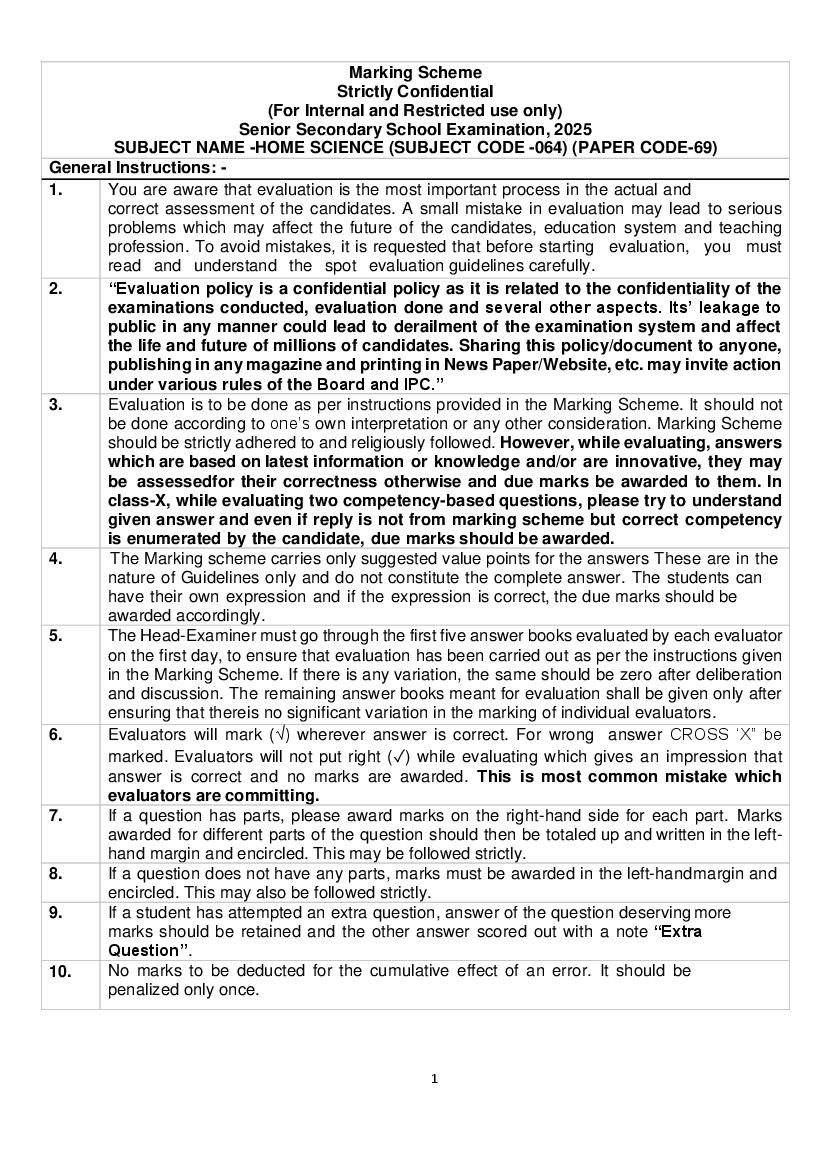
Strictly Confidential
(For Internal and Restricted use only)
Senior Secondary School Examination, 2025
SUBJECT NAME -HOME SCIENCE (SUBJECT CODE -064) (PAPER CODE-69)
General Instructions: -
1. You are aware that evaluation is the most important process in the actual and
correct assessment of the candidates. A small mistake in evaluation may lead to serious
problems which may affect the future of the candidates, education system and teaching
profession. To avoid mistakes, it is requested that before starting evaluation, you must
read and understand the spot evaluation guidelines carefully.
2. “Evaluation policy is a confidential policy as it is related to the confidentiality of the
examinations conducted, evaluation done and several other aspects. Its’ leakage to
public in any manner could lead to derailment of the examination system and affect
the life and future of millions of candidates. Sharing this policy/document to anyone,
publishing in any magazine and printing in News Paper/Website, etc. may invite action
under various rules of the Board and IPC.”
3. Evaluation is to be done as per instructions provided in the Marking Scheme. It should not
be done according to one’s own interpretation or any other consideration. Marking Scheme
should be strictly adhered to and religiously followed. However, while evaluating, answers
which are based on latest information or knowledge and/or are innovative, they may
be assessedfor their correctness otherwise and due marks be awarded to them. In
class-X, while evaluating two competency-based questions, please try to understand
given answer and even if reply is not from marking scheme but correct competency
is enumerated by the candidate, due marks should be awarded.
4. The Marking scheme carries only suggested value points for the answers These are in the
nature of Guidelines only and do not constitute the complete answer. The students can
have their own expression and if the expression is correct, the due marks should be
awarded accordingly.
5. The Head-Examiner must go through the first five answer books evaluated by each evaluator
on the first day, to ensure that evaluation has been carried out as per the instructions given
in the Marking Scheme. If there is any variation, the same should be zero after deliberation
and discussion. The remaining answer books meant for evaluation shall be given only after
ensuring that thereis no significant variation in the marking of individual evaluators.
6. Evaluators will mark (√) wherever answer is correct. For wrong answer CROSS ‘X” be
marked. Evaluators will not put right (✓) while evaluating which gives an impression that
answer is correct and no marks are awarded. This is most common mistake which
evaluators are committing.
7. If a question has parts, please award marks on the right-hand side for each part. Marks
awarded for different parts of the question should then be totaled up and written in the left-
hand margin and encircled. This may be followed strictly.
8. If a question does not have any parts, marks must be awarded in the left-hand margin and
encircled. This may also be followed strictly.
9. If a student has attempted an extra question, answer of the question deserving more
marks should be retained and the other answer scored out with a note “Extra
Question”.
10. No marks to be deducted for the cumulative effect of an error. It should be
penalized only once.
1
Page 2
Paper) has to be used. Please do not hesitate to award full marks if the answer deserves
it.
12. Every examiner has to necessarily do evaluation work for full working hours i.e., 8 hours
every day and evaluate 20 answer books per day in main subjects and 25 answer books per
day in other subjects (Details are given in Spot Guidelines). This is in view of the reduced
syllabus and number of questions in question paper.
13. Ensure that you do not make the following common types of errors committed by the
Examiner in the past: -
● Leaving answer or part there of unassessed in an answer book.
● Giving more marks for an answer than assigned to it.
● Wrong totaling of marks awarded on an answer.
● Wrong transfer of marks from the inside pages of the answer book to the title page.
● Wrong question wise totaling on the title page.
● Wrong totaling of marks of the two columns on the title page.
● Wrong grand total.
● Marks in words and figures not tallying/not same.
● Wrong transfer of marks from the answer book to online award list.
● Answers marked as correct, but marks not awarded. (Ensure that the right tick mark is
correctly and clearly indicated. It should merely be a line.Same is with the X for
incorrect answer.)
● Half or a part of answer marked correct and the rest as wrong, but no marks awarded.
14. While evaluating the answer books if the answer is found to be totally incorrect,
it should be marked as cross (X) and awarded zero (0) Marks.
15. Any un assessed portion, non-carrying over of marks to the title page, or totaling error
detected by the candidate shall damage the prestige of all the personnel engaged in the
evaluation work as also of the Board. Hence, in orderto uphold the prestige of all concerned,
it is again reiterated that the instructions be followed meticulously and judiciously.
16. The Examiners should acquaint themselves with the guidelines given in the
“Guidelines for spot Evaluation” before starting the actual evaluation.
17. Every Examiner shall also ensure that all the answers are evaluated, marks
carried over to the title page, correctly totaled and written in figures and words.
18. The candidates are entitled to obtain photocopy of the Answer Book on request on payment
of the prescribed processing fee. All Examiners/Additional Head Examiners/Head Examiners
are once again reminded that they must ensure that evaluation is carried out strictly as per
value points for each answer as given in the Marking Scheme.
2
Page 3
MARKING SCHEME
Q. No. EXPECTED ANSWERS / VALUE POINTS Marks
SECTION A (Multiple Choice Questions)
1. (C) Diet consultant 1
2. (B) Shola craft 1
3. (A) 5 – 60° C 1
4. (C) Tamil Nadu 1
5. (a)(D) Food Security Programmes 1
OR OR
(b) (A) Vitamin A 1
6. (B) India 1
7. (C) The Factories Act 1
8. (D) Physical hazard: Hair 1
9. (B) Tertiary 1
10. (A) Tumbling 1
11. (C) i – 2, ii – 1, iii – 4, iv – 3 1
12. (D) i – 3, ii – 4, iii – 1, iv – 2 1
13. (A) (i) and (iv) 1
14.(a) (B) (i) and (ii) 1
OR OR
(b) (C) (iii) and (iv) 1
SECTION B (Case Study-Based Questions)
15. (C) Observation Home: A kind of home for Children 1
16. (A) i – 4, ii – 3, iii – 2, iv – 1 1
17. (A) Both (A) and (R) are true and (R) is the correct explanation of (A). 1
18. (C) (A) is true, but (R) is false. 1
SECTION C (Short Answer Questions)
19.(a) ‘Poshan Abhiyaan monitors and reviews the implementation of strategies
to address the nutritional problems’. Justify this statement by giving any
two short term interventions.
Short term interventions of Poshan Abhiyaan- 1X2=2
1. Integrated Child Development Services (ICDS) to cover all vulnerable children
in the age group of 0-6 years and all pregnant and lactating mothers
2. Fortification of essential foods (salt fortified with iodine)
3. Production and popularisation of low-cost nutritious foods
4. Control of micronutrient deficiencies among vulnerable groups, namely
deficiencies of iron, vitamin A, folic acid and iodine by supplementing these
nutrients, distributing free tablets etc.
OR OR
(b) A doctor has diagnosed a fall in haemoglobin levels of an adolescent girl.
Which nutritional deficiency disorder does it indicate? List any two other
symptoms which may be seen in her in this disorder.
3
Page 4
Iron Deficiency Anemia / IDA / Anemia 1
Symptoms- ½X2=1
1.Shortness of breath / breathlessness
2.Fatigue
3.Lethargy
4.General pallor
5.Paleness of conjunctiva of eyes / tongue / nail beds / soft palate
6.Cognitive functions (attention span / memory / concentration) are adversely
affected
20. Few children of a village have become victims of a natural calamity and are
without home. Besides these, which other four types of vulnerable
children need care and protection?
Vulnerable children who need care and protection - ½X4=2
1.Abandoned children
2.Street children
3.Runaway children
4.Missing children
5.Abused or neglected by the guardian
6.Mentally or physically challenged / Children with special needs
7.Children suffering from terminal illness / incurable disease
8.Physically or sexually abused children
9.Children who are tortured or exploited or engaged in illegal acts
10.Victims of drug abuse
11.Trafficked children
12.Victims of armed conflict, civil commotion
13.Orphan children
14.Children rescued from red light areas
15.Child labourers
16.Children of prisoners
Any other, Any four
21. What is meant by food fortification? Give its two examples.
Food fortification- 1
It is an industrial process of adding the essential nutrient/s that is lacking in the
food stuffs or condiments to ensure that minimum dietary requirements are met.
Any other
Examples- ½X2=1
1. Iodised salt / Salt double fortified with Iodine and Iron
2.Folic acid added to flour
4
Page 5
4.Vitamin A and D added to oils / fats
5.Iron,Vitamin B₁₂ and Folic Acid added to wheat / rice
22. By using different types of lines in various combinations on fabrics, name
four basic groups of shapes which can be formed?
Four basic groups of shapes- ½X4=2
1.Natural shapes
2.Stylised shapes
3.Geometric shapes
4.Abstract shapes
23. How is ironing different from hot pressing of clothes? Give any two
differences.
S.No. Ironing Hot Pressing 1+1=2
1. It is the process of It is a process which helps to put
smoothening out wrinkles creases in sleeves, trousers,
created with use or during pleated skirts, curtains etc. with
washing. heat and pressure.
2. It is done on light clothes. It is done on both light and
heavy clothes.
3. It is done by back-and-forth It applies a downward pressure
motion. by lifting up-and-down motion.
Any other, Any two differences
24. A student is curious to learn about the major developments in food
processing and technology that occurred before the 20th century. In this
context, name two researchers who made a significant contribution in
those times. Also name the process developed by each one of them.
Researcher Process Developed 1+1=2
Nicolas Appert Canning
Louis Pasteur Pasteurization
Any two researchers with the process they developed
25.(a) Differentiate between underweight and wasting.
Underweight Wasting 1+1=2
A person is said to be underweight When weight is not adequate relative
when his / her body weight is less to height, it is termed wasting.
than adequate for his / her age.
One difference
OR OR
5
Page 6
Full form of PEM- 1
Protein Energy Malnutrition
Description of PEM- 1
1.Caused by inadequate food intake vis–a–vis the requirements i.e., insufficient
intake of the macronutrients (energy and protein) / poverty / infections / chronic
illnesses
2.Types- Marasmus, Kwashiorkor
3.Severe undernutrition due to deficiency of food and energy is termed as
Marasmus and that caused by protein deficiency is termed as Kwashiorkor
4.Symptoms - Underweight, Wasting, Stunting
5.Children are at greatest risk but it can occur in adults, especially elderly and in
some diseases e.g. T.B., AIDS etc.
6.It is assessed by evaluating the anthropometric measurements (weight, height,
head-chest circumference, etc.)
7.Treatment - through balanced nutrition
Any other, Any one
26.(a) Sumera lived in a remote village and was never sent to school. Now her
parents want to admit her in a residential school. Suggest the name of the
scheme by the Government of India meant for such girls. Explain any two
other features of this scheme.
Name of the scheme- 1
Kasturba Gandhi Balika Vidyalaya / KGBV
Features- 1X2=2
1.Scheme of Government of India under Sarva Shiksha Abhiyaan (SSA), now
Samagra Shiksha
2.Provide free school education to dropout girls from rural and disadvantaged
sections of the society
3.Enrolls girls in class VI (upper primary) and is till class XII (Senior Secondary)
4.All the girls study the Bridge Course for preparing them for the entry level
5.Schools have been opened in backward blocks of each district
6.Helps in the implementation of ‘Right to Education Act’ (RTE), Government of
India
7.Aims to enhance literacy rate, empower girls, bridge gender gap, provide quality
and equity in education
OR OR
(b) Jacob wants to set up a suitable workplace for his employees in his own
manufacturing company. Advise him to use ergonomics in designing
workplaces by giving the definition of ergonomics and its two benefits.
6
Page 7
1.Human Factors Engineering
2.Adjustment of Human and Machine
3.Involves application of human biological sciences combined with engineering
science to achieve optimum mutual adjustment of human work, with the benefit
being measured in terms of human efficiency and well-being
4.Study of humans at work, in order to understand the complex interrelationships
of people with their job requirements, methods of working, tools / equipment
used and the environment
5.Derived from two Greek words — ‘ergon’ (work) and ‘nomics’ (natural laws)
6.Study of work with the primary goal being to adapt the work environment to the
worker
Any other, Any one
Benefits of Ergonomics- 1X2=2
1.Reduces risk of injury and accidents
2.Increases productivity
3.Reduces mistakes and need to do the work again
4.Increases efficiency
5.Decreases absenteeism due to ill health / accidents / stress
6.Improves morale of workers
7.Increases job satisfaction through comfortable working conditions
27. Provide six reasons how a pre-school environment is beneficial for young
children’s development.
Pre-school environment is beneficial due to following reasons- ½X6=3
1.Child centered approach
2.Play way method which makes learning enjoyable
3.Children enjoy the company of others / socialization with peers
4.Facilitates quick learning due to peers / stimulating environment
5.Makes children independent and do their work on their own like eating on their
own
6.Beneficial for children who live in difficult circumstances or who need
additional support for learning / Children with special needs (CWSN)
7.Enhances child’s exploration to other adults and other environments and
materials / enhances creativity and curiosity
8.Prepares children for formal schooling
9.Provides a good learning environment
10.Facilitates sharing, cooperation, empathy
11.Develops self-confidence and self-awareness
12.Develops communication skills / language skills
13.Helps to manage emotions
14.Aids in holistic development of the child
15.Improves concentration, memory and attention span
16.Assists in growth and development of children outside the home
17.Teaches self-care, healthy habits and disciplined routine
Any other, Any six
7
Page 8
skills?
DCJ professionals should be well versed in computer skills to – 1
1.write and present technical reports and documents / prepare presentations /
analyse data etc.
2.operate the video production station or radio station and related suitable
softwares
3.design graphics
4.edit using multimedia
5.write emails or creative briefs for effective communication
6.use Microsoft Office / Google / AI applications
7.increase work efficiency
8.use social media platforms for creating impact on masses
9.saves time / resources
Any other, Any one
(b) In which two areas can a Development Journalist work?
Areas in which Development Journalist can work - ½X2=1
1.Traditional Media - Print / TV / Radio etc.
2.Community Media - Radio jockey / Anchor etc.
3.Digital Media - Online news / Blog writing / Social media / Podcast etc.
4.Teaching / Academics / Training
5.Research
6.International agencies / Government agencies / NGOs
7.Freelancing / Consultancy
8.Government / Corporate sector
(c) Name the umbrella term that includes computer hardware and software,
digital broadcast, etc.
Information and Communication Technologies / ICT 1
29.(a) Enlist six features of Hospital laundry.
Features of Hospital laundry- ½X6=3
1.Takes care of hygiene, cleanliness and disinfection / sterilization
2.Most of the articles are of cotton, only the blankets are woollen
3.Articles are dyed (in colours specific to the hospital and department) with dyes
which have excellent wash-fastness
4.Stubborn stains may not be taken notice of
5.Finishing like starching and whitening is not included
6.Ironing and pressing may not be done to perfection
7.Repair, mending and condemnation of unusable material may or may not form
a part of the services required
8.Some hospitals have started using disposables where there is a threat of
infection, which are then destroyed by burning
8
Page 9
10.Eco friendly detergents may be used
11.High-capacity washers and hydroextractors are used
Any other, Any six
OR OR
(b) Mention six work operations which are performed by an automatic
washing machine.
Six work operations performed by automatic washing machine- ½X6=3
1.Filling up water
2.Water Level Control
3.Regulation of Temperature of Water
4.Washing
5.Rinsing
6.Water Extraction
SECTION D (Long Answer Questions)
30. (a) Which type of diet should be given to a person who has dentures? Give
any two examples of this diet.
Type of diet- 1
Mechanical soft diet
Examples- ½X2=1
1. Mashed fruits / vegetables
2. Pureed fruits / vegetables
3. Peeled and Grated fruits / vegetables
4. Boiled / Stewed fruits / vegetables
5. Well-cooked dal / rice / khichri / dalia
6. Smoothies / Curd / Custard / Pudding / Kheer
7.Boiled / Scrambled eggs / Tender meat / Minced meat
(b) Describe any two ways of feeding a patient.
Ways of feeding a patient -
1X2=2
1.Oral feeding / Feeding by mouth -
i. Best / most preferred way
ii. Nutritionally adequate
2.Tube feeding -
i. Introduced through nose or stomach etc.
ii. Preferred as long as gastrointestinal tract is functional
iii. Can be given when the person is able to digest and absorb
9
Page 10
i. Patient is nourished with special solutions which are given through a drip in a
vein
ii. Can be used to provide nutrition to unconscious patients
Any two ways with any one point of description for each
31. Your grandmother has purchased apples from a street vendor, who
cheated her by weighing less.
(a)By which four ways can a fruit and vegetable vendor deceive his
customers using defective weights and measures?
Fruits and vegetable vendor can deceive customers by- ½X4=2
1.not using -standardized weights / weights and measures with seal / weights
with genuine verification stamp
2.using weights which are hollow from below / tempering with weights
3.using stones for weighing instead of standard weights
4.not mentioning correct weight on packaged fruits and vegetables
5.sticking magnet on the bottom of the pan of the weighing scale
6.using the weighing scale where the pointer is not in the centre or missing
7.using defective and unverified electronic weighing machines / beam scales /
platform scales / non calibrated weighing machine
8.putting additional rings on one side of the manual weighing balance
9.weighing machine kept on the uneven / slant surface
Any other, Any four
(b)As an alert consumer, what are her two responsibilities in this context.
Responsibilities of consumer- 1X2=2
1.Should purchase good quality products weighed by verified scale weights
2.Be vigilant and watch carefully how the vendors are weighing goods
3.If vendors are using defective weights and measures, tell them not to do so
4.If vendors do not listen, inform others not to purchase from them / restrict their
entry in the area
5.Take vendors’ photo or video and report to concerned authorities
6.Insist for digital / electronic weighing scales than manual
7.Insist for weighing prepackaged goods
8.Participate in consumer forums
9.Be aware of National Consumer Helpline
10.Be aware of latest consumer laws and consumer rights
32.(a) (i)‘‘Food safety challenges have changed globally as well as in India, and
Food Quality and Food Safety have gained tremendous importance’’. In
this context, highlight two significant reasons of importance of Food
Quality and Safety.
10
Page 11
1.Protection from food borne microbial illnesses
2.Changing lifestyles, diverse eating habits and large population increase risks
of food contamination
3.Increasing demand for processed and packaged foods require strict safety
measures
4.Quality concerns arise for pre-packaged spices, condiments, various types of
spice powder and mixes due to increased demand
5.Complex logistics in bulk food transportation increase the risk of contamination
6.Rising food-borne diseases and emerging pathogens demand better safety
protocols
7.India’s participation in the World Trade Organisation (WTO) has increased the
need for effective food standards in international trade
8.Environmental pollution / pesticides increase the risk of food contamination
9.Ingredients/Additives in processed foods require thorough safety analysis
10.Growing consumer demand for safe, wholesome, nutritious foods drives
quality control efforts
(ii) Identify two common food-borne pathogens that can spread infection in
healthy individuals.
Common food-borne pathogens that can spread infection- 1X2=2
1.Salmonella
2.Staphylococcus aureus
3.Escherichia coli (E. coli)
4.Norovirus
5.Rotavirus
6.Hepatitis A, E
OR OR
(b) (i) What is the full name of the comprehensive law that consolidated
various old food laws in India? When was it enacted?
Name of the comprehensive law that consolidated various old food laws in
India- 1
Food Safety and Standards Act / FSSA
Enacted in-
1
2006
(ii) A food manufacturing company is establishing a Food Safety
Management System. Describe two systems the company can use to
ensure food safety and quality.
11
Page 12
1.Good Manufacturing Practices (GMP) –
i. Part of quality assurance to ensure products are safe
ii. Enables to minimise or eliminate contamination and false labelling
iii. Helps to refine compliance and performance by manufacturers / producers
iv. Ensures that manufacturers / processors take proactive steps to make
products safe
v. Good business tool for food operations
2.Good Handling Practices (GHP) -
i. A comprehensive approach from the farm to the store / consumer
ii. Identifies potential sources of risk
iii. Indicates what steps and procedures are taken to minimize the risk of
contamination
iv. Ensures that all persons who handle food have good hygiene practices
v. Reduces the risk of cross-contamination during food handling
3. Hazard Analysis Critical Control Points (HACCP) -
i. It is a preventive approach to ensure food safety
ii. Identifies critical control points in the production process to prevent, eliminate
or reduce food safety hazards
iii. Assesses chances of occurrence of hazards during each step / stage in the
food chain – raw material procurement, manufacturing, distribution, usage of
food products and defining measures for hazard control
iv. Ensures good quality end product
v. Utilises resources efficiently and in a cost-effective manner
vi. Important for consumer protection and international food trade
Any two systems with any one point of description for each
33. (a) A fashion design team has been tasked with creating a new apparel
collection inspired by the Golden Mean. Describe any three ways how they
would integrate the principles of proportion into their design process, with
a focus on Golden Mean.
Ways of integrating proportion in the dress- 1X3=3
1.Garment Proportion-
i. Proportion of golden mean which is represented by ratios like 3:5:8, 5:8:13 and
so on.
ii. In a skirt and blouse, the blouse should represent 3 parts, the skirt should
represent 5 parts and combined effect represents 8.
iii. In a shirt-pant, the shirt should represent 5 parts and pant should represent 8
parts and combined effect represents 13.
2.Proportion of Colour-
i. By using golden mean, different colours can be used to create proportion of
colour in apparel.
ii. Different colour proportions can be created for saree and blouse / shirt and
pant / skirt and blouse etc.
12
Page 13
i. This is achieved when different textures of the material used to make the
garment increase or decrease the size of the person wearing the garment.
ii. Heavy and bulky textures should be avoided for a thin and short person.
iii. Clinging textures should be avoided for a stout person.
4. Proportion of Shape and Form-
i. The size and positioning of motifs or prints in a dress are in proportion to the
size of the wearer.
ii. Small child’s dress should have small prints whereas adults’ dress may have
big prints.
iii. A high waist bodice used in maternity clothes camouflages the fullness of the
abdomen.
iv. Equal divisions make a person look shorter and wider, whereas unequal
horizontal divisions make a person look slimmer.
Any three ways with one point of description for each
(b) They have been asked to use colour value 0 and 10 from a Grey Scale.
What do these equivalent values represent?
When using the Grey Scale, the values 0 and 10 represent- ½X2=1
Value 0- Black
Value 10- White
34.(a) Kartik’s family has reserved a 3-night stay at a resort for their vacation.
As the Front Office Manager, list down the actions to be taken during each
stage of ‘Guest cycle’ to ensure good hospitality services for Kartik’s family.
Which two staff members / personnel would assist the Front Office Manager
in this work?
Actions to be taken during each stage of ‘Guest cycle’- 1X4=4
1.Pre-arrival Stage-
i. Quoting room rates to guest
ii. Checking room availability
iii. Reserving a room
iv. Providing information regarding the resort
2.Arrival Stage-
i. Registering guests on arrival / check-in
ii. Welcoming guests
iii. Allocating rooms and handing over keys
iv. Maintaining record of check- in
v. Handling luggage / providing porter services
3.Occupancy -
i. Providing various services as per the guest’s requirements
ii. Ensuring security of the guest
iii. Coordination of various guest services
iv. Ensuring guest satisfaction and retaining customer loyalty
13
Page 14
i. Check-out from the resort
ii. Clearance of bill
iii. Handing over the resort room key
iv. Handling baggage
v. Maintaining up-to-date record of the room occupancy
vi. Maintaining guest history
vii. Taking feedback from the guest
Four stages with any one action for each
Staff members / personnel who would assist the Front Office Manager- ½X2=1
1.Front Office Supervisor
2.Front Office Cashier
3.Telephone Operator / Information Assistant
4.Assistant Manager- Front Office
5.Lobby Manager
6.Receptionist (Front Office Agent)
7.Bell Captain
8.Bellboy
9.Doorman
OR OR
(b) ‘Fresh Cake and Cafe’, a new bakery and coffee shop is opened in your city.
Its Food and Beverage Department has the responsibility for the sale of food
and beverages.
Name any two service departments related to it. Describe four functions /
roles of any one of these service departments.
Various service departments- ½X2=1
1.Kitchen
2.Restaurant
3.Kitchen Stewarding
4.Coffee shop
5.Online order / Take away
Functions of these service departments- 1X4=4
1.Kitchen-
i. Place where food is prepared
ii. Kitchen may be divided into various sections for food preparations, such as
bakery and confectionery, hot beverages etc.
iii. Following staff in the kitchen perform different roles:
❖ Executive Chef (Chef-de-cuisine) is the head of the kitchen- Planning,
organising and controlling the kitchen operations
❖ Deputy Chef - Supports Executive Chef
❖ Chef-de-partie - Supervises some sections of the kitchen
14
Page 15
2. Restaurant / Coffee shop-
i. A commercial facility that provides food and beverages to the customers
ii. Equipped with dining tables, chairs and other required furniture with crockery,
cutlery, linen and décor, varying in quality as suited to the objectives, concept and
standards of the establishment
iii. Restaurant personnel coordinate closely with the kitchen for the supply of food
orders to guests
iv. Standard of cleanliness, hygiene and service to be maintained
v. Staff has to be smiling, courteous to the guests and possess good manners and
etiquette
vi. Staff should have thorough knowledge of the ways of serving the food
vi. Following staff in the restaurant perform different roles:
❖ Restaurant Manager - Responsible for overall functioning of the restaurant.
❖ Senior Restaurant Supervisor-Supervises functioning of restaurant
❖ Head Waiter-Lead a team of waiters / stewards who actually serve the food
❖ Assistant Waiter - Clears the table
3. Kitchen Stewarding-
i. Concerned with the storage, maintenance, cleanliness and issue of cutlery,
crockery and glassware to the restaurant and kitchen
ii. Maintain cleanliness in the kitchen and to wash used pots and pans
iii. Following staff in the stewarding perform different roles:
❖ Executive Kitchen Steward
❖ Kitchen Steward
❖ Dishwasher
❖ Pot washer
❖ Utility workers to clean the kitchen
4.Online order / Take away-
i. Allows customers to order food and beverage online
ii. Allows food and beverages to be delivered to customers residence / office etc.
iii. May offer schemes / discounts etc.
Any other, Any four functions / roles of any one service department
35. Blazer jackets, hot pants, polo shirts and baggy pants are displayed in a
fashion store for sale.
(a) Classify and differentiate them as per fashion terms used in the fashion
industry.
Classification as per fashion terms- ½X2=1
1.Classic / Style
2.Fads
15
Page 16
Classic / Style Fads ½X2=1
A timeless style that never becomes Temporary fashions that are short
completely obsolete, but instead lived and go in a single season.
remains more or less accepted for an
extended period.
It is characterised by simplicity of They lack the design strength to hold
design, which keeps it ever lasting. consumer attention for long.
Any other, Any one difference
(b) Which three career opportunities will be available to fashion design
professionals in this fashion store? Mention any one role for each of them.
Career opportunities available to fashion design professionals- 1X3=3
1.Visual Merchandise Designer-
i. Designing window / in-store displays
ii. Arranging store merchandise
iii. Creating props and accents
iv. Organising clothing placement
v. Styling mannequins
vi. Spearheading marketing campaigns
2.Fashion Designer-
i. Create designs for clothing and apparel
ii. Working with popular fashion designers / manufacturers
iii. Managing own fashion labels
iv. Fashion forecasting
v. Fashion stylists
3.Interior Designer-
i. Combining form with function
ii. Introducing interior concepts that will increase the beauty, safety and
functionality of a particular space or area
iii. Create settings of fashion stores
Any other, Any three career opportunities with one role of each
16
Document Details
| Board / Org | CBSE |
| Exam | Class 12 |
| Type | Solution |
| Pages | 16 |
| Updated | 24 Sep 2026 |