CBSE Class 12 Question Paper 2025 Solution Horticulture
Finished viewing? Save it for later —
Download CBSE Class 12 Question Paper 2025 Solution Horticulture (PDF · 9 pages)About CBSE Class 12 Question Paper 2025 Solution Horticulture
CBSE Class 12 Question Paper 2025 Solution Horticulture is available here for free download. Published by CBSE for Class 12, this solution can be viewed online or downloaded as a PDF (9 pages). Candidates preparing for Class 12 can use CBSE Class 12 Question Paper 2025 Solution Horticulture to understand the exam pattern, the type of questions asked, and the overall difficulty level.
Frequently Asked Questions
How can I download CBSE Class 12 Question Paper 2025 Solution Horticulture?
Open this page and click the Download button to save CBSE Class 12 Question Paper 2025 Solution Horticulture as a PDF. It is completely free on AglaSem Docs.
Is CBSE Class 12 Question Paper 2025 Solution Horticulture free to download?
Yes. CBSE Class 12 Question Paper 2025 Solution Horticulture can be viewed online and downloaded as a PDF free of cost on AglaSem Docs.
How many pages does CBSE Class 12 Question Paper 2025 Solution Horticulture have?
CBSE Class 12 Question Paper 2025 Solution Horticulture contains 9 pages, which you can read online or download together as a single PDF.
Where can I find more Class 12 study material?
You can find more Class 12 question papers, sample papers, syllabus, and answer keys on AglaSem Docs.
CBSE Class 12 Question Paper 2025 Solution Horticulture – Text
Read the full text of this solution below — useful to quickly search, copy and reference the content online without downloading the PDF.
📄 View text version (9 pages)
Page 1
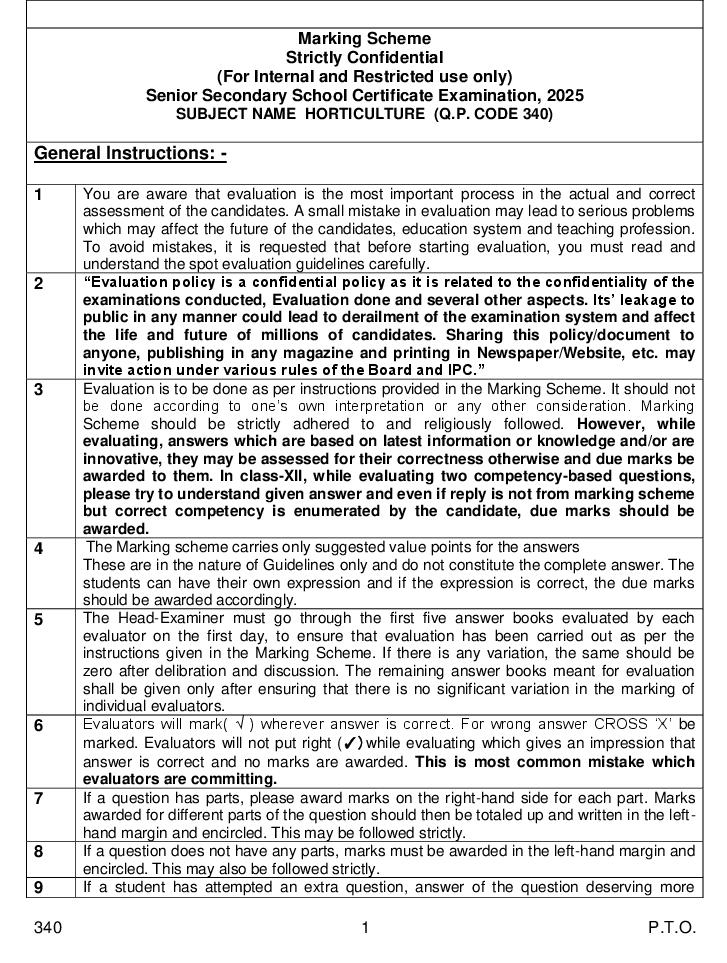
Strictly Confidential
(For Internal and Restricted use only)
Senior Secondary School Certificate Examination, 2025
SUBJECT NAME HORTICULTURE (Q.P. CODE 340)
General Instructions: -
1 You are aware that evaluation is the most important process in the actual and correct
assessment of the candidates. A small mistake in evaluation may lead to serious problems
which may affect the future of the candidates, education system and teaching profession.
To avoid mistakes, it is requested that before starting evaluation, you must read and
understand the spot evaluation guidelines carefully.
2 “Evaluation policy is a confidential policy as it is related to the confidentiality of the
examinations conducted, Evaluation done and several other aspects. Its’ leakage to
public in any manner could lead to derailment of the examination system and affect
the life and future of millions of candidates. Sharing this policy/document to
anyone, publishing in any magazine and printing in Newspaper/Website, etc. may
invite action under various rules of the Board and IPC.”
3 Evaluation is to be done as per instructions provided in the Marking Scheme. It should not
be done according to one’s own interpretation or any other consideration. Marking
Scheme should be strictly adhered to and religiously followed. However, while
evaluating, answers which are based on latest information or knowledge and/or are
innovative, they may be assessed for their correctness otherwise and due marks be
awarded to them. In class-XII, while evaluating two competency-based questions,
please try to understand given answer and even if reply is not from marking scheme
but correct competency is enumerated by the candidate, due marks should be
awarded.
4 The Marking scheme carries only suggested value points for the answers
These are in the nature of Guidelines only and do not constitute the complete answer. The
students can have their own expression and if the expression is correct, the due marks
should be awarded accordingly.
5 The Head-Examiner must go through the first five answer books evaluated by each
evaluator on the first day, to ensure that evaluation has been carried out as per the
instructions given in the Marking Scheme. If there is any variation, the same should be
zero after delibration and discussion. The remaining answer books meant for evaluation
shall be given only after ensuring that there is no significant variation in the marking of
individual evaluators.
6 Evaluators will mark( √ ) wherever answer is correct. For wrong answer CROSS ‘X’ be
marked. Evaluators will not put right (✓)while evaluating which gives an impression that
answer is correct and no marks are awarded. This is most common mistake which
evaluators are committing.
7 If a question has parts, please award marks on the right-hand side for each part. Marks
awarded for different parts of the question should then be totaled up and written in the left-
hand margin and encircled. This may be followed strictly.
8 If a question does not have any parts, marks must be awarded in the left-hand margin and
encircled. This may also be followed strictly.
9 If a student has attempted an extra question, answer of the question deserving more
340 1 P.T.O.
Page 2
10 No marks to be deducted for the cumulative effect of an error. It should be penalized only
once.
11 A full scale of marks __________(example 0 to 80/70/60/50/40/30 marks as given in
Question Paper) has to be used. Please do not hesitate to award full marks if the answer
deserves it.
12 Every examiner has to necessarily do evaluation work for full working hours i.e., 8 hours
every day and evaluate 20 answer books per day in main subjects and 25 answer books
per day in other subjects (Details are given in Spot Guidelines).This is in view of the
reduced syllabus and number of questions in question paper.
13 Ensure that you do not make the following common types of errors committed by the
Examiner in the past:-
● Leaving answer or part thereof unassessed in an answer book.
● Giving more marks for an answer than assigned to it.
● Wrong totaling of marks awarded on an answer.
● Wrong transfer of marks from the inside pages of the answer book to the title page.
● Wrong question wise totaling on the title page.
● Wrong totaling of marks of the two columns on the title page.
● Wrong grand total.
● Marks in words and figures not tallying/not same.
● Wrong transfer of marks from the answer book to online award list.
● Answers marked as correct, but marks not awarded. (Ensure that the right tick mark
is correctly and clearly indicated. It should merely be a line. Same is with the X for
incorrect answer.)
● Half or a part of answer marked correct and the rest as wrong, but no marks awarded.
14 While evaluating the answer books if the answer is found to be totally incorrect, it should
be marked as cross (X) and awarded zero (0)Marks.
15 Any unassessed portion, non-carrying over of marks to the title page, or totaling error
detected by the candidate shall damage the prestige of all the personnel engaged in the
evaluation work as also of the Board. Hence, in order to uphold the prestige of all
concerned, it is again reiterated that the instructions be followed meticulously and
judiciously.
16 The Examiners should acquaint themselves with the guidelines given in the “Guidelines
for Spot Evaluation” before starting the actual evaluation.
17 Every Examiner shall also ensure that all the answers are evaluated, marks carried over to
the title page, correctly totaled and written in figures and words.
18 The candidates are entitled to obtain photocopy of the Answer Book on request on
payment of the prescribed processing fee. All Examiners/Additional Head Examiners/Head
Examiners are once again reminded that they must ensure that evaluation is carried out
strictly as per value points for each answer as given in the Marking Scheme.
340 2
Page 3
$
MARKING SCHEME
HORTICULTURE
SECTION A
OBJECTIVE TYPE QUESTIONS
Source Chapter Page
No. No.
1. (i) (D) Remove NCERT 1 5 1
(ii) (C) Paranoid NCERT 2 35 1
(iii) (B) CTRL + B NCERT 3 66 1
(iv) (A) French NCERT 4 90 1
(v) (B) Water conservation NCERT 5 116 1
(vi) (C) Perseverance NCERT 4 103 1
2. (i) (D) Phalaenopsis CBSE 1 5 1
(ii) (A) Suntory and Florigene CBSE 1 8 1
(iii) (A) Cold storage CBSE 2 19 1
(iv) (B) Public area CBSE 3 27 1
(v) (C) Fragrance CBSE 3 30 1
(vi) (C) Arches CBSE 4 34 1
(vii) (B) Archicad CBSE 5 44 1
3. (i) (A) Zoysia japonica CBSE 6 49 1
(ii) (B) Dethatching CBSE 6 52 1
(iii) (B) Watering CBSE 7 57 1
(iv) (A) Leaf cutting CBSE 7 60 1
340 3 P.T.O.
Page 4
(vi) (B) Tagetes erecta CBSE 8 87 1
(vii) (B) Mycoplasma CBSE 8 102 1
4. (i) (B) Carnation CBSE 9 118 1
(ii) (C) Fusarium CBSE 9 118 1
(iii) (C) Capital intensity CBSE 9 118 1
(iv) (B) European CBSE 10 135 1
(v) (C) Humectants CBSE 11 146 1
(vi) (C) Freeze drying CBSE 11 145 1
5. (i) (A) Floral preservatives CBSE 12 156 1
(ii) (B) 4C CBSE 12 159 1
(iii) (C) Rose CBSE 12 159 1
(iv) (D) Hedge CBSE 4 35 1
(v) (A) 1 – 4 CBSE 8 71 1
(vi) (A) CAD CBSE 5 41 1
6. (i) (B) IARI, New Delhi CBSE 1 9 1
(ii) (D) Tuticorin CBSE 11 142 1
(iii) (C) Manmade enrichment items CBSE 3 30 1
(iv) (D) Sunken garden CBSE 4 38 1
(v) (B) Termites CBSE 6 53 1
(vi) (A) Netherlands CBSE 11 141 1
SECTION B
SUBJECTIVE TYPE QUESTIONS
7. MINTS : Set of simple rules that helps to capitalize words correctly.
M : Months, I : I, N : Names, T : Titles and S : Starting letter of sentence
[NCERT, Employability, 9]
340 4
Page 5
(1) Libre Office Impress
(2) Microsoft Office PowerPoint
(3) Open Office Impress
(4) Google slides
(5) Apple keynote
9. Startups [NCERT, Employability, 89]
A startup is a company that is in the first stage of its operations, started
with minimum investment.
10. Self-control [NCERT, Employability, 23]
The ability to control one’s emotions, thoughts and behaviour effectively
in different situations.
11. Green jobs in agriculture [NCERT, Employability, 114,116]
Organic farming, water quality testing, water conservation, water
management
12. Functions of family area [CBSE / 3 / 27 / 2]
(a) Screening neighbours from viewing and learning
(b) Screening from wind and shading from Sun
(c) Providing comfort to the family members
(d) Entertaining personnel guests
13. Edges refers to low growing herbaceous perennials meant for lining and
demarcation of the boundary. [CBSE / 4 / 36 / 2]
Foliage plant : Alternanthera spp Eupatorium cannobinum.
Flower plant : Zephyranthes, Amaryllis.
14. Plugging is the process of using small pieces of sod transplanted in the
soil at intermittent intervals. [CBSE / 6 / 50 / 2]
15. Ikebana is Japanese art form, symbolises the unity of nature and
humanity. It emphasised not on mass arrangement of flowers but on the
individuality of the flower, foliage and branches. [CBSE / 10 / 123 / 2]
340 5 P.T.O.
Page 6
suppleness of dried plant materials by attracting water vapour from the
surrounding areas. [CBSE / 11 / 146 / 2]
17. (a) Commercial floriculture : is a branch of Horticulture which deals
with commercial growing, marketing, and arranging flowers and
ornamental plants, which includes annuals, biennials and
perennials viz, trees, shrubs, climbers and herbaceous perennials.
[CBSE / 1 / 1 / 3]
(b) Hi-tech floriculture : is the technology which is ultra modern, less
environment dependent and capital intensive having improved
productivity with quality produce.
18. Directly associated components of commercial floriculture :
[CBSE / 2 / 17 / 3]
(i) Florist trade
(ii) Plant and bedding plant nursery
(iii) Planting material production
(iv) Seed production
(v) Flower perfumery
(vi) Bonsai production
(vii) Flori-clinics and consultancy services
19. (a) First stage of planning / Need Analysis : [CBSE / 3 / 26 / 3]
Is the compilation of an inventory of what should be accomplished
by means of the landscaping and what the landscape will include,
based on the preferences, requirements and life styles of the family
members.
To facilitate the need analysis, property area is divided into
three areas as given below.
(i) Public area / Approach area / Front area
(ii) Family area / private living area
(iii) Service area / utility area
(b) Second stage of planning : It is the inventory of all existing
property items including the architecture of the proposal home
building, plot size, landscape, various view points, soil
characteristics, climate etc are prepared.
20. Qualities of root stocks of rose [CBSE / 8 / 72 / 4]
(i) It should produce fibrous root system.
340 6
Page 7
(iii) It should have vigorous growth habits be healthy, resistant to
diseases and frost. Plants should have uniform growth.
(iv) It should have a bark, thick enough to hold the bud firmly and
provide sap to the budded plant.
(v) It should be reasonably free from suckers.
(vi) It should support the budded plant for a long time.
(vii) It should withstand a wide range of soils and climatic conditions.
Commonly used rootstocks are : Rosa bourboniana (Edward Rose), Rosa
canina (Dog Rose)
Rosa indica var adorate (for northern plains)
Rosa laxa, Rosa manetti, Rosa multiflora
(for outdoor roses and well suited for hills)
21. (i) High productivity per unit area [CBSE / 9 / 109 / 4]
(ii) Ensures the production of any plant at any place and throughout
the year.
(iii) Off-season flower production
(iv) Blemish-free high quality product (flowers and planting materials)
(v) Easy to control insect-pests and diseases
(vi) Water requirement reduces upto 30 percent
(vii) Labour requirement is less
(viii) Earliness as well as reduced crop duration.
Management of high temperature :
(a) using Naturally ventilated polyhouses with side (1·5 m) and top
(1 m) ventilation
(b) use of fan and pad system for cooling use of 50% intensity shade
nets (12 to 4 pm) installed inside the polyhouses
(c) use of toggers/misters during afternoon once/twice only in
vegetative phase of flower crop
(d) photo-selective shading points with less reduction of PAR allowing
69% light and are useful in late spring and summer 450 kg/ha in a
ratio of 1 : 3 (paint : water)
22. Climate : [CBSE / 6 / 49 / 4]
(A) Warm tropical and sub tropical climates : Cynodon dactylon :
340 7 P.T.O.
Page 8
drainage and high soil acidity.
Selection No. 1
zoysia japonica (Korean grass)
zoysia matrella (Manilla grass)
zoysia tenuifolia (Korean Velvel grass)
good in shade, how every they are very slow to grow
(B) Warm humid region
Axonopus affinis
Eremochloa or picroides
Paspalum notatum and stenotaphrum secundatum used for erosion
control.
Mowing and rowing in lawn
(i) Mowing lawn first time : Lawn mower should not be used as newly
established grass will be uprooted. The grass should trimmed with
a help of sharp scythe or hedge shear initially. It should be cut at a
height of 3 cm while mowing. Mowing should be done at an interval
of 10 – 15 days, depending upon the season and grass species.
(ii) Rolling : Method of correcting minor variations in the turf grass
surface particularly those caused by pedestrian traffic.
23. Water drying : The flowers and foliage are kept in water and allowed to
dry .It is suitable for flowers like Hydragea, corn flower, and fever flow.
First the lower leaves and flowers from the stem are stripped, then
materials are kept in standing normal water with about 5 cm depth at
room temperature. The material is kept undisturbed in a dry, well
aerated room until both the holder and flowers are dried.
Freeze drying : The flowers are arranged in a specimen chamber, then
frozen unto – 35C. Any frozen ice crystals on the flowers are sublimed
or vapourized with the application of heat. After transforming into
condensation, the vapour is captured into a separate chamber as ice.
This method is expensive and yield high quality finished floral products.
24. Post-harvesting of Gerbera
(a) Harvesting : Flowers are cut when the outer two rows of disc
florets are perpendicular at the stalk.
340 8
Page 9
escape from the cavity.
(b) Pre-cooling : Stored at 2 to 3C with a relative humidity of
90 – 95C as soon as possible after harvest to overcome the field
heat.
(c) Pulsing : The cut flowers must be immersed in a solution
containing a preservatives viz., 1% commercial bleach/sodium
hypochlorite for four hours at 14 – 15C.
(d) Storage : Flowers can be stored dry at a temperature at 2 – 5C for
2 days. Flowers can be stored loose in deionised water for 4 – 7
days at 4C. After storage the sterns should be cut once again and
placed in water or preservative for 2 – 3 hours for rehydration.
340 9 P.T.O.
Document Details
| Board / Org | CBSE |
| Exam | Class 12 |
| Type | Solution |
| Pages | 9 |
| Updated | 24 Sep 2026 |