CBSE Class 12 Sample Paper 2022 for Accountancy Term 1
Finished viewing? Save it for later —
Download CBSE Class 12 Sample Paper 2022 for Accountancy Term 1 (PDF · 24 pages)About CBSE Class 12 Sample Paper 2022 for Accountancy Term 1
CBSE Class 12 Sample Paper 2022 for Accountancy Term 1 is available here for free download. Published by CBSE for Class 12, this sample paper can be viewed online or downloaded as a PDF (24 pages). Candidates preparing for Class 12 can use CBSE Class 12 Sample Paper 2022 for Accountancy Term 1 to understand the exam pattern, the type of questions asked, and the overall difficulty level.
Frequently Asked Questions
How can I download CBSE Class 12 Sample Paper 2022 for Accountancy Term 1?
Open this page and click the Download button to save CBSE Class 12 Sample Paper 2022 for Accountancy Term 1 as a PDF. It is completely free on AglaSem Docs.
Is CBSE Class 12 Sample Paper 2022 for Accountancy Term 1 free to download?
Yes. CBSE Class 12 Sample Paper 2022 for Accountancy Term 1 can be viewed online and downloaded as a PDF free of cost on AglaSem Docs.
How many pages does CBSE Class 12 Sample Paper 2022 for Accountancy Term 1 have?
CBSE Class 12 Sample Paper 2022 for Accountancy Term 1 contains 24 pages, which you can read online or download together as a single PDF.
Where can I find more Class 12 study material?
You can find more Class 12 question papers, sample papers, syllabus, and answer keys on AglaSem Docs.
CBSE Class 12 Sample Paper 2022 for Accountancy Term 1 – Text
Read the full text of this sample paper below — useful to quickly search, copy and reference the content online without downloading the PDF.
📄 View text version (24 pages)
Page 1
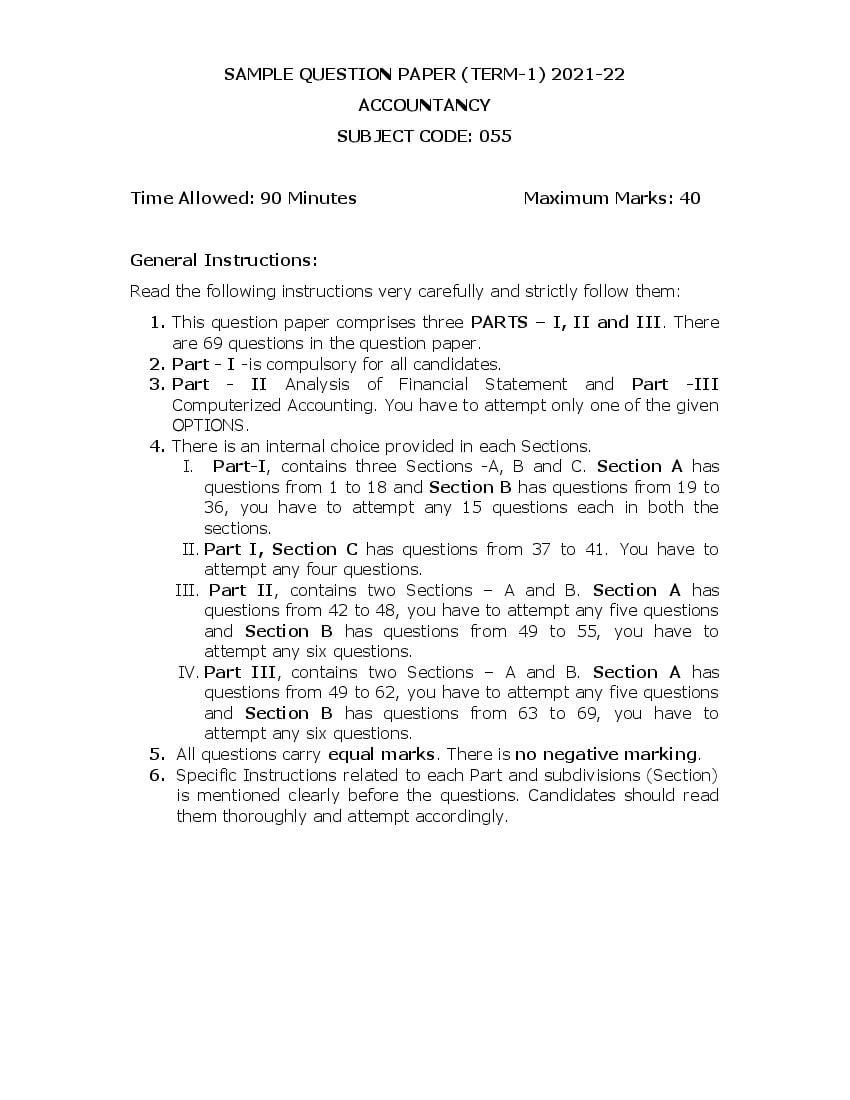
ACCOUNTANCY
SUBJECT CODE: 055
Time Allowed: 90 Minutes Maximum Marks: 40
General Instructions:
Read the following instructions very carefully and strictly follow them:
1. This question paper comprises three PARTS – I, II and III. There
are 69 questions in the question paper.
2. Part - I -is compulsory for all candidates.
3. Part - II Analysis of Financial Statement and Part -III
Computerized Accounting. You have to attempt only one of the given
OPTIONS.
4. There is an internal choice provided in each Sections.
I. Part-I, contains three Sections -A, B and C. Section A has
questions from 1 to 18 and Section B has questions from 19 to
36, you have to attempt any 15 questions each in both the
sections.
II. Part I, Section C has questions from 37 to 41. You have to
attempt any four questions.
III. Part II, contains two Sections – A and B. Section A has
questions from 42 to 48, you have to attempt any five questions
and Section B has questions from 49 to 55, you have to
attempt any six questions.
IV. Part III, contains two Sections – A and B. Section A has
questions from 49 to 62, you have to attempt any five questions
and Section B has questions from 63 to 69, you have to
attempt any six questions.
5. All questions carry equal marks. There is no negative marking.
6. Specific Instructions related to each Part and subdivisions (Section)
is mentioned clearly before the questions. Candidates should read
them thoroughly and attempt accordingly.
Page 2
Section – A
Instructions:
From question number 1 to 18, attempt any 15 questions.
1. Gain / loss on revaluation at the time of change in profit sharing
ratio of existing partners is shared by ___(i)______ whereas in case
of admission of a partner it is shared by____(ii)_____.
(A) (i) Remaining Partners, (ii) All Partners.
(B) (i) All Partners, (ii) Old partners.
(C) (i) New Partner, (ii) All partner.
(D) (i) Sacrificing Partner, (ii) Incoming partner.
2. Calculate the amount of second & final call when Abhijit Ltd, issues
Equity shares of ₹10 each at a premium of 40% payable on
Application ₹3, On Allotment ₹5, On First Call ₹2.
(A) Second & final call ₹3.
(B) Second & final call ₹4.
(C) Second & final call ₹1.
(D) Second & final call ₹14.
3. Anish Ltd, issued a prospectus inviting applications for 2,000
shares. Applications were received for 3,000 shares and pro- rata
allotment was made to the applicants of 2,400 shares. If Dhruv has
been allotted 40 shares, how many shares he must have applied
for?
(A) 40
(B) 44
(C) 48
(D) 52
Page 3
1,98,000 shares were subscribed. The amount was payable as ₹3
on application, ₹4 an allotment and balance on first call. If a
shareholder holding 3,000 shares has defaulted on first call, what is
the amount of money received on first call?
(A) ₹9,000.
(B) ₹5,85,000.
(C) ₹5,91,000.
(D) ₹6,09,000.
5. What will be the correct sequence of events?
(i) Forfeiture of shares. (ii) Default on Calls.
(iii) Re-issue of shares. (iv) Amount transferred to capital reserve.
Options:
(A) (i), (iv), (ii), (iii)
(B) (ii), (iv), (i), (iii)
(C) (ii), (i), (iii), (iv)
(D) (iii), (iv), (i) (ii)
6. Arun and Vijay are partners in a firm sharing profits and losses in the
ratio of 5:1.
Balance Sheet (Extract)
Liabilities ₹ Assets ₹
Machinery 40,000
If the value of machinery reflected in the balance sheet is overvalued by
33 %, find out the value of Machinery to be shown in the new Balance
Sheet:
(A) ₹ 44,000
(B) ₹48,000
(C) ₹ 32,000
(D) ₹30,000
7. Which of the following is true regarding Salary to a partner when
the firm maintains fluctuating capital accounts?
Page 4
(B) Debit P & L A/c and Credit Partner’s Capital A/c.
(C) Debit P & L Appropriation A/c and Credit Partner’s Current A/c.
(D) Debit P & L Appropriation A/c and Credit Partner’s Capital A/c.
8. At the time of reconstitution of a partnership firm, recording of an
unrecorded liability will lead to:
(A) Gain to the existing partners
(B) Loss to the existing partners
(C) Neither gain nor loss to the existing partners
(D) None of the above
9. E, F and G are partners sharing profits in the ratio of 3:3:2.
According to the partnership agreement, G is to get a minimum
amount of ₹80,000 as his share of profits every year and any
deficiency on this account is to be personally borne by E. The net
profit for the year ended 31st March 2021 amounted to ₹3,12 ,000.
Calculate the amount of deficiency to be borne by E?
(A) ₹1,000
(B) ₹4,000
(C) ₹8,000
(D) ₹2,000
10. At the time of admission of a partner, what will be the effect of the
following information?
Balance in Workmen compensation reserve ₹40,000. Claim for
workmen compensation ₹45,000.
(A) ₹45,000 Debited to the Partner’s capital Accounts.
(B) ₹40,000 Debited to Revaluation Account.
(C) ₹5,000 Debited to Revaluation Account.
(D) ₹5,000 Credited to Revaluation Account.
Page 5
interest on the amount of additional capital advanced by him to the
firm at a rate of:
(A) entitled for 6% p.a. on their additional capital, only when there are
profits.
(B) entitled for 10% p.a. on their additional capital
(C) entitled for 12% p.a. on their additional capital
(D) not entitled for any interest on their additional capitals.
12. Revaluation of assets at the time of reconstitution is necessary
because their present value may be different from their:
(A) Market Value.
(B) Net Value.
(C) Cost of Asset
(D) Book Value.
13. If average capital employed in a firm is ₹8,00,000, average of
actual profits is ₹1,80,000 and normal rate of return is10%, then
value of goodwill as per capitalization of average profits is:
(A) ₹10,00,000
(B) ₹18,00,000
(C) ₹80,00,000
(D) ₹78,20,000
14. In which of the following situation Companies Act 2013 allows for
issue of shares at discount?
(A) Issued to vendors.
(B) Issued to public.
(C) Issued as sweat equity.
(D) None of the above.
15. As per Section 52 of Companies Act 2013, Securities Premium
Reserve cannot be utilised for:
Page 6
(B) Issue of fully paid bonus shares.
(C) Writing off discount on issue of securities.
(D) Writing off preliminary expenses.
16. Net Assets minus Capital Reserve is:
(A) Purchase consideration
(B) Goodwill
(C) Total assets
(D) Liquid assets
17. Kalki and Kumud were partners sharing profits and losses in the
ratio of 5:3. On 1st April,2021 they admitted Kaushtubh as a new
partner and new ratio was decided as 3:2:1.
Goodwill of the firm was valued as ₹3,60,000. Kaushtubh couldn’t
bring any amount for goodwill. Amount of goodwill share to be
credited to Kalki and Kumud Account’s will be: -
(A) ₹ 37,500 and ₹22,500 respectively
(B) ₹ 30,000 and ₹30,000 respectively
(C) ₹ 36,000 and ₹24,000 respectively
(D) ₹ 45,000 and ₹15,000 respectively
18. Sarvesh, Sriniketan and Srinivas are partners in the ratio of 5:3: 2.
If Sriniketan’s share of profit at the end of the year amounted to
₹1,50,000, what will be Sarvesh’s share of profits?
(A) ₹5,00,000.
(B) ₹1,50,000.
(C) ₹3,00,000.
(D) ₹2,50,000.
Page 7
Section – B
Instructions:
From question number 19 to 36, attempt any 15 questions.
19. Angle and Circle ware partners in a firm. Their Balance Sheet
showed Furniture at ₹2,00,000; Stock at ₹1,40,000; Debtors at
₹1,62,000 and Creditors at ₹60,000. Square was admitted and new
profit-sharing ratio was agreed at 2:3:5. Stock was revalued at
₹1,00,000, Creditors of ₹15,000 are not likely to be claimed,
Debtors for ₹2,000 have become irrecoverable and Provision for
doubtful debts to be provided @ 10%.
Angle’s share in loss on revaluation amounted to ₹30,000. Revalued
value of Furniture will be:
(A) ₹2,17,000
(B) ₹1,03,000
(C) ₹3,03,000
(D) ₹1,83,000
20. Asha and Nisha are partner’s sharing profits in the ratio of 2:1.
Kashish was admitted for 1/4 share of which 1/8 was gifted by
Asha. The remaining was contributed by Nisha.
Goodwill of the firm is valued at ₹ 40,000. How much amount for
goodwill will be credited to Nisha’s Capital account?
(A) ₹2,500.
(B) ₹5,000.
(C) ₹20,000.
(D) ₹ 40,000.
21. At the time of admission of new partner Vasu, Old partners Paresh
and Prabhav had debtors of ₹6,20,000 and a provision for doubtful
debts of ₹20,000 in their books. As per terms of admission, assets
were revalued, and it was found that debtors worth ₹15,000 had
turned bad and hence should be written off. Which journal entry
reflects the correct accounting treatment of the above situation.
Page 8
To Sundry Debtors 15,000
Provision for Doubtful Debts A/c Dr. 15,000
To Bad Debts A/c 15,000
(B) Bad Debt A/c Dr. 15,000
To Sundry Debtors 15,000
Revaluation A/c Dr. 15,000
To Provision for Doubtful Debts A/c 15,000
(C) Revaluation A/c Dr. 15,000
To Sundry Debtors A/c 15,000
(D) Bad Debt A/c Dr. 15,000
To Revaluation A/c 15,000
22. Given below are two statements, one labelled as Assertion (A) and
the other labelled as Reason (R)
Assertion (A): Transfer to reserves is shown in P & L Appropriation
A/c.
Reason (R): Reserves are charge against the profits.
In the context of the above statements, which one of the following
is correct?
Codes:
(A) (A) is correct, but (R) is wrong.
(B) Both (A) and (R) are correct.
(C) (A) is wrong, but (R) is correct.
(D) Both (A) and (R) are wrong.
23. Anubhav, Shagun and Pulkit are partners in a firm sharing profits
and losses in the ratio of 2:2:1. On 1st April 2021, they decided to
change their profit-sharing ratio to 5:3:2. On that date, debit
balance of Profit & Loss A/c ₹30,000 appeared in the balance sheet
and partners decided to pass an adjusting entry for it.
Which of the undermentioned options reflect correct treatment for
the above treatment?
Page 9
capital account credited by ₹3,000
(B) Pulkit's capital account will be credited by ₹3,000 and Shagun's
capital account will be credited by ₹3,000
(C) Shagun's capital account will be debited by ₹30,000 and Anubhav’s
capital account credited by ₹30,000
(D) Shagun's capital account will be debited by ₹3,000 and Anubhav’s
and Pulkit’s capital account credited by ₹2,000 and ₹1,000
respectively.
24. A, B and C are partners, their partnership deed provides for interest
on drawings at 8% per annum. B withdrew a fixed amount in the
middle of every month and his interest on drawings amounted to
₹4,800 at the end of the year. What was the amount of his monthly
drawings?
(A) ₹10,000.
(B) ₹5,000.
(C) ₹1,20,000.
(D) ₹48,000.
25. Abhay and Baldwin are partners sharing profit in the ratio 3:1. On
31st March 2021, firm’s net profit is ₹1,25,000. The partnership
deed provided interest on capital to Abhay and Baldwin ₹15,000 &
₹10,000 respectively and Interest on drawings for the year
amounted to ₹6000 from Abhay and ₹4000 from Baldwin. Abhay is
also entitled to commission @10% on net divisible profits. Calculate
profit to be transferred to Partners Capital A/c’s.
(A) ₹1,00,000
(B) ₹1,10,000
(C) ₹1,07,000
(D) ₹90,000
26. Given below are two statements, one labelled as Assertion (A) and
the other labelled as Reason (R):
Assertion (A): Revaluation A/c is prepared at the time of
Admission of a partner.
Page 10
liabilities at the time of admission of a partner, so that the true
financial position of the firm is reflected.
In the context of the above two statements, which of the following
is correct?
Codes:
(A) Both (A) and (R) are correct and (R) is the correct reason of (A).
(B) Both (A) and (R) are correct but (R) is not the correct reason of (A).
(C) Only (R) is correct.
(D) Both (A) and (R) are wrong.
27. Apaar Ltd forfeited 4,000 shares of ₹20 each, fully called up, on
which only application money of ₹6 has been paid. Out of these
2,000 shares were reissued and ₹8,000 has been transferred to
capital reserve. Calculate the rate at which these shares were
reissued.
(A) ₹20 Per share
(B) ₹18 Per share
(C) ₹22 Per share
(D) ₹8 Per share
28. Which of the following statement is/are true?
(i) Authorized Capital < Issued Capital
(ii) Authorized Capital ≥ Issued Capital
(iii) Subscribed Capital ≤ Issued Capital
(iv) Subscribed Capital > Issued Capital
(A) (i) only
(B) (i) and (iv) Both
(C) (ii) and (iii) Both
(D) (ii) only
29. Mickey, Tom and Jerry were partners in the ratio of 5:3:2. On 31st
March 2021, their books reflected a net profit of ₹2,10,000. As per
the terms of the partnership deed they were entitled for interest on
Page 11
respectively. Besides this a salary of ₹60,000 each was payable to
Mickey and Tom.
Calculate the ratio in which the profits would be appropriated.
(A) 1:1:1
(B) 5:3:2
(C) 7:6:2
(D) 4:3:2
30. Mohit had been allotted for 600 shares by a Govinda Ltd on pro rata
basis which had issued two shares for every three applied. He had
paid application money of ₹3 per share and could not pay allotment
money of ₹5 per share. First and final call of ₹2 per share was not
yet made by the company. His shares were forfeited. the following
entry will be passed:
Equity Share Capital A/c Dr ₹X
To share Forfeited A/c ₹Y
To Equity Share Allotment A/c ₹Z
Here X, Y and Z are:
(A) ₹ 6,000; ₹2,700; ₹3,000 respectively.
(B) ₹ 9,000; ₹2,700; ₹4,500 respectively.
(C) ₹ 4,800; ₹2,700; ₹2,100 respectively.
(D) ₹ 7,200; ₹2,700; ₹4,500 respectively.
31. Given below are two statements, one labelled as Assertion (A) and
the other labelled as Reason (R):
Assertion (A): In case of shares issued on Pro–rata basis, excess
money received at the time of application can be utilised till
allotment only.
Reason (R): Company has to pay interest on calls in advance
@12% p.a. for amount adjusted towards calls (if any). In the
context of the above two statements, which of the following is
correct?
Page 12
(A) Both (A) and (R) are true, but (R) is not the explanation of working
capital management.
(B) Both(A) and (R) are true and (R) is a correct explanation of (A).
(C) Both (A) and (R) are false.
(D) (A) is false, but (R) is true.
32. Ajay and Vinod are partners in the ratio of 3:2. Their fixed Capital
were ₹3,00,000 and ₹4,00,000 respectively. After the close of
accounts for the year it was observed that the Interest on Capital
which was agreed to be provided at 5% pa was erroneously
provided at 10%p.a. By what amount will Ajay’s account be affected
if partners decide to pass an adjustment entry for the same?
(A) Ajay’s Current A/c will be Debited by ₹15,000.
(B) Ajay’s Current A/c will be Credited by ₹6,000.
(C) Ajay’s Current A/c will be Credited by ₹35,000.
(D) Ajay’s Current A/c will be Debited by ₹20,000.
33. Vishnu Ltd. forfeited 20 shares of ₹10 each, ₹8 called up, on which
John had paid application and allotment money of ₹5 per share, of
these, 15 shares were reissued to Parker as fully paid up for ₹6 per
share. What is the balance in the share Forfeiture Account after the
relevant amount has been transferred to Capital Reserve Account?
(A) ₹0
(B) ₹5
(C) ₹25
(D) ₹100
34. Newfound Ltd took over business of Old land ltd and paid for it by
issue of 30,000, Equity Shares of ₹100 each at a par along with 6%
Preference Shares of ₹1,00,00,000 at a premium of 5% and a
cheque of ₹8,00,000. What was the total agreed purchase
consideration payable to Old Land ltd.
(A) ₹1,05,00,000.
(B) ₹1,43,00,000.
Page 13
(D) ₹1,35,00,000.
35. A and B are partners in the ratio of 3:2. C is admitted as a partner
and he takes ¼th of his share from A. B gives 3/16 from his share
to C. What is the share of C?
(A) 1/4
(B) 1/16
(C) 1/6
(D) 1/16
36. Krishan Ltd has Issued Capital of 20, 00,000 Equity shares of ₹10
each. Till Date ₹8 per share have been called up and the entire
amount received except calls of ₹4 per share on 800 shares and ₹3
per share from another holder who held 500 shares. What will be
amount appearing as ‘Subscribed but not fully paid capital’ in the
balance sheet of the company?
(A) ₹ 2,00,00,000
(B) ₹ 1,95,99,000
(C) ₹ 1,59,95,300
(D) ₹ 1,99,95,300
Part – I
Section – C
Instructions:
From question number 37 to 41, attempt any 4 questions.
Question no.’s 37 and 38 are based on the hypothetical
situation given below.
Bright Star Limited is engaged in manufacture of high-end medical
equipment. Considering the prospects of high growth in this segment
the company has decided to expand and for this purpose additional
investment of ₹50,00,00,000 is required. Directors have decided that
Page 14
and balance by issue of Equity shares.
As per memorandum of association of the company the face value of
Equity shares is ₹100 each. Also, considering the market standing of
the company these shares would be issued at a premium of 25%.
Directors decided to issue sufficient shares to collect the desired
amount (including premium).
The prospectus was issued to public, and the issue was oversubscribed
by 2,00,000 shares which were issued letters of regret. Answer the
below mentioned questions considering that the entire amount was
payable on application.
37. What is the total amount collected on application?
(A) ₹42,50,00,000
(B) ₹40,00,00,000
(C) ₹32,00,00,000
(D) None of the above
38. How many Equity shares were offered for issue by Bright Star Ltd?
(A) 40,00,000 shares.
(B) 50,00,000 shares.
(C) 35,00,000 shares.
(D) 32,00,000 shares.
Question no.’s 39, 40 and 41 are based on the hypothetical
situation given below.
On 1st September 2020, twenty students of Modern College started
their Partnership Firm in the name of “Be Safe” for selling sanitisers
on digital mode. Since they were good friends of each other, they
were not having any explicit agreement in place. All of them have
agreed to invest ₹15,000/- each as capital. The books were closed
on 31st March 2021, on which date the following information was
provided by the firm:
Page 15
Sale of Sanitisers 1,20,000
Cost of goods sold 50,000
Total Remuneration to partners 2,000 per month
Rent to a partner 1,000 per month
Manager’s Commission 5,000
Closing Stock as on March 31,2021 9,000
6% Fixed Deposit (made on 31.3.2021) 20,000
39. Calculate the amount of profits to be transferred to Profit and Loss
Appropriation Account. -
(A) Profit ₹58,000
(B) Profit ₹44,000
(C) Profit ₹59,200
(D) Profit ₹58,700
40. On 31st March 2021, Remuneration to Partners will be provided to
the partners of “Be Safe” but only out of:
(A) Profits for the accounting year
(B) Reserves
(C) Accumulated Profits
(D) Goodwill
41. On 01st December 2020 one of the partners of the firm introduced
additional capital of ₹30,000 and also advanced a loan of ₹40,000
to the firm. Calculate the amount of interest that Partner will
receive for the current accounting period-
(A) ₹4,200
(B) ₹1,400
(C) ₹ 1575
(D) ₹ 800
Page 16
Section – A
Instructions:
From question number 42 to 48, attempt any 5 questions.
42. Given below are two statements, one labelled as Assertion (A) and
the other labelled as Reason (R):
Assertion (A): The focus of calculation of working capital revolves
around managing the operating cycle of the business.
Reason (R): It is because the concept of operating cycle is
required to ascertain the liquidity of assets and urgency of
payments to liabilities.
In the context of the above two statements, which of the following
is correct?
Codes:
(A) Both (A) and (R) are true, but (R) is not the explanation of working
capital management.
(B) Both(A) and (R) are true and (R) is a correct explanation of (A).
(C) Both (A) and (R) are false.
(D) (A) is false, but (R) is true.
43. Which of the following are included in traditional classification of
ratios?
(i) Liquidity Ratios.
(ii) Statement of Profit and loss Ratios.
(iii) Balance Sheet Ratios.
(iv) Profitability Ratios.
(v) Composite Ratios.
(vi) Solvency Ratios.
(A) (ii), (iii) and (v)
(B) (i), (iv) and (vi)
(C) (i), (ii) and (vi)
(D) All (i), (ii), (iii), (iv), (v), (vi)
Page 17
(A) solvency, activity, and profitability
(B) liquidity, efficiency, and solvency
(C) liquidity, activity, and profitability
(D) liquidity, solvency, and profitability
45. Which one of the following is correct?
(i) A ratio is an arithmetical relationship of one number to another
number.
(ii) Liquid ratio is also known as acid test ratio.
(iii) Ideally accepted current ratio is 1: 1.
(iv) Debt equity ratio is the relationship between outsider’s funds and
shareholders’ funds.
In the context of the above two statements, which of the following
options is correct?
(A) All (i), (ii), (iii) and (iv) are correct.
(B) Only (i), (ii) and (iv) are correct.
(C) Only (ii), (iii) and (iv) are correct.
(D) Only (ii) and (iv) are correct.
46. Which of the following are the tools of Vertical Analysis?
(i) Ratio Analysis.
(ii) Comparative Statements.
(iii) Common Size Statements.
(A) Only (iii)
(B) Both (i) and (iii)
(C) Both (i) and (ii)
(D) Only (i)
Page 18
(Balance sheet) as defined in Schedule III of Companies Act 2013.
Column I Column II
(I) Loose Tools (a) Intangible fixed assets
(Ii) Patents (b)Other current assets
(III) Prepaid insurance (c) Long term Borrowings
(IV) Debentures (d) Inventories
(V) Machinery (e) Tangible Fixed assets
Choose the correct option:
A. (I)-(a), (II)-(b), (III)- (d), (IV)- (c), (V)-(e)
B. (I)-(d), (II)- (a), (III)-(b), (IV)- (c), (V)-(e)
C. (I)-(d), (II)- (a), (III)-(b), (IV)-(e), (V)-(c)
D. (I)- (e), (II)- (d), (III)- (a), (IV)-(b), (V)-(b)
48. Which ratio indicates the proportion of assets financed out of
shareholders’ funds?
(A) Debt equity ratio.
(B) Fixed assets turnover ratio.
(C) Proprietary ratio.
(D) Total assets to debt ratio.
Part – II
Section – B
Instructions:
From question number 49 to 55, attempt any 6 questions.
49. If Total sales is ₹2,50,000 and credit sales is 25% of Cash sales.
The amount of credit sales is:
(A) ₹50,000
(B) ₹2,50,000
(C) ₹16,000
(D) ₹3,00,000
Page 19
inventory is ₹80,000, Inventory turnover ratio is 6 times, and the
Selling price is 25% above cost?
(A) ₹1,20,000.
(B) ₹1,60,000.
(C) ₹2,00,000.
(D) None of the above.
51. Which of the following statements are false?
a) When all the comparative figures in a balance sheet are stated as
percentage of the total, it is termed as horizontal analysis.
b) When financial statements of several years are analysed, it is
termed as vertical analysis.
c) Vertical Analysis is also termed as time series analysis.
Choose from the following options:
(A) Both (a) and (b)
(B) Both (a) and (c)
(C) Both (b) and (c)
(D) All three (a), (b), (c)
52. Given below are two statements, one labelled as Assertion (A) and
the other labelled as Reason (R):
Assertion (A): Increasing the value of closing inventory increases
profit.
Reason (R): Increasing the value of closing inventory reduces cost
of goods sold.
In the context of the above two statements, which of the following
is correct?
Codes:
(A) Both (A) and (R) are correct and (R) is the correct reason of (A).
(B) Both (A) and (R) are correct but (R) is not the correct reason of (A).
(C) Only (R) is correct.
(D) Both (A) and (R) are wrong.
Page 20
the other labelled as Reason (R):
Assertion (A): A high operating ratio indicates a favourable
position.
Reasoning (R): A high operating ratio leaves a high margin to
meet non-operating expenses.
In the context of the above two statements, which of the following
is correct?
Code:
(A) (A) and (R) both are correct and (R) correctly explains (A).
(B) Both (A) and (R) are correct but (R) does not explain (A).
(C) Both (A) and (R) are incorrect.
(D) (A) is correct but (R) is incorrect.
54. Current ratio of Adaar Ltd. is 2.5:1. Accountant wants to maintain it
at 2:1. Following options are available.
(i) He can repay Bills Payable
(ii) He can purchase goods on credit
(iii) He can take short term loan
Choose the correct option.
(A) Only (i) is correct
(B) Only (ii) is correct
(C) Only (i) and (iii) are correct
(D) Only (ii) and (iii) are correct
55. A company has an operating cycle of eight months. It has accounts
receivables amounting to ₹1,00,000 out of which ₹60,000 have a
maturity period of 11 months. How would this information be
presented in the balance sheet?
(A) ₹40000 as current assets and ₹60,000 as non-current assets.
(B) ₹60,000 as current assets and ₹40,000 as non-current assets.
(C) ₹1,00,000 as non-current assets.
(D) ₹1,00,000 as Current assets.
Page 21
Section – A
Instructions:
From question number 56 to 62, attempt any 5 questions.
56. Which key combination collapses the ribbon?
(A). [Ctrl]+[F1]
(B). [Ctrl]+[F3]
(C). [Ctrl]+[F5]
(D). [Ctrl]+[F7]
57. The CAS should be-
(A) Simple and integrated, transparent, accurate, scalability, reliability.
(B) Complex, Accurate, Transparent, faster to work.
(C) Able to transform the manual accounting system to computerised
accounting system.
(D) None of the above.
58. The components of Computerised Accounting System are:
(A) Data, Report, Ledger, Hardware, Software.
(B) Data, People, Procedure, Hardware, Software.
(C) People, Procedure, Ledger, Data, Chart of Accounts.
(D) Data, Coding, Procedure, Rules, Output.
59. Where are amounts owed by customers for credit purchases found?
(A) accounts receivable journal
(B) general ledger
(C) sales journal
(D) accounts receivable subsidiary ledger
Page 22
model?
(A) Organise data, process data, and collect data
(B) Collect data, organise and process data, and communicate
information
(C) Process data, organise data, and collect data
(D) Organise data, collect data, and communicate information
61. Codification of Accounts required for the purpose of:
(A) Hierarchical relationship between groups and components
(B) Data processing faster and preparing of final accounts
(C) Keeping data and information secured
(D) None of the above.
62. Which mathematical operator is represented by an asterisk (*)?
(A). Exponentiation
(B). Addition
(C). Subtraction
(D). Multiplication
Part – III
Section – B
Instructions:
From question number 63 to 69, attempt any 6 questions.
63 What category of functions is used in this formula: =PMT (C10/12,
C8, C9,1)
(A) Logical
(B) Financial
(C) Payment
(D) Statistical
Page 23
selecting all data up to and including the last row?
(A) [Ctrl]+[Down-arrow]
(B) [Ctrl]+[Home]
(C) [Ctrl]+[Shift]
(D) [Ctrl]+ [Up Arrow]
65 Which formulae would result in TRUE if C4 is less than 10 and D4 is
less than 100?
(A) =AND(C4>10, D4>10)
(B) =AND(C4>10, C4<100).
(C) =AND(C4>10, D4<10).
(D) =AND (C4<10, D4,100)
66 Where is the address of the active cell displayed?
(A) Row heading
(B) Status bar
(C) Name Box
(D) Formula bar
67 Which of the following arguments in a financial function represents
the total number of payments?
(A) FV
(B) PV
(C) Nper
(D) Rate
68 Which function results can be displayed in Auto Calculate?
(A). SUM and AVERAGE
(B). MAX and LOOK
(C). LABEL and AVERAGE
(D). MIN and BLANK
Page 24
the beginning of the current row?
A. [Ctrl]+[Home]
B. [Page Up]
C. [Home]
D. [Ctrl]+[Backspace]
Document Details
| Board / Org | CBSE |
| Exam | Class 12 |
| Type | Sample Paper |
| Pages | 24 |
| Updated | 30 Apr 2026 |