CBSE Class 12 Question Paper 2025 Solution Japanese
Finished viewing? Save it for later —
Download CBSE Class 12 Question Paper 2025 Solution Japanese (PDF · 11 pages)About CBSE Class 12 Question Paper 2025 Solution Japanese
CBSE Class 12 Question Paper 2025 Solution Japanese is available here for free download. Published by CBSE for Class 12, this solution can be viewed online or downloaded as a PDF (11 pages). Candidates preparing for Class 12 can use CBSE Class 12 Question Paper 2025 Solution Japanese to understand the exam pattern, the type of questions asked, and the overall difficulty level.
Frequently Asked Questions
How can I download CBSE Class 12 Question Paper 2025 Solution Japanese?
Open this page and click the Download button to save CBSE Class 12 Question Paper 2025 Solution Japanese as a PDF. It is completely free on AglaSem Docs.
Is CBSE Class 12 Question Paper 2025 Solution Japanese free to download?
Yes. CBSE Class 12 Question Paper 2025 Solution Japanese can be viewed online and downloaded as a PDF free of cost on AglaSem Docs.
How many pages does CBSE Class 12 Question Paper 2025 Solution Japanese have?
CBSE Class 12 Question Paper 2025 Solution Japanese contains 11 pages, which you can read online or download together as a single PDF.
Where can I find more Class 12 study material?
You can find more Class 12 question papers, sample papers, syllabus, and answer keys on AglaSem Docs.
CBSE Class 12 Question Paper 2025 Solution Japanese – Text
Read the full text of this solution below — useful to quickly search, copy and reference the content online without downloading the PDF.
📄 View text version (11 pages)
Page 1
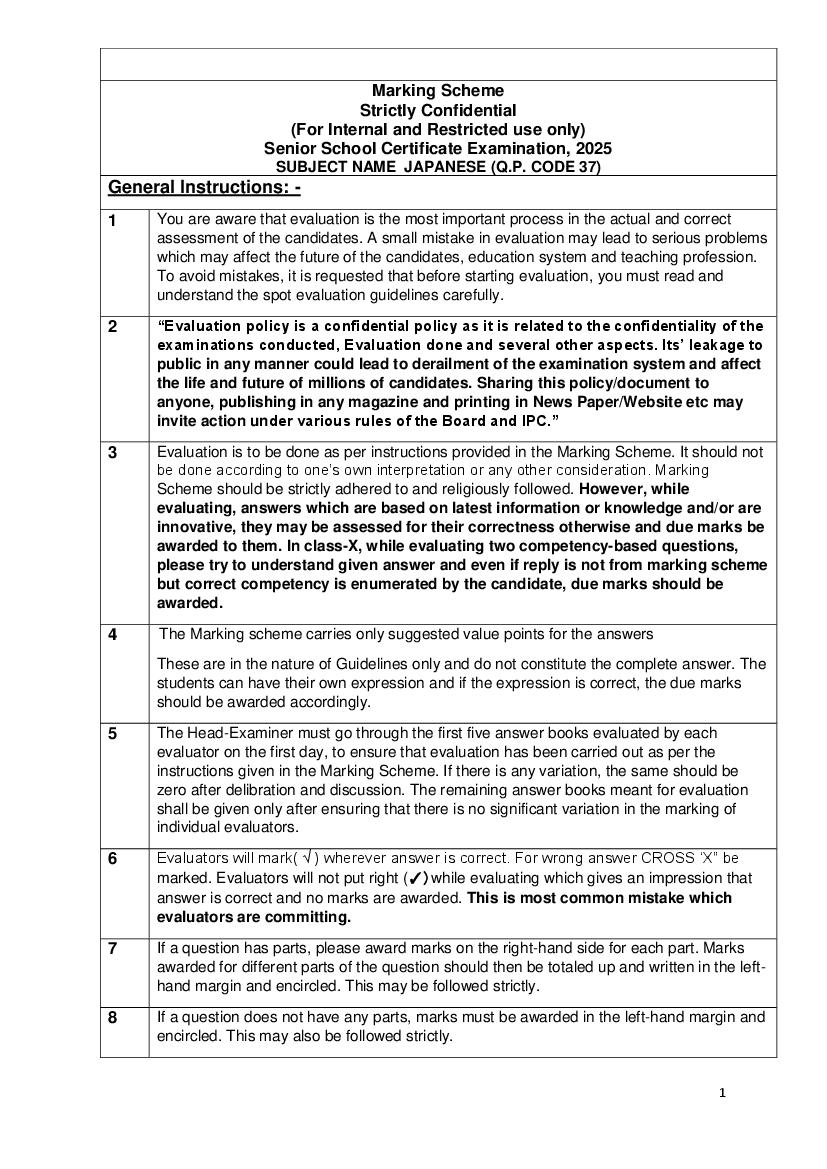
Strictly Confidential
(For Internal and Restricted use only)
Senior School Certificate Examination, 2025
SUBJECT NAME JAPANESE (Q.P. CODE 37)
General Instructions: -
1 You are aware that evaluation is the most important process in the actual and correct
assessment of the candidates. A small mistake in evaluation may lead to serious problems
which may affect the future of the candidates, education system and teaching profession.
To avoid mistakes, it is requested that before starting evaluation, you must read and
understand the spot evaluation guidelines carefully.
2 “Evaluation policy is a confidential policy as it is related to the confidentiality of the
examinations conducted, Evaluation done and several other aspects. Its’ leakage to
public in any manner could lead to derailment of the examination system and affect
the life and future of millions of candidates. Sharing this policy/document to
anyone, publishing in any magazine and printing in News Paper/Website etc may
invite action under various rules of the Board and IPC.”
3 Evaluation is to be done as per instructions provided in the Marking Scheme. It should not
be done according to one’s own interpretation or any other consideration. Marking
Scheme should be strictly adhered to and religiously followed. However, while
evaluating, answers which are based on latest information or knowledge and/or are
innovative, they may be assessed for their correctness otherwise and due marks be
awarded to them. In class-X, while evaluating two competency-based questions,
please try to understand given answer and even if reply is not from marking scheme
but correct competency is enumerated by the candidate, due marks should be
awarded.
4 The Marking scheme carries only suggested value points for the answers
These are in the nature of Guidelines only and do not constitute the complete answer. The
students can have their own expression and if the expression is correct, the due marks
should be awarded accordingly.
5 The Head-Examiner must go through the first five answer books evaluated by each
evaluator on the first day, to ensure that evaluation has been carried out as per the
instructions given in the Marking Scheme. If there is any variation, the same should be
zero after delibration and discussion. The remaining answer books meant for evaluation
shall be given only after ensuring that there is no significant variation in the marking of
individual evaluators.
6 Evaluators will mark( √ ) wherever answer is correct. For wrong answer CROSS ‘X” be
marked. Evaluators will not put right (✓)while evaluating which gives an impression that
answer is correct and no marks are awarded. This is most common mistake which
evaluators are committing.
7 If a question has parts, please award marks on the right-hand side for each part. Marks
awarded for different parts of the question should then be totaled up and written in the left-
hand margin and encircled. This may be followed strictly.
8 If a question does not have any parts, marks must be awarded in the left-hand margin and
encircled. This may also be followed strictly.
1
Page 2
marks should be retained and the other answer scored out with a note “Extra Question”.
10 No marks to be deducted for the cumulative effect of an error. It should be penalized only
once.
11 A full scale of marks __________(example 0 to 80/70/60/50/40/30 marks as given in
Question Paper) has to be used. Please do not hesitate to award full marks if the answer
deserves it.
12 Every examiner has to necessarily do evaluation work for full working hours i.e., 8 hours
every day and evaluate 20 answer books per day in main subjects and 25 answer books
per day in other subjects (Details are given in Spot Guidelines).This is in view of the
reduced syllabus and number of questions in question paper.
13 Ensure that you do not make the following common types of errors committed by the
Examiner in the past:-
● Leaving answer or part thereof unassessed in an answer book.
● Giving more marks for an answer than assigned to it.
● Wrong totaling of marks awarded on an answer.
● Wrong transfer of marks from the inside pages of the answer book to the title page.
● Wrong question wise totaling on the title page.
● Wrong totaling of marks of the two columns on the title page.
● Wrong grand total.
● Marks in words and figures not tallying/not same.
● Wrong transfer of marks from the answer book to online award list.
● Answers marked as correct, but marks not awarded. (Ensure that the right tick mark is
correctly and clearly indicated. It should merely be a line. Same is with the X for
incorrect answer.)
● Half or a part of answer marked correct and the rest as wrong, but no marks awarded.
14 While evaluating the answer books if the answer is found to be totally incorrect, it should
be marked as cross (X) and awarded zero (0)Marks.
15 Any unassessed portion, non-carrying over of marks to the title page, or totaling error
detected by the candidate shall damage the prestige of all the personnel engaged in the
evaluation work as also of the Board. Hence, in order to uphold the prestige of all
concerned, it is again reiterated that the instructions be followed meticulously and
judiciously.
16 The Examiners should acquaint themselves with the guidelines given in the “Guidelines
for Spot Evaluation” before starting the actual evaluation.
17 Every Examiner shall also ensure that all the answers are evaluated, marks carried over to
the title page, correctly totaled and written in figures and words.
18 The candidates are entitled to obtain photocopy of the Answer Book on request on
payment of the prescribed processing fee. All Examiners/Additional Head Examiners/Head
Examiners are once again reminded that they must ensure that evaluation is carried out
strictly as per value points for each answer as given in the Marking Scheme.
2
Page 3
MARKING SCHEME
JAPANESE
PART A
KANJI (20)
1. Choose the correct Hiragana reading of the underlined kanji from A, B, C and
D. You may write only the answer in the Answer sheet. Do any 10. (10 x 1=10)
Example: それは山です。
A) さん B) やま C) き D) かわ
Answer: B) やま
I. きょう内科のおいしゃさんにみてもらいました。
A) ないか B) うちがわ C) しゃない D) かない
II. 薬をのんで、ねつがさがりました。
A) めくすり B) ぐすり C) めぐすり D) くすり
III. あめがふって、てんきが涼しくなりました。
A) かなしく B) すずしく C) あたらしく D) おいしく
IV. 冬なので、セーターをたくさんかわないと…….。
A) なつ B) ふゆ C) あき D) はる
V. 洋ふくがすきですか、わふくがすきですか。
A) とう B) なん C) せい D) よう
VI. 日本へ行って、いろいろかん光したいとおもいます。
A) かんこ B) かんこう C) かんちょ D) かんちょう
VII. むすこは学者バッチ(batch)をもらうといっていました。
A) がくもの B) まなびしゃ C) がくしゃ D) まなびもの
VIII. いらないものは屋上においてあります。
A) へやじょ B) おくじょう C) おくじょ D) へやじょう
IX. いつもお世話になりました。どうもありがとうございました。
A) せいわ B) せいわあ C) せわ D) せわあ
X. わたしのしゅみは旅行することです。
3
Page 4
XI. このかみの真ん中にちいさいマークをつけてください。
A) しんじゅう B) しんなか C) まんちゅう D) まんなか
XII. きょういくはしゃかいの土台です。
A) どうだい B) どだい C) とうたい D) とうだい
2. Choose the correct kanji of the underlined Hiragana from A, B, C and D. You may
write only the answer in the Answer sheet. Do any 10. (10 x 1=10)
Example: それはやまです。
A) 日 B) 山 C) 川 D) 月
Answer: B) 山
I. にほんのえいがをみたことがありますか。
A) 駅画 B) 映学 C) 映画 D) 駅学
II. テレビのおとがでません。どうしようかな?
A) 後 B) 音 C) 外 D) 声
III. なんども(many times)かんじをれんしゅうしたけど、いまでもらくじゃない。
A) 来 B) 楽 C) 学 D) 行
IV. わたしはうたがすきですが、うたえません。
A) 絵 B) 飲 C) 書 D) 歌
V. はははオンラインでしごとをしていますから、べんりです。
A) 市子と B) 四語と C) 仕事 D) 四事
VI. きんよりぎんのほうがやすいです。
A) 近 B) 金 C) 銀 D) 食
VII. みせのひととてんいんはおなじいみですか。
A) 店員 B) 店見 C) 店買 D) 店貝
VIII. こばやしせんせいはがくせいににんきがあります。
A) 小森 B) 小本 C) 小林 D) 小木
IX. みちがわからないとき、ちずをもっていってください。
A) 地図 B) 池図 C) 弛図 D) 千図
X. うみのちかくにすみたいです。
A) 生み B) 海 C) 産み D) 川
XI. どのきせつがいちばんあついですか。
4
Page 5
XII. ラフルさんはあたまがよくてハンサムなひとです。
A) 頭 B) 顔 C) 体 D) 手
GRAMMAR (20)
3. Choose the correct particle from A, B, C and D to complete the following
sentences. You may write only the answer in the Answer sheet. Do any 10. (10 x 1=10)
Example: それ__やまです。
A) が B) は C) も D) に
Answer: B) は
I. でんしゃ___かさをわすれて、こまりました。
A) が B) は C) を D) に
II. せんせいはいませき__はずしていますから、あとできてください。
A) を B) から C) に D) は
III. バス__すいていたから、わたしはすわることができた。
A) と B) を C) が D) で
IV. がっこう___そつぎょうしたら、なにをしたいとおもいますか。
A) は B) が C) も D) を
V. ピクニックは7がつ__よていです。
A) が B) の C) と D) を
VI. このみせでは100えん__なんでもかえます。
A) を B) で C) は D) か
VII. てんきがよくないですから、からだ__きをつけてください。
A) の B) が C) に D) と
VIII. そこにはがっこうのルール___かいてありますね。
A) を B) で C) の D) が
IX. うるさいですね。おおきいこえ__はなしましょう。
A) か B) を C) の D) で
X. がっこうはきびしい(strict)ですね。
………ええ、やすみ__とってはいけませんから。
A) が B) を C) は D) で
XI. セミナー__しゅっせきできました。よかったです。
A) を B) が C) は D) に
5
Page 6
A) で B) に C) を D) と
4. Choose the correct form of the verb from A, B, C and D to complete the following
sentences. You may write only the answer in the Answer sheet. Do any 5. (5 x 1=5)
Example: すずきさんはいま____います。
A) ねる B) ねて C) ねない D) ねた
Answer: B) ねて
I. Google map で____とおりにいったけど、まちがえた。
A) みる B) みない C) みて D) みた
II. にちようびにどこへも____、うちにいます。
A) いって B) いかないで C) いく D) いった
III. くもっていますね。たいようは____でしょう。
A) できます B) できない C) でます D) でない
IV. こんどのなつやすみにすいえいを____とおもっています。
A) なる B) ならい C) ならおう D) ならって
V. あしたまでにこのレポートをかいて___なければなりません。
A) おか B) おき C) おいて D) おきて
VI. いくら____もまにあいません。
A) いそいて B) いそんで C) いそいで D) いそって
5. Match column 1st with column 2nd by choosing the answer from A, B, C and D,
which has the same meaning as of column 1st. You may write only the answer in the
Answer sheet. (5 x 1=5)
COLUMN 1st COLUMN 2nd
I. みんなきましたが、ゆきさんは A. ゆきさんはみんなといっしょにきました。
まだきていません。 B. ゆきさんはおそいです。
C. ゆきさんははやいです。
D. ゆきさんはきましたがみんなはまだきていません。
COLUMN 1st COLUMN 2nd
II. じゆうににほんについてはなし A. にほんについてインターネットでしらべてください。
てください。 B. にほんについておとうさんにきいてください。
6
Page 7
ださい。
D. にほんについてほんをよんでください。
COLUMN 1st COLUMN 2nd
III. きのうからずっとあめがふっていま A. いまあめがやみました。
す。 B. いまもあめがふっていますよ。
C. けさあめがふっていませんでした。
D. こんばんあめがふるかもしれません。
COLUMN 1st COLUMN 2nd
IV. さっきでんわしました。 A. これからでんわをします。
B. すこしまえでんわをしませんでした。
C. すこしまえにでんわをしました。
D. これからでんわをしません。
COLUMN 1st COLUMN 2nd
V. たんじょうのパーティーがありますか A. こなくてもいいです。
ら、ぜひきてください。 B. こないでください。
C. きていただけませんか。
D. きてはいけません。
PART B
COMPREHENSION AND WRITING (40)
6. Read the following words given in the bracket and choose the odd one out. You
may write only the answer in the Answer sheet. Do any 5. (5 x 1=5)
I. (シャツ、ポスター、カメラ、カレンダー)がやぶれてしまいました。
II. わたしのうちのちかくに(だいがくいん、れんきゅう、どうぶつえん、きょうかい)があります。
III. (テレビ、コンピューター、コピーき、チケット)がこしょうしています。
IV. (さら、えだ、かびん、ちゃわん)がわれてしまいました。
7
Page 8
VI. (みち、たいよう、ほし、そら)などはしぜんのものです。
7. Read the following paragraph and answer the questions that follow. You may
write only the answers in the Answer sheet. (6 x 1=6)
まいあさ お うち で で んし ゃ かよ
けんじさんはかいしゃいんです。毎朝、7 じに起きて、8 じに家を出ます。かれは電車でかいしゃに通
ぷん
っています。かいしゃはしんじゅくにあります。でんしゃで 30分かかります。
まいにち
かいしゃでは、けんじさんはマーケティングのしごとをしています。毎日、おおくのメールをよんだり、レポ
ひと
ートをかいたりします。ひるごはんはかいしゃの人といっしょにたべます。ときどき、そとへレストランでた
べにいきますが、ふつうはかいしゃのしょくどうでたべます。
ひ
しごとは6じごろおわりますが、いそがしいときはざんぎょうをします。ざんぎょうがない日は、7 じごろに
すこ ほん
うちにかえります。かえったあと、ばんごはんをたべて、少しテレビをみます。そして、ねるまえに本もよ
みます。
しゅうまつはともだちとあそんだり、しゅみのスポーツをしたりします。けんじさんのしゅみはテニスです。
にちようび
日曜日には、いつもちかくのテニスコートでともだちとテニスをします。けんじさんはしあわせで、たのし
いせいかつをしています。
Answer the following. Do any 3.
I. けんじさんはまいあさおきてからなにをしますか。―うちをでて、でんしゃにのって、かいしゃへいきます。
II. かれはどうやってかいしゃへいきますか。-でんしゃにのって、かいしゃへいきます。
III. かれのかいしゃはうちからちかいですか、とおいですか。-とおいです。でんしゃで30ぷんです/か
かります。
IV. けんじさんはなんのしごとをしていますか。-マーケティングのしごとをしています。
V. けんじさんはいつもかいしゃのしょくどうでごはんをたべますか。
-いいえ、ときどき、そとへレストランでたべにいきます。
Mark True or False, as per the information given in the above paragraph.
Do any 3.
VI. けんじさんはまいにちいそがしいです。-FALSE
VII. けんじさんはほんをよむじかんもありません。-FALSE
VIII. けんじさんのしゅみはテニスをすることです。-TRUE
IX. けんじさんはしゅうまつにかいしゃのひととあそびます。-FALSE
X. けんじさんのせいかつはハッピーです。-TRUE
8
Page 9
box given below. One option can be used only once. You may write only the answer
in the Answer sheet. (4 x 1=4)
おかねをはらわなくてもいい、 いまでんわではなしている、 つかってはいけない
でんわ ちゅ う きょうはみせがあいていない いくらでもたべることができる
I. 「電話中」はいまでんわではなしているといういみです。
し よ う き ん し
II. 「使用禁止」はつかってはいけないといういみです。
た ほうだい
III. 「食べ放題」はいくらでもたべることができるといういみです。
むりょう
IV. 「無料」はおかねをはらわなくてもいいといういみです。
ほんじつきゅうぎょう
V. 「本日休業 」はきょうはみせがあいていないといういみです。
9. Choose the appropriate words from the box given below and complete the
following text. You may write only the answer in the Answer sheet. One word can
be used only once. (10 x 1=10)
らいしゅう、わたしのうちででパーティーがあります。パーティーのじゅんびをするために、わたしはいろいろ
なことを○
1 きめます。○
2 まず、へやをきれいに○
3 します。それから、へやにはポスターを○
4 はります。テ
ーブルにはりょうりとおさらを○
5 ならべます。へやははなで○
6 かざります。
また、にわにはあたらしいはなを○
7 うえます。パーティーがおわったら、つかったものをもとのところに○
8
もどします。そして、ゴミを○
9 すてます。そうじもします。○
10 さいごに、ともだちをパーティーにさそいます。
このようにパーティーのじゅんびをして、ともだちとたのしいじかんをすごすことをたのしみにしています。
すてます, かざります, うえます, まず, きめます, もどします
さいご, はります, します, ならべます
OR
まいあさ、わたしはルーティン(routine)があります。○
1 まず、おきたら、かおを○
2 あらいます。それから、
はを○
3 みがきます。あさごはんをたべたあと、わたしはがっこうに行くじゅんびを○
4 します。
うちをでるまえに、ドアのかぎを○
5 かけます。きのうはかぎが見つかりませんでしたから、すこしじかんが
かかりました。がっこうについたら、きょうしつでつくえやいすなどを○
6 ならべます。せんせいがくるまえに、
ともだちにしゅくだいについていろいろ○
7 しつもんします。
ごご、うちにかえるときに、でんしゃに○
8 のります。そしてうちのちかくのえきで○
9 おります。
9
Page 10
いちにち
たべて、テレビをみて○
10 さいごにねます。これで一日がおわります。
みがきます, しつもんします, さいご, おります, かけます
のります, まず, します, あらいます, ならべます
10. Everyone knows about the problem of the waste, which is increasing day by day.
Write a paragraph of about 300-400 words on “ごみのだしかた”. Use as many Kanji as
possible. (5 x 1=5)
OR
Which Japanese/ Indian dish do you like the most? Write the recipe of your favorite
dish. Also tell the ingredients and their quantity required for the same in Japanese.
(Format:1mark, Ingredients: 2 marks and Procedure/ Recipe; 2 marks)
11. Look at the picture below and write 5 meaningful sentences by using 〜ている
grammar pattern. (5 x 1=5)
例:すずきさんはレポート をかいている人です。
I. やまださんは コーヒーをのんでいる人です。
II. さとうさんは コンピューターをつかっている・うっている・タイピングをしている人です。
III. たなかさんは コピーをしている人です。
IV. ミラーさんはでんわをして・かけている人です。
V. まつもとさんはしんぶんをよんでいる人です。
OR
Frame any 5 meaningful sentences by using Imperative/Command form of Verbs.
Use different verb in each sentence. Also write the meaning in English.
Example: The mother says to her child―
When he is not eating lunch: たべろ。―Eat. Answers will vary.
12. Translate the following sentences into English. Do any 5. (5 x 1=5)
I. 日本のがっこうではしょうがっこう、ちゅうがっこう、こうこうがあります。インドでもおなじです。
There are Elementary school, Middle /Junior High school and High school in the schools
of Japan. In India, it is also same.
II. にほんではしょうがっこうは6ねんかん、ちゅうがっこうは3ねんかん、こうこうは3ねんかんですが、インド
ではそうじゃありません。In Japan, Elementary schools are of 6 years, Middle /Junior High
schools are of 3 years and the High schools are of 3 years. In India, it is not so/same.
10
Page 11
The Japanese and Indian students both wear school uniform to go to school.
IV. 日本ではがくせいたちはがっこうできゅうしょくをたべますが、インドじんのがくせいたちはうちからもってきた
おべんとうをたべます。In Japan the students eat mid-day meal at schools but in India the
students eat the lunch, which they bring from home.
V. にほんのがっこうではそうじのじかんもあります。In Japanese schools, the time for the cleaning is
also there.
VI. にほんのがっこうは8じから3じまでですが、インドは8じから2んじまでです。The Japanese schools
are from 8:00 to 3:00 ,while the Indian schools are from 8:00 to 2:00.
11
Document Details
| Board / Org | CBSE |
| Exam | Class 12 |
| Type | Solution |
| Pages | 11 |
| Updated | 24 Sep 2026 |