CBSE Class 12 Home Science Question Paper 2019 Solutions
Finished viewing? Save it for later —
Download CBSE Class 12 Home Science Question Paper 2019 Solutions (PDF · 17 pages)About CBSE Class 12 Home Science Question Paper 2019 Solutions
CBSE Class 12 Home Science Question Paper 2019 Solutions is available here for free download. Published by CBSE for Class 12, this solution can be viewed online or downloaded as a PDF (17 pages). Candidates preparing for Class 12 can use CBSE Class 12 Home Science Question Paper 2019 Solutions to understand the exam pattern, the type of questions asked, and the overall difficulty level.
Frequently Asked Questions
How can I download CBSE Class 12 Home Science Question Paper 2019 Solutions?
Open this page and click the Download button to save CBSE Class 12 Home Science Question Paper 2019 Solutions as a PDF. It is completely free on AglaSem Docs.
Is CBSE Class 12 Home Science Question Paper 2019 Solutions free to download?
Yes. CBSE Class 12 Home Science Question Paper 2019 Solutions can be viewed online and downloaded as a PDF free of cost on AglaSem Docs.
How many pages does CBSE Class 12 Home Science Question Paper 2019 Solutions have?
CBSE Class 12 Home Science Question Paper 2019 Solutions contains 17 pages, which you can read online or download together as a single PDF.
Where can I find more Class 12 study material?
You can find more Class 12 question papers, sample papers, syllabus, and answer keys on AglaSem Docs.
CBSE Class 12 Home Science Question Paper 2019 Solutions – Text
Read the full text of this solution below — useful to quickly search, copy and reference the content online without downloading the PDF.
📄 View text version (17 pages)
Page 1
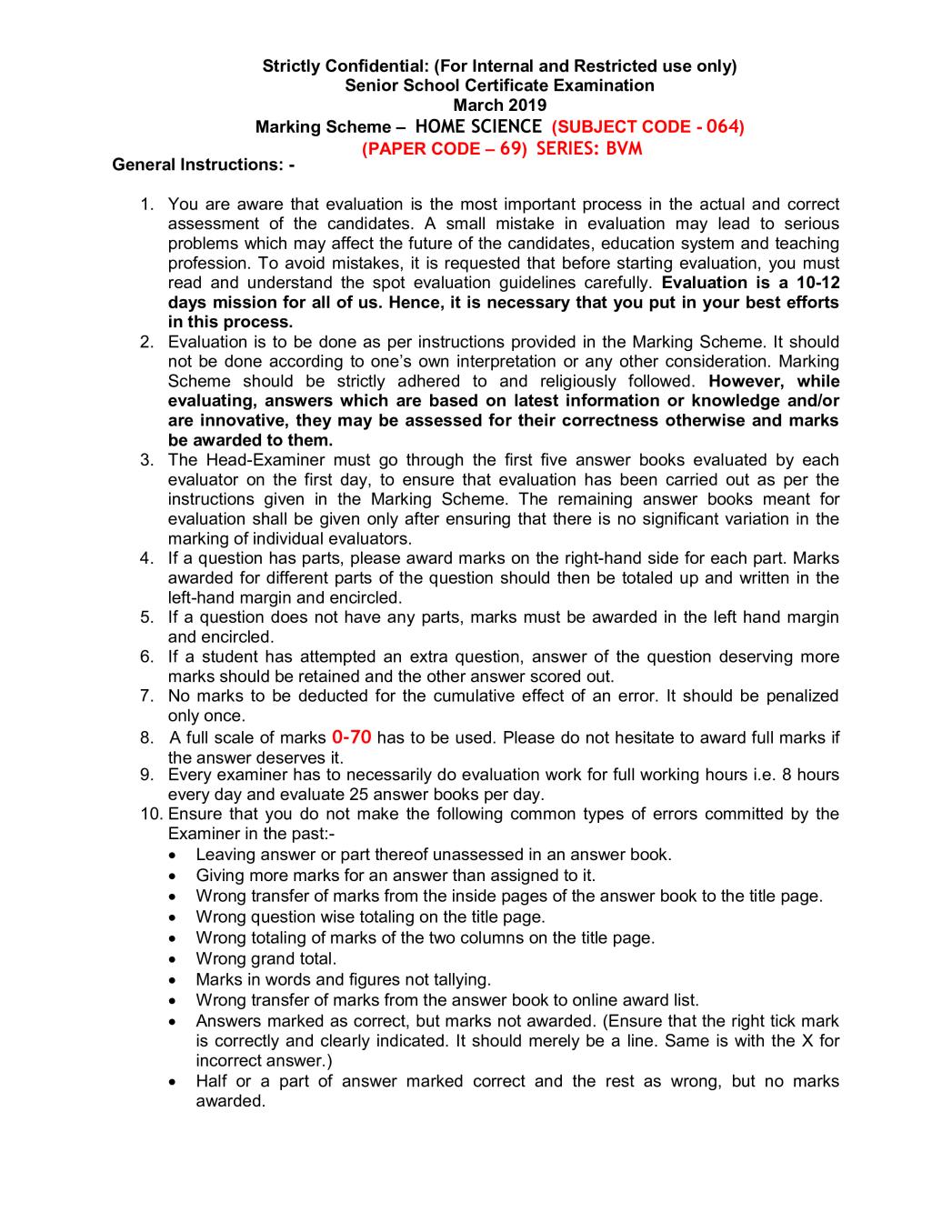
Senior School Certificate Examination
March 2019
Marking Scheme – HOME SCIENCE (SUBJECT CODE - 064)
(PAPER CODE – 69) SERIES: BVM
General Instructions: -
1. You are aware that evaluation is the most important process in the actual and correct
assessment of the candidates. A small mistake in evaluation may lead to serious
problems which may affect the future of the candidates, education system and teaching
profession. To avoid mistakes, it is requested that before starting evaluation, you must
read and understand the spot evaluation guidelines carefully. Evaluation is a 10-12
days mission for all of us. Hence, it is necessary that you put in your best efforts
in this process.
2. Evaluation is to be done as per instructions provided in the Marking Scheme. It should
not be done according to one’s own interpretation or any other consideration. Marking
Scheme should be strictly adhered to and religiously followed. However, while
evaluating, answers which are based on latest information or knowledge and/or
are innovative, they may be assessed for their correctness otherwise and marks
be awarded to them.
3. The Head-Examiner must go through the first five answer books evaluated by each
evaluator on the first day, to ensure that evaluation has been carried out as per the
instructions given in the Marking Scheme. The remaining answer books meant for
evaluation shall be given only after ensuring that there is no significant variation in the
marking of individual evaluators.
4. If a question has parts, please award marks on the right-hand side for each part. Marks
awarded for different parts of the question should then be totaled up and written in the
left-hand margin and encircled.
5. If a question does not have any parts, marks must be awarded in the left hand margin
and encircled.
6. If a student has attempted an extra question, answer of the question deserving more
marks should be retained and the other answer scored out.
7. No marks to be deducted for the cumulative effect of an error. It should be penalized
only once.
8. A full scale of marks 0-70 has to be used. Please do not hesitate to award full marks if
the answer deserves it.
9. Every examiner has to necessarily do evaluation work for full working hours i.e. 8 hours
every day and evaluate 25 answer books per day.
10. Ensure that you do not make the following common types of errors committed by the
Examiner in the past:-
Leaving answer or part thereof unassessed in an answer book.
Giving more marks for an answer than assigned to it.
Wrong transfer of marks from the inside pages of the answer book to the title page.
Wrong question wise totaling on the title page.
Wrong totaling of marks of the two columns on the title page.
Wrong grand total.
Marks in words and figures not tallying.
Wrong transfer of marks from the answer book to online award list.
Answers marked as correct, but marks not awarded. (Ensure that the right tick mark
is correctly and clearly indicated. It should merely be a line. Same is with the X for
incorrect answer.)
Half or a part of answer marked correct and the rest as wrong, but no marks
awarded.
Page 2
be marked as (X) and awarded zero (0) Marks.
12. Any unassessed portion, non-carrying over of marks to the title page, or totaling error
detected by the candidate shall damage the prestige of all the personnel engaged in the
evaluation work as also of the Board. Hence, in order to uphold the prestige of all
concerned, it is again reiterated that the instructions be followed meticulously and
judiciously.
13. The Examiners should acquaint themselves with the guidelines given in the Guidelines
for spot Evaluation before starting the actual evaluation.
14. Every Examiner shall also ensure that all the answers are evaluated, marks carried over
to the title page, correctly totaled and written in figures and words.
15. The Board permits candidates to obtain photocopy of the Answer Book on request in an
RTI application and also separately as a part of the re-evaluation process on payment of
the processing charges.
Page 3
SECTION A
Q1. Name any two food items which are given ISI mark. [1]
Mineral Water/ Milk Powder/ Condensed Milk/ Custard Powder/ Infant Food/ Biscuits/ Any
other (Any two) [½ ×2=1]
OR
Mention one possible adulterant each found in bura sugar and pure ghee.
i) Bura Sugar – Washing Soda/ Chalk Powder (Any one)
ii) Pure Ghee – Vanaspati Ghee/ Starch (Any one) [½ ×2=1]
Q2. Write any two activities which are done under MGNREGA. [1]
Activities under MGNREGA:
i) Road construction
ii) Toilet construction
iii) Poultry and goat shelter
iv) Manure/ vermi composting
v) Re-charging ground water
vi) Any other (Any two) [½ ×2=1]
Q3. Name one grease absorbant and one acid which are used to remove stains from garments. [1]
Grease Absorbant
i) Talcum Powder
ii) Bran
iii) French Chalk
iv) Powdered Magnesia
v) Fullers Earth (Any One)
Acid
i) Acetic Acid/ Vinegar
ii) Citric Acid/ Lemon
iii) Oxalic Acid
iv) Tartaric Acid / Tomato (Any one) [½ ×2=1]
Q4. Convince your brother to invest in a fixed deposit scheme of a bank by telling him its two
benefits. [1]
Benefits of Fixed Deposit
i) Loan Facility
ii) Tax Rebate upto 1.5Lakh for 5 years
iii) High Rate of interest
iv) Safe (Any two) [½ ×2=1]
3
Page 4
income. [1]
Ways to supplement
i) Screen print/ Block print/ Tie Dye any article
ii) Embroider suits
iii) Design motifs
iv) Open Boutique
v) Open repair/ alteration unit
vi) Open tailoring Unit
vii) Working in a garment industry
viii) Any other (Any two) [½ ×2=1]
Q6. Which nutrient deficiency may lead to anaemia during pregnancy? How much of this nutrient
has been recommended daily for pregnant women by ICMR? [1]
i) Iron
ii) 35mg
OR
i) Folic Acid
ii) 500 µg(micro gram) (Any one) [ i, ii - ½ ×2=1]
OR
Which nutrient is needed for sufficient secretion of mothers milk? How much of this
nutrient should be taken daily by her?
i) Calcium
ii) 1200 mg
OR
i) Protein
ii) 74 gms/ 68 gms (Any one) [ i, ii - ½ ×2=1]
4
Page 5
Q7. Region and traditions of a family influences their meal plans. Support this statement with the
help of two examples each. [2]
Region
i) Coconut/ Sea food included in meals in South India/ Coastal Region
ii) Rice in Hills
iii) Any other (Any two)
Traditions
i) Abstain from non-vegetarian food on certain days
ii) Many families avoid onion, garlic during navratras
iii) Eat certain foods on festivals– ghewar on Teej, Gujia on Holi, Cakes on
Christmas, Sweets on Diwali, Sewiyan on Eid
iv) Any other (Any two) [½ ×4=2]
OR
Every family selects their foods according to their health and food practices. Support the
statement with the help of two examples each.
Health:
i) Light, digestible and bland foods are selected for invalids
ii) Low sodium or less salt is selected for high Blood Pressure patients
iii) High Fibre foods are selected for constipation
iv) Any other (Any two)
Family Food Practices:
i) Families select roasted spices
ii) Some families select lots of chilies/ spices
iii) Zero oil/ Super foods are selected by families
iv) Any other (Any two) [½ ×4=2]
Q8. Write four factors that influences your choice of colours of your dres s? [2]
Factors:
i) Season — bright colours in winters/ light colours in summers
i) Occasion — bright in marriage , sobre in mourning
ii) Time of day — light colours in day time dark colours at night
iii) Age — pastel colours for infants , bright for toddlers/ any other
iv) Fashion – example neon colours in fashion
v) Occupation – Colours worn by Doctors - White/ Lawyers - Black and White
vi) Figure – Colours selected according to figure/ complexion/ personal choice
vii) Any other (Any four) [1/2×4=2]
5
Page 6
in your school canteen? [2]
Unhygienic Conditions:
i) Utensils were being washed in dirty water.
ii) Food not covered
iii) Using stale food
iv) Dirty surroundings/ near an open drain
v) Presence of pests and rodents
vi) Food handlers not wearing gloves/ caps/ have long dirty nails
vii) Dust bins- not covered/ not emptied/ not lined
viii) Cob webs/ clogged wire mesh/ grime on exhaust fans (Any four)
[1/2×4=2]
Q10. Your uncle wants to live in an old age home after his wife’s death. Which four facilities
should he check to fulfill his physical needs? [2]
Physical Needs:
i) Private room with attached toilet
ii) Safety from falls, slippage, etc
iii) Medical checkups/ first aid/ ambulance facility
iv) Hygienically prepared balanced meals
v) Clean surroundings
vi) Leveled ground for walks
vii) Building fence for safety
viii) Any other (Any four) [1/2×4=2]
Q11. Menu for lunch is egg tomato curry with plain parantha. Suggest any two types of
modifications in this meal, to suit the requirement of a fever patient. Support your answer
with examples [2]
Modifications:
Change in-
i) Consistency----give tomato soup/ any other
ii) Methods of cooking -- roast chapatti instead of frying/ give boiled egg/ any other
iii) Food stuff— avoid egg if allergic/ replace with paneer instead/ any other
iv) Nutrient -- add coriander leaves in curry/or soyabean atta in wheat flour /any other
v) Frequency — give this meal at frequent intervals ( Any two ) [1×2=2]
6
Page 7
Suggest two modifications in the meal of idli and sambhar to meet the nutritional needs of an
adolescent girl. Give reasons for your suggestions.
Modifications with reasons:
Modifications in Idli/ Sambhar Reasons
i. Add grated beetroot/ Green leafy Iron
vegetables in idli/ any other
ii. Add til/ curd/ any other Calcium
iii. Spinach/ mint – in chutney/ any other Folic Acid
iv. Add peanuts/ More dal/ Multigrains/ Protein
any other
v. Add drumsticks/ carrots in sambhar/ Vitamin A
any other
vi. Flax seeds/ any other Zinc
vii. Tomato/ Amla Chutney/ any other Vitamin C
( Any two with reasons) [1×2=2]
Q12. Twenty eight year old Mohan wants to resign from his job. Suggest four ways he can
cope with his job related responsibilities. [2]
Ways to cope:
i) Update Knowledge/ on the Job Training
ii) Cooperate and inculcate Team Spirit
iii) Time and Energy Management
iv) Be open to suggestions/ Understand others point of view
v) Systematic/ Plan Ahead
vi) Obey rules and regulations
vii) Adopt positive Attitude
viii) An y Other (Any four ) [1/2×4=2]
Q13. Family environment plays an important role in shaping the personality of an adolescent.
Support this statement with any two examples. [2]
Role of Family environment:
i) Weak family bonds/ separated/divorced parents--insecure, aggressive , introvert or
rebellious, poor body image, delinquent behaviour in adolescents. (Any other)
(Any one)
ii) Strong family bonds - stable and balanced personality /confident and positive
body image
iii) Any other (Any one) [1×2=2]
7
Page 8
Suresh is often pressurized by his friends to take drugs. If you were Suresh, in what four
ways would you have dealt with them?
Ways to deal with Peer Pressure
i) Share with elders
ii) Say ‘No’ firmly without feeling guilty
iii) Maintain distance from such friends
iv) Make friends aware of its consequences
v) Approach a counsellor
vi) Any other (Any four) [1×2=2]
SECTION C
Q14. What three precautions for each should be adopted while using chlorine tablets and
storing this potable water in a container? [3]
Precautions for using Chlorine tablets:
i) Use correct proportion of tablet/one tablet (4mg) in 1 litre OR one tablet in 20
litres of water.
ii) Shake to ensure tablet is dissolved.
iii) Leave for 10 minutes before consuming.
iv) In case of very dirty water 2 tablets should be used.
v) Use fresh/not expired tablets
vi) Tablets should be dry
vii) The bottle should be recapped tightly (Any three)
Store water Safely
i) Store in clean containers/ keep in clean place.
ii) Cover purified water
iii) Use long handled dispenser to take out water.
iv) Do not dip fingers in water. (Any three) [1/2 ×6=3]
Q15. Your brother has his own business. Suggest him two investment schemes which can give
tax free interest. Mention two other features of both these schemes. [3]
Public Provident Fund (PPF) [1/2 Mark]
i) Loan
ii) Premature withdrawal
iii) Tax rebate
iv) High interest rate
v) Safe (Any two) [1/2 ×2=1]
8
Page 9
i) Loan
ii) Tax rebate
iii) Life cover
iv) Easy Installments
v) Safe
vi) Any other (Any two) [1/2 ×2=1]
[1+1+1=3]
OR
Your father got ten lakh rupees on his retirement . Suggest him two post office schemes
which can give tax rebate facility. Mention two other features of both these schemes.
National Saving Certificate (NSC) [1/2 Mark]
i) It is a five years scheme
ii) Can take loan against it
iii) No limit of investment
iv) No liquidity/ no premature withdrawal
v) Interest taxable
vi) Safe
vii) Accessible
viii) High rate of Interest (Any two) [½ ×2=1]
Senior Citizen Saving Scheme(SCSS) [1/2 Mark]
i) Time period -- 5 years
ii) Minimum- 1000 and its multiples
iii) Max investment limit- 15 lakh
iv) High rate of interest
v) Interest paid quarterly
vi) Interest taxable
vii) Safe
vii) Accessible (Any two) [½ ×2=1]
[½ + ½ + 1 + 1=3]
9
Page 10
Q16. What could be four possible causes of depression in adolescents? Suggest four ways to
help them. [4]
Causes of Depression:
i) Broken home /conflicts at home
ii) Pressure of studies.
iii) Too high expectations from adults
iv) Heredity/ biological cause/ hormonal imbalance
v) Peer pressure/ rejection by peers
vi) Comparison/ partiality with others
vii) Identity crisis
viii) Mental and sexual abuse
ix) Any other (Any four)
Ways to Cope:
i) Counsel and guide her
ii) Provide support
iii) Keep her occupied constructively
iv) Sensitize the family
v) Keep a close watch on them
vi) Any other (Any four) [½ ×8=4]
Q17. Consumer protection Act has been made in favour of consumers. Tell them about its eight
major salient features. [4]
Salient features of Consumer Protection Act:
i) It includes both goods and services
ii) It covers all the sectors whether private, public or co-operative
iii) Three-tier quasi-judicial machinery at three levels - District, State and National
iv) Rights of consumers have been spelt out.
v) Nominal fee for filing in the courts.
vi) Timely redressal/ all cases settled in 3 to 5 months.
vii) Both compensatory and punitive (punishable)
viii) Courts to send notice to opposite party within 28 days of complaint/Opposite party
to reply within 30 days.
ix) It is mandatory for both the parties to attend all hearings
x) Can file online (Any eight) [1/2×8=4]
10
Page 11
Suggest four ways each a family can increase its money income and real income.
Ways to increase Money income-
i) Part time jobs
ii) Rent out portion of house
iii) Take tuitions
iv) Make and sell articles/ income generating activities
v) Sound investments/ earn Interest
vi) Any other (Any four)
Four ways to increase real income-
i) Do your own household work
ii) Borrow books from library
iii) Use community facilities - use local bus to travel instead of using own car
iv) Grow vegetables in own kitchen garden
v) Exchange goods and services/ barter system
vi) Fringe benefits (सहायक लाभ) - reimburse petrol bills etc.
vii) Any other (Any four) [1/2×8=4]
Q18. Write two ill-effects on health of consuming foods adulterated with kesari dal. Suggest six
ways to safeguard against such menance. [4]
Ill effects of Kesari Dal
i) Stiffening and pain of knee and ankle joints
ii) Paralysis of limbs/ Lathyrism [1/2Mark each]
Ways to Safeguard
i) Buy products with standard mark
ii) Buy sealed
iii) Buy reputed brand,
iv) Buy from reputed shops
v) File complaint
vi) Be alert (Any six) [1+3=4]
11
Page 12
Identify one adulterant in your food which may be responsible for rashes on the exposed parts
of your body. List four other health hazards, if such foods are consumed continuously. Name
three foods in which this adulterant may be found.
Argemone [½ mark]
Health Hazards:
i) Blindness
ii) Enlarged liver
iii) Respiratory distress
iv) Heart failure
v) Oedema (जल जमाव) (Any two)
Food adulterated with argemone:
i) Mustard oil
ii) Mustard seeds
iii) Mustard powder
iv) Mustard sauce (Any three ) [1/2+2+11/2=4]
Q19. Enumerate three malpractices a goldsmith can adopt to deceive the customers. What three
steps can consumers take to protect themselves from these malpractices? Also draw the
standard mark that consumers should check for buying reliable gold. [4]
Malpractices by Goldsmith:
i) Adulterates with brass/ Iridium/ any other metal
ii) Tampers with weighing machine / Scale not start at zero
iii) Iron strings/ wires inside the hollow bangles
iv) Weighs gem stones at the price of gold
v) Sells 18 carat gold at price of 24 carat
vi) Too high making charges (Any three ) [1/2×3=11/2]
Steps taken by consumers:
i) Be alert
ii) Buy from reputed shops
iii) Buy only Hallmark jewellery
iv) File a complaint
v) Buy from reputed brands
vi) Take bill (Any three) [1/2×3=11/2]
Hallmark [1 mark]
[11/2 + 11/2 + 1=4]
12
Page 13
Draw a symbol of quality given to agricultural products. Make consumers aware of three
malpractices adopted by vegetable vendors. What are their three responsibilities in this
context?
Symbol
[1 mark]
Malpractices by vegetable vendors:
i) Used stones or hollow weights
ii) Kept the balance on a slope
iii) Hung iron rings
iv) Put magnet
v) Sprinkle water / soak them in water (Any three ) [1/2×3=11/2]
Responsibilities of consumers:
i) Be alert — watch closely while he is weighing vegetables
ii) Refuse to buy if uses stones / insist in using stamped weights.
iii) Check his balance for magnet, iron rings
iv) Buy from reputed shops / outlets
v) Report any malpractices
vi) Any other (Any three ) [1/2×3=11/2]
[1+11/2+11/2=4]
13
Page 14
three more specific symptoms which can help confirm your suspicion. Suggest four dietary
changes for his meals. [4]
Jaundice [½ mark]
Symptoms of Jaundice:
i) Whitish tongue.
ii) Yellowing of eyes
iii) White chalky stools
iv) Dark yellow urine
v) Excessive fatigue
vi) Low grade fever
vii) Loss of appetite
viii) Nausea and vomiting (Any three ) [1/2×3=11/2]
Dietary Changes
i) Light and digestible meals
ii) High carbohydrate diet
iii) Plenty of fluids
iv) Liquid to soft diets at frequent intervals
v) Bl and food / no spi c es
vi) Avoid fried / avoid too much oil
vii) Avoid processed foods
viii) Any other (Any four) [1/2×4=2]
[1/2 +1½ +2=4]
Q21. Which four qualities would you check to ensure a durable fabric for your shirt? Give four
instructions to your tailor for its satisfactory workmanship [4]
Qualities for Durability
i) High thread count - more strong
ii) Origin of fibre- nylon /manmade strong, silk stronger
iii) Weave - plain/twill strong
iv) Yarn- blends stronger/ cord yarn - stronger than single ply
v) Filament - stronger than staple
vi ) Finishes - mercerised strong (Any four) [1 /2×4=2]
Workmanship of shirt
i) Cutting of fabric along the grain
ii) Stitched with strong colourfast matching thread
iii) Button and button hole aligned with each other ,
iv) Extra buttons
v) Stitches of hem invisible from right side.
vi) Interlocked seam/ French/ Run and Fell
vii) Placket/ neat and finished/ sufficiently overlapped
viii) Reinforced underarms/ pockets
ix) Bukram in Collar and Cuff
x) Collar should be flat on bodice
xi) Print and pocket/ arm aligned with bodice
xii) Any other (Any four) [1 /2×4=2]
[2+2=4]
14
Page 15
Q22. Label is an important consumer aid. List its six advantages and four drawbacks. [5]
Advantages:
i) Provide information of manufacturing and expiry date.
ii) Can complain to the address given
iii) Can check standard mark for quality
iv) Batch/ Lot number -Can refer to this while complaining
v) MRP - Prices can be checked
vi) Can check whether Vegetarian/ non-vegetarian
vii) Ingredients — can avoid if allergic to any
viii) Nutritional facts — can check nutrients
ix) Net weight/ volume can be checked
x) Precautions/ storage instruction
xi) Any other (Any six )
Drawbacks
i) Blurred print
ii) Overlapping print
iii) Printed in local language
iv) Very fine print
v) Incomplete information
vi) Imitation of popular brands
vii) Any other (Any four) [3+2=5]
Q23. Explain any f i v e principles of development with the help of examples. [5]
Principles of Developments:
i) Development involves change – Eg: can see change in pictures (any other)
ii) Development is continuous and lifelong - Eg: Development starts from birth till
death (any other)
iii) Development proceeds from general to specific and development occurs from
simple to complex - Eg: Every lady’s picture is mother’s picture. Later he can differentiate
between mother and other women (any other)
iv) Development is multi directional and follows a fixed pattern wh ich can start
either from head to toe – (i) cephalocaudal (मस्तकाधोमुखी) or (ii) inside to outside
(proximodistal - निकट से द रू का ववकास). (any other)
v) Development occurs in stages for different parts of the body- Eg: Adult size hands
and feet in adolescents (any other)
vi) Development is predictable - Eg: Birth weight doubles in five to six months and triples in
one year.
vii) Development is due to maturation - Eg: able to stand up if leg muscles are strong. (any
other)
viii) All domains of development are correlated - Eg: if deaf, speech is effected.
(any other)
ix) There are individual differences in development - Eg: children of same age
have different height and weight. (any other)
x) Development is influenced by heredity and environment - Eg: (i)
Heredity – same colour eyes as parents, (ii) Environment – Good Nutrition leads
to good health (any other)
(Any five with examples) [1×5=5]
15
Page 16
for this? Which four precautions should be adopted while storing these? [5]
Reasons for discolouration:
i) Did not remove when fresh
ii) Used wrong chemical
iii) Did not test the chemical in hidden corner of the fabric.
iv) Used strong chemicals
v) Chemical may be applied from the front side/ chemical not applied from
back
vi) Worked in a circular movement starting from centre to outside
vii) Did not neutralize acid reagents with an alkaline or vice-versa
viii) Did not rinse all traces of chemicals immediately after removing the stains
(Any six)
Precautions for storage of cotton sarees:
i) Remove starch before storing
ii) Wash them before storing.
iii) Dry completely
iv) Keep them in dry box/ keep away from dampness
v) Spray boxes with insecticide/ neem leaves/ insect repellent
vi) Line boxes with newspaper/ change newspaper frequently
vii) Any other (Any four) [3+2=5]
Q25. Alka is designing a sari blouse for a woman who is short in height. How should she use the
four elements of art for her? Illustrate three ways by which she can create rhythm in this
dress. [5]
Elements of art (कला के तत्व):
i) Line- vertical lines in sari / no border/narrow border
ii) Colour — sari and blouse matching/ same colours
iii) Texture- fine clingy texture
iv) Shape and form- small prints [½ ×4=2]
Rhythm (लय) :
Note: Draw pictures showing rhythm in following three ways
i) Repetition (दोहराना) - of embroidery, piping, colour etc. at neckline, sleeves and sari
border (any other)
ii) Gradation (उतार चढ़ाव) - gradually increasing or decreasing size of motifs, lines, colors.
texture in an orderly sequence. (any other)
iii) Radiation (ववककरण)-gathers in blouse, puff sleeves/ necklines etc. (any other)
iv) Parallelism(समानता) - continuous flowing pleats in saree/ pin tucks in blouse (any
other)
v) Alteration(अदल बदल) — alternate two designs in pleats one plain one printed (any
other)
vi) Opposition(ववपरीत) – design on opposite sides of blouse should be continuous.
(Any three) [1×3=3]
[2+3=5]
16
Page 17
Illustrate all five principles of design in a salwar kameez with labels.
(Note : 1/2 marks for label and 1/2 for diagram)
1. Balance(संतलु न)— (Any one)
i) Formal Balance - similar motifs/trimmings /patterns on both sides of the
garment, sleeves/ any other
ii) Informal Balance - design on one side balanced by motif piping / pocket/ logo
on other side/ any other
iii) Radial Balance – design radiating from centre or any one point
2. Rhythm(लय) — (Any one)
i) Repetition of piping/motifs / print/ trimmings on sleeves/neckline/ hem
ii) Radiation-puff sleeves in shirt/ patiala salwar/ any other
iii) Gradation of colour/ motifs/ any other
iv) Parallelism- parallel pin tucks / kalian in kameez/ salwar /any other
v) Alteration- alternate prints/line/ any other
vi) Opposition – opposite sides/ sleeves in continuity/ any other
3. Harmony(अनरू ु पता)/ Unity(एकता) -- (Any one)
i) Repeat same print on salwar, kameez, dupatta
ii) Silk dupatta with silk salwar kameez – same texture
iii) Related colour schemes matching colour of salwar and dupatta
iv) The print of arm aligned with bodice of kameez
v) Same style lines/ cuts umbrella cut on sleeves, shirt, hem, etc.
vi) Same hem length aligned with sleeves.
vii) Any other
4. Proportion(अनुपात) (Any one)
i) Size of pocket is proportionate to the size of kameez
ii) Size of collar / pocket is proportionate to the border
iii) Size of shirt is proportionate to the length of salwar
iv) Golden mean/ scale
v) Any other
5. Emphasis(दबाव) (Any one)
i) Embroidery/ patch work on neckline/ hem, etc.
ii) Contrasting colour/ piping / pocket etc.
iii) Any other [1×5=5]
_____________________________________________________________________
17
Document Details
| Board / Org | CBSE |
| Exam | Class 12 |
| Type | Solution |
| Pages | 17 |
| Updated | 30 Apr 2026 |