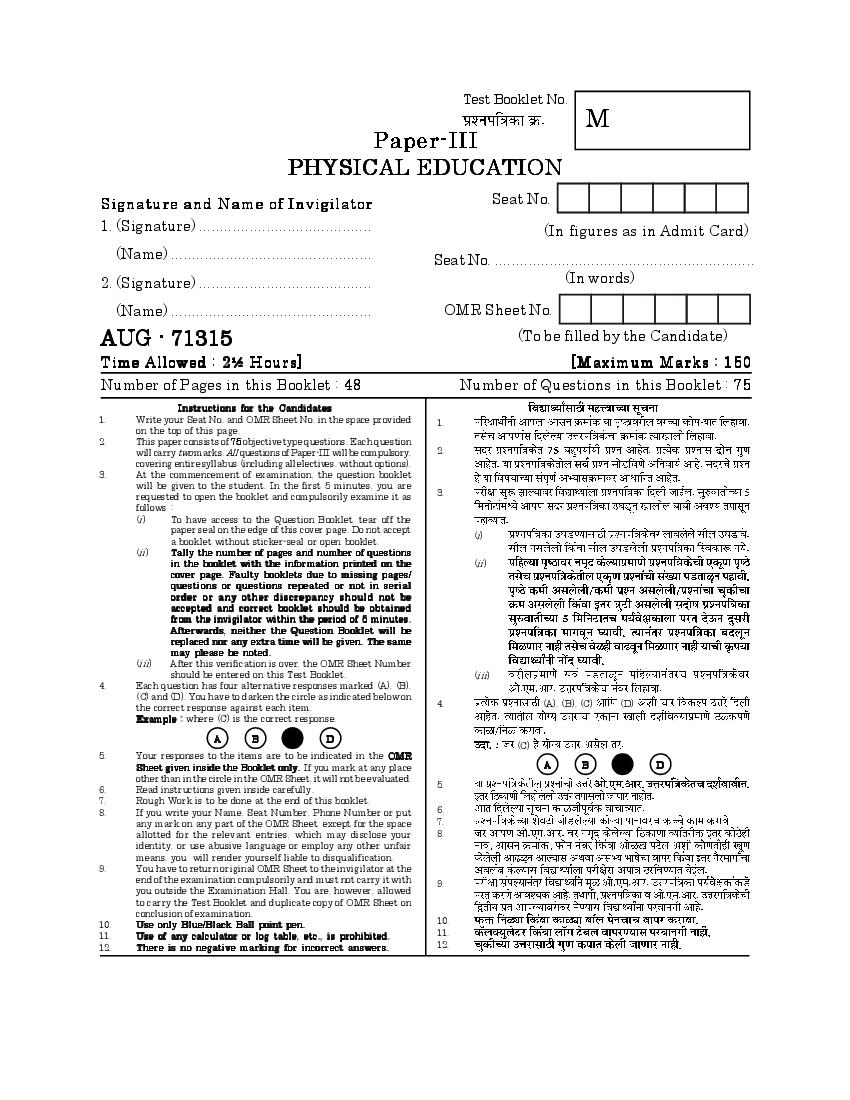
MAHA SET 2015 Question Paper 3 Physical Education
Finished viewing? Save it for later —
Download MAHA SET 2015 Question Paper 3 Physical Education (PDF · 48 pages)About MAHA SET 2015 Question Paper 3 Physical Education
MAHA SET 2015 Question Paper 3 Physical Education is available here for free download. Published by Maharashtra Exams for Maharashtra State Eligibility Test, this question paper can be viewed online or downloaded as a PDF (48 pages). Candidates preparing for Maharashtra State Eligibility Test can use MAHA SET 2015 Question Paper 3 Physical Education to understand the exam pattern, the type of questions asked, and the overall difficulty level.
Frequently Asked Questions
How can I download MAHA SET 2015 Question Paper 3 Physical Education?
Open this page and click the Download button to save MAHA SET 2015 Question Paper 3 Physical Education as a PDF. It is completely free on AglaSem Docs.
Is MAHA SET 2015 Question Paper 3 Physical Education free to download?
Yes. MAHA SET 2015 Question Paper 3 Physical Education can be viewed online and downloaded as a PDF free of cost on AglaSem Docs.
How many pages does MAHA SET 2015 Question Paper 3 Physical Education have?
MAHA SET 2015 Question Paper 3 Physical Education contains 48 pages, which you can read online or download together as a single PDF.
Where can I find more Maharashtra State Eligibility Test study material?
You can find more Maharashtra State Eligibility Test question papers, sample papers, syllabus, and answer keys on AglaSem Docs.
MAHA SET 2015 Question Paper 3 Physical Education – Text
Read the full text of this question paper below — useful to quickly search, copy and reference the content online without downloading the PDF.
📄 View text version (48 pages)
Page 1
M
PHYSICAL EDUCATION
Signature and Name of Invigilator Seat No.
1. (Signature) ......................................... (In figures as in Admit Card)
(Name) ................................................ Seat No. ..............................................................
2. (Signature) ......................................... (In words)
(Name) ................................................ OMR Sheet No.
AUG - 71315 (To be filled by the Candidate)
Time Allowed : 2½ Hours] [Maximum Marks : 150
Number of Pages in this Booklet : 48 Number of Questions in this Booklet : 75
Instructions for the Candidates
1. Write your Seat No. and OMR Sheet No. in the space provided 1.
on the top of this page.
2. This paper consists of 75 objective type questions. Each question
will carry two marks. All questions of Paper-III will be compulsory, 2.
covering entire syllabus (including all electives, without options).
3. At the commencement of examination, the question booklet
will be given to the student. In the first 5 minutes, you are
requested to open the booklet and compulsorily examine it as 3.
follows :
(i) To have access to the Question Booklet, tear off the
paper seal on the edge of this cover page. Do not accept
(i)
a booklet without sticker-seal or open booklet.
(ii) Tally the number of pages and number of questions
in the booklet with the information printed on the (ii)
cover page. Faulty booklets due to missing pages/
questions or questions repeated or not in serial
o rder or any other discre pancy should not be
accepted and correct booklet should be obtained
from the invigilator within the period of 5 minutes.
Afterwards, neither the Question Booklet will be
replaced nor any extra time will be given. The same
may please be noted.
(iii) After this verification is over, the OMR Sheet Number
should be entered on this Test Booklet. (iii)
4. Each question has four alternative responses marked (A), (B),
(C) and (D). You have to darken the circle as indicated below on
the correct response against each item. 4. (A), (B), (C) (D)
Example : where (C) is the correct response.
A B D
(C)
5. Your responses to the items are to be indicated in the OMR
Sheet given inside the Booklet only. If you mark at any place A B D
other than in the circle in the OMR Sheet, it will not be evaluated.
5.
6. Read instructions given inside carefully.
7. Rough Work is to be done at the end of this booklet.
8. If you write your Name, Seat Number, Phone Number or put 6.
any mark on any part of the OMR Sheet, except for the space 7.
allotted for the relevant entries, which may disclose your 8.
identity, or use abusive language or employ any other unfair
means, you will render yourself liable to disqualification.
9. You have to return original OMR Sheet to the invigilator at the
end of the examination compulsorily and must not carry it with 9.
you outside the Examination Hall. You are, however, allowed
to carry the Test Booklet and duplicate copy of OMR Sheet on
conclusion of examination.
10. Use only Blue/Black Ball point pen. 10.
11. Use of any calculator or log table, etc., is prohibited. 11.
12. There is no negative marking for incorrect answers. 12.
Page 2
Page 3
Paper III
III
Time Allowed : 2½ Hours] [Maximum Marks : 150
Note : This Question Paper contains Seventy Five (75) multiple choice questions,
each question carries Two (2) marks. Attempt All questions.
(75) (2)
1. The main purpose of a Pilot study
1.
of physical education research is :
(A) To obtain funds for subsequent
research (A)
(B) To provide opportunities for
students to get research
(B)
experience
(C) To set and improve research
plan
(C)
(D) To find out the reliability of the
study (D)
3 [P.T.O.
Page 4
labelled as Assertion (A) and the
(R)
other labelled as Reason (R) :
(A) :
Assertion (A) :
Type-I error is rejecting the null
hypothesis when it is true. I
Reason (R) :
(R) :
Type-I error arises due to false
I
interpretation of data.
In the context of the above two
statements, which one of the
following is correct ?
(A) (A) (R)
(A) Both (A) and (R) are right
(B) (A) (R)
(B) (A) is wrong but (R) is right
(C) (A) is right but (R) is wrong (C) (A) (R)
(D) Both (A) and (R) are wrong (D) (A) (R)
4
Page 5
the correct answer from the codes
given below :
I
List I
(i)
(i) BMI
(ii)
(ii) Body composition
(iii)
(iii) Explosive strength
(iv)
(iv) Anthropometry
List II II
(1) Size and proportion of the (1)
human body
(2)
(2) Performance related fitness
(3)
(3) Health related fitness
(4)
(4) Obesity
Codes :
(i) (ii) (iii) (iv)
(i) (ii) (iii) (iv)
(A) (1) (4) (3) (2)
(A) (1) (4) (3) (2)
(B) (4) (3) (2) (1)
(B) (4) (3) (2) (1)
(C) (3) (2) (1) (4) (C) (3) (2) (1) (4)
(D) (2) (1) (4) (3) (D) (2) (1) (4) (3)
5 [P.T.O.
Page 6
the correct option from the codes
given below :
I
List I
(i)
(i) Basketball
(ii)
(ii) Archery
(iii)
(iii) Volleyball
(iv)
(iv) Handball
II
List II
(1)
(1) Hyde
(2)
(2) Brady
(3)
(3) Cornish
(4)
(4) Johnson
Codes :
(i) (ii) (iii) (iv)
(i) (ii) (iii) (iv)
(A) (4) (3) (2) (1)
(A) (4) (3) (2) (1)
(B) (3) (2) (1) (4) (B) (3) (2) (1) (4)
(C) (4) (1) (2) (3) (C) (4) (1) (2) (3)
(D) (1) (4) (3) (2) (D) (1) (4) (3) (2)
6
Page 7
measure strength of different
forms :
(I) Sit-ups
(I)
(II) Squat Jump
(II)
(III) Medicine Ball Throw
(III)
(IV) Pull-ups
(IV)
Among them strength endurance is
measured by :
Codes : (A) (I) (II)
(A) (I) and (II) (B) (II) (III)
(B) (II) and (III)
(C) (III) (IV)
(C) (III) and (IV)
(D) (IV) (I)
(D) (IV) and (I)
6.
6. Which of the following is the most
reliable measure of variability ?
(A)
(A) Range
(B)
(B) Quartile deviation
(C) Average deviation (C)
(D) Standard deviation (D)
7 [P.T.O.
Page 8
labelled as Assertion (A) and the
(R)
other labelled as Reason (R) :
(A) :
Assertion (A) :
Johnson Basketball test is a
standardized test
Reason (R) :
(R) :
Johnson Basketball test evaluates
basketball playing ability.
Find out the correct answer from the
codes given below :
(A) Both (A) and (R) are true but
(A) (A) (R) (R)
(R) is the correct explanation
of (A) (A)
(B) Both (A) and (R) are true but (B) (A) (R) (R)
(R) is not the correct explanation
(A)
of (A)
(C) (A) (R)
(C) (A) is true but (R) is false
(D) (A) is false but (R) is true (D) (A) (R)
8
Page 9
(A) ‘t’ test
(B) ANOVA (A)
(C) ANCOVA (B)
(D) Chi-square test (C)
9. Match the following List I and (D)
List II and choose the correct answer 9. I II
by the codes given below :
List I I
(i) Limitation (i)
(ii) Hypothesis (ii)
(iii) Type I error (iii) I
(iv) Type II error (iv) II
List II II
(1) Rejecting the null hypothesis (1)
(2) Accepting the null hypothesis (2)
(3) Intelligent guess (3)
(4) Fixing boundaries (4)
(5) Uncontrollable factors (5)
Codes :
(i) (ii) (iii) (iv) (i) (ii) (iii) (iv)
(A) (5) (3) (2) (1) (A) (5) (3) (2) (1)
(B) (4) (3) (1) (2) (B) (4) (3) (1) (2)
(C) (5) (3) (1) (2) (C) (5) (3) (1) (2)
(D) (5) (3) (4) (2) (D) (5) (3) (4) (2)
9 [P.T.O.
Page 10
10.
movement most clearly demonstrates
basic skill in nonlocomotor body
management ?
(A) Hopping up and down
(A)
(B) Standing on a balance beam
(C) Leaping with variation in (B)
distance
(C)
(D) Throwing an object various
distances (D)
11. When teaching a new skill for a
11.
particular sport, the teacher should
do which of the following first ?
(A) Provide drills to lead up to the
(A)
skill
(B) Have students practice the skill (B)
(C) Introduce the skill
(C)
(D) Provide feedback to correct
errors (D)
10
Page 11
planning in order :
(I) Establishing learning experi-
(I)
ences
(II)
(II) Organising learning experi-
ences (III)
(III) Evaluation (IV)
(IV) Define objectives
Select the correct option :
(A) (I), (II), (IV) (III)
(A) (I), (II), (IV) and (III)
(B) (IV), (I), (II) (III)
(B) (IV), (I), (II) and (III)
(C) (IV), (I), (III) (II)
(C) (IV), (I), (III) and (II)
(D) (II), (IV), (I) and (III) (D) (II), (IV), (I) (III)
11 [P.T.O.
Page 12
the correct answer from the codes
given below :
I
List I
(i)
(i) Three seconds rules
(ii)
(ii) Throw-in
(iii)
(iii) Straight push
(iv)
(iv) Service
II
List II
(1)
(1) Football
(2)
(2) Hockey
(3)
(3) Basketball
(4)
(4) Badminton
(5)
(5) Baseball
Codes :
(i) (ii) (iii) (iv)
(i) (ii) (iii) (iv)
(A) (1) (2) (3) (4) (A) (1) (2) (3) (4)
(B) (2) (1) (4) (3) (B) (2) (1) (4) (3)
(C) (3) (1) (2) (4) (C) (3) (1) (2) (4)
(D) (1) (2) (5) (4) (D) (1) (2) (5) (4)
12
Page 13
the correct answer from the codes
given below :
I
List I
(i)
(i) Group environment question-
naire (ii)
(ii) Pacer (PACER) (iii)
(iii) Scat (SCAT) (iv)
(iv) Miller Volley test II
List II (1)
(1) Badminton
(2)
(2) Team cohesion
(3)
(3) Cardio-respiratory endurance
(4)
(4) Anxiety
Codes :
(i) (ii) (iii) (iv)
(i) (ii) (iii) (iv)
(A) (3) (2) (4) (1)
(A) (3) (2) (4) (1)
(B) (4) (1) (3) (2) (B) (4) (1) (3) (2)
(C) (2) (3) (4) (1) (C) (2) (3) (4) (1)
(D) (1) (2) (3) (4) (D) (1) (2) (3) (4)
13 [P.T.O.
Page 14
maintains a straight body alignment
by keeping legs near to the surface
which helps him in :
(A) Increasing the kinetic energy of
the swimmer (A)
(B) Reducing the effect of gravity (B)
on the swimmer
(C) Increasing the buoyancy of the
swimmer (C)
(D) Reducing the water resistance
(D)
on the swimmer
16. To ensure smooth, controlled 16.
movement under load, a muscle
must be able to make fine
adjustments to the amount of force
produced during the contraction.
Such fine adjustments are
accomplished primarily by varying
the :
(A)
(A) Number of motor units
recruited during contraction
(B) Duration of contraction of motor
(B)
units
(C) Amount of oxygen available to (C)
the muscle
(D)
(D) Amount of force produced by
the muscle fibres individually
14
Page 15
17.
phase of the competition period
should be :
(A) Low intensity and low volume
(A)
of load
(B) Low intensity and high volume (B)
of load
(C)
(C) High intensity and low volume
of load
(D)
(D) High intensity and high volume
of load 18.
18. In Snooker, the player makes very
fine adjustment in application of
force and direction on his cue. Such
fine adjustments are accomplished
(A)
due to his :
(A) Differentiation Ability (B)
(B) Adaptation Ability
(C)
(C) Reaction Ability
(D) Orientation Ability (D)
15 [P.T.O.
Page 16
19. (A)
Assertion (A) and Reason (R) given
(R)
below :
Assertion (A) : (A) :
Supervision is concerned with
studying and improving conditions
further.
(R) :
Reason (R) :
Supervision is needed because all
teachers of physical education are
not sincere in teaching.
Which of the following statements
is correct ?
(A) (A) (R)
(A) (A) is true but (R) is false
(B) (A) (R)
(B) (A) is false but (R) is true
(C) (A) (R)
(C) Both (A) and (R) are true
(D) Both (A) and (R) are false (D) (A) (R)
16
Page 17
20.
the process of motivation :
(A) Occurrence of needs, Drive
towards behaviour, Develop-
(A)
ment of motives, Achievement
of goals
(B) Achievement of goals, Drive
(B)
towards behaviour, Develop-
ment of motives, Occurrence of
needs
(C)
(C) Occurrence of needs, Develop-
ment of motives, Drive towards
behaviour, Achievement of
(D)
goals
(D) Occurrence of needs, Achieve-
ment of goals, Drive towards
21.
behaviour, Development of
motives
21. The types of learning in which the
(A)
problem gets solved suddenly ?
(A) Learning by insight (B)
(B) Programmed learning
(C)
(C) Conditional learning
(D) Learning by imitation (D)
17 [P.T.O.
Page 18
22.
as :
(A)
(A) Neutral transfer
(B) Positive transfer (B)
(C) Negative transfer (C)
(D) Bilateral transfer
(D)
23. Select the correct combination of
23.
components that define motivation :
(A) Direction, persistence,
continuing motivation,
(A)
intensity
(B) Desire, persistence, continuing
motivation (B)
(C) Internal forces and external
(C)
forces
(D)
(D) Direction, social factors and
cognitive factors
18
Page 19
bicycle will have to discard many
wrong movements until he learns
how to ride it perfectly. The principle
underlying this process of learning
is called : (A)
(A) Trial and error (B)
(B) Insight (C)
(C) Classical conditioning
(D)
(D) Instrumental conditioning
25.
25. Carpal joint is the example of :
(A)
(A) Pivot joint
(B)
(B) Condyloid joint
(C)
(C) Hinge joint
(D) Ball and Socket joint (D)
19 [P.T.O.
Page 20
26.
take place in :
(A)
(A) Frontal plane and frontal axis
(B)
(B) Sagittal plane and longitudinal
axis
(C)
(C) Frontal plane and sagittal
(D)
axis
27.
(D) Sagittal plane and frontal axis
27. Newton’s second law of motion is
also known as :
(A)
(A) Law of inertia
(B)
(B) Law of action and reaction
(C)
(C) Law of momentum
(D) Law of gravitation (D)
20
Page 21
the correct option using the codes
given below :
I
List I
(i)
(i) Elevation
(ii)
(ii) Retraction
(iii) Protraction (iii)
(iv) Depression (iv)
List II II
(1) Movement of the scapula toward (1)
the spine in the transverse
plane
(2)
(2) Movement of the scapula
inferiorly in the frontal plane
(3) Movement of the scapula (3)
superiorly in the forntal plane
(4) Movement of scupula away from (4)
the spine in the transverse
plane
Codes :
(i) (ii) (iii) (iv)
(i) (ii) (iii) (iv)
(A) (3) (1) (4) (2)
(A) (3) (1) (4) (2)
(B) (3) (2) (1) (4) (B) (3) (2) (1) (4)
(C) (2) (4) (1) (3) (C) (2) (4) (1) (3)
(D) (2) (3) (1) (4) (D) (2) (3) (1) (4)
21 [P.T.O.
Page 22
(A) Centripetal force is more than
(A)
centrifugal force
(B) Centrifugal force is more than
(B)
centripetal force
(C) Centripetal and centrifugal
force become zero (C)
(D) Centrifugal force is less than
centripetal force
(D)
30. If a bus started suddenly, the
passengers in the bus will tend to
fall : 30.
(A) In the direction opposite to the
direction of motion of the bus
(A)
(B) In the same direction as the
(B)
direction of motion of bus
(C)
(C) Side-way direction
(D) He will not tend to fall (D)
22
Page 23
low and fast after rebound :
(A) Back spin
(A)
(B) Top spin
(B)
(C) Left spin
(C)
(D) Right spin
32. In order to prevent hyperthermia, (D)
an athlete shout not do which of the
32.
following ?
(A) Avoid two consecutive bouts of
(A)
performing involving heavy
fluid loss
(B) Wear light clothing that
breathes (B)
(C) Plan activity in the middle of
(C)
the day when temperatures are
highest
(D)
(D) Drink fluids, during and after
activity
23 [P.T.O.
Page 24
statements and choose the correct
codes given below :
(1) :
Statement (1) :
One of the end products of
photosynthesis is the raw material
for respiration.
(2) :
Statement (2) :
One of the end products of
respiration is the raw material for
photosynthesis.
Codes : (A) (1) (2)
(B) (1) (2)
(A) Both (1) and (2) are correct
(C) (1) (2)
(B) Both (1) and (2) are wrong
(C) (1) is correct and (2) is wrong
(D) (1) (2)
(D) (1) is wrong and (2) is correct
24
Page 25
occurs during the conversion of
pyruvic acid to acetyl CoA :
(A) Oxidation and reduction
(A)
(B) Hydration and carboxylation
(B)
(C) Dehydrogenation and decarbo-
xylation (C)
(D) Decarboxylation and hydro- (D)
genation
35.
35. The acclimitisation to altitude leads
to :
(A)
(A) Hypoventilation
(B)
(B) Decreased cardiac output
(C)
(C) Pulmonary oedema
(D) Increase in cardiac output (D)
25 [P.T.O.
Page 26
increase in blood flow is due to :
(A) Sympathetic vasodilation
(A)
(B) Metabolic vasodilation
(B)
(C) Muscle pumping
(C)
(D) Parasympathetic vasodilation
(D)
37. In running 100 metres, the
37.
increased oxygen requirements of
tissues is met by :
(A)
(A) Increased cardiac output
(B)
(B) Increased erythropoietin
(C) CO2
(C) Rise in CO2 partial pressure
(D) Increased arterial CO2 partial (D) CO 2
pressure
26
Page 27
secretive, adventurous Vs. cautious,
sociable Vs. reclusive, these traits
describe which dimension of
personality ?
(A) Agreeableness
(A)
(B) Conscientiousness
(B)
(C) Extraversion
(D) Emotional stability (C)
39. In Closing Ceremony of a Sporting (D)
Event if the following items are to
39.
be performed :
(I) Jumbled March Past
(I)
(II) Declaration of Championship
closed (II)
(III) Putting off the Flame (III)
(IV) Lowering of Flag (IV)
The correct sequence of the above
events shall be :
Codes :
(A) (I), (II), (III) (IV)
(A) (I), (II), (III) and (IV)
(B) (I), (II), (IV) (III)
(B) (I), (II), (IV) and (III)
(C) (IV), (I), (II) and (III) (C) (IV), (I), (II) (III)
(D) (IV), (III), (II) and (I) (D) (IV), (III), (II) (I)
27 [P.T.O.
Page 28
principle of specificity of training ?
(A) Individual differences should be
(A)
considered
(B) Progression, based on (B)
individual’s fitness, should be (C)
considered
(D)
(C) Ability specific training is
imparted
(D) Physiological changes are 41.
monitored during training
41. Which of the following is the correct
order of first aid treatment procedures
(1)
for common strain and sprain ?
(2)
(1) To use ice application
(2) To elevate the injured part (3)
(3) To rest (4)
(4) To use elastic bandage to press
the injured area
(A) (1), (2), (3) (4)
(A) (1), (2), (3) and (4)
(B) (2), (1), (4) (3)
(B) (2), (1), (4) and (3)
(C) (3), (1), (4) (2)
(C) (3), (1), (4) and (2)
(D) (3), (1), (2) and (4) (D) (3), (1), (2) (4)
28
Page 29
objective of Extramurals ?
(A) Development of sportsman like (A)
qualities
(B)
(B) Development of sporting
excellence (C)
(C) Development of social qualities (D)
(D) Selection of Institute Team 43. I II
43. Match List I with List II and select
the correct option using the codes
I
given below :
(i)
List I
(i) Basketball (ii)
(ii) Kabaddi (iii)
(iii) Volleyball (iv)
(iv) Football II
List II (1)
(1) Sudden death (2)
(2) Libero
(3)
(3) Dead ball
(4)
(4) Lona
Codes :
(i) (ii) (iii) (iv)
(i) (ii) (iii) (iv)
(A) (4) (3) (2) (1)
(A) (4) (3) (2) (1)
(B) (4) (3) (1) (2) (B) (4) (3) (1) (2)
(C) (3) (2) (1) (4) (C) (3) (2) (1) (4)
(D) (3) (4) (2) (1) (D) (3) (4) (2) (1)
29 [P.T.O.
Page 30
doping in sports in India ?
(A) IADA (A)
(B) WADA (B)
(C) NADA (C)
(D) IDTL
(D)
45. Which of the following is contra-
45.
indication of the Ultrasound ?
(A) Scar tissue
(A)
(B) Infection
(B)
(C) Warts
(C)
(D) Collitis
(D)
46. Which of the following is an incorrect
46.
description of nutrient ?
(A) Protein is the main source of
(A)
energy supply
(B)
(B) Vitamins are organic compounds
involved in body metabolism
(C) Water is essential for life (C)
(D) Minerals are essential (D)
substances for bones and teeth
30
Page 31
years were the Olympic Games
not held ?
(A) 1916, 1940 1954
(A) 1916, 1940 and 1954
(B) 1916, 1940 1944
(B) 1916, 1940 and 1944
(C) 1916, 1920 1928
(C) 1916, 1920 and 1928
(D) 1940, 1944 and 1948 (D) 1940, 1944 1948
48. Twelve (12) players of a Basketball 48.
Team want to shake hand with each
other. The number of shake hands
will be :
(A) 11
(A) 11
(B) 66
(B) 66
(C) 22 (C) 22
(D) 33 (D) 33
31 [P.T.O.
Page 32
is :
(I)
(I) A continuous process
(II)
(II) Based on observations and
interaction between supervisor
and organisation (III)
(III) A fault finding and criticism
process
(IV)
(IV) For future improvement.
The correct combination is :
(A) (I), (III) (IV)
(A) (I), (III) and (IV)
(B) (II), (III) (IV)
(B) (II), (III) and (IV)
(C) (I), (II) (III)
(C) (I), (II) and (III)
(D) (I), (II) and (IV) (D) (I), (II) (IV)
32
Page 33
Knock-out Tournament. The
number of the byes will be :
(A) 08
(A) 08
(B) 22
(B) 22
(C) 18
(C) 18
(D) 02 (D) 02
51. The branch of philosophy concerned 51.
with examining the nature of
knowledge is :
(A)
(A) Metaphysics
(B)
(B) Axiology
(C)
(C) Pragmatism
(D) Epistemology (D)
33 [P.T.O.
Page 34
52.
technique of supervision ?
(A)
(A) Visitation
(B)
(B) Conference
(C) Workshop (C)
(D) Get-together
(D)
53. From the following, identify the one,
53.
which is not included in the steps
of the classic model of decision
making :
(A)
(A) Idea generation
(B)
(B) Problem creation
(C)
(C) Agenda setting
(D) Policy making (D)
34
Page 35
is not required to make a physical
educator dynamic for the discipline
of physical education ?
(A) The ability to monopolize
(A)
(B) The ability to analyze
(C) The ability to organize (B)
(D) The ability to supervise (C)
55. Given below are two statements, one (D)
is Assertion (A) and the other is
Reason (R) : 55. (A)
(R)
Assertion (A) :
Intramural Programme should be (A) :
an integral part of the Physical
Education Programme in the
Institutions.
Reason (R) : (R) :
Sports for all works as a method of
inculcating health, fitness and
wellness in institutions.
In the context of the two
statements which one of the
following is correct ?
Codes :
(A) Both (A) and (R) are right (A) (A) (R)
(B) Both (A) and (R) are right, (B) (A) (R)
but (R) is not the correct
(R) (A)
explanation of (A)
(C) (A) is wrong, but (R) is right (C) (A) (R)
(D) (A) is right, but (R) is wrong (D) (A) (R)
35 [P.T.O.
Page 36
for Cricket in India were :
(I) Madhav Rao Scindia (I)
(II) Sharad Pawar
(II)
(III) Rajiv Shukla
(III)
(IV) Jagmohan Dalmia
(IV)
The correct option using the code
is :
(A) (I), (II) (IV)
(A) (I), (II) and (IV)
(B) (II), (III) (IV)
(B) (II), (III) and (IV)
(C) (III), (IV) (I)
(C) (III), (IV) and (I)
(D) (I), (III) (IV)
(D) (I), (III) and (IV)
57.
57. The cards that are used in officiating
of Badminton Tournament :
(A) Yellow, Green, Red (A)
(B) Yellow, Red, Black (B)
(C) Green, Black, Blue (C)
(D) Black, Red, Green (D)
36
Page 37
Football which helps Referee to
judge whether a goal is scored or
not is :
(A)
(A) Use of goal judge
(B)
(B) Use of camera
(C)
(C) Use of GLT
(D) Use of review system (D)
59. A Kindergarten class gathers around 59.
a large parachute, with the teacher’s
direction, they work together to lift
and lower the parachute, and then
make it spin in a circle by passing
it hand to hand. The lesson is an
example of :
(A)
(A) a cooperative game
(B)
(B) competition
(C) a combative activity (C)
(D) outdoor education (D)
37 [P.T.O.
Page 38
when odd number of teams
participate is calculated using which
formula ?
(A) N/2 + 1
(A) N/2 + 1
N 1
N 1 (B)
(B) 2
2
N 1
N 1 (C)
(C) 2
2
(D) N/2 – 1 (D) N/2 – 1
61. Which would be the most 61.
appropriate teaching style to teach
movement concepts to elementary
children ?
(A)
(A) Command style
(B)
(B) Self-check style
(C)
(C) Guided discovery style
(D) Reciprocal style (D)
38
Page 39
(A) Social competitive incentive (A)
(B) Reward incentive (B)
(C) Social incentive (C)
(D) Monetary incentive
(D)
63. Who said, “Sound mind in a sound
63.
body” ?
(A) Descartes
(A)
(B) Rousseau
(B)
(C) Aristotle
(C)
(D) Plato
(D)
64. The initial steep rise in the learning
64.
graph is an indication of quick
progress and is technically
known as :
(A) End spurt (A)
(B) Initial spurt (B)
(C) Saturation point (C)
(D) Middle spurt (D)
39 [P.T.O.
Page 40
followed in swimming a team
Medley Relay should be :
(I)
(I) Back stroke
(II)
(II) Free style
(III)
(III) Butterfly stroke
(IV)
(IV) Breast stroke
Select the right sequence :
(A) (I), (II), (III) and (IV) (A) (I), (II), (III) (IV)
(B) (I), (IV), (III) and (II) (B) (I), (IV), (III) (II)
(C) (II), (III), (IV) and (I) (C) (II), (III), (IV) (I)
(D) (IV), (III), (II) and (I) (D) (IV), (III), (II) (I)
66. Sports are more than reflections 66.
of society because they are sites,
where :
(A) People have important personal
(A)
and social experiences
(B) Society and culture are created
(B)
and reproduced
(C) Social differences are
meaningless (C)
(D) There is no social inequality (D)
40
Page 41
same way as the natural world,
because :
(A)
(A) human behaviour is meaningful
and varies between individuals
and cultures
(B)
(B) it is difficult for sociologists to
gain access to a research
laboratory (C)
(C) sociologists are not national
or critical enough in their
(D)
approach
(D) we cannot collect empirical
data about social life 68.
68. Which of the following statements
about Tennis is true ?
(A)
(A) The scorer always calls the
receiver’s score first
(B) A ball lands on the line is out (B)
(C) The scoring term for ‘zero’ is (C)
love
(D) “Advantage in” means the
(D)
server gets to serve the next
game
41 [P.T.O.
Page 42
Assertion (A) and the Reason (R)
(R)
given below :
(A) :
Assertion (A) :
Staffing is assembling men and
material.
Reason (R) :
(R) :
Staffing is assembling the resources.
Which of the following statements
is correct ?
(A) Both (A) and (R) are true and
(A) (A) (R) (R) (A)
(R) is the correct explanation
of (A)
(B) Both (A) and (R) are true but (B) (A) (R)
(R) is not the correct explanation
(R) (A)
of (A)
(C) (A) (R)
(C) (A) is true but (R) is false
(D) (A) is false but (R) is true (D) (A) (R)
42
Page 43
manipulation is :
(A) Petrissage
(A)
(B) Kneading
(C) Pressure (B)
(D) Tapotment (C)
71. Academic rigor is an important
(D)
component of facilitating learning,
because it means : 71.
(A) Lesson plans are interesting
and exciting
(A)
(B) The content of what we teach
is meaningful and our (B)
expectations of that content are
demanding
(C) The teaching methods we use
(C)
keep students awake and paying
attention
(D) Our expectations are set at a
(D)
level that ensures all students
will meet the requirements of
state testing.
43 [P.T.O.
Page 44
more influenced by :
(A) Family (A)
(B)
(B) Peer group
(C)
(C) Religious institutions
(D)
(D) School
73.
73. A pre-game meal should include :
(I) High carbs
(I)
(II) High protein
(II)
(III) Spicy and oily food
(III)
(IV) Fluids and gelatines
(IV)
Choose the correct option :
(A) (I) and (II)
(A) (I) (II)
(B) (I) and (IV) (B) (I) (IV)
(C) (I) and (III) (C) (I) (III)
(D) (II) and (IV) (D) (II) (IV)
44
Page 45
Assertion (A) and the Reason (R)
(R)
given below :
(A) :
Assertion (A) :
Supervision is planning for the
future. (R) :
Reason (R) :
Supervision is concerned with
management of resources.
Which of the following is correct ?
Codes :
(A) (A) (R)
(A) (A) is true, but (R) is false
(B) (A) (R)
(B) (A) is false, but (R) is true
(C) (A) (R)
(C) Both (A) and (R) are true
(D) Both (A) and (R) are false (D) (A) (R)
45 [P.T.O.
Page 46
women Decathlon :
(I) 400 mts (I) 400
(II) Long jump (II)
(III) High jump (III)
(IV) 100 mts (IV) 100
(V) 1500 mts (V) 1500
(VI) Shot put (VI)
(VII) Javelin Throw (VII)
(VIII) Pole Vault (VIII)
(IX) 100 mts Hurdles (IX) 100
(X) Discus Throw (X)
Select the correct code :
(A) (IV)—(X)—(VIII)—(VII)—(I) (A) (IV)—(X)—(VIII)—(VII)—(I)
(B) (VI)—(V)—(VIII)—(VII)—(IX) (B) (VI)—(V)—(VIII)—(VII)—(IX)
(C) (I)—(II)—(III)—(IV)—(V) (C) (I)—(II)—(III)—(IV)—(V)
(D) (V)—(VI)—(VII)—(IX)—(II) (D) (V)—(VI)—(VII)—(IX)—(II)
46
Page 47
47 [P.T.O.
Page 48
48
Document Details
| Board / Org | Maharashtra Exams |
| Exam | Maharashtra State Eligibility Test |
| Type | Question Paper |
| Pages | 48 |
| Updated | 30 Apr 2026 |