MAHA SET 2018 Question Paper 2 Commerce
Finished viewing? Save it for later —
Download MAHA SET 2018 Question Paper 2 Commerce (PDF · 24 pages)About MAHA SET 2018 Question Paper 2 Commerce
MAHA SET 2018 Question Paper 2 Commerce is available here for free download. Published by Maharashtra Exams for Maharashtra State Eligibility Test, this question paper can be viewed online or downloaded as a PDF (24 pages). Candidates preparing for Maharashtra State Eligibility Test can use MAHA SET 2018 Question Paper 2 Commerce to understand the exam pattern, the type of questions asked, and the overall difficulty level.
Frequently Asked Questions
How can I download MAHA SET 2018 Question Paper 2 Commerce?
Open this page and click the Download button to save MAHA SET 2018 Question Paper 2 Commerce as a PDF. It is completely free on AglaSem Docs.
Is MAHA SET 2018 Question Paper 2 Commerce free to download?
Yes. MAHA SET 2018 Question Paper 2 Commerce can be viewed online and downloaded as a PDF free of cost on AglaSem Docs.
How many pages does MAHA SET 2018 Question Paper 2 Commerce have?
MAHA SET 2018 Question Paper 2 Commerce contains 24 pages, which you can read online or download together as a single PDF.
Where can I find more Maharashtra State Eligibility Test study material?
You can find more Maharashtra State Eligibility Test question papers, sample papers, syllabus, and answer keys on AglaSem Docs.
MAHA SET 2018 Question Paper 2 Commerce – Text
Read the full text of this question paper below — useful to quickly search, copy and reference the content online without downloading the PDF.
📄 View text version (24 pages)
Page 1
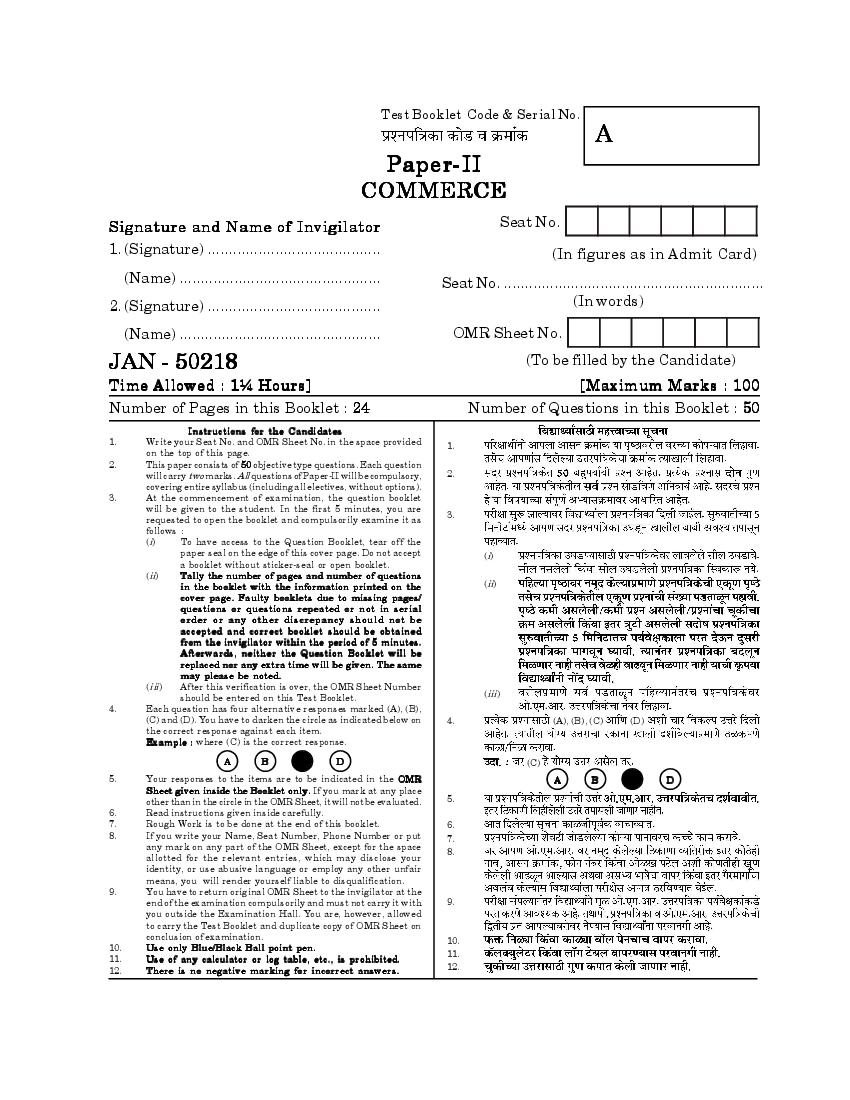
A
Paper-II
COMMERCE
Signature and Name of Invigilator Seat No.
1. (Signature) ......................................... (In figures as in Admit Card)
(Name) ................................................ Seat No. ..............................................................
2. (Signature) ......................................... (In words)
(Name) ................................................ OMR Sheet No.
JAN - 50218 (To be filled by the Candidate)
Time Allowed : 1¼ Hours] [Maximum Marks : 100
Number of Pages in this Booklet : 24 Number of Questions in this Booklet : 50
Instructions for the Candidates
1. Write your Seat No. and OMR Sheet No. in the space provided 1.
on the top of this page.
2. This paper consists of 50 objective type questions. Each question
will carry two marks. All questions of Paper-II will be compulsory, 2.
covering entire syllabus (including all electives, without options).
3. At the commencement of examination, the question booklet
will be given to the student. In the first 5 minutes, you are
3.
requested to open the booklet and compulsorily examine it as
follows :
(i) To have access to the Question Booklet, tear off the
paper seal on the edge of this cover page. Do not accept (i)
a booklet without sticker-seal or open booklet.
(ii) Tally the number of pages and number of questions
in the booklet with the information printed on the (ii)
cover page. Faulty booklets due to missing pages/
questions or questions repeated or not in serial
o rder or any other discre pancy should not be
accepted and correct booklet should be obtained
from the invigilator within the period of 5 minutes.
Afterwards, neither the Question Booklet will be
replaced nor any extra time will be given. The same
may please be noted.
(iii) After this verification is over, the OMR Sheet Number
should be entered on this Test Booklet. (iii)
4. Each question has four alternative responses marked (A), (B),
(C) and (D). You have to darken the circle as indicated below on 4. (A), (B), (C) (D)
the correct response against each item.
Example : where (C) is the correct response.
A B D (C)
5. Your responses to the items are to be indicated in the OMR A B D
Sheet given inside the Booklet only. If you mark at any place
other than in the circle in the OMR Sheet, it will not be evaluated. 5.
6. Read instructions given inside carefully.
7. Rough Work is to be done at the end of this booklet. 6.
8. If you write your Name, Seat Number, Phone Number or put 7.
any mark on any part of the OMR Sheet, except for the space
8.
allotted for the relevant entries, which may disclose your
identity, or use abusive language or employ any other unfair
means, you will render yourself liable to disqualification.
9. You have to return original OMR Sheet to the invigilator at the
end of the examination compulsorily and must not carry it with 9.
you outside the Examination Hall. You are, however, allowed
to carry the Test Booklet and duplicate copy of OMR Sheet on
conclusion of examination. 10.
10. Use only Blue/Black Ball point pen.
11.
11. Use of any calculator or log table, etc., is prohibited.
12. There is no negative marking for incorrect answers. 12.
Page 2
Page 3
Paper II
II
Time Allowed : 75 Minutes] [Maximum Marks : 100
Note : This paper contains Fifty (50) multiple choice questions. Each question
carrying Two (2) marks. Attempt All questions.
(50) (2)
1. Which of the Government’s policy in 1.
respect of public expenditure and
revenue has a significant impact on
business ?
(A) Monetary policy (A)
(B) Fiscal policy (B)
(C) Trade policy (C)
(D) Foreign exchange policy (D)
2. SEZ stands for .................. . 2. SEZ
(A) Special European Zone (A)
(B) Special Export Zone (B)
(C) Special Environmental Zone (C)
(D) Special Economic Zone (D)
3 [P.T.O.
Page 4
level of strategies applicable to
multiunit business ? (A)
(A) Corporate strategy (B)
(B) SBU level strategy
(C) Functional level strategy (C)
(D) Divisional level strategy (D)
4. Which one of the following is not a 4.
powerful environmental force the
business is confronted with ?
(A) Consumer movement
(A)
(B) Environmentalism
(B)
(C) Changing competitive
(C)
environment
(D) Increasing population (D)
5. MSMEs contribute about ................. 5.
of India’s GDP.
(A) 8%
(A) 8%
(B) 19%
(B) 19%
(C) 35% (C) 35%
(D) 40% (D) 40%
4
Page 5
‘contingent liability’ is shown by way
of a footnote below the Balance
Sheet ?
(A)
(A) Convention of conservatism
(B)
(B) Convention of full disclosure
(C)
(C) Convention of materiality
(D)
(D) Convention of consistency
7. A company paid ` 50,000 for a 7. ` 50,000
purchase of copyright for five years.
The process of writing off this
cost over a period of five years is
called ................ .
(A)
(A) Depreciation
(B)
(B) Amortization
(C)
(C) Deferred Revenue Expenditure
(D) Depletion (D)
5 [P.T.O.
Page 6
by ................... .
(A) Current Ratio (A)
(B) Debt/Equity Ratio (B)
(C) Net Profit Ratio (C)
(D) Turnover Ratio (D)
9. Which of the following is not an
9.
assumption of Break-Even
Analysis ?
(A) Total fixed cost does not change
(B) Total variable cost does not (A)
change
(B)
(C) General price level does not
(C)
change
(D) Product mix does not change (D)
6
Page 7
cost of standard hours and standard
cost of actual hours is called
as .................. .
(A)
(A) Labour rate variance
(B)
(B) Labour cost variance
(C)
(C) Labour efficiency variance
(D)
(D) Labour mix variance
11. In normal conditions, the demand 11.
curve for a commodity :
(A) slopes upwards from left to
(A)
right
(B) slopes downwards from left to (B)
right
(C)
(C) is horizontal, parallel to X-axis
(D) is vertical, parallel to Y-axis (D)
7 [P.T.O.
Page 8
more than proportionate to the
change in its price, it is a :
(A) Perfectly inelastic demand (A)
(B) Perfectly elastic demand (B)
(C) Unitary elastic demand (C)
(D) Highly elastic demand (D)
13. Which of the following is not 13.
a feature of monopolistic
competition ?
(A)
(A) Homogenous product
(B)
(B) Large number of sellers
(C) Selling costs (C)
(D) Product differentiation (D)
8
Page 9
production is applicable in :
(A) Long period (A)
(B) Market period (B)
(C) Short period (C)
(D) Very long period (D)
15. With increasing level of output the 15.
Average Variable Cost (AVC) of a (AVC)
firm :
(A)
(A) Initially falls, then continues to
rise
(B)
(B) Remain unchanged
(C)
(C) Goes on continuously falling
(D) Goes on continuously rising (D)
16. Why is random sampling preferred ? 16.
(A) It is easy to draw (A)
(B) The results will be statistically (B)
valid
(C) It is a popular method (C)
(D) It is free from errors (D)
9 [P.T.O.
Page 10
‘absolute measure of dispersion’ ?
(A) Range (A)
(B) Standard deviation (B)
(C) Mean deviation (C)
(D) Coefficient of variation (D)
18. The empirical formula used to know 18.
mode is ................. .
(A) Mean – 2 Median (A) – 2
(B) 2 Mean – 3 Median (B) 2 – 3
(C) 3 Median – 2 Mean (C) 3 – 2
(D) 3 Median + 2 Mean (D) 3 + 2
19. Which of the following is a 19. (Parameter)
parameter ?
(A) Sample mean (A)
(B) Population mean (B)
(C) Size of sample (C)
(D) Size of population (D)
10
Page 11
Event A : Getting head.
A :
Event B : Getting tail.
B :
Which of the following statements
is true ?
(A) The events A and B are
(A) (A) (B)
independent
(B) The events A and B are
mutually exclusive (B) (A) (B)
(C) The events A and B are
independent and mutually
(C) (A) (B)
exclusive
(D) The events A and B are neither
(D) (A) (B)
independent nor mutually
exclusive
21. Tactic is a component of .............. . 21.
(A) Planning
(A)
(B) Organising
(B)
(C) Directing (C)
(D) Co-ordinating (D)
11 [P.T.O.
Page 12
within the scope of ............... .
(A) Directing (A)
(B) Organising (B)
(C) Controlling (C)
(D) Planning (D)
23. Which one of the following is not 23.
Fayol’s principle of management ?
(A) Unity of Command (A)
(B) Unity of Direction (B)
(C) Authority and Responsibility (C)
(D) Management by Exception (D)
24. Find the odd one out : 24.
The components of planning are :
(A) Objective (A)
(B) Procedure (B)
(C) Decentralisation of authority (C)
(D) Budget (D)
12
Page 13
(A) Communication (A)
(B) Direction (B)
(C) Organization (C)
(D) Plan (D)
26. Which of the following statements 26.
is true ?
(A)
(A) Marketing and selling are inter-
changeable terms
(B)
(B) Marketing and selling are not
inter-changeable terms
(C)
(C) Selling is a broader term which
includes marketing
(D) Advertising includes selling and (D)
marketing
13 [P.T.O.
Page 14
that ............... is the key to success.
(A) Offer of better and modified
(A)
products
(B) Fulfilling expectations of
customers (B)
(C) Focussing on drawbacks of
(C)
competing products
(D) Manufacturing products on
(D)
large scale
28. Product Life Cycle (PLC) includes 28.
mainly four stages such as
Introduction, Growth, Maturity
and ................... .
(A)
(A) Prosperity
(B)
(B) Decline
(C) Depression (C)
(D) Inflation (D)
14
Page 15
.................... is the first step.
(A) Information search (A)
(B) Purchase decision (B)
(C) Evaluation of alternatives (C)
(D) Need recognition (D)
30. Relationship marketing refers to 30.
maintaining relations with ..............
to achieve the marketing purpose.
(A) Employees (A)
(B) Dealers (B)
(C) Customers (C)
(D) Suppliers (D)
15 [P.T.O.
Page 16
is ` 2,00,000 and it can generate `2
cash inflow of ` 80,000, ` 60,000,
` 80,000, ` 60,000, ` 1,00,000
` 1,00,000 and ` 40,000 in the year
` 40,000 2013, 2014, 2015
2013, 2014, 2015 and 2016
2016 10%
respectively. Assume 10% rate of
discount. Calculate the net present
1
value of cash inflow. Time value of
money of ` 1 @ 10% discount 10%
factor : DF
Year DF Value
1 .909
1 .909
2 .826
2 .826
3 .751
3 .751
4 .683
4 .683
(A) 1.1240
(A) 1.1240
(B) 1.1235
(B) 1.1235
(C) 1.335 (C) 1.335
(D) 1.634 (D) 1.634
16
Page 17
considered while determining the
working capital ?
(A)
(A) Inventory
(B)
(B) Trade Receivables
(C)
(C) Cash at bank
(D)
(D) Software
33. Which of the following is Dividend 33.
Policy Model ?
(A) Gordon’s model (A)
(B) Schumpeter model (B)
(C) Ricardian model (C)
(D) Miles-Ezzell’s model (D)
34. The concept of cost of capital can also 34.
be explained in terms of ............... .
(A) Direct cost (A)
(B) Fixed cost (B)
(C) Total cost (C)
(D) Opportunity cost (D)
17 [P.T.O.
Page 18
liabilities ?
(A) Advance from customers (A)
(B) Contingent liabilities (B)
(C) Bank overdraft (C)
(D) Provident fund dues (D)
36. Which one of the following is not a 36.
labour legislation ?
(A)
(A) Factories Act
(B)
(B) Competition Act
(C)
(C) Payment of Wages Act
(D)
(D) Industrial Disputes Act
37. Theory ‘Y’ was developed by ............ . 37.
(A) Fiedler (A)
(B) Vroom (B)
(C) McGregor (C)
(D) Herzberg (D)
18
Page 19
Human Resource Management.
(A) Performance Appraisal (A)
(B) Selection (B)
(C) Placement (C)
(D) Recruitment (D)
39. Which of the following does not 39. (wages)
directly affect wage and salary (salary)
structures ?
(A) Ability to pay (A)
(B) Labour supply and demand (B)
(C) Union demands (C)
(D) Regional backwardness (D)
40. Employee welfare does not exactly 40.
depend on :
(A) Conditions of Work
(A)
Environment
(B)
(B) Employees’ Health Services
(C) Employees’ Education (C)
(D) Organisational Culture (D)
19 [P.T.O.
Page 20
banks are usually :
(A) Not affected by Bank rate (A)
(B) Not related to Bank rate (B)
(C) Lower than Bank rate (C)
(D) Higher than Bank rate (D)
42. Banks which operate through single 42.
office and generally confined to
limited area of town or city are
called :
(A)
(A) Central Banks
(B)
(B) Urban Banks
(C)
(C) Unit Banks
(D) Metro Banks (D)
20
Page 21
one day or on overnight basis it is
known as :
(A)
(A) Term Money
(B)
(B) Call Money
(C)
(C) Notice Money
(D)
(D) Near Money
44. Who was the first Indian Governor 44.
of RBI ?
(A) C. D. Deshmukh (A)
(B) Bengal Rama Rau (B)
(C) R. K. Shanmukham Chetty (C)
(D) K. G. Ambegaonkar (D)
45. Along with Central and State 45.
Governments the paid up capital of (RRBs)
RRB is shared by :
(A) RBI (A)
(B) Sponsoring Bank (B)
(C) NABARD (C)
(D) SBI (D)
21 [P.T.O.
Page 22
(WTO)
was :
(A) An organisation
(A)
(B) An agreement
(B)
(C) A policy (C)
(D) A conference (D)
47. Which of the following is not the 47.
item of current account of balance (BOP)
of payment ?
(A) Import of services (A)
(B) Interest payments (B)
(C) Export of goods (C)
(D) External borrowings (D)
48. India’s share in global merchandise 48. 2015
trade in 2015 was :
(A) 2.00% (A) 2.00%
(B) 2.50% (B) 2.50%
(C) 3.00% (C) 3.00%
(D) 1.60% (D) 1.60%
22
Page 23
attempts to promote economic
co-operation and growth of the
(ADB)
countries in :
(A)
(A) Asia and Far East
(B)
(B) South East Asia
(C)
(C) South and West Asia
(D)
(D) South and Central Asia
50.
50. The direction of Indian exports has
shifted in recent period towards :
(A) Asia
(A)
(B) North America
(B)
(C) Europe
(C)
(D) Africa (D)
23 [P.T.O.
Page 24
24
Document Details
| Board / Org | Maharashtra Exams |
| Exam | Maharashtra State Eligibility Test |
| Type | Question Paper |
| Pages | 24 |
| Updated | 30 Apr 2026 |