CBSE Class 12 History Question Paper 2020 Set 61-1-2
Finished viewing? Save it for later —
Download CBSE Class 12 History Question Paper 2020 Set 61-1-2 (PDF · 19 pages)About CBSE Class 12 History Question Paper 2020 Set 61-1-2
CBSE Class 12 History Question Paper 2020 Set 61-1-2 is available here for free download. Published by CBSE for Class 12, this question paper can be viewed online or downloaded as a PDF (19 pages). Candidates preparing for Class 12 can use CBSE Class 12 History Question Paper 2020 Set 61-1-2 to understand the exam pattern, the type of questions asked, and the overall difficulty level.
Frequently Asked Questions
How can I download CBSE Class 12 History Question Paper 2020 Set 61-1-2?
Open this page and click the Download button to save CBSE Class 12 History Question Paper 2020 Set 61-1-2 as a PDF. It is completely free on AglaSem Docs.
Is CBSE Class 12 History Question Paper 2020 Set 61-1-2 free to download?
Yes. CBSE Class 12 History Question Paper 2020 Set 61-1-2 can be viewed online and downloaded as a PDF free of cost on AglaSem Docs.
How many pages does CBSE Class 12 History Question Paper 2020 Set 61-1-2 have?
CBSE Class 12 History Question Paper 2020 Set 61-1-2 contains 19 pages, which you can read online or download together as a single PDF.
Where can I find more Class 12 study material?
You can find more Class 12 question papers, sample papers, syllabus, and answer keys on AglaSem Docs.
CBSE Class 12 History Question Paper 2020 Set 61-1-2 – Text
Read the full text of this question paper below — useful to quickly search, copy and reference the content online without downloading the PDF.
📄 View text version (19 pages)
Page 1
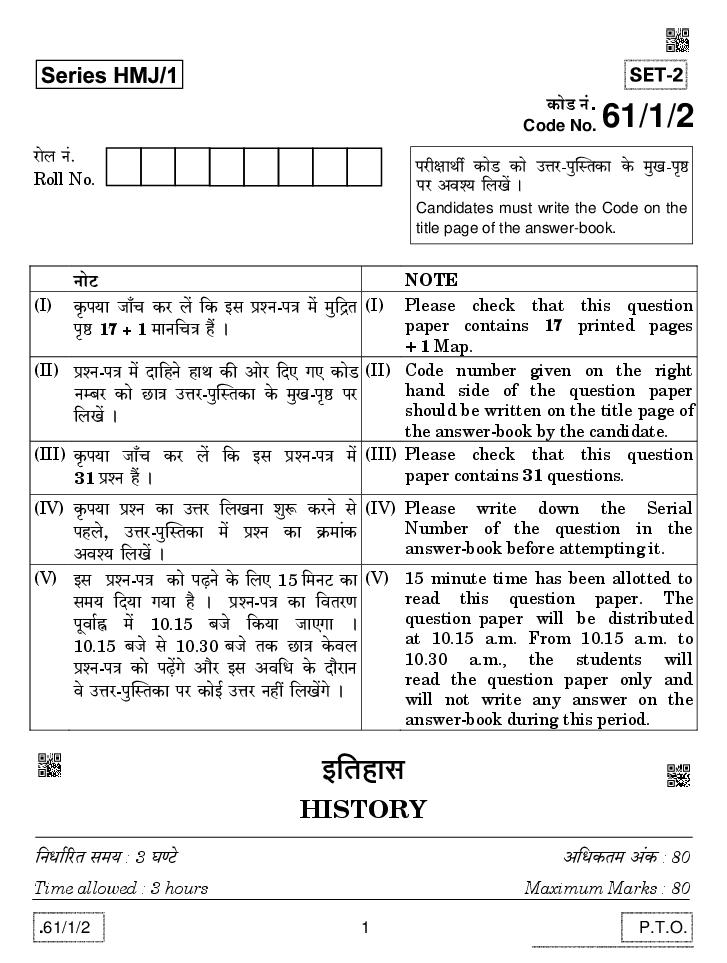
Code No. 61/1/2
amob Z§. narjmWu H$moS >H$mo CÎma-nwpñVH$m Ho$ _wI-n¥ð
Roll No. >na Adí` {bIo§ &
Candidates must write the Code on the
title page of the answer-book.
ZmoQ> NOTE
(I) H¥$n`m Om±M H$a b| {H$ Bg àíZ-nÌ _o§ _w{ÐV (I)Please check that this question
n¥ð> 17 + 1 _mZ{MÌ h¢ & paper contains 17 printed pages
+ 1 Map.
(II) àíZ-nÌ _| Xm{hZo hmW H$s Amoa {XE JE H$moS (II) Code number given on the right
>Zå~a H$mo N>mÌ CÎma-nwpñVH$m Ho$ _wI-n¥ð> na hand side of the question paper
{bI| & should be written on the title page of
the answer-book by the candidate.
(III) H¥$n`m Om±M H$a b| {H$ Bg àíZ-nÌ _| (III) Please check that this question
>31 àíZ h¢ & paper contains 31 questions.
(IV) H¥$n`m àíZ H$m CÎma {bIZm ewê$ H$aZo go (IV) Please write down the Serial
nhbo, CÎma-nwpñVH$m _| àíZ H$m H«$_m§H$ Number of the question in the
Adí` {bI| & answer-book before attempting it.
(V) Bg àíZ-nÌ H$mo n‹T>Zo Ho$ {bE 15 {_ZQ >H$m (V) 15 minute time has been allotted to
g_` {X`m J`m h¡ & àíZ-nÌ H$m {dVaU read this question paper. The
nydm©• _| 10.15 ~Oo {H$`m OmEJm & question paper will be distributed
10.15 ~Oo go 10.30 ~Oo VH$ N>mÌ Ho$db at 10.15 a.m. From 10.15 a.m. to
10.30 a.m., the students will
àíZ-nÌ H$mo n‹T>|Jo Am¡a Bg Ad{Y Ho$ Xm¡amZ read the question paper only and
do CÎma-nwpñVH$m na H$moB© CÎma Zht {bI|Jo & will not write any answer on the
answer-book during this period.
B{Vhmg
HISTORY
{ZYm©[aV g_` : 3 KÊQ>o A{YH$V_ A§H$ : 80
Time allowed : 3 hours Maximum Marks : 80
.61/1/2 1 P.T.O.
Page 2
{ZåZ{b{IV {ZX}em| H$mo ~hþV gmdYmZr go n{‹T>E Am¡a CZH$m nyar Vah go nmbZ H$s{OE :
(i) àíZ-nÌ _| nm±M IÊS> h¢ H$, I, J, K Am¡a L> & g^r àíZ A{Zdm`© h¢ &
(ii) IÊS> H$ àíZ g§»`m 1 go 20 VH$ A{V bKw-CÎmar` àíZ h¢ & àË`oH$ àíZ 1 A§H$ H$m h¡ &
àË`oH$ àíZ H$m CÎma EH$ eãX `m EH$ dmŠ` _| Xr{OE &
(iii) IÊS> I àíZ g§»`m 21 go 24 VH$ bKw-CÎmar` àíZ h¢ & àË`oH$ àíZ 3 A§H$m| H$m h¡ &
àË`oH$ àíZ H$m CÎma A{YH$V_ 100 eãXm| _| Xr{OE &
(iv) IÊS> J àíZ g§»`m 25 go 27 VH$ XrK©-CÎmar` àíZ h¢ & àË`oH$ àíZ 8 A§H$m| H$m h¡ & àË`oH$
àíZ H$m CÎma A{YH$V_ 350 eãXm| _| Xr{OE &
(v) IÊS> K àíZ g§»`m 28 go 30 VH$ òmoV AmYm[aV àíZ h¢ & àË`oH$ àíZ 6 A§H$m| H$m h¡ &
(vi) IÊS> L> àíZ g§»`m 31 _mZ{MÌ àíZ h¡, {Og_| _hÎdnyU© narjU _Xm| H$mo nhMmZZm Am¡a
ñWmZ A§{H$V H$aZm em{_b h¡ & _mZ{MÌ H$mo CÎma-nwpñVH$m Ho$ gmW ZËWr H$s{OE &
(vii) CÎma g§{jßV VWm q~Xþdma hmoZo Mm{hE Am¡a gmW hr Cn`w© º$ eãX gr_m H$m `Wmg§^d nmbZ
H$s{OE &
(viii) H$moB© g_J« {dH$ën Zht h¡ & VWm{n, EH$-EH$ A§H$ Ho$ Xmo àíZm| _|, VrZ-VrZ A§H$m| Ho$ EH$ àíZ
_|, AmR>-AmR> A§H$m| Ho$ VrZ àíZm| _| Am¡a _mZ{MÌ àíZ _| Am§V[aH$ {dH$ën {X`m J`m h¡ & Eogo
àíZm| _| Ho$db EH$ hr {dH$ën H$m CÎma Xr{OE &
(ix) BgHo$ A{V[aº$, Amdí`H$VmZwgma, àË`oH$ IÊS> Am¡a àíZ Ho$ gmW `Wmo{MV {ZX}e {XE JE h¢ &
IÊS> H$ 120=20
1. h‹S>ßnmB© {b{n H$mo ahñ¶‘¶ ³¶m| H$hm J¶m h¡ ?
{ZåZ{b{IV {dH$ënm| ‘| go ghr H$maU H$m M¶Z H$s{OE : 1
(A) ¶h {‘ò H$s {MÌmË‘H$ {b{n go ‘ob ImVr h¡ &
(B) Bg‘| {M•m| H$s g§»¶m H$ht A{YH$ h¡, 600 go 1000 Ho$ ~rM &
(C) ¶h ~mBª go XmBª Amoa {bIr JB© Wr &
(D) BgH$s {bImB© AmO VH$ n‹T>r Zht Om gH$s h¡ &
2. {ZåZ{b{IV {b{n¶m| ‘| go {H$gH$m AW© Ooåg qàgon Ûmam {ZH$mbm J¶m Wm ? 1
(A) ~§Jmbr Am¡a XodZmJar
(B) g§ñH¥$V Am¡a àmH¥$V
(C) ~«m÷r Am¡a IamoîR>r
(D) ¶yZmZr Am¡a BÊS>mo-¶yZmZr
3. ~wÕ H$s Cn‘mVm ‘hmàOmn{V JmoV‘r g§K ‘| AmZo dmbr nhbr _{hbm _________ Wt & 1
AWdm
~wÕ H$m AnZo AZw¶m{``m| Ho$ {bE ApÝV‘ g§Xoe ³¶m Wm ? 1
.61/1/2 2
Page 3
Read the following instructions very carefully and strictly follow them :
(i) This question paper comprises five sections A, B, C, D and E. All questions
are compulsory.
(ii) Section A – Questions number 1 to 20 are very short-answer type questions,
carrying 1 mark each. They are required to be answered in one word or one
sentence each.
(iii) Section B – Questions number 21 to 24 are short-answer type questions,
carrying 3 marks each. Answers to each of them should not exceed 100 words.
(iv) Section C – Questions number 25 to 27 are long-answer type questions,
carrying 8 marks each. Answers to each of them should not exceed 350 words.
(v) Section D – Questions number 28 to 30 are source based questions, carrying
6 marks each.
(vi) Section E – Question number 31 is a map question that includes identification
and location of significant test items. Attach the map with the answer-book.
(vii) Answers should be brief and to the point also the above word limit be adhered
to as far as possible.
(viii) There is no overall choice. However, an internal choice has been provided in
2 questions of one mark, 1 question of three marks, 3 questions of eight marks
and the map question. You have to attempt only one of the choices in such
questions.
(ix) In addition to this, separate instructions are given with each section and
question, wherever necessary.
SECTION A 120=20
1. Why is the Harappan script called enigmatic ?
Choose the correct reason from the following options : 1
(A) It resembles the Hieroglyphic script of Egypt.
(B) It had too many symbols, between 600 and 1000 in number.
(C) It was written from left to right.
(D) Its writing remains undeciphered to date.
2. Which of the following scripts were deciphered by James Prinsep ? 1
(A) Bengali and Devanagari
(B) Sanskrit and Prakrit
(C) Brahmi and Kharosthi
(D) Greek and Indo-Greek
3. The Buddha’s foster mother, Mahapajapati Gotami was the first woman
to be ordained as a _________. 1
OR
What was the last message of the Buddha to his followers ? 1
.61/1/2 3 P.T.O.
Page 4
Amhma g§~§Yr AmXVm| Ho$ {df¶ ‘| OmZH$mar àmßV H$aZo ‘| {ZåZ{b{IV {dÛmZm| H$m H$m¡Z -gm
dJ© g’$b ahm ? 1
(A) nwam-àm{U {dkm{Z¶m|
(B) nwam-‘mZdOm{V {dkm{Z¶m|
(C) ^y-nwamVmpÎdH${dXm|
(D) nwam-dZñn{Vkm|
5. {ZåZ{b{IV ‘| go H$m¡Z-gm {dH$ën gm±Mr Ho$ ñVynm| ‘| ‘[a³V ñWmZ’ H$s ‘y{V© H$m ÚmoVH$ h¡ ? 1
(A) ñVyn H$s gÁOm
(B) ‘mZd H$s àd¥{Îm H$m àVrH$
(C) ~wÕ Ho$ ܶmZ H$s Xem
(D) gm¡^m½¶
6. ~m¡Õ Y‘© Ho$ g§X^© ‘| {ZåZ{b{IV H$WZm| H$m gmdYmZrnyd©H$ Aܶ¶Z H$s{OE :
I. ~wÕ Ho$ OrdZH$mb ‘| Am¡a CZH$s ‘¥Ë¶w Ho$ ~mX ^r ~m¡Õ Y‘© VoµOr go ’¡$bm &
II. ~m¡Õ Y‘© Zo AmMaU Am¡a ‘yë¶m| H$mo A{YH$ ‘hÎd Zht {X¶m &
III. Omo bmoJ g‘H$mbrZ Ym{‘©H$ àWmAm| go Ag§VwîQ> Wo, Eogo ~hþV go bmoJm| go ~m¡Õ Y‘©
Zo AmJ«h {H$¶m &
IV. ~m¡Õ Y‘© Zo OÝ‘ Ho$ AmYma na loîR>Vm H$mo A{YH$ ~b {X¶m &
Cn`w©º$ H$WZm| ‘| go H$m¡Z-go ghr h¢ ? 1
(A) I Am¡a II
(B) II Am¡a IV
(C) I Am¡a III
(D) III Am¡a IV
7. {ZåZ{b{IV à{V_m H$s nhMmZ H$s{OE Am¡a Bgo Cn¶w³V erf©H$ Xr{OE : 1
.61/1/2 4
Page 5
practices of Harappa from the remains of charred grains and seeds found
in the Harappan sites ? 1
(A) Archeo-Zoologists
(B) Archeo-Ethnographists
(C) Geo-Archeologists
(D) Archeo-Botanists
5. Which of the following options indicates the sculpture of ‘Empty Seat’ in
the Sanchi Stupa ? 1
(A) Decoration of Stupa
(B) Symbol of human attribute
(C) Meditation of Buddha
(D) Good fortune
6. Study the following statements regarding Buddhism carefully :
I. Buddhism grew rapidly, both during the lifetime and after the
death of Buddha.
II. Buddhism did not give much importance to conduct and values.
III. Buddhism appealed to many people who were dissatisfied with the
existing religious practices.
IV. Buddhism laid much stress on superiority based on birth.
Which of the above statements are correct ? 1
(A) I and II
(B) II and IV
(C) I and III
(D) III and IV
7. Identify the following image and give it an appropriate title : 1
.61/1/2 5 P.T.O.
Page 6
~wÕ H$s {ejmAm| H$mo H$hm{Z¶m| Ho$ ê$n ‘| ‘w»¶V… {Ì{nQ>H$ Ho$ EH$ J«ÝW _________ ‘| go
nwZ{Z©{‘©V {H$¶m J¶m h¡ & 1
8. ZrMo Xmo H$WZ {XE JE h¢, EH$ H$mo Ñ‹T>H$WZ (A) Ho$ ê$n ‘| OmZm J¶m h¡ Am¡a Xÿgao H$mo
H$maU (R) Ho$ ê$n ‘| OmZm J¶m h¡ &
Ñ‹T>H$WZ (A) : ~{Z©¶a H$m {ZOr ñdm{‘Ëd Ho$ JwUm| ‘| X¥‹T> {dídmg Wm & CgZo XoIm {H$ ‘wµJb
gm‘«mÁ¶ ‘| ^y{‘ na amOH$s` ñdm{‘Ëd amÁ¶ Am¡a CgHo$ {Zdm{g¶m| XmoZm| Ho$
{bE A{hVH$a h¡ &
H$maU (R) : ^yYmaH$ AnZo ~ƒm| H$mo ^y{‘ Zht Xo gH$Vo Wo & Bg{bE do CËnmXZ Ho$ ñVa H$mo
~ZmE aIZo Am¡a Cg‘| ~‹T>moÎmar Ho$ {bE XÿaJm‘r {Zdoe Ho$ à{V CXmgrZ Wo &
Cn`w©º$ Ñ‹T>H$WZ Am¡a H$maU go kmV H$s{OE {H$ {ZåZ{b{IV _| go H$m¡Z-gm {dH$ën ghr h¡ : 1
(A) (A) Am¡a (R) XmoZm| ghr h¢ Am¡a (R), (A) H$m ghr ñnîQ>rH$aU h¡ &
(B) (A) Am¡a (R) XmoZm| ghr h¢, naÝVw (R), (A) H$m ghr ñnîQ>rH$aU Zht h¡ &
(C) (A) Am¡a (R) XmoZm| µJbV h¢ &
(D) (A) Am¡a (R) XmoZm| ghr h¢ &
9. {ZåZ{b{IV emgH$m| ‘| go {H$gHo$ emgZH$mb ‘| µJ¡a-‘wgb‘mZ àOm na O{µO¶m {’$a go bJm
{X¶m J¶m Wm ? 1
(A) AH$~a
(B) Ohm±Jra
(C) emhOhm±
(D) Am¡a§JµOo~
10. ‘wµJb gm‘«mÁ¶ Ho$ g§X^© ‘| {ZåZ{b{IV H$WZm| H$m gmdYmZrnyd©H$ Aܶ¶Z H$s{OE :
I. ‘wµJb gm‘«mÁ¶ ~hþV go {^Þ-{^Þ Z¥OmVr¶ g‘yhm| Am¡a Ym{‘©H$ g‘wXm¶m| H$mo g‘m{hV
{H$E hþE Wm &
II. g^r Y‘m] H$mo A{^ì¶{º$ H$s nyU© ñdV§ÌVm Wr &
III. em§{V Am¡a ñWm{¶Ëd Ho$ òmoV Ho$ ê$n ‘| ~mXemh g^r Y‘m] Am¡a Z¥OmVr¶ g‘yhm| go
D$na hmoVm Wm &
IV. ‘wµJbm| Ho$ AYrZ A{^OmV-dJ© ^r {^Þ Y‘m] Am¡a Z¥OmVr¶ g‘yhm| go g§~§{YV Wm &
Cn`w©º$ ‘| go H$m¡Z-go H$WZ AH$~a H$s gwbh-E-Hw$b Zr{V H$mo Xem©Vo h¢ ? 1
(A) I, III Am¡a IV
(B) II, III Am¡a IV
(C) I, II Am¡a III
(D) I, II Am¡a IV
.61/1/2 6
Page 7
lieu of Q. No. 7 :
Buddha’s teachings have been reconstructed from stories found mainly in
_________, one of the texts of Tipitaka. 1
8. Given below are two statements, one labelled as Assertion (A) and the
other labelled as Reason (R).
Assertion (A) : Bernier was a firm believer in the virtues of private
property. He saw crown ownership of land in the Mughal
empire as being harmful to both State and the people.
Reason (R) : Landlords could not pass on their land to their children,
so they were averse to any long time investment in the
expansion of production.
From the above Assertion and Reason, find out which one of the following
is true : 1
(A) Both (A) and (R) are true and (R) is the correct explanation of (A).
(B) Both (A) and (R) are true, but (R) is not the correct explanation of
(A).
(C) Both (A) and (R) are false.
(D) Both (A) and (R) are true.
9. During the reign of which of the following rulers was Jizya reimposed on
non-Muslim subjects ? 1
(A) Akbar
(B) Jahangir
(C) Shah Jahan
(D) Aurangzeb
10. Study the following statements regarding the Mughal empire carefully :
I. The Mughal empire comprised of many different ethnic groups and
religious communities.
II. All the religions had absolute freedom of expression.
III. The emperor stood above all the religions and ethnic groups for
peace and stability.
IV. The nobility under Mughals also belonged to different religions
and ethnic groups.
Which of the above statements reflects the Sulh-i-kul policy of Akbar ? 1
(A) I, III and IV
(B) II, III and IV
(C) I, II and III
(D) I, II and IV
.61/1/2 7 P.T.O.
Page 8
AWdm
Cg qbJm¶V ^³V H$m Zm‘ {b{IE, {OgZo ~mahdt eVmãXr ‘| H$Zm©Q>H$ ‘| ZE Am§XmobZ H$m
ZoV¥Ëd {H$¶m & 1
12. Cg ~moYdY©H$ ¶m {gI g‘wXm¶ Ho$ Jwé H$s nhMmZ H$s{OE Am¡a CZH$m Zm‘ {b{IE {OZHo$
H$m`m] Am¡a ¶moJXmZm| H$mo ZrMo {X¶m J¶m h¡ : 1
– CÝhm|Zo Imbgm n§W H$s Ztd S>mbr &
– CÝhm|Zo AnZo {gIm| H$mo nm±M {^Þ àVrH$ g‘{n©V {H$E &
– CÝhm|Zo g‘wXm¶ H$mo gm‘m{OH$, Ym{‘©H$ Am¡a g¡Ý¶ ~b Ho$ ê$n ‘| g§J{R>V {H$¶m &
– CÝhm|Zo Zm¡d| Jwé, Jwé VoJ ~hmXþa H$s aMZmAm| H$mo Jwé J«ÝW gm{h~ ‘| g§H${bV
{H$¶m &
13. ~m°Šg _| Xr JB© {ZåZ{b{IV OmZH$mar H$mo gmdYmZrnyd©H$ n{‹T>E :
gJwU ^{³V Ho$ ^³V H$s nhMmZ H$s{OE Am¡a CgH$m Zm‘ {b{IE & 1
• dh ‘madm‹S> Ho$ ‘o‹S>Vm H$s EH$ amOnyV amOHw$_mar Wr &
• CgH$m {ddmh CgH$s BÀN>m Ho$ {déÕ ‘odm‹S> Ho$ {ggmo{X¶m Hw$b ‘| H$a {X¶m J¶m &
• CgZo AnZo n{V H$s Amkm H$s AdhobZm H$aVo hþE nËZr Am¡a ‘m± Ho$ na§namJV
Xm{¶Ëdm| H$mo {Z^mZo go BZH$ma {H$¶m &
• CgZo à^w H¥$îU H$mo AnZm ào‘r ‘mZm &
14. {ZåZ{b{IV ‘| go H$m¡Z-gr BãZ ~VyVm H$s nwñVH$ [ah²bm H$s {deofVm Zht h¡ ? 1
(A) ¶h nwñVH$ µ\$magr ‘| {bIr JB© h¡ &
(B) ¶h ^maVr¶ Cn‘hmÛrn Ho$ gm‘m{OH$ Am¡a gm§ñH¥${VH$ OrdZ Ho$ {df¶ ‘| ~hþV hr
àMwa Am¡a amoMH$ OmZH$m[a¶m± XoVr h¡ &
(C) Bg nwñVH$ ‘| boIH$ H$s ¶mÌm Ho$ AZw^d g‘m{hV h¢ &
(D) ¶h nwñVH$ kmZ H$m EH$ ‘hÎdnyU© òmoV h¡ &
15. A§S>mb, EH$ Abdma ‘{hbm AnZo-Amn H$mo _________ H$s ào`gr g‘PVr Wr & 1
16. amîQ´>r` ^mfm Ho$ g§X^© _| {ZåZ{b{IV ‘Vm| na gmdYmZrnyd©H$ {dMma H$s{OE :
I. ¶h {hÝXþñVmZr hmoZr Mm{hE Omo Z Vmo g§ñH¥$V{ZîR> {hÝXr hmo Am¡a Z µ’$magr{ZîR>
CXÿ©, {H$ÝVw ¶h {hÝXr Am¡a CXÿ© XmoZm| H$m {‘lU hmo &
II. Bg_| Aݶ AbJ ^mfmAm| go eãXm| H$mo em{‘b Zht H$aZm Mm{hE &
III. h‘mar amîQ´>r` ^mfm H$mo EH$ gånÞ Am¡a ge³V CnH$aU Ho$ ê$n ‘| {dH${gV H$aZm
Mm{hE, Omo bmoJm| Ho$ {dMmam| Am¡a ^mdZmAm| H$mo A{^춳V H$aZo ‘| g‘W© hmo &
IV. dh {hÝXþAm| Am¡a ‘wgb‘mZm| H$mo VWm CÎma Am¡a X{jU Ho$ bmoJm| H$mo EH$OwQ> H$a
gH$Vr hmo &
.61/1/2 8
Page 9
OR
Name the Lingayat devotee who led a new movement in Karnataka in
the twelfth century. 1
12. Identify and name the preceptor or Guru of the Sikh community whose
works and contributions are given below : 1
– He laid the foundation of the Khalsa Panth.
– He bestowed the Sikhs with five distinct symbols.
– He consolidated the community as a socio-religious and military
force.
– He compiled the compositions of the ninth guru, Guru Tegh
Bahadur in Guru Granth Sahib.
13. Read the following information given in the box carefully :
Identify and name the devotee of Saguna Bhakti. 1
• She was a Rajput princess from Merta in Marwar.
• She was married against her wishes to a prince of the Sisodia clan
of Mewar.
• She defied her husband and did not submit to the traditional role
of a wife and mother.
• She considered Lord Krishna as her lover.
14. Which of the following is not a characteristic of Ibn Battuta’s book,
Rihla ? 1
(A) This book is written in Persian.
(B) It provides rich and interesting details of the social and cultural
life in the subcontinent.
(C) This book contains the travel experiences of the author.
(D) This book is an important source of knowledge.
15. Andal, a woman Alvar considered herself as the beloved of _________. 1
16. Consider the following ideas regarding the national language carefully :
I. It should be Hindustani which should neither be Sanskritised
Hindi nor Persianised Urdu, but a blend of both Hindi and Urdu.
II. It should not admit words from other different languages.
III. The national language must develop into a rich and powerful
instrument, capable of expressing the thoughts and feelings of the
people.
IV. It could unify Hindus and Muslims and people of the North and
the South.
.61/1/2 9 P.T.O.
Page 10
(A) I, II Am¡a IV
(B) II, III Am¡a IV
(C) I, III Am¡a IV
(D) I, II Am¡a III
17. {ZåZ{b{IV H$WZ H$m gmdYmZrnyd©H$ Aܶ¶Z H$s{OE :
‘‘‘oam ‘mZZm h¡ {H$ n¥WH$ {Zdm©{MH$m Aëng§»¶H$m| Ho$ {bE AmË‘KmVr gm{~V hmoJr Am¡a CÝh|
~hþV ^mar ZwH$gmZ nhþ±MmEJr & AJa CÝh| h‘oem Ho$ {bE AbJ H$a {X¶m J¶m, Vmo do H$^r
^r AnZo H$mo ~hþg§»¶H$m| ‘| ê$nmV§[aV Zht H$a nmE±Jo & {Zamem H$m ^md CÝh| ewê$ go An§J
~Zm XoJm &’’
Cn`w©º$ H$WZ {ZåZ{b{IV ‘| go {H$gH$m h¡ ? 1
(A) S>m°. Aå~oS>H$a
(B) n§. Odmhabmb Zohê$
(C) Jmo{dÝX d„^ n§V
(D) gaXma nQ>ob
18. 1946 ‘| H¡${~ZoQ> {‘eZ ^maV ³¶m| Am¶m ?
{ZåZ{b{IV {dH$ënm| ‘| go Cn¶w³V H$maU H$m M¶Z H$s{OE : 1
(A) {dYm{¶H$m ‘| A§J«oµOm| H$s gh^m{JVm H$mo {dñVma XoZo Ho$ {bE &
(B) {dYm¶r ñVa na {ÛV§Ì àma§^ H$aZo Ho$ {bE &
(C) ñdV§Ì ^maV Ho$ {bE Cn¶w³V amOZr{VH$ ñdê$n gwPmZo Ho$ {bE &
(D) ^maVr¶m| H$mo g§Kr¶ ݶm¶mb¶ àXmZ H$aZo Ho$ {bE &
19. AJñV 1946 ‘| ‘wpñb‘ brJ Ûmam ‘à˶j H$m¶©dmhr {Xdg’ Kmo{fV H$aZo H$m ‘w»¶ H$maU
³¶m Wm ? 1
20. {~«{Q>e emgZ Ho$ {déÕ Jm±YrOr Ûmam ewê$ {H$E JE ‘^maV N>mo‹S>mo Am§XmobZ’ Ho$ VmËH$m{bH$
H$maU H$s nhMmZ H$s{OE & 1
(A) H¡${~ZoQ> {_eZ
(B) {H«$ßg {_eZ
(C) gmB_Z H$_reZ
(D) _mC§Q>~oQ>Z ßbmZ
.61/1/2 10
Page 11
(A) I, II and IV
(B) II, III and IV
(C) I, III and IV
(D) I, II and III
17. Study the following statement carefully :
‘‘I believe separate electrorates will be suicidal to the minorities and will
do them tremendous harm. If they are isolated for ever, they can never
convert themselves into a majority and the feeling of frustration will
cripple them even from the very beginning.’’
Who among the following made the above statement ? 1
(A) Dr. Ambedkar
(B) Pt. Jawaharlal Nehru
(C) Govind Ballabh Pant
(D) Sardar Patel
18. Why did the Cabinet Mission come to India in 1946 ?
Choose the suitable reason from the following options : 1
(A) To expand the participation of Britishers in the legislature.
(B) To introduce dyarchy at the legislative level.
(C) To suggest a suitable political framework for free India.
(D) To provide a federal court to the Indians.
19. What was the main reason for announcing ‘Direct Action Day’ by the
Muslim League in August 1946 ? 1
20. Identify the immediate reason of launching the ‘Quit India Movement’ by
Gandhiji against the British rule. 1
(A) Cabinet Mission
(B) Cripps Mission
(C) Simon Commission
(D) Mountbatten Plan
.61/1/2 11 P.T.O.
Page 12
21. 1857 Ho$ {dÐmoh Ho$ ~mX Cn{Zdoer eham| ‘| bmE JE {H$Ýht VrZ n[adV©Zm| H$s naI
H$s{OE & 3
AWdm
^maVr¶ B{Vhmg Ho$ ‘ܶH$mb Ho$ Xm¡amZ X{jU ^maV Ho$ eham| H$s ‘w»¶ {deofVmAm| H$s
naI H$s{OE & 3
22. ñnîQ> H$s{OE {H$ Ab-{~ê$Zr Zo ¶h H¡$go H$hm {H$ Om{V ì¶dñWm ‘| g{Þ{hV An{dÌVm H$s
AdYmaUm àH¥${V Ho$ {Z¶‘m| Ho$ {déÕ Wr & 3
23. ‘mohZOmoX‹S>mo Ho$ XþJ© ‘| {demb ñZmZmJma H$s A{^ݶmg ¶moOZm H$mo CXmhaUm| g{hV ñnîQ>
H$s{OE & 3
24. dU©Z H$s{OE {H$ Jm±YrOr Zo {H$g àH$ma 1922 VH$ ^maVr¶ amîQ´>dmX H$mo ~Xb {X`m Wm & 3
IÊS> J 83=24
25. 600 B©.ny. go 600 B©gdr Ho$ Xm¡amZ ~«m÷Ur¶ {ZYm©aU Ho$ AZwgma nm[adm[aH$ g§~§Ym| Am¡a
{ddmh Ho$ {Z¶‘m| H$m dU©Z H$s{OE & 8
AWdm
~«m÷Ur¶ {gÕmÝV Ho$ g§X^© _| ~§YwVm Am¡a dU© ì`dñWm Ho$ AmXe© ì¶dgm¶m| H$m dU©Z
H$s{OE & ‘Bg {gÕmÝV H$m gmd©^m¡{‘H$ nmbZ Zht {H$¶m’, ¶h {gÕ H$aZo Ho$ {bE CXmhaU
Xr{OE & 4+4=8
26. ‘hmZd‘r {S>ã~m go Ow‹S>o AZwîR>mZm| H$s ì¶m»¶m H$s{OE Am¡a amOH$s¶ Ho$ÝÐ ‘| pñWV hµOma
am‘ ‘§{Xa Ho$ ‘hÎd H$mo ñnîQ> H$s{OE & 6+2=8
AWdm
{dQ²>R>b ‘§{Xa Am¡a {dénmj ‘§{Xa H$s ñWmn˶H$bm H$s {deofVmAm| H$mo ñnîQ> H$s{OE & 2+6=8
27. AR>mahdt eVmãXr Ho$ A§{V_ XeH$m| ‘| nhm{‹S>¶m| (nhm‹S>r bmoJ) Ho$ OrdZ OrZo Ho$ VarH$m| H$m
‘yë¶m§H$Z H$s{OE & CÝhm|Zo g§Wmbm| Ho$ AmJ‘Z na {H$g àH$ma à{V{H«$¶m 춳V H$s ? 5+3=8
AWdm
CZ n[apñW{V¶m| H$m ‘yë¶m§H$Z H$s{OE {OZHo$ AÝVJ©V CÞrgdt eVmãXr Ho$ Xm¡amZ g§Wmb
amO‘hb nhm{‹S>¶m| Ho$ BX©-{JX© ~go & CÝhm|Zo {~«{Q>e emgZ Ho$ {déÕ {dÐmoh ³¶m| {H$¶m ? 5+3=8
.61/1/2 12
Page 13
21. Examine any three changes brought into the colonial cities after the
Revolt of 1857. 3
OR
Examine the main features of the towns of South India during the
medieval period of Indian history. 3
22. Explain how Al-Biruni stated that the concept of social pollution intrinsic
to the caste system was contrary to the laws of nature. 3
23. Explain with examples the layout design of the Great Bath on the Citadel
in Mohenjodaro. 3
24. Describe how Gandhiji had transformed Indian Nationalism by 1922. 3
SECTION C 83=24
25. Describe the familial ties and rules of marriage as per the Brahmanical
prescription during c. 600 BCE – 600 CE. 8
OR
Describe the Brahmanical theory regarding kinship and the ideal
occupations of the varna order. Give examples to prove that this theory
was not universally followed. 4+4=8
26. Explain the rituals associated with Mahanavami Dibba and explain the
significance of Hazara Rama temple located in the Royal Centre. 6+2=8
OR
Explain the architectural features of Vitthala temple and Virupaksha
temple. 2+6=8
27. Evaluate the way of life of the Paharias (hill folk) during the
late eighteenth century. How did they respond to the coming of the
Santhals ? 5+3=8
OR
Evaluate the circumstances under which the Santhals settled in the
periphery of Rajmahal hills during the nineteenth century. Why did they
revolt against the British rule ? 5+3=8
.61/1/2 13 P.T.O.
Page 14
28. {ZåZ{b{IV òmoV H$m gmdYmZrnyd©H$ Aܶ¶Z H$s{OE Am¡a CgHo$ ZrMo {XE JE àíZm| Ho$
CÎma {b{IE :
AH$~a Ho$ emgZ ‘| ^y{‘ H$m dJuH$aU
AmBZ ‘| dJuH$aU Ho$ ‘mnX§S> H$s {ZåZ{b{IV gyMr Xr JB© h¡ :
AH$~a ~mXemh Zo AnZr Jhar XÿaX{e©Vm Ho$ gmW µO‘rZm| H$m dJuH$aU {H$¶m Am¡a
haoH$ (dJ© H$s µO‘rZ) Ho$ {bE AbJ-AbJ amOñd {ZYm©[aV {H$¶m & nmobO dh
µO‘rZ h¡ {Og‘| EH$ Ho$ ~mX EH$ ha µ\$gb H$s gmbmZm IoVr hmoVr h¡ Am¡a {Ogo H$^r
Imbr Zht N>mo‹S>m OmVm h¡ & nam¡Vr dh µO‘rZ h¡ {Og na Hw$N> {XZm| Ho$ {bE IoVr amoH$
Xr OmVr h¡ Vm{H$ dh AnZr Imo¶r VmH$V dmng nm gHo$ & MMa dh µO‘rZ h¡ Omo
VrZ ¶m Mma dfm] VH$ Imbr ahVr h¡ & ~§Oa dh µO‘rZ h¡ {Og na nm±M ¶m Cggo
µÁ¶mXm dfm] go IoVr Zht H$s JB© hmo & nhbo Xmo àH$ma H$s µO‘rZ H$s VrZ {H$ñ‘| h¢,
AÀN>r, ‘ܶ‘ Am¡a Iam~ & do ha {H$ñ‘ H$s µO‘rZ Ho$ CËnmX H$mo Omo‹S> XoVo h¢, Am¡a
BgH$m Vrgam {hñgm ‘ܶ‘ CËnmX ‘mZm OmVm h¡, {OgH$m EH$-{VhmB© {hñgm emhr
ewëH$ ‘mZm OmVm h¡ &
(28.1) MMa ^y{‘ VrZ go Mma dfm] VH$ Imbr Š`m| N>mo‹S>r OmVr Wr ? 2
(28.2) Bg dJuH$aU Ho$ AmYma H$mo ñnîQ> H$s{OE & 2
(28.3) ³¶m Amn g‘PVo h¢ {H$ `h amOñd H$m ‘yë¶m§H$Z H$aZo H$m ‘µO ~yV AmYma Wm ?
ñnîQ> H$s{OE & 2
29. {ZåZ{b{IV òmoV H$m gmdYmZrnyd©H$ Aܶ¶Z H$s{OE Am¡a CgHo$ ZrMo {XE JE àíZm| Ho$
CÎma {b{IE :
{dÐmohr J«m‘rU
J«m‘rU AdY joÌ go [anmoQ>© ^oOZo dmbo EH$ Aµ’$ga Zo {bIm :
AdY Ho$ bmoJ CÎma go Omo‹S>Zo dmbr g§Mma bmBZ na µOmoa ~Zm aho h¢... & AdY Ho$
bmoJ Jm±d dmbo h¢... & ¶o Jm±d dmbo ¶yamo{n¶m| H$s nH$‹S> go {~bHw$b ~mha h¢ & nb ‘|
{~Ia OmVo h¢, nb ‘| {’$a OwQ> OmVo h¢ & emgH$s¶ A{YH$m[a¶m| H$m H$hZm h¡ {H$ BZ
Jm±d dmbm| H$s g§»¶m ~hþV ~‹S>r h¡ Am¡a CZHo$ nmg ~mH$m¶Xm ~§XÿH|$ h¢ &
(29.1) BZ Jm±d dmbm| go ì¶dhma H$aZo ‘| A§J«oµOm| Ho$ gm_Zo AmZo dmbr g‘ñ¶mAm| H$s naI
H$s{OE & 2
(29.2) A§J«oµOm| Ho$ à{V AdY Ho$ bmoJ {damoYr ³¶m| Wo ? H$maU H$s naI H$s{OE & 2
(29.3) A§J«oµOm| Zo {dÐmo{h¶m| H$m X‘Z {H$g àH$ma {H$¶m ? 2
.61/1/2 14
Page 15
28. Study the following source carefully and answer the questions that
follow :
Classification of lands under Akbar
The following is a listing of criteria of classification excerpted from the
Ain :
The Emperor Akbar in his profound sagacity classified the lands
and fixed a different revenue to be paid by each. Polaj is land
which is annually cultivated for each crop in succession and is
never allowed to lie fallow. Parauti is land left out of cultivation for
a time that it may recover its strength. Chachar is land that has
lain fallow for three or four years. Banjar is land uncultivated for
five years and more. Of the first two kinds of land, there are three
classes, good, middling, and bad. They add together the produce of
each sort, and the third of this represents the medium produce,
one-third part of which is exacted as the Royal dues.
(28.1) Why was Chachar land left uncultivated for some three to four
years ? 2
(28.2) Explain the basis of this classification. 2
(28.3) Do you think it was a sound basis to assess the revenue ? Explain. 2
29. Study the following source carefully and answer the questions that
follow :
Villagers as rebels
An officer reporting from rural Awadh (spelt as Oude in the following
account) noted :
The Oude people are gradually pressing down on the line of
communication from the North ... the Oude people are villagers ...
these villagers are nearly intangible to Europeans melting away
before them and collecting again. The Civil Authorities report these
villagers to amount to a very large number of men, with a number
of guns.
(29.1) Examine the problem faced by the British in dealing with these
villagers. 2
(29.2) Why were people of Oude (Awadh) hostile against the British ?
Examine the reason. 2
(29.3) How did the British suppress the rebels ? 2
.61/1/2 15 P.T.O.
Page 16
CÎma {b{IE :
g‘«mQ> Ho$ A{YH$mar ³¶m-³¶m H$m¶© H$aVo Wo ?
‘oJñWZrµO Ho$ {ddaU H$m EH$ A§e {X¶m J¶m h¡ :
gm‘«mÁ¶ Ho$ ‘hmZ A{YH$m[a¶m| ‘| go Hw$N> Z{X¶m| H$s XoI-aoI Am¡a ^y{‘ ‘mnZ H$m H$m‘
H$aVo h¢ O¡gm {H$ {‘ò ‘| hmoVm Wm & Hw$N> à‘wI Zham| go CnZham| Ho$ {bE N>mo‹S>o OmZo
dmbo nmZr Ho$ ‘wIÛma H$m {ZarjU H$aVo h¢ Vm{H$ ha ñWmZ na nmZr H$s g‘mZ ny{V© hmo
gHo$ & ¶hr A{YH$mar {eH$m[a¶m| H$m g§MmbZ H$aVo h¢ Am¡a {eH$m[a¶m| Ho$ H¥$˶m| Ho$
AmYma na CÝh| BZm‘ ¶m X§S> XoVo h¢ & do H$a dgybr H$aVo h¢ Am¡a ^y{‘ go Ow‹S>o g^r
ì¶dgm¶m| H$m {ZarjU H$aVo h¢ gmW hr bH$‹S>hmam|, ~‹T>B©, bmohmam| Am¡a IZZH$Vm©Am|
H$m ^r {ZarjU H$aVo h¢ &
(30.1) {H$g CÔoí¶ Ho$ {bE g‘«mQ> Ho$ A{YH$m[a¶m| H$s {Z¶w{³V H$s JB© Wr ? 2
(30.2) A{YH$m[a¶m| Ûmam {H$E JE ì¶dgm¶ Ho$ àH$mam| H$mo ñnîQ> H$s{OE & 2
(30.3) H$‘©Mm[a¶m| Ho$ H$m¶m] H$m {ZarjU H$aZo H$s ³¶m Amdí¶H$Vm Wr ? 2
IÊS> L>
(‘mZ{MÌ AmYm[aV àíZ) 16=6
31. (31.1) ^maV Ho$ {XE JE amOZr{VH$ aoIm-‘mZ{MÌ (n¥îR> 19 na) ‘|, {ZåZ{b{IV H$mo
Cn`wº$ {M•m| go A§{H$V H$s{OE Am¡a CZHo$ Zm‘ {b{IE : 13=3
(i) bmoWb – {dH${gV h‹S>ßnmB© nwamñWb
(ii) H$m¡emå~r – ñVå^ A{^boI
AWdm
AOÝVm – ~m¡Õ nwamñWb
(iii) AO_oa AWdm AmJam – ‘wµJbm| Ho$ AYrZ àmÝV
(31.2) ^maV Ho$ Bgr amOZr{VH$ aoIm-_mZ{MÌ na VrZ ñWmZm| H$mo A, B Am¡a C go A§{H$V
{H$¶m J¶m h¡, Omo 1857 Ho$ {dÐmoh go g§~§{YV h¢ & CZH$mo nhMm{ZE Am¡a CZHo$ ghr
Zm‘ CZHo$ {ZH$Q> ItMr JB© aoImAm| na {b{IE & 13=3
ZmoQ> : {ZåZ{b{IV àíZ Ho$db Ñ{îQ>~m{YV narjm{W©¶m| Ho$ {bE à. g§. 31 Ho$ ñWmZ na h¢ :
(31.1) amîQ´>r¶ Am§XmobZ Ho$ {H$Ýht VrZ Ho$ÝÐm| Ho$ Zm‘ {b{IE & 13=3
(31.2) {H$Ýht VrZ ‘hmOZnXm| Ho$ Zm‘ {b{IE & 13=3
AWdm
{H$Ýht VrZ ~m¡Õ nwamñWbm| H$m C„oI H$s{OE & 13=3
.61/1/2 16
Page 17
follow :
What the king’s officials did
Here is an excerpt from the account of Megasthenes :
Of the great officers of state, some ... superintend the rivers,
measure the land, as is done in Egypt, and inspect the sluices by
which water is let out from the main canals into their branches, so
that every one may have an equal supply of it. The same persons
have charge also of the huntsmen, and are entrusted with the
power of rewarding or punishing them according to their deserts.
They collect the taxes, and superintend the occupations connected
with land; as those of the woodcutters, the carpenters, the
blacksmiths, and the miners.
(30.1) For what purpose were the king’s officials appointed ? 2
(30.2) Explain the types of jobs they carried out. 2
(30.3) What was the need to superintend the work of the workmen ? 2
SECTION E
(Map Based Question) 16=6
31. (31.1) On the given political outline map of India (on page 19), locate and
label the following with appropriate symbols : 13=3
(i) Lothal a mature Harappan site
(ii) Kaushambi a pillar inscription
OR
Ajanta a Buddhist site
(iii) Ajmer OR Agra a territory under Mughals
(31.2) On the same outline map of India, three places have been marked
as A, B and C, which are associated with the Revolt of 1857.
Identify them and write their correct names on the lines drawn
near them. 13=3
Note : The following questions are for the Visually Impaired Candidates, only in
lieu of Q. No. 31 :
(31.1) Name any three centres of the national movement. 13=3
(31.2) Name any three Mahajanapadas. 13=3
OR
Mention any three Buddhist sites. 13=3
.61/1/2 17 P.T.O.
Page 18
Page 19
^maV H$m aoIm-_mZ{MÌ (amOZr{VH$)
Outline Map of India (Political)
C
B
A
.61/1/2 19 P.T.O.
Document Details
| Board / Org | CBSE |
| Exam | Class 12 |
| Type | Question Paper |
| Pages | 19 |
| Updated | 22 Jul 2026 |