CBSE Class 12 History Question Paper 2020 Set 61-2-1
Finished viewing? Save it for later —
Download CBSE Class 12 History Question Paper 2020 Set 61-2-1 (PDF · 19 pages)About CBSE Class 12 History Question Paper 2020 Set 61-2-1
CBSE Class 12 History Question Paper 2020 Set 61-2-1 is available here for free download. Published by CBSE for Class 12, this question paper can be viewed online or downloaded as a PDF (19 pages). Candidates preparing for Class 12 can use CBSE Class 12 History Question Paper 2020 Set 61-2-1 to understand the exam pattern, the type of questions asked, and the overall difficulty level.
Frequently Asked Questions
How can I download CBSE Class 12 History Question Paper 2020 Set 61-2-1?
Open this page and click the Download button to save CBSE Class 12 History Question Paper 2020 Set 61-2-1 as a PDF. It is completely free on AglaSem Docs.
Is CBSE Class 12 History Question Paper 2020 Set 61-2-1 free to download?
Yes. CBSE Class 12 History Question Paper 2020 Set 61-2-1 can be viewed online and downloaded as a PDF free of cost on AglaSem Docs.
How many pages does CBSE Class 12 History Question Paper 2020 Set 61-2-1 have?
CBSE Class 12 History Question Paper 2020 Set 61-2-1 contains 19 pages, which you can read online or download together as a single PDF.
Where can I find more Class 12 study material?
You can find more Class 12 question papers, sample papers, syllabus, and answer keys on AglaSem Docs.
CBSE Class 12 History Question Paper 2020 Set 61-2-1 – Text
Read the full text of this question paper below — useful to quickly search, copy and reference the content online without downloading the PDF.
📄 View text version (19 pages)
Page 1
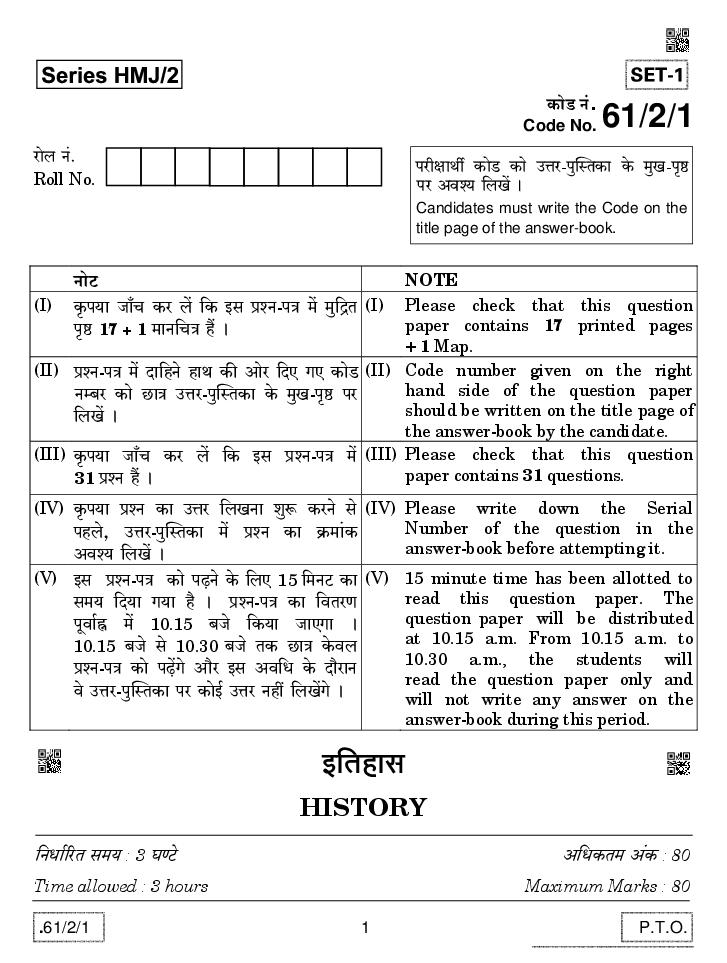
Code No. 61/2/1
amob Z§. narjmWu H$moS >H$mo CÎma-nwpñVH$m Ho$ _wI-n¥ð
Roll No. >na Adí` {bIo§ &
Candidates must write the Code on the
title page of the answer-book.
ZmoQ> NOTE
(I) H¥$n`m Om±M H$a b| {H$ Bg àíZ-nÌ _o§ _w{ÐV (I)Please check that this question
n¥ð> 17 + 1 _mZ{MÌ h¢ & paper contains 17 printed pages
+ 1 Map.
(II) àíZ-nÌ _| Xm{hZo hmW H$s Amoa {XE JE H$moS (II) Code number given on the right
>Zå~a H$mo N>mÌ CÎma-nwpñVH$m Ho$ _wI-n¥ð> na hand side of the question paper
{bI| & should be written on the title page of
the answer-book by the candidate.
(III) H¥$n`m Om±M H$a b| {H$ Bg àíZ-nÌ _| (III) Please check that this question
>31 àíZ h¢ & paper contains 31 questions.
(IV) H¥$n`m àíZ H$m CÎma {bIZm ewê$ H$aZo go (IV) Please write down the Serial
nhbo, CÎma-nwpñVH$m _| àíZ H$m H«$_m§H$ Number of the question in the
Adí` {bI| & answer-book before attempting it.
(V) Bg àíZ-nÌ H$mo n‹T>Zo Ho$ {bE 15 {_ZQ >H$m (V) 15 minute time has been allotted to
g_` {X`m J`m h¡ & àíZ-nÌ H$m {dVaU read this question paper. The
nydm©• _| 10.15 ~Oo {H$`m OmEJm & question paper will be distributed
10.15 ~Oo go 10.30 ~Oo VH$ N>mÌ Ho$db at 10.15 a.m. From 10.15 a.m. to
10.30 a.m., the students will
àíZ-nÌ H$mo n‹T>|Jo Am¡a Bg Ad{Y Ho$ Xm¡amZ read the question paper only and
do CÎma-nwpñVH$m na H$moB© CÎma Zht {bI|Jo & will not write any answer on the
answer-book during this period.
B{Vhmg
HISTORY
{ZYm©[aV g_` : 3 KÊQ>o A{YH$V_ A§H$ : 80
Time allowed : 3 hours Maximum Marks : 80
.61/2/1 1 P.T.O.
Page 2
{ZåZ{b{IV {ZX}em| H$mo ~hþV gmdYmZr go n{‹T>E Am¡a CZH$m nyar Vah go nmbZ H$s{OE :
(i) àíZ-nÌ _| nm±M IÊS> h¢ H$, I, J, K Am¡a L> & g^r àíZ A{Zdm`© h¢ &
(ii) IÊS> H$ àíZ g§»`m 1 go 20 VH$ A{V bKw-CÎmar` àíZ h¢ & àË`oH$ àíZ 1 A§H$ H$m h¡ &
àË`oH$ àíZ H$m CÎma EH$ eãX `m EH$ dmŠ` _| Xr{OE &
(iii) IÊS> I àíZ g§»`m 21 go 24 VH$ bKw-CÎmar` àíZ h¢ & àË`oH$ àíZ 3 A§H$m| H$m h¡ &
àË`oH$ àíZ H$m CÎma A{YH$V_ 100 eãXm| _| Xr{OE &
(iv) IÊS> J àíZ g§»`m 25 go 27 VH$ XrK©-CÎmar` àíZ h¢ & àË`oH$ àíZ 8 A§H$m| H$m h¡ & àË`oH$
àíZ H$m CÎma A{YH$V_ 350 eãXm| _| Xr{OE &
(v) IÊS> K àíZ g§»`m 28 go 30 VH$ òmoV AmYm[aV àíZ h¢ & àË`oH$ àíZ 6 A§H$m| H$m h¡ &
(vi) IÊS> L> àíZ g§»`m 31 _mZ{MÌ àíZ h¡, {Og_| _hÎdnyU© narjU _Xm| H$mo nhMmZZm Am¡a
ñWmZ A§{H$V H$aZm em{_b h¡ & _mZ{MÌ H$mo CÎma-nwpñVH$m Ho$ gmW ZËWr H$s{OE &
(vii) CÎma g§{jßV VWm q~Xþdma hmoZo Mm{hE Am¡a gmW hr Cn`w©º $ eãX gr_m H$m `Wmg§^d nmbZ
H$s{OE &
(viii) H$moB© g_J« {dH$ën Zht h¡ & VWm{n, EH$-EH$ A§H$ Ho$ Xmo àíZm| _|, VrZ-VrZ A§H$m| Ho$ EH$ àíZ
_|, AmR>-AmR> A§H$m| Ho$ VrZ àíZm| _| Am¡a _mZ{MÌ àíZ _| Am§V[aH$ {dH$ën {X`m J`m h¡ & Eogo
àíZm| _| Ho$db EH$ hr {dH$ën H$m CÎma Xr{OE &
(ix) BgHo$ A{V[aº$, Amdí`H$VmZwgma, àË`oH$ IÊS> Am¡a àíZ Ho$ gmW `Wmo{MV {ZX}e {XE JE h¢ &
IÊS> H$ 120=20
1. ’«$m§grgr gm±Mr ñVyn Ho$ nydu VmoaU Ûma H$mo ’«$m§g bo OmZo Ho$ {bE ³¶m| ~hþV CËgwH$ Wo ? 1
AWdm
ñVyn ³¶m| à{V{îR>V Wo ? 1
2. ~mo{YgÎmm H$s g§H$ënZm H$mo n[a^m{fV H$s{OE & 1
3. d¡îUddmX Am¡a e¡ddmX ‘| AÝVa ñnîQ> H$s{OE & 1
4. h‹S>ßnm Ho$ ZJam| H$m g~go AZyR>m nhby Wm __________ H$m {dH$mg & 1
5. {ZåZ{b{IV dJm] ‘| go H$m¡Z-gm EH$ Mma dUm] Ho$ ~«m÷Ur¶ {ZYm©aU ‘| Zht AmVm h¡ ? 1
(A) ~«m÷U
(B) j{̶
(C) {ZfmX
(D) d¡í¶
.61/2/1 2
Page 3
Read the following instructions very carefully and strictly follow them :
(i) This question paper comprises five sections A, B, C, D and E. All questions
are compulsory.
(ii) Section A – Questions number 1 to 20 are very short-answer type questions,
carrying 1 mark each. They are required to be answered in one word or one
sentence each.
(iii) Section B – Questions number 21 to 24 are short-answer type questions,
carrying 3 marks each. Answers to each of them should not exceed 100 words.
(iv) Section C – Questions number 25 to 27 are long-answer type questions,
carrying 8 marks each. Answers to each of them should not exceed 350 words.
(v) Section D – Questions number 28 to 30 are source based questions, carrying
6 marks each.
(vi) Section E – Question number 31 is a map question that includes identification
and location of significant test items. Attach the map with the answer-book.
(vii) Answers should be brief and to the point also the above word limit be adhered
to as far as possible.
(viii) There is no overall choice. However, an internal choice has been provided in
2 questions of one mark, 1 question of three marks, 3 questions of eight marks
and the map question. You have to attempt only one of the choices in such
questions.
(ix) In addition to this, separate instructions are given with each section and
question, wherever necessary.
SECTION A 120=20
1. Why were the French keen to take away the eastern gateway of Sanchi
Stupa to France ? 1
OR
Why were the Stupas venerated ? 1
2. Define the concept of Bodhisatta. 1
3. Differentiate between Vaishnavism and Shaivism. 1
4. The most unique feature of the Harappan cities was the development of
_________. 1
5. Which one of the following categories is not supposed to have belonged to
the Brahmanical prescription of four varnas ? 1
(A) Brahmanas
(B) Kshatriyas
(C) Nishadas
(D) Vaishyas
.61/2/1 3 P.T.O.
Page 4
Aܶ¶Z H$s{OE :
I. nwamVÎd{dX² H$ÀMm ‘mb O¡go – àñVa qnS>, Vm±~m-A¶ñH$, e§I Am{X H$mo ImoOVo h¢ &
II. do ‘¥Xm H$s g§aMZm H$m Aܶ¶Z H$aVo h¢ &
III. do AnyU© dñVwE±, ˶mJ {X¶m J¶m ‘mb Am¡a Hy$‹S>m-H$aH$Q> nmVo h¢ &
IV. CÝhm|Zo ‘¥XmAm| Ho$ amgm¶{ZH$ {díbofU Ho$ à¶mg {H$E &
{eën CËnmXZ Ho$ÝÐm| H$s nhMmZ Ho$ {bE D$na {XE JE H$maUm| ‘| go H$m¡Z-go ghr h¢ ? 1
(A) I Am¡a II
(B) II Am¡a III
(C) I Am¡a III
(D) III Am¡a IV
7. ZrMo Xr JB© ‘y{V© H$mo nhMm{ZE Am¡a CgH$m ghr Zm‘ {b{IE : 1
.61/2/1 4
Page 5
craft production in Harappan culture :
I. Archaeologists look for raw materials such as stone nodules,
copper ore, shells, etc.
II. They study the soil texture.
III. They find unfinished objects, rejects and waste material.
IV. They try to have chemical analysis of the soils.
Which of the above are correct reasons for identifying centres of craft
production ? 1
(A) I and II
(B) II and III
(C) I and III
(D) III and IV
7. Identify the following image and write its appropriate name : 1
.61/2/1 5 P.T.O.
Page 6
~m¡Õ bmoH$ na§nam Ho$ AZwgma ¶h nm¶m OmVm h¡ {H$ {H$gr ñÌr Ûmam Nw>E OmZo go d¥jm| ‘| ’y$b
{Ib CR>Vo Wo Am¡a ’$b AmZo bJVo Wo, {Ogo H$hm OmVm Wm _________ & 1
8. Ab-{~ê$Zr Ûmam ^maV Ho$ Y‘©, Xe©Z, IJmob-{dkmZ VWm µH$mZyZ na {bIr nwñVH$ H$m Zm‘
{b{IE & 1
9. Cg {dXoer ¶mÌr H$m Zm‘ {b{IE, {Ogo ‘whå‘X {~Z VwJbH$ Zo {X„r H$m µH$mOr ¶m
ݶm¶mYre H$B© dfm] Ho$ {bE {Z¶w³V {H$¶m & 1
10. Amn {H$g àH$ma gmoMVo h¢ {H$ ’«$m§ñdm ~{Z©¶a ‘wµJb Xa~ma go ZµOXrH$s go Ow‹S>m ahm ? 1
11. A{^boIr¶ gmú`m| Ho$ AZwgma, {ZåZ{b{IV ‘| go {dO¶ZJa gm‘«mÁ¶ H$s ñWmnZm {H$gZo
H$s Wr ? 1
(A) X³H$Z Ho$ gwbVmZ
(B) C‹S>rgm Ho$ JOnVr emgH$
(C) h[aha Am¡a ~w³H$m
(D) V{‘bZmSw> Ho$ Mmob
12. {ZåZ{b{IV H$WZm| H$mo n{‹T>E :
I. H¥$îUXod am¶ Ho$ emgZ H$s Mm[a{ÌH$ {deofVm {dñVma Am¡a Ñ‹T>rH$aU Wr &
II. CgHo$ gm_«mÁ` ‘| empÝV Am¡a gånÞVm Wr &
III. Hw$N> ^ì¶ ‘§{Xam| H$m {Z‘m©U H$aZo H$m lo¶ Cgo OmVm h¡ &
IV. dh g§J‘ amOd§e go g§~§{YV Wm &
D$na {XE JE H$WZm| ‘| go H$m¡Z-go H¥$îUXod am¶ go g§~§{YV h¢ ? 1
(A) Ho$db I
(B) I, II Am¡a III
(C) II, III Am¡a IV
(D) I, III Am¡a IV
13. {ZåZ{b{IV H$WZm| ‘| go H$m¡Z-gm AH$~a Ho$ g§~§Y ‘| ghr Zht h¡ ? 1
(A) AH$~a eoI _wBZwÔrZ {MíVr H$m ^º$ Wm &
(B) AH$~a Zo AnZo gm‘«mÁ¶ H$m {dñVma {H$`m Am¡a Cgo gwÑ‹T> ~Zm`m &
(C) AnZo Ym{_©H$ kmZ Ho$ {bE CgZo B~mXV ImZm H$m {Z_m©U H$am`m &
(D) H§$Yma H$mo boH$a CgHo$ gµ\$m{dXm| Ho$ gmW gm¡hmX©nyU© g§~§Y Wo &
.61/2/1 6
Page 7
of Q. No. 7 :
According to popular belief in Buddhism, a woman whose touch caused
trees to flower and bear fruit was called _________. 1
8. Name the book written by Al-Biruni on religion, philosophy, astronomy
and laws of India. 1
9. Name the foreign traveller who was appointed as qazi or judge of Delhi
by Muhammad Bin Tughlaq for several years. 1
10. How do you think Francois Bernier was closely associated with the
Mughal Court ? 1
11. According to epigraphic evidence, who among the following founded the
Vijayanagara empire ? 1
(A) Sultans of Deccan
(B) Gajapati rulers of Orissa
(C) Harihara and Bukka
(D) Cholas of Tamil Nadu
12. Read the following statements :
I. Krishnadeva Raya’s rule was characterised by expansion and
consolidation.
II. There was peace and prosperity in his empire.
III. He was credited with building some fine temples.
IV. He belonged to the Sangama dynasty.
Which of the above statements are related to Krishnadeva Raya ? 1
(A) Only I
(B) I, II and III
(C) II, III and IV
(D) I, III and IV
13. Which one of the following statements regarding Akbar is not correct ? 1
(A) Akbar was the devotee of Shaikh Muinuddin Chishti.
(B) Akbar expanded and consolidated his empire.
(C) He constructed Ibadat Khana due to his quest for religious
knowledge.
(D) He had cordial relations with Safavids over Qandahar.
.61/2/1 7 P.T.O.
Page 8
Wm & 1
15. hþ‘m¶y±Zm‘m H$m boIH$ H$m¡Z Wm ? 1
AWdm
~mXemhZm‘m H$m boIH$ H$m¡Z Wm ? 1
16. ghm¶H$ g§{Y Ho$ {ZåZ{b{IV àmdYmZm| ‘| go H$m¡Z-gm EH$ AdY na 1801 ‘| bmJy Zht Wm ? 1
(A) A§J«oµO AnZo gh¶moJr nj H$s AmÝV[aH$ Am¡a ~mhar MwZm¡{V¶m| go ajm Ho$ {bE
CÎmaXmB© hm|Jo &
(B) gh¶moJr nj Ho$ ^yjoÌ ‘| {~«{Q>e g¡{ZH$ Qw>H$‹S>r V¡ZmV ahoJr &
(C) gh¶moJr nj H$mo Cg {~«{Q>e g¡{ZH$ Qw>H$‹S>r Ho$ aIaImd H$s ì¶dñWm H$aZr hmoJr &
(D) A§J«oµOm| H$s AZw‘{V Ho$ {~Zm gh¶moJr nj {H$Ýht Aݶ emgH$m| Ho$ gmW g§{Y H$a
gHo$Jm &
17. A{^H$WZ (A) : H$m±J«og nmQ>u Zo ‘Xmo amîQ´> {gÕmÝV’ H$mo H$^r ñdrH$ma Zht {H$¶m Wm, O~
Cgo AnZr BÀN>m Ho$ {déÕ ~±Q>dmao na ‘§Oyar XoZr n‹S>r &
H$maU (R) : ^maV ~hþV gmao Y‘m] Am¡a ~hþV gmar Om{V¶m| H$m Xoe h¡ Am¡a Cgo Eogo hr
~ZmE aIZm Mm{hE &
Cn¶w©³V A{^H$WZ (A) Am¡a H$maU (R) H$m Aܶ¶Z H$s{OE Am¡a ~VmBE {H$ {ZåZ{b{IV
‘| go H$m¡Z-gm ghr h¡ : 1
(A) (A) ghr h¡, naÝVw (R) ghr Zht h¡ &
(B) (A) ghr Zht h¡, naÝVw (R) ghr h¡ &
(C) (A) Am¡a (R) XmoZm| ghr h¢ Am¡a (R), (A) H$s ghr ì`m»`m h¡ &
(D) (A) Am¡a (R) XmoZm| ghr h¢, naÝVw (R), (A) H$s ghr ì¶m»¶m Zht h¡ &
18. Ym{‘©H$ H$maH$ H$hm± VH$ 1857 Ho$ {dÐmoh Ho$ {bE CÎmaXmB© Wm ? 1
19. {ZåZ{b{IV KQ>ZmAm| na {dMma H$s{OE : 1
I. H¡${~ZQ> {_eZ
II. g§{dYmZ g^m _| àñVm{dV ‘‘CÔoí` àñVmd’’
III. 1935 H$m ^maV gaH$ma H$m A{Y{Z`_
IV. H$bH$Îmm H$s ~~©a qhgm
BZ KQ>ZmAm| H$m ghr H$mbmZwH«$_ h¡ :
(A) I, IV, III, II
(B) III, I, IV, II
(C) I, III, II, IV
(D) II, I, III, IV
20. ‘Jm±Yr-Ba{dZ g‘Pm¡Vo’ Ho$ {H$gr EH$ àmdYmZ H$m C„oI H$s{OE & 1
.61/2/1 8
Page 9
1526. 1
15. Who was the author of Humanyun Nama ? 1
OR
Who was the author of Badshah Nama ? 1
16. Which one of the following provisions of Subsidiary Alliance was not
applicable on Awadh in 1801 ? 1
(A) The British would be responsible for protecting their ally from
internal and external threats.
(B) The British contingent would be stationed in the territory of the
ally.
(C) The ally would provide resources to maintain the British
contingent.
(D) The ally was free to enter into agreements with other rulers
without the permission of the British.
17. Assertion (A) : The Congress Party never accepted the ‘two-nation
theory’ when forced against its will to accept partition.
Reason (R) : India is a land of many religions and races and must
remain so.
Study the above Assertion (A) and Reason (R) and find out which one of
the following is correct : 1
(A) (A) is true, but (R) is not true.
(B) (A) is not true, but (R) is true.
(C) Both (A) and (R) are true and (R) is the correct explanation of (A).
(D) Both (A) and (R) are true, but (R) is not the correct explanation of
(A).
18. How far was the religious factor responsible for the Revolt of 1857 ? 1
19. Consider the following events : 1
I. Cabinet Mission
II. ‘‘Objective Resolution’’ in the Constituent Assembly
III. The Government of India Act, 1935
IV. The Great Calcutta Killing
The correct chronological order of these events is :
(A) I, IV, III, II
(B) III, I, IV, II
(C) I, III, II, IV
(D) II, I, III, IV
20. State any one provision of ‘Gandhi-Irwin Pact’. 1
.61/2/1 9 P.T.O.
Page 10
21. h‹S>ßnmdm{g¶m| Ûmam H¥${f Ho$ {bE à¶w³V qgMmB© Ho$ VarH$m| H$m dU©Z H$s{OE & 3
22. ‘‘_hmZd_r {S>ã~m, {dO`ZJa gm_«mÁ` H$s EH$ {d{eîQ> g§aMZm Wr &’’ H$WZ H$mo ݶm¶g§JV
R>hamBE & 3
23. CZ n[apñW{V¶m| H$m {díbofU H$s{OE, {OZHo$ AÝVJ©V A§J«oµO A{YH$m[a¶m| Zo CÞrgdt eVmãXr
_| g§Wmbm| H$mo amO‘hb H$s nhm{‹S>¶m| H$s n[a{Y ‘| ~gZo Ho$ {bE Am‘§{ÌV {H$¶m Wm & 3
AWdm
AR>mahdt eVmãXr Ho$ A§V Ho$ XeH$m| _| amO‘hb H$s nhm{‹S>¶m| Ho$ nhm‹S>r bmoJm| H$s Am{W©H$
Am¡a gm‘m{OH$ XemAm| H$m {díbofU H$s{OE & 3
24. ‘‘ñdamO Ho$ {bE {hÝXÿ, _wgb_mZ, nmagr Am¡a {gI, g~H$mo EH$OwQ> hmoZm n‹S>oJm &’’ Jm±YrOr
Ho$ Bg H$WZ H$mo Agh`moJ Am§XmobZ Ho$ g§X^© _| ñnîQ> H$s{OE & 3
IÊS> J 83=24
25. ‘hmOZnXm| H$s {deofVmAm| H$mo ñnîQ> H$s{OE Am¡a g~go e{º$embr OZnX Ho$ ê$n _| _JY
H$s ì`m»`m H$s{OE & 4+4=8
AWdm
‘m¡¶© àemgZ H$s ‘w»¶ {deofVmAm| H$mo ñnîQ> H$s{OE Am¡a AemoH$ Ho$ ‘Yå_’ Ho$ {gÕm§Vm| H$s
ì`m»`m H$s{OE & 5+3=8
26. ^maV ‘| ‘wµJbH$mb Ho$ Xm¡amZ O§Jb ‘| ahZo dmbo bmoJm| Ho$ OrdZ H$m dU©Z H$s{OE & 8
AWdm
^maV ‘| ‘wµJbH$mb Ho$ Xm¡amZ H¥${f CËnmXZ go Ow‹S>o {H$gmZm| Am¡a ^y{‘ha g§^«m§Vm| H$s ^y{‘H$m
H$m dU©Z H$s{OE & 8
27. ‘‘A§J«oµOm| Zo ~§Jmb ‘| AnZo emgZ Ho$ ewê$ go hr ZJa {Z¶moOZ H$m¶©^ma AnZo hmWm| ‘| bo
{b¶m Wm &’’ Bg H$WZ H$s naI H$s{OE & 8
AWdm
‘‘A§J«oµOm| Zo ^maV ‘| {hb ñQ>oeZm| (nd©Vr¶ g¡aJmhm|) H$s ñWmnZm H$s &’’ Bg H$WZ H$mo
à‘m{UV H$s{OE & 8
.61/2/1 10
Page 11
21. Describe the methods of irrigation used by Harappans for agriculture. 3
22. ‘‘Mahanavami Dibba was a distinctive structure of the Vijayanagara
Empire.’’ Justify the statement. 3
23. Analyse the circumstances under which the British officials invited
Santhals to settle in the peripheries of Rajmahal hills during the
nineteenth century. 3
OR
Analyse the economic and social conditions of the Paharias (hill folk) of
Rajmahal hills during the late eighteenth century. 3
24. ‘‘For Swaraj, Hindus, Muslims, Parsis and Sikhs will have to unite.’’
Explain this statement of Gandhiji in the context of Non-Cooperation
Movement. 3
SECTION C 83=24
25. Explain the characteristics of Mahajanapadas and explain Magadha as
the most powerful Mahajanapada. 4+4=8
OR
Explain the main features of the Mauryan administration and explain
the principles of Ashoka’s ‘Dhamma’. 5+3=8
26. Describe the lives of forest-dwellers during the Mughal period in India. 8
OR
Describe the role of peasants and landed elites involved in agricultural
production during the Mughal period in India. 8
27. ‘‘The British took upon themselves the task of town planning from the
early years of their rule in Bengal.’’ Examine the statement. 8
OR
‘‘The British commissioned hill stations in India.’’ Substantiate the
statement. 8
.61/2/1 11 P.T.O.
Page 12
28. {ZåZ{b{IV òmoV H$m gmdYmZrnyd©H$ Aܶ¶Z H$s{OE Am¡a CgHo$ ZrMo {XE JE àíZm| Ho$
CÎma {b{IE :
‘‘C{MV’’ gm‘m{OH$ H$V©ì¶
‘hm^maV Ho$ Am{Xnd©Z² go EH$ H$hmZr CÕ¥V h¡ :
EH$ ~ma ~«m÷U ÐmoU Ho$ nmg, Omo Hw$é d§e Ho$ amOHw$‘mam| H$mo YZw{d©Úm H$s {ejm XoVo
Wo, EH$bì¶ Zm‘H$ dZdmgr {ZfmX ({eH$mar g‘wXm¶) Am¶m & ÐmoU Zo Omo Y‘©
g‘PVo Wo, Cgo {eî¶ Ho$ ê$n ‘| ñdrH$ma H$aZo go ‘Zm H$a {X¶m & EH$bì¶ Zo dZ ‘|
bm¡Q> H$a {‘Å>r go ÐmoU H$s à{V‘m ~ZmB© VWm Cgo AnZm Jwé ‘mZ H$a dh ñd¶§ hr Vra
MbmZo H$m Aä¶mg H$aZo bJm & g‘¶ Ho$ gmW dh Vra MbmZo ‘| {gÕhñV hmo J¶m &
EH$ {XZ Hw$é amOHw$‘ma AnZo Hw$Îmo Ho$ gmW O§Jb ‘| {eH$ma H$aVo hþE EH$bì¶ Ho$
g‘rn nhþ±M JE & Hw$Îmm H$mbo ‘¥J H$s M‘‹S>r Ho$ dñÌ ‘| {bnQ>o {ZfmX H$mo XoIH$a
^m¢H$Zo bJm & H«$mo{YV hmoH$a EH$bì¶ Zo EH$ gmW gmV Vra MbmH$a CgH$m ‘w±h ~§X
H$a {X¶m & O~ dh Hw$Îmm bm¡Q>m Vmo nm§S>d Vra§XmµOr H$m ¶h AX²^wV Ñí¶ XoIH$a
AmíM¶©M{H$V hmo JE & CÝhm|Zo EH$bì¶ H$mo Vbmem, CgZo ñd¶§ H$mo ÐmoU H$m {eî¶
~Vm¶m &
ÐmoU Zo AnZo {ච{eî¶ AOw©Z go EH$ ~ma ¶h H$hm Wm {H$ dh CZHo$ g^r {eî¶m| ‘|
A{ÛVr¶ Vra§XmµO ~ZoJm & AOw©Z Zo ÐmoU H$mo CZH$m ¶h àU ¶mX {Xbm¶m & ÐmoU
EH$bì¶ Ho$ nmg JE {OgZo CÝh| AnZm Jwé ‘mZH$a àUm‘ {H$¶m & V~ ÐmoU Zo Jwé
X{jUm Ho$ ê$n ‘| EH$bì¶ go CgHo$ Xm{hZo hmW H$m A±JyR>m ‘m±J {b¶m & EH$bì¶ Zo
µ’$m¡aZ Jwé H$mo AnZm A±JyR>m H$mQ> H$a Xo {X¶m & A~ EH$bì¶ Vra MbmZo ‘| CVZm VoµO
Zht ahm & Bg Vah ÐmoU Zo AOw©Z H$mo {XE dMZ H$mo {Z^m¶m : H$moB© ^r AOw©Z go ~ohVa
YZwYm©ar Zht ahm &
(28.1) ÐmoU Zo EH$bì¶ H$mo AnZm {eî¶ ñdrH$ma H$aZo go ³¶m| ‘Zm H$a {X¶m ? 2
(28.2) EH$bì¶ Zo Vra MbmZo H$s CÎm‘ Hw$ebVm H¡$go àmßV H$s ? 2
(28.3) EH$bì¶ Zo AnZo-Amn H$mo nm§S>dm| Ho$ g‘j ÐmoU H$m {eî¶ hmoZo H$m n[aM` Š`m|
{X¶m ? 2
.61/2/1 12
Page 13
28. Study the following source carefully and answer the questions that
follow :
‘‘Proper’’ social roles
Here is a story from the Adi Parvan of the Mahabharata :
Once Drona, a Brahmana who taught archery to the Kuru princes,
was approached by Ekalavya, a forest-dwelling nishada (a hunting
community). When Drona, who knew the dharma, refused to have
him as his pupil, Ekalavya returned to the forest, prepared an
image of Drona out of clay, and treating it as his teacher, began to
practise on his own. In due course, he acquired great skill in
archery. One day, the Kuru princes went hunting and their dog,
wandering in the woods, came upon Ekalavya. When the dog smelt
the dark nishada wrapped in black deer skin, his body caked with
dirt, it began to bark. Annoyed, Ekalavya shot seven arrows into its
mouth. When the dog returned to the Pandavas, they were amazed
at this superb display of archery. They tracked down Ekalavya, who
introduced himself as a pupil of Drona.
Drona had once told his favourite student Arjuna, that he would be
unrivalled amongst his pupils. Arjuna now reminded Drona about
this. Drona approached Ekalavya, who immediately acknowledged
and honoured him as his teacher. When Drona demanded his right
thumb as his fee, Ekalavya unhesitatingly cut it off and offered it.
But thereafter, when he shot with his remaining fingers, he was no
longer as fast as he had been before. Thus, Drona kept his word : no
one was better than Arjuna.
(28.1) Why did Drona refuse to accept Ekalavya as his pupil ? 2
(28.2) How did Ekalavya acquire the supreme skill of archery ? 2
(28.3) Why did Ekalavya introduce himself to the Pandavas as a pupil of
Drona ? 2
.61/2/1 13 P.T.O.
Page 14
CÎma {b{IE :
‘wµJb ehµOmXr Ohm±Amam H$s VrW©¶mÌm 1643
{ZåZ{b{IV JÚm§e Ohm±Amam Ûmam a{MV eoI ‘wBZwÔrZ {MíVr H$s OrdZr ‘w{Zg-Ab-AImh
(¶mZr AmË‘m H$m {dídñV) go {b¶m J¶m h¡ :
AëbmhVmbm H$s Vmarµ’$ Ho$ ~mX... ¶h ’$H$sam Ohm±Amam... amOYmZr AmJam go AnZo
{nVm (~mXemh emhOhm±) Ho$ g§J nmH$ Am¡a ~oOmo‹S> AO‘oa Ho$ {bE {ZH$br... ‘¢ Bg
~mV Ho$ {bE dm¶XmnañV Wr {H$ ha amoµO Am¡a ha ‘wH$m‘ na ‘¢ Xmo ~ma H$s Ap™V¶mar
Z‘mµO AXm H$ê±$Jr... ~hþV {XZ... ‘¢ amV H$mo ~mK Ho$ M‘‹S>o na Zht gmoB© Am¡a AnZo
n¡a ‘wH$Ôg XaJmh H$s Va’$ Zht ’¡$bmE, Z hr _¢Zo AnZr nrR> CZH$s Va’$ H$s & ‘¢
no‹S> Ho$ ZrMo {XZ JwµOmaVr Wr &
dradma H$mo a‘µOmZ Ho$ ‘wH$Ôg ‘hrZo Ho$ Mm¡Wo amoµO ‘wPo {MamJ Am¡a BVa ‘| Sy> ~o XaJmh
H$s {µO¶maV H$s Iwer hm{gb hþB©... My±{H$ {XZ H$s amoeZr H$s EH$ N>‹S>r ~mH$s Wr ‘¢
XaJmh Ho$ ^rVa JB© Am¡a AnZo OX© Mohao H$mo CgH$s Mm¡IQ> H$s Yyb go aJ‹S>m & XadmµOo
go ‘wH$Ôg XaJmh VH$ ‘¢ Z§Jo nm±d dhm± H$s µO‘rZ H$mo My‘Vr hþB© JB© & Jwå~X Ho $ ^rVa
amoeZr go ^ar XaJmh ‘| ‘¢Zo ‘µOma Ho$ Mmam| Amoa gmV ’o$ao {bE & Am{˜a ‘| AnZo hmWm|
go ‘wH$Ôg XaJmh na ‘¢Zo g~go CåXm BVa {N>‹S>H$m & My±{H$ Jwbm~r XþnÅ>m Omo ‘oao {ga na
Wm, ‘¢ CVma MwH$s Wr Bg{bE Cgo ‘¢Zo ‘wH$Ôg ‘µOma Ho$ D$na aIm &...
(29.1) Ohm±Amam Zo eoI Ho$ à{V AnZm {dídmg Am¡a ^{³V H$mo {H$g àH$ma Xem©¶m ? 2
(29.2) CgZo XaJmh H$mo EH$ {d{eîQ> VrW© Am¡a lÕm H$m ñWb ³¶m| _mZm ? 2
(29.3) CgZo {H$g àH$ma XaJmh na AnZm gå‘mZ àH$Q> {H$¶m ? 2
30. {ZåZ{b{IV òmoV H$m gmdYmZrnyd©H$ Aܶ¶Z H$s{OE Am¡a CgHo$ ZrMo {XE JE àíZm| Ho$
CÎma {b{IE :
‘‘EH$ Jmobr ^r Zht Mbm¶r J¶r’’
‘yZ Zo Omo {bIm :
24 K§Q>o go ^r µÁ¶mXm dµŠV VH$ X§JmB© ^r‹S> H$mo Bg {demb ì¶mdgm{¶H$ eha ‘|
~oamoH$-Q>moH$ V~mhr ’¡$bmZo Xr JB© & ~ohVarZ ~mµOmam| H$mo ObmH$a amI H$a {X¶m J¶m
O~{H$ CnÐd ’¡$bmZo dmbm| Ho$ D$na EH$ Jmobr ^r Zht MbmB© J¶r & ...{µObm
‘{OñQ´>oQ> Zo AnZo ({demb nw{bg) ~b H$mo eha ‘| ‘mM© H$m AmXoe {X¶m Am¡a CgH$m
H$moB© gmW©H$ BñVo‘mb {H$E {~Zm dmng ~wbm {b¶m... &
(30.1) àemg{ZH$ ì¶dñWm Ho$ g‘mßV hmo OmZo Ho$ H$maUm| H$s naI H$s{OE & 2
(30.2) hmbV H$mo {Z¶§{ÌV H$aZo Ho$ {bE A§J«oµO A{YH$mar H$moB© H$X‘ ³¶m| Zht CR>m gHo$ ? 2
(30.3) ³¶m Amn ¶h gmoMVo h¢ {H$ {µObm ‘{OñQ´>oQ> H$s ^y{‘H$m ݶm¶g§JV Wr ? 2
.61/2/1 14
Page 15
The pilgrimage of the Mughal princess Jahanara, 1643
The following is an excerpt from Jahanara’s biography of Shaikh
Muinuddin Chishti, titled Munis al-Arwah (The Confidant of Spirits) :
After praising the one God ... this lowly faqira (humble soul)
Jahanara ... went from the capital Agra in the company of my
great father (Emperor Shah Jahan) towards the pure region of
incomparable Ajmer ... I was committed to this idea, that everyday
in every station I would perform two cycles of optional prayer ... .
For several days ... I did not sleep on a leopard skin at night, I did
not extend my feet in the direction of the blessed sanctuary of the
revered saving master, and I did not turn my back towards him. I
passed the days beneath the trees.
On Thursday, the fourth of the blessed month of Ramzan, I
attained the happiness of pilgrimage to the illuminated and the
perfumed tomb ... . With an hour of daylight remaining, I went to
the holy sanctuary and rubbed my pale face with the dust of that
threshold. From the doorway to the blessed tomb I went barefoot,
kissing the ground. Having entered the dome, I went around the
light-filled tomb of my master seven times ... Finally, with my own
hand I put the finest quality of itar on the perfumed tomb of the
revered one, and having taken off the rose scarf that I had on my
head, I placed it on the top of the blessed tomb ...
(29.1) How did Jahanara exhibit her faith and devotion to the Shaikh ? 2
(29.2) Why did she consider Dargah as a special place of pilgrimage and
reverence ? 2
(29.3) How did she pay her obeisance at the Dargah ? 2
30. Study the following source carefully and answer the questions that follow :
‘‘Without a shot being fired’’
This is what Moon wrote :
For over twenty-four hours riotous mobs were allowed to rage
through this great commercial city unchallenged and
unchecked. The finest bazaars were burnt to the ground
without a shot being fired to disperse the incendiaries (i.e. those
who stirred up conflict). The ... District Magistrate marched his
(large police) force into the city and marched it out again
without making any effective use of it at all ...
(30.1) Examine the causes for the collapse of the administrative system. 2
(30.2) Why could the British officials not take any action to control the
situation ? 2
(30.3) Do you think the role of the District Magistrate was justified ? 2
.61/2/1 15 P.T.O.
Page 16
(_mZ{MÌ AmYm[aV àíZ) 16=6
31. (31.1) ^maV Ho$ {XE JE amOZr{VH$ aoIm-‘mZ{MÌ (n¥îR> 19 na) ‘|, {ZåZ{b{IV H$mo
Cn¶w³V {M•m| go A§{H$V H$s{OE Am¡a CZHo$ Zm‘ {b{IE : 1+1+1=3
(i) ZmJoída – EH$ {dH${gV h‹S>ßnmB© nwamñWb
AWdm
A‘amdVr – EH$ ~m¡Õ ñWb
(ii) nmZrnV – ‘wµJbm| Ho$ AYrZ àmÝV
(iii) A_¥Vga AWdm MånmaZ – amîQ´>r¶ Am§XmobZ H$m Ho$ÝÐ
(31.2) ^maV Ho$ Bgr amOZr{VH$ aoIm-_mZ{MÌ _|, VrZ ñWmZm| H$mo A, B Am¡a C go Xem©¶m
J¶m h¡ Omo 1857 Ho$ Xm¡amZ A§J«oµOm| Ho$ {Z¶§ÌU ‘| Wo & CÝh| nhMm{ZE Am¡a CZHo$ ghr
Zm_ CZHo$ {ZH$Q> ItMr JB© aoImAm| na {b{IE & 13=3
ZmoQ> : {ZåZ{b{IV àíZ Ho$db Ñ{îQ>~m{YV narjm{W©¶m| Ho$ {bE à. g§. 31 Ho$ ñWmZ na h¢ :
(31.1) {H$Ýht VrZ {dH${gV h‹S>ßnmB© nwamñWbm| H$m C„oI H$s{OE & 13=3
AWdm
1857 Ho$ {dÐmoh Ho$ {H$Ýht VrZ Ho$ÝÐm| H$m C„oI H$s{OE & 13=3
(31.2) amîQ´>r¶ Am§XmobZ Ho$ {H$Ýht VrZ Ho$ÝÐm| Ho$ Zm‘ {b{IE & 13=3
.61/2/1 16
Page 17
(Map Based Question) 16=6
31. (31.1) On the given political outline map of India (on page 19), locate and
label the following with appropriate symbols : 1+1+1=3
(i) Nageshwar – A mature Harappan site
OR
Amaravati – A Buddhist site
(ii) Panipat – A territory under the Mughals
(iii) Amritsar OR Champaran – A centre of national movement
(31.2) On the same political outline map of India, three places have been
marked as A, B and C, which were under the British control
during 1857. Identify them and write their correct names on the
lines drawn near them. 13=3
Note : The following questions are for the Visually Impaired Candidates only in
lieu of Q. No. 31 :
(31.1) Mention any three mature Harappan sites. 13=3
OR
Mention any three centres of Revolt of 1857. 13=3
(31.2) Name any three centres of National Movement. 13=3
.61/2/1 17 P.T.O.
Page 18
Page 19
^maV H$m aoIm-_mZ{MÌ amOZr{VH$)
Outline Map of India (Political)
C
A
B
.61/2/1 19 P.T.O.
Document Details
| Board / Org | CBSE |
| Exam | Class 12 |
| Type | Question Paper |
| Pages | 19 |
| Updated | 22 Jul 2026 |