NCERT Solutions Class 4 The World Around Us Chapter 6 Happy and Healthy Living
Finished viewing? Save it for later —
Download NCERT Solutions Class 4 The World Around Us Chapter 6 Happy and Healthy Living (PDF · 40 pages)About NCERT Solutions Class 4 The World Around Us Chapter 6 Happy and Healthy Living
NCERT Solutions Class 4 The World Around Us Chapter 6 Happy and Healthy Living is available here for free download. Published by NCERT for Class 4, this solution can be viewed online or downloaded as a PDF (40 pages). Candidates preparing for Class 4 can use NCERT Solutions Class 4 The World Around Us Chapter 6 Happy and Healthy Living to understand the exam pattern, the type of questions asked, and the overall difficulty level.
Frequently Asked Questions
How can I download NCERT Solutions Class 4 The World Around Us Chapter 6 Happy and Healthy Living?
Open this page and click the Download button to save NCERT Solutions Class 4 The World Around Us Chapter 6 Happy and Healthy Living as a PDF. It is completely free on AglaSem Docs.
Is NCERT Solutions Class 4 The World Around Us Chapter 6 Happy and Healthy Living free to download?
Yes. NCERT Solutions Class 4 The World Around Us Chapter 6 Happy and Healthy Living can be viewed online and downloaded as a PDF free of cost on AglaSem Docs.
How many pages does NCERT Solutions Class 4 The World Around Us Chapter 6 Happy and Healthy Living have?
NCERT Solutions Class 4 The World Around Us Chapter 6 Happy and Healthy Living contains 40 pages, which you can read online or download together as a single PDF.
Where can I find more Class 4 study material?
You can find more Class 4 question papers, sample papers, syllabus, and answer keys on AglaSem Docs.
NCERT Solutions Class 4 The World Around Us Chapter 6 Happy and Healthy Living – Text
Read the full text of this solution below — useful to quickly search, copy and reference the content online without downloading the PDF.
📄 View text version (35 pages)
Page 1
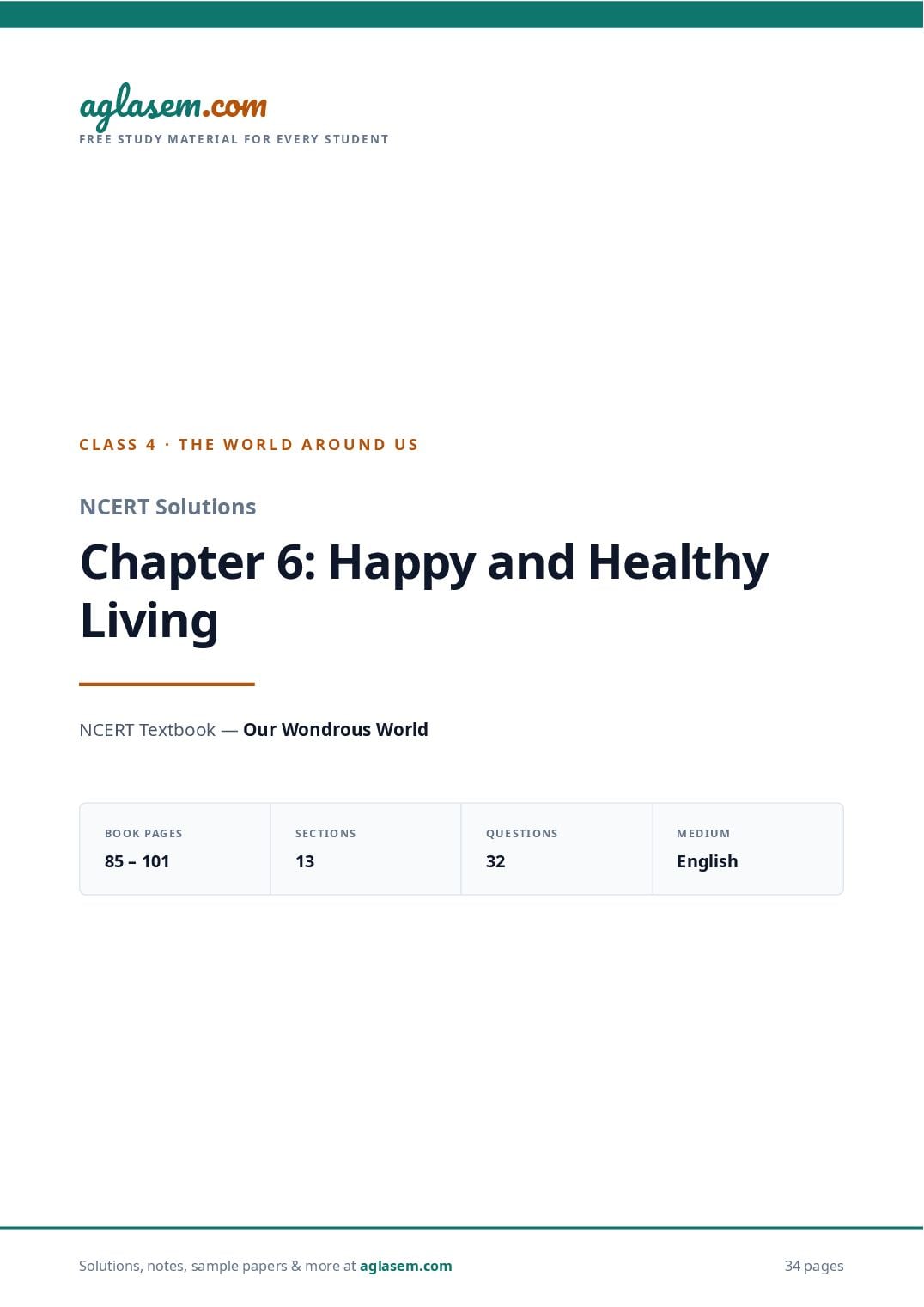
CLASS 4 · THE WORLD AROUND US
NCERT Solutions
Chapter 6: Happy and Healthy
Living
NCERT Textbook — Our Wondrous World
BOOK PAGES SECTIONS QUESTIONS MEDIUM
85 – 101 13 32 English
Solutions, notes, sample papers & more at 34 pages
Page 2
CLASS 4 · THE WORLD AROUND US · OUR WONDROUS WORLD
NCERT Solutions — Chapter 6: Happy and Healthy
Living
Chapter 6 first follows a grain of rice or wheat all the way from the farm to our plate, and counts everyone
who helps it on the way. It then teaches four habits of happy and healthy living — eating mindfully without
wasting food, playing and doing yoga, sleeping enough, and knowing a safe touch from an unsafe
touch.
TEXTBOOK BOOK PAGES
Our Wondrous World (Class 4) 85 – 101
SECTIONS QUESTIONS
13 32
MEDIUM
English
In-text Questions — Page 85
When do I feel happy?
Q1 All of us feel happy at different times and for different reasons. When do you feel
happy? Write your answers in the bubbles given below.
When do I feel happy?
When I play When I eat my
games. favourite food.
The four bubbles printed on page 85. Two of them are already filled in the book.
This is your own answer, so no two children will write the same thing. The book has already filled
two of the four bubbles.
When I play games.
When I eat my favourite food.
Page 1 of 34
Page 3
Fill the two empty bubbles like this:
1. Think of a day when you felt very happy.
2. Ask yourself what you were doing at that moment.
3. Write it in a few words, beginning with ‘When…’.
Sample answer: When my friends come to my house. · When my teacher praises
my work.
Why: All of us feel happy at different times and for different reasons. When we know
what makes us happy, we can do more of it.
Activity 1 — Page 85
Page 2 of 34
Page 4
Food items and ingredients
ACTIVITY
Q1 Connect the food items shown below with the ingredients used to make them.
FOOD ITEMS INGREDIENTS FOOD ITEMS
A blue bowl full of a yellow A heap of peanuts A black pot of a yellow
flattened-rice dish with A brown root cut open, curry with a red chilli
green bits in it white inside (tapioca) floating in it
A plate of small golden A heap of chana (gram) A blue bowl heaped with
fried pieces A heap of thin white round brown laddoos
rice flakes
A plate with two soft white A heap of green peas A plate with a pale mound
steamed cakes A knobby brown root of cooked food with red
(ginger) and green bits on it
A plate with three A heap of golden wheat A plate with two puffed
triangular fried samosas grains round breads
Two green pea pods,
one of them open
The pictures of Activity 1 on page 85. The book prints no names beside them.
Look at each dish and ask one question: which grain, pulse or root is this made from? Then draw
a line from that dish to the ingredient.
These pairs are easy to see:
The bowl of the yellow flattened-rice dish → the white rice flakes (poha).
The plate with two puffed round breads → the wheat grains.
The plate with the pale mound → the brown root cut open. Sabudana is made from this
root.
The plate of small golden fried pieces → the peanuts.
The bowl of round brown laddoos → the chana, because laddoos are made from gram flour.
The plate of samosas → the green peas, which are filled inside them.
Page 3 of 34
Page 5
a g
Class 4 The World Around Us Chapter 6 Happy and Healthy Livingl AglaSem · NCERT Solutions
co m
m.
Note: The book prints no names beside these pictures. So for the last two or three
m l a se
— the two white steamed cakes, the yellow curry in the black pot, the ginger root
o g the name of
.c pods — your teacher may accept another matching.aWrite
m
and the pea
se as your family calls it.
theadish
l
ag
o m
c ag
Why: Every cooked dish begins as a grain, a pulse, a vegetable or a root grown on a
farm. Cooking only changes its shape m .
a s e and its taste.
agl
co m
m.
Activity 2 and Write — Pages 88–89
m as e
.co l
Journey of the Grains
a g
se m
a
ACTIVITY
a g l
✓
s
Observe the pictures and answer the following questions. Put a tick ( ) on the
a
Q1
m
.co agl
elements that assist a grain in its journey.
se m
g l a
a
SOIL STONE AIR WOOD WATER TIGER
co m
✓
m .
m l a se
.co FARMER ag INSECT
sem
EARTHWORM HILLS FIRE BAT
a
agl
se m
com
The table printed on page 88. Soil is already ticked in the book.
g l a
m . a
ase
agl
co m
.
Tick these six: Soil, Air, Water, Farmer, Earthworm and Insect. Soil is already ticked in the
e m
as
book.
m l
m .co a g
l a se
ag
.c
SOIL STONE AIR WOOD WATER TIGER
s e m
m a
agl
✓ ✓ ✓
m .co
FARMER EARTHWORM
l a se HILLS FIRE INSECT BAT
a g
✓ ✓ ✓
co m
m .
m as e
.co
a g l Page 4 of 34
Page 6
The same table with all the helpers ticked.
Here is what each one does for the grain:
Soil — holds the seed and gives the plant its food.
Air — every plant needs air to live and grow.
Water — makes the seed sprout, and the plant drinks it every day.
Farmer — sows, waters, weeds, guards and harvests the crop.
Earthworm — moves inside the soil and makes it soft and loose.
Insect — carries pollen from one flower to another.
Do not tick Stone, Wood, Tiger, Hills, Fire and Bat. None of them helps a grain grow in a field.
Why: A helper is anything without which the grain could not reach our plate. Take
away the soil or the water, and there is no crop at all.
Page 5 of 34
Page 7
Q2 What is the role of farmers in this process?
PICTURE WHAT IT SHOWS
1 A farmer walking over the ploughed field and sowing seeds by hand.
2 The sun shining over the young crop, and water flowing into the field
from a pump.
3 Rain falling from dark clouds on the field and on the stream beside it.
4 A cow standing beside the growing crop, next to two sacks marked
MANURE.
5 Earthworms moving about inside the brown soil, under the crop.
6 The farmer standing in the tall green crop, beside a scarecrow.
7 The farmer sitting in the field and pulling out the weeds.
8 The farmer cutting the ripe golden crop with a sickle.
9 The farmer filling grain into a sack from a big heap.
10 A shopkeeper at his shop filling grain for a customer, with open sacks
marked WHEAT and RICE.
11 A woman cleaning grain on a tray at home, and a man cooking in a pan
on the stove.
12 A girl at the table eating rotis, with a bowl of curry and a glass of water.
The twelve pictures of ‘Journey of the Grains’ on pages 86 and 87.
The farmer does most of the work in this journey. The pictures show him at six different jobs.
1. He sows the seeds in the ploughed field (picture 1).
2. He brings water to the field (picture 2).
3. He puts manure in the field to make the soil rich (picture 4).
4. He guards the crop, and puts up a scarecrow (picture 6).
5. He pulls out the weeds growing among the plants (picture 7).
6. He cuts the ripe crop with a sickle and fills the grain into sacks (pictures 8 and 9).
Page 6 of 34
Page 8
Why: Soil, water and sunlight are already there in the field. But someone must sow
the seed, care for the crop and harvest it. That someone is the farmer, so without
him the seed would never become grain in a sack.
Tip: The farmer waits many months between picture 1 and picture 8. That is why the
book calls this a remarkable journey.
Q3 List out the missing elements in the table above.
SOIL STONE AIR WOOD WATER TIGER
✓
FARMER EARTHWORM HILLS FIRE INSECT BAT
The table printed on page 88. Soil is already ticked in the book.
The table on page 88 leaves out many helpers. The pictures on pages 86 and 87 show them.
Sunlight — the plant makes its own food in the sunlight.
Rain and clouds — they fill the field with water.
Seed — the whole journey starts with it.
Manure — it makes the soil rich.
Cattle — they give manure, and pull the plough and the cart.
Shopkeeper — he keeps the grain in his shop and sells it to us.
Cook and family members — they clean the grain, cook it and serve it.
Tractor and farm tools — they plough the field and cut the crop.
Tip: The Hindi edition asks this more clearly — list the helping things that are not in
the table. So do not write stone, wood, tiger, hills, fire or bat here. They are in the
table, but they are not helpers.
Page 7 of 34
Page 9
Why: No single helper is enough by itself. The grain reaches our plate only when all
of them work together.
Q4 From the time a seed is sown, to the point when food reaches our plate, it is a
remarkable journey. Can you list the roles of the different elements involved in this
journey? (a) Soil: (b) Water: (c) Farmer: (d) Cattle: (e) Shopkeeper: (f) Family
members: (g) Any other:
PICTURE WHAT IT SHOWS
1 A farmer walking over the ploughed field and sowing seeds by hand.
2 The sun shining over the young crop, and water flowing into the field
from a pump.
3 Rain falling from dark clouds on the field and on the stream beside it.
4 A cow standing beside the growing crop, next to two sacks marked
MANURE.
5 Earthworms moving about inside the brown soil, under the crop.
6 The farmer standing in the tall green crop, beside a scarecrow.
7 The farmer sitting in the field and pulling out the weeds.
8 The farmer cutting the ripe golden crop with a sickle.
9 The farmer filling grain into a sack from a big heap.
10 A shopkeeper at his shop filling grain for a customer, with open sacks
marked WHEAT and RICE.
11 A woman cleaning grain on a tray at home, and a man cooking in a pan
on the stove.
12 A girl at the table eating rotis, with a bowl of curry and a glass of water.
The twelve pictures of ‘Journey of the Grains’ on pages 86 and 87.
Write one line against each name. Here is what each of them does.
Page 8 of 34
Page 10
a g
Class 4 The World Around Us Chapter 6 Happy and Healthy Livingl AglaSem · NCERT Solutions
co m
m.
ITS ROLE IN THE JOURNEY
m as e
(a) Soil
.co
Holds the seed, and gives the plant food and a place to stand.
a g l
se m
g l a
(b) Water
a
Makes the seed sprout, and the plant drinks it every day.
(c) Farmer Sows, waters, puts manure, weeds, guards and harvests the crop.
com
m . ag
se
(d) Cattle Give manure for the field, and help in ploughing and carrying the load.
Keeps the grain g l a
(e) Shopkeeper
ain sacks in his shop and sells it to us.
(f) Family Clean the grain, cook it, and serve the food on our plate.
co m
m.
members
m as e
.co a g l
m
(g) Any other Sunlight helps the plant make its food; earthworms make the soil soft; rain fills the field
l a se with water.
a g
Why: The efforts of people and animals make this journey possible for us. Water, soil
m a s
and sunlight also play an important role in it.
m .co agl
l a se
a g
Activity 3 — Page 89
co m
m .
m as e
.co a g l
se m
g l a
a
se m
com g l a
m . a
ase
agl
co m
m .
m as e
.co a g l
se m
g l a
a c
m .
m a s e
e m . co agl
g l as
a
co m
m .
m as e
.co
a g l Page 9 of 34
Page 11
Thank You Everyone!
ACTIVITY
Q1 Whom would you like to thank for the food you eat? Please write your answers in
the following space.
Thank you Thank you Thank you
Thank you Food Thank you
Thank you Thank you Thank you
The eight ‘Thank you’ boxes printed around the word Food on page 89.
Write one name in each ‘Thank you’ box around the word Food. Eight boxes are printed, so you
need eight names.
1. Think again of the twelve pictures of the grain’s journey.
2. Name the person, animal or thing that helped at each step.
3. Write one name in each box.
Sample answer: the farmer · the cattle · the earthworms · the sun and the rain · the
soil · the driver who carried the grain · the shopkeeper · my mother, who cooks our
food.
Why: When we remember all the contributors with love and gratitude, we feel the
importance of each grain, and we enjoy the taste.
Discuss — Page 92
Page 10 of 34
Page 12
Mindful Eating
DISCUSS
Q1 What role does your tongue play in this process?
The teacher’s six instructions, printed on page 92:
(a) Put the food item in your mouth slowly.
(b) Use your tongue and mouth to feel the surface of the food.
(c) Gently, chew it with your teeth.
(d) Feel the flavour and taste, using your tongue, nose and other
senses.
(e) Remember the taste as you continue to chew.
(f) Before swallowing, remember the texture of the food.
The students followed these steps with their eyes closed, with one peanut on the palm.
The tongue is the part that feels and tastes the food.
It feels the surface of the food — smooth or rough, hard or soft (step b).
It tells us the taste — sweet, salty, sour or bitter (step d).
It moves the food about inside the mouth and pushes it back to the teeth.
Why: Without the tongue we could still chew our food, but we would not know what
we were eating. That is why the teacher asked the students to use the tongue first.
Page 11 of 34
Page 13
Q2 What do your teeth do to the food?
The teacher’s six instructions, printed on page 92:
(a) Put the food item in your mouth slowly.
(b) Use your tongue and mouth to feel the surface of the food.
(c) Gently, chew it with your teeth.
(d) Feel the flavour and taste, using your tongue, nose and other
senses.
(e) Remember the taste as you continue to chew.
(f) Before swallowing, remember the texture of the food.
The students followed these steps with their eyes closed, with one peanut on the palm.
The teeth chew the food and break it into small pieces.
The front teeth cut the food, and the back teeth grind it.
Chewing gently and slowly makes the food soft (step c).
When the food is soft, it is ready to be swallowed.
Why: A big, hard piece is difficult to swallow. Small, soft pieces slip down easily and
the body can use them better.
Page 12 of 34
Page 14
Q3 What happens to the food inside your mouth during this process?
The teacher’s six instructions, printed on page 92:
(a) Put the food item in your mouth slowly.
(b) Use your tongue and mouth to feel the surface of the food.
(c) Gently, chew it with your teeth.
(d) Feel the flavour and taste, using your tongue, nose and other
senses.
(e) Remember the taste as you continue to chew.
(f) Before swallowing, remember the texture of the food.
The students followed these steps with their eyes closed, with one peanut on the palm.
Inside the mouth the food changes slowly. Four things happen to it.
1. It becomes wet, because our mouth is always a little wet.
2. It breaks into small pieces as the teeth chew it.
3. Its taste and smell spread, so we enjoy it more.
4. It becomes soft, and then we swallow it (step f).
Why: Chewing slowly mixes the food with the water in the mouth. That is why food
eaten slowly tastes better than food gulped down.
Try this: Take one peanut, close your eyes and follow the six steps. Notice how the
taste keeps changing while you chew.
Activity 4 and Write — Page 93
Page 13 of 34
Page 15
a g
Class 4 The World Around Us Chapter 6 Happy and Healthy Livingl AglaSem · NCERT Solutions
Valuing Food
co m
e m.
m as
ACTIVITY
.co a g l
a s em grain is precious. Do you eat every grain of food served on your plate?
gl
Every
a
Q1
c om ag
Answer this one honestly — yes or no. Thenm .
a s e look carefully at your plate after your next meal.
agl
Sample answer: Yes, on most days I finish everything on my plate. On some days I
leave a little rice. Then I take less rice the next time.
co m
em.
m l as
.co g
What matters is what you do next.
ema small helping first. a
a s
gl Ask for more only if you are still hungry.
Take
a
m a s
.co agl
Why: When we waste food, we fail to respect the hard efforts of everyone who
se m
a
helped bring food to our plate.
a g l
co m
m .
m as e
.co a g l
se m
g l a
a
se m
com g l a
m . a
ase
agl
co m
m .
m as e
.co a g l
se m
g l a
a c
m .
m a s e
e m . co agl
g l as
a
co m
m .
m ase
.co
a g l Page 14 of 34
Page 16
Q2 For a week, keep a record of the food you eat for breakfast, lunch and dinner. After
every meal, make an entry in the following table. If you ate everything, write ‘Yes’
and add a happy smiley. If you left some food, write ‘No’ and add a sad face.
DAY BREAKFAST LUNCH DINNER DID YOU DID YOU HOW
EAT WASTE? DO
FULLY? YOU
FEEL?
1.
2.
3.
4.
5.
6.
7.
The table printed on page 93. Fill one row after every day.
This is a week-long activity that you do at home.
1. Keep the table near the place where you eat.
2. After every meal, write down what you ate.
3. If you ate everything, write ‘Yes’ and draw a happy smiley.
4. If you left some food, write ‘No’ and draw a sad face.
5. In the last column write how you felt — happy, sorry or full.
6. After seven days, count how many rows say ‘No’.
Page 15 of 34
Page 17
DAY BREAKFAST LUNCH DINNER DID YOU DID YOU HOW DO
EAT WASTE? YOU
FULLY? FEEL?
1. Poha and milk Rice, dal, Two rotis, Yes 🙂 No Happy
bhindi curd
2. Idli and Roti, Khichdi No 🙁 Yes, some Sorry
sambar rajma, rice
salad
3. Paratha and Rice, dal, Two rotis, Yes 🙂 No Happy
curd lauki sabzi
4.
5.
6.
7.
A sample of the first three rows, filled in.
What you should find: the number of sad faces goes down as the week goes on. That happens
because you start taking only as much food as you can finish.
Why: Writing something down makes us notice our own habit. What we notice, we
can change.
Q3 What will you do — If someone offers you food more than you need?
Say politely: ‘Thank you, this much is enough for me.’
Take a small helping first.
Ask for more only if you are still hungry.
Never take food on the plate just because it looks nice.
Page 16 of 34
Page 18
Why: Food left on the plate cannot be used again. It is wasted, and with it the hard
work of the farmer, the shopkeeper and the cook.
Q4 What will you do — If you do not like a food item on your plate?
Do not throw it away. Try these three things.
1. Before it is served, say politely that you want only a little of that item.
2. Taste a little of it. Our taste changes as we grow, and many foods we disliked start tasting
good.
3. If you really cannot eat it, give it to someone at home who likes it — but do this before you
begin eating from your plate.
Why: Many people worked to bring that food to your plate. Leaving it there wastes
all of that work.
Tip: A plate with different kinds of food keeps us healthy. So it is worth trying a small
bite of a new food each time.
Write — Page 94
Page 17 of 34
Page 19
Enjoy Sports
Q1 Look at the picture below. Identify the activities people are engaged in.
The park on page 94, redrawn here as simple line art.
In the park picture the children are busy with many different activities.
Throwing and catching a ball.
Playing football.
Running on the grass.
Swinging on a swing.
Sliding down a slide.
Playing near the climbing frame.
Playing badminton on the path.
Riding a bicycle.
Reading a book, sitting on the wall.
Walking on the paths and sitting on the benches.
Why: Almost all of these make the whole body move. Running, cycling, swinging and
playing with a ball are the very activities that keep us strong and energetic.
Discuss and Find out — Page 95
Page 18 of 34
Page 20
a g
Class 4 The World Around Us Chapter 6 Happy and Healthy Livingl AglaSem · NCERT Solutions
Enjoy Sports
co m
e m.
m as
DISCUSS FIND OUT
.co a g l
a s em physical activities do you do in your daily life?
gl
Which
a
Q1
c om ag
.
m parts.
s e
This is your own answer. Make your list in three
a
1. What you do at home — helpingaginlthe house, walking to the shop, climbing the stairs.
2. What you do in school — games period, running in the ground, yoga.
co m
m.
3. What you do in the evening — cycling, skipping, playing with friends in an open field.
m as e
.co a g l
Sample answer: I walk to school and back every day. In the games period I play kho-
a s emIn the evening I cycle for half an hour and play badminton with my sister.
gl
kho.
a
a s
com to keep us strong and energetic. agl
Why: Regular physical activities like playing in open fields with friends, running,
.
em
jumping, cycling and skipping are necessary
a s
agl
co m
.
Q2 How do you feel on a day when you play a lot?
se m
o m g l a
m .c a
se such a day the body feels tired, but the mind feels happy and fresh.
g l aOn
a
se m
While playing, we breathe fast and feel warm.
Afterwards we feel very hungry.
com g l a
m . a
Sleep comes quickly at night.
e
asand full of energy.
a g l
The next morning we feel light
co
Why: Playing makes the whole body work. The body then asks for food and rest, and
m
m .
e
after them it feels stronger than before.
m l as
m .co a g
l a se
ag
.c
s e m
m a
e m . co agl
g l as
a
com
m .
m ase
.co
a g l Page 19 of 34
Page 21
Q3 Can you name the games depicted in the pictures below?
1 2
3 4
10
9
7 8
6
4 5
3
2
1
The four game pictures on page 95, redrawn here as simple line art.
The four games are:
1. Gilli-danda — a short wooden piece (the gilli) is struck with a long stick (the danda).
2. Pittu — also called Lagori or Seven Stones. A ball is thrown at a pile of flat stones to knock it
down.
3. Poshampa — two children join their hands high to make an arch, and the others pass under
it.
4. Hopscotch — called Stapu, Kith-kith or Langdi in different places. You hop on one foot over
squares numbered 1 to 10.
Tip: These games have different names in different parts of India. Ask at home what
your family calls each one.
Why: All four are played outdoors, and each needs running, hopping, aiming or
throwing. That is how they keep us strong and quick.
Activity 5 — Page 95
Page 20 of 34
Page 22
Easy yoga poses
ACTIVITY
Q1 With your teacher’s guidance, practice the easy yoga poses given below for a week,
and record your observations.
Pose 1 Pose 2 Pose 3
stroke-linecap="round" stroke-linejoin="round"
Do this activity with your teacher for one whole week.
1. Sit or stand on a mat in an open, airy place.
2. Do each pose slowly, and only as far as it feels comfortable.
3. Stay in the pose while you count slowly up to ten. Keep breathing normally.
4. Come out of the pose slowly. Never pull or jerk your body.
5. Write one line in your notebook every day about how you felt.
The book does not print the names of the three poses. They are:
Pose 1 — Vajrasana: sitting on your heels with your back straight.
Pose 2 — Vrikshasana (tree pose): standing on one leg, the other foot resting against the
inner thigh, hands joined in front of the chest.
Pose 3 — Sukhasana: sitting cross-legged with the hands resting on the knees.
Sample answer: “Day 1 — I could not stand on one leg for long and I wobbled. Day
4 — I stayed in the tree pose while counting to ten. Day 7 — My back felt straighter,
and I felt calm and fresh after the poses.”
Page 21 of 34
Page 23
Why: Physical activities like yoga improve our posture, and keep us happy and
active. Doing them every day is what makes the difference, not doing them once.
Sleep Well too! — Page 97
Activity 6 and Discuss
ACTIVITY DISCUSS
Q1 Think about a day when you exercised or played a lot. What do you think would
happen if you did not sleep well after that?
The tiredness of that day would stay in the body. You would feel it the next day.
You would wake up tired and sleepy.
Your arms and legs would still ache.
It would be difficult to focus on work or play.
You would feel irritable, and small things would upset you.
Why: A good sleep takes away our tiredness and makes us feel fresh. Without sleep
the body gets no time to become fresh again.
Page 22 of 34
Page 24
Q2 Fill the table given below.
DAY WHEN DID WHEN DID DURATION HOW YOU FELT
YOU YOU GET OF SLEEP DURING THE
SLEEP? UP? DAY? (A, B, C)
Yesterday
Day before
yesterday
Prior to it
a: Felt fresh; b: Lazy; c: Sleepy
The table printed on page 97.
Fill this table from your own last three days.
1. Write the time you went to sleep and the time you got up.
2. Count the hours between the two times. That is the duration of sleep.
3. In the last column write a if you felt fresh, b if you felt lazy and c if you felt sleepy.
Slept at 9:30 p.m., got up at 6:30 a.m.
9:30 p.m. to 12 midnight = 2 hours 30 minutes
12 midnight to 6:30 a.m. = 6 hours 30 minutes
2 h 30 min + 6 h 30 min = 9 hours
DAY WHEN DID WHEN DID DURATION OF HOW YOU FELT
YOU SLEEP? YOU GET SLEEP DURING THE DAY?
UP? (A, B, C)
Yesterday 9:30 p.m. 6:30 a.m. 9 hours a
Day before 11:00 p.m. 6:00 a.m. 7 hours c
yesterday
Prior to it 10:00 p.m. 6:00 a.m. 8 hours a
Page 23 of 34
Page 25
a g
Class 4 The World Around Us Chapter 6 Happy and Healthy Livingl AglaSem · NCERT Solutions
a: Felt fresh; b: Lazy; c: Sleepy
co m
e m.
com as
A sample filled table.
. a g l
m
ase
agl
What you should find: on the days you slept longer you wrote a, and on the day you slept less
you wrote c.
co m
. ag
Why: The table puts the two things side by side — hours of sleep, and how you felt.
a s emsee.
Then the link between them is easy to
agl
co m
m.
Why do you think our body needs rest?
e
Q3
m l as
.co a g
a s em
a l body needs rest because it works the whole day.
gOur
m
We walk, run, play, write and think all day, and that makes the body tired.
a s
m .co
A good sleep takes away the tiredness and makes us feel fresh.
agl
l a se
While we sleep the body becomes strong again, and we grow.
a g
Why: Getting enough sleep is just as important as eating healthy and exercising. The
co m
three of them together keep us healthy.
m .
m as e
.co a g l
a s em
agl Q4 Do you think it is important to rest after a busy day of exercise and play? Why?
se m
com g l a
. a
m
ase
agl
Yes, it is important. Here is why.
After a busy day of exercise and play, the muscles are tired and sore.
m
Rest and sleep take that tiredness away and make them strong again.
. co
m
Without enough sleep it becomes difficult for us to focus on work or play.
m as e
.co l
We feel tired, sleepy and irritable the whole next day.
a g
se m
g l a Why: Exercise makes the body work hard, and rest lets it become fresh. The body
a c
needs both, one after the other.
m .
m a s e
e m . co agl
s
Activity 7 — Page 98agla
co m
m .
m ase
.co
a g l Page 24 of 34
Page 26
Feeling Safe
ACTIVITY
Q1 ✓
Look at the pictures of different situations given below. Put a tick ( ) for the
situation where the child would feel comfortable and put a cross (✗) for the
situation where the child would feel uncomfortable.
1 2
3 4
The four situations on page 98, redrawn here as simple line art. Each picture has an
empty circle beside it for your mark.
Look at the child in each picture — at the face, and at the body. If the child looks happy and
comfortable, put a tick. If the child looks uneasy or scared, or is pulling away, put a cross.
Page 25 of 34
Page 27
PICTURE YOUR WHAT THE PICTURE SHOWS
MARK
1 ✗ The boy is stepping back with his arms held away, and he looks
frightened.
2 ✗ The boy leans away from the hand on his face and looks uneasy.
3 ✓ The boy is smiling. His mother is beside him, and the doctor is checking
him to make him well.
4 ✗ The girl is pushing the man’s arm away and looks worried.
Why: The book gives the rule on the next page. A safe touch is like a comforting hug
from your mother or another family member, that makes you feel happy and
comfortable. An unsafe touch is one that makes you feel uneasy, scared, confused or
uncomfortable — whether it is from someone you know or a stranger.
Remember: It is your own feeling that decides. If anyone ever makes you feel
uncomfortable, it is okay to say ‘No’ and tell a trusted adult, like your teacher or your
parents.
Write — Page 99
Feeling Safe
Q1 What would you do if someone’s touch made you feel uncomfortable?
The book tells us exactly what to do. Speak up.
1. Say ‘No’ and move away.
2. Tell a trusted adult, like your teacher or your parents.
3. Remember, you do not have to feel uncomfortable or guilty. It is not your fault.
Why: An unsafe touch is one that makes you feel uneasy, scared, confused or
uncomfortable — whether it is from someone you know or a stranger. Your own
feeling is reason enough to say ‘No’ and to tell someone.
Page 26 of 34
Page 28
Q2 If you face an unsafe situation, who would you tell?
Tell a trusted adult. The book names two — your teacher and your parents.
A trusted adult is a grown-up you feel safe with, and who listens to you. It can also be another
family member you trust.
Sample answer: At home I would tell my mother. In school I would tell my class
teacher.
Why: The book says it plainly — if you ever feel unsafe, speak up! You do not have to
feel uncomfortable or guilty.
Q3 List two situations where you would firmly say ‘No’.
Write any two situations in which you would feel unsafe or uncomfortable. Here are two.
1. If someone touches me in a way that makes me feel uneasy, scared, confused or
uncomfortable — whether I know that person or not.
2. If anyone makes me feel unhappy, unsafe or uncomfortable in any way.
Sample answer: 1. If a person’s touch makes me feel scared, I will say ‘No’ and move
away. 2. If anyone makes me feel unsafe, I will say ‘No’ and tell my parents or my
teacher.
Why: The book says that if anyone ever makes you feel uncomfortable, it is okay to
say ‘No’ and tell a trusted adult, like your teacher or your parents. You do not have to
feel uncomfortable or guilty.
Let us reflect — Pages 100–101
Page 27 of 34
Page 29
End-of-chapter questions
LET US REFLECT
Q1 If the following are missing, what would happen to a food grain? Elements — Soil,
Water, Sunlight. Animals — Cattle, Earthworm. People — Farmer, Shopkeeper, Cook.
ELEMENTS
Soil
Water
Sunlight
ANIMALS
Cattle
Earthworm
PEOPLE
Farmer
Shopkeeper
Cook
The list printed on page 100, with a blank line beside each name.
Write one line against each name. Here is the completed list.
Page 28 of 34
Page 30
a g
Class 4 The World Around Us Chapter 6 Happy and Healthy Livingl AglaSem · NCERT Solutions
co m
e m.
m l as
.co
ELEMENTS
a g
se m
l a
Soil The seed would get no place to grow and no food. It would not sprout at all.
g
a Water The seed would stay dry and would not sprout. A growing plant would dry up.
co m
. ag
Sunlight
m
The plant could not make its own food. It would turn pale and weak.
as e
ANIMALS
a g l
m
Cattle We would get no manure for the field, and no help in ploughing or carrying loads.
co
em.
as
Earthworm The soil would stay hard. Air and water could not reach the roots.
. com a g l
s em
PEOPLE
l a
ag Farmer Nobody would sow, water, weed or harvest. The grain would never be grown.
m a s
.co agl
Shopkeeper The grain would not reach our town, our market and our home.
se m
Cook
g l a
The grain would stay raw. Nobody would turn it into food on our plate.
a
The same list, with the answers written in.
com
m .
m as e
.co g
Why: Each one does a job that nobody else can do. Take away even one of them, and
a l
a s em the grain stops somewhere on its journey and never reaches our plate.
agl
se m
coofmbalanced diet with the food items you like. g l a
Q2
.
Design your own favourite plate
m food.)
(Remember we should notewaste
a
a s
agl
co m
BREAKFAST PLATE LUNCH PLATE
.
DINNER PLATE
m
m as e
.co a g l
se m
g l a
a
The empty table printed on page 100.
.c
s e m
m a
e m . co agl
as
a g l
A balanced plate has different kinds of food on it, not just one kind. Put something of each kind
on every plate:
co m
m .
m as e
.co
a g l Page 29 of 34
Page 31
a grain — roti, rice, poha or idli;
a dal, curd, milk or egg;
a vegetable;
a fruit.
PLATE WHAT YOU CAN PUT ON IT
Breakfast plate Two idlis with sambar, one banana, a glass of milk
Lunch plate Two rotis, a bowl of rice, dal, bhindi sabzi, curd, a slice of papaya
Dinner plate Two rotis, palak sabzi, moong dal, cucumber and carrot salad
A sample balanced plate for each meal.
Now change the items to the ones you like, and keep the four kinds.
Why: One food alone cannot give the body everything it needs. Different foods
together do.
Remember: Serve yourself only as much as you can finish. We should not waste
food.
Q3 Which activities did you enjoy during your ‘mindful eating’?
This is your own answer. Look again at the six steps the teacher gave, and pick the ones you
enjoyed.
1. Sitting in a circle with my eyes closed.
2. Guessing the food only by touching it with my palm.
3. Feeling its surface with my tongue.
4. Chewing it slowly and noticing the taste change.
5. Smelling it with my nose while I chewed.
Sample answer: I enjoyed guessing the peanut with my eyes closed. I also enjoyed
chewing it slowly, because the taste became sweeter the longer I chewed.
Page 30 of 34
Page 32
Why: Mindful eating is about paying attention to what we eat and how we feel while
eating. When we eat slowly and focus on each bite, we can enjoy our food better.
Q4 How can you keep your body strong? Write down the names of the exercises and
games you would practice. Exercises: ____ Games: ____
Four things together keep the body strong: eating right food at the right time, playing every
day, doing yoga, and sleeping enough.
NAMES YOU CAN WRITE
Exercises Running, skipping, jumping, cycling, stretching, and yoga poses like Vajrasana, Vrikshasana and
Sukhasana.
Games Kho-kho, kabaddi, gilli-danda, pittu, hopscotch, football, badminton, and playing catch with a ball.
Sample answer: Exercises — skipping and cycling for 20 minutes, and yoga every
morning. Games — kho-kho in school and badminton in the evening.
Why: Regular physical activities keep us strong and energetic, and yoga improves
our posture. Good food and enough sleep then let the body use all that work.
Page 31 of 34
Page 33
Q5 Which habits would you practice daily? Indicate your plans.
ACTIVITY YOUR PLAN
Wake up early
Yoga and exercises
Eat a balanced diet on time
Exercise and play
Less use of TV and mobile
Read a book
Sleep peacefully
The table printed on page 101, with an empty column for your plan.
Against each habit write what you will actually do, with a time. A plan with a time is easy to
follow.
ACTIVITY YOUR PLAN
Wake up early I will get up at 6 o’clock every morning.
Yoga and exercises I will do yoga and exercises for 15 minutes after brushing.
Eat a balanced diet on time Breakfast at 7:30, lunch at 1 o’clock, dinner at 8 o’clock.
Exercise and play I will play in the park for one hour after school.
Less use of TV and mobile I will watch TV or use the mobile for only half an hour a day.
Read a book I will read a story book for 20 minutes before sleeping.
Sleep peacefully I will sleep by 9:30 at night, so I get 8 and a half hours of sleep.
A sample plan you can compare with your own.
Page 32 of 34
Page 34
Sleep by 9:30 p.m., get up at 6:00 a.m.
9:30 p.m. to 12 midnight = 2 hours 30 minutes
12 midnight to 6:00 a.m. = 6 hours
Total sleep = 8 hours 30 minutes
Why: For happy and healthy living, eating right, at the right time, in the right way is
necessary. At the same time, engaging in physical activities, resting and relaxing are
equally important.
Chapter at a glance
All of us feel happy at different times and for different reasons.
The journey of a grain is long. Soil, water, air and sunlight, earthworms and cattle, and
people like the farmer, the shopkeeper and the cook all help it along.
Mindful eating means eating slowly and paying attention to each bite. The tongue tastes,
the teeth chew, and the food becomes wet and soft.
Every grain is precious. Take only as much food as you need, and finish what is on your
plate.
Exercise, games and yoga keep the body strong, and keep us happy and active.
A good sleep takes away our tiredness. Without enough sleep we feel tired, sleepy and
irritable, and it is difficult to focus on work or play.
A safe touch makes you feel happy and comfortable. An unsafe touch makes you feel
uneasy, scared, confused or uncomfortable. If anyone ever makes you feel uncomfortable,
it is okay to say ‘No’ and tell a trusted adult, like your teacher or your parents.
Page 33 of 34
Page 35
a g
Class 4 The World Around Us Chapter 6 Happy and Healthy Livingl AglaSem · NCERT Solutions
co m
m.
Quick revision
m l a se
m .co WHAT IT MEANS agIT COMES IN
IDEA ase
WORD OR WHERE PAGE
agl
THE CHAPTER
Journey of the The long path from a sown seed to food on our plate Twelve pictures show it 86–87
com
ag
grain
m .
as e
l
Manure Picture 4 of the journey 86
g
Waste from cattle that is put in the field to make the soil rich
Earthworm
a
A small animal that lives in the soil and makes it soft and Picture 5 of the journey 86
com
loose
Thank You e m .
a s
com us agl
Gratitude Remembering with love everyone who helped bring food to Everyone! 89–90
m .
e
as eating
a g l
Mindful Paying attention to what we eat and how we feel while The peanut activity in 92
eating class
m a s
.co agl
Texture How the food feels in the mouth — smooth, rough, hard or Instruction (f) 92
soft
se m
g l a
Khel Yoga a
The textbook on 'Physical Education and Well-being', full of Enjoy Sports 96
exercises and games
co m
m .
ase
Duration of The number of hours between sleeping and getting up Activity 6 97
m
co agl
sleep
m .
as e
l
Safe touch Feeling Safe 99
g
A comforting hug from your mother or another family
a member, that makes you feel happy and comfortable
se m
Unsafe touch
com
A touch that makes you feel uneasy, scared, confused or Feeling Safe 99
g l a
uncomfortable
m . a
ase
Trusted adult
agl Feeling Safe 99
Someone like your teacher or your parents, whom you can
tell
co m
Balanced diet A plate that has different kinds of food the body needs
m .
Let us reflect 100
m as e
.co a g l
sem
g l a
a c
m .
m a s e
e m . co agl
g l as
a
co m
m .
m as e
.co
a g l Page 34 of 34
Document Details
| Board / Org | NCERT |
| Exam | Class 4 |
| Type | Solution |
| Pages | 40 |
| Language | english |
| Updated | 13 Oct 2026 |