MAHA SET 2018 Question Paper 2 Defence and Strategic Studies
Finished viewing? Save it for later —
Download MAHA SET 2018 Question Paper 2 Defence and Strategic Studies (PDF · 24 pages)About MAHA SET 2018 Question Paper 2 Defence and Strategic Studies
MAHA SET 2018 Question Paper 2 Defence and Strategic Studies is available here for free download. Published by Maharashtra Exams for MAHA SET, this question paper can be viewed online or downloaded as a PDF (24 pages). Candidates preparing for MAHA SET can use MAHA SET 2018 Question Paper 2 Defence and Strategic Studies to understand the exam pattern, the type of questions asked, and the overall difficulty level.
Frequently Asked Questions
How can I download MAHA SET 2018 Question Paper 2 Defence and Strategic Studies?
Open this page and click the Download button to save MAHA SET 2018 Question Paper 2 Defence and Strategic Studies as a PDF. It is completely free on AglaSem Docs.
Is MAHA SET 2018 Question Paper 2 Defence and Strategic Studies free to download?
Yes. MAHA SET 2018 Question Paper 2 Defence and Strategic Studies can be viewed online and downloaded as a PDF free of cost on AglaSem Docs.
How many pages does MAHA SET 2018 Question Paper 2 Defence and Strategic Studies have?
MAHA SET 2018 Question Paper 2 Defence and Strategic Studies contains 24 pages, which you can read online or download together as a single PDF.
Where can I find more MAHA SET study material?
You can find more MAHA SET question papers, sample papers, syllabus, and answer keys on AglaSem Docs.
MAHA SET 2018 Question Paper 2 Defence and Strategic Studies – Text
Read the full text of this question paper below — useful to quickly search, copy and reference the content online without downloading the PDF.
📄 View text version (24 pages)
Page 1
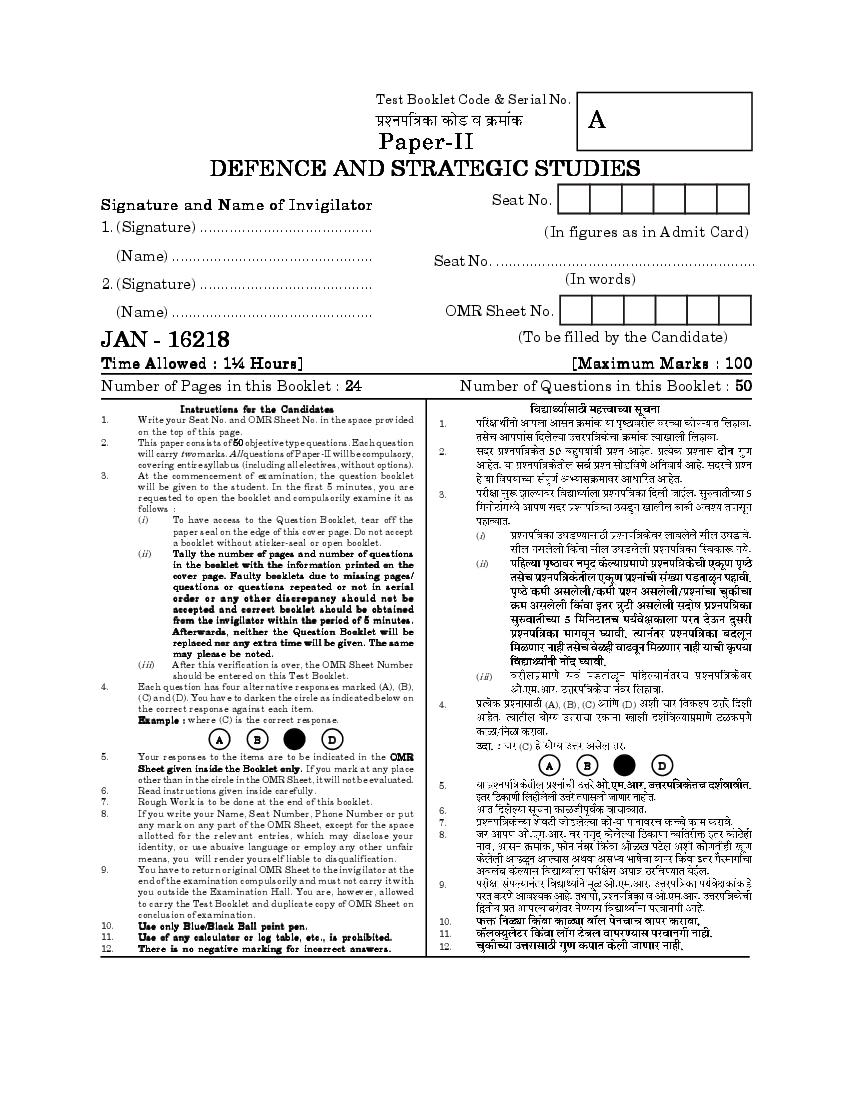
A
DEFENCE AND STRATEGIC STUDIES
Signature and Name of Invigilator Seat No.
1. (Signature) ......................................... (In figures as in Admit Card)
(Name) ................................................ Seat No. ..............................................................
2. (Signature) ......................................... (In words)
(Name) ................................................ OMR Sheet No.
JAN - 16218 (To be filled by the Candidate)
Time Allowed : 1¼ Hours] [Maximum Marks : 100
Number of Pages in this Booklet : 24 Number of Questions in this Booklet : 50
Instructions for the Candidates
1. Write your Seat No. and OMR Sheet No. in the space provided 1.
on the top of this page.
2. This paper consists of 50 objective type questions. Each question
will carry two marks. All questions of Paper-II will be compulsory, 2.
covering entire syllabus (including all electives, without options).
3. At the commencement of examination, the question booklet
will be given to the student. In the first 5 minutes, you are
requested to open the booklet and compulsorily examine it as 3.
follows :
(i) To have access to the Question Booklet, tear off the
paper seal on the edge of this cover page. Do not accept (i)
a booklet without sticker-seal or open booklet.
(ii) Tally the number of pages and number of questions
in the booklet with the information printed on the (ii)
cover page. Faulty booklets due to missing pages/
questions or questions repeated or not in serial
o rder or any other discre pancy should not be
accepted and correct booklet should be obtained
from the invigilator within the period of 5 minutes.
Afterwards, neither the Question Booklet will be
replaced nor any extra time will be given. The same
may please be noted.
(iii) After this verification is over, the OMR Sheet Number
should be entered on this Test Booklet. (iii)
4. Each question has four alternative responses marked (A), (B),
(C) and (D). You have to darken the circle as indicated below on
the correct response against each item. 4. (A), (B), (C) (D)
Example : where (C) is the correct response.
A B D
(C)
5. Your responses to the items are to be indicated in the OMR
Sheet given inside the Booklet only. If you mark at any place A B D
other than in the circle in the OMR Sheet, it will not be evaluated.
5.
6. Read instructions given inside carefully.
7. Rough Work is to be done at the end of this booklet.
8. If you write your Name, Seat Number, Phone Number or put 6.
any mark on any part of the OMR Sheet, except for the space 7.
allotted for the relevant entries, which may disclose your 8.
identity, or use abusive language or employ any other unfair
means, you will render yourself liable to disqualification.
9. You have to return original OMR Sheet to the invigilator at the
end of the examination compulsorily and must not carry it with 9.
you outside the Examination Hall. You are, however, allowed
to carry the Test Booklet and duplicate copy of OMR Sheet on
conclusion of examination.
10. Use only Blue/Black Ball point pen. 10.
11. Use of any calculator or log table, etc., is prohibited. 11.
12. There is no negative marking for incorrect answers. 12.
Page 2
Page 3
Paper II
II
Time Allowed : 75 Minutes] [Maximum Marks : 100
Note : This paper contains Fifty (50) multiple choice questions, each carrying
Two (2) marks. Attempt All questions.
(50) (2)
1. Who among the following chairs the 1.
meetings of the National Security
Council in India ?
(A)
(A) President
(B)
(B) Prime Minister
(C)
(C) Defence Minister
(D) National Security Advisor (D)
2. Defence and strategic studies is 2.
akin to so many other disciplines,
except :
(A)
(A) Sociology
(B)
(B) History
(C)
(C) Political Science
(D) Astronomy (D)
3 [P.T.O.
Page 4
the statement that “war is an
instrument of policy by other
means” ? (A)
(A) Carl Von Clausewitz
(B)
(B) Frederick the Great
(C)
(C) J.F.C. Fuller
(D) A. Jomini (D)
4. Kautilya’s concept of Inter-state 4.
relations was based on which of the
following theories ?
(A) Theory of Saptanga (A)
(B) Mandala Theory (B)
(C) Theory of Four Fold Army (C)
(D) Sadgunya Theory (D)
5. Military Industrial Complex 5.
argument was delivered by whom
in his farewell address ?
(A)
(A) President Eisenhower
(B) President J.F. Kennedy (B)
(C) President Ronald Reagan (C)
(D) Henry Kissinger (D)
4
Page 5
after the :
(A) Sino-Indian Conflict, 1962
(A) 1962
(B) Soviet Intervention in
(B) 1979
Afghanistan, 1979
(C) End of Cold War
(C)
(D) Attack on the World Trade
Centre, 2001 (D) 2001
7. The strategy of minimum credible 7.
deterrence is reversed by which one
of the following ?
(A) No first use (A)
(B) First strike (B)
(C) Second strike (C)
(D) No strike (D)
8. Who propounded the theory of 8.
“Expanding Torrent” ?
(A)
(A) J.F.C. Fuller
(B)
(B) Liddle Hart
(C)
(C) Jomini
(D) Clausewitz (D)
5 [P.T.O.
Page 6
given in List-I with Colonies in the -II
List-II by using the correct code :
List-I List-II -I -II
(Colonial Powers) (Colonies)
(a) France (i) East Timor (a) (i)
(b) Netherlands (ii) Indo-China (b) (ii)
(c) Portugal (iii) Philippines (c) (iii)
(d) Spain (iv) Indonesia (d) (iv)
Codes :
(a) (b) (c) (d) (a) (b) (c) (d)
(A) (iii) (i) (iv) (ii) (A) (iii) (i) (iv) (ii)
(B) (iv) (ii) (iii) (i) (B) (iv) (ii) (iii) (i)
(C) (ii) (iv) (i) (iii) (C) (ii) (iv) (i) (iii)
(D) (i) (iii) (ii) (iv) (D) (i) (iii) (ii) (iv)
10. Identify the correct code for the 10. (A)
Assertion (A) and Reason (R) as
given below : (R)
Assertion (A) : (A)
Preventive war can be justified
using balance of power logic.
Reason (R) :
(R)
That rationale can also provide a
basis for frequent use of military
force in a war.
Codes :
(A) Both (A) and (R) are not correct
(B) Both (A) and (R) are correct, but (A) (A) (R)
(R) is not always a rationale
of (A) (B) (A) (R)
(C) (A) is correct, but (R) is not (R) (A)
correct (C) (A) (R)
(D) (A) is not correct, but (R) is
correct (D) (A) (R)
6
Page 7
Assertion (A) and Reason (R) as (R)
given below :
(A)
Assertion (A) :
A state is specifically a political
and geopolitical entity.
Reason (R) : (R)
Because specific cultural groups are
associated with state for political
legitimacy.
Codes :
(A) (A) (R)
(A) (A) is true, (R) is false
(B) (A) (R)
(B) (A) is false, (R) is true
(C) Both (A) and (R) are false (C) (A) (R)
(D) Both (A) and (R) are true (D) (A) (R)
12. According to the rationale of the 12.
first use principle, states reserve
the right to use nuclear weapons in
self-defence can be stated as :
(A)
(A) Mutual Assured Destruction
(B)
(B) Nuclear Deterrence
(C) Trident (C)
(D) Nuclear Non-Proliferation (D)
7 [P.T.O.
Page 8
CTBT ?
(A)
(A) Ban on all kinds of Nuclear
Weapons test explosion
(B) To favour international
(B)
monitoring system to check the
treaty violations
(C) To detect the underground,
atmospheric or underwater
(C)
explosions
(D) To export and import the
Nuclear technology (D)
14. Who among the following stated 14.
that “If you tell a lie big enough
and keep repeating it, people will
eventually come to believe it” ?
(A) Gobbles (A)
(B) John Foster Dulles (B)
(C) Andrew Gramico (C)
(D) Anthony Eden (D)
8
Page 9
states of India was first to face the
brow-brunt of ethnic insurgency ?
(A)
(A) Assam
(B)
(B) Nagaland
(C) Manipur (C)
(D) Tripura (D)
16. When did the UN General Assembly 16.
adopted the Arms Trade Treaty (ATT)
(ATT) on conventional arms ?
(A) 2015 (A) 2015
(B) 2013 (B) 2013
(C) 2011 (C) 2011
(D) 2006 (D) 2006
17. The Armed Forces Special Powers 17.
Act was enacted in Jammu and
Kashmir in the year :
(A) 1985
(A) 1985
(B) 1987
(B) 1987
(C) 1990 (C) 1990
(D) 1992 (D) 1992
9 [P.T.O.
Page 10
participants, multiple major powers
to conquer and occupy enemy
territory. Decision makers utilize all
available weapons of warfare and
target both civilian and military
sites. What kind of war is this ?
(A) Civil War (A)
(B) Asymmetric War (B)
(C) Limited War (C)
(D) General War (D)
19. Match the List-I (Books) with 19. -I -II
List-II (Authors) with the help of the
codes given below :
-I -II
List-I List-II
(Books) (Authors)
(a) (i)
(a) Politics Among (i) E.H. Carr
Nations
(b) World Between (ii) Edward (b) (ii)
Two Wars Said
(c) Orientalism (iii) Francis (c) (iii)
Fukuyama
(d) End of History (iv) Hans
(d) (iv)
and The Last Morgenthau
Man
Codes :
(a) (b) (c) (d)
(a) (b) (c) (d)
(A) (ii) (iv) (iii) (i)
(A) (ii) (iv) (iii) (i)
(B) (iv) (i) (ii) (iii) (B) (iv) (i) (ii) (iii)
(C) (i) (iii) (iv) (ii) (C) (i) (iii) (iv) (ii)
(D) (iii) (ii) (i) (iv) (D) (iii) (ii) (i) (iv)
10
Page 11
Assertion (A) and Reason (R) as
(R)
given below :
(A)
Assertion (A) :
“Power flows from the barrel of a
gun.” (R)
Reason (R) :
Dictum gained popularity due to its
pithiness and vivid imagery, rather
than any profoundity
Codes :
(A) (A) (R)
(A) Both (A) and (R) are not correct
(B) (A) (R)
(B) Both (A) and (R) are correct
(C) (A) (R) (A)
(C) (A) is not correct, (R) is the
logical explanation of (A)
(D) (A) is correct, (R) is not the (D) (A) (R) (A)
logical explanation of (A)
11 [P.T.O.
Page 12
propounded the concept of structural
violence ?
(A)
(A) A.G. Frank
(B)
(B) Kofi Annan
(C)
(C) Johan Galtung
(D) Barry Buzan (D)
22. The concept of Confidence Building 22.
measures germinated from which
one of the following ?
(A) 1975
(A) Conference on Security and
Cooperation in Europe in 1975
(B)
(B) Canberra Commission
(C)
(C) Atlantic Charter
(D) Brundtland Commission (D)
23. Chabahar port is located in : 23.
(A) Iraq (A)
(B) Iran (B)
(C) Afghanistan (C)
(D) Papua New Guinea (D)
12
Page 13
Afghanistan and Central Asia
constitute a single region” ?
(A) Shuja Pasha (A)
(B) Wajahat Hussain (B)
(C) Ahmad Rashid (C)
(D) Maleeha Zodi (D)
25. Which year the Nuclear Weapon 25.
Free Zone Treaty in South-East Asia
was opened for signature ?
(A) 1995 (A) 1995
(B) 1996 (B) 1996
(C) 1985 (C) 1985
(D) 1967 (D) 1967
26. SAARC was established in the 26.
year :
(A) 1980
(A) 1980
(B) 1985
(B) 1985
(C) 1990
(C) 1990
(D) 1995 (D) 1995
13 [P.T.O.
Page 14
(Authors) and Table-II (Works)
by using the correct codes given
below : -I -II
Table-I Table-II
(Authors) (Works) (a) (i)
(a) Alfred Mahan (i) The Art of
(b) (ii)
War
(b) Antoine Henri (ii) The Command
(c) (iii)
Jomini of Air
(c) Carl Von (iii) From Sail to
Clausewitz Steamin (d) (iv)
(d) Giulio Douhet (iv) The Principles
of War
Codes :
(a) (b) (c) (d)
(a) (b) (c) (d)
(A) (ii) (iv) (i) (iii)
(A) (ii) (iv) (i) (iii)
(B) (iii) (i) (iv) (ii)
(B) (iii) (i) (iv) (ii)
(C) (i) (iii) (ii) (iv) (C) (i) (iii) (ii) (iv)
(D) (iv) (ii) (iii) (i) (D) (iv) (ii) (iii) (i)
14
Page 15
useful because :
(A) Helps to avoid war between (A)
states
(B)
(B) Helps to establish peace
between states
(C)
(C) Helps to increase economic
co-operation between states
(D) Helps to improve standard of (D)
living
29. Gorbachev adopted dual policies in 29.
order to make Soviet Union stable
through openness and radical
restructuring in the context of :
(A) Perestroika (A)
(B) Glasnost (B)
(C) Shock therapy (C)
(D) Both (A) and (B) (D) (A) (B)
30. Confidence Building Measures 30. (CBM)
(CBM) were first conceptualised in
the wake of which of the following
conflicts ?
(A) 1965
(A) India-Pakistan War of 1965
(B) 1962
(B) Sino-Indian Conflict of 1962
(C) Vietnam War (C)
(D) Cold War (D)
15 [P.T.O.
Page 16
original members of the Association
of South-East Asian Nations :
(A) Indonesia, Malaysia (A)
(B) Philippines, Singapore (B)
(C) Vietnam and Laos (C)
(D) Singapore, Indonesia (D)
32. Who among the following is the 32.
author of the book, “The Clash of
Civilization and the re-making of
World Order” ?
(A)
(A) Francis Fukuyama
(B) Joseph Frankel (B)
(C) Samuel P. Huntington (C)
(D) K. Booth (D)
33. The following is an external deter- 33.
minant of the Defence Budget :
(A) National Interest (A)
(B) Threat Perception (B)
(C) Commitment of Ideology (C)
(D) Technological Capability (D)
16
Page 17
(A) Techniques of presentation of (A)
Peace
(B)
(B) Strategy of National Security
(C)
(C) Technique of Balance of Power
(D)
(D) Part of Diplomacy
35. Choose one of the following 35.
countries which is not part of G-4 G-4
Nations who are contesting for
permanent seat in the United
Nations Security Council : (A)
(A) Germany
(B)
(B) Japan
(C)
(C) India
(D)
(D) Mexico
36. The Cuban Missile Crisis is the best 36.
example of :
(A) Brinkmanship (A)
(B) Limited War (B)
(C) Guerilla War (C)
(D) Insurgency (D)
17 [P.T.O.
Page 18
List-I (Authors) with List-II (Books)
by using the correct code :
-I -II
List-I List-II
(Authors) (Books)
(a) Henry (i) India; (a) (i)
Kissinger Emerging
Power
(b) (ii)
(b) Leo Tolstoy (ii) History of
Warfare
(c) (iii)
(c) Stephen Phillip (iii) Diplomacy
Cohen
(d) J.F.C. Fuller (iv) War and (d) (iv)
Peace
Codes :
(a) (b) (c) (d)
(a) (b) (c) (d)
(A) (ii) (iii) (iv) (i)
(A) (ii) (iii) (iv) (i)
(B) (iv) (ii) (i) (iii)
(B) (iv) (ii) (i) (iii)
(C) (iii) (iv) (i) (ii) (C) (iii) (iv) (i) (ii)
(D) (i) (iii) (ii) (iv) (D) (i) (iii) (ii) (iv)
18
Page 19
South Asia ever since it moved from
the east of Suez in :
(A) 1970 (A) 1970
(B) 1971 (B) 1971
(C) 1972 (C) 1972
(D) 1973 (D) 1973
39. Which one of the following is not 39.
correct in respect of collective
security theory ?
(A)
(A) The aggressor is always right
(B)
(B) Aggressor must be stopped
(C)
(C) Wars are prevented by restraint
of military action
(D)
(D) The aggressor is easily identified
19 [P.T.O.
Page 20
the UN General Assembly Session
was :
(A)
(A) Ellonor Roosevelt
(B)
(B) Ms. Angle E. Brooks
(C)
(C) Smt. Vijaya Laxmi Pandit
(D)
(D) Margaret Alwa
41. Transfer of Military Technology 41.
affects :
(A) Transfer of arms strategy
(A)
(B) Weapon technology and
national security (B)
(C) Technology and arms trade
(C)
(D) Technological know-how and
arms buildup (D)
42. TRIMS relates to which of the 42. (TRIMS)
following issues ?
(A) Trade (A)
(B) Telecom (B)
(C) Investment (C)
(D) Monetary (D)
20
Page 21
Assertion (A) and Reason (R) as
(R)
given below :
Assertion (A) : (A)
States share a common interest in
peace.
(R)
Reason (R) :
Any state that disturbs peace is both
irrational and immoral.
Codes :
(A) Both (A) and (R) are not correct
(A) (A) (R)
(B) (A) is correct, but (R) is not
correct (B) (A) (R)
(C) (A) is not correct, but (R) is
(C) (A) (R)
correct
(D) Both (A) and (R) are correct (D) (A) (R)
44. Identify the correct code for the 44. (A)
Assertion (A) and Reason (R) as (R)
given below :
(A)
Assertion (A) :
Nuclear fusion is used to generate
electricity.
(R)
Reason (R) :
Nuclear power is not used because
it cannot be controlled.
Codes :
(A) Both (A) and (R) are correct (A) (A) (R)
(B) Both (A) and (R) are not correct (B) (A) (R)
(C) (A) is correct, (R) is not correct (C) (A) (R)
(D) (A) is not correct, (R) is correct (D) (A) (R)
21 [P.T.O.
Page 22
of NAFTA ?
(A) Cuba (A)
(B) Canada (B)
(C) Mexico (C)
(D) USA (D)
46. Who among the following 46.
distinguished between ‘industrial’
and ‘militant’ societies ?
(A)
(A) E. Durkheim
(B)
(B) Karl Marx
(C) Herbert Spencer (C)
(D) Saint Simon (D)
47. The Architect of India’s Nuclear 47.
Programme was :
(A) Vikram Sarabhai Patel (A)
(B) Dr. Homi Jahangir Bhabha (B)
(C) Dr. A.P.J. Kalam (C)
(D) C.N.R. Rao (D)
22
Page 23
the determinant of Defence
Expenditure ?
(A)
(A) Economic Condition
(B)
(B) Geography of the country
(C)
(C) Relations with Neighbours
(D) Non-Cooperation by Opposition (D)
49. Globalisation resulted in : 49.
(A) Financial Integration (A)
(B) Monetary Union (B)
(C) Global Free Trade (C)
(D) Economic Interdependence (D)
50. ‘Inflation’ is a phenomenon which is 50.
associated with :
(A)
(A) Increase in money circulation
(B) Decrease in money circulation (B)
(C) Negative Balance of Payment
(C)
Situation
(D)
(D) Price rise
23 [P.T.O.
Page 24
24
Document Details
| Board / Org | Maharashtra Exams |
| Exam | MAHA SET |
| Type | Question Paper |
| Pages | 24 |
| Updated | 30 Apr 2026 |