MAHA SET 2015 Question Paper 3 Mathematical Sciences
Finished viewing? Save it for later —
Download MAHA SET 2015 Question Paper 3 Mathematical Sciences (PDF · 48 pages)About MAHA SET 2015 Question Paper 3 Mathematical Sciences
MAHA SET 2015 Question Paper 3 Mathematical Sciences is available here for free download. Published by Maharashtra Exams for MAHA SET, this question paper can be viewed online or downloaded as a PDF (48 pages). Candidates preparing for MAHA SET can use MAHA SET 2015 Question Paper 3 Mathematical Sciences to understand the exam pattern, the type of questions asked, and the overall difficulty level.
Frequently Asked Questions
How can I download MAHA SET 2015 Question Paper 3 Mathematical Sciences?
Open this page and click the Download button to save MAHA SET 2015 Question Paper 3 Mathematical Sciences as a PDF. It is completely free on AglaSem Docs.
Is MAHA SET 2015 Question Paper 3 Mathematical Sciences free to download?
Yes. MAHA SET 2015 Question Paper 3 Mathematical Sciences can be viewed online and downloaded as a PDF free of cost on AglaSem Docs.
How many pages does MAHA SET 2015 Question Paper 3 Mathematical Sciences have?
MAHA SET 2015 Question Paper 3 Mathematical Sciences contains 48 pages, which you can read online or download together as a single PDF.
Where can I find more MAHA SET study material?
You can find more MAHA SET question papers, sample papers, syllabus, and answer keys on AglaSem Docs.
MAHA SET 2015 Question Paper 3 Mathematical Sciences – Text
Read the full text of this question paper below — useful to quickly search, copy and reference the content online without downloading the PDF.
📄 View text version (48 pages)
Page 1
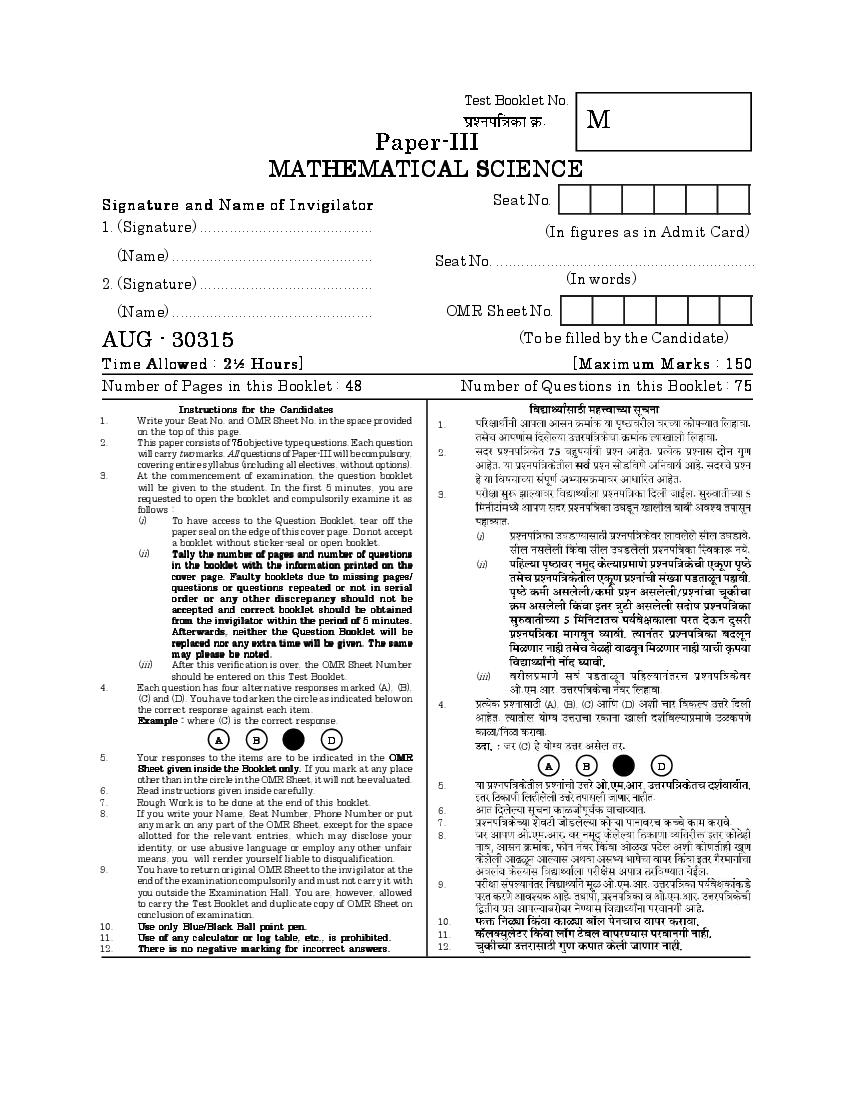
M
MATHEMATICAL SCIENCE
Signature and Name of Invigilator Seat No.
1. (Signature) ......................................... (In figures as in Admit Card)
(Name) ................................................ Seat No. ..............................................................
2. (Signature) ......................................... (In words)
(Name) ................................................ OMR Sheet No.
AUG - 30315 (To be filled by the Candidate)
Time Allowed : 2½ Hours] [Maximum Marks : 150
Number of Pages in this Booklet : 48 Number of Questions in this Booklet : 75
Instructions for the Candidates
1. Write your Seat No. and OMR Sheet No. in the space provided 1.
on the top of this page.
2. This paper consists of 75 objective type questions. Each question
will carry two marks. All questions of Paper-III will be compulsory, 2.
covering entire syllabus (including all electives, without options).
3. At the commencement of examination, the question booklet
will be given to the student. In the first 5 minutes, you are
requested to open the booklet and compulsorily examine it as 3.
follows :
(i) To have access to the Question Booklet, tear off the
paper seal on the edge of this cover page. Do not accept
(i)
a booklet without sticker-seal or open booklet.
(ii) Tally the number of pages and number of questions
in the booklet with the information printed on the (ii)
cover page. Faulty booklets due to missing pages/
questions or questions repeated or not in serial
order or any other discre pancy should not be
accepted and correct booklet should be obtained
from the invigilator within the period of 5 minutes.
Afterwards, neither the Question Booklet will be
replaced nor any extra time will be given. The same
may please be noted.
(iii) After this verification is over, the OMR Sheet Number
should be entered on this Test Booklet. (iii)
4. Each question has four alternative responses marked (A), (B),
(C) and (D). You have to darken the circle as indicated below on
the correct response against each item. 4. (A), (B), (C) (D)
Example : where (C) is the correct response.
A B D
(C)
5. Your responses to the items are to be indicated in the OMR
Sheet given inside the Booklet only. If you mark at any place A B D
other than in the circle in the OMR Sheet, it will not be evaluated.
5.
6. Read instructions given inside carefully.
7. Rough Work is to be done at the end of this booklet.
8. If you write your Name, Seat Number, Phone Number or put 6.
any mark on any part of the OMR Sheet, except for the space 7.
allotted for the relevant entries, which may disclose your 8.
identity, or use abusive language or employ any other unfair
means, you will render yourself liable to disqualification.
9. You have to return original OMR Sheet to the invigilator at the
end of the examination compulsorily and must not carry it with 9.
you outside the Examination Hall. You are, however, allowed
to carry the Test Booklet and duplicate copy of OMR Sheet on
conclusion of examination.
10. Use only Blue/Black Ball point pen. 10.
11. Use of any calculator or log table, etc., is prohibited. 11.
12. There is no negative marking for incorrect answers. 12.
Page 2
Page 3
Paper III
Time Allowed : 2½ Hours] [Maximum Marks : 150
Note : This paper contains Seventy Five (75) multiple choice questions, each
carrying Two (2) marks. Attempt All questions.
1. Let a function f [0, 1] R be
2. Consider the subset :
defined by :
A {x Q :2 x2 5}
1, when x is ra t iona l
f (x)
0, wh en x is ir r a t iona l
of the space R with usual metric.
Then :
Then :
(A) f is Riemann integrable on
(A) A is closed and bounded
[0, 1]
(B) A is neither open nor
(B) f is continuous on [0, 1]
closed
(C) f is not integrable on [0, 1]
(C) A is compact
(D) f is of bounded variation on
(D) A is connected
[0, 1]
3 [P.T.O.
Page 4
Newton-Raphson method used for Minimize
solving algebraic equations is :
Z x12 x1 x2 2 x 22 x1 x2
(A) 1 Subejct to 2x1 + x2 1
and x1 0; x2 0
(B) 2
Using Wolfe’s method, we observe
(C) 4 that the problem has a/an :
(A) Unique optimum solution
(D) 3
(B) Unbounded solution
4. Let denote the forward difference (C) Infinite optimum solution
operator. Then the value of (D) Infeasible solution
2 (cos x) is :
( 1)n
6. The series 2 n ! 1 converges
n 0
2 h
(A) 4 sin cos ( x h)
to :
2
(A)
(B) 4 sin 2 h cos ( x h) 2
(B) 4
2 h
(C) 3 cos cos ( x h)
2
(C)
4
(D) 3 sin 2 h cos ( x h) (D) 2
4
Page 5
A sequence of sets {A n , n 1} Let {X n , n 1} be a sequence of
converges iff : random variables with p.m.f. :
1 1
P (X n 1) , P (X n 0) 1 .
Ak Ak n n
(A)
n 1 k n n 1 k n
Then :
m
Ak Ak (A) X n 0
(B)
n 1 k n n 1 k n P
(B) X n c 0
P
(C) Ak Ak (C) X n 1
n 1 k n n 1 k n
(D) Xn does not converge to any X
(D) Ak Ak in probability
n 1 k n n 1 k n
sin nx
7. Let X be a complete metric space and 8. The series n log n is :
n 2
T : X X satisfies : (A) absolutely convergent
d (T( x ), T ( y )) d ( x, y) (B) not convergent pointwise on
[0, 2 ]
for all x , y X, x y . Then :
(C) uniformly convergent on
(A) T has at most one fixed point
[0, 2 ]
(B) T has at least one fixed point
(D) pointwise convergent but not
(C) T has exactly one fixed point uniformly convergent on
(D) T has two fixed points [0, 2 ]
5 [P.T.O.
Page 6
of reals with usual metric and the
Which of the following statements
discrete metric, respectively. Then
is not true ?
the mapping :
(A) If 0 Xn X , then E X n EX
f : Rd Ru
(B) If X n 0 , then :
E Xk EXk defined by f ( x ) [ x ] , for all x in R
k 1 k 1
([x] denote the integral part of x)
(C) If Y X n and Y is integrable
is :
random variable, then lim X n
(A) monotonically decreasing
may not be finite
(D) If Y X n and Y is integrable (B) not continuous
random variable, then lim X n (C) continuous
may not be finite
(D) homeomorphism
6
Page 7
If | X n | Y a.s., Y is integrable, Let {Xn, n 1} be a sequence of
then i.i.d. Bernoulli random variables
1
Xn
P
X E Xn EX . with P(X n 0) .
3
This theorem is known as : If S n X1 X2 X3 ........ Xn ,
n 1.
(A) Monotone convergence theorem
Then we have :
(B) Fatou’s Lemma
Sn L 1
(A)
(C) Dominated convergence n 3
theorem Sn am 1
(B)
n 3
(D) Poisson weak law of large Sn a.s. 2
(C)
n 3
numbers
Sn a. s.
(D) 0
10. For the point i in C, the n
11. Let : [0, 2 ] C be defined by
corresponding point of the unit in t
(t ) e , where n is some integer.
sphere S in R3 under the
Then the value of the integral
stereographic projection is : 1
d z is :
z
(A) (1, 1, 1)
(A) 2 ni
(B) (1, 0, 0)
(B) 2
(C) (0, 1, 0) (C) 2 n
(D) (0, 0, 1) (D) 2 in
7 [P.T.O.
Page 8
and Z B ( a; R) . Then :
Which of the following statements (A) f ( z ) has a power series
is wrong ? representation
(B) f(z) cannot have a power series
(A) Theoretical basis of Central
representation
Limit theorem was first (C) f(z) is always a real number
introduced by Laplace (D) f ( z ) is always a purely
imaginary number
(B) Suppose {A n , h 1} be a
Or
sequence of events such
If X1 , X 2 , ...... X n be independent
P (A n ) and identically distributed random
that , then
n 1 variables having uniform
P (lim A n ) 0 distribution on [#1 , #2 ] , then the
joint pdf of the order statics
(C) If X Y E B (X) E B (Y) X (1) , X (2) , ...... X (n ) will be given by
where E B (.) denote conditional one of the following over the range
#1 < X (1) X (2) ...... X (n ) #2
expectation
and zero otherwise :
(D) If X n a.s.
X iff as n (A) n !/ (#2 #1 )n
(B) n ! (#2 #1 )n
P w | X k (w ) X(w )| 1/r 0
n!
k n ! (C)
#1 #2n
" r , an integer
(D) n ! #1n #2
8
Page 9
and suppose that is a closed maximal ideal of Z [x] ?
rectifiable curve in B(a; R). Then the
(A) (2)
value of the integral f ( z ) d z is :
(B) (x)
(A) 2 i
(B) 1 (C) (3, x)
(C) –1 (D) (x2 + 1)
(D) 0 Or
Or
Let X be a random variable such
Let X1, X2 be a random variable 1
that variance of X is . Then an
2
from N(0, 1) and Y1, Y2 be another
upper bound for P[| X E X| $ 1] as
random sample from N(1, 1). X’s
given by the Chebyshev’s inequality
and Y’s are independent rvs. The
distribution of : is :
(X1 X2 ) / 2
1
z (A)
4
[(Y1 1)2 (Y2 1)2 ] / 2
(B) 1
(A) F(1, 1)
1
(B) X2 with 3df (C)
2
(C) N(1, 2)
3
(D)
(D) t with 2df 4
9 [P.T.O.
Page 10
6×6 matrices over C with minimal
integers has the property that every
polynomial (x – 1) (x – 2)2 and
group having that order is a simple characteristic polynomial (x – 1)2
(x – 2)4 is :
group ?
(A) 1
(A) 10 (B) 2
(C) 3
(B) 17
(D) 4
Or
(C) 21
Let X be a rv with the following df :
(D) 6
0 ; x 0
Or 1
F (x) ; 0 x 1
4
1 1
Let X be a rv with B(n, p). Then the [1 e ( x 1) ] ; x 1
2 2
distribution of n – X is : Then EX is :
1
(A) B (n – 1, p) (A)
4
5
(B) B (n, 1 – p) (B)
4
1
(C) B (n – 1, q), q = 1 – p (C)
2
3
(D) B (n, p) (D)
4
10
Page 11
forms is positive definite ? monotonically increasing real
(A) x 2 y2 2 yz z2 functions on [0, 1], converges
pointwise to the function f % 0 .
(B) x 2 y2 2 z2
(A) Then {fn} need not be uniformly
(C) x 2 y2 yz z2
convergent to f
(D) x 2 y2 z2
(B) Then {fn} converges uniformly
Or
to f
Let X be a rv with U ( #, #), # $ 0 ,
(C) If the functions fn are non-
then the distribution of Y | X|
negative, then f n must be
is :
1 continuous for sufficiently
(A) f ( y ) ;0 y 2#
2#
large n
1
(B) f ( y ) ; # y 2#
3#
(D) If the function f n are non-
1
(C) f ( y ) ;0 y #
# negative, then f n must be
1
(D) f ( y ) ;0 y 3# constant for sufficiently large n
3#
11 [P.T.O.
Page 12
is true ?
Consider one parameter exponential
family {f ( x , #); # & ' R 1 } with (A) Any uniformly continuous
probability function : function on [a, b] is of bounded
variation on [a, b]
f ( x , #) exp [u (#) k ( x ) v (#) w ( x )]
(B) If f : R R is continuously
When this family has monotone
differentiable function, then it
likelihood ratio in k(x) ?
is of bounded variation on
(A) u (#) is decreasing function
[ n , n ] for any n N
of #
(C) Any bounded function on [a, b]
(B) u(#) is non-decreasing function
is of bounded variation on
of #
[a, b]
(C) v (#) is decreasing function
(D) Difference of any two
of #
monotonically increasing
(D) v(#) is non-decreasing function functions on [a, b] is always of
of # bounded variation on [a, b]
12
Page 13
Which of the following does not For testing simple null against
belong to exponential family of simple alternative hypothesis which
distributions ? of the following statements is most
1 x /# appropriate ?
(A) f ( x , #) e ,x$0
#
(A) UMP level ( test exists
(B) f ( x , #) ( x #)
e ,x$#
(B) UMPU level ( test exists
4
5x 5
(C) f ( x , #) e x /#, x $ 0
# (C) UMP invariant test exists
e x /# x2 (D) Most powerful level ( test exists
(D) f ( x , #) , x $0
2 #3
21. Let f : R 3 R be a continuous
20. Let f be a real function define on
function. If
R as :
D {( x , y, z ) R 3| x2 y2 z2 4}
p 2 p p
, if t , p, q Z, ( p, q) 1
f (t ) q 2 q q Then f(D) :
0 , if t is irr at iona l
(A) need not be an interval in R
Then :
(B) is always an interval of the form
(A) f is not continuous at t = 1
(a, b)
(B) f is continuous at all rationals
(C) is union of two disjoint closed
(C) f is not continuous at all sets in R
irrationals
(D) is always an interval of the form
(D) f is continuous at all irrational [a, b]
13 [P.T.O.
Page 14
A size ( test is said to unbiased Let X be a binomial random
if : variable with parameters n and p.
Consider the prior distribution
(A) It has maximum power in the
( p) 1, 0 p 1 . Then the Bayes
class of all size () tests
estimator under squared error loss
(B) Size and power are equal
function is :
(C) Power is smaller than size
(A) *(X) X/n
(D) Size of the test does not exceed
X n
(B) *(X)
its power n
22. Let N, H, G be groups. Which of the X 1
(C) *(X)
n 2
following is true ?
X 1
(D) *(X)
(A) If N G , then G/N is isomorphic n 1
to a subgroup of G 23. Which of the following is not a
Noetherian ring ?
(B) If H N and N G , then H G
(A) Z
(C) If N G and H is a subgroup
of G, then N H H N (B) Z[x]
(D) If N G , then G/N is isomorphic (C) Q[x1, x2, ....., xn, ....]
to a subgroup of G (D) Q(x1, x2, ....., xn, ....)
14
Page 15
Let X have the hypergeometric
as :
distribution with probability mass
(A) Q-vector spaces but not as fields
function :
+M , +N m , (B) abelian groups but not as
-/ x 0. /- n x 0.
P (X x)
+N , , Q-vector spaces
-/ n 0.
(C) fields
x 0, 1, 2, ......, M
(D) commutative rings
The UMP level ( test for
H0 : M M 0 against H 1 : M $ M 0 Or
is given by :
Which of the following distribution
(A) Reject H0 if M 0 X $ k such
is not an exact sampling
that sup PH 0 (M 0 X $ k) (
(B) Reject H0 if N – X > k such that distribution ?
su p P (N X $ k) (
H0 (A) Beta distribution
(C) Reject H0 if X > k such that
(B) Chi-square distribution
su p P (X $ k ) (
H0
(C) t-distribution
(D) Reject H0 if N – M – x > k such
that su p P (N – M – X $ k ) ( (D) F-distribution
H0
15 [P.T.O.
Page 16
26. Let f be a real function on [0, 1] and
extension and the Galois group is
cyclic of order 10. Then the number
{( x , f ( x )) : x [0, 1]}
of intermediate fields F other than
L and K is :
be its graph. Then :
(A) 10
(B) 4 (A) f is continuous implies its graph
(C) 2
is an open set in R2
(D) 5
Or
(B) f is continuous implies its graph
In likelihood ratio test, under some
is a compact set in R2
regularity conditions on f(x, 0), the
rv –2 log 1( x ) (where 1( x ) is a
likelihood ratio) is asymptotically (C) f has at least one fixed
distributed as :
point
(A) Normal
(B) Exponential (D) f is continuous implies it is an
(C) Chi-square
open map
(D) F-distribution
16
Page 17
b
f p ( | f ( x )| p d x )1/ p , p 1
a
Let Xn converges in probability to
and f su p {| f ( x )| : x [ a, b ]}.
X, then :
Then :
(A) (C[ a, b], ) is a separable
(A) X n converges almost sum metric space
to X (B) (C[ a, b], 1 ) is a Hilbert space
(C) (C[ a, b], ) is not a Banach
(B) Xn converges in distribution space
(D) (C[ a, b], 1 ) is a Banach space
to X
Or
Xn Let X1 , X 2 , ......, X n be i.i.d. random
(C) converges almost sum to
k variable following U(0, #). Suppose
X
, k 0 H n (x) P (X (n ) x ) . Then H n ( x )
k
converges uniformly to :
Xn (A) a degenerate distribution at #
(D) Yn converges in distribution to
(B) a degenerate distribution at 0
Xn
if Yn converges in law to
C (C) a degenerate distribution at 1
X if P [Yn 0] 1 #
(D) a degenerate distribution at
2
17 [P.T.O.
Page 18
(A) not a complete metric space 1 1
0 if 0 x
2 n
(B) a compact metric space 1 1 1 1
n (x ) 1 if x
2 2 n 2
f n (x)
1 1 1 1
(C) a Hilbert space for p = 1 1 n (x ) if x
2 2 2 n
1 1
0 if x 1
(D) a separable metric space 2 n
Or for n = 2, 3, ......
Then the sequence f n n 2 is :
Let X1 , X 2 , ....., X n be iid rvs with
(A) not a Cauchy sequence in
Cauchy distribution as : (C[0, 1], )
(B) not convergent in (C[0, 1], 1)
1
f (x) ; x
(1 x2 ) (C) not a Cauchy sequence in
Then by using CLT the distribution (C[0, 1], 1)
n Xi (D) not convergent in (C[0, 1], )
of Yi , where Yi is :
i 1 1 X12 Or
A multivariate method for
(A) AN (0, 1)
investigating the relationship
+ 8, between two sets of variables is :
(B) AN -/ 0, 0.
n
(A) Discriminant Analysis
(C) Does not exist (B) MANOVA
(C) Multiple Logistic Regression
+ n,
(D) AN -/ 0, 0.
8 (D) Canonical Correlation
18
Page 19
where the topology is generated by ................... occurs when variables in
all intervals of the form [a, b) and the data are highly correlated.
Rk denotes space of reals where the (A) Heteroscedasticity
topology is generated by all open (B) Heterogeneity
intervals (a, b) and all sets of the (C) Estimation bias
form (a, b) – K, where
(D) Multicollinearity
1 31. Let R denotes the set of real
K | n N .
n
numbers in its usual topology and
Then which of the following
R l denotes the same set in the
statements is correct ? topology generated by all intervals
(A) The topology of Rl is finer than of the form [a, b). Let f : R Rl
the topology of Rk be defined by f ( x ) x for every real
number x . Then which of the
(B) The topology of Rk is finer than
following statements is true ?
the topology of Rl
(A) f is not continuous
(C) The topology of Rl is coarser
(B) f is continuous
than the topology of Rk
(C) f is homeomorphism
(D) The topologies of Rl and Rk are
(D) f –1 is not continuous
not comparable
19 [P.T.O.
Page 20
Or
Multiple correlation coefficient :
Principal Component Analysis is a
(A) must be between –1 and +1
multivariate method that : (B) must be between 0 and 1
(C) must be non-negative
(A) reduces dimension of data
(D) can take any value
(B) reduces heterogeneity of data
33. Consider the following four
statements :
(C) reduces multicollinearity of data
(I) Every separable topological
(D) reduces skewness of data space is second countable
(II) Every second countable space is
32. Rw denotes the infinite product of
separable
R with itself. Suppose Rw is given (III) Every separable metric space is
second countable
the box topology. Then which of the
(IV) Every first countable space is
following is true ?
second countable
(A) Rw is connected Then which of the following
statements is correct ?
(B) Rw is not connected (A) All are correct
(B) Only (I) and (II) are correct
(C) Rw is compact
(C) Only (II) and (III) are correct
(D) Rw is connected and compact
(D) Only (III) and (IV) are correct
20
Page 21
Consider the linear model :
Hotelling’s T2 test is a generalization
of : y1 #1 #3 1
y2 #2 #3 2
(A) Chi-square test
where 1 and 2 are errors. The
(B) F-test
linear combination :
(C) T-test
11#1 1 2 #2 1 3 #3
(D) Likelihood ratio test is estimable if and only if :
34. Which of the following statements (A) 11 12 13
is not true ? (B) 13 11 12
(A) A tree is a bipartite graph (C) 1 2 13 11
(B) K5, the complete graph on 5 (D) 13 12 11
vertices is a planar graph 35. The number of distinct trees on
4 vertices is :
(C) Every connected graph contains
(A) 16
a spanning tree
(B) 14
(D) The number of vertices of odd
(C) 15
degree in a graph is always
(D) 12
even
21 [P.T.O.
Page 22
Consider the simple linear Consider the model y X3 . A
linear function of observations
regression model :
belongs to the error space if and only
yi #0 #1 xi i, i 1, 2
if its coefficient vector is :
2
where i ~ NID (0, 2 ), x1 1 and
(A) orthogonal to the rows of
x2 1. matrix X
The best linear unbiased estimators (B) orthogonal to the columns of
of #0 and #1 respectively are : matrix X
y2 y1 (C) parallel to the rows of matrix X
(A) y,
2 !
(D) parallel to the columns of
y2 y1 matrix X
(B) , y
2 !
37. Suppose that n + 1 objects are put
(C) y1 y , y2 y
into n boxes. Then which one of the
(D) y, y
following statements is true ?
36. A debating team consists of three (A) No box contains more than one
boys and two girls. Then the number object
of ways they can sit in a row is : (B) Exactly one box contains two
objects
(A) 100
(C) At most one box contains two
(B) 120
or more objects
(C) 125
(D) At least one box contains two
(D) 110 or more of the objects
22
Page 23
The kth order polynomial model in In simple linear regression model,
one variable is : if the data contain repeated
observations on Y at the same value
y 30 31 X 32 X 2 ....... 3k X k ,
of X, then the maximum value of
where ~ NID (0, 2 ) . If we set2
coefficient of determination (R2) is :
j
xj X , j 1, 2, ......, k , then the
(A) greater than 1
model is :
(B) equal to 1
(A) simple linear regression model
(C) equal to 0
(B) non-linear regression model
(D) less than 1
(C) logistic regression model
39. The orthogonal trajectories of the
(D) multiple linear regression model
Parabola 6 ay 2 ( x 3) , where a is
38. The solution of differential equation
variable parameter, is given by
x
(sec x. t a n x . t a n y e ) dx
equation :
(sec x.sec 2 y ) d y 0
(A) ( x 3)2 y2 c2
is :
y2
(A) t a n y x (B) ( x 3)2 c2
e c 2
(B) t a n y ex c (x 3)2
(C) y2 c2
2
(C) t a n x . t a n y ex c
(D) ( x 3)2 y2 c2
(D) t a n y . sec x e x
c
23 [P.T.O.
Page 24
For a sampling design (U, S, P), let,
d2y
4y sin 2 x
for i = 1, 2, ......., N, yi denotes y-value dx 2
of ith element of the population
is :
1 if i t h elem en t of t h e popu la t ion
Ti belon gs t o t h e sa m ple
0 ot h er wise 1
(A) y ( x ) c1 cos 2 x c2 sin 2 x
8
and
i denotes the inclusion probability
x sin 2 x
8
of ith element of the population.
Then the Horvitz-Thompson (B) y ( x ) c1 e2 x c2 e 2 x
estimator for population mean is
1 x sin 2 x
given by : 8
1 N yi
(A) YH T
N i 1 i (C) y ( x ) c1 cos 2 x c2 sin 2 x 1
1 N yi Ti
(B) YHT N i 1 i x sin 2 x
1 N yi Ti
(C) YHT
n i 1 i (D) y ( x ) c1 e2 x c2 e 2 x 1
1 N
(D) YHT yT
n i 1 i i
x sin 2 x
24
Page 25
Based on the random sample of size
Which of the following statements
n = 100 taken by using SRSWOR
it is observed that sample mean is wrong ?
Y 150 and standard error
(A) For a fixed effective size (FES)
SE (Y) 8.1 then the 95%
confidence interval for population design with n-draws, row sum
mean is : of ith row of double inclusion
(A) (134.124, 165.876)
probability matrix is (n 1) i
(B) (145.950, 154.050)
(C) (125.700, 174.300) (B) PPSWR is not a FES design
(D) (141.900, 158.100)
(C) Under ordered SRSWR design
41. The set of linearly independent
solutions of differential equation : with N = 5 and n = 2,
d4y d2y P (4( s ) 2) 4 / 5 , where 4( s )
0
dx 4 d x2
is : denotes the number of distinct
(A) {1, x , e x , e x } elements in the sample
(B) {1, x , e x , x. e x }
(D) For FES design,
(C) {1, x , e x , x . e x }
(D) {1, x , e x , x e x } P (4( s ) con st a n t ) 1
25 [P.T.O.
Page 26
residues modulo 23 is : functions is totally multiplicative ?
(A) f (n ) 2 (n )
(A) 10
(B) f (n ) 5 (n )
(B) 22
(C) f (n ) 6 (n )
(C) 11
(D) f (n ) n3
(D) 2
Or
Or
Let Y be the mean of cluster means
Under SRSWOR sampling design,
of clusters selected under cluster
the bias of the regression estimator
sampling then variance of Y is given
of population mean YReg is given by :
by : 1 2
(A) V(Y) s
n b
(A) cov (3ˆ , X)
+1 1, 2
(B) V(Y) -/ .s
n N0 w
(B) cov (3ˆ , X)
+1 1, 2 2
(C) cov (3ˆ , X) (C) V(Y) -/ .s s
n N0 b w
cov (3ˆ , X) +1 1, 2
(D) (D) V(Y) -/ .s
s xy n N0 b
26
Page 27
congruence x 2 % 1 (mod 260) is : d i op h a n t i n e eq u a t i on s is not
(A) 8 solvable ?
(B) 2 (A) 2 x 3y 7
(C) 4
(B) 4 x 3y 19
(D) 10
(C) 8 x 3y 36
Or
(D) 21 x 15 y 62
Auxiliary variable’s information is
Or
useful in :
(i) ratio estimation The coefficients of orthogonal
3
(ii) stratum formation in stratified contrast ci d i are :
i 1
sampling
(A) c1 = 1, c2 = 1, c3 = 1, d1 = –1,
(iii) cluster sampling
d2 = –1, d3 = –1
(iv) PPS sampling
(B) c1 = 1, c2 = –1, c3 = 1, d1 = –1,
Which of the above statements is/
are correct ? d2 = 1, d3 = –1
(A) only (i), (ii) and (iv) (C) c1 = 1, c2 = 2, c3 = 0, d1 = –1,
(B) only (i) and (iv) d2 = 0, d3 = 1
(C) only (iii) and (iv) (D) c1 = –2, c2 = 1, c3 = 1, d1 = 0,
(D) only (i) d2 = –1, d3 = 1
27 [P.T.O.
Page 28
the trajectory :
Multiple comparison of treatment
x a ( – sin ), y a (1 cos ) means given by Dunnett is used
where ( t ) , in a gravitational for :
field of uniform acceleration g along
(A) comparison of one particular
downward y direction. Then
treatment with other treatment
2
2 m a2 sin 2 will represent :
2 means
(A) Kinetic energy
(B) comparison of any two
(B) Potential energy treatment means
(C) Lagrangian (C) comparison of any three
(D) Hamiltonian treatment means
for the motion. (Choose the correct (D) comparison of several treatment
answer) means simultaneously
28
Page 29
47. A dynamical system consists of three
In BIBD, there are a treatments,
par t i cl es m1, m2 and m3 in motion
b blocks, each block contains k
in space. The distances between m1
treatments and each treatment
and m2, m1 and m3 remain constant occurs r times and that there are
ar = bk total observations. The
throughout motion. The motion will
number of times each pair of
be governed by n Lagrange’s
treatments appears in the same
equation. Then : block is :
r (k 1)
(A)
(A) n = 7 (a 1)
k (r 1)
(B)
(B) n = 6 (a 1)
a (k 1)
(C)
(C) n = 5 (r 1)
b(r 1)
(D)
(D) n = 9 ( k 1)
29 [P.T.O.
Page 30
rotating with uniform angular
is described by a (3 × 3) matrix A.
velocity 7. If the motion is force free
Then :
Lagrange’s equations will imply :
(A) A is a real, Orthogonal matrix
1 d 2r
(A) 7
r dt2
(B) A is a real, Singular matrix
1 d 2r
(B) 72
r dt2
(C) A is complex Hermitian matrix
1 d 2r 1
(C)
(D) A is a non-Hermitian matrix r dt2 7
1 d 2r 1
Or (D)
r dt2 72
Or
In 2k factorial design with k = 2, the
When the interaction effect AB is
main effects A and B, interaction confounded in 22 factorial design :
(A) the block effect and the main
effect AB. The interaction effect AB
effect A are identical
is given by : (B) the block effect and the
interaction effect AB are
(A) [ ab (1) a b] / 2
identical
(C) the block effect and the main
(B) [ ab a b (1)] / 2
effect B are identical
(C) [ ab b a (1)] / 2 (D) the block effect and the
interaction effect AB are not
(D) [ a b ab (1)] / 2 identical
30
Page 31
51. The velocity components of two-
represents total energy of the
dimensional steady fluid flow are
system, then :
(A) System is time dependent and known to be :
conservative
u = y and v = x
(B) System is time independent and
conservative Which of the following statements
(C) The potential is velocity
does not describe the fluid motion
dependent
properly ?
(D) System is time independent and
non-conservative
(A) The stream lines are
Or
rectangular hyperbolas
In 23–1 fractional factorial design
with treatments A, B and C, the (B) The fluid motion is irrotational
estimate of the main effect A is :
and steam lines are rectangular
(A) [ abc b a c] / 2
hyperbolas
(B) [ abc a b c] / 2
(C) The fluid motion is rotational
(C) [ abc c a b] / 2
(D) [ abc – a b c] / 2 (D) The fluid motion is irrotational
31 [P.T.O.
Page 32
Seasonal variations can occur in a
Secular trend in a time series can
time series within a period of :
be measured by :
(A) nine years
(A) two methods (B) one year
(C) three years
(B) three methods
(D) four years
(C) four methods
53. If and 9 denote velocity potential
(D) five methods and stream function of a two-
dimensional motion of an
52. A curve C : r r ( s ) is a plane curve
incompressible fluid, then :
if and only if :
(A) Both and 9) are harmonic
(A) r ' 8 r '' 0 functions
(B) Only is a harmonic function
(B) (r ' 8 r '' ) . r ''' 0
(C) Only 9 is a harmonic function
(C) r ' 8 r '' 8 r ''' 0
(D) Neither is a harmonic function
(D) (r ' 8 r '' ) . r ''' con st a nt nor 9
32
Page 33
When the trend is of exponential
The most frequently used
type, the moving averages should be
mathematical model of a time series computed by using the :
is the : (A) weighted mean
(A) multiplicative model (B) harmonic mean
(C) arithmetic mean
(B) exponential model
(D) geometric mean
(C) mixed model
55. The equations of motion for two-
(D) additive model dimensional fluid motion due to a
point source do not lead to the
54. If v denotes velocity field of an
following :
incompressible fluid in motion, then
(A) Stream lines are concentric
the mass conservation will not imply circles
the following : (B) Flow lines are straight lines
diverging from the location of
(A) : . v 0
the source
;<
(B) :.v 0
;t (C) Stream lines and flow lines do
;< not intersect
(C) : . (< v ) 0
;t
(D) Stream lines and flow lines are
(D) : 8 v 0 orthogonal
33 [P.T.O.
Page 34
on a right circular cylinder will not
Consider a two state Markov chain
be a geodesic ?
{X n : n 0} with state space (A) Ellipse
S {0, 1} and stationary transition (B) Straight line
probability matrix : (C) Circle
(D) Helix
1 p p
P Or
q 1 q!
Consider a Markov chain
Let (0) P (X 0 0) and {X n , n 0}. Let
(1) P (X 0 1) , then to have pij( n ) P (X m / n j| Xm i) .
P (X n 0) (0) and The following relation holds :
(n ) (r ) (n r )
P (X n 1) (1) the values of (0) (A) pij pik pk j for all r
k s
and (1) are :
such that 1 r n
(n ) (r ) (n r )
(A) (0) p, (1) q (B) pij pik pk j for some
k s
r < n
(B) (0) 1 p, (1) q
(n ) r
(C) pij pik p knj r for some
k s
q p
(C) (0) , (1) r < n
p q p q
(n ) r
(D) pij pik p knj r for all
p q k s
(D) (0) , (1)
p q p q 1 r < n
34
Page 35
forms on a two-dimensional surface Let :
are : f ij(n ) P (X m 1 j, Xm 2 j ,.....,
Xm n 1 j, Xm n j | Xm i)
I : du2 (u 2 c2 ) d v 2 (n )
and lim f ij f ij .
n
2c Suppose i is a recurrent state and
II : d ud v
u2 c2 i j . Which of the following is
true ?
Which of the following statements (A) j is transient and f ij 1
does follow ? (B) j is null recurrent
(C) j is transient and f ji 1
(D) j is recurrent and f ij f ji 1
(A) Parametric curves are not
58. C is a curve on the surface S with
orthogonal
first fundamental form :
I : dz 2 a 2 d #2 , a-constant.
(B) Asymptotic lines are not
K and 5 denote curvature and
orthogonal torsion of C.
If C is a non-geodesic curve on S,
(C) Parametric curves are then :
(A) K and 5 in general will be
conjugate directions
position dependent
(B) K and 5 are both constants
(D) Parametric curves are
(C) K may be constant and 5 = 0
asymptotic lines
(D) K/5 will be a constant
35 [P.T.O.
Page 36
dimensional surface S with first
Consider a Markov chain having
fundamental form :
transition matrix :
I : g11 (d x 1 )2 2 g12 (d x1 ) (dx 2 )
g22 (d x 2 )2
1 0 0 0 0 0
1/4 1/2 1/4 0 0 0 will be non-orthogonal if and only
0 1/5 2/5 1/5 0 1/5
P if :
0 0 0 1/6 1/3 1/2
0 0 0 1/2 0 1/2 (A) g11 0
0 0 0 1/4 0 3/4 !
(B) g12 0
(C) g22 0
and state space S = {0, 1, 2, 3, 4, 5}.
(D) g11 g22 ( g12 )2 0
Which of the following statements Or
is correct ? Let {N (t ), t 0} denotes Poisson
process. If N(t) = 1, then the arrival
(A) 2 is transient state
time for the first event has
distribution :
(B) 0 is transient state
(A) Exponential with mean t
(B) Uniform (0, t)
(C) 5 is transient state
t
(C) Gamma (1, )
2
(D) 3 is transient state
(D) Poisson with mean 1
36
Page 37
the variables x and y explicitly, then of a simple pendulum with a
the extremal is : variable length is :
(A) 1
(A) Parabola
(B) 6
(B) Straight line
(C) 3
(C) Ellipse
(D) 2
(D) Circle
Or
Or
In the demographic study of
What is the denominator in the
population, a country with low birth
General Fertility Rate (GFR) ?
rate and low death rate is in the
(A) All married women following phase :
(B) Married women in age group (A) First
15-49
(B) Second
(C) All women in age group 15-49 (C) Third
(D) All women (D) Fourth
37 [P.T.O.
Page 38
1 extremizing the functional :
I [ y ( x )] (12 xy '2
y ) dx
3
1
I [ y ( x )] y (2 x y) d x
1
satisfying y ( 1) 1 , y (0) 0 is :
y (1) 0 , y (0) 0
(A) x y2 has :
(B) y 3 x 0 (A) a unique solution
(B) exactly two solutions
(C) y x2
(C) no solution
(D) y x 3
0
(D) Infinite number of solutions
Or Or
New Zealand has 23% of its Which of the following statements
population less than 15, 12% over is not correct ?
65, and the remaining 65% between (A) Control charts are a proven
15 and 65. technique for improving
The young dependency ratio for New productivity
Zealand is : (B) Control charts are effective in
defect prevention
(A) 53.8
(C) Control charts never prevent
(B) 16.9
unnecessary process adjustment
(C) 18.5 (D) Control charts provide information
(D) 35.4 about process capability
38
Page 39
integral equation,
integral equation having kernel :
1
y(x) 1 (x 2 y (t )) d t
(x t ) 0
K (n , t ) e
is :
is :
(A) 1 4
(A) e( x t ) (1 1)
(B) 1 2
(B) e( x t ) (1 1)
(C) 1 2
(C) e( x t ) (1 1)
(D) 1 4
(D) e (x t ) (1 1 )2
Or
Or
The probability of false alarm for
The use of warning limits used in
X -chart with 3-sigma control limits
control charts increases :
is :
(A) proportion of defectives
(A) 0.0027
(B) process capability
(B) 0.00027
(C) risk of false alarms
(C) 0.002
(D) process variability
(D) 0.027
39 [P.T.O.
Page 40
67. For the homogeneous Fredholm
corresponding to the integral :
x
y( x ) 1 y (t ) d t integral equation :
0
is :
(A) y ' y 0, y (0) 0
1
(B) y ' y 0, y (0) 1 ( x) 1 ex t (t ) d t
0
(C) y ' y 0, y (0) 0
(D) y ' y 0, y (0) 1
Or
a non-trivial solution exists when
USL LSL
If C P , where
62
1 has the value :
USL : Upper specification limit
LSL : Lower specification limit
2 : Process standard deviation 2
(A) 1
e 1
Then the probability of non-
conformance (p), when process mean,
USL LSL 1
6 is given by : (B) 1 2
2 e 1
(A) p 2 = (C P )
(B) p 2 = ( 3 CP )
1
(C) p 2 = ( CP ) (C) 1
e 1
(D) p 2 = (6 C P )
where denotes the distribution
2
function of standard normal (D) 1 2
e 1
distribution.
40
Page 41
68. Let * be the usual convolution
Which of the following statements
is not correct ? product on L 1 (R
R ). For any two
(A) Sampling inspection by
differentiable functions :
variables provides better quality
protection than by attributes
d
f, g L1 (R ) , (( f * g ) ( x )) .
dx
(B) Sampling inspection by
variables require less inspection d d
(A) f (x) * g( x ) g( x ) * f (x)
dx dx
than by attributes
(C) Errors of measurements are (B) need not be equal to
bettter surfaced in sampling
d
inspection by variables than by f (x) * g(x)
dx
attributes
d d
(C) f (x) * g( x ) g( x ) * f (x)
(D) Sampling plan (N = 10,000, dx dx
n = 500, C = 2) provides less
(D) need not be equal to
protection to the vendor that the
sampling plan (N = 10,000, d
g(x) * f (x)
dx
n = 500, C = 0)
41 [P.T.O.
Page 42
Let be the coherent structure of For a probabilistic discrete inventory
n associated components with model with instantaneous demand
component reliabilities p1 , p2 , ..., pn and no setup cost, the optimum stock
level ‘z’ can be obtained by (Here
then :
C 1–inventory carrying cost and
n
(A) P[ (X) 1] > pi C2–shortage cost) :
i 1
z z 1
c2
n (A) p(d ) p (d )
(B) P[ (X) 1] > pi d 0 c1 c2 d 0
i 1
z z 1
c2
n n (B) p(d ) p (d )
(C) > pi P [ (X) 1] pi d 0 c1 c2 d 0
i 1 i 1
z z 1
c2
n
(C) p(d ) p (d )
(D) P[ (X) 1] pi d 0 c1 c2 d 0
i 1
z z 1
c2
69. Let L [ , ] be the class of all (D) p(d ) p (d )
d 0 c1 c2 d 0
2 -periodic Lebesgue integrable
functions. Which of the following 70. Let L be the Laplace transform.
statements is true ?
Then L( t ) :
(A) f * g need not be equal to g * f
? ? ? (A) = ,s$0
(B) ( f * g )? (n ) s
f (n ) . g ( n ) f (n )
?
. g (n ), " n Z (B)
2
(C) f 1 g 1 f *g 1
(C) , s$0
(D) ( f * g ) (n )
?
? ? 2 s 3 /2
f (n ) . g(n ),
"n Z (D) , s$0
s
42
Page 43
The probability distribution of 1
monthly sale of a Paragon shoe is n 1 n p (log n ) q
as follows : is convergent for :
Monthly Sale Probability (A) p > 0 and q > 0
0 0.01 (B) p = 1 and q = 1
(C) p 1 and q > 1
100 0.06
(D) p 1 and q 1
200 0.25
Or
300 0.35
In (M / G / 1) : ( / GD) queueing
400 0.20 model, if
500 0.03 1 is average customer arrival rate
2 is Std. deviation
600 0.10
<) is Traffic intensity
The cost of carrying inventory is
then average queue length is given
Rs. 20 per unit per month and the
by :
cost of unit shortage is Rs. 80 per
month. Then optimum stock level 1 2 2 2 <2
(A)
2 1 (1 <)
which minimizes the total expected
cost is given by : 1 22 2 <2
(B)
2 (1 <)2
(A) 100
1 2 2 2 <2
(B) 300 (C)
2 (1 <)
(C) 400
122 2 <2
(D)
(D) 200 2 1 (1 <)2
43 [P.T.O.
Page 44
Or
f "( x ) 0, " x ( a , b) .
Then which of the following is
true ?
In (M / D / 1) : (GD / / ) queue
+ n , n
- x i . f ( xi )
(A) f - i 1 . i 1
, system where the service time is
- n . n
- . 1
/ 0 constant and < . The Pollaczek-
6
xi (a, b), " i 1, 2, ......, n
Khintchine formula for expected
+ n , n
- x i. f ( xi )
- i 1 . i 1 number of customers in the system
(B) f ,
- n . n
- .
/ 0 reduces to :
xi (a, b), " i 1, 2, ......, n
<2
+ n , n
(A) L S <
- (xi ) . f ( xi ) 2 (1 <)
(C) f - i 1 .$ i 1
,
- n . n
- .
/ 0 <2
(B) L S <
2 (1 <)
xi (a, b), " i 1, 2, ......, n
+ n , <2
xi . (C) L S <
- (1 <)2
1 + n ,
(D) f - i 1 . f ( x i .,
)
- n . n -/ i 1 0
- .
/ 0 <2
(D) L S <
(1 <)2
xi (a, b), " i 1, 2, ......, n
44
Page 45
74. If f : [0, 1] R defined as :
be the set of rationals (Z ' Q) . If
m is the Lebesgue measure, then :
1, if x Q @ [0, 1]
f (x)
(A) m (Z) m (Q) 0, ot h er wise
(B) m (Z ) m (Q)
(C) m (Z) $ m (Q) then :
(D) 0 m (Z) m (Q)
Or (A) f is Riemann integrable
In dynamic programming,
function
det er m i n e t h e v al u es of x1, x2 and
x3 so as to :
1
Maximize : Z x1 . x2 . x3 (B) (L) f (x) d x 0
0
Subject to : x1 x2 x3 20
1
and x1 , x 2 , x3 0 (C) (L) f (x) d x 1
0
(A) (10/3, 10/3, 10/3)
(B) (20/3, 20/3, 20/3) (D) f is not Lebesgue integrable
(C) (20, 20, 20)
function
(D) (30, 30, 30)
45 [P.T.O.
Page 46
measurable subsets of R . If
In a non-linear programming
m (E 1 ) 0 and m (E 2 ) $ 0 , then :
problem, which of the following is not
(A) every subset of E2 is
correct ?
measurable
(A) The objective function is
(B) every superset of E1 is
concave, if the principal mirrors
measurable
of bordered Hessian matrix,
(C) E 2 @ (R E 1) need not be
alternate in sign, beginning
measurable
with the negative sign
(D) E2 – E1 is measurable
(B) If f(x) is strictly convex, the
Or
Kuhn-Tucker conditions are
Dynamic programming deals with
sufficient conditions for an
the :
absolute maximum
(A) single stage decision-making
(C) In case of maximization of
problem
NLPP, all constraints must be
(B) time independent decision-
con v er t ed i n t o ‘ ’ type and in
making problem
the case of minimization NLPP
(C) problems which fix the levels of
into ‘ ’ type
different variables so as to
(D) If the principal minors of maximize profit or minimize
bordered Hessian matrix are cost
positive, the objective function (D) multi-stage decision-making
is convex problems
46
Page 47
47 [P.T.O.
Page 48
48
Document Details
| Board / Org | Maharashtra Exams |
| Exam | MAHA SET |
| Type | Question Paper |
| Pages | 48 |
| Updated | 30 Apr 2026 |