CBSE Class 12 Sample Paper 2027 Solution (Marking Scheme) for Accountancy
Finished viewing? Save it for later —
Download CBSE Class 12 Sample Paper 2027 Solution (Marking Scheme) for Accountancy (PDF · 13 pages)About CBSE Class 12 Sample Paper 2027 Solution (Marking Scheme) for Accountancy
CBSE Class 12 Sample Paper 2027 Solution (Marking Scheme) for Accountancy is available here for free download. Published by CBSE for Class 12, this solution can be viewed online or downloaded as a PDF (13 pages). Candidates preparing for Class 12 can use CBSE Class 12 Sample Paper 2027 Solution (Marking Scheme) for Accountancy to understand the exam pattern, the type of questions asked, and the overall difficulty level.
Frequently Asked Questions
How can I download CBSE Class 12 Sample Paper 2027 Solution (Marking Scheme) for Accountancy?
Open this page and click the Download button to save CBSE Class 12 Sample Paper 2027 Solution (Marking Scheme) for Accountancy as a PDF. It is completely free on AglaSem Docs.
Is CBSE Class 12 Sample Paper 2027 Solution (Marking Scheme) for Accountancy free to download?
Yes. CBSE Class 12 Sample Paper 2027 Solution (Marking Scheme) for Accountancy can be viewed online and downloaded as a PDF free of cost on AglaSem Docs.
How many pages does CBSE Class 12 Sample Paper 2027 Solution (Marking Scheme) for Accountancy have?
CBSE Class 12 Sample Paper 2027 Solution (Marking Scheme) for Accountancy contains 13 pages, which you can read online or download together as a single PDF.
Where can I find more Class 12 study material?
You can find more Class 12 question papers, sample papers, syllabus, and answer keys on AglaSem Docs.
CBSE Class 12 Sample Paper 2027 Solution (Marking Scheme) for Accountancy – Text
Read the full text of this solution below — useful to quickly search, copy and reference the content online without downloading the PDF.
📄 View text version (14 pages)
Page 1
CBSE Class 12 Sample
Paper 2027 Solution
(Marking Scheme) for
Accountancy
EXAM YEAR TYPE SUBJECT
CBSE Class 12 2027 Solutions Accountancy
Notes · Sample Papers · Previous Year Papers · Mock Tests
Page 2
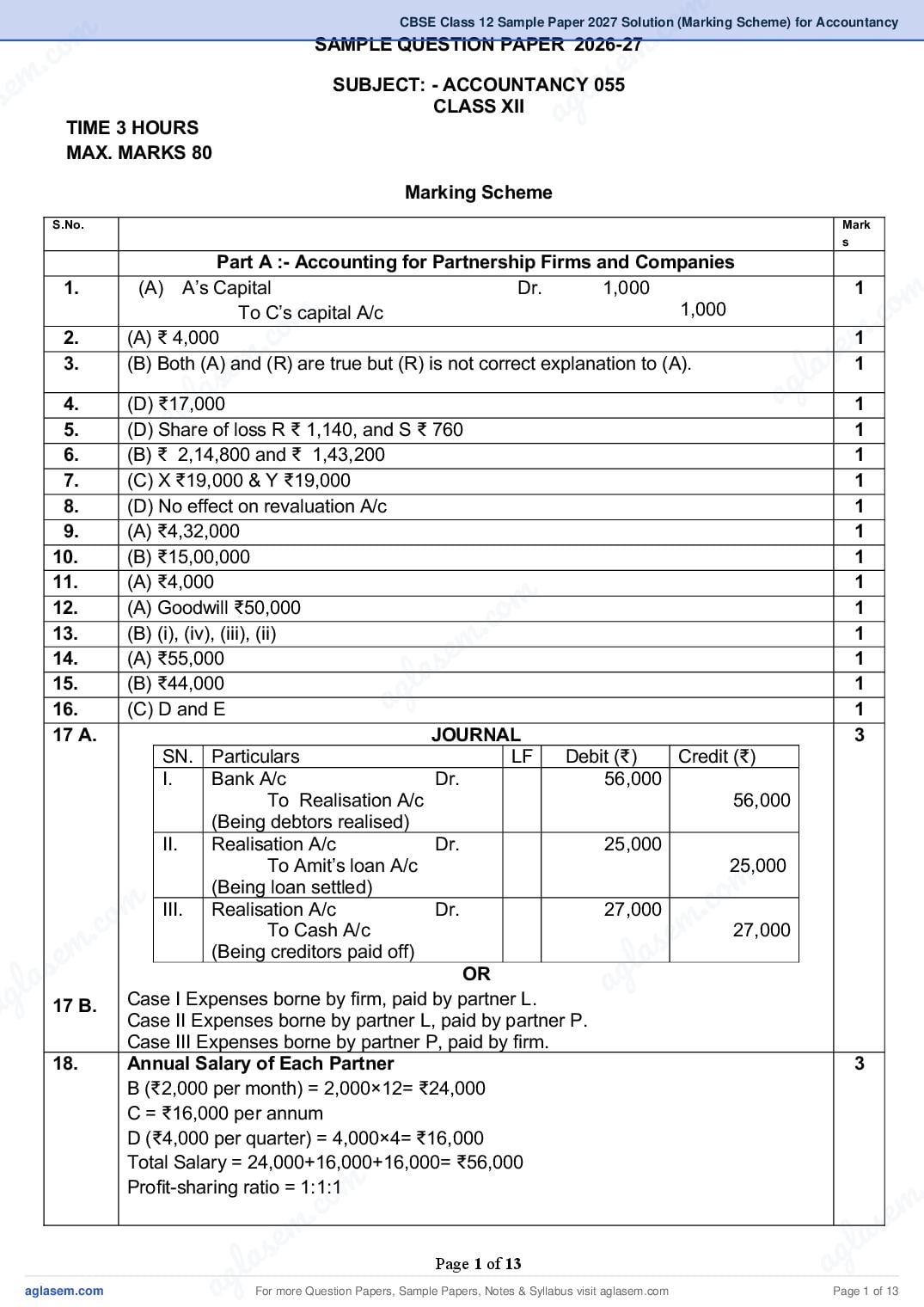
m SAMPLE QUESTION PAPER 2026-27 .c
m .co s e m
se la
SUBJECT: - ACCOUNTANCY 055
g
TIME 3 HOURS
CLASS XII
a
MAX. MARKS 80
Marking Scheme
S.No. Mark
s
Part A :- Accounting for Partnership Firms and Companies
1. (A) A’s Capital Dr. 1,000 1
m
m
To C’s capital A/c 1,000
.co
2. (A) ₹ 4,000
.co e
s1
m
1
3.
em
(B) Both (A) and (R) are true but (R) is not correct explanation to (A).
s l a
g la ag 1
a of loss R ₹ 1,140, and S ₹ 760
4. (D) ₹17,000
5. (D) Share 1
6. (B) ₹ 2,14,800 and ₹ 1,43,200 1
7. (C) X ₹19,000 & Y ₹19,000 1
8. (D) No effect on revaluation A/c 1
9. (A) ₹4,32,000 1
10. (B) ₹15,00,000 1
11. (A) ₹4,000 1
m
.co
12. (A) Goodwill ₹50,000 1
13. (B) (i), (iv), (iii), (ii)
e m 1
14. (A) ₹55,000
l as 1
ag
15. (B) ₹44,000 1
16. (C) D and E 1
17 A. JOURNAL 3
SN. Particulars LF Debit (₹) Credit (₹)
I. Bank A/c Dr. 56,000
To Realisation A/c 56,000
(Being debtors realised)
II. Realisation A/c Dr. 25,000
To Amit’s loan A/c 25,000
m
.co
(Being loan settled)
m
.co m
III. Realisation A/c Dr. 27,000
To Cash A/c 27,000
s e
s em (Being creditors paid off)
g la
g la 17 B. OR
a
a Case I Expenses borne by firm, paid by partner L.
Case II Expenses borne by partner L, paid by partner P.
Case III Expenses borne by partner P, paid by firm.
18. Annual Salary of Each Partner 3
B (₹2,000 per month) = 2,000×12= ₹24,000
C = ₹16,000 per annum
D (₹4,000 per quarter) = 4,000×4= ₹16,000
Total Salary = 24,000+16,000+16,000= ₹56,000
m .
.co
Profit-sharing ratio = 1:1:1
e m
em l as
las ag
g
Page 1 of 13
a For more Question Papers, Sample Papers, Notes & Syllabus visit Page 1 of 13
Page 3
Profit > Total Salary (₹56,000)
Remaining Profit:
62,000−56,000 = 6,000
This ₹6,000 is divided equally:
6,000÷3 = ₹ 2,000 each
Case 2: Net Profit 35,000 (45,000-10,000) < Total Salary (₹56,000)
When profit is insufficient, available profit is divided in the ratio of actual
appropriations which in the given case is 24,000:16,000:16,000, i.e. 3:2:2
So ₹35,000 will be divided in 3:2:2
B’s share= 35,000*3/7= ₹ 15,000
C’s share= 35,000*2/7= ₹ 10,000
D’s share= 35,000*2/7= ₹ 10,000
Case 3: Net Loss = ₹20,000+10,000= ₹ 30,000
In case of loss, no salary is allowed.
Loss is shared equally.
30,000÷3 = ₹ 10,000 each
19. I. Number of debentures = Purchase Consideration/ Issue Price 3
= 6,30,000/90 = 7,000 debenture
II.
JOURNAL
Date Particulars LF Dr. (₹) Cr. (₹)
Assets A/c Dr. 6,00,000
Goodwill A/c Dr. 70,000
To liabilities A/c 40,000
To Crane Ltd. 6,30,000
(Being business purchased)
Crane Ltd. Dr. 6,30,000
Discount on issue of debentures A/c Dr. 70,000
To 10% Debentures A/c 7,00,000
(Being 7,000 debentures issued at 10%
discount)
20. Year ending 31st March Profit Adjusted Profit 3
2022 (1,00,000) (1,00,000)
2023 30,00,000 30,00,000
2024 16,00,000 16,00,000
2025 17,50,000+3,00,000-70,000 19,80,000
2026 18,50,000-80,000+50,000 18,20,000
83,00,000
Average Profit = 83,00,000 ÷ 5 = ₹ 16,60,000
Goodwill = Average Profit × 3 years = 16,60,000 x 3 = ₹ 49,80,000
Page 2 of 13
For more Question Papers, Sample Papers, Notes & Syllabus visit Page 2 of 13
Page 4
m Balance sheet of XYZ Ltd. (Extract) . c
c.21.o em
Note s Amount
4
m a
se l
Particular Amount
Nog
a currentyear
previous
year
Equity and liabilities
Shareholder funds
a. Share capital 1 9,26,000 -
Notes to accounts:
m
.co
Particulars Amount (₹)
m
m
1.Share Capital .co s e m
s e l a
ag
Authorized Share capital
g l a
8,00,000 Equity share of ₹10 each 80,00,000
a -------------
Issued Share Capital
1,00,000 Equity Shares of ₹10 each 10,00,000
-------------
Subscribed and Called-up Capital:
Subscribed and fully paid up capital
90,000 Equity Shares of ₹10 each 9,00,000
Add: forfeited Shares
m 26,000
m .co 9,26,000
s e
a
.
l
ag
22 A. I. S’s Commission = 1,10,000*10/110 = ₹10,000 4
II. JOURNAL
Date Particulars LF Dr. (₹) Cr. (₹)
Profit & loss Appropriation a/c Dr. 1,10,000
To S’s Current a/c 55,000
To D’s Current a/c 22,000
To A‘s Current a/c 33,000
m
.co
(Being profit distributed)
m
c. o III. TABLE SHOWING ADJUSTMENT
s e m
e m la
las PARTICULARS S (₹) D (₹) A (₹)
ag
TOTAL
g
(₹)
a Commission to be credited 10,000 - - 10,000
Correct profit 50,000 20,000 30,000 1,00,000
Amount wrongly credited ( 55,000) (22,000) (33,000) (1,10,000)
Net effect 5,000 2,000 3,000 Nil
m .
.co s e m
s em l a
g la Page 3 of 13 ag
a For more Question Papers, Sample Papers, Notes & Syllabus visit Page 3 of 13
Page 5
Date Particulars LF Dr. (₹) Cr. (₹)
D’s Current a/c Dr. 2,000
A’s Current a/c Dr. 3,000
To S’s Current a/c 5,000
(Being adjustment of omitted commission)
22 B. Dr. Delta’s Executor’s A/c Cr.
Date Particulars (₹) Date Particulars (₹)
31-08-23 To Bank A/c 22,000 31-08-23 By Delta’s Capital A/c 3,22,000
31-03-24 To Bank A/c 1,17,500 31-03-24 By Interest A/c 17,500
31-03-24 To Balance c/d 2,00,000
3,39,500 3,39,500
31-03-25 To Bank A/c 1,20,000 1-04-24 By Balance b/d 2,00,000
31-03-25 To Balance c/d 1,00,000 31-3-25 By Interest A/c 20,000
2,20,000 2,20,000
31-03-26 To Bank A/c 1,10,000 1-04-25 By Balance b/d 1,00,000
31-3-26 By Interest A/c 10,000
1,10,000 1,10,000
23. I. JOURNAL 6
Dat Particulars LF Dr. (₹) Cr. (₹)
e
a) Bank A/c Dr. 67,500
To Debenture application and allotment A/c 67,500
( Being application money on 12% debentures
received)
Debenture application and allotment A/c Dr. 67,500
Discount on issue of debentures A/c Dr. 7,500
Loss on issue of debentures A/c Dr. 3,750
To 12% Debentures A/c 75,000
To Premium on redemption of
debentures A/c 3,750
(Being application money transferred to 12%
debentures a/c issued at discount 10%,
redeemable at 5% premium.)
b) Bank A/c Dr. 96,000
To Debenture application and allotment A/c 96,000
(Being application money on 9% debentures
received)
Debenture application and allotment A/c Dr. 96,000
Loss on issue of debentures A/c Dr. 8,000
To 9% debentures A/c 80,000
To Securities premium A/c 16,000
To Premium on redemption of 8,000
debentures A/c
(Being application money transferred to 9%
debentures a/c issued at premium of ₹20,
redeemable at a premium of ₹10)
II. JOURNAL
Date Particulars LF Dr (₹) Cr (₹)
Bank A/c Dr. 4,00,000
To Bank Loan A/c 4,00,000
Page 4 of 13
For more Question Papers, Sample Papers, Notes & Syllabus visit Page 4 of 13
Page 6
m .co
.co em
(Being loan raised from The Development
m Bank)
s
la 5,00,000 5,00,000
se Debenture Suspense A/c
To 9% Debentures A/c
Dr.
ag
(Being Debentures issued as collateral
Security)
Balance Sheet (Extract as per schedule 3)
As at …
Particulars Note Amount Amount
m
.co
No current previous
o m year year
m
. c s e
m
eLiabilities
Equity and liabilities
l a
as
l Borrowings
Non-Current
ag
a g
Long-Term 1 4,00,000
Notes to accounts:
Particulars (₹)
Long-term Borrowings
9% Debentures 5,00,000
Less: Debentures Suspense A/c
. c om 5,00,000 -
Bank Loan
e m 4,00,000
l as
ag
24. I. (A) A sacrifices 1/10 and B sacrifices 1/10; C gains 1/5 6
II. (C) C’s Capital A/c Dr.
To A’s Capital A/c
To B’s Capital A/c
III. (B) ₹ 30,000
IV. (A) ₹ 25,000
V. (C) Old ratio
VI. (A) ₹ 2,22,500
om
25 A. JOURNAL 6
m . c
c. o Date Particulars LF Dr. (₹)
s e m Cr. (₹)
s em 1 Machinery A/c Dr.
g l a
5,000
l a a10,000
ag
Furniture A/c Dr.
To Premium For Goodwill a/c 15,000
(Machinery and furniture brought by
the partner for premium for goodwill
share)
2 Premium For Goodwill A/c Dr. 15,000
To A’s capital A/c 5,000
To B’s capital A/c 10,000
m
(Premium for goodwill distributed
.
.co
between old partners)
s e m
s em l a
g la Page 5 of 13 ag
a For more Question Papers, Sample Papers, Notes & Syllabus visit Page 5 of 13
Page 7
Bad debts A/c Dr. 5,000
To Debtors A/c 10,000
(Debts amounting to 10,000 but only
paid 50% of the amount)
4 Revaluation A/c Dr. 4,500
Provision for doubtful debts A/c Dr. 500
To Bad debts A/c 5,000
(Bad debts adjusted to provision for
doubtful debts a/c and remaining
transferred to revaluation account)
5 Revaluation A/c Dr. 31,500
To Provision for doubtful
debts A/c 3,000
To Patents A/c 5,000
To Stock A/c 20,000
To Unforeseen liability A/c 3,500
(Assets and liabilities transferred to
revaluation account)
6 A’s capital A/c Dr. 12,000
B’s capital A/c Dr. 24,000
To Revaluation A/c 36,000
(Loss on revaluation transferred to
partners’ capital account)
7 General reserve A/c Dr. 6,000
To A’s capital a/c 2,000
To B’s capital a/c 4,000
(General reserve transferred to
partners capital account)
8 A’ s capital A/c Dr. 1,000
B’s capital A/c Dr. 2,000
To Profit and loss A/c 3,000
(Balance of profit and loss account
transferred to partners’ capital
account)
9 Bank A/c Dr. 1,08,000
To Z’s capital A/c 1,08,000
(Capital brought by the new partner
as per the combined capital of old
partners)
Adjusted capital of X = 150,000+5,000+2000-12000-1000 = ₹1,44,000
Adjusted capital of Y=300,000+10,000+4,000-24000-2000 = ₹2,88,000
Z will bring as capital =1/4 (144,000+2,88,000) = ₹1,08,000
Page 6 of 13
For more Question Papers, Sample Papers, Notes & Syllabus visit Page 6 of 13
Page 8
m .co
.co m
Balance Sheet (After Reconstitution)
s e
em a
Liabilities (₹) Assets (₹)
s Creditors 30,000 Cash
g l 1,33,000
Outstanding expenses 4,000 Debtors. 30,000 a
Less: Prov. For
doubtful debts (3000) 27,000
Capital accounts Stock 1,00,000
X 1,44,000
Y 2,88,000 Furniture 40,000
m
.co
Z 1,08,000 Machinery 2,77,500
m
.co
Unforeseen liabilities 3,500
e m
e m
5,77,500 5,77,500
l as
l as ag
Dr. ag
OR
25 B. Revaluation A/c Cr.
Particulars (₹) Particulars (₹)
To Provision for Legal 2400 By provision for doubtful 200
Claim debts
To Stock 1800 By furniture 2,000
To Partners’ Capital A/c By premises 9,000
A 2,800
m
.co
B 2,800
C 1,400 7,000
s
11,200em 11,200
g l a
Dr.
Particulars A (₹) B (₹)
aPartners’
C (₹)
Capital A/c
Particulars A (₹) B (₹) C (₹)
Cr.
To Goodwill 4,000 4,000 2,000 Balance b/d 92,000 60,000 40,000
To C’s capital 500 500 General 2,000 2,000 1,000
Reserve
To C’s capital 4,500 4,500 By A’s capital 4,500
To Bank 10,400 By B’s capital 4,500
To C loan 40,000 By Revaluation 2,800 2,800 1,400
To balance c/d 87,800 55,800 By A’s capital
m 500
o 500
m By B’s capital
. c
c. o 96,800 64,800 52,400 96,800
s e m64,800 52,400
em laDr (₹)
26 A. JOURNAL 6
las Date Particulars LF
g
a 16,20,000
Cr (₹)
ag 1 Bank A/c Dr
To Equity Share Application A/c 16,20,000
(Application money received on 2,70,000
shares)
2 Equity Share application A/c Dr 16,20,000
To Equity Share Capital A/c 4,80,000
To Bank A/c 3,00,000
To Equity Share Allotment A/c 6,00,000
m .
.co m
To Securities Premium A/c 2,40,000
s e
em
(Share application accepted on 1,20,000
s l a
g la Page 7 of 13 ag
a For more Question Papers, Sample Papers, Notes & Syllabus visit Page 7 of 13
Page 9
3 Equity Share Allotment A/c Dr 6,00,000
To Equity Share Capital A/c 4,80,000
To Securities Premium A/c 1,20,000
(Allotment money due on 1,20,000
shares)
4 Equity Share first call A/c Dr 3,60,000
To Equity Share capital A/c 2,40,000
To Securities Premium A/c 1,20,000
(First call money due on 1,20,000 shares)
5 Bank A/c Dr 3,56,400
Call in arrears A/c Dr 3,600
To Equity Share First call A/c 3,60,000
(First call received)
6 Equity Share capital A/c Dr 12,000
Securities Premium A/c Dr 1,200
To Share Forfeited A/c 9,600
To Equity share first call A/c 3,600
(1,200 shares forfeited for non-payment
of call money)
7 Bank A/c Dr 1,20,000
To Equity Share Capital A/c 12,000
To Securities Premium A/c 1,08,000
(All forfeited shares reissued)
8 Share forfeited A/c Dr 9,600
To Capital Reserve A/c 9,600
(Gain on reissue of shares transferred to
capital reserve)
OR
26 B.
I.
Dr. Cash Book Cr.
Particulars (₹) Particulars (₹)
To Share application A/c 15,00,000 By Share application A/c 1,00,000
To Share allotment A/c 70,60,000 By Balance c/d 86,10,000
To Share capital A/c 50,000
To Securities premium 1,00,000
A/c
87,10,000 87,10,000
Dr. Share Capital A/c Cr.
Particulars (₹) Particulars (₹)
To Share Forfeited A/c 1,80,000 By Share Application 10,00,000
A/c
To Balance c/d 8,70,000 By Bank A/c 50,000
10,50,000 10,50,000
Page 8 of 13
For more Question Papers, Sample Papers, Notes & Syllabus visit Page 8 of 13
Page 10
m .co
.co em
Dr. Securities Premium A/c Cr.
em
Particulars (₹) Particulars
l as (₹)
s To Share Allotment/Calls
in Arrears A/c 15,40,000 ag
By Share Allotment A/c 90,00,000
To Balance c/d 75,60,000 By Bank A/c 1,00,000
91,00,000 91,00,000
II. Journal Entries
Date Particulars LF Dr. (₹) Cr. (₹)
1 Securities premium A/c Dr. 15,40,000
Share capital A/c Dr. 1,80,000
m
m
To Share Allotment A/c /calls in
.co
m .co
arrears A/c 15,40,000
s e m
s e To Share forfeited A/c
l
1,80,000 a
g l a
(Being 18,000 shares forfeited for non-
ag
a2 payment of allotment)
Bank A/c Dr. 1,50,000
To Share capital A/c 50,000
To securities premium A/c 1,00,000
(Being 5,000 forfeited shares reissued
at premium)
3 Share forfeited A/c Dr. 50,000
om
To Capital Reserve A/c 50,000
(Being profit on reissue transferred to
. c
Capital Reserve)
e m
as
l of Financial Statements
ag (Option – I)
Part B :- Analysis
27. (C) ₹ 1,50,000 1
28. (A) Both A and R are correct, and R is the correct explanation of A 1
29. (B) Cash used in investing activities ₹ 8,00,000 1
30. (C) Purchase of marketable securities for ₹ 25,000 cash 1
31 A. Comparative Income statement 3
for the year ended March 31, 2026
m %
m Particulars 2025 2026 Absolute
c. o Change
m .co (₹) (₹)
s e Change m
s e 40,00,000 gl
a (₹)
la a
Revenue from operations 20,00,000 20,00,000 100
ag Expenses
Cost of Revenue from
operations 2,00,000 4,00,000 2,00,000 100
Interest paid 1,00,000 1,00,000 ------ ----
Total expenses 3,00,000 5,00,000 2,00,000 66.67
IV.Net profit before tax (I-III) 17,00,000 35,00,000 18,00,000 105.88
V.Less: Income tax 8,50,000 17,50,000 9,00,000 105.88
m .
Net profit after Tax (IV-V)
.co 8,50,000 17,50,000 9,00,000 105.88
s e m
s em l a
g la Page 9 of 13 ag
a For more Question Papers, Sample Papers, Notes & Syllabus visit Page 9 of 13
Page 11
31 B. Common Size Statement of Profit and Loss
for the year ended March 31, 2026
Particulars 2026 (₹) % Change of
Revenue from
operation
Revenue from operations 6,00,000 100
Other incomes 30,000 5
Total Revenue 6,30,000 105
Expenses
Cost of Revenue from operations 4,00,000 66.67
Indirect Expenses (2,00,000 x 25%) 50,000 8.33
Total expenses 4,50,000 75
IV.Net profit before tax (I-III) 1,80,000 30
V.Less: Income tax 54,000 9
Net profit after Tax (1V-V) 1,26,000 21
32. Items head Sub - head 3
I. Warranty claims payable Current Liabilities
Other current
liabilities
II. Preliminary expenses written Expenses in statement Other Expenses
off of Profit & loss account
III. Interest Accrued but not Due Current Liabilities Other current
on Debentures. liabilities
33 A. I. Decrease in Quick Ratio 4
Reason: Quick Assets decrease while Quick Liabilities remain unchanged
II. Increase in Quick Ratio
Reason: A new Quick Asset (insurance receivable) is created, received with
in operating cycle
III. Increase in Quick Ratio
Reason: Quick Assets will increase as cash will be received in 12 months.
IV. Decrease in Quick Ratio
Reason: Quick Assets decrease (Bank reduced by 80,000), while Quick
Liabilities remain unchanged.
OR
33 B. Current ratio = Current Assets/Current Liabilities
Current Assets = Liquid assets + Closing inventory+ Prepaid expenses =75,000+
11,000+2,000 = 88,000
Current ratio = 88,000/60,000 = 1.47:1
Inventory Turnover ratio = Cost of revenue from operation/Average inventory
Cost of revenue from operation = Opening Inventory + Purchases + Direct expenses
– Closing inventory = 7,000+3,50,000+10,000+40,000-11,000
= ₹ 3,96,000
Average inventory = (7,000+11,000)/2 = ₹ 9,000
Inventory Turnover ratio = 3,96,000/9,000 = 44 times
Page 10 of 13
For more Question Papers, Sample Papers, Notes & Syllabus visit Page 10 of 13
Page 12
m .co
c.34.o Cash Flow Statement
s em
6
m for the year ended 31st March 2026
a
se Particulars
A. Cash Flow from Operating Activities
Amounts
ag
l (₹)
Net Profit before Tax and Extraordinary Items 75,000
Adjustments for non-cash and non-operating items:
Add: Depreciation 33,000
Amortization of goodwill 36,000
Loss on sale of Machinery 1,000
Interest on debentures 10,250
m
.co
Less: Gain on sale of land (20,000) 60,250
m
.co
Operating profit before working capital changes 1,35,250
e m
Less: Increase in Current Assets and Decrease in
em l as
l as
Current Liabilities
Trade Receivables (20,500) ag
ag
Trade Payables (12,500) (33,000)
Cash generated from operation 1,02,250
Less: Tax paid (38,500)
Net Cash flow in Operating Activities 63,750
B. Cash Flow from Investing Activities
Sale of Machinery 3,000
Purchase of Machinery
m (1,47,000)
Purchase of land
.co (2,00,000)
Sale of land
s em 2,20,000
la
Net Cash used in Investing Activities (1,24,000)
Working Notes: g
a Machinery A/c
Dr. Cr.
Particulars (₹) Particulars (₹)
To Balance b/d 5,00,000 By Accumulated 8,000
Depreciation A/c
To Bank A/c 1,47,000 By Bank A/c 3,000
m
c. o
By Loss on sale of 1,000
m
.co
machinery A/c
e m
s
By balance c/d 6,35,000
e m la
las 6,47,000
ag 6,47,000
ag
Dr. Accumulated Depreciation A/c Cr.
Particulars (₹) Particulars (₹)
To Machinery A/c 8,000 By Balance b/d 75,000
To Balance c/d 1,00,000 By Statement of profit &
loss 33,000
m .
.co m
1,08,000 1,08,000
s e
s em l a
g la Page 11 of 13 ag
a For more Question Papers, Sample Papers, Notes & Syllabus visit Page 11 of 13
Page 13
Surplus i.e. change in closing balance and opening balance = 50,000
Add: Provision for tax = 25,000
75,000
Part B :- Computerised Accounting
(Option – II)
27. (B) Correct # REF ! Error 1
28. (C) Using $ sign 1
29. (D) Array 1
30. (B) Numbers and letters are assigned in consecutive order 1
31 A. (i) Contra Voucher 3
A Contra Voucher is used to record transactions involving cash and bank
accounts only.
It is prepared when:
¥ Cash is deposited into bank
¥ Cash is withdrawn from bank
¥ Transfer from one bank account to another
(ii) Post-dated Voucher
A Post-dated Voucher is a voucher prepared on the current date but entered in the
books on a future date.
It is used when:
¥ Payment or receipt is scheduled for a future date
¥ Post-dated cheques are issued or received
The entry is recorded only on the specified future date.
(iii) Receipt Voucher
A Receipt Voucher is used to record cash or bank receipts.
It is prepared when:
¥ Cash is received from customers
¥ Cheque is received
¥ Any other amount is received
OR
Advantages of Pivot Table Report
1. Summarizes large data quickly
2. Easy data analysis (totals, averages, counts etc.)
3. Flexible arrangement (rows and columns can be rearranged easily)
4. Quick comparison of data
5. Automatic calculations
6. Time-saving and user-friendly
32. Three limitations of Computerised Accounting System: 3
1. High Initial Cost
Installation of hardware, software, and training of staff requires significant
investment.
2. Risk of Data Loss
Data may be lost due to system failure, virus attack, hacking, or power
breakdown if proper backup is not maintained.
3. Dependence on Skilled Personnel
Trained staff is required to operate and maintain the system. Lack of technical
knowledge may lead to errors.
Page 12 of 13
For more Question Papers, Sample Papers, Notes & Syllabus visit Page 12 of 13
Page 14
m c
Validation is a feature in MS Excel that controls the type of. data entered into a
c.33o A. Data s e m 4
m cell.
la to predefined rules.
se g
It ensures that users enter correct and specific data according
For example: a
¥ Allowing only whole numbers between 1 and 100
¥ Allowing only dates within a certain range
¥ Creating a drop-down list of allowed values
It helps in maintaining accuracy and consistency of data.
OR
The Error Alert tab in Data Validation allows you to:
m
.co
33 B.
¥ Display an error message when invalid data is entered
m
.co m
¥ Prevent incorrect data entry
m
¥ Choose the type of alert:
s e
s e
o Stop (Prevents entry completely)
l a
g l a
o Warning (Allows entry after warning)
ag
a o Information (Shows message but allows entry)
It helps in controlling wrong inputs effectively.
34. The formula =SUM(B2B3) will display a #NAME? error. 6
Reason:
Excel shows #NAME? error when:
¥ The formula contains incorrect syntax.
¥ A range operator (:) is missing between cell references.
In =SUM(B2B3), the colon (:) between B2 and B3 is missing.
m
.co
Steps to Correct the Error:
1. Select the cell showing the error.
e m
2. Click on the Formula Bar.
l as
3. Correct the formula by inserting a colon between the cell references:
=SUM(B2:B3)
4. Press Enter. ag
The formula will now correctly calculate the sum of cells B2 and B3.
Correct Formula: =SUM(B2:B3)
m
m .co
m .co s e m
s e g la
g la a
a
m .
.co s e m
s em l a
g la Page 13 of 13 ag
a For more Question Papers, Sample Papers, Notes & Syllabus visit Page 13 of 13
Document Details
| Board / Org | CBSE |
| Exam | Class 12 |
| Type | Solution |
| Pages | 13 |
| Updated | 29 Oct 2026 |