CBSE Class 12 Sample Paper 2027 Solution (Marking Scheme) for Applied Maths
Finished viewing? Save it for later —
Download CBSE Class 12 Sample Paper 2027 Solution (Marking Scheme) for Applied Maths (PDF · 13 pages)About CBSE Class 12 Sample Paper 2027 Solution (Marking Scheme) for Applied Maths
CBSE Class 12 Sample Paper 2027 Solution (Marking Scheme) for Applied Maths is available here for free download. Published by CBSE for Class 12, this solution can be viewed online or downloaded as a PDF (13 pages). Candidates preparing for Class 12 can use CBSE Class 12 Sample Paper 2027 Solution (Marking Scheme) for Applied Maths to understand the exam pattern, the type of questions asked, and the overall difficulty level.
Frequently Asked Questions
How can I download CBSE Class 12 Sample Paper 2027 Solution (Marking Scheme) for Applied Maths?
Open this page and click the Download button to save CBSE Class 12 Sample Paper 2027 Solution (Marking Scheme) for Applied Maths as a PDF. It is completely free on AglaSem Docs.
Is CBSE Class 12 Sample Paper 2027 Solution (Marking Scheme) for Applied Maths free to download?
Yes. CBSE Class 12 Sample Paper 2027 Solution (Marking Scheme) for Applied Maths can be viewed online and downloaded as a PDF free of cost on AglaSem Docs.
How many pages does CBSE Class 12 Sample Paper 2027 Solution (Marking Scheme) for Applied Maths have?
CBSE Class 12 Sample Paper 2027 Solution (Marking Scheme) for Applied Maths contains 13 pages, which you can read online or download together as a single PDF.
Where can I find more Class 12 study material?
You can find more Class 12 question papers, sample papers, syllabus, and answer keys on AglaSem Docs.
CBSE Class 12 Sample Paper 2027 Solution (Marking Scheme) for Applied Maths – Text
Read the full text of this solution below — useful to quickly search, copy and reference the content online without downloading the PDF.
📄 View text version (14 pages)
Page 1
CBSE Class 12 Sample
Paper 2027 Solution
(Marking Scheme) for
Applied Maths
EXAM YEAR TYPE SUBJECT
CBSE Class 12 2027 Solutions Maths
Notes · Sample Papers · Previous Year Papers · Mock Tests
Page 2
m .co
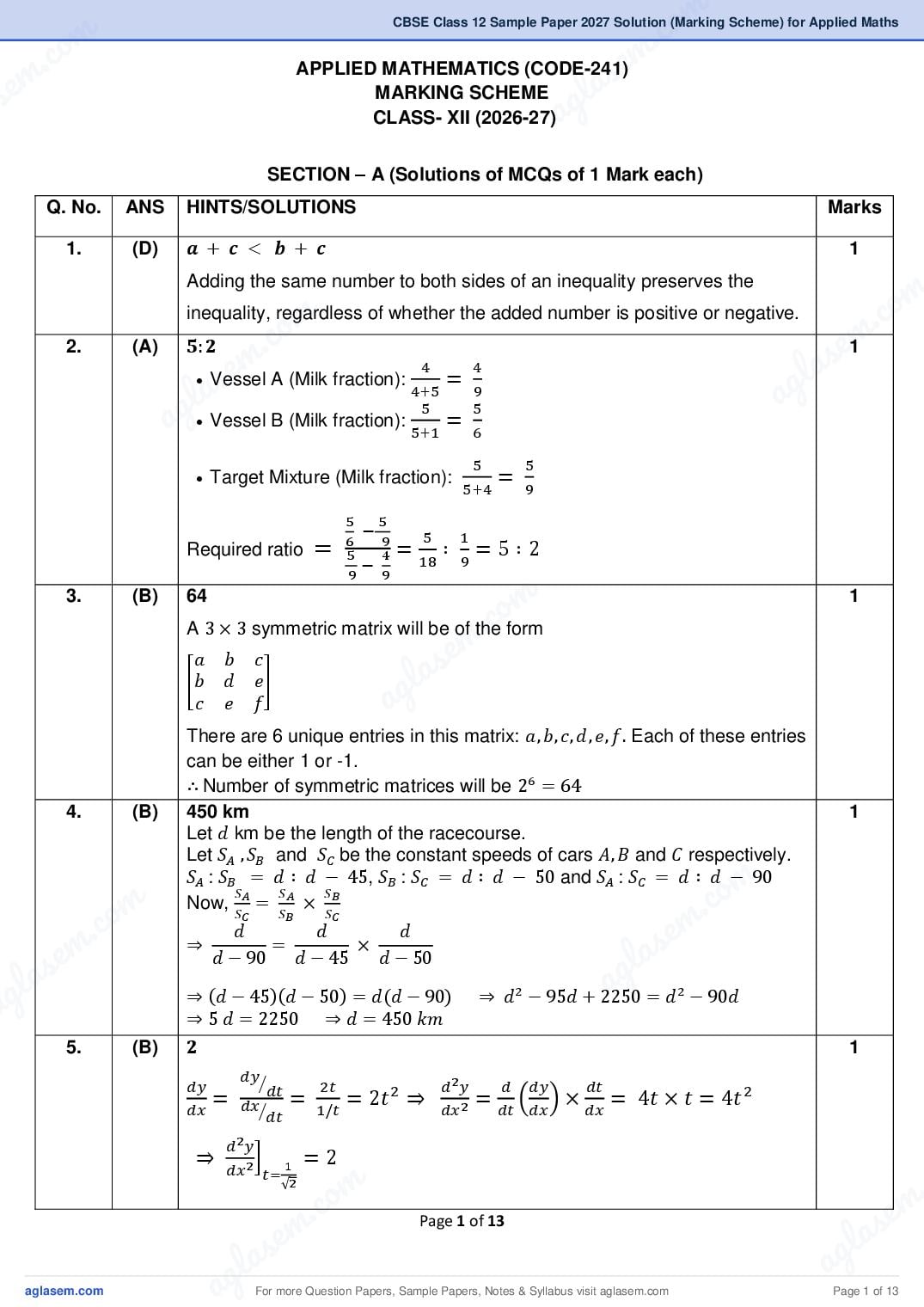
m .co APPLIED MATHEMATICS (CODE-241)
s e m
se MARKING SCHEME
g l a
CLASS- XII (2026-27) a
SECTION – A (Solutions of MCQs of 1 Mark each)
Q. No. ANS HINTS/SOLUTIONS Marks
1. (D) 𝒂 + 𝒄 < 𝒃 + 𝒄 1
Adding the same number to both sides of an inequality preserves the
m
m
inequality, regardless of whether the added number is positive or negative.
.co
𝟓: 𝟐 .co s e1m
em
2. (A)
s 4 4
l a
ag
=
l a
Vessel A (Milk fraction):
4+5 9
ag Vessel B (Milk fraction): 5+1 = 6
5 5
5 5
Target Mixture (Milk fraction): =
5+4 9
5 5
− 5 1
6 9
Required ratio = 5 4 = 18 ∶ 9 = 5 ∶ 2
− 9
9
om
3. (B) 64 1
A 3 × 3 symmetric matrix will be of the form . c
e m
𝑎 𝑏 𝑐
las
[𝑏
𝑐
𝑑
𝑒
𝑒]
𝑓 ag
There are 6 unique entries in this matrix: 𝑎, 𝑏, 𝑐, 𝑑, 𝑒, 𝑓. Each of these entries
can be either 1 or -1.
∴ Number of symmetric matrices will be 26 = 64
4. (B) 450 km 1
Let 𝑑 km be the length of the racecourse.
Let 𝑆𝐴 , 𝑆𝐵 and 𝑆𝐶 be the constant speeds of cars 𝐴, 𝐵 and 𝐶 respectively.
𝑆𝐴 : 𝑆𝐵 = 𝑑 ∶ 𝑑 − 45, 𝑆𝐵 : 𝑆𝐶 = 𝑑 ∶ 𝑑 − 50 and 𝑆𝐴 : 𝑆𝐶 = 𝑑 ∶ 𝑑 − 90
m
m .co
𝑆 𝑆 𝑆
Now, 𝑆𝐴 = 𝑆𝐴 × 𝑆𝐵
.co em
𝐶 𝐵 𝐶
e m ⇒
𝑑
=
𝑑
×
𝑑
las
las 𝑑 − 90 𝑑 − 45 𝑑 − 50
g
a = 𝑑 − 90𝑑
ag ⇒ (𝑑 − 45)(𝑑 − 50) = 𝑑(𝑑 − 90) ⇒ 𝑑 − 95𝑑 + 2250
⇒ 5 𝑑 = 2250 ⇒ 𝑑 = 450 𝑘𝑚
2 2
5. (B) 𝟐 1
𝑑𝑦⁄
𝑑𝑦 2𝑡 𝑑2𝑦 𝑑 𝑑𝑦 𝑑𝑡
= 𝑑𝑥 𝑑𝑡 = = 2𝑡 2 ⇒ = ( ) × 𝑑𝑥 = 4𝑡 × 𝑡 = 4𝑡 2
𝑑𝑥 ⁄𝑑𝑡 1/𝑡 𝑑𝑥 2 𝑑𝑡 𝑑𝑥
𝑑2𝑦
⇒ ] =2
𝑑𝑥 2 𝑡= 1
m .
.co
√2
e m
em
Page 1 of 13
l as
l as ag
ag For more Question Papers, Sample Papers, Notes & Syllabus visit Page 1 of 13
Page 3
7. (C) 3 1
Here y = (a + b)log(x + c) − dex+k can be written as
y = A log(x + c) − dex . 𝑒 𝑘
⇒ y = A log(x + c) − Bex , where a + b = A and d. ek = B.
Clearly the given differential equation has three arbitrary constants, so its
order is 3
8. (D) 𝟒𝟎(𝒆𝟐 − 𝒆𝟏 ) 1
4
4 20 𝑒 0.5𝑥
Increase in revenue = ∫2 20𝑒 0.5𝑥 𝑑𝑥 = ] = 40 (𝑒 2 − 𝑒 1 )
0.5 2
9. (C) Principal component increases and interest component decreases. 1
10. (B) 8% 1
𝑅 3200
𝑃= ⟹ 40000 = ⟹ 𝑖 = 0.08
𝑖 𝑖
⟹ 𝑟 = 0.08 = 8 %
11. (B) 𝟓𝒆−𝟓 1
Mean rate per 100 𝑐𝑚² = 2
2
For 250 𝑐𝑚², mean 𝜆 = × 250 = 5
100
51
𝑃(𝑋 = 1) = 𝑒 −5 × 1! = 5𝑒 −5
12. (D) Neither I nor II 1
13. (B) Y is more consistent than X 1
Variance measures spread/dispersion around mean.
Lower Variance → More Consistent (as the values closer to mean)
Higher Variance → Less Consistent (values more spread out)
Since Y has lower variance, its values are more tightly clustered around the
mean.
So, Y is more consistent than X.
14. (B) Minimum 1
15. (C) We are 99% confident that the calculated interval of (501.125, 508.875) 1
grams contains the true mean weight 𝝁.
16. (C) 𝟐 1
𝟑
2 × 6𝐶4 × 𝑝4 × 𝑞 2 = 3 × 6𝐶3 × 𝑝3 × 𝑞 3
⟹ 30 𝑝4 𝑞 2 = 60 𝑝3 𝑞 3
⟹ 𝑝 = 2𝑞
⟹ 𝑝 = 2(1 − 𝑝)
2
∴𝑝=
3
Page 2 of 13
For more Question Papers, Sample Papers, Notes & Syllabus visit Page 2 of 13
Page 4
om .co
c. 17. e m
em
(A) 𝟏
l as 1
s 𝟐
𝑃(𝑋=𝑟) 𝑛𝐶𝑟 𝑝𝑟 𝑞 𝑛−𝑟 𝑝 2𝑟−𝑛 ag
= 𝑛−𝑟 𝑟
=( )
𝑃(𝑋=𝑛−𝑟) 𝑛𝐶𝑛−𝑟 𝑝 𝑞 𝑞
𝑝
which will be independent of 𝑛 and 𝑟 only when =1
𝑞
1
i.e., 𝑝 = 𝑞 =
2
18. (C) A line segment 1
m
m .co
m .co s e m
s e l a
g l a ag
a
m
.co
s em
g la
a
The feasible region is the line segment 𝑥 + 𝑦 = 5.
19. (C) Assertion (A) is true but Reason (R) is false. 1
|2. 𝑎𝑑𝑗 (𝐴)| = 23 |𝑎𝑑𝑗(𝐴)| = 8 × 42 = 128. So, Assertion is true, whereas
Reason is false as |𝑘 𝐴| = 𝑘 𝑛 |𝐴|
20. (D) Assertion (A) is false but Reason (R) is true. 1
m
.co
Two distributions can have same mean but different variance.
m
.co m
So, Assertion is false whereas Reason is true.
m s e
s e Section –B
g l a
g la [This section comprises of solution of very short answer type questions (VSA) of 2 marks
a
a 21(A).
each]
As 𝑥 is an odd integer so 𝑥 = 2𝑛 + 1, where 𝑛 ∈ 𝑍
Now to show 𝑥 2 ≡ 1(𝑚𝑜𝑑8)
Consider, (2𝑛 + 1)2 = 4𝑛2 + 4𝑛 + 1 = 4𝑛(𝑛 + 1) + 1 = 4(2𝑚) + 1
1
∵ product of two consecutive integers is always even
⇒ 𝑥 2 = (2𝑛 + 1)2 = 8𝑚 + 1 ≡ 1(𝑚𝑜𝑑8) ⇒ 𝑥 2 ≡ 1(𝑚𝑜𝑑8) 1
∵ 8𝑚 + 1 leaves remainder 1 when divided by 8.
m .
OR
.co s e m
em a
Page 3 of 13
s l
l a ag
ag For more Question Papers, Sample Papers, Notes & Syllabus visit Page 3 of 13
Page 5
We have, 35 ≡ 243 (𝑚𝑜𝑑11) ≡ 1 (𝑚𝑜𝑑 11) ½
⇒ 35 ≡ 1(𝑚𝑜𝑑11) ⇒ (35 )66 ≡ 166 𝑚𝑜𝑑11 ≡ 1 𝑚𝑜𝑑11
⇒ 3330 ≡ 1(𝑚𝑜𝑑11) ⇒ 3330 × 33 ≡ 27(𝑚𝑜𝑑11) ⇒ 3333 ≡ 27(𝑚𝑜𝑑11) 1
⇒ 3333 ≡ 5(𝑚𝑜𝑑11) ∴ 𝑥 = 5 ½
22. 𝐶−𝑆
Under linear depreciation, 𝐷 =
𝑛
120000−10000
⟹𝐷= ½
10
110000
⟹𝐷= = 11000
10 ½
The annual depreciation is ₹ 11000.
By the end of 6 years the book value = (𝐶 − 6𝐷) = 120000 − 6(11000)
= ₹ 54000 1
23. Distance covered upstream and downstream is 12 km each side.
Let speed of man in still water be 𝑥 km/h and speed of the stream is 4 km/h
Then speed downstream = (𝑥 + 4) km/h
and speed upstream = (𝑥 − 4) km/h ½
12 12
According to question, + = 4 ½
𝑥+4 𝑥−4
1 1 1 𝑥−4+𝑥+4 1
⟹ + = ⟹ =
𝑥+4 𝑥−4 3 (𝑥+4)(𝑥−4) 3
⟹ 6𝑥 = 𝑥 2 − 16 ⟹ 𝑥 2 − 6𝑥 − 16 = 0 ½
⟹ (𝑥 − 8 ) ( 𝑥 + 2) = 0
⟹ 𝑥 = 8 or 𝑥 = − 2 but 𝑥 ≠ – 2 ∴ 𝑥 = 8 km/h. ½
Hence speed of man in still water is 8 km/h.
24(A). Given 𝑃(𝑋 = 2) = 𝑃(𝑋 = 3)
𝑚2 𝑚3 ½
⟹ 𝑒 −𝑚 = 𝑒 −𝑚
2! 3!
⟹ 3𝑚2 = 𝑚3
∴𝑚=3 1
So, mean = variance = 𝑚 = 3 ½
OR
24 (B). 6 ½
(i) Rate per 6 minutes = 20 × = 2 trains
60
∴𝑚=2 ½
22
(ii) Probability of exactly 2 trains = (𝑋 = 2) = 𝑒 −2
2!
= 2 × 0.1353 = 0.2706 1
Page 4 of 13
For more Question Papers, Sample Papers, Notes & Syllabus visit Page 4 of 13
Page 6
m .co
c. o25. 𝑥 𝑦
s e m
em + = 1 i.e, 𝑥 + 𝑦 = 6
a
Equation of AB is ½
s 6 6
g l
𝑥
Equation of CD is 8 + 4 = 1 i.e, 𝑥 + 2𝑦 = 8
𝑦
a ½
𝑥 𝑦
Equation of EF is + = 1 i.e, 2𝑥 + 𝑦 = 8 ½
4 8
Constraints are: 𝑥 + 𝑦 ≤ 6, 𝑥 + 2𝑦 ≥ 8, 2𝑥 + 𝑦 ≥ 8 ½
Section –C
[This section comprises of solution of short answer type questions (SA) of 3 marks each]
m
26(A) Given 𝑆(𝑡) = m
c. o , 𝑡 > 0
4𝑡 2 +1
m .co
𝑡
s e
s em l a
ag
For finding intervals for increasing or decreasing let’s find 𝑆′(𝑡).
g la
𝑆(𝑡)a =
4𝑡 2 +1 1
= 4𝑡 +
𝑡 𝑡
1 4𝑡 2 −1 (2𝑡−1)(2𝑡+1)
⇒ 𝑆’(𝑡) = 4 − = = 1
𝑡2 𝑡2 𝑡2
1 1
Now for decreasing: 𝑆′(𝑡) ≤ 0 ⇒ (2𝑡 − 1)(2𝑡 + 1) ≤ 0 ⇒ − ≤𝑡 ≤
2 2
1
As 𝑡 > 0 ∴ for 0 < 𝑡 ≤ , 𝑆(𝑡) is decreasing. 1
2
m
⇒ for first half of the opening day, the price of the IPO decreased. .co
s em
Now for increasing: 𝑆′(𝑡) ≥ 0 ⇒ (2𝑡 − 1)(2𝑡 + 1) ≥ 0
g la
a ⇒ − -≤ 𝑡 𝑎𝑛𝑑 𝑡 ≥
1
2
1
2
1
As 𝑡 > 0 ∴ for 𝑡 ≥ , 𝑆(𝑡) is increasing. 1
2
⇒ After the first half of the opening day, the price of the IPO kept increasing.
Hence, the stock price decreased for the first half of the opening day and then
started increasing thereon.
m
c o m OR
m .co
. s e
em a
26(B). 𝐝𝐏 1 1 1
= (Q − Q ) [ (15 − 2P) − (3P − 5) ] = (20 − 5P)
l
(i) =
s
d S
g
𝐝𝐭 2 2 2
g la ⇒
𝐝𝐏
= (20 − 5P)
1 a
a
1
𝐝𝐭 2
(ii) Solving the differential equation by separating the variables
𝐝𝐏 1 𝟏 1
= dt ⇒ ∫ dP = ∫ dt + C ½
𝟐𝟎−𝟓𝐏 2 𝟐𝟎−𝟓𝐏 2
log|20 − 5P| 1
⇒ = t+C
−5 2
om .
⇒ 2 log|20 − 5P| = −5t − 10 C (1) ½
.c e m
em
Page 5 of 13
l as
l as ag
ag For more Question Papers, Sample Papers, Notes & Syllabus visit Page 5 of 13
Page 7
1
⇒ 2 log|20 − 10| = −10 C ⇒ − log10 = C
5
½
Using this in (1), we get 2 log|20 − 5P| = −5t + 2 log 10
20−5P 20−5P 20−5P
⇒ 2 log (
10
) = −5t ⇒ log ( ) = −2.5t ⇒ = e−2.5t
10 10
⇒ 20 − 5P = 10e−2.5t ⇒ 20 − 10e−2.5t = 5P ½
⇒ P = 4 − 2e−2.5t ⇒ P = 2( 2 − e−2.5t )
27. Converting the parameters to their quarterly values.
Periods of interest (n) = 4 x 5 = 20,
½
yield rate r = 6% so i = 6/400 = 0.015
Face value (F) = ₹1000
Annual coupon payment = 1000 x 4% = ₹40
½
Quarterly coupon payment = 40/4 = ₹10
Now redemption price = face value
Purchase price of bond (P) =
1−(1+i)−n 1−(1+0.015)−20
C[
i
] + R(1 + i)−n = 10[ 0.015
] + 1000(1 + 0.015)−20 1
1−0.742
= 10 [ ] + 1000 × 0.742
0.015
= 172 + 742 = ₹ 914 1
28(A). Let PV of the share is ₹ 100 then final value = 100 + 0.331 × 100 = ₹133.10 ½
1
𝐹𝑉 𝑛
CAGR = [( ) − 1] × 100
𝑃𝑉
1
1
133.10 𝑛
⟹ 8.5 = [( ) − 1] × 100 ⟹ 8.5 = [(1.331)𝑛 − 1] × 100 ½
100
1
⟹ 1.085 = (1.331)𝑛
1 log(1.331)
⟹ log(1.085) = log(1.331) ⟹𝑛 = 1
𝑛 log(1.085)
0.124
⟹𝑛= = 3.5 years (approx.) 1
0.035
∴ Required number of years = 3.5 years (approx.)
OR
Page 6 of 13
For more Question Papers, Sample Papers, Notes & Syllabus visit Page 6 of 13
Page 8
om .co
c. 28(B). e m
m Capital requirement after 𝑛 years = ₹ 45,000,000
as
se Annual payment into the sinking fund = ₹ 5,00,000 gl
a
𝑟 = 15% ⟹ 𝑖 = 0.15 ½
(1+𝑖)𝑛 −1
Now sinking fund 𝑆 = 𝑃 ×
𝑖
(1+0.15)𝑛 −1
⟹ 45000000 = 500000 × ½
0.15
⟹ 90 × 0.15 = [(1.15)𝑛 − 1] ⟹ 13.50 = (1.15)𝑛 − 1 ⟹ (1.15)𝑛 = 14.5 1
Applying log on both sides we get 𝑛 log(1.15) = log(14.5)
o m
m . c
.co m
log(14.5) 1.161
e
⟹𝑛= = 0.061 = 19.03 years (approx.) 1
e m
log(1.15)
l as
s
So, the required number of years = 19.03 years (approx.)
a ag
1l 2
29. A =a[g ]
2 1
5 4
A2 = [ ] ½
4 5
13 14
A3 = [ ]
14 13 ½
13 14 7 14 6 0 0 0
⟹ A3 − 7A − 6 I = [ ] −[ ]−[ ]=[ ]=O
om
14 13 14 7 0 6 0 0 1
. c
1 1 5 4
Now, A−1 = (A2 − 7I) = ([ ] − [
7 0
e]) =
1 −2
[
4
] = [ m
−1/3 2/3
]
6 6 4 5
s
0 7 6 4
la(𝜎) = 6.25
−2 2/3 −1/3 1
30. ag
Mean (𝜇) = 30, standard deviation
20−30
(i) For 𝑋 = 20, 𝑍 = = −1.6
6.25
40−30
For 𝑋 = 40, 𝑍 = = 1.6
6.25
𝑃(20 < 𝑋 < 40) = 𝑃(−1.6 < 𝑍 < 1.6) = 2 𝑃(0 ≤ 𝑍 < 1.6)
= 2 × 0.4452 = 0.8904 1
m
m
c. o (ii)
∴ Number of students = 2000 × 0.8904 = 1780.8 ≈ 1781 students
m.co ½
m For 𝑋 = 25, 𝑍 =
25−30
= −0.8
s e
s e 6.25
g l a
g la a
𝑃(𝑋 < 25) = 𝑃(𝑍 < −0.8) = 0.5 − 𝑃(0 ≤ 𝑍 ≤ 0.8)
a = 0.5 − 0.2881 = 0.2119 1
∴ Number of students = 2000 × 0.2119 = 423.8 ≈ 424 students ½
31. 𝑥̅ = 2080, 𝜇 = 2200
½
𝑛 = 25, 𝑠 = 280
𝐻0 : Null hypothesis : There is no significant difference between 𝑥̅ and 𝜇
½
m
𝐻1 : Alternate hypothesis : There is a significant difference between 𝑥̅ and 𝜇
.
.co s e m
em a
Page 7 of 13
s l
l a ag
ag For more Question Papers, Sample Papers, Notes & Syllabus visit Page 7 of 13
Page 9
𝑡= 𝑠 = 280 = −2.143
√𝑛 √25
df = 24 and 𝑡24 (0.025) = 2.064
Since |𝑡| = 2.143 > 2.064 ½
∴ Null hypothesis is rejected.
So, nutritionist’s claim is not valid. ½
Section –D
[This section comprises of solution of long answer type questions (LA) of 5 marks each]
32. First, we use the demand function to calculate the revenue function
𝑝 = 274 − 𝑥 2
𝑅(𝑥) = 𝑥𝑝 = 𝑥 (274 − 𝑥 2 ) = 274𝑥 − 𝑥 3 (1)
Marginal Revenue (𝑀𝑅) = 𝑅 ′ (𝑥) = 274 − 3𝑥 2 (2) ½
Marginal Cost (𝑀𝐶) = 4 + 3𝑥 (given)
Let 𝑃 be the profit
To calculate value of 𝒙 for which 𝑷 is maximum
Now,
𝑑𝑃
= 𝑅 ′ (𝑥) − 𝐶 ′ (𝑥) = 𝑀𝑅 − 𝑀𝐶 = 274 − 3𝑥 2 − 4 − 3𝑥 using (1) and (2)
𝑑𝑥
= 270 − 3𝑥 − 3𝑥 2 1
𝑑𝑃
For maximum profit, = 0
𝑑𝑥
⟹ 3(90 − 𝑥 − 𝑥 2 ) = 0 ⟹ 𝑥 = 9, −10
but 𝑥 ≠ −10 so 𝑥 = 9 1
𝑑2 𝑃
∵ = 0 − 3 − 6𝑥 < 0 at 𝑥 = 9 ∴ 𝑃 is maximum at 𝑥 = 9
𝑑𝑥 2
When 𝑥0 = 9 then 𝑝0 = 274 − 92 = 193 ½
To find consumer surplus
𝑥
C.S. = ∫0 0 𝑝 𝑑𝑥 − 𝑥0 𝑝0
9 1
= ∫0 [ 274 − 𝑥 2 ]𝑑𝑥 − 9 × 193
9
𝑥3
= (274𝑥 − ) − 1737 = 2223 − 1737 = ₹ 486 1
3 0
33(A). Let 𝑥, 𝑦 and 𝑧 respectively be the number of units of Cotton, Silk, and Wool that
can be produced.
𝑥 𝑦 𝑧
For unit 𝑈1 , + + = 20 i.e, 2𝑥 + 𝑦 + 2𝑧 = 800
20 40 20
𝑥 𝑦 𝑧 1½
For unit 𝑈2 , + + = 12 i.e, 2𝑥 + 𝑦 + 𝑧 = 600
25 50 50
𝑥 𝑦 𝑧
For unit 𝑈3 , + + = 19 i.e, 2𝑥 + 2𝑦 + 𝑧 = 760
20 20 40
Page 8 of 13
For more Question Papers, Sample Papers, Notes & Syllabus visit Page 8 of 13
Page 10
m .co
m .co 2 1 2
s e m
se Now, 𝐷 = |2 1 1| = 2(1 − 2) − 1(2 − 2) + 2(4 − 2) = 2 ≠ 0
g l a
2 2 1 a ½
800 1 2
𝐷𝑥 = |600 1 1| = 800(1 − 2) − 1(600 − 760) + 2(1200 − 760) = 240
760 2 1
2 800 2 ½
𝐷𝑦 = |2 600 1| = 2(600 − 760) − 800(2 − 2) + 2(1520 − 1200) = 320
2 760 1 ½
m
.co
2 1 800
m
.co
𝐷𝑧 = |2 1 600| = 2(760 − 1200) − 1(1520 − 1200) + 800(4 − 2) = 400
e m
2 2 760
em 𝐷𝑦
l as ½
s
𝐷 𝐷
∴ 𝑥 = 𝑥 = 120, 𝑦 = = 160 and 𝑧 = 𝑧 = 200
Hence, thela
𝐷
firm can produce 120 units of Cotton, 160 units of Silk, and 200 units a
𝐷 𝐷
g 1/2
g
of Woolawith the available time fully used. 1
OR
33(B). 2 1 1 52 x
P = E −1 . C , where E = [1 0 1] , C = [36] and let P = [y] ½
0 2 1 35 z
|E| = 2(0 − 2) − 1(1 − 0) + 1(2 − 0) = −3 ≠ 0 ∴ E −1 exists ½
o m
−2 1 1 −2 1 1 .c
1
e m] 1
s
−1
E = [−1 2 −1] = [−1 2 −1 1
2 −4a −1
|E| −3
2 −4 −1
g l
x −2 1
1
a
1 52 −33
1
⟹ P = [y] = [−1 2 −1] [36] = −3 [−15] 1
−3
z 2 −4 −1 35 −75
⟹ x = 11, y = 5, z = 25 1½
Now, 11 → K, 5 → E, 25 → Y
So, the secret code word is ‘KEY’ m
.co
½
m
c. oLet the number of local and hybrid goats be 𝑥 and 𝑦 respectively. sem
34.
s em Profit on a local goat = ₹ (190 − 60) = ₹ 130 g l a
la a ½
ag Profit on a hybrid goat = ₹ (250 − 60) = ₹ 190
So, the LPP is
Maximize 𝑍 = 130𝑥 + 190𝑦
subject to 400𝑥 + 600𝑦 ≤ 12000 or 2𝑥 + 3𝑦 ≤ 60
1½
𝑥 + 𝑦 ≤ 22
m 𝑥 ≥ 0, 𝑦 ≥ 0
.
.co s e m
em a
Page 9 of 13
s l
l a ag
ag For more Question Papers, Sample Papers, Notes & Syllabus visit Page 9 of 13
Page 11
correct
graph
Corner Points Value of 𝑍 1 for
correct
O (0,0) 0
table
A (22,0) 2860
B (0,20) 3800
Maximum value
C (6, 16) 3820
Hence the maximum weekly profit of ₹ 3,820 is obtained when the farmer buys
6 local goats and 16 hybrid goats.
35(A).
Year Productio 4 yearly 4 yearly Centered Centered
n moving moving Total moving 4 yearly
total average moving
Average
total → 1
2015 86
mark
2016 92
376 94
4 yearly
2017 98 192.25 96.125
moving
393 98.25
average
2018 100 200.5 100.25
→ 1½
409 102.25 marks
2019 103 207.25 103.625
Page 10 of 13
For more Question Papers, Sample Papers, Notes & Syllabus visit Page 10 of 13
Page 12
m .co
.co s e m
em a
420 105 centered
s g l total → 1
2020 108
a
211.75 105.875
mark
427 106.75
2021 109 215.25 107.625
centered
434 108.5
moving
2022 107
average
m
2023 110
.co
→ 1½
m
.co m
marks
m s e
s e l a
ag
OR
g l a
35(B). (i)
a
Year Volume in 𝑥𝑖 − 𝐴 𝑋2 𝑋𝑌
𝑋=
(𝑥𝑖 ) crores (𝑌) 0.5
𝑥𝑖 − 2020.5
=
0.5
2018 2071 −5 25 −10355
m9
c. o 1
2019 3134 −3 −9402
2½ for
m
se
2020 4572 −1 −4572 correct
1la 5554 table
ag3
2021 5554 1
2022 8839 9 26517
2023 13462 5 25 67310
𝑛=6 ∑𝑌 ∑𝑋 = 0 ∑ 𝑋 2 = 70 ∑ 𝑋𝑌
= 37632 = 75052
m
m
c. o𝑎 = 𝑛 = 6 = 6272
∑𝑌 37632
m.co
m s e ½
s e ∑ 𝑋𝑌 75052
g l a
g la 𝑏=∑ 2=
𝑋 70
= 1072.17 (approx.)
a ½
a Required line is 𝑌 = 𝑎 + 𝑏𝑋 = 6272 + 1072.17 𝑋 ½
(ii) Estimate trend Value for 2025 = 6272 + 1072.17 × 9 = 15921.53 crores 1
m .
.co s e m
em a
Page 11 of 13
s l
l a ag
ag For more Question Papers, Sample Papers, Notes & Syllabus visit Page 11 of 13
Page 13
[ This section comprises solution of 3 case- study/passage-based questions of 4 marks]
36.
1 1 2
(i) Part of tank filled by pipe A and C in 1 hour = + = 1
12 20 15
1 1 3
(ii) Part of tank filled by pipe A and B in 1 hour =
12
+ = 1
15 20
(iii) (A) Tap A always remains open and tap B and C are open alternatively for 1 hour
1 1 1 1
So, Part of tank filled in 2 hours = + 15 + 12 + 20
12
2 1 1 17
= + + =
12 15 20 60 1
Now, part of tank filled after three full cycles (6 hours)
17 17
=3 × = 1
60 20
OR
1 1 1 1
(iii) (B) Part of tank filled in 2 hours = + + +
12 15 12 20
2 1 1 17
= + + = ½
12 15 20 60
17 17
Now, part of tank filled after three full cycles (6 hours) = 3 × =
60 20 ½
17 3
Part of tank left to be filled = 1 − =
20 20
1 1 3
In the 7th hour, tank filled by pipes A and B = + = ½
12 15 20
which is same as the part of unfilled tank, so the tank will be filled completely at the
end of 7th hour.
½
So, the part of unfilled tank at the end of 7 hours is 0.
37. (i) Total cost: 𝑇𝐶(𝑥) = 80 + 2 𝑥 + (0.08 𝑥)𝑥
= 80 + 2 𝑥 + 0.08 𝑥 2 1
Total cost 80
(ii) Average Cost: 𝐴𝐶(𝑥) = = + 2 + 0.08 𝑥 1
𝑥 𝑥
(iii) (A) To minimize average cost, we differentiate 𝐴𝐶(𝑥)
80
𝐴𝐶(𝑥) = + 2 + 0.08 𝑥
𝑥
−80 0.08 𝑥 2 − 80
𝐴𝐶 ′ (𝑥) = 2
+ 0 + 0.08 =
𝑥2
½
𝑥
For minima 𝐴𝐶 ′ (𝑥) = 0 and 𝐴𝐶 ′′ (𝑥) > 0
Now 𝐴𝐶 ′ (𝑥) = 0
0.08 𝑥 2 − 80
⟹
𝑥2
= 0 ⟹ 𝑥 2 − 1000 = 0 ⟹ 𝑥 = ±10√10 ½
Since 𝑥 ≠ −10√10 ∴ 𝑥 = 10√10 ⟹ 𝑥 = 10(3.2) = 32 ½
′′ 160
𝐴𝐶 (𝑥) = > 0, for all 𝑥 > 0 ½
𝑥3
So, for minimum average cost per floor 32 floors should be built.
OR
Page 12 of 13
For more Question Papers, Sample Papers, Notes & Syllabus visit Page 12 of 13
Page 14
m .co
m .co s e m
a
(iii) (B) For finding interval for strictly decreasing value of average cost we
se differentiate 𝐴𝐶(𝑥)
80 ag l
𝐴𝐶(𝑥) = + 2 + 0.08 𝑥 ½
𝑥
−80 0.08 𝑥 2 − 80
𝐴𝐶 ′ (𝑥) = + 0 + 0.08 =
𝑥2 𝑥2
For decreasing 𝐴𝐶 ′ (𝑥) ≤ 0
½
0.08 𝑥 2 − 80
⟹
𝑥2
≤ 0 ⟹ 𝑥 2 − 1000 ≤ 0 as 𝑥 2 > 0 for all 𝑥.
½
⟹ (𝑥 − 10√10 )(𝑥 + 10√10 ) ≤ 0 ⟹ − 10√10 ≤ 𝑥 ≤ 10√10
m
.co
Since 𝑥 > 0 as number of floors can’t be negative.
m ½
.co m
∴ 0 < 𝑥 ≤ 10√10 ⟹ 0 < 𝑥 ≤ 32
m s e
e
So, for integral values of floors, the average cost decreases till the building of 32
s l a
floors.
g l a ag
38.
9
a
Loan amount = 𝑃 = ₹ (15,00,000 − 4,00,000) = ₹ 11,00,000
𝑖= = 0.0075 , 𝑛 = 10 × 12 = 120
12×100
½
1 1
(i) under flat rate EMI = 𝑃 (𝑖 + ) = 1100000(0.0075 + ) ½
𝑛 120
= 1100000( 0.0075 + 0.0083) = 1100000 × 0.0158 = ₹ 17,380
1
𝑃×𝑖×(1+𝑖)𝑛
m
.co
(ii) EMI =
(1+𝑖)𝑛 −1
e m
la
1100000×0.0075×(1+0.0075)120 s
=
g
1
(1+0.0075) −1
a 120
1100000×0.0075×2.451
= = 1100000 × 0.0075 × 1.69 = ₹ 13,942.50 1
2.451 −1
m
m .co
m.co s e m
s e g l a
g la a
a
m .
.co s e m
em a
Page 13 of 13
s l
l a ag
ag For more Question Papers, Sample Papers, Notes & Syllabus visit Page 13 of 13
Document Details
| Board / Org | CBSE |
| Exam | Class 12 |
| Type | Solution |
| Pages | 13 |
| Updated | 29 Oct 2026 |