CBSE Class 12 Sample Paper 2027 Solution (Marking Scheme) for Bharatanatyam
Finished viewing? Save it for later —
Download CBSE Class 12 Sample Paper 2027 Solution (Marking Scheme) for Bharatanatyam (PDF · 5 pages)About CBSE Class 12 Sample Paper 2027 Solution (Marking Scheme) for Bharatanatyam
CBSE Class 12 Sample Paper 2027 Solution (Marking Scheme) for Bharatanatyam is available here for free download. Published by CBSE for Class 12, this solution can be viewed online or downloaded as a PDF (5 pages). Candidates preparing for Class 12 can use CBSE Class 12 Sample Paper 2027 Solution (Marking Scheme) for Bharatanatyam to understand the exam pattern, the type of questions asked, and the overall difficulty level.
Frequently Asked Questions
How can I download CBSE Class 12 Sample Paper 2027 Solution (Marking Scheme) for Bharatanatyam?
Open this page and click the Download button to save CBSE Class 12 Sample Paper 2027 Solution (Marking Scheme) for Bharatanatyam as a PDF. It is completely free on AglaSem Docs.
Is CBSE Class 12 Sample Paper 2027 Solution (Marking Scheme) for Bharatanatyam free to download?
Yes. CBSE Class 12 Sample Paper 2027 Solution (Marking Scheme) for Bharatanatyam can be viewed online and downloaded as a PDF free of cost on AglaSem Docs.
How many pages does CBSE Class 12 Sample Paper 2027 Solution (Marking Scheme) for Bharatanatyam have?
CBSE Class 12 Sample Paper 2027 Solution (Marking Scheme) for Bharatanatyam contains 5 pages, which you can read online or download together as a single PDF.
Where can I find more Class 12 study material?
You can find more Class 12 question papers, sample papers, syllabus, and answer keys on AglaSem Docs.
CBSE Class 12 Sample Paper 2027 Solution (Marking Scheme) for Bharatanatyam – Text
Read the full text of this solution below — useful to quickly search, copy and reference the content online without downloading the PDF.
📄 View text version (6 pages)
Page 1
CBSE Class 12 Sample
Paper 2027 Solution
(Marking Scheme) for
Bharatanatyam
EXAM YEAR TYPE SUBJECT
CBSE Class 12 2027 Solutions Dance
Notes · Sample Papers · Previous Year Papers · Mock Tests
Page 2
m .co
m .co s e m
se g l a
a
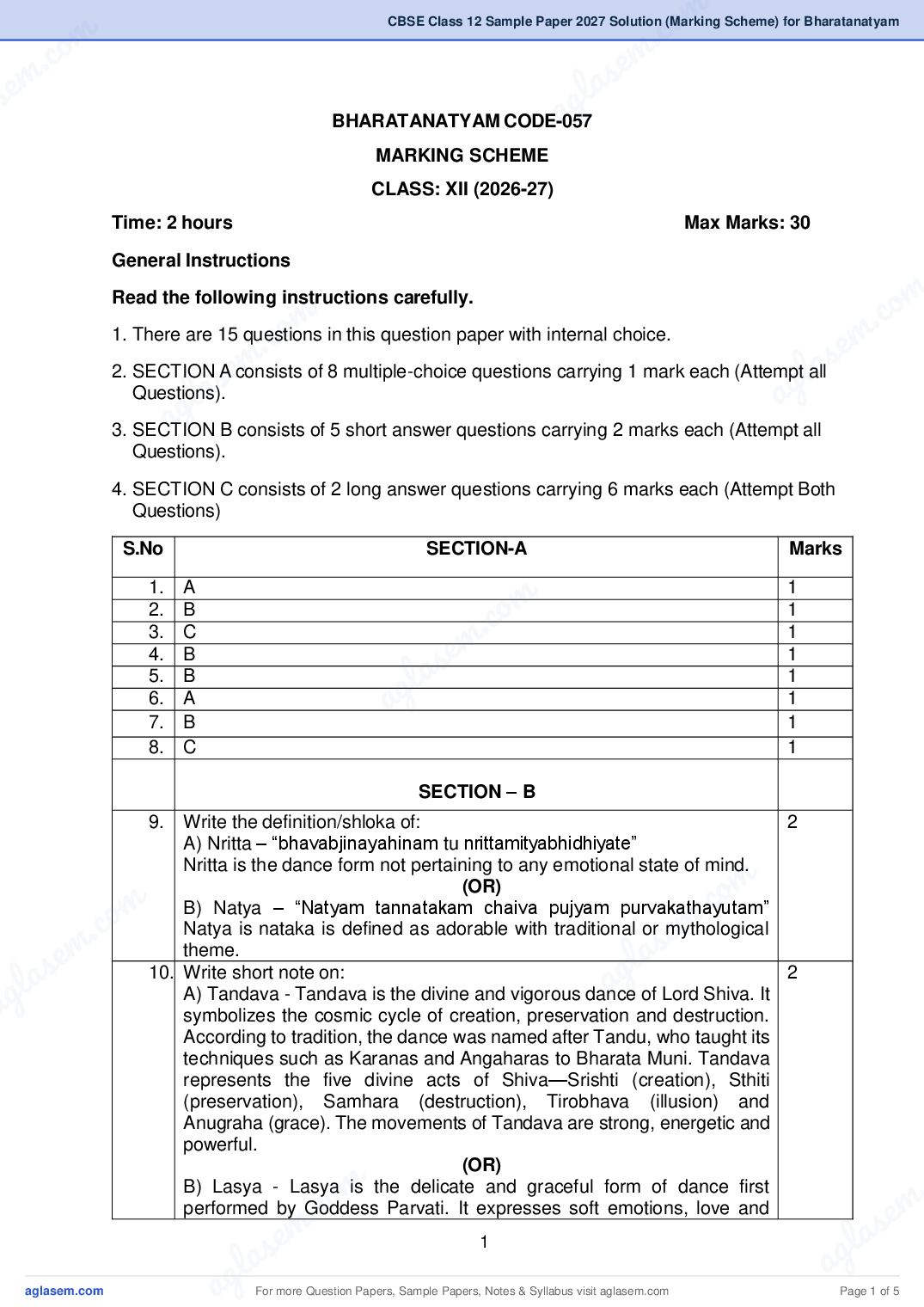
BHARATANATYAM CODE-057
MARKING SCHEME
CLASS: XII (2026-27)
Time: 2 hours Max Marks: 30
General Instructions
m
.co
Read the following instructions carefully.
m
.co
m of 8 multiple-choice questions carrying 1 mark each (Attempt lallase
1. There are 15 questions in this question paper with internal choice. m
2. SECTION Aeconsists
l as ag
ag B consists of 5 short answer questions carrying 2 marks each (Attempt all
Questions).
3. SECTION
Questions).
4. SECTION C consists of 2 long answer questions carrying 6 marks each (Attempt Both
Questions)
S.No SECTION-A Marks
om
1. A 1
2. B
. c 1
3. C
e m 1
4. B
las 1
g
5. B 1
6.
7.
A
B
a 1
1
8. C 1
SECTION – B
9. Write the definition/shloka of: 2
A) Nritta – “bhavabjinayahinam tu nrittamityabhidhiyate”
Nritta is the dance form not pertaining to any emotional state of mind.
m
.co
m
.co
B) Natya – “Natyam tannatakam chaiva pujyam purvakathayutam”
e m
e m
Natya is nataka is defined as adorable with traditional or mythological
theme.
l as
las 10. Write short note on:
ag
2
ag A) Tandava - Tandava is the divine and vigorous dance of Lord Shiva. It
symbolizes the cosmic cycle of creation, preservation and destruction.
According to tradition, the dance was named after Tandu, who taught its
techniques such as Karanas and Angaharas to Bharata Muni. Tandava
represents the five divine acts of Shiva—Srishti (creation), Sthiti
(preservation), Samhara (destruction), Tirobhava (illusion) and
Anugraha (grace). The movements of Tandava are strong, energetic and
powerful.
m .
.co
B) Lasya - Lasya is the delicate and graceful form of dance first
e m
s
performed by Goddess Parvati. It expresses soft emotions, love and
s em l a
ag
1
a For more Question Papers, Sample Papers, Notes & Syllabus visit Page 1 of 5
Page 3
dance of Lord Shiva, and its movements are gentle, graceful and
expressive. Traditionally, Lasya is presented through a series of
compositions called Lasyangas.
11. Explain: 2
A) Lokdharmi - Lokadharmi refers to a realistic style of presentation in
drama and dance, which is based on natural behaviour and actions of
people in everyday life. In this style, emotions and actions are shown in
a simple and natural way without much stylization.
B) Natyadharmi - Natyadharmi refers to a stylized and conventional style
of presentation used in classical theatre and dance. It follows specific
rules, gestures and symbolic movements described in the Natya
Shastra, and actions are expressed through artistic and codified
techniques rather than natural behaviour.
12. Write about: 2
A) Laya - It refers to the speed or tempo of the music and dance. It
determines the time interval between the two matras (beats). A tala does
not have a fixed speed or tempo but can be played at different speeds.
It
is classified into three categories: -
● Vilambita or slow speed.
● Madhya or medium speed.
● Druta or fast speed.
B) Sangeeta - “Geetam vaadyam tatha nrityam trayam
sangeetamuchyate”
:- song, instrumental music, and dance — these three together are
referred to as Sangeet.
13. Write short note on: 2
A) Adavu - - Adavu is a foundation stone for the bharatanatyam dance.
These are the alphabets of bharatanatyam dance and are taught to the
students in the very beginning of the dance training. Adavu is a
systematically organized combination of footwork and hand movement
to confirm to the rhythm. If adavus are not practiced properly, the whole
structure of bharatanatyam would be weak. When number of these
adavus are put togather, they form a korvai. Tanjore brothers had
categorized these adavus into ten varieties and each variety has many
variations.
B) Arangetram - Arangetram is the debut stage performance of a
Bharatanatyam dancer after years of rigorous training under a guru. The
word means “ascending the stage” for the first time. In this performance,
the dancer presents a full Margam repertoire to demonstrate their skill
in Nritta, Nritya and Abhinaya. It marks the student’s readiness to
perform independently.
SECTION – C
2
For more Question Papers, Sample Papers, Notes & Syllabus visit Page 2 of 5
Page 4
m .co
m .co s em
se g la
a one of the following:
14. Write a short life sketch and contribution of any 6
A) T balasaraswati –
T. Balasaraswati (1918–1984):- she was a legendary Bharatanatyam
dancer renowned for her exceptional artistry and devotion to the
classical
dance form. Belonging to a family of traditional musicians and dancers,
she played a pivotal role in reviving and popularizing Bharatanatyam
during a time when it was under threat of decline. Her style emphasized
m
.co
abhinaya (expressive storytelling), bringing poetry and emotions to life
m
through intricate facial expressions and gestures.
.co
Balasaraswati’s performances were deeply rooted in tradition and
s em
em a
celebrated the spiritual essence of Bharatanatyam. She was particularly
as
acclaimed for her renditions of padams and javalis, where her ability to
g l
l a
ag
convey subtle emotions made her unparalleled. Her contributions
earned
her numerous accolades, including the Padma Bhushan and Padma
Vibhushan.
Her legacy continues to inspire generations of dancers, as she
demonstrated that Bharatanatyam is not just an art form but a medium
for
profound expression and devotion.
B) Tanjore quartet –
m
Life Sketch:
m .co
The Tanjore Quartet were four brothers who played a crucial role in
s e
la
the development of Bharatanatyam. They were Chinnayya Pillai,
ag
Ponnayya Pillai, Sivanandam Pillai, and Vadivelu Pillai. They were
born in Thanjavur (Tamil Nadu) in the early 19th century. These
brothers were disciples of the great Carnatic composer Muthuswami
Dikshitar and served in the court of King Serfoji II of Thanjavur. They
were highly skilled in music, dance, and choreography and are
regarded as important figures in the history of Bharatanatyam.
Contribution:
1. The Tanjore Quartet systematized the Margam, the
traditional sequence of a Bharatanatyam performance.
m
m .co
2. They arranged the items of Margam such as Alarippu,
.co m
Jatiswaram, Shabdam, Varnam, Padam, and Tillana in a structured
m order.
s e
s e 3. They composed many Varnams, Padams, and Tillanas
g l a
g la that are still performed today.
a
a 4. They combined music, rhythm, and expressive dance
beautifully in their compositions.
5. They helped transform temple dance traditions into a
refined classical stage performance.
6. Their structure of Bharatanatyam performance continues
to be followed by dancers even today.
Conclusion:
m .
.co s e m
s em l a
ag
3
a For more Question Papers, Sample Papers, Notes & Syllabus visit Page 3 of 5
Page 5
Bharatanatyam by organizing its performance structure and
enriching its repertoire. Their work laid the foundation of the modern
Bharatanatyam tradition.
15. Explain: 6
A) Four types of Abhinaya (angika, vachika, aaharya and satvika) with
examples. –
In Bharatanatyam and Indian classical dance, Abhinaya means
the art of expressing emotions, ideas, and stories to the
audience. According to the Natya Shastra, Abhinaya is of four
types:
1. Angika Abhinaya
Angika Abhinaya refers to expression through the movements of
the body such as hands, eyes, head, and facial expressions.
Example: Showing the rising sun with hand gestures or
expressing joy through facial expressions.
2. Vachika Abhinaya
Vachika Abhinaya involves expression through speech, dialogue,
songs, or recitation. It includes the use of voice in drama or
dance-drama.
Example: Singing or reciting a verse while expressing the
meaning in a dance-drama performance.
3. Aharya Abhinaya
Aharya Abhinaya refers to the external elements such as
costume, ornaments, makeup, and stage decoration used to
enhance the character.
Example: A Bharatanatyam dancer wearing traditional costume,
temple jewelry, and makeup to portray a divine character.
4. Sattvika Abhinaya
Sattvika Abhinaya represents the inner feelings and emotions
that arise naturally from the mind and heart.
Example: Tears of sorrow, trembling due to fear, or showing deep
devotion while portraying a devotee of Lord Krishna.
Conclusion:
These four types of Abhinaya help dancers effectively
communicate emotions and stories to the audience, making
classical dance expressive and meaningful.
B) Nine Rasas with their sthayi bhavas and examples. –
The concept of Navarasa is very important in Indian classical dance
and drama. It is described in the ancient text Natya Shastra written
by Bharata Muni. Rasa means the emotional flavor experienced by
the audience, and each Rasa is connected with a permanent
emotion called Sthayi Bhava.
4
For more Question Papers, Sample Papers, Notes & Syllabus visit Page 4 of 5
Page 6
m .co
m .co s e m
se g l a
a
There are nine Rasas in total. Shringara Rasa represents love and
its Sthayi Bhava is Rati. An example of this is the love of Radha for
Krishna. Hasya Rasa represents laughter and its Sthayi Bhava is
Hasa, for example when a comic character makes the audience
laugh. Karuna Rasa expresses sorrow and its Sthayi Bhava is
Shoka, such as Sita feeling sad in Ashoka Vatika. Raudra Rasa
m
.co
shows anger and its Sthayi Bhava is Krodha, like Lord Shiva
m
expressing anger. Veera Rasa represents bravery and its Sthayi
.co
Bhava is Utsaha, for example a warrior fighting courageously in
s em
em a
battle. Bhayanaka Rasa expresses fear and its Sthayi Bhava is
as
Bhaya, such as a character being frightened by a demon. Bibhatsa
g l
l a
ag
Rasa represents disgust and its Sthayi Bhava is Jugupsa, showing
hatred toward something unpleasant. Adbhuta Rasa expresses
wonder and its Sthayi Bhava is Vismaya, for example when someone
sees a miracle. The ninth Rasa is Shanta Rasa, which represents
peace and its Sthayi Bhava is Sama, such as a sage meditating
calmly.
Thus, these nine Rasas help dancers and actors express different
emotions and make the performance meaningful and expressive.
m
m .co
s e
a
m
m .co
m .co s e m
s e g l a
g la a
a
m .
.co s e m
s em l a
ag
5
a For more Question Papers, Sample Papers, Notes & Syllabus visit Page 5 of 5
Document Details
| Board / Org | CBSE |
| Exam | Class 12 |
| Type | Solution |
| Pages | 5 |
| Updated | 29 Oct 2026 |