CBSE Class 12 Sample Paper 2027 Solution (Marking Scheme) for Biotechnology
Finished viewing? Save it for later —
Download CBSE Class 12 Sample Paper 2027 Solution (Marking Scheme) for Biotechnology (PDF · 8 pages)About CBSE Class 12 Sample Paper 2027 Solution (Marking Scheme) for Biotechnology
CBSE Class 12 Sample Paper 2027 Solution (Marking Scheme) for Biotechnology is available here for free download. Published by CBSE for Class 12, this solution can be viewed online or downloaded as a PDF (8 pages). Candidates preparing for Class 12 can use CBSE Class 12 Sample Paper 2027 Solution (Marking Scheme) for Biotechnology to understand the exam pattern, the type of questions asked, and the overall difficulty level.
Frequently Asked Questions
How can I download CBSE Class 12 Sample Paper 2027 Solution (Marking Scheme) for Biotechnology?
Open this page and click the Download button to save CBSE Class 12 Sample Paper 2027 Solution (Marking Scheme) for Biotechnology as a PDF. It is completely free on AglaSem Docs.
Is CBSE Class 12 Sample Paper 2027 Solution (Marking Scheme) for Biotechnology free to download?
Yes. CBSE Class 12 Sample Paper 2027 Solution (Marking Scheme) for Biotechnology can be viewed online and downloaded as a PDF free of cost on AglaSem Docs.
How many pages does CBSE Class 12 Sample Paper 2027 Solution (Marking Scheme) for Biotechnology have?
CBSE Class 12 Sample Paper 2027 Solution (Marking Scheme) for Biotechnology contains 8 pages, which you can read online or download together as a single PDF.
Where can I find more Class 12 study material?
You can find more Class 12 question papers, sample papers, syllabus, and answer keys on AglaSem Docs.
CBSE Class 12 Sample Paper 2027 Solution (Marking Scheme) for Biotechnology – Text
Read the full text of this solution below — useful to quickly search, copy and reference the content online without downloading the PDF.
📄 View text version (9 pages)
Page 1
CBSE Class 12 Sample
Paper 2027 Solution
(Marking Scheme) for
Biotechnology
EXAM YEAR TYPE SUBJECT
CBSE Class 12 2027 Solutions Biotechnology
Notes · Sample Papers · Previous Year Papers · Mock Tests
Page 2
m .co
m .co s e m
se BIOTECHNOLOGY – CODE NO.g a
l 045
SESSION 2026-27
a
MARKING SCHEME
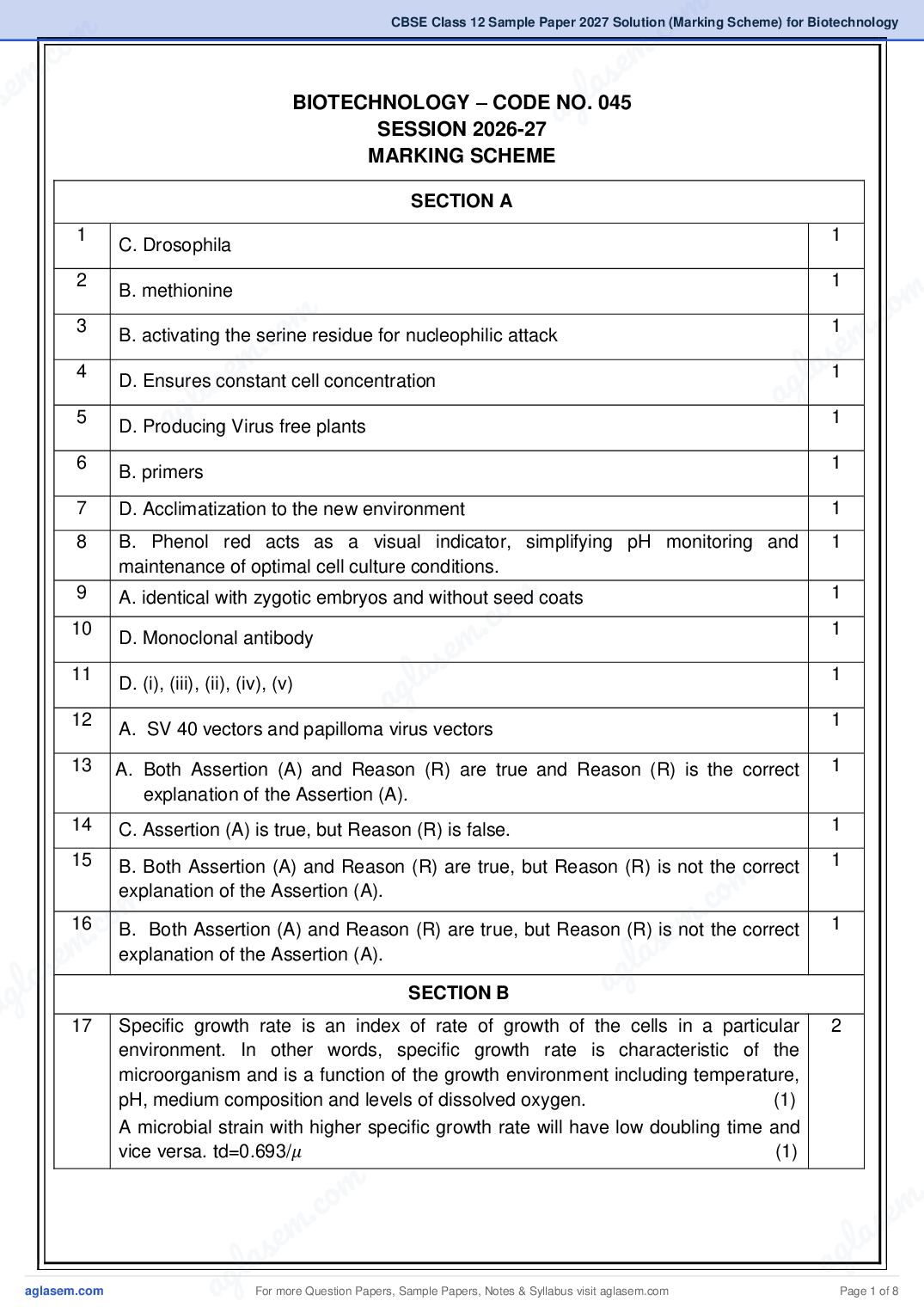
SECTION A
1 1
C. Drosophila
m
2 1
.co
B. methionine
m
.co m
3 1
B. activating the serine residue for nucleophilic attack
s1 e
s em l a
ag 1
4
la
D. Ensures constant cell concentration
5 g
a Virus free plants
D. Producing
6 1
B. primers
7 D. Acclimatization to the new environment 1
8 B. Phenol red acts as a visual indicator, simplifying pH monitoring and 1
maintenance of optimal cell culture conditions.
om
9 A. identical with zygotic embryos and without seed coats 1
. c
m
10 1
D. Monoclonal antibody
s e
11
D. (i), (iii), (ii), (iv), (v)
g la 1
12
a 1
A. SV 40 vectors and papilloma virus vectors
13 A. Both Assertion (A) and Reason (R) are true and Reason (R) is the correct 1
explanation of the Assertion (A).
14 C. Assertion (A) is true, but Reason (R) is false. 1
15 1
m
B. Both Assertion (A) and Reason (R) are true, but Reason (R) is not the correct
m .co
explanation of the Assertion (A).
c. oB. Both Assertion (A) and Reason (R) are true, but Reason (R) sisenot
16 m the correct 1
s em explanation of the Assertion (A). g l a
la a
ag
SECTION B
17 Specific growth rate is an index of rate of growth of the cells in a particular 2
environment. In other words, specific growth rate is characteristic of the
microorganism and is a function of the growth environment including temperature,
pH, medium composition and levels of dissolved oxygen. (1)
A microbial strain with higher specific growth rate will have low doubling time and
vice versa. td=0.693/𝜇 (1)
m .
.co s e m
s em l a
g la ag
a For more Question Papers, Sample Papers, Notes & Syllabus visit Page 1 of 8
Page 3
A.
DNA template to be amplified.
Primers which are oligonucleotides, usually 10-18 nucleotides long that
hybridise to the target DNA region one to each strand of the DNA. Two
primers of such a sequence are required so that they can hybridise.
DNA polymerase which is stable at temperatures above 80oC. Taq
polymerase which has been isolated from a thermostable bacterial species
is used.
Deoxynucleotide triphosphates and buffer. (O.5X4)
OR
B.
I. Microinjection: Foreign DNA is directly injected into recipient animal and plant
cells using fine syringe under a phase contrast microscope. (1)
II. Biolistics: Microscopic particle of gold and tungsten are coated with DNA of
interest and bombarded onto cells with a particle gun. (1)
III.Electroporation: A pulse of high voltage is applied which makes temporary
pores in plasma membrane facilitating uptake of DNA. (Any two) (1)
19 Baffle flasks have V- shaped notches or indentations in the sides of the flask. (1) 2
This improves the growth of the microbes by improving the efficiency of oxygen
transfer due to increased turbulence of the agitated culture medium. (1)
20 Protoplasts are plant cells without cell wall and can be isolated by enzymatic 2
methods (cellulases, hemicellulases and pectinases) from leaf, seedling and calli
etc. (1)
As the protoplast lack cell wall, they can be utilized for
a) Various biochemical and metabolic studies.
b) Fusion of two somatic cells to create somatic hybrids.
c) Fusion of enucleated and nucleated protoplasts to create cybrids.
d) Genetic manipulation. (Any two) (0.5+0.5)
21 Polyclonal antibodies are heterogeneous mixture that bind to multiple different 2
epitopes on a single antigen because they are produced by various populations of
B lymphocytes, each recognizing a different part of the antigen. Monoclonal
antibodies, in contrast, are highly specific and bind to only a single epitope on an
antigen. (1)
This specificity of monoclonal antibodies is because they are produced by a single
clone of immortalized B lymphocytes (hybridoma), derived from one antigen-
activated B cell that recognizes that particular epitope. (1)
SECTION C
22 OKT3 acts as an immunosuppressant by binding to the CD3 molecule on the 3
surface of T cells, which are key players in acute graft rejection. (1)
For more Question Papers, Sample Papers, Notes & Syllabus visit Page 2 of 8
Page 4
m .co
m .co s em
se g a preventing them
lthereby
from attacking the transplanted organ. a
This binding blocks the normal function of the T cells,
(1)
When OKT3 therapy is over, the existing OKT3 molecules gradually clear from the
body. OKT3 can resume their normal immune functions within a week. (1)
23 3
Processing raw information i.e.
DNA sequence information is processed into genes
proteins encoded by the genes can be inferred
m
.co
Gene function can be determined
m
.co
the regulatory sequences can be identified
e m
Inferring phylogenetic relationships
em
(Any three points)
l a s
24 A.
la s ag
3
ag
X-Impeller
Y-Cooling Jacket
(0.5)
(0.5)
Z-Sparger (Air bubbles) (0.5)
B. Yes, this can be considered as strain improvement. (0.5)
The transgene/ foreign gene is introduced through RDT which is a method of
genetic engineering that results in improved characters. (1)
For Visually impaired students
m
.co
A. Small scale fermentors of capacity 10-100 liters are used in research
m
e
laboratories. (0.5)
las
These are used by the scientists in research, to optimize various parameters
for the growth of microbes.
ag
The laboratory scale fermentors are also used by scientists, to produce
(0.5)
enough quantities of metabolites from microbes for research purposes. (0.5)
B. Yes, this can be considered as strain improvement. (0.5)
The transgene/ foreign gene is introduced through RDT which is a method of
genetic engineering that results in improved characters. (1)
25 Attempt either option A or B. 3
A. Whey proteins result in the elevation of a tripeptide glutathione (gamma-
m
m glutamyl cysteinyl glycine) in cells. (1)
.co
m .co This peptide is a reducing compound and has a broad range of functions
s e m
s e including detoxification of xenobiotics. (1)
g l a
g la Protection of cellular components from the effect of oxygen intermediates and
a
a free radicals.
OR
(1)
B. PER – Protein Efficiency ratio : Weight gain by consuming 1gm of food protein.
BV – Biological value : It measure the amount of protein nitrogen that is
retained from a given amount of protein nitrogen consumed.
BCAA profile – Essential for the biosynthesis of muscle proteins.
m .
.co s e m
s em l a
g la ag
a For more Question Papers, Sample Papers, Notes & Syllabus visit Page 3 of 8
Page 5
Digestion of fragment by specific Restriction enzyme. (0.5)
Separation of fragments. (0.5)
Perform Agarose gel electrophoresis. (0.5)
B. RFLP pattern would be exactly same in case of identical twins. (1)
27 Read the gel bottom to top 3
A. 5’ ACTAGCGATG 3’
Make complementary
3’ TGATCGCTAC 5’ (1)
B. To terminate the chain (1)
C. ddNTP is different because it lacks 3’-OH group (1)
For Visually impaired students
A. 5’ TCTGGGCTACTCGGGCGT 3’ (1)
B. Dideoxy chain termination method. (1)
C. Automated DNA squenator does not make use of radio lables, so it is
considered safer. (1)
28 A. Homologous Recombination/Creation of gene knock out (1) 3
B. Inner Cell Mass (ICM) (0.5)
Stage: Blastocyst (0.5)
Reason: The ICM contains pluripotent embryonic stem cells capable of
forming all tissues, making it ideal for regenerative and genetic disorder
studies. (1)
For Visually impaired students
A. Finite cell lines have a limited lifespan and will eventually stop dividing.
Continuous cell lines, on the other hand, are immortal and can grow
indefinitely in culture. (1)
B. The HER2 receptor is a cell surface protein that normally receives growth
signals, promoting cell growth and multiplication. In HER2-positive breast
cancer, these receptors are often overexpressed, leading to excessive
growth signaling and uncontrolled proliferation of cancer cells. (1)
Herceptin works by specifically binding to the HER2 receptors on the surface
of these cancer cells. This binding blocks the receptors from receiving the
growth signals, effectively disrupting the signaling pathway that drives cancer
cell growth and thus inhibiting the progression of breast cancer. (1)
SECTION D
29 A. P is abl gene and Q is bcr gene. (1) 4
B. Philadelphia chromosome. (1)
C. (i) FISH - Fluorescence in Situ Hybridization.
(ii) Fluorescence in Situ Hybridization based on fluorescently labelled probes.
(2)
For more Question Papers, Sample Papers, Notes & Syllabus visit Page 4 of 8
Page 6
m .co
m .co s em
se g la
OR
a
D. Karyotyping requires metaphase arrested chromosomes and is also not an
easy procedure. (2)
For Visually impaired students
A. A is abl gene and B is bcr gene. (1)
B. Philadelphia chromosome. (1)
C.
m
.co
(i) FISH - Fluorescence in Situ Hybridization.
m
.co m
(ii) Fluorescence in Situ Hybridization based on fluorescently labelled probes.
s e
em a (2)
as g l
g l
OR
a
aeasy
D. Karyotyping requires metaphase arrested chromosomes and is also not an
procedure. (2)
30 A. The molecular ions are generated either by a loss or gain of a charge (e.g. 4
electron ejection,protonation or deprotonation). (1)
B. Mass spectrometry is used in-
Obtaining protein structural information such as peptide mass or amino
acid sequence
m
Identifying the type and location of amino acid modification within proteins.
m .co (1) (any one)
C. m/z= (M+ nH)n+/ n+
s e
For n=4,m/z= 10,000+ 4/4= 2501
g la
For n=2, m/z= 10,000+ 2/2=5001
a
OR
D. m/z= (M+ nH)n+/ n+
For n=6, m/z= 20,000+ 6/6= 3334.33
For n=7, m/z= 20,000+7/7=2858.14 (2)
For Visually impaired students
A. The molecular ions are generated either by a loss or gain of a charge (e.g.
m
electron ejection,protonation or deprotonation). (1)
m .co
B. Mass spectrometry is used in-
m .co Obtaining protein structural information such as peptide mass or amino
s e m
s e
acid sequence
g l a
la
Identifying the type and location of amino acid modification within proteins.
g a
a
(1) (any one)
C. Ionization Chamber / Ion Source
Mass Analyzer
Detector
Vacuum System
Electromagnet
Amplifier (0.5x4)
m .
.co s e m
s em l a
g la ag
a For more Question Papers, Sample Papers, Notes & Syllabus visit Page 5 of 8
Page 7
D. The sample is transferred from a condensed phase to a gas phase with the
help of a solid matrix. Ion formation in MALDI is achieved by directing a
pulsed laser beam onto a sample suspended or dissolved in a matrix. The
matrix absorbs the laser light energy and vaporises. In the gas phase, the
matrix plays a role in sample ionisation. The charged molecules are directed
by electrostatic lenses from the ionisation source to the mass analyser. (2)
SECTION E
31 Attempt either option A or B. 5
A.
I. 5’ GAATTC 3’ (1)
3’ CTTAAG 5’ (1)
Sticky ends
II. 5’GTATTAGCTG 3’ 5’ AATTCTATAAAACG 3’
3’CATAATCGACTTAA 5’ + 3’ GATATTTTGC 5’
(1)
III. E refers to genus name, co the species name, the capital R refers to the strain
name (RY13) and (I) roman numeral refers to it being the first enzyme to be
isolated from this strain. (2)
OR
B. Insertional activation will occur in the recombinant plasmid, Lac Z gene will be
inactivated. (1)
We can differentiate between recombinants from non-recombinants by using
chromogenic media/Blue and white selection method. Transformed Ecoli cells
with pUC19 contain selectable marker gene Lac Z. Lac Z gene codes for the
enzyme B-galactosidase, whose activity can cleave a colourless substrate
called X- gal into a blue coloured product, hence blue colonies.
This region also contains polylinker and thus insertion of foreign
DNA(Recombination) into any of the restriction site will result in altered non-
functional enzyme, no cleavage of the X-gal substrate, Colonies will appear
white. (4)
32 Attempt either option A or B. 5
A.
I. The following are the major concerns about GM Crops.
(a) Genetically modified plants may cause some allergic or toxic reactions in the
long run.
(b) Transgenic plants may lead to proliferation of new microbial and insect
strains.
(c) Transgenic plants pose the ecological risk of developing into weeds.
(d) Non-target and beneficial organisms may also be effected.
(e) Transgene may escape through pollen grains and may cause gene
contamination in natural populations.
For more Question Papers, Sample Papers, Notes & Syllabus visit Page 6 of 8
Page 8
m .co
m .co s em
se g la pattern.
(g) The antibiotic resistance marker genes used a
(f) The GM crops may lead to the change in the evolutionary
to produce transgenic crops
may horizontally transfer into microbes and thus exacerbate the problem of
antibiotic resistance in human and animal pathogens. (Any 3)
II.
(a) Delayed fruit ripening.
(b) Longer shelf life.
OR
m
.co
B.
m
.co m
I. Genetically engineered Arabidopsis plants with three genes introduced from
m
a bacterium produce PHB (poly hydroxyl butyrate) globules exclusively in
s e
s e l a
ag
their chloroplast without affecting Plant growth and development from
g l a
leaves. The large-scale production of PHB is easily achieved by extraction
a
from leaves of genetically engineered Populus. (2)
II. Artificial seeds are the embryos raised in tissue culture and encapsulated in
protective chemicals like calcium alginate which form an artificial seed coat
and prevents them from desiccating.
They can be utilized for the rapid and mass propagation of elite plant
species as well as hybrid varieties.
m
m .co
s e
g la
a
(3)
33. Attempt either option A or B. 5
A.
I. 2-D gel electrophoresis. First dimension by Iso electric focusing, Second
dimension by SDS-PAGE.
m
m Principle of IEF- Separation of the proteins is on the basis of their Isolectric
.co
m .co pH (pI).
s e m
s e Ampholytes (Polyamino- Polycarboxylic acids) are used in generating the pH
g l a
g la gradient.
a
a SDS-PAGE- Separation of the proteins is on the basis of their molecular
mass.
As two processes (IEF and SDS –PAGE) are carried at right angle to each
other, thereby increasing the resolution. Proteins are separated into 2-D
patterns with high resolution as two properties of the proteins have been
exploited in their separation- charge and size.
II. Thermal and pH stability, solvent tolerance, solubility, catalytic potency. (any 2)
m .
.co s e m
s em l a
g la ag
a For more Question Papers, Sample Papers, Notes & Syllabus visit Page 7 of 8
Page 9
B.
I. The single substitution of valine for glutamic acid (val/glu are at the 6th
position of the haemoglobin beta chain) dramatically changes the structure of
scHb making it form fibres within the RBC resulting in the deformation of the
cell (sickling). Since the disease is due to this molecular alteration, it is called
molecular disease.
II. V.M Ingram
The principle of protein fingerprinting is to generate peptide maps after
proteolytic cleavage and separation of the peptides.
Generation of peptides from protein using trypsin (a proteolytic enzyme)
Performing paper electrophoresis
Then paper chromatography at 90 0 C to the direction of electrophoresis
and
separation of peptides based on partition coefficient in the given solvent
system.
visualization of the peptides using ninhydrin. On examining this peptide and
determining its amino acid sequence, Valine substitution for glutamic acid in
the peptide is observed.
*********
For more Question Papers, Sample Papers, Notes & Syllabus visit Page 8 of 8
Document Details
| Board / Org | CBSE |
| Exam | Class 12 |
| Type | Solution |
| Pages | 8 |
| Updated | 29 Oct 2026 |