aglasem.com
Schools Admission Mock Test Playground
ClassChoose class
StateSelect state

TIFR GS 2023 Syllabus and Sample Paper Chemistry
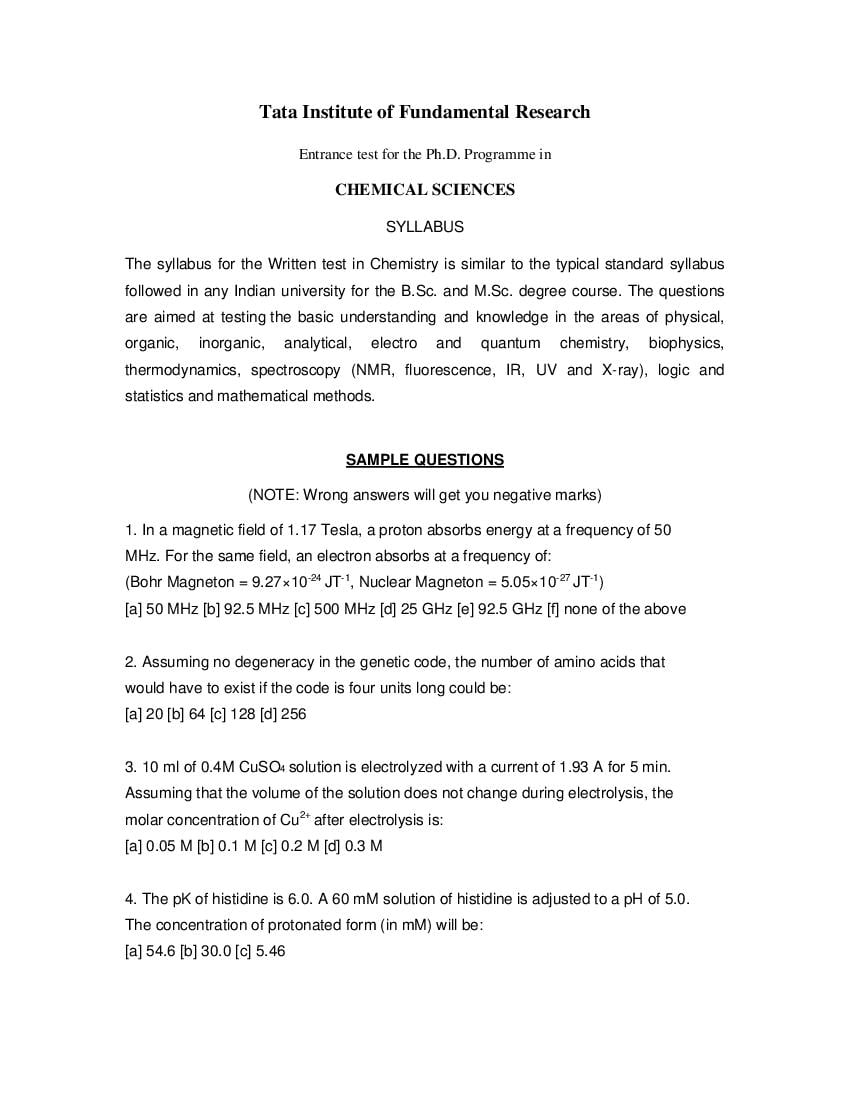
Download the TIFR GS 2023 Syllabus and Sample Paper Chemistry PDF for free at AglaSem. This official TIFR GS syllabus lists the complete course structure, unit-wise topics and weightage, marking scheme and prescribed books, so you can plan your preparation and focus on high-scoring topics. More Detail
TIFR GS 2023 Syllabus and Sample Paper Chemistry - Page 1 of 1

Finished viewing? Save it for later —

Download TIFR GS 2023 Syllabus and Sample Paper Chemistry (PDF · 1 page)
Downloaded 11 times

About TIFR GS 2023 Syllabus and Sample Paper Chemistry

TIFR GS 2023 Syllabus and Sample Paper Chemistry is available here for free download. Published by Default for TIFR GS, this syllabus can be viewed online or downloaded as a PDF (1 page). Candidates preparing for TIFR GS can use TIFR GS 2023 Syllabus and Sample Paper Chemistry to understand the exam pattern, the type of questions asked, and the overall difficulty level.

Frequently Asked Questions

How can I download TIFR GS 2023 Syllabus and Sample Paper Chemistry?

Open this page and click the Download button to save TIFR GS 2023 Syllabus and Sample Paper Chemistry as a PDF. It is completely free on AglaSem Docs.

Is TIFR GS 2023 Syllabus and Sample Paper Chemistry free to download?

Yes. TIFR GS 2023 Syllabus and Sample Paper Chemistry can be viewed online and downloaded as a PDF free of cost on AglaSem Docs.

How many pages does TIFR GS 2023 Syllabus and Sample Paper Chemistry have?

TIFR GS 2023 Syllabus and Sample Paper Chemistry contains 1 page, which you can read online or download together as a single PDF.

Where can I find more TIFR GS study material?

You can find more TIFR GS question papers, sample papers, syllabus, and answer keys on AglaSem Docs.

TIFR GS 2023 Syllabus and Sample Paper Chemistry – Text

Read the full text of this syllabus below — useful to quickly search, copy and reference the content online without downloading the PDF.

📄 View text version (1 page)

Page 1

Tata Institute of Fundamental Research Entrance test for the Ph.D. Programme in CHEMICAL SCIENCES SYLLABUS The syllabus for the Written test in Chemistry is similar to the typical standard syllabus followed in any Indian university for the B.Sc. and M.Sc. degree course. The questions are aimed at testing the basic understanding and knowledge in the areas of physical, organic, inorganic, analytical, electro and quantum chemistry, biophysics, thermodynamics, spectroscopy (NMR, fluorescence, IR, UV and X-ray), logic and statistics and mathematical methods. SAMPLE QUESTIONS (NOTE: Wrong answers will get you negative marks) 1. In a magnetic field of 1.17 Tesla, a proton absorbs energy at a frequency of 50 MHz. For the same field, an electron absorbs at a frequency of: (Bohr Magneton = 9.27×10⁻²⁴ JT-1, Nuclear Magneton = 5.05×10⁻²⁷ JT-1) [a] 50 MHz [b] 92.5 MHz [c] 500 MHz [d] 25 GHz [e] 92.5 GHz [f] none of the above 2. Assuming no degeneracy in the genetic code, the number of amino acids that would have to exist if the code is four units long could be: [a] 20 [b] 64 [c] 128 [d] 256 3. 10 ml of 0.4M CuSO4 solution is electrolyzed with a current of 1.93 A for 5 min. Assuming that the volume of the solution does not change during electrolysis, the molar concentration of Cu2+ after electrolysis is: [a] 0.05 M [b] 0.1 M [c] 0.2 M [d] 0.3 M 4. The pK of histidine is 6.0. A 60 mM solution of histidine is adjusted to a pH of 5.0. The concentration of protonated form (in mM) will be: [a] 54.6 [b] 30.0 [c] 5.46

Document Details

Board / OrgDefault
ExamTIFR GS
TypeSyllabus
Pages1
Updated22 Jul 2026

More for TIFR GS

📄Question Paper 📘Syllabus