TIFR GS 2023 Syllabus and Sample Paper Mathematics
Finished viewing? Save it for later —
Download TIFR GS 2023 Syllabus and Sample Paper Mathematics (PDF · 3 pages)About TIFR GS 2023 Syllabus and Sample Paper Mathematics
TIFR GS 2023 Syllabus and Sample Paper Mathematics is available here for free download. Published by Default for TIFR GS, this syllabus can be viewed online or downloaded as a PDF (3 pages). Candidates preparing for TIFR GS can use TIFR GS 2023 Syllabus and Sample Paper Mathematics to understand the exam pattern, the type of questions asked, and the overall difficulty level.
Frequently Asked Questions
How can I download TIFR GS 2023 Syllabus and Sample Paper Mathematics?
Open this page and click the Download button to save TIFR GS 2023 Syllabus and Sample Paper Mathematics as a PDF. It is completely free on AglaSem Docs.
Is TIFR GS 2023 Syllabus and Sample Paper Mathematics free to download?
Yes. TIFR GS 2023 Syllabus and Sample Paper Mathematics can be viewed online and downloaded as a PDF free of cost on AglaSem Docs.
How many pages does TIFR GS 2023 Syllabus and Sample Paper Mathematics have?
TIFR GS 2023 Syllabus and Sample Paper Mathematics contains 3 pages, which you can read online or download together as a single PDF.
Where can I find more TIFR GS study material?
You can find more TIFR GS question papers, sample papers, syllabus, and answer keys on AglaSem Docs.
TIFR GS 2023 Syllabus and Sample Paper Mathematics – Text
Read the full text of this syllabus below — useful to quickly search, copy and reference the content online without downloading the PDF.
📄 View text version (3 pages)
Page 1
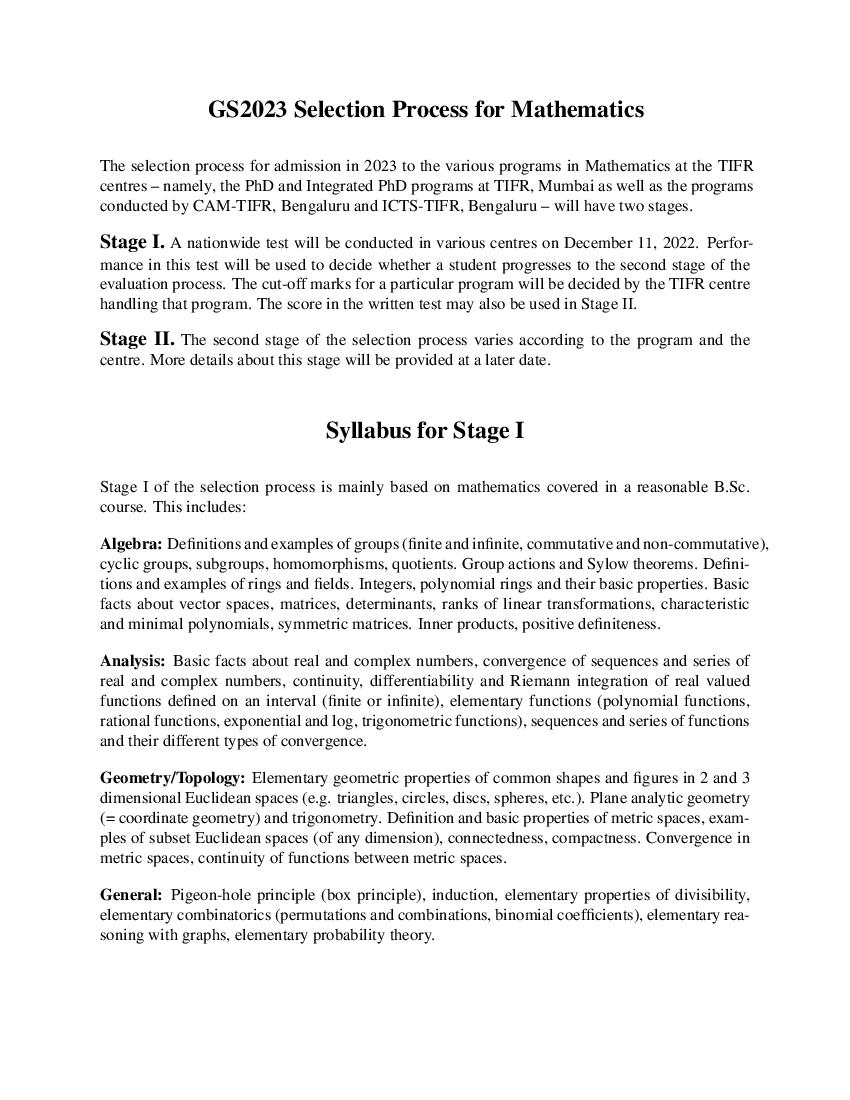
The selection process for admission in 2023 to the various programs in Mathematics at the TIFR
centres – namely, the PhD and Integrated PhD programs at TIFR, Mumbai as well as the programs
conducted by CAM-TIFR, Bengaluru and ICTS-TIFR, Bengaluru – will have two stages.
Stage I. A nationwide test will be conducted in various centres on December 11, 2022. Perfor-
mance in this test will be used to decide whether a student progresses to the second stage of the
evaluation process. The cut-off marks for a particular program will be decided by the TIFR centre
handling that program. The score in the written test may also be used in Stage II.
Stage II. The second stage of the selection process varies according to the program and the
centre. More details about this stage will be provided at a later date.
Syllabus for Stage I
Stage I of the selection process is mainly based on mathematics covered in a reasonable B.Sc.
course. This includes:
Algebra: Definitions and examples of groups (finite and infinite, commutative and non-commutative),
cyclic groups, subgroups, homomorphisms, quotients. Group actions and Sylow theorems. Defini-
tions and examples of rings and fields. Integers, polynomial rings and their basic properties. Basic
facts about vector spaces, matrices, determinants, ranks of linear transformations, characteristic
and minimal polynomials, symmetric matrices. Inner products, positive definiteness.
Analysis: Basic facts about real and complex numbers, convergence of sequences and series of
real and complex numbers, continuity, differentiability and Riemann integration of real valued
functions defined on an interval (finite or infinite), elementary functions (polynomial functions,
rational functions, exponential and log, trigonometric functions), sequences and series of functions
and their different types of convergence.
Geometry/Topology: Elementary geometric properties of common shapes and figures in 2 and 3
dimensional Euclidean spaces (e.g. triangles, circles, discs, spheres, etc.). Plane analytic geometry
(= coordinate geometry) and trigonometry. Definition and basic properties of metric spaces, exam-
ples of subset Euclidean spaces (of any dimension), connectedness, compactness. Convergence in
metric spaces, continuity of functions between metric spaces.
General: Pigeon-hole principle (box principle), induction, elementary properties of divisibility,
elementary combinatorics (permutations and combinations, binomial coefficients), elementary rea-
soning with graphs, elementary probability theory.
Page 2
The following are some sample questions for the online test that will be held on December 11.
Some question papers from previous years can be found at
http://univ.tifr.res.in/admissions/Prev_QP/Prev_QP.htm
Sample multiple choice questions
1. Let f : R → R be a continuous bounded function. Then
(a) f has to be uniformly continuous
(b) there exists an x ∈ R such that f (x) = x
(c) f can not be increasing
(d) lim f (x) exists.
x→∞
2. Define a function (
x + x2 cos( πx ), if x 6= 0
f (x) =
0, if x = 0
Consider the statements:
I. f is differentiable at x = 0 and f 0 (0) = 1.
II. f is differentiable everywhere and f 0 (x) is continuous at x = 0.
III. f is increasing in a neighbourhood around x = 0.
IV. f is not increasing in any neighbourhood of x = 0.
Which one of the following combinations of the above statements is true.
(a) I. and II.
(b) I. and III.
(c) II. and IV.
(d) I. and IV.
Sample true/false questions
1. If A and B are 3 × 3 matrices and A is invertible, then there exists an integer n such that
A + nB is invertible.
2. Let P be a degree 3 polynomial with complex coefficients such that the constant term is
2010. Then P has a root α with |α| > 10.
3. The symmetric group S5 consisting of permutations on 5 symbols has an element of order 6.
Page 3
to 0 pointwise. Then the integral
Z 1
fn (x)dx
0
converges to 0.
5. There are n homomorphisms from the group Z/nZ to the additive group of rationals Q.
6. A bounded continuous function on R is uniformly continuous.
Document Details
| Board / Org | Default |
| Exam | TIFR GS |
| Type | Syllabus |
| Pages | 3 |
| Updated | 22 Jul 2026 |