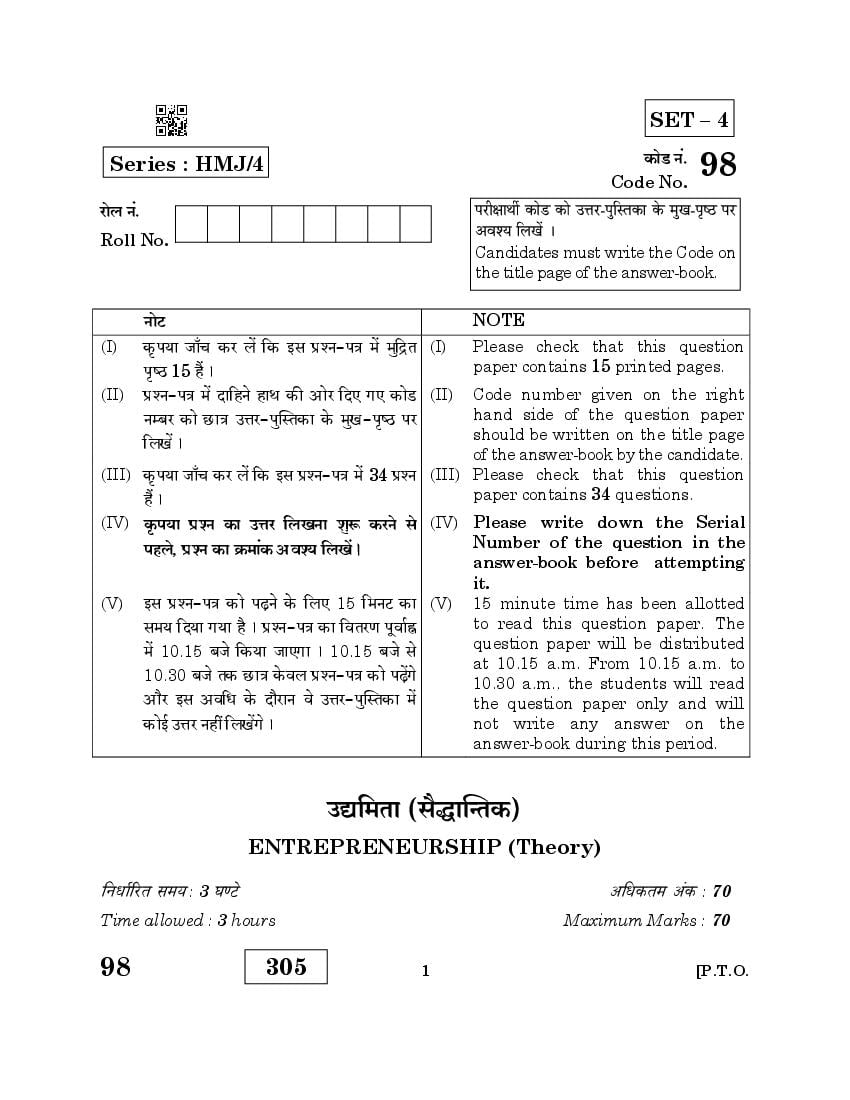
CBSE Class 12 Entrepreneurship Question Paper 2020
Finished viewing? Save it for later —
Download CBSE Class 12 Entrepreneurship Question Paper 2020 (PDF · 16 pages)About CBSE Class 12 Entrepreneurship Question Paper 2020
CBSE Class 12 Entrepreneurship Question Paper 2020 is available here for free download. Published by CBSE for Class 12, this question paper can be viewed online or downloaded as a PDF (16 pages). Candidates preparing for Class 12 can use CBSE Class 12 Entrepreneurship Question Paper 2020 to understand the exam pattern, the type of questions asked, and the overall difficulty level.
Frequently Asked Questions
How can I download CBSE Class 12 Entrepreneurship Question Paper 2020?
Open this page and click the Download button to save CBSE Class 12 Entrepreneurship Question Paper 2020 as a PDF. It is completely free on AglaSem Docs.
Is CBSE Class 12 Entrepreneurship Question Paper 2020 free to download?
Yes. CBSE Class 12 Entrepreneurship Question Paper 2020 can be viewed online and downloaded as a PDF free of cost on AglaSem Docs.
How many pages does CBSE Class 12 Entrepreneurship Question Paper 2020 have?
CBSE Class 12 Entrepreneurship Question Paper 2020 contains 16 pages, which you can read online or download together as a single PDF.
Where can I find more Class 12 study material?
You can find more Class 12 question papers, sample papers, syllabus, and answer keys on AglaSem Docs.
CBSE Class 12 Entrepreneurship Question Paper 2020 – Text
Read the full text of this question paper below — useful to quickly search, copy and reference the content online without downloading the PDF.
📄 View text version (16 pages)
Page 1
Series : HMJ/4 .
Code No.
98
.
Roll No.
Candidates must write the Code on
the title page of the answer-book.
NOTE
(I) - (I) Please check that this question
15 paper contains 15 printed pages.
(II) - (II) Code number given on the right
- - hand side of the question paper
should be written on the title page
of the answer-book by the candidate.
(III) - 34 (III) Please check that this question
paper contains 34 questions.
(IV) (IV) Please write down the Serial
, Number of the question in the
answer-book before attempting
it.
(V) - 15 (V) 15 minute time has been allotted
- to read this question paper. The
question paper will be distributed
10.15 10.15
at 10.15 a.m. From 10.15 a.m. to
10.30 - 10.30 a.m., the students will read
- the question paper only and will
not write any answer on the
answer-book during this period.
()
ENTREPRENEURSHIP (Theory)
{ZYm©[aV g‘¶ : 3 KÊQ>o A{YH$V‘ A§H$ : 70
Time allowed : 3 hours Maximum Marks : 70
98 305 1 [P.T.O.
Page 2
(i) - – , , , - 34
(ii) - 1 17 , 1
(iii) - 18 24 -I 2
(iv) - 25 29 -II , 3
(v) - 30 32 -I , 4
(vi) - 33 34 -II , 6
(vii)
(viii) - , - , -
, - , - –
1
(ix) , ,
–
:
1. ,
________ 1
98 2
Page 3
Read the following instructions very carefully and strictly follow them :
(i) This question paper comprises five sections – A, B, C, D and E. There are
34 questions in the question paper. All questions are compulsory.
(ii) Section A – Question. No. 1 to 17 are very short-answer type questions,
carrying 1 mark each.
(iii) Section B – Question. No. 18 to 24 are short-answer type I questions,
carrying 2 marks each.
(iv) Section C – Question. No. 25 to 29 are short-answer type II questions,
carrying 3 marks each.
(v) Section D – Q. no. 30 to 32 are long answer type-I questions, carrying
4 marks each.
(vi) Section E – Question. No. 33 and 34 are long answer type-II questions,
carrying 6 marks each.
(vii) Answer should be brief and to the point.
(viii) There is no overall choice. However, an internal choice has been provided
in two questions of 1 mark, two questions of 2 marks, two question of 3
marks, one question of 4 marks and one question of 6 marks. You have to
attempt only one of the choices in such questions.
(ix) In addition to this, separate instructions are given with each section and
question, wherever necessary.
SECTION – A
Fill in the blanks :
1. Samar is a budding rural entrepreneur who is working on improving the
health index of the women in rural areas. Samar needs to understand
various health issues confronted by women in order to create a socially
committed organization. For this, he wants to gather information about
the target market or customers in an organized manner. This organized
effort of Samar is known as ______. 1
98 3 [P.T.O.
Page 4
, (i) , (ii)
‘ ’ _______ _______
1
3. , ,
, -
________ 85%
1
4. ________
1
________
1
5. _______ _______
1
6. _______ , ,
1
98 4
Page 5
emerging as a good alternative to two major problems; (i) climatic change
due to auto exhaust and (ii) increasing pollution leading to ill health.
This Act of ‘Welsa Moto Corp’s’ has taken care of _______ and _______
elements of macro environment. 1
3. Amit, an Entrepreneur, is always in touch with the changes taking place
in the environment. He identifies opportunities and finds strategies to
capitalise on these opportunities at the earliest. Sensing the requirement
of providing reasonably priced food at their own place within no time with
multiple options, he started the first online food network in India.
Because of _______ advantage, he was able to capture more than 85% of
the market share in no time. 1
4. _______ feature of partnership states that any partner can act on behalf of
the firm. 1
OR
_______ process of entrepreneurship involves the translation of a useful
idea into an application which has commercial value. 1
5. _______ and _______ are the components of a Brand shown in the figure.
1
6. _______ is an affluent individual, who provides capital for a business
start-up having a high-risk, high-return matrix usually in exchange for
convertible debt or ownership equity. 1
98 5 [P.T.O.
Page 6
7. ,
1
8. () , () , () ()
1
9.
1
10. ‘... (K.Y.C.) ’
` 4,00,000 ` 6,00,000
` 1,40,000 23.33% 1
11. 1
‘ ’ 1
12. 1
13. ‘ ’
(a)
(b)
(c)
(d) 1
14.
(a) ,
(b) /
(c) -
(d) 1
98 6
Page 7
7. A financial plan is a projection of key financial data about the potential
investment commitment needed for the new venture. 1
8. SWOT Analysis means to consider (a) Strengths (b) Weaknesses
(c) Opportunities and (d) Tenure of Business. 1
9. Primary Market facilitates transfer of resources from the savers to the
entrepreneurs seeking funds for setting new enterprises. 1
10. Gupta is the owner of KYC stores dealing in grocery items. He has an
equity stake of ` 4,00,000 in the business. He has borrowed ` 6,00,000
from State Bank of India. His net profit for the year is ` 1,40,000. The
Return on Equity for Gupta will be 23.33%. 1
11. In a Reverse acquisition a public company takes over a private company. 1
OR
Sales promotions initiatives are often referred to as ‘above the line’
activities. 1
12. The secondary market enhances the marketability of securities and
provides liquidity to investments. 1
Multiple Choice Questions :
13. Gross working capital means :
(a) sum total of all assets.
(b) sum total of all fixed assets.
(c) sum total of all current assets.
(d) current assets minus current liabilities. 1
14. Marketing Plan is a document :
(a) regarding the marketing objectives, strategies and activities to be
followed by the new Enterprise.
(b) which describes the flow of goods/services from production point to
the customers.
(c) which determines how many units must be sold or how much sales
volume must be achieved in order to have break-even-point.
(d) which reflects the projected cash available with the Enterprise. 1
98 7 [P.T.O.
Page 8
(a) (b)
(c) (d) 1
16. -
-
,
,
(a) (b)
(c) (d) 1
17.
?
(a) 2 (b) 3
(c) 4 (d) 6 1
–
18.
2
19. ,
2
98 8
Page 9
following source of idea field :
(a) Service sector ideas (b) Trading related ideas
(c) Natural resources (d) Market driven ideas 1
16. Rushan devised an apparatus to measure the quality of air at home which
can be fitted in any Air conditioner and the air conditioner can become an
air purifier as well. His product is still in the pre-commercialization stage.
Rushan wants to exclude others from making, using, selling and importing
this apparatus. The intellectual property right which Rushan will have to
obtain is :
(a) Copyright (b) Patent
(c) Industrial design (d) Trade mark 1
17. How many whole time members are nominated by the Union Government
of India to Securities and Exchange Board of India ?
(a) 2 (b) 3
(c) 4 (d) 6 1
SECTION – B
18. Sanjana graduated from National Institute of Fashion Studies and wants
to start her own boutique. She wants to understand the feasibility and
viability of the proposed venture. This will also facilitate her in assessing
and making provisions for the bottlenecks in the progress and
implementation of the idea. She also wants to know about the success of
the project along with the risk factors involved.
Identify and give the meaning of the document which is required by
Sanjana on the basis of the above para. 2
19. Mahesh, an entrepreneur is planning to enter into a new business of
manufacturing laptop bags with an inbuilt lock facility. Being highly
complex and tedious, its manufacturing operations need to be well
planned. He decides that the complete bag will be manufactured at his
own factory i.e. no part of its manufacturing process will be outsourced.
Identify the important component of business plan that is discussed
above. Also, state what needs to be described in the above stated
manufacturing situation. 2
98 9 [P.T.O.
Page 10
2
21. ‘ ’ 2
() 2
22. ,
() () 2
23. ‘ ’
? 2
24. ‘ .’
‘ ’
2
–
25.
3
3
26.
3
98 10
Page 11
OR
State any four sources which lead to the emergence of basic ideas. 2
21. State any four advantages of ‘penetration pricing’ method to the firm. 2
OR
State any four purposes of ‘Logo’. 2
22. Government banned the use of polythene bags and single use plastic
material in order to curb the increasing pollution level by dumping of
plastics. Harjot took this as an opportunity and is planning to manufacture
biodegradable bags of different sizes by processing the sugarcane bagasse.
Create a logo and a tagline for the bags manufactured by Harjot. 2
23. Give the meaning of ‘Cash Conversion Cycle’. How is Cash Conversion
Cycle of a trading concern different from a manufacturing concern ? 2
24. ‘Pipro Ltd.’ is a software company based in Bengluru, India. It is already
listed at National Stock Exchange. In order to expand its business in north-
east, under the ‘Look East Policy’ of the government, it needs financial
resources.
State any two methods through which she can fulfill her financial
requirements through Primary Market other than Public issue. 2
SECTION – C
25. With the help of any three points, explain why is it important for a
business to understand the environment in which it operates. 3
OR
Explain proforma investment decisions and proforma financing decisions as
components of a financial plan. 3
26. Rohit is working on designing of a unique face mask which would not only
filter the air inhaled but also send alert messages on the registered mobile
number if the user is in a zone of high pollution. This idea is germinated
because of the interest and curiosity of Rohit as he is always interested in
finding out the specific current problems and their solutions. Before
launching his idea he also analysed the pros and cons of the product. Now
he has to complete two more steps of an important process.
Identify the process. Explain the steps to be completed by Rohit in the
process identified. 3
98 11 [P.T.O.
Page 12
‘ ’ ‘ ’ ,
‘-’
, ‘-
’
, ‘ ’
‘-’
‘-
’
(i) ‘-’ ‘ ’
(ii) ?
(iii) ? 3
28.
(a) – 120
(b) – ` 20
(c) – ` 100
(d) – 12% 3
3
29. :
(i)
(ii) 100
(iii) -
25 3
98 12
Page 13
Footwear’ procures 70% of its raw material from ‘Polymers Ltd.’ The major
production of ‘Polymers Ltd.’ is plastic chips, PU foam and elastic which is
used by ‘B-relax Footwear’ in its manufacturing processes. After due
diligence, they decide to merge with each other. If they merge, ‘B-relax
Footwear’ doesn’t need to look for a vendor and sourcing raw materials
would be seamless. On the other hand, as a result of the merger, ‘Polymers
Ltd.’ doesn’t need to worry about the sales and marketing. All they need to
do is to improve their processes to produce better raw materials for ‘B-relax
Footwear’. After the merger the combined entity will be known as ‘B-relax
Inc’.
(i) Identify and explain the type of merger between ‘B-relax Footwear’
and ‘Polymers Ltd.’
(ii) Why is due diligence required before merger ?
(iii) Which is the most dominant reason for this merger ? Explain. 3
28. Calculate the Economic Order Quantity from the following information :
(a) Annual consumption – 120 units.
(b) Cost of placing and receiving an order – ` 20
(c) Price per unit – ` 100
(d) Storage cost as percentage of average inventory – 12% 3
OR
State any six features of Venture Capital Finance. 3
29. From the given situations, identify and explain the method of floatation of
new issues :
(i) ICICI is in need of additional capital for its new venture. It decides to
raise funds by selling the issues mainly to General Insurance
Corporation of India and Life-Insurance Corporation of India.
(ii) Jay is holding 100 shares of a company. He has been given a privilege
offer to subscribe to a new issue of the same company in proportion of
his current shareholding with the company. Jay was unwilling to
subscribe, so he renounced the offer in favour of Veeru who bought the
shares.
(iii) Gopal is working as the Regional Chairman in a well reputed
Non-Banking Finance Company which is listed in Stock Exchange. As
performance bonus, the company gave 25 equity shares to Gopal. 3
98 13 [P.T.O.
Page 14
30.
4
31. 4
4
32. ( ), ,
100
, -
` 38,000
` 80 45 60
` 40 15 20
100 40 60
:
(a)
(b) - 4
–
33.
6
6
34. 6
_______________
98 14
Page 15
30. There are various ways in which an entrepreneur can spot trends. Describe
the four ways of identifying the trends with the help of examples. 4
31. Explain with the help of any four points the advantages of franchising to the
franchisee. 4
OR
Explain Internal expansion and External expansion as part of growth and
development of an Enterprise. 4
32. ‘Flavouright Foods Ltd.’ started a business of making nachos (corn chips) in
three variants, Classic Cheese, Toasted Corn and Tangy Tomato. To start
with, all the three variants will be sold in a standard packing of 100 gms
each, the selling price would differ due to the ingredients used. Fixed costs
are ` 38,000
Sales price and variable costs per unit are as follows :
Particulars Classic Cheese Toasted Corn Tangy Tomato
Sales Price ` 80 45 60
Variable Cost ` 40 15 20
Packets sold 100 40 60
From the above information calculate :
(a) Weighted contribution margin per unit.
(b) Breakeven point – total and per product. 4
SECTION – E
33. While preparing an operational plan, an entrepreneur has to pay attention
towards various elements. Explain these elements. 6
OR
Explain the steps for idea and opportunity assessment after the product
identification has been done by the entrepreneur. 6
34. Explain any six reasons for the failure of mergers and acquisitions. 6
____________
98 15 [P.T.O.
Page 16
Document Details
| Board / Org | CBSE |
| Exam | Class 12 |
| Type | Question Paper |
| Pages | 16 |
| Updated | 22 Jul 2026 |