CBSE Class 12 Sample Paper 2027 Solution (Marking Scheme) for Business Studies
Finished viewing? Save it for later —
Download CBSE Class 12 Sample Paper 2027 Solution (Marking Scheme) for Business Studies (PDF · 17 pages)About CBSE Class 12 Sample Paper 2027 Solution (Marking Scheme) for Business Studies
CBSE Class 12 Sample Paper 2027 Solution (Marking Scheme) for Business Studies is available here for free download. Published by CBSE for Class 12, this solution can be viewed online or downloaded as a PDF (17 pages). Candidates preparing for Class 12 can use CBSE Class 12 Sample Paper 2027 Solution (Marking Scheme) for Business Studies to understand the exam pattern, the type of questions asked, and the overall difficulty level.
Frequently Asked Questions
How can I download CBSE Class 12 Sample Paper 2027 Solution (Marking Scheme) for Business Studies?
Open this page and click the Download button to save CBSE Class 12 Sample Paper 2027 Solution (Marking Scheme) for Business Studies as a PDF. It is completely free on AglaSem Docs.
Is CBSE Class 12 Sample Paper 2027 Solution (Marking Scheme) for Business Studies free to download?
Yes. CBSE Class 12 Sample Paper 2027 Solution (Marking Scheme) for Business Studies can be viewed online and downloaded as a PDF free of cost on AglaSem Docs.
How many pages does CBSE Class 12 Sample Paper 2027 Solution (Marking Scheme) for Business Studies have?
CBSE Class 12 Sample Paper 2027 Solution (Marking Scheme) for Business Studies contains 17 pages, which you can read online or download together as a single PDF.
Where can I find more Class 12 study material?
You can find more Class 12 question papers, sample papers, syllabus, and answer keys on AglaSem Docs.
CBSE Class 12 Sample Paper 2027 Solution (Marking Scheme) for Business Studies – Text
Read the full text of this solution below — useful to quickly search, copy and reference the content online without downloading the PDF.
📄 View text version (18 pages)
Page 1
CBSE Class 12 Sample
Paper 2027 Solution
(Marking Scheme) for
Business Studies
EXAM YEAR TYPE SUBJECT
CBSE Class 12 2027 Solutions Business Studies
Notes · Sample Papers · Previous Year Papers · Mock Tests
Page 2
. s e
em l a
as a g
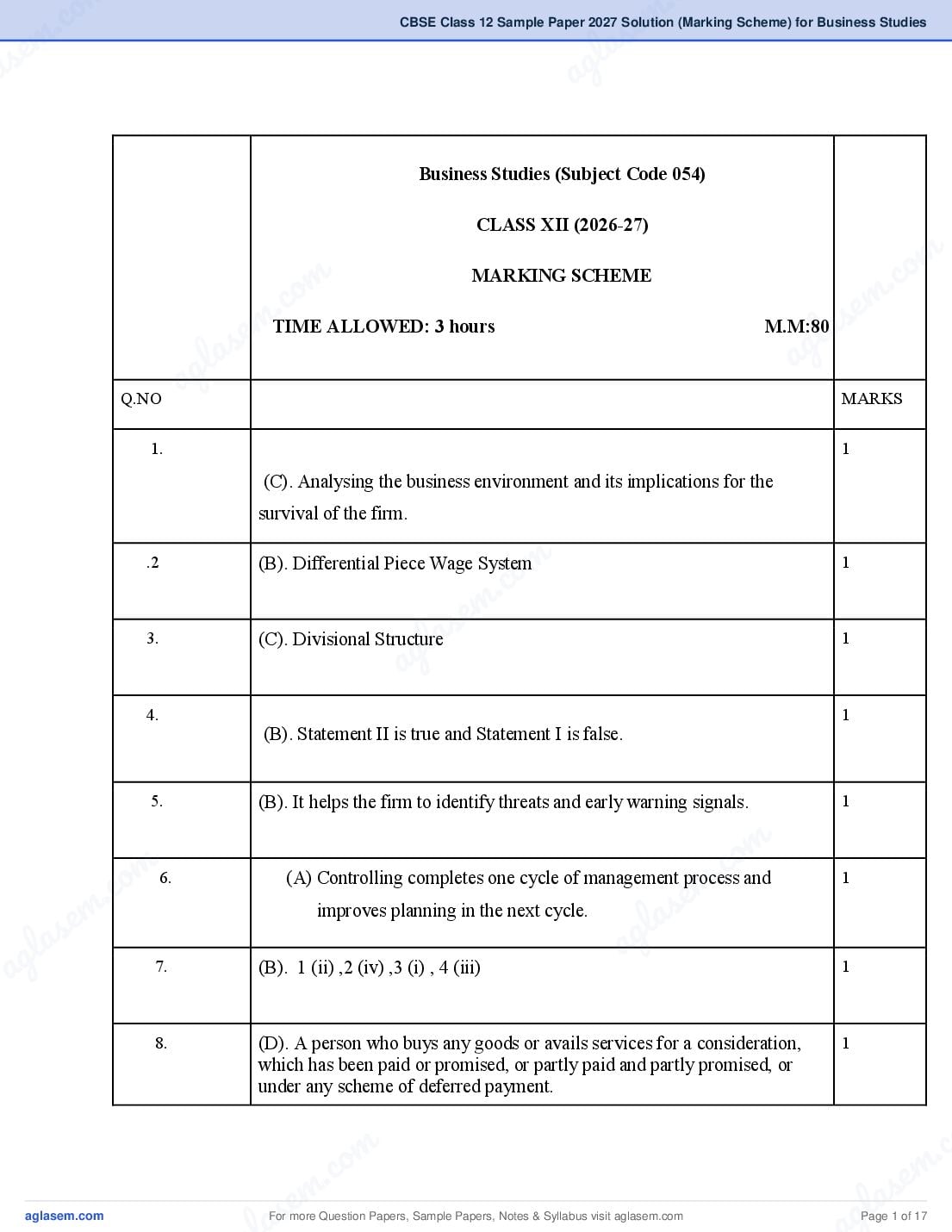
Business Studies (Subject Code 054)
CLASS XII (2026-27)
m
om . co
c m
MARKING SCHEME
.
mTIME ALLOWED: 3 hours s e
se g l a
a
M.M:80
l a
Q.NO
ag MARKS
1. 1
(C). Analysing the business environment and its implications for the
survival of the firm.
m
c. o
.2 (B). Differential Piece Wage System 1
s em
g l a
a
3. (C). Divisional Structure 1
4. 1
(B). Statement II is true and Statement I is false.
5. (B). It helps the firm to identify threats and early warning signals. 1
o m
m c
. and
c. o 6. e m
(A) Controlling completes one cycle of management process
s
1
s em improves planning in the next cycle.
g la
gla a
a 7. (B). 1 (ii) ,2 (iv) ,3 (i) , 4 (iii) 1
8. (D). A person who buys any goods or avails services for a consideration, 1
which has been paid or promised, or partly paid and partly promised, or
under any scheme of deferred payment.
m . c
c. o s e m
m a
se
For more Question Papers, Sample Papers, Notes & Syllabus visit
g l
Page 1 of 17
Page 3
10. 1
(C). A is true but R is false.
11. (A). Central Consumer Protection Authority 1
12. (D). It is usually less liquid but contributes more to the profits than fixed 1
assets.
13. (B). State Commission 1
14. (D).(vii),(vi),(iii),(ii) 1
15. 1
(D). Financial planning
16. C). Semi Variable cost 1
17. (B). Level of competition 1
18. (A). Right to be heard, Read labels carefully so as to have information 1
about prices, net weight, manufacturing and expiry dates, etc.
19. (B). Issue of debentures 1
20. (B). Improving employee motivation 1
21. (i) Preliminary Screening: Preliminary screening helps the manager 1x3=3
eliminate unqualified or unfit job seekers based on the information supplied One mark
in the application forms. Preliminary interviews help reject misfits for for each
For more Question Papers, Sample Papers, Notes & Syllabus visit Page 2 of 17
Page 4
. s e
em l a
as a g
reasons, which did not appear in the application forms. statement
(ii) Selection Tests: An employment test is a mechanism (either a paper
and pencil test or an exercise that attempts to measure certain characteristics
of individuals. These characteristics range from aptitudes, such as manual
o m
m . c
dexterity, to intelligence to personality.
. co
(iii) Employment Interview: Interview is a formal, in-depth conversation
s e m
s em
conducted to evaluate the applicant’s suitability for the job. The role of the a
g l
g l a a
a
interviewer is to seek information and that of the interviewee is to provide
the same. Though, in present times, the interviewee also seeks information
from the interviewer.
OR
Benefits of training and development to the organisation: (any3)
(i) Training is a systematic learning, always better than hit and trial
m
c. o
methods which lead to wastage of efforts and money.
leading to higher profits. em
(ii) It enhances employee productivity both in terms of quantity and quality,
s
(iii) Training equips thela
ag
future manager who can take over in case of
emergency.
(iv) Training increases employee morale and reduces absenteeism and
employee turnover.
(v) It helps in obtaining an effective response to a fast changing
environment – technological and economic.
m
m c. o
c. o 22. se
m
em gla
a)1
las a
a) The barrier of communication due to which Supreet was unable to +
ag meet the target is Faulty Translation. b)1x2=3
(½ mark
b) The barriers under the group Semantic Barriers are: (any two)
for each
(i) Badly expressed message: Sometimes intended meaning may not be
heading+
conveyed by a manager to his subordinates. These badly expressed messages
½ mark for
may be an account of inadequate vocabulary, usage of wrong words,
m . c
c. o s e m
m a
se
For more Question Papers, Sample Papers, Notes & Syllabus visit
g lPage 3 of 17
Page 5
(ii) Symbols with different meanings: A word may have several meanings. explanatio
The receiver has to perceive one such meaning for the word used by the n)
communicator. Wrong perception leads to communication problems
(iii) Unclarified assumptions: Some communications may have certain
assumptions which are subject to different interpretations.
(iv) Technical jargon: It is usually found that specialists use technical jargon
while explaining to persons who are not specialists in the concerned field.
Therefore, they may not understand the actual meaning of many such words.
(v Body language and gesture decoding: Every movement of the body
communicates some meaning. The body movement and gestures of the
communicator matters so much in conveying the message. If there is no
match between what is said and what is expressed in body movements,
communications may be wrongly perceived.
23. (A) 1½+1½
(a) Control considerations-Issue of more equity may lead to dilution of =3
management’s control over the business. Debt financing has no such (½ mark
for each
implication. Companies afraid of a takeover bid would prefer debt to equity.
heading+1
(b) State of capital market- Health of the capital market may also affect the
mark for
choice of source of fund. During the period when the stock market is rising,
each
more people invest in equity. However, a depressed capital market may
explanatio
make the issue of equity shares difficult for any company.
n)
OR
(B)
(a) Choice of technique-Some organisations are capital intensive
whereas others are labour intensive. A capital-intensive organisation
requires higher investment in plant and machinery as it relies less on
manual labour. The requirement of fixed capital for such
organisations would be higher. Labour intensive organisations on the
other hand require less investment in fixed assets. Hence, their fixed
For more Question Papers, Sample Papers, Notes & Syllabus visit Page 4 of 17
Page 6
. s e
em l a
as a g
capital requirement is lower.
(b) Growth prospects-Higher growth of an organisation generally
requires higher investment in fixed assets. Even when such growth is
expected, a company may choose to create higher capacity in order
m
ominvestment in fixed assets and consequently larger fixed capital. . co
to meet the anticipated higher demand quicker. This entails larger
.c e m
me 1) Campus Recruitment: Colleges and institutes of management and a s
l 1x3=3
24.
l a s a g
ag technology have become a popular source of recruitment for (1 mark
for each
technical, professional and managerial jobs. Many big organisations
correct
maintain a close liaison with the universities, vocational schools and
statement)
management institutes to recruit qualified personnel for various jobs.
2) Placement Agencies and Management Consultants: In technical and
m
professional areas, private agencies and professional bodies appear
c o
. personnel demand and supply. These
to be doing substantive work. Placement agencies provide a
nationwide service in m
s e matching
agencies compilea
gl names to their clients. Such agencies charge a
bio-data of a large number of candidates and
recommendasuitable
fee for their services. Management consultancy firms help the
organisations to recruit technical, professional and managerial
personnel. They specialise in middle level and top level executive
placements.
m
3) Casual Callers: Many reputed business organisations keep a database
m c. o
c. o
of unsolicited applicants in their offices. Such job-seekers can be a
s em
em la as they arise.
valuable source of manpower. A list of such job-seekers can be
las a g
prepared and can be screened to fill the vacancies
ag 25. (A) 2+2=4
a) Cause and effect relationship-The principles of management are (½ mark
intended to establish a relationship between cause and effect so that for each
they can be used in similar situations in a large number of cases. As heading
and 1 ½
m . c
c. o s e m
m a
se
For more Question Papers, Sample Papers, Notes & Syllabus visit
g l
Page 5 of 17
Page 7
situation, what would be its likely effect. The principles of explanatio
management are less than perfect since they mainly apply to human n)
behaviour. In real life, situations are not identical. So, accurate cause
and effect relationships may be difficult to establish
b) Universal applicability-The principles of management are intended
to apply to all types of organisations, business as well as non-
business, small as well large, public sector as well as private sector,
manufacturing as well as the services sectors. However, the extent of
their applicability would vary with the nature of the organisation,
business activity, scale of operations and the like.
OR
(B)
a) Harmony not discord-Taylor called for complete mental revolution
on the part of both management and workers. It means that
management and workers should transform their thinking. In such a
situation even trade unions will not think of going on strike etc.
Management should share the gains of the company, if any, with the
workers. At the same time workers should work hard and be willing
to embrace change for the good of the company. Both should be part
of the family. According to Taylor, ‘Scientific management has for
its foundation the firm conviction that the true interests of the two are
one and the same;
b) Science not rule of thumb-Taylor pioneered the introduction of the
method of scientific inquiry into the domain of management practice.
Taylor believed that there was only one best method to maximise
efficiency. This method can be developed through study and analysis.
The method so developed should substitute ‘Rule of Thumb’
throughout the organisation. Scientific method involved
investigation of traditional methods through work-study, unifying the
For more Question Papers, Sample Papers, Notes & Syllabus visit Page 6 of 17
Page 8
. s e
em l a
as a g
best practices and developing a standard method, which would be
followed throughout the organisation.
26. Components of physical distribution- the element of marketing mix 2x2=4
m
co
discussed (Any two):
. om m
c raw materials from the point of production to the point of sale. It is forsethe
1. Transportation: Transportation is the means of carrying goods and (½ marks .
s em one of the major elements in the physical distribution of goods. Itgislaheading
la a and 1½
ag important because unless the goods are physically made available,
marks for
the sale cannot be completed.
the
2. Warehousing: Warehousing refers to the act of storing and assorting
explanatio
products in order to create time utility in them. The basic purpose of n)
warehousing activities is to arrange placement of goods and provide
m
facilities to store them. The need for warehousing arises because
c o
. higher will be the level of service to
there may be a difference between the time a product is produced and
e m
s
the time it is level of inventory,
g
customers but the a
lcapital would be tied up in the stock. Thus, a balance
cost of carrying the inventory will also be high
because a lota of
is to be maintained in respect of the cost and customer satisfaction.
required for consumption.
3. Inventory control: Linked to warehousing decisions are the inventory
decisions which hold key to success for many manufacturers,
m
especially those where the per unit cost is high. A very important
m c. o
c. o
decision in respect of inventory is deciding about the level of
s em
em la relationship, order
inventory.
las g
a from manufacturers to
4. Order processing: In a typical buyer-seller
ag placement is the first step. Products flow
customers via channel members while orders flow in the reverse
direction, from customers to the manufacturers. A good physical
distribution system should provide for an accurate and speedy
processing of orders, in the absence of which, goods would reach the
m . c
c. o s e m
m a
se
For more Question Papers, Sample Papers, Notes & Syllabus visit
g l
Page 7 of 17
Page 9
result in customer dissatisfaction, with the danger of loss of business
and goodwill.
27. A) The principle of managerial control applied by Mr Himank in the case 2+2=4
is Management by Exception. Management by exception, which is A)1 mark
often referred to as control by exception, is an important principle of for naming
management control based on the belief that an attempt to control and 1
mark for
everything results in controlling nothing. Thus, only significant
explanatio
deviations which go beyond the permissible limit should be brought
n
to the notice of management.
B) The subsequent step in the controlling process that must be
undertaken by Mr Akhil to ensure that standards are accomplished is- B)1mark
Taking Corrective Action: No corrective action is required when the for
deviations are within acceptable limits. However, when the identificati
deviations go beyond the acceptable range, especially in the on and 1
important areas, it demands immediate managerial attention so that mark for
deviations do not occur again and standards are accomplished. In case explanatio
n
the deviation cannot be corrected through managerial action, the
standards may have to be revised.
28. (A) (1+1 ½ X
a) Leadership is the process of influencing the behaviour of people by 2=4 )
making them strive voluntarily towards achievement of organisational goals. (1 mark
for
b) Any two styles of leadership depending on the use of authority-
elucidating
(i) Autocratic or Authoritarian leader An autocratic leader gives orders and
+ ½ mark
expects his subordinates to obey those orders. If a manager is following this
for the
style, then communication is only one-way with the subordinate only acting
heading +
according to the command given by the manager. This leader is dogmatic, 1 mark for
i.e., does not change or wish to be contradicted. His following is based on the
the assumption that reward or punishment both can be given depending upon explanatio
For more Question Papers, Sample Papers, Notes & Syllabus visit Page 8 of 17
Page 10
. s e
em l a
as a g
the result. This leadership style is effective in getting productivity in many n)
situations like in a factory where the supervisor is responsible for production
on time and has to ensure labour productivity. Quick decision-making is also
facilitated.
o m
m . c
(ii) Democratic or Participative leader A democratic leader will develop
actiono plans and make decisions in consultation with his subordinates. He
.c e m
em
will encourage them to participate in decision-making. This kind of a
l s
l a s a g
ag leadership style is more common now-a-days, since leaders also recognise
that people perform best if they have set their own objectives. They also need
to respect the other’s opinion and support subordinates to perform their
duties and accomplish organisational objectives. They exercise more control
by using forces within the group.
(iii) Laissez faire or Free-rein leader Such a leader does not believe in the
m
c. o
use of power unless it is absolutely essential. The followers are given a high
m work on their own tasks resolving issues
degree of independence to formulate their own objectives and ways to
s e
l a
achieve them. The group members
a g is there only to support them and supply them the
themselves. The manager
required information to complete the task assigned.
OR
(B)
a) Motivation means incitement or inducement to act or move. In the
context of an organisation, it means the process of making subordinates to
o m
c
act in a desired manner to achieve certain organisational goals.
m . every
c. o m
eare: (Any two)
b) Maslow’s theory was based on human needs. He felt that within
em s
labasic in the hierarchy
s
human being, there exists a hierarchy of five needs. These
la a g
g
(i) Basic Physiological Needs: These needs are most
a and correspond to primary needs. Hunger, thirst, shelter, sleep and sex are
some examples of these needs. In the organisational context, basic salary
helps to satisfy these needs.
(ii) Safety/Security Needs: These needs provide security and protection from
m . c
c. o s e m
m a
se
For more Question Papers, Sample Papers, Notes & Syllabus visit
g l
Page 9 of 17
Page 11
Pension plans etc.,
(iii) Affiliation/Belonging Needs: These needs refer to affection, sense of
belongingness, acceptance and friendship.
(iv) Esteem Needs: These include factors such as self-respect, autonomy
status, recognition and attention.
(v) Self Actualisation Needs: It is the highest level of need in the hierarchy.
It refers to the drive to become what one is capable of becoming. These needs
include growth, self-fulfillment and achievement of goals.
29. 1) Social Environment-The social environment of business includes the 2+2=4
social forces like customs and traditions, values, social trends, (1 mark
society’s expectations from business, etc. Traditions define social each for
identificati
practices that have lasted for decades or even centuries. For example,
on and
the celebration of Diwali, Eid, Christmas, and Guru Parv in India
1each
provides significant financial opportunities for greeting card
mark for
companies, sweets or confectionery manufacturers, tailoring outlets
explanatio
and many other related businesses. Values refer to concepts that a n)
society holds in high esteem. Social trends present various
opportunities and threats to business enterprises.
2) Technological Environment-Technological environment includes
forces relating to scientific improvements and innovations which
provide new ways of producing goods and services and new methods
and techniques of operating a business. For example, recent
technological advances in computers and electronics have modified
the ways in which companies advertise their products.
30. A) Concept identified is Coordination 1+3=4
B) Characteristics of coordination are-(any three) A)1mark
1.Coordination is a continuous process: Coordination is not a one-time for naming
function but a continuous process. It begins at the planning stage and the
concept+
For more Question Papers, Sample Papers, Notes & Syllabus visit Page 10 of 17
Page 12
. s e
em l a
as a g
continues till controlling. B) 1X3=3
2.Coordination is an all pervasive function: Coordination is required at all (one mark
levels of management due to the interdependent nature of activities of for each
correct
various departments. It integrates the efforts of different departments and
m
co
statement)
have om .
different levels. The purchase, production and sales departmental efforts
.c to be coordinated e m
s
for achieving organisational objectives
em
s 3.Coordination integrates group efforts: Coordination unifies unrelateda or g l a
a
harmoniously.
l
ag diverse interests into purposeful work activity. It gives a common focus to
group effort to ensure that performance is as it was planned and scheduled.
4. Coordination ensures unity of action: The purpose of coordination is to
secure unity of action in the realisation of a common purpose. It acts as the
binding force between departments and ensures that all action is aimed at
m
c. o
achieving the goals of the organisation.
inm
Coordination is the responsibility of all managers: Coordination is the
function of every manager e
la s the organisation. Top level managers need to
a g
coordinate with their subordinates to ensure that the overall policies for the
organisation are duly carried out. Middle level management coordinates with
both the top level and first line managers. Operational level management
coordinates the activities of its workers to ensure that work proceeds
according to plans.
5. Coordination is a deliberate function: A manager has to coordinate
o m
c
the efforts of different people in a conscious and deliberate manner.
m . and
c. o m
e spirit.
Even where members of a department willingly cooperate
em la s
s
work, coordination gives a direction to that willing
la a g
ag
m . c
c. o s e m
m a
se
For more Question Papers, Sample Papers, Notes & Syllabus visit
g l
Page 11 of 17
Page 13
1. Product cost: One of the most important factors affecting the price of a (½ mark
product or service is its cost. This includes the cost of producing, distributing for the
heading
and selling the product. The cost sets the minimum level or the floor price at
and
which the product may be sold. Generally, all marketing firms strive to cover
1 ½ marks
all their costs, at least in the long run. In addition, they aim at earning a
for the
margin of profit over and above the costs. In certain circumstances, for
explanatio
example, at the time of introducing a new product or while entering a new n)
market, the products may be sold at a price, which does not cover all the
costs. But in the long run, a firm cannot survive unless at least all its costs
are covered. Semi variable costs are those costs which vary with the level of
activity but not in direct proportion with it.
2. Utility and Demand: While the product costs set the lower limits of the
price, the utility provided by the product and the intensity of demand of the
buyer sets the upper limit of price, which a buyer would be prepared to pay.
In fact the price must reflect the interest of both the parties to the
transaction—the buyer and the seller. The buyer may be ready to pay up to
the point where the utility from the product is at least equal to the sacrifice
made in terms of the price paid. The seller would, however, try to at least
cover the costs. According to the law of demand, consumers usually purchase
more units at a low price than at a high price.
the maximum price for its products.
3. Marketing Methods Used: Price fixation process is also affected by other
elements of marketing such as distribution system, quality of salesmen
employed, quality and promoted, these must be made available to customers
at the right amount of advertising, sales promotion efforts, the type of
packaging, product differentiation, credit facility and customer services
provided. Similarly, the uniqueness of any of the elements mentioned above
gives the company a competitive freedom in fixing prices of its products.
OR
For more Question Papers, Sample Papers, Notes & Syllabus visit Page 12 of 17
Page 14
. s e
em l a
as a g
(B)The concepts of branding, packaging and labelling as elements of product
mix:
Branding: One of the most important decisions that a marketer has to take in
the area of ‘product’ is in respect of branding. If products were sold by
o m
m . c
generic names, it would be very difficult for him to decide whether the firm’s
.co will be marketed under a brand name or a generic name. Thus, most sem
products
s em
marketers give a name to their product, which helps in identifying and a
g l
g l a a
a
distinguishing their products from the competitors’ products. This process of
giving a name or a sign or a symbol etc., to a product is called branding.
Packaging: Packaging refers to the act of designing and producing the
container or wrapper of a product. Packaging plays a very important role in
the marketing success or failure of many products, particularly the consumer
non-durable products. In fact if one makes an analysis of the reasons for the
m
c. o
success of some of the successful products in the recent past, it can be noted
mbut important task in the marketing of goods
that packaging has played its due role.
s e
relates to designing thela
Labelling: A simple looking
ag
label to be put on the package. The label may vary
from a simple tag attached to the product (such as in case of local unbranded
products like sugar, wheat, pulses, etc.) indicating some information about
the quality or price, to complex graphics that are part of the package, like the
ones on branded products. Labels are useful in providing detailed
information about the product, its contents, method of use, etc.
m
m c. o
c. o s e m
s em g la
gla a
a
32. 1+1+4=6
(a) The institution that provides the platform is the Stock Exchange.
According to the Securities Contracts (Regulation) Act, 1956, Stock 1 mark for
Exchange means anybody of individuals, whether incorporated or not, naming +
constituted for the purpose of assisting, regulating or controlling the business 1 mark for
m . c
c. o s e m
m a
se
For more Question Papers, Sample Papers, Notes & Syllabus visit
g l
Page 13 of 17
Page 15
1x 4
(b) Functions of the institution discussed are: (½ mark
each for
1.Providing Liquidity and Marketability to existing Securities: The basic
heading
function of a stock exchange is the creation of a continuous market where
+½ mark
securities are bought and sold. It gives investors the chance to disinvest and each
reinvest. This provides both liquidity and easy marketability to already explanatio
existing securities in the market. n)
2. Pricing of Securities: Share prices on a stock exchange are determined by
the forces of demand and supply. A stock exchange is a mechanism of
constant valuation through which the prices of securities are determined.
Such a valuation provides important instant information to both buyers and
Sellers in the market.
3. Safety of Transaction: The membership of a stock exchange is well-
regulated and its dealings are well defined according to the existing legal
framework. This ensures that the investing public gets a safe and fair deal on
the market.
4. Contributes to Economic Growth: Through the process of disinvestment
and reinvestment savings get channelised into their most productive
investment avenues. This leads to capital formation and economic growth.
33. 1½ X
Decentralisation is a fundamental step and its importance can be understood 4=6
from the following points: (Any four) (½ mark
for each
(i) Develops initiative among subordinates: Decentralisation helps to
heading
promote self-reliance and confidence amongst the subordinates. This is
and 1
because when lower managerial levels are given freedom to make their own
mark for
explanatio
For more Question Papers, Sample Papers, Notes & Syllabus visit Page 14 of 17
Page 16
. s e
em l a
as a g
decisions they learn to depend on their own judgment. n)
(ii) Develops managerial talent for the future: Formal training plays an
important part in equipping subordinates with skills that help them rise in the
m
co
organisation but equally important is the experience gained by handling
.c om
assignments independently. Decentralisation gives them a chance to prove
e m .
m
e considered to fill up more challenging positions through promotions.
their abilities and creates a reservoir of qualified manpower who can be
l a s
l a s a g
ag
(iii) Quick decision making: In a decentralised organisation, however, since
decisions are taken at levels which are nearest to the points of action and
there is no requirement for approval from many levels, the process is much
faster. There are also less chances of information getting distorted because it
doesn’t have to go through long channels.
m
c. o
(iv) Relief to top management: Decentralisation diminishes the amount of
e ma superior over the activities of a subordinate
sfreedom to act and decide albeit within the limits
direct supervision exercised by
a
because they are given lthe
g
set by the superior. a
Also, personal supervision is generally replaced by other
forms of control such as return on investment etc.
(v) Facilitates growth: Decentralisation awards greater autonomy to the
lower levels of management as well as divisional or departmental heads. This
m
allows them to function in a manner best suited to their department and
m
fosters a sense of competition amongst the departments.
c. o
c. o s e m
em la
(vi) Better control: Decentralisation makes it possible to evaluate
las a g
g
performance at each level and the departments can be individually held
a accountable for their results. The extent of achievement of organisational
objectives as well as the contribution of each department in meeting the
overall objectives can be ascertained. Decentralisation compels the
management to innovative performance measurement systems.
m . c
c. o s e m
m a
se
For more Question Papers, Sample Papers, Notes & Syllabus visit
g l
Page 15 of 17
Page 17
activities. They detail the exact manner in which any work is to be
performed. They are specified in a chronological order. Procedures (½ mark
for each
are specified steps to be followed in particular circumstances. They
heading
are generally meant for insiders to follow. The sequence of steps or
and 1 ½
actions to be taken are generally to enforce a policy and to attain pre-
mark for
determined objectives. Policies and procedures are interlinked with
explanatio
each other. n)
b) Strategy-A strategy provides the broad contours of an
organisation’s business. It will also refer to future decisions defining
the organisation's direction and scope in the long run. Thus, we can
say a strategy is a comprehensive plan.for accomplishing an
organisation objectives. This comprehensive plan will include three
dimensions, (i) determining long term objectives, (ii) adopting a
particular course of action, and (iii) allocating resources necessary to
achieve the objective. Whenever a strategy is formulated, the
business environment needs to be taken into consideration
c) Rule-Rules are specific statements that inform what is to be done.
They do not allow for any flexibility or discretion. It reflects a
managerial decision that a certain action must or must not be taken.
They are usually the simplest type of plans because there is no
compromise or change unless a policy decision is taken.
OR
(B)
a) Planning facilitates decision making-Planning helps the manager to look
into the future and make a choice from amongst various alternative courses
of action. The manager has to evaluate each alternative and select the most
viable proposition. Planning involves setting targets and predicting future
conditions, thus helping in taking rational decisions.
b) Planning reduces the risk of uncertainty- Planning is an activity which
For more Question Papers, Sample Papers, Notes & Syllabus visit Page 16 of 17
Page 18
. s e
em l a
as a g
enables a manager to look ahead and anticipate changes. By deciding in
advance the tasks to be performed, planning shows the way to deal with
changes and uncertain events. Changes or events cannot be eliminated but
they can be anticipated and managerial responses to them can be developed.
o m
m . c
c) Planning establishes standards of controlling-Planning involves setting of
goals.o Planning provides the goals or standards against which actual
.c e m
em
performance is measured. By comparing actual performance with some a
l s
l a s a g
ag standard, managers can know whether they have actually been able to attain
the goals. The nature of corrective action required depends upon the extent
of deviations from the standard. Therefore, planning provides the basis of
control.
m
. co
s em
g l a
a
m
m c. o
c. o s e m
s em la
gla ag
a
m . c
c. o s e m
m a
se
For more Question Papers, Sample Papers, Notes & Syllabus visit
g l
Page 17 of 17
Document Details
| Board / Org | CBSE |
| Exam | Class 12 |
| Type | Solution |
| Pages | 17 |
| Updated | 29 Oct 2026 |