CBSE Class 12 Philosophy Question Paper 2019
Finished viewing? Save it for later —
Download CBSE Class 12 Philosophy Question Paper 2019 (PDF · 5 pages)About CBSE Class 12 Philosophy Question Paper 2019
CBSE Class 12 Philosophy Question Paper 2019 is available here for free download. Published by CBSE for Class 12, this question paper can be viewed online or downloaded as a PDF (5 pages). Candidates preparing for Class 12 can use CBSE Class 12 Philosophy Question Paper 2019 to understand the exam pattern, the type of questions asked, and the overall difficulty level.
Frequently Asked Questions
How can I download CBSE Class 12 Philosophy Question Paper 2019?
Open this page and click the Download button to save CBSE Class 12 Philosophy Question Paper 2019 as a PDF. It is completely free on AglaSem Docs.
Is CBSE Class 12 Philosophy Question Paper 2019 free to download?
Yes. CBSE Class 12 Philosophy Question Paper 2019 can be viewed online and downloaded as a PDF free of cost on AglaSem Docs.
How many pages does CBSE Class 12 Philosophy Question Paper 2019 have?
CBSE Class 12 Philosophy Question Paper 2019 contains 5 pages, which you can read online or download together as a single PDF.
Where can I find more Class 12 study material?
You can find more Class 12 question papers, sample papers, syllabus, and answer keys on AglaSem Docs.
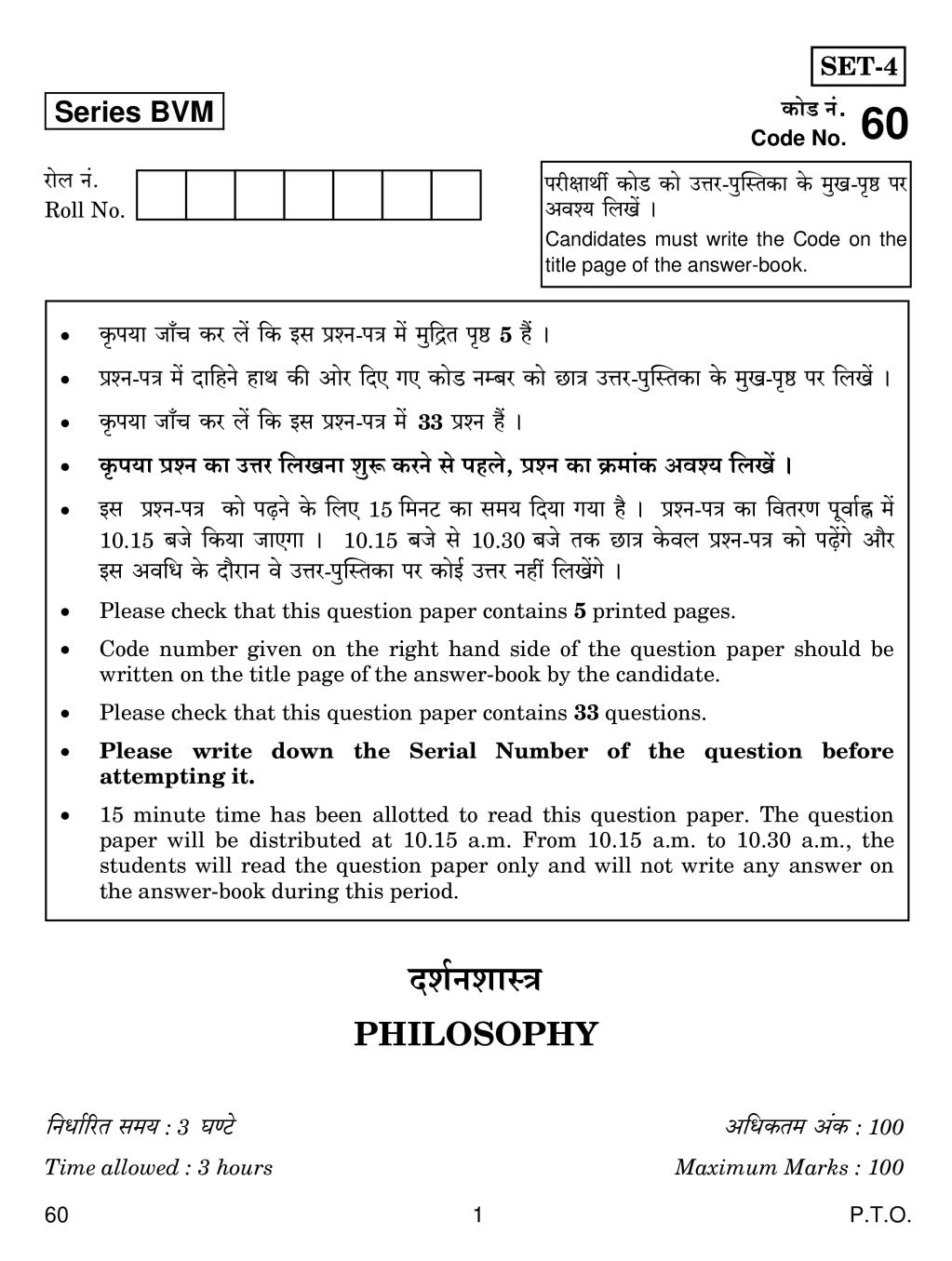
CBSE Class 12 Philosophy Question Paper 2019 – Text
Read the full text of this question paper below — useful to quickly search, copy and reference the content online without downloading the PDF.
📄 View text version (5 pages)
Page 1
Series BVM H$moS> Z§.
Code No. 60
amob Z§. narjmWu H$moS >H$mo CÎma-nwpñVH$m Ho$ _wI-n¥ð >na
Roll No. Adí` {bIo§ &
Candidates must write the Code on the
title page of the answer-book.
H¥$n`m Om±M H$a b| {H$ Bg àíZ-nÌ _o§ _w{ÐV n¥ð> 5 h¢ &
àíZ-nÌ _| Xm{hZo hmW H$s Amoa {XE JE H$moS >Zå~a H$mo N>mÌ CÎma-nwpñVH$m Ho$ _wI-n¥ð> na {bI| &
H¥$n`m Om±M H$a b| {H$ Bg àíZ-nÌ _| >33 àíZ h¢ &
H¥$n`m àíZ H$m CÎma {bIZm ewê$ H$aZo go nhbo, àíZ H$m H«$_m§H$ Adí` {bI| &
Bg àíZ-nÌ H$mo n‹T>Zo Ho$ {bE 15 {_ZQ >H$m g_` {X`m J`m h¡ & àíZ-nÌ H$m {dVaU nydm©• _|
10.15 ~Oo {H$`m OmEJm & 10.15 ~Oo go 10.30 ~Oo VH$ N>mÌ Ho$db àíZ-nÌ H$mo n‹T>|Jo Am¡a
Bg Ad{Y Ho$ Xm¡amZ do CÎma-nwpñVH$m na H$moB© CÎma Zht {bI|Jo &
Please check that this question paper contains 5 printed pages.
Code number given on the right hand side of the question paper should be
written on the title page of the answer-book by the candidate.
Please check that this question paper contains 33 questions.
Please write down the Serial Number of the question before
attempting it.
15 minute time has been allotted to read this question paper. The question
paper will be distributed at 10.15 a.m. From 10.15 a.m. to 10.30 a.m., the
students will read the question paper only and will not write any answer on
the answer-book during this period.
Xe©ZemñÌ
PHILOSOPHY
{ZYm©[aV g_` : 3 KÊQ>o A{YH$V_ A§H$ : 100
Time allowed : 3 hours Maximum Marks : 100
60 1 P.T.O.
Page 2
(i) g^r àíZ A{Zdm`© h¢ &
(ii) àíZ g§»`m 1 – 14 VH$ Ho$ àË`oH$ àíZ Ho$ 2 A§H$ h¢ & BZ àíZm| Ho$ àË`oH$ Ho$ CÎma
40 eãXm| go A{YH$ Zht hmoZo Mm{hE &
(iii) àíZ g§»`m 15 – 28 VH$ Ho$ àË`oH$ àíZ Ho$ 3 A§H$ h¢ & BZ àíZm| Ho$ àË`oH$ Ho$ CÎma
60 eãXm| go A{YH$ Zht hmoZo Mm{hE &
(iv) àíZ g§»`m 29 – 33 VH$ Ho$ àË`oH$ àíZ Ho$ 6 A§H$ h¢ & BZ àíZm| Ho$ àË`oH$ Ho$ CÎma
150 eãXm| go A{YH$ Zht hmoZo Mm{hE &
General Instructions :
(i) All questions are compulsory.
(ii) Questions no. 1 – 14 are of 2 marks each. The answers to these questions
should not exceed 40 words each.
(iii) Questions no. 15 – 28 are of 3 marks each. The answers to these questions
should not exceed 60 words each.
(iv) Questions no. 29 – 33 are of 6 marks each. The answers to these questions
should not exceed 150 words each.
1. nwéfmW© Ho$ ê$n ‘| AW© H$m dU©Z H$s{OE &
Describe artha as a purusārtha.
.
2. O¡Z Xe©Z ‘| ñ¶mX²dmX H$m ³¶m AW© h¡ ?
In Jainism, what is meant by syādvāda ?
3. XoH$mV© Ho$ AZwgma ‘Z H$m ‘w»¶ JwU ³¶m h¡ ?
According to Descartes, what is the main characteristic of mind ?
60 2
Page 3
-
What is meant by the Buddhist concept of pratityasamutpāda ?
5. O¡Z Xe©Z ‘| An[aJ«h H$s AdYmaUm H$m ³¶m AW© h¡ ?
What does the notion of aparigraha mean in Jainism ?
6. ‘X¡dr AmXoe-dmX’ ‘| A§V^y©V {gÕm§V ³¶m h¡ ?
State the principle underlying ‘Divine Command Theory’.
7. ‘gX²JwU’ nX H$m ³¶m AW© h¡ ?
What does the term ‘virtue’ mean ?
8. H$m§Q> Ûmam à{Vnm{XV ‘g{XÀN>m’ H$s AdYmaUm H$s n[a^mfm Xr{OE &
Define Kant’s notion of ‘good will’.
9. ZmardmXr kmZ-‘r‘m§gm Ho$ ‘w»¶ JwU H$m dU©Z H$s{OE &
Describe the main characteristic of feminist epistemology.
10. X§S> Ho$ à{VH$mar {gÕm§V ‘| H$m¡Z-gm Zr{VdMZ A§V{Z©{hV h¡ ?
What is the underlying principle of retributive theory of punishment ?
11. Mma Aml‘m| H$m n[aJUZ H$s{OE &
Enumerate the four asramas.
12. ݶm¶-Xe©Z ‘| B©ída H$s AdYmaUm ³¶m h¡ ?
What is Nyaya’s conception of God ?
60 3 P.T.O.
Page 4
What is meant by ‘environment’ ?
14. ‘‘mZd A{YH$mam| Ho$ hZZ’ H$m ³¶m AW© h¡ ?
What is meant by ‘violation of human rights’ ?
15. Cn¶mo{JVmdmXr Zr{VemñÌ ‘| A§V^y©V {gÕm§V H$s ì¶m»¶m H$s{OE &
Explain the principle underlying the utilitarian ethics.
16. AañVy Ho$ ‘ܶ-‘mJ© {gÕm§V H$s ì¶m»¶m H$s{OE &
Explain Aristotle’s doctrine of Golden Mean.
17. H$m§Q> Ûmam à{Vnm{XV gmd©^m¡{‘H$VmdmX {gÕm§V H$s ì¶m»¶m H$s{OE &
Explain Kant’s principle of universalizability.
18. gmYmaU Y‘© Am¡a AmnX Y‘© ‘| ^oX H$s{OE &
Distinguish between sādharana
. and āpad dharma.
19. ‘‘qbJ àmH¥${VH$ h¡, b¢{JH$Vm gm‘m{OH$ g§aMZm h¡ &’’ MMm© H$s{OE &
‘‘Sex is natural, gender is a social construct.’’ Discuss.
20. ^JdX²JrVm ‘| {ZîH$m‘ H$‘© H$s AdYmaUm H$s ì¶m»¶m H$s{OE &
Explain Bhagvadgita’s notion of nishkama karma.
21. ‘hmd«V Ho$ ê$n ‘| ~«÷M¶© H$s AdYmaUm H$s ì¶m»¶m H$s{OE &
Explain the notion of brahmaćarya
. as a Mahāvrata.
.
22. ~mo{YgÎd Ho$ AmXe© ³¶m h¢ ?
What are the ideals of a Bodhisattva ?
23. X§S> ³¶m hmoVm h¡ ? X§S> Ho$ {ZdmaUmW© {gÕm§V H$s ì¶m»¶m H$s{OE &
What is punishment ? Explain the deterrent theory of punishment.
60 4
Page 5
Explain the cosmological argument for the existence of God.
25. XoH$mV© Ho$ AZwgma nXmW© H$m ‘yb JwU ³¶m h¡ ? {H$VZo àH$ma Ho$ nXmW© hmoVo h¢ ? ì¶m»¶m
H$s{OE &
What, according to Descartes, is the main characteristic of substance ?
How many substances are there ? Explain.
26. ³¶m n¶m©daU H$m g§ajU gmYZ h¡ ¶m gmܶ ? ì¶m»¶m H$s{OE &
Is the protection of environment a means or an end in itself ? Explain.
27. ³¶m ‘m¡{bH$ A{YH$ma {Zanoj h¢ ? ì¶m»¶m H$s{OE &
Are fundamental rights absolute ? Explain.
28. dU© Am¡a Om{V ‘| ^oX H$s{OE &
Distinguish between class and caste.
29. B©ída H$s gÎmm {gÕ H$aZo Ho$ {bE Z¡¶m{¶H$m| Ûmam Xr JB© H$maUVm ¶w{³V H$s ì¶m»¶m
H$s{OE &
Explain Nayayikas causal argument for the proof of the existence of
God.
30. ~wÕ Ho$ Xÿgao Am¶© g˶ H$s ì¶m»¶m H$s{OE &
Explain Buddha’s Second Noble Truth.
31. ³¶m Aew^ H$m ApñVËd B©ída Ho$ ào‘ go AmoV-àmoV hmoZo H$s g§H$ënZm go gwg§JV h¡ ? MMm©
H$s{OE &
Is the existence of evil compatible with all loving God ? Discuss.
32. AmË_m Am¡a nwZO©Ý_ Ho$ ñdê$n ‘| ³¶m g§~§Y h¡, ì¶m»¶m H$s{OE &
Explain the relationship between the nature of atman and rebirth.
33. Ym{‘©H$ g{hîUwVm Ho$ {df¶ ‘| ñdm‘r {ddoH$mZ§X Ûmam {XE JE VH$m] H$m narjU H$s{OE &
Examine Swami Vivekananda’s arguments for religious tolerance.
60 5 0000
P.T.O.
Document Details
| Board / Org | CBSE |
| Exam | Class 12 |
| Type | Question Paper |
| Pages | 5 |
| Updated | 30 Apr 2026 |