CBSE Class 12 Sample Paper 2027 Solution (Marking Scheme) for Chemistry
Finished viewing? Save it for later —
Download CBSE Class 12 Sample Paper 2027 Solution (Marking Scheme) for Chemistry (PDF · 12 pages)About CBSE Class 12 Sample Paper 2027 Solution (Marking Scheme) for Chemistry
CBSE Class 12 Sample Paper 2027 Solution (Marking Scheme) for Chemistry is available here for free download. Published by CBSE for Class 12, this solution can be viewed online or downloaded as a PDF (12 pages). Candidates preparing for Class 12 can use CBSE Class 12 Sample Paper 2027 Solution (Marking Scheme) for Chemistry to understand the exam pattern, the type of questions asked, and the overall difficulty level.
Frequently Asked Questions
How can I download CBSE Class 12 Sample Paper 2027 Solution (Marking Scheme) for Chemistry?
Open this page and click the Download button to save CBSE Class 12 Sample Paper 2027 Solution (Marking Scheme) for Chemistry as a PDF. It is completely free on AglaSem Docs.
Is CBSE Class 12 Sample Paper 2027 Solution (Marking Scheme) for Chemistry free to download?
Yes. CBSE Class 12 Sample Paper 2027 Solution (Marking Scheme) for Chemistry can be viewed online and downloaded as a PDF free of cost on AglaSem Docs.
How many pages does CBSE Class 12 Sample Paper 2027 Solution (Marking Scheme) for Chemistry have?
CBSE Class 12 Sample Paper 2027 Solution (Marking Scheme) for Chemistry contains 12 pages, which you can read online or download together as a single PDF.
Where can I find more Class 12 study material?
You can find more Class 12 question papers, sample papers, syllabus, and answer keys on AglaSem Docs.
CBSE Class 12 Sample Paper 2027 Solution (Marking Scheme) for Chemistry – Text
Read the full text of this solution below — useful to quickly search, copy and reference the content online without downloading the PDF.
📄 View text version (13 pages)
Page 1
CBSE Class 12 Sample
Paper 2027 Solution
(Marking Scheme) for
Chemistry
EXAM YEAR TYPE SUBJECT
CBSE Class 12 2027 Solutions Chemistry
Notes · Sample Papers · Previous Year Papers · Mock Tests
Page 2
m .co
m .co s e m
se g l a
a
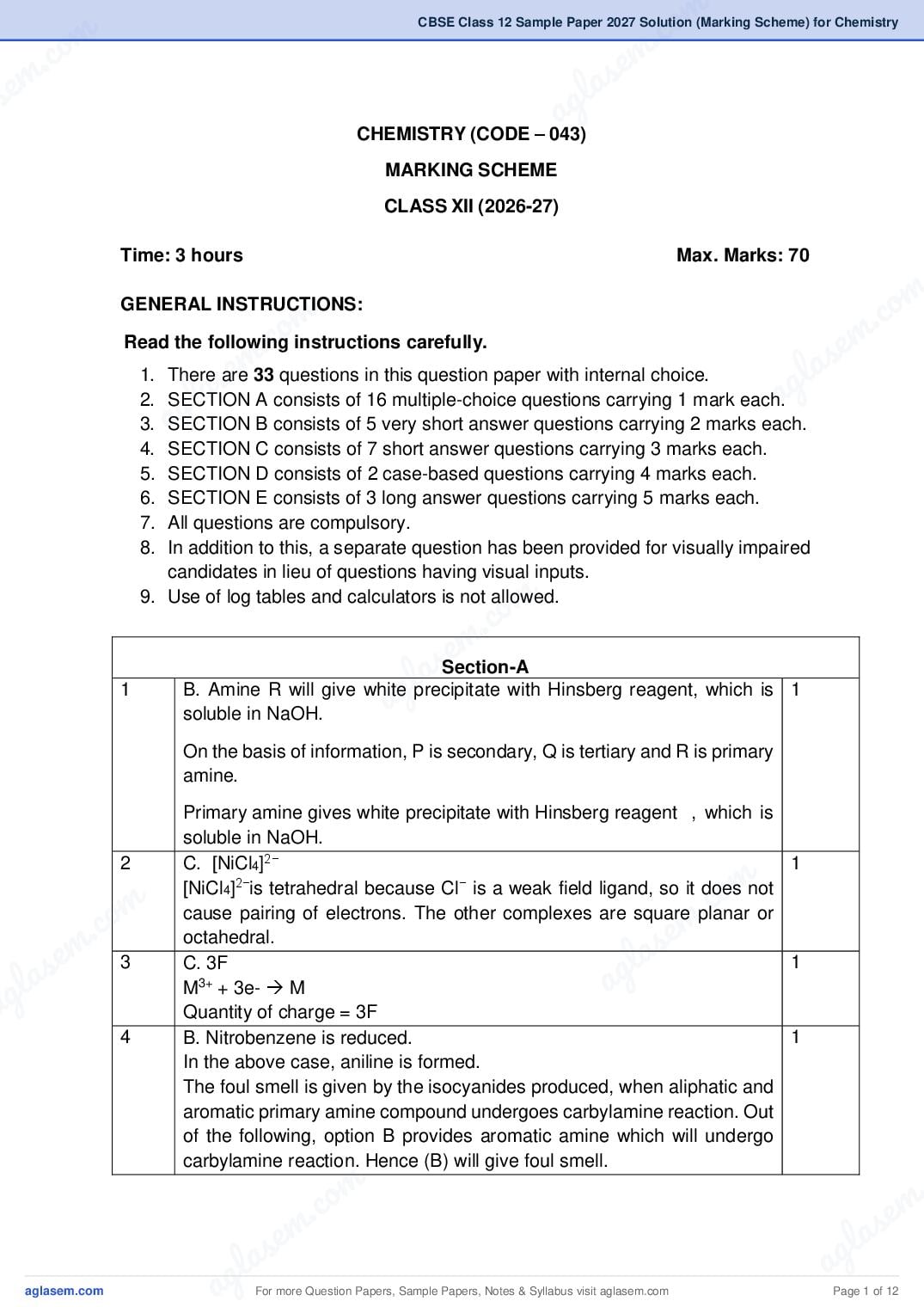
CHEMISTRY (CODE – 043)
MARKING SCHEME
CLASS XII (2026-27)
Time: 3 hours Max. Marks: 70
m
m .co
GENERAL INSTRUCTIONS:
.co
Read the following instructions carefully.
s e m
s em33 questions in this question paper with internal choice. g l a
a
1. There are
l A consists of 16 multiple-choice questions carrying 1 mark each.a
3. a
g
2. SECTION
SECTION B consists of 5 very short answer questions carrying 2 marks each.
4. SECTION C consists of 7 short answer questions carrying 3 marks each.
5. SECTION D consists of 2 case-based questions carrying 4 marks each.
6. SECTION E consists of 3 long answer questions carrying 5 marks each.
7. All questions are compulsory.
8. In addition to this, a separate question has been provided for visually impaired
candidates in lieu of questions having visual inputs.
m
.co
9. Use of log tables and calculators is not allowed.
s em
la Section-A
B. Amine R will give whitegprecipitate
1
soluble in NaOH. a with Hinsberg reagent, which is 1
On the basis of information, P is secondary, Q is tertiary and R is primary
amine.
Primary amine gives white precipitate with Hinsberg reagent , which is
soluble in NaOH.
2 C. [NiCl4]2− 1
m
.co
2−
[NiCl4] is tetrahedral because Cl⁻ is a weak field ligand, so it does not
m
.co m
cause pairing of electrons. The other complexes are square planar or
m s e
a
octahedral.
s e g l
la
3 C. 3F 1
g M3+ + 3e- M a
a Quantity of charge = 3F
4 B. Nitrobenzene is reduced. 1
In the above case, aniline is formed.
The foul smell is given by the isocyanides produced, when aliphatic and
aromatic primary amine compound undergoes carbylamine reaction. Out
of the following, option B provides aromatic amine which will undergo
carbylamine reaction. Hence (B) will give foul smell.
m .
.co s e m
s em l a
g la ag
a For more Question Papers, Sample Papers, Notes & Syllabus visit Page 1 of 12
Page 3
Henry’s law
(for visually challenged learners)
B. mole fraction of the gas in the solution
6 D. (i) second order (ii) first order 1
The rate of reaction will depend on both the reactants in case (i)
In case (ii), when water is in excess, the rate of reaction is independent
of concentration of water. Such reactions are called pseudounimolecular
reactions.
7 A. an acidic, non-essential amino acid. 1
The amino acid can be synthesised in our bodies so it is non-essential.
It has two –COOH groups and one -NH2 group, therefore it is acidic.
8 D. (i) and (ii) 1
OMgCl OH
(i) C2H5COC2H5 + CH3MgCl → C2H5CC2H5 hydrolysis C2H5CC2H5
CH3 CH3
OMgCl OH
(ii)C2H5COCH3 + C2H5MgCl → C2H5CCH3 hydrolysis C2H5CCH3
C2H5 C2H5
OMgCl OH
(iii)C2H5CH(MgCl)C2H5 +CH3CHO→ CH3CH hydrolysis CH3CH
C2H5CC2H5 C2H5CHC2H5
OMgCl OH
(iv) C2H5CH(MgCl)CH3 +C2H5CHO→C2H5CH hydrolysis C2H5CH
C2H5CHCH3 C2H5CHCH3
9 B: Mn 1
Mn3+ act as strong oxidising agent.
10 A. The reaction follows SN2 mechanism and is accompanied by inversion 1
of configuration.
11 B. 32 min 1
50% reaction is completed in 16 min. For remaining 50% of the
substance to reduce to its half (25%) time required will be 16 min.
Therefore 50% +25% = 75% of the reaction will be completed in 32
min
For more Question Papers, Sample Papers, Notes & Syllabus visit Page 2 of 12
Page 4
m .co
m .co s em
se g la
12 a H⁺ and Cl⁻ ions. More
A. HCl is a strong acid and fully dissociates into 1
ions lead to higher conductivity.
CH₃COOH and NH₃ are weak electrolytes and are partially ionized
having lower conductivity. Glucose is a non-electrolyte, no ions and
hence no conductivity.
13 B. A and R are true, and R is not the correct explanation of A 1
14 C. A is true but R is false. 1
m
.co
Reason is false, the correct statement -
m
.co m
The pi bonding takes place by overlapping of p orbitals of oxygen with d
m s e
a
orbitals of manganese.
s e l
a ag
15 A. A and R are true, and R is the correct explanation of A 1
16
g l
A. A and R are true, and R is the correct explanation of A 1
a 3+
[Co(NH3)6] is diamagnetic because all electrons are paired. NH3 is a
strong field ligand, so it causes electron pairing in the d-orbitals.
Hence, the reason correctly explains the assertion.
Section-B
Question No. 17 to 21 are very short answer questions carrying 2 marks each
17A
1
I.
m
II. .co
Chromium has more number of unpaired electrons than Titanium
m
s e
leading to stronger interatomic attractions holding its atoms 1
la
together requiring more energy to break as compared to titanium.
g
17B I.
a OR
The transition metals form a large number of complex compounds.
This is due to the comparatively smaller sizes of the metal ions, 1
their high ionic charges and the availability of d orbitals for bond
formation. Hence Titanium forms complex compounds, whereas
Potassium and calcium do not.
II.
om
1
m . c
c. o18 s e m
em
The statement is true for a zero order reaction as the rate is independent 1
s of concentration of reactants.
g l a
l a For reactions of order other than zero, like order 1, 2 etc. the rate of 1a
ag reaction decreases with the decrease in concentration of reactants.
m .
.co s e m
s em l a
g la ag
a For more Question Papers, Sample Papers, Notes & Syllabus visit Page 3 of 12
Page 5
II. Addition of lemon juice lowers the pH which breaks the hydrogen 1
bonds, the globules of casein unfold and it gets denatured.
For Visually Challenged Learners
I. Adenine, Guanine, Cytosine and Thymine 1
II. Addition of lemon juice lowers the pH which breaks the hydrogen
bonds, the globules of casein unfold and it gets denatured. 1
20 Nitro group will increase the reactivity. 1
The nitro group is a strong electron-withdrawing group (EWG) due to
both its inductive (-I) and resonance (-M) effects whereas methoxy group
is electron donating in nature. ½
In chlorobenzene when nitro group is present at
the ortho or para position, it withdraws electron density from the ring and
stabilizes this negative charge through resonance. Hence increases its ½
reactivity towards nucleophilic
21 I. Magnesium being more reactive than iron acts as a sacrificial anode 1
and undergoes oxidation (Mg → Mg²⁺ + 2e⁻), supplying electrons to
the iron pipe, which behaves like cathode, thus preventing corrosion.
II. Cathode: Mg2+ + 2e- Mg (l) ½
Anode: 2Cl- Cl2 (g) + 2e- ½
Section-C
Question No. 22 to 28 are short answer questions, carrying 3 marks each.
22 I. Fe2+ (4 unpaired electrons) has higher magnetic moment, as it ½, ½
contains more unpaired electrons as compared to other two.
II.
a) It provides large surface area and variable oxidation state.
1
b) Iron has large crystal lattices containing interstitial sites large 1
enough to accommodate small non-metal atoms like oxygen,
carbon, nitrogen.
23 𝐸𝑎
log K= log A -
2.303𝑅𝑇 ½
½
𝐸𝑎
Slope = -
2.303𝑅
For more Question Papers, Sample Papers, Notes & Syllabus visit Page 4 of 12
Page 6
m .co
m .co s e m
se g l a
Slope = y2-y1 a
= -4.46 –(-3.91) = - 5500 J/K/mol 1
X2-x1 .00333-.00323
(value of slope may vary slightly if different values of y2,y1, x2 and x1 are
chosen)
Equating the value of slope to the expression – (Correct
𝐸𝑎 answer
= − 5500 where R= 8.314 JK-1mol-1
m
- and
.co
2.303𝑅 correct
𝐸𝑎
m
= 5500 X 2.303 X 8.314
.co
unit)
e m
em ½ ,a½s
s
𝐸𝑎 = 105.31 kJmol-1
g l
g laVisually challenged learners a
a For
𝐸𝑎
log k= log A -
2.303𝑅𝑇
𝐸𝑎 1
Slope = -
2.303𝑅
𝐸𝑎
- = − 4500 where R= 8.314 JK-1mol-1
m
2.303𝑅
= 4500 X 2.303 X 8.314 .c
o 1
em
𝐸𝑎
la s
𝐸𝑎 = 86.16 kJmol
g
-1
a ½,½
(Correct
answer
and
correct
unit)
24 I. Aldol condensation, dil NaOH ½+½
II. Etard Reaction, CrO2Cl2 ½+½
m
om .co ½+½
em
III. Wolf -kishner reduction, >C=N.NH2
. c 25 s
e m I.
a) The net volume of resulting solution was found tola
las ag be slightly more
ag than 20 mL. Carbon disulphide and acetone have weak ½
intermolecular interactions which leads to increase in the volume
½
of the solution.
b) When solution is replaced with chloroform, net volume shows ½
slight decrease from 20 mL, as chloroform and acetone have ½
strong intermolecular interactions owing to hydrogen bonding.
m .
.co s e m
s em l a
g la ag
a For more Question Papers, Sample Papers, Notes & Syllabus visit Page 5 of 12
Page 7
Total number of parts of all components
= 6 x 10-3 x 106
1030 + 0.006
= 6 x 10-3 x 106
1030
= 5.8 ppm ½
26 I.
a) Nitrobenzene to flurobenzene
Sn/HCl NaNO2/HCl NaBF4
1
C6H5NO2 C6H5NH2 C6H5N2+Cl- C6H5 F
b) Benzoic acid to benzylamine 1
heat LiAlH4
C6H5COOH + NH3 C6H5CONH2 C6H5CH2NH2
II. −NH2 group in aniline is strongly activating in electrophilic ½
substitutions, hence giving 2,4,6 trisubstituted products. Acetylation
converts
−NH2 to −NHCOCH3
which is less activating due to resonance with the carbonyl group, ½
hence controlling and enabling the substitution at para position .
27(A) I. 1-Bromo-2(1-methylpropyl) benzene 1
II. When CH3CH2CH2Cl reacts with AgCN
Compound X = CH3CH2CH2NC ½
When CH3CH2CH2Cl reacts with KCN
½
Compound Y = CH3CH2CH2CN
KCN is predominantly an ionic compound, which it dissociates in
solution to produce free cyanide ions which is an ambident nucleophile ½
and attacks through C- side.
AgCN is a covalent compound, in this case, the bond formation occurs
½
through the nitrogen atom of the cyanide group, leading to the formation
of the isocyanide.
OR
27(B) I. 3-bromo-2,2,3-trimethylpentane 1
II. CH₂=CH-CH₂Cl (allyl chloride) will be hydrolysed more readily
than (CH₃)₂CHCl 1
For more Question Papers, Sample Papers, Notes & Syllabus visit Page 6 of 12
Page 8
m .co
m .co s em
se g la
a more stabilised than 1
allyl carbocation (CH₂=CH-CH₂ ) is +
secondary carbocation formed(CH₃)₂CH+.
Due to resonance in allyl carbocation, where positive charge is
delocalised on two carbons, makes it more stable.
28 I. The relative lowering of vapour pressure is given by:
𝑃 ∘ − 𝑃𝑆 𝑛𝐵
= 𝜒𝐵 = ½
𝑃∘ 𝑛𝐴 + 𝑛𝐵
m
c o m
𝑛𝐴 = number of moles of water = 1000/18= 55.56 mol
m .co
. of moles of solute = W /M
𝑛 = number
m s e
a
𝐵 B B
s e = 0.5 (as 50 % reduction is there) l
a a½g
𝑃 ∘ −𝑃𝑆
g l 𝑃∘
a Substituting the value:
0.5= nB/ (nB +55.56)
0.5 nB + 0.5 X 55.56 = nB
Or
0.5 nB= 0.5 X55.56
om
½
nB= 55.56 mol = WB/MB
. c
e m
On calculation:
la s
a g
M =100/55.56 = 1.8 g/mol
B ½
II. Nitric acid solution containing 32% of water by mass forms an 1
azeotropic solution. It has the same composition in both the liquid
and vapor phases. Hence cannot be separated into its components
through fractional distillation.
29 I. D. less than 4.09 1
m
II. A. p-bromophenol > p-chlorophenol > p-flourophenol > phenol1
m . c ohave 1
co
III. A. Phenol is more stronger acid than the cyclohexanol so will
. e m
s
less pKa value than cyclohexanol.
s em g l a - phenoxide 1
la
Phenol loses hydrogen ion to form its conjugate base
g ion, which is stabilised by resonance. a
a Where as in the Cyclohexanol, conjugate base formed is less stable
due to localisation of negative charge on oxygen atom.
OR
III. B. pKa of p-nitrophenol is 7.2 while p-chlorophenol is 9.38. Following 1
this trend, more the nitro groups, lower will be the pKa value.
m
Therefore, pKa value of 4 chloro-2,6- dintirophenol is higher than
.
.co s e m
s em l a
g la ag
a For more Question Papers, Sample Papers, Notes & Syllabus visit Page 7 of 12
Page 9
strength, therefore 4 chloro-2,6- dintirophenol is less acidic than
2,4,6 trinitrophenol. 1
For visually challenged learners
I. B. o-cresol
II. B. – OCH3
III. A. 2,4 Dintirophenol is more acidic in nature. 1
The nitro group is a strong electron withdrawing group. It exerts 1
both –I effect and –M effect, hence withdraws electrondensity from
the ring. Phenoxide ion formed is stabilised. 1+1
Presence of two nitro groups make the phenoxide ion formed more
stable as compared to the presence of one nitro group.
OR
III. B. pKa of cresol will be higher than phenol. The pKa values increases
due to presence of electron donating groups.
½+½
pKa of p-nitrophenol will be lower than phenol. The pKa values
decreases due to presence of electron withdrawing groups
½+½
30 I. B. reducing sugars give a brick red ppt. with Benedict’s solution 1
II. B. sucrose and starch are plant based carbohydrates. lactose is milk 1
sugar (animal milk) and glycogen is animal starch
III. A. Sample is maltose. The sugar is reducing in nature as it gives
positive Benedict’s test – it is not sucrose. The sugar undergoes 1+1
hydrolysis so it is not a monosaccharide –i.e not glucose or fructose.
The sugar gives same monosaccharide on hydrolysis lactose gives
glucose and galactose while maltose gives 2 glucose molecules.
Therefore, it is maltose.
OR
III. B. The carbohydrate gives only one monosaccharide on hydrolysis.
Starch on hydrolysis gives glucose. No, the carbohydrate is not 1+1
starch. The carbohydrate is soluble in water while starch is
insoluble. Moreover starch is not a reducing sugar.
31(A) I.
a) A highly acidic medium protonates the ammonia derivatives, 1
reducing their nucleophilicity. In a basic medium, the carbonyl
compound is not protonated. reducing its electrophilicity for
nucleophilic attack. Hence, a mildly acidic pH of about 3.5 gives
the best rate for derivative formation.
For more Question Papers, Sample Papers, Notes & Syllabus visit Page 8 of 12
Page 10
m .co
m .co s em
se g la
b) Dry hydrogen chloride protonates thea oxygen of the carbonyl 1
compounds and therefore, increases the electrophilicity of the
carbonyl carbon facilitating the nucleophilic attack of alcohol.
c) The hydrogen sulphite addition compound is water soluble and
can be converted back to the original carbonyl compound by 1
treating it with dilute mineral acid or alkali. Therefore, these are
m
.co
useful for separation and purification of aldehydes.
m
II.
m .co s e m
s e l a
g l a ag
a
½ +½
m
m .co
s e
g la
a ½+½
31(B)
OR
I.
a) HCHO > CH₃CHO > C₆H₅CHO
m
c. o
1
m b) CH₃CONH₂ < CH₃COOH < CH₃COOCH₃ < CH₃COCl
.co
1
m
c) CH₃COCH₃ < CH₃CHO < CF₃CHO
s em 1
s e la C₃H₆O
II. The possible isomers of compound with moleculargformula
g la a
a are:
Propan-1-al: CH₃–CH₂–CHO ½
Propanone: CH₃–CO–CH₃ (a ketone) ½
Propanal (CH₃CH₂CHO) gives a positive Tollens’ test (silver mirror).
½+½
Tollens’ reagent oxidises aldehydes to carboxylates, reducing Ag⁺ to
metallic Ag. Ketones and alcohols do not give this test.
m .
.co s e m
s em l a
g la ag
a For more Question Papers, Sample Papers, Notes & Syllabus visit Page 9 of 12
Page 11
arranged in a chiral octahedral geometry, so it is optically active and
will rotate the plane of polarization whereas [Cr(H2O)3Cl3] exists as
a fac and mer isomers but is not optically active because it is
symmetrical (has a plane of symmetry).
II. [Ni(CO)4] has higher crystal field splitting due to the strong field
ligand CO as compared to [Ni(H2O)6]2+ which has weak ligand H2O. ½+½
The ligand nature (strong vs weak field) determines the difference.
III. Primary valency is oxidation number of the metal which is 2 and
½ +½
secondary valency is coordination number which is 4 and is satisfied
by all ligands coordinated to the metal.
IV. CN⁻ is a strong field ligand, causing low-spin octahedral geometry
with d2sp3 hybridisation. ½ +½
V. [Cu(H₂O)₄]SO₄·H₂O) is a complex, the blue colour is due to water that
acts as ligand. In absence of ligand, crystal field splitting does not 1
occur, hence on losing water of crystallisation copper sulphate
becomes colourless.
OR
32(B) I. Compound A shows maximum conductivity. On dissociation 1
A → [Co(NH₃)₆]³⁺ + 3Cl⁻ (total 4 ions),
B → [Co(NH₃)₅Cl]²⁺ + 2Cl⁻ (3 ions),
C → [Co(NH₃)₄Cl₂]⁺ + Cl⁻ (2 ions).
The more the number of ions in solution, the higher is its
conductivity.
II. t2g5eg⁰
Strong field causes pairing in t2g, only one unpaired electron 1
remains.
III. [Cr(NH₃)₂(H₂O)₂(C₂O₄)]Cl 1
IV. [Co(NH₃)₂Cl₂(en)]Cl is optically active; [Co(NH₃)₄Cl₂]Cl is not. The
1
bidentate ligand en can produce a chiral (non-superimposable)
octahedral arrangement (no internal mirror plane), giving optical
isomerism. Complexes with only monodentate ligands like MA₄B₂
are symmetric and achiral.
V. The different ligands (NH₃ vs H₂O) produce different crystal field
½+½
splitting (Δ), so they absorb different wavelengths of light which gives
different observed colours.
Ligand nature ie strength of ligand determines crystal field splitting
and thus the energy (wavelength) of d–d transitions, affecting colour.
For more Question Papers, Sample Papers, Notes & Syllabus visit Page 10 of 12
Page 12
m .co
m .co s e m
se g l a
33(A) I. a
a) Cell potential from the Nernst equation increases when the reaction 1
quotient Q=[Zn2+][Cu2+] decreases. In experiment 4, [Zn2+]=0.01 M
(very low) and [Cu2+]=1.00 M (high), so Qc is very small , log Qc is
very negative , the −0.0591/2 log Q term is positive and large, giving
the highest E.
b) E=Eo−0.059/2 log Qc
½
m
.co
E=Eo−0.059/2 log [Zn2+]/[Cu2+]
m
.co m
= 1.1-0.059/2 log [1/0.10]
m
=1.1-0.02955 log 10
s e
s e = 1.1 – 0.02955
½
l a
g l a = 1.07045 V a½g
a The measured EMF differs because when current flows through a
cell, it faces some internal resistance (r) due to resistance of ½
electrolyte, electrodes or salt bridge which lowers the observed cell
voltage.
II.
om
1
. c
e m
s
la gravity of electrolyte in a lead storage ½ + ½
During charging, the g
III.
a specific
battery increases, while discharging it decreases.
OR
33(B) I. For 𝑐1=0.010
123.9=Λ∘𝑚–𝐴√0.0100
123.9= Λ∘𝑚 – 𝐴(0.100) ………….(1) ½
For 𝑐2=0.040 M
120.7= Λ∘𝑚 – 𝐴√0.040
m
.co
120.7= Λ∘𝑚 – 𝐴(0.2)……………..(2) ½
m
.co m
Subtract (2) from (1):
m s e
s e 123.9−120.7=[Λ∘𝑚-𝛬∘𝑚]+[−0.100𝐴−(−0.200𝐴)]
g l a ½
g la 3.2=0.100A a
a A= 3.2/0.100
A = 32.0 Scm2 mol-1𝑀-1/2
½
Now substitute 𝐴 into (1) to get Λ∘𝑚
½
123.9= Λ∘𝑚 – 32 (0.100)
𝛬∘𝑚 =123.9 + 3.2
𝛬∘𝑚 = 127.1 Scm2mol−1 ½
m .
.co s e m
s em l a
g la ag
a For more Question Papers, Sample Papers, Notes & Syllabus visit Page 11 of 12
Page 13
Anode: 2H2→ 4H+ + 4e−
Cathode : O2 + 4H+ + 4e− → 2H2O ½
Overall Reaction: 2H2 + O2 → 2H2𝑂 ½
The two advantages of fuel cells compared to conventional batteries are:
Higher efficiency: Fuel cells can convert chemical energy to
½
electrical energy more efficiently than many conventional
batteries.
Continuous operation: As long as fuel (hydrogen) and oxidant ½
(oxygen) are supplied, fuel cells can operate indefinitely, unlike
batteries which need recharging.
For more Question Papers, Sample Papers, Notes & Syllabus visit Page 12 of 12
Document Details
| Board / Org | CBSE |
| Exam | Class 12 |
| Type | Solution |
| Pages | 12 |
| Updated | 29 Oct 2026 |