MAHA SET 2015 Question Paper 2 Library _ Information Science
Finished viewing? Save it for later —
Download MAHA SET 2015 Question Paper 2 Library _ Information Science (PDF · 24 pages)About MAHA SET 2015 Question Paper 2 Library _ Information Science
MAHA SET 2015 Question Paper 2 Library _ Information Science is available here for free download. Published by Maharashtra Exams for MAHA SET, this question paper can be viewed online or downloaded as a PDF (24 pages). Candidates preparing for MAHA SET can use MAHA SET 2015 Question Paper 2 Library _ Information Science to understand the exam pattern, the type of questions asked, and the overall difficulty level.
Frequently Asked Questions
How can I download MAHA SET 2015 Question Paper 2 Library _ Information Science?
Open this page and click the Download button to save MAHA SET 2015 Question Paper 2 Library _ Information Science as a PDF. It is completely free on AglaSem Docs.
Is MAHA SET 2015 Question Paper 2 Library _ Information Science free to download?
Yes. MAHA SET 2015 Question Paper 2 Library _ Information Science can be viewed online and downloaded as a PDF free of cost on AglaSem Docs.
How many pages does MAHA SET 2015 Question Paper 2 Library _ Information Science have?
MAHA SET 2015 Question Paper 2 Library _ Information Science contains 24 pages, which you can read online or download together as a single PDF.
Where can I find more MAHA SET study material?
You can find more MAHA SET question papers, sample papers, syllabus, and answer keys on AglaSem Docs.
MAHA SET 2015 Question Paper 2 Library _ Information Science – Text
Read the full text of this question paper below — useful to quickly search, copy and reference the content online without downloading the PDF.
📄 View text version (24 pages)
Page 1
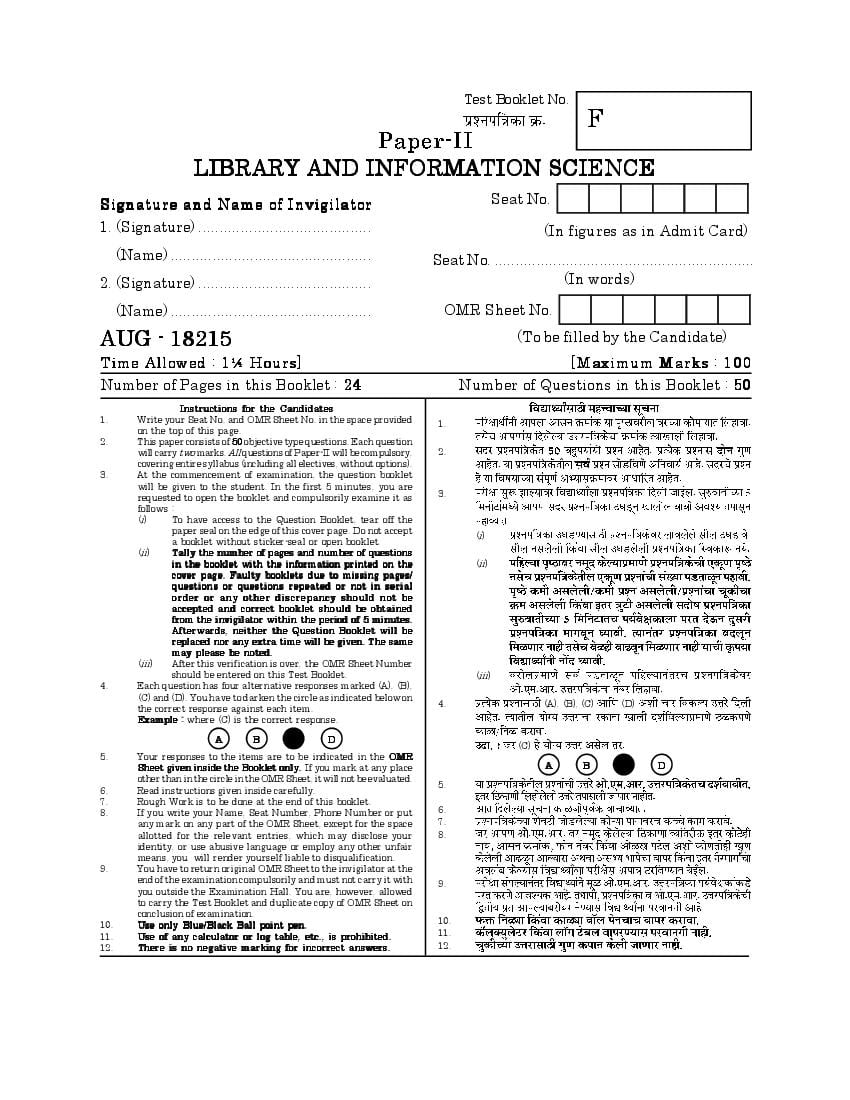
F
LIBRARY AND INFORMATION SCIENCE
Signature and Name of Invigilator Seat No.
1. (Signature) ......................................... (In figures as in Admit Card)
(Name) ................................................ Seat No. ..............................................................
2. (Signature) ......................................... (In words)
(Name) ................................................ OMR Sheet No.
AUG - 18215 (To be filled by the Candidate)
Time Allowed : 1¼ Hours] [Maximum Marks : 100
Number of Pages in this Booklet : 24 Number of Questions in this Booklet : 50
Instructions for the Candidates
1. Write your Seat No. and OMR Sheet No. in the space provided 1.
on the top of this page.
2. This paper consists of 50 objective type questions. Each question
will carry two marks. All questions of Paper-II will be compulsory, 2.
covering entire syllabus (including all electives, without options).
3. At the commencement of examination, the question booklet
will be given to the student. In the first 5 minutes, you are
requested to open the booklet and compulsorily examine it as 3.
follows :
(i) To have access to the Question Booklet, tear off the
paper seal on the edge of this cover page. Do not accept (i)
a booklet without sticker-seal or open booklet.
(ii) Tally the number of pages and number of questions
in the booklet with the information printed on the (ii)
cover page. Faulty booklets due to missing pages/
questions or questions repeated or not in serial
o rder or any other discre pancy should not be
accepted and correct booklet should be obtained
from the invigilator within the period of 5 minutes.
Afterwards, neither the Question Booklet will be
replaced nor any extra time will be given. The same
may please be noted.
(iii) After this verification is over, the OMR Sheet Number
should be entered on this Test Booklet. (iii)
4. Each question has four alternative responses marked (A), (B),
(C) and (D). You have to darken the circle as indicated below on
the correct response against each item. 4. (A), (B), (C) (D)
Example : where (C) is the correct response.
A B D
(C)
5. Your responses to the items are to be indicated in the OMR
Sheet given inside the Booklet only. If you mark at any place A B D
other than in the circle in the OMR Sheet, it will not be evaluated.
5.
6. Read instructions given inside carefully.
7. Rough Work is to be done at the end of this booklet.
8. If you write your Name, Seat Number, Phone Number or put 6.
any mark on any part of the OMR Sheet, except for the space 7.
allotted for the relevant entries, which may disclose your 8.
identity, or use abusive language or employ any other unfair
means, you will render yourself liable to disqualification.
9. You have to return original OMR Sheet to the invigilator at the
end of the examination compulsorily and must not carry it with 9.
you outside the Examination Hall. You are, however, allowed
to carry the Test Booklet and duplicate copy of OMR Sheet on
conclusion of examination.
10. Use only Blue/Black Ball point pen. 10.
11. Use of any calculator or log table, etc., is prohibited. 11.
12. There is no negative marking for incorrect answers. 12.
Page 2
Page 3
Paper II
II
Time Allowed : 75 Minutes] [Maximum Marks : 100
Note : This Paper contains Fifty (50) multiple choice questions, each question
carrying Two (2) marks. Attempt All questions.
(50) (2)
1. First state-aided Public Library in 1.
India was established by :
(A) William Jones
(A)
(B) W.A. Borden
(B)
(C) Maharaja Sayajirao Gaekwad
(C)
(D) Raja Ram Mohan Roy (D)
2. In a virtual library : 2.
(A) There is no corresponding (A)
physical collection
(B)
(B) Collection is available online as
well as offline
(C)
(C) Collection is available online as
well as print form
(D)
(D) Collection is available on CD as
well as print form
3 [P.T.O.
Page 4
examples of :
(A) Application software (A)
(B) System software (B)
(C) Computer language (C)
(D) Operating system (D)
4. Lotka’s law is related to : 4.
(A) Word frequency count
(B) Scientific productivity (A)
(C) Distribution of papers in the (B)
periodicals (C)
(D) Citation analysis (D)
5. Which of the following cannot 5.
be considered as probability
sampling ?
(A)
(A) Lottery method of sampling
(B)
(B) Systematic sampling
(C) Snowball sampling (C)
(D) Cluster sampling (D)
4
Page 5
of a theory of scales for the
measurement of operational
variables ?
(A)
(A) E.S. Pearson
(B)
(B) S.S. Stevens
(C)
(C) F.W. Lancaster
(D)
(D) Steve Leach
7. The standard deviation of a 7.
population is :
(A)
(A) Mean of the squared deviations
(B) Mean deviation (B)
(C) Simply the variance
(C)
(D) Simply the square root of the
(D)
variance
5 [P.T.O.
Page 6
Information Science Abstracts) are
arranged according to :
(A) DDC
(A)
(B) Colon classification
(B)
(C) A special scheme of
classification (C)
(D) UDC (D)
9. According to Dr. S.R. Ranganathan 9.
the proportion of expenditure of
University Library budget on books
and other reading materials should
be : (A) 60%
(A) 60%
(B) 50%
(B) 50%
(C) 40%
(C) 40%
(D) 30%
(D) 30%
6
Page 7
(A) Questionnaire (A)
(B) Interview (B)
(C) Diary (C)
(D) Flow chart (D)
11. Which management school regards 11.
management as a Universal
process ?
(A)
(A) The Human Relations School
(B)
(B) The Classical School
(C)
(C) The System School
(D) The Social Systems School (D)
12. In 1990 4P’s were translated into 4 12. 1990 ‘Ps’
C’s of marketing. Here ‘Promotion’ ‘C’s’
(P) represents : ‘P’
(A) Cost to users (A)
(B) Customer needs and wants (B)
(C) Communication (C)
(D) Convenience (D)
7 [P.T.O.
Page 8
(A) Analysis only
(A)
(B) Analysis, evaluation and design
(B)
(C) Analysis and design only
(C)
(D) Analysis and evaluation only (D)
14. Likert’s name is associated with : 14.
(A) Theory of Motivation
(B) Evolving organizational (A)
structure (B)
(C) Style of leadership (C)
(D) Decision-making theory (D)
15. Management of the Library by 15.
Library Committee is an example
of ..........
(A)
(A) MBO
(B)
(B) Participative Management
(C)
(C) Decentralisation
(D) Consultative Management (D)
8
Page 9
16.
involves :
(A) Responsibility only
(B) Authority and Accountability (A)
only
(B)
(C) Accountability and
Responsibility only
(C)
(D) Responsibility, Authority and
(D)
Accountability
17.
17. Index Translationum is a world
bibliography of translations of :
(A) Periodical articles
(A)
(B) Books
(B)
(C) Books and periodical articles (C)
(D) Patents (D)
9 [P.T.O.
Page 10
‘Dissertation Abstracts Interna-
tional’ ?
(A)
(A) Pro-quest
(B)
(B) Springer
(C)
(C) Emerald
(D) OUP (D)
19. INSPEC database records .......... 19.
(A) Full text (A)
(B) Index and Abstract (B)
(C) Numerical (C)
(D) Abstract and Full text (D)
20. Which of the following journals is 20.
available only in electronic form ?
(A) D-Lib Magazine (A)
(B) Journal of Documentation (B)
(C) Library Quarterly (C)
(D) Library Trends (D)
10
Page 11
for a user who has one concrete
reference with him would be :
(A) Building block (A)
(B) Successive fractions (B)
(C) Citation Pearl Growing (C)
(D) Boolean search (D)
22. Name the author of ‘Grammar of 22.
Classification’ :
(A) S.R. Ranganathan (A)
(B) H.E. Bliss (B)
(C) W.C.B. Sayers (C)
(D) J. Mills (D)
23. ‘OCLC’ was founded in the year : 23.
(A) 2001
(A) 2001
(B) 2000
(B) 2000
(C) 1967
(C) 1967
(D) 1978
(D) 1978
11 [P.T.O.
Page 12
of Indian Publishers ?
(A) INFLIBNET (A)
(B) DELNET (B)
(C) RRRLF (C)
(D) R.R. BOWKER (D)
25. Which of the following evaluation 25.
techniques is used in forecasting ?
(A) Market research (A)
(B) Performance evaluation (B)
(C) Cost-benefit analysis (C)
(D) Delphi technique (D)
26. The basic components of network 26.
analysis in PERT/CPM are :
(A) Event and performance (A)
(B) Event and activity (B)
(C) Activity and conditions (C)
(D) Conditions and dummy activity (D)
12
Page 13
27.
books on deposit under :
(A) Registration of Books Act,
1867
(A) 1867
(B) The Delivery of Books Act,
(B) 1956
1956
(C) The Copyright Act, 1985
(C) 1985
(D) Right to Information Act,
(D) 2003
2003
28. Who was the first Librarian of 28.
Imperial Library ?
(A) John Macfarlane (A)
(B) J.A. Chapman (B)
(C) Khan Bahadur MA Asadullah
(C)
(D) B.S. Kesavan
(D)
13 [P.T.O.
Page 14
mark the odd one :
(A) Public lectures and talks by
(A)
eminent persons
(B) Celebration of festivals
(B)
(C) Arranging the music show etc.
(D) Providing information (C)
pinpointedly (D)
30. Bodleian Library is in the
30.
University of :
(A) Cambridge (A)
(B) Oxford (B)
(C) Harvard (C)
(D) Stanford (D)
31. When was Encyclopedia Britannica 31.
first published ?
(A) 1758 (A) 1758
(B) 1768 (B) 1768
(C) 1865 (C) 1865
(D) 1875 (D) 1875
14
Page 15
Introduction to Library
Classification’’ ?
(A)
(A) J.D. Brown
(B)
(B) S.R. Ranganathan
(C) W.C. Berwick Sayers (C)
(D) Howard Phillips (D)
33. The concept of systematic indexing 33.
was devised by :
(A) E.J. Coates (A)
(B) J.E.L. Farradane (B)
(C) H.P. Luhn (C)
(D) J. Keiser (D)
34. SQL stands for : 34.
(A) Structured Query Language (A)
(B) Standard Query Language (B)
(C) Systematic Query Language (C)
(D) Soft Query Language (D)
15 [P.T.O.
Page 16
35.
source attempts to explain the
literary terms and works ?
(A) Oxford Dictionary of
(A)
Quotations
(B)
(B) Who’s Who of Indian
Writers
(C)
(C) Information please Almanac
(D)
(D) Benet’s Reader’s Encyclopedia
36. ‘Shodhagangotri’ Project is 36.
concerned with :
(A)
(A) Theses
(B)
(B) Synopsis of Theses
(C) Books (C)
(D) E-Journals
(D)
16
Page 17
is :
(A) a 2
(A) a 2
(B) b 2
(B) b 2
(C) 2
(C) 2
(D) c 2 (D) c 2
38. Who is the author of the book 38.
‘‘Organization of Knowledge in
Libraries’’ ?
(A)
(A) S.R. Ranganathan
(B)
(B) W.C.B. Sayers
(C) J. Mills (C)
(D) H.E. Bliss (D)
39. Name the two states of India, in 39. 1989
which the Public Libraries Act was
passed in 1989 ?
(A)
(A) Kerala and Haryana
(B)
(B) Haryana and Goa
(C)
(C) Manipur and Mizoram
(D)
(D) Kerala and Goa
17 [P.T.O.
Page 18
40.
in India is :
(A) Andhra Pradesh Library
(A)
Association
(B)
(B) Bengal Library Association
(C) Indian Library Association (C)
(D) Madras Library Association (D)
41. Who has introduced Advancement
41.
of Librarianship Programme ?
(A) IFLA
(A)
(B) UNESCO
(B)
(C) FID
(C)
(D) ICSU
(D)
18
Page 19
analogue signal is :
(A) it is discrete (A)
(B) it is continuous (B)
(C) it transmits fast (C)
(D) it has less noise (D)
43. Identify the Dublin Core 43.
metadata element that is not related
to the resource as intellectual
property :
(A)
(A) Creator
(B)
(B) Publisher
(C)
(C) Title
(D) Contributor (D)
19 [P.T.O.
Page 20
44.
Chairman of the committee
related to :
(A) National Policy on Library and (A)
Information System
(B) Development of Libraries and
(B)
their Organization
(C) Curriculum Development in (C)
Library and Information
Science
(D) Public Libraries in India (D)
45. Zero Based Budgeting means : 45.
(A) A budgeting without funds
(A)
(B) Budgeting afresh
(B)
(C) Budgeting based on previous
(C)
year’s expenses
(D)
(D) Performance budget
20
Page 21
term and an accession number of the
document as an indicator of
reference ?
(A)
(A) POPSI
(B)
(B) KWIC
(C) Index of DDC (C)
(D) Relative Index (D)
47. Identify the entity that belongs to 47.
first group of entities in FRBR :
(A) Object (A)
(B) Event (B)
(C) Concept (C)
(D) Expression (D)
48. In CCF, the equivalent of leader in 48.
MARC 21, is called : 21
(A) Directory (A)
(B) Record Label (B)
(C) Record Separator (C)
(D) Data Fields (D)
21 [P.T.O.
Page 22
for characteristics ?
(A) Canon of Differentiation (A)
(B) Canon of Exclusiveness (B)
(C) Canon of Ascertainability (C)
(D) Canon of Permanence (D)
50. Which of the following is an example 50.
of equivalence relationship ?
(A) Nervous system—Central
(A)
nervous system
(B)
(B) Freedom—Liberty
(C)
(C) Hunting—Hunters
(D)
(D) Weaving—Cloth
22
Page 23
23 [P.T.O.
Page 24
24
Document Details
| Board / Org | Maharashtra Exams |
| Exam | MAHA SET |
| Type | Question Paper |
| Pages | 24 |
| Updated | 30 Apr 2026 |