MAHA SET 2015 Question Paper 2 Commerce
Finished viewing? Save it for later —
Download MAHA SET 2015 Question Paper 2 Commerce (PDF · 28 pages)About MAHA SET 2015 Question Paper 2 Commerce
MAHA SET 2015 Question Paper 2 Commerce is available here for free download. Published by Maharashtra Exams for MAHA SET, this question paper can be viewed online or downloaded as a PDF (28 pages). Candidates preparing for MAHA SET can use MAHA SET 2015 Question Paper 2 Commerce to understand the exam pattern, the type of questions asked, and the overall difficulty level.
Frequently Asked Questions
How can I download MAHA SET 2015 Question Paper 2 Commerce?
Open this page and click the Download button to save MAHA SET 2015 Question Paper 2 Commerce as a PDF. It is completely free on AglaSem Docs.
Is MAHA SET 2015 Question Paper 2 Commerce free to download?
Yes. MAHA SET 2015 Question Paper 2 Commerce can be viewed online and downloaded as a PDF free of cost on AglaSem Docs.
How many pages does MAHA SET 2015 Question Paper 2 Commerce have?
MAHA SET 2015 Question Paper 2 Commerce contains 28 pages, which you can read online or download together as a single PDF.
Where can I find more MAHA SET study material?
You can find more MAHA SET question papers, sample papers, syllabus, and answer keys on AglaSem Docs.
MAHA SET 2015 Question Paper 2 Commerce – Text
Read the full text of this question paper below — useful to quickly search, copy and reference the content online without downloading the PDF.
📄 View text version (28 pages)
Page 1
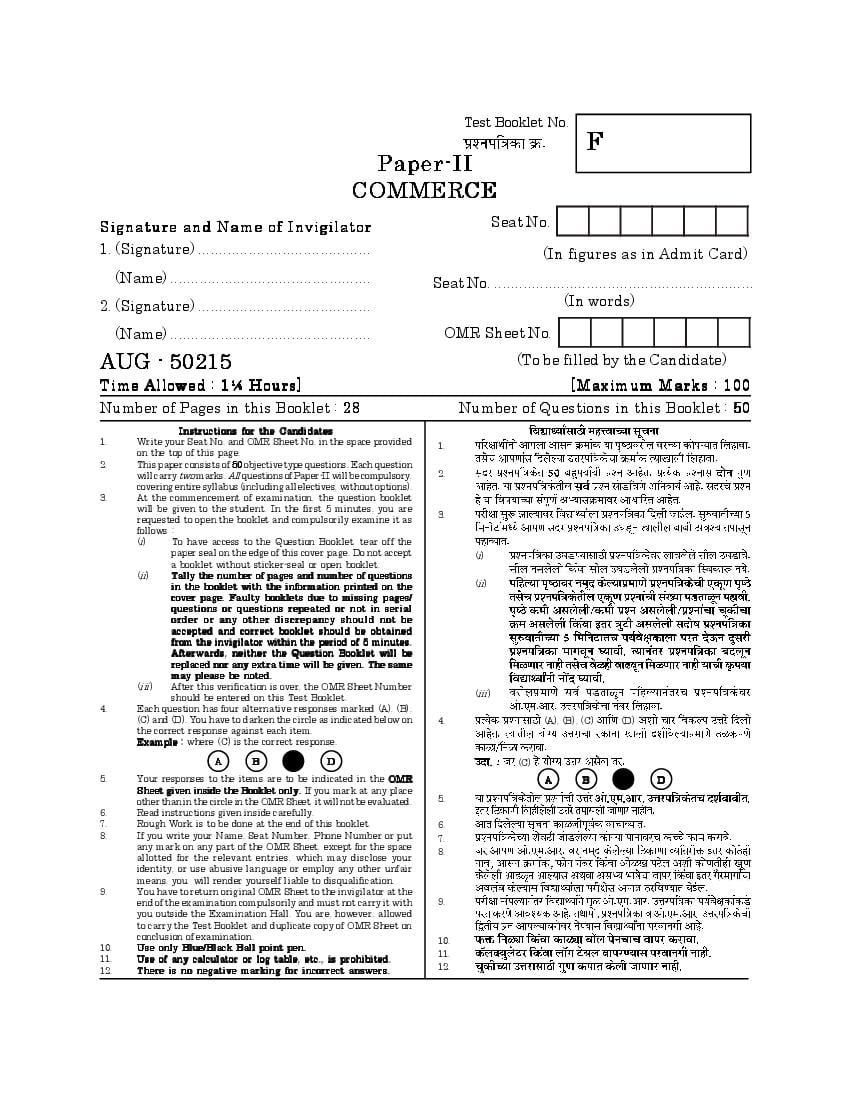
F
COMMERCE
Signature and Name of Invigilator Seat No.
1. (Signature) ......................................... (In figures as in Admit Card)
(Name) ................................................ Seat No. ..............................................................
2. (Signature) ......................................... (In words)
(Name) ................................................ OMR Sheet No.
AUG - 50215 (To be filled by the Candidate)
Time Allowed : 1¼ Hours] [Maximum Marks : 100
Number of Pages in this Booklet : 28 Number of Questions in this Booklet : 50
Instructions for the Candidates
1. Write your Seat No. and OMR Sheet No. in the space provided 1.
on the top of this page.
2. This paper consists of 50 objective type questions. Each question
will carry two marks. All questions of Paper-II will be compulsory, 2.
covering entire syllabus (including all electives, without options).
3. At the commencement of examination, the question booklet
will be given to the student. In the first 5 minutes, you are
3.
requested to open the booklet and compulsorily examine it as
follows :
(i) To have access to the Question Booklet, tear off the
paper seal on the edge of this cover page. Do not accept (i)
a booklet without sticker-seal or open booklet.
(ii) Tally the number of pages and number of questions
in the booklet with the information printed on the (ii)
cover page. Faulty booklets due to missing pages/
questions or questions repeated or not in serial
o rder or any other discre pancy should not be
accepted and correct booklet should be obtained
from the invigilator within the period of 5 minutes.
Afterwards, neither the Question Booklet will be
replaced nor any extra time will be given. The same
may please be noted.
(iii) After this verification is over, the OMR Sheet Number
should be entered on this Test Booklet. (iii)
4. Each question has four alternative responses marked (A), (B),
(C) and (D). You have to darken the circle as indicated below on 4. (A), (B), (C) (D)
the correct response against each item.
Example : where (C) is the correct response.
A B D (C)
5. Your responses to the items are to be indicated in the OMR A B D
Sheet given inside the Booklet only. If you mark at any place
other than in the circle in the OMR Sheet, it will not be evaluated. 5.
6. Read instructions given inside carefully.
7. Rough Work is to be done at the end of this booklet. 6.
8. If you write your Name, Seat Number, Phone Number or put 7.
any mark on any part of the OMR Sheet, except for the space
8.
allotted for the relevant entries, which may disclose your
identity, or use abusive language or employ any other unfair
means, you will render yourself liable to disqualification.
9. You have to return original OMR Sheet to the invigilator at the
end of the examination compulsorily and must not carry it with 9.
you outside the Examination Hall. You are, however, allowed
to carry the Test Booklet and duplicate copy of OMR Sheet on
conclusion of examination. 10.
10. Use only Blue/Black Ball point pen.
11.
11. Use of any calculator or log table, etc., is prohibited.
12. There is no negative marking for incorrect answers. 12.
Page 2
Page 3
Paper II
II
Time Allowed : 75 Minutes] [Maximum Marks : 100
Note : This paper contains Fifty (50) multiple choice questions. Each question
carrying Two (2) marks. Attempt All questions.
(50) (2)
1. Appointment of independent 1.
Directors is the part of corporate
governance as per the.............. .
(A) SEBI
(A) SEBI
(B)
(B) Government of India
(C) Indian Companies Act (C)
(D) RBI (D)
2. Public Enterprise is defined as : 2.
(A) An organisation run by Joint
efforts of Centre and State (A)
Governments
(B) An organisation which Centers
(B)
to the needs relating to Public
Utilities
(C) An organisation in which
(C)
capital is invested by Public
(D) An organisation owned and
managed by Public authorities (D)
for definite set of Public
Purposes
3 [P.T.O.
Page 4
came into force from :
(A) 1986
(A) 1986
(B) 1987
(B) 1987
(C) 1988
(C) 1988
(D) 1991
(D) 1991
4. Who is the Chairman of the 13th
4.
Finance Commission ?
(A) C.R. Rao (A)
(B) D.S. Sharma (B)
(C) Vijay Kelkar (C)
(D) B.K. Chaturvedi
(D)
5. Which one of the following is not the
5.
objective of MRTP Act, 1969 ?
(A) Checking unfair trade practices
(A)
(B) Checking restrictive trade
(B)
practices
(C) Checking monopoly (C)
(D) Promoting competition (D)
4
Page 5
between outsiders’ fund and.............. .
(A) Retained earnings (A)
(B)
(B) Shareholders’ funds
(C)
(C) Borrowers’ funds
(D)
(D) Debtors’ fund
7.
7. Cash Budget is categorised as........... .
(A) Operating Budget
(A)
(B) Long-term Budget
(B)
(C) Financial Budget
(C)
(D) Functional Budget
(D)
5 [P.T.O.
Page 6
the assets are gradually realised, the
cash collected is distributed among
various claimants as and when it is
available, this distribution is
called................ .
(A)
(A) Gradual disbursement
(B)
(B) Gradual distribution
(C)
(C) Piece-meal disbursement
(D)
(D) Piece-meal distribution
9.
9. ‘Salary paid to employees’ is an
example of................ .
(A)
(A) Revenue Income
(B)
(B) Revenue Expenditure
(C)
(C) Capital Expenditure
(D)
(D) Differed Revenue Expenditure
6
Page 7
following information :
2010-11 2011-12
2010-11 2011-12
` 10,00,000 ` 15,00,000
Sales ` 10,00,000 ` 15,00,000
` 2,00,000 ` 3,00,000
Profit ` 2,00,000 ` 3,00,000
` 25,000
If fixed cost is ` 25,000, what will
be breakeven point ?
(A) ` 1,00,000
(A) ` 1,00,000
(B) ` 1,52,000
(B) ` 1,52,000
(C) ` 1,25,000
(C) ` 1,25,000
(D) ` 1,22,000
(D) ` 1,22,000
11.
11. Which one of the following formula
will be used for computing the price
elasticity of demand ? (A)
% Ch a n ge in Qu a n t it y Dem a n ded
(A) % Ch a n ge in P r ice
(B)
Ch a n ge in Qu a n t it y Dem a n ded
(B)
N a t ion a l In com e
(C)
% Ch a nge in Qu a n t ity Dema n ded
(C)
100
% Cha n ge in P rice
(D) % Cha nge in Su pply (D)
7 [P.T.O.
Page 8
of Sugar. It receives total revenue ` 24,000
of ` 24,000 Raising Production to 4 4
tons increase total revenue to
` 28,000
` 28,000. Thus marginal revenue
is :
(A) ` 4,000
(A) ` 4,000
(B) ` 8,000
(B) ` 8,000
(C) ` 28,000
(C) ` 28,000
(D) ` 52,000
(D) ` 52,000
13. The input costs that do not require 13.
an outlay of money by the concern
called............... .
(A)
(A) Marginal costs
(B)
(B) Explicit costs
(C) Implicit costs (C)
(D) Replacement costs (D)
8
Page 9
characteristics is not of competitive
market ?
(A)
(A) There are many buyers and
many sellers in the market
(B)
(B) The goods offered by the various
sellers are homogeneous
(C)
(C) Firms can freely enter or exit
the market
(D) Firms cannot freely enter or exit (D)
the market
15. Total revenue divided by the 15.
quantity sold called :
(A) Revenue (A)
(B) Total Revenue (B)
(C) Average Revenue (C)
(D) Marginal Revenue (D)
9 [P.T.O.
Page 10
us in making decisions about a
population based on the sample i ¼r ha
P; k l ew
gkl
results is known as :
(A)
(A) Primary data
(B)
(B) Interview
(C)
(C) Questionnaire
(D) Inferential Statistics (D)
17. Persons who go to respondents and 17.
gather information form them
through pre-designed schedules are
known as :
(A)
(A) Researcher
(B)
(B) Enumerator
(C) Systems Analyst (C)
(D) Data Miner (D)
10
Page 11
the investigator himself is known
as :
(A)
(A) Primary data
(B)
(B) Secondary data
(C)
(C) Questionnaire
(D)
(D) Schedule
19.
19. The collection of data compiled by
some one else another than the user,
which may be in published form or
in unpublished form is known
as................ .
(A)
(A) Primary data
(B)
(B) Secondary data
(C)
(C) Questionnaire
(D)
(D) Schedule
11 [P.T.O.
Page 12
in tabular form is :
(A)
(A) the last step in statistical
analysis
(B)
(B) the elementary step
(C)
(C) not very important in statistical
analysis (D)
(D) important in statistical analysis
21. “Any organisation in order to 21.
achieve its objectives should form its
organisation structure based in
activity analysis, decision analysis
and relation analysis” is the view
of................. . (A)
(A) Koontz and O’Donnel
(B)
(B) Mary Cushing Niles
(C)
(C) Peter Drucker
(D) Albers (D)
12
Page 13
determined goal is :
(A) Control (A)
(B) Planning (B)
(C)
(C) Evaluation
(D)
(D) Direction
23.
23. Which is the basic function of
management in respect of future
management action spring ?
(A)
(A) Organising
(B)
(B) Planning
(C)
(C) Directing
(D)
(D) Controlling
13 [P.T.O.
Page 14
of the important principles of
management was given by :
(A)
(A) Taylor
(B)
(B) Terry
(C)
(C) Urwick
(D)
(D) Fayol
25. How many purpose has been 25.
identified by the Peter R. Drucker
about the business ?
(A)
(A) Six
(B)
(B) Four
(C)
(C) Eight
(D) Ten (D)
14
Page 15
ultimate objective is to develop :
(A) Brand (A)
(B) Process (B)
(C) Behaviour (C)
(D) Theory (D)
27. The concept of marketing mix 27.
involves a deliberate and careful
choice of organization in terms of
product, price, promotion and place
strategies and............... .
(A)
(A) Philosophies
(B)
(B) Policies
(C)
(C) Concepts
(D)
(D) Planning
15 [P.T.O.
Page 16
called as................. .
(A)
(A) Segmentation
(B)
(B) Allocation of marketing
(C) Only segmentation (C)
(D) Market segmentation (D)
29. Channel of distribution acts as a
29.
linking pool between the producer
and.................... .
(A)
(A) Middlemen
(B)
(B) Final Consumer
(C)
(C) Wholesaler
(D) Retailer (D)
16
Page 17
environment ?
(A)
(A) Economical
(B)
(B) Political
(C) Financial resources (C)
(D) Social (D)
31. According to......................principle,
31.
ideal capital structure should be able
to cater to additional requirements
of funds in future.
(A)
(A) Control
(B)
(B) Flexibility
(C)
(C) Cost
(D)
(D) Timing
17 [P.T.O.
Page 18
of.......................... .
(A) Business Management (A)
(B) Financial Accounting
(B)
(C) Management Accounting
(C)
(D) Human Resource Management
(D)
33. Economic life of a plant is 8 years,
33. 8
and its costs are ` 5,00,000. Annual
` 5,00,000
Saving (cash inflows) is ` 1,00,000.
` 1,00,000
Hence post payback profit would
be :
(A) ` 3,00,000 (A) ` 3,00,000
(B) ` 2,50,000 (B) ` 2,50,000
(C) ` 4,50,000 (C) ` 4,50,000
(D) ` 2,00,000 (D) ` 2,00,000
18
Page 19
to distribute dividend in cash due
to liquidity problem then company
can :
(A)
(A) Distribute profit in cash
(B) Distribute Assets (B)
(C) Distribution dividend in the
(C)
form of bonds
(D)
(D) Distribute property
35.
35. The cost of preference share capital
is after tax which can be converted
into................ .
(A)
(A) Cost before profit
(B)
(B) Cost before tax
(C)
(C) Cost after tax
(D)
(D) Cost before dividend
19 [P.T.O.
Page 20
of Human Resource Management ?
(I) Compensation (I)
(II) Directing (II)
(III) Development (III)
(IV) Integrating (IV)
(A) I, II, III
(A) I, II, III
(B) II, III, IV
(B) II, III, IV
(C) III, IV, I (C) III, IV, I
(D) IV, I, II
(D) IV, I, II
37. The Apprentices Act was passed
37.
in............... .
(A) 1971
(A) 1971
(B) 1948
(B) 1948
(C) 1961
(C) 1961
(D) 1953
(D) 1953
20
Page 21
obectives is combination of :
(A) Functional and personnel
(A)
objectives
(B)
(B) Societal, governmental and
organisational objectives
(C) Local, state and international (C)
objectives
(D) Societal, organisational,
(D)
functional and personnel
objectives
39.
39. What is the initial step in
developing a recruitment action
plan ?
(A)
(A) By Position
(B)
(B) By Role
(C)
(C) By Worker
(D) By Job (D)
21 [P.T.O.
Page 22
process is................ .
(A)
(A) Planning
(B)
(B) Communication
(C)
(C) Job evaluation
(D)
(D) Employment
41.
41. The financial stability of any bank
is determined by................ .
(A) Capital Adequacy Ratio (A)
(B) Credit Deposite Ratio (B)
(C) Current Asset Ratio (C)
(D) Debt Equity Ratio (D)
22
Page 23
form a private banking company
is.....................crores.
(A) 1000
(A) 1000
(B) 500
(B) 500
(C) 200
(C) 200
(D) 100
(D) 100
43.
43. Which of the following function is
not performed by non-banking
financial institution ?
(A)
(A) Issuing loans and advances
(B)
(B) Issuing cheques
(C)
(C) Issuing promissory note
(D)
(D) Issuing bill of exchange
23 [P.T.O.
Page 24
not performed by Reserve Bank of
India ?
(A)
(A) Control the Credit
(B)
(B) Issue of Currency Note
(C)
(C) Advice to Government
(D) Loan to Government (D)
45. All co-operative banks are regulated 45.
by................... .
(A) R.B.I. (A)
(B) R.B.I. and State Government (B)
(C) S.E.B.I. and R.B.I. (C)
(D) R.B.I. and Central Government (D)
24
Page 25
advantage is developed by :
(A) Adam Smith (A)
(B) J.S. Mill
(B)
(C) David Ricardo
(C)
(D) Bertil Ohlin
(D)
47. Component of capital account
47.
is :
(A)
(A) Export of goods
(B)
(B) Amortisation
(C)
(C) Private payment
(D)
(D) Insurance
25 [P.T.O.
Page 26
48.
Monetary Fund (IMF) is :
(A)
(A) To act as a short term credit
institution
(B) To assist the reconstruction and
(B)
development of the member
countries
(C)
(C) To promote the long term
balanced growth of
international trade
(D)
(D) To provide development finance
on easy term to less developed
member countries
26
Page 27
(A) To provide a machinery for the
orderly adjustment and
(A)
exchange rates
(B) To promote the long term
(B)
balanced growth of
international trade and the
maintenance of equilibrium in
balance of payments
(C) To provide machinery for (C)
international consultation
(D) To help in stimulating the
(D)
productive investment of
private capital
50. EXIM Bank of India was set up as 50.
a :
(A) Wholly owned corporation by
the RBI (A)
(B) Wholly owned corporation by
(B)
the IMF
(C) Wholly owned corporation by (C)
the IDBI
(D) Wholly owned corporation by
the Government (D)
27 [P.T.O.
Page 28
28
Document Details
| Board / Org | Maharashtra Exams |
| Exam | MAHA SET |
| Type | Question Paper |
| Pages | 28 |
| Updated | 30 Apr 2026 |