MBOSE Class 12 Sample Question Paper 2027 History
Finished viewing? Save it for later —
Download MBOSE Class 12 Sample Question Paper 2027 History (PDF · 10 pages)About MBOSE Class 12 Sample Question Paper 2027 History
MBOSE Class 12 Sample Question Paper 2027 History is available here for free download. Published by Meghalaya Board for Class 12, this sample paper can be viewed online or downloaded as a PDF (10 pages). Candidates preparing for Class 12 can use MBOSE Class 12 Sample Question Paper 2027 History to understand the exam pattern, the type of questions asked, and the overall difficulty level.
Frequently Asked Questions
How can I download MBOSE Class 12 Sample Question Paper 2027 History?
Open this page and click the Download button to save MBOSE Class 12 Sample Question Paper 2027 History as a PDF. It is completely free on AglaSem Docs.
Is MBOSE Class 12 Sample Question Paper 2027 History free to download?
Yes. MBOSE Class 12 Sample Question Paper 2027 History can be viewed online and downloaded as a PDF free of cost on AglaSem Docs.
How many pages does MBOSE Class 12 Sample Question Paper 2027 History have?
MBOSE Class 12 Sample Question Paper 2027 History contains 10 pages, which you can read online or download together as a single PDF.
Where can I find more Class 12 study material?
You can find more Class 12 question papers, sample papers, syllabus, and answer keys on AglaSem Docs.
MBOSE Class 12 Sample Question Paper 2027 History – Text
Read the full text of this sample paper below — useful to quickly search, copy and reference the content online without downloading the PDF.
📄 View text version (11 pages)
Page 1
MBOSE Class 12
Sample Question Paper
2027 History
EXAM YEAR TYPE SUBJECT
Meghalaya Class 12 2027 Sample Paper History
Notes · Sample Papers · Previous Year Papers · Mock Tests
Page 2
.co s e m
s em l a
a ag
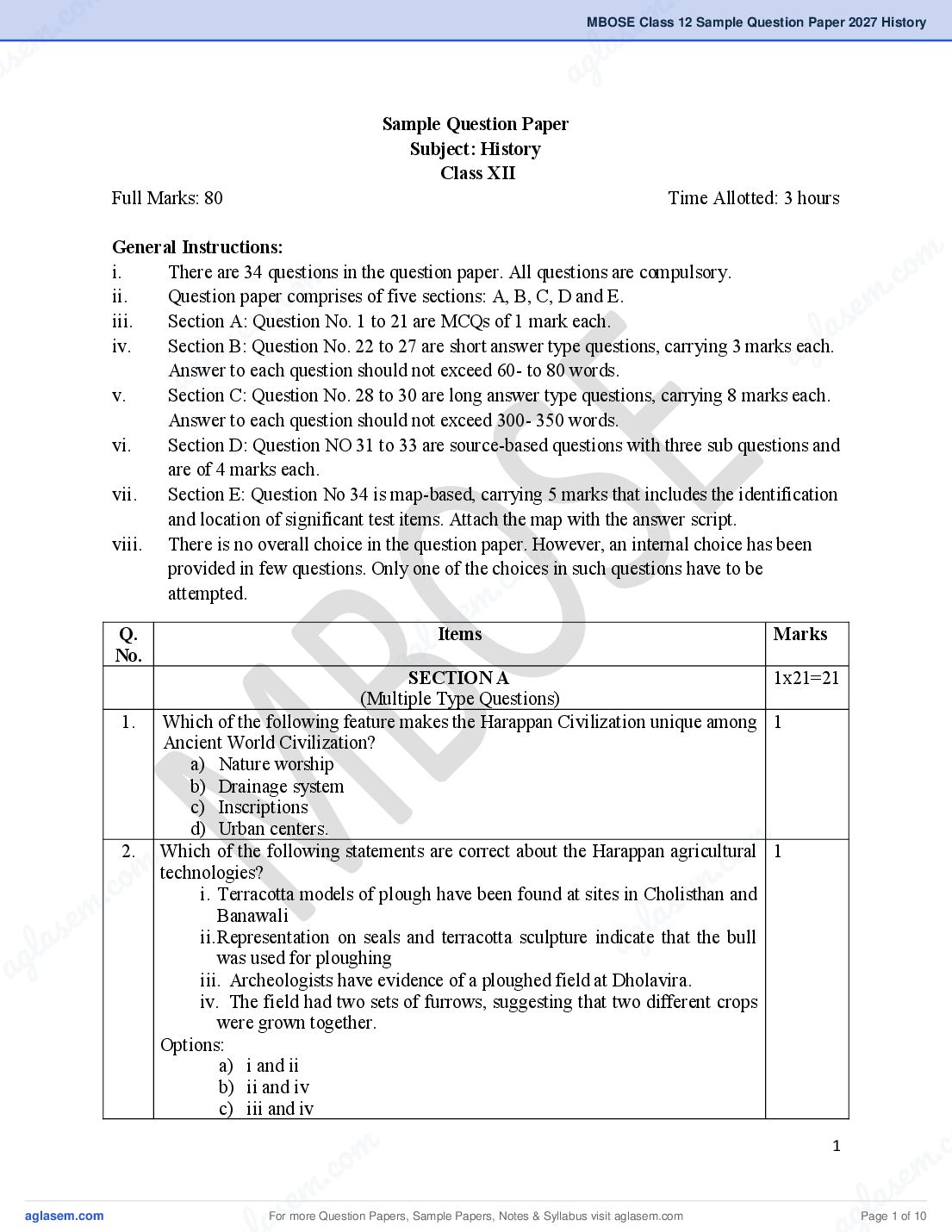
Sample Question Paper
Subject: History
Class XII
Full Marks: 80 Time Allotted: 3 hours
General Instructions:
m
i.
om
There are 34 questions in the question paper. All questions are compulsory.
. co
ii.
. c
Question paper comprises of five sections: A, B, C, D and E.
e m
iii.
e m
Section A: Question No. 1 to 21 are MCQs of 1 mark each.
l as
iv.
l as
Section B: Question No. 22 to 27 are short answer type questions, carrying 3 marks each.
ag
ag
Answer to each question should not exceed 60- to 80 words.
v. Section C: Question No. 28 to 30 are long answer type questions, carrying 8 marks each.
Answer to each question should not exceed 300- 350 words.
vi. Section D: Question NO 31 to 33 are source-based questions with three sub questions and
are of 4 marks each.
vii. Section E: Question No 34 is map-based, carrying 5 marks that includes the identification
and location of significant test items. Attach the map with the answer script.
viii. There is no overall choice in the question paper. However, an internal choice has been
m
.co
provided in few questions. Only one of the choices in such questions have to be
attempted.
e m
Q.
l as
Items Marks
No. g
aSECTION A 1x21=21
(Multiple Type Questions)
1. Which of the following feature makes the Harappan Civilization unique among 1
Ancient World Civilization?
a) Nature worship
b) Drainage system
c) Inscriptions
m
d) Urban centers.
.co
2. Which of the following statements are correct about the Harappan agricultural 1
m
.co m
technologies?
m
i. Terracotta models of plough have been found at sites in Cholisthan and
s e
s e Banawali
g la
g la a
ii. Representation on seals and terracotta sculpture indicate that the bull
a was used for ploughing
iii. Archeologists have evidence of a ploughed field at Dholavira.
iv. The field had two sets of furrows, suggesting that two different crops
were grown together.
Options:
a) i and ii
b) ii and iv
c) iii and iv
om
1
. c
. c e m
m as
se
For more Question Papers, Sample Papers, Notes & Syllabus visit
gl
Page 1 of 10
Page 3
3. Identify the ruler of ancient India with the help of the following information. 1
• He was arguably the most powerful of the Gupta rulers.
• His court poet was Harisena.
• He was considered as PurushaOr supreme being in the Prayaga Prashasti
Options:
a) Chandragupta Maurya
b) Samudra Gupta
c) Kanishka
d) Bimbisara
4. Two statements are given below; one labeled as Assertion (A) and the other as 1
Reason(R). Read the statements carefully and choose the correct option.
Assertion (A): The Jatakas were written in Pali around the middle of the first
millennium CE.
Reason (R): Gandatindu Jataka describes the subjects of a merciful king.
Options:
a) Both A and R are true and R is the correct explanation of A
b) Both A and R are true but R is not the correct explanation of A
c) A is true but R is false
d) A is false but R is true
5. Sanskrit texts and inscriptions used the term ‘Vanik’ to designate 1
a) Priest
b) Teachers
c) Rulers
d) Merchants
6. According to Matanga Jataka, a Pali text, the Bodhisatta is identified as a 1
a) Chandala
b) Brahmana
c) Kshatriya
d) Vaishya
7. Which of the following statement about Jainism is/are true? 1
i. The basic philosophy of the Jainas came into existence in North India after
the birth of Mahavira.
ii. The most important idea in Jainism is that the whole world is animated.
iii. According to Jaina teachings, the cycle of birth and re-birth is shaped
through Karma
a) i and ii
b) ii and iii
c) i. only
d) i. and iii
8. Match the Column I with Column II and choose the correct option. 1
Column I Column II
A. MarcoPolo i. Portugal
B. Duarte Barbosa ii. France
2
For more Question Papers, Sample Papers, Notes & Syllabus visit Page 2 of 10
Page 4
.co s e m
s em l a
a ag
C. Jean Baptiste Tarvenier iii. Russia
D. Afasanii Nikitin iv. Italy
a) A-i, B-ii, C-iii, D-iv
b) A-ii, B-i, C-iv, D-iii
c) A-iv, B-i, C-ii, D-iii
m
co
d) A-iv, B-ii, C-i, D-iii
o m traveler became a Sanyasi for a time?
Who among the cfollowing m .
9.
m . 1
s e
s e Razzak g l a
a
a) Abdur
b) l Al- Beruni a
ac)g Shaikh Ali Hazin
d) Mahmud Balkhi
10. Who coined the term ‘great’ and ‘little’ traditions? 1
a) Robert Redfield
b) John Marshall
c) REM Wheeler
d) Francis Buchanan
11. Identify the image given below and choose the correct option: 1
m
m .co
s e
l a
ag
m
m
c. o Option m.co
m s e
e la
a) Sculpture of Vitthala Temple
las b) Sculpture of the Hazara Rama Temple
ag
ag c) Sculpture of Virupaksha
d) Sculpture of Lotus Mahal
Note: The following question is for the visually impaired candidates only 1
in lieu question No. 11
Gandhiji asked the remission of taxes for the peasants in which of the
following movement?
a) Rowlatt Satyagraha
b) Champaran Satyagraha
om
3
. c
. c e m
m as
se
For more Question Papers, Sample Papers, Notes & Syllabus visit
gl
Page 3 of 10
Page 5
d) Salt Satyagraha
12. Which one of the following is mainly attributed to the decline of the 1
Vijaynagar Empire after the death of Krishnadeva Raya?
a) The religious differences between Delhi Sultan and successors of
Krishnadeva Raya
b) The successors of Krishnadeva Raya were troubled by religious chiefs.
c) The successors of Krishnadeva Raya were betrayed by their soldiers
d) Rama Raya’s forces defeated the armies of Bijapur and Golkonda
13. Two statements are given below; one labeled as Assertion (A) and the other as 1
Reason (R). Read the statements carefully and choose the correct option.
Assertion (A): The Mughal Empire was among the large territorial empire in
Asia.
Reason (R): These empires were the Ming (China), Safavid (Iran) and
Ottoman (Turkey).
Options:
a) Both A and R are true and R is the correct explanation of A.
b) Both A and R are true but R is not the correct explanation of A.
c) A is true but R is false.
d) A is false but R is true.
14. Which of the following is not correctly paired? 1
a) Kharif-Summer
b) Rabi – Spring
c) Jin-i-Kamil – Cash crop
d) Maize – Makka
15. Identify the following uprising from the given information: 1
• The movement began at Supa, Poona district in 1875.
• The ryots burnt the khatas, looted grain shops and set the Sahukar’s houses
on fire
• From Poona the revolt spread to Ahmednagar.
Options:
a) Santhal rebellion
b) Indigo Revolt
c) Deccan Riots
d) Munda Rebellion
16. Which of the following explains the Paharias? 1
a) Hunting
b) Shifting cultivation
c) Food gatherers
d) All of the above
17. Match column I with column II and choose the correct option 1
Column I Column II
A. Bell of arms i. Foreigners
B. Firangi ii. Storeroom in which weapons are kept
4
For more Question Papers, Sample Papers, Notes & Syllabus visit Page 4 of 10
Page 6
.co s e m
s em l a
a ag
C. Mutiny iii. Representative of the Governor
General who lived in a state not under
British Rule.
D. Resident iv. A collective disobedience of rules in
armed forces.
m
co
Codes:
om .
a) A-i, B-ii, C-iii, D-iv
. c
b) A-i, B-iii, C-iv, D-ii
e m
e m
c) A-ii, B-i, C-iv, D-iii
l as
as
d) A-iv, B-iii, C-i, D-ii
l 1 a
g
18.
g
Who led the Revolt of 1857 at Arrah?
a a) Nana Sahib
b) Rani Lakshmi Bai
c) Shah Mal
d) Kunwar Singh
19. The reason for which Simon Commission visited India was 1
a) Enquiring the conditions in the colony
b) Granting special privileges to minorities
c) Granting separate electorates to Dalits
m
.co
d) To forge a compromise with the congress
20. Identify the Act of the British in India from the given information: 1
• It was passed in 1919
e m
• It permitted arrest without trial
l as
ag
• It imposed censorship of the Press
Options:
a) Morley Minto
b) Montague-Chelmsfort
c) Rowlatt Act
d) None of the above
21. What was the Primary objective of the meeting on 13th October 1939 between 1
Gandhiji, Rajendra Prasad and Linlithgow?
a) India’s dominant status
m
.co
b) Complete independence
m c) India’s involvement in the Second World War
.co d) Quit India Resolution.
s e m
s em SECTION – B
g la
6x3=
la a
(Short-Answer Type Question) 18
ag 22. A) According to Mackay describe any three features of the Harappan drainage
system that made it the most complete ancient drainage system discovered
3
so far.
OR
B) Why were both seals and weights important for trade in the Harappan 3
Civilization? Explain with examples.
23. How did the Mahabharata develop from oral tradition to its written form? 3
om
5
. c
. c e m
m as
se
For more Question Papers, Sample Papers, Notes & Syllabus visit
gl
Page 5 of 10
Page 7
traditions?
OR
B) According to Bernier, what were the harmful effects of Crown Ownership 3
of land in the Mughal Empire?
25. Imagine you are an amara-nayaka in the Vijayanagar Empire. Based on your 3
understanding of the amara-nayaka system, explain any three duties you
would perform to ensure the smooth administration of your territory.
26. A) Analyse the importance of the Fifth Report. 3
OR
B) Briefly explain the causes of the Garo Resistance of 1872-73 against 3
British Colonial expansion.
27. Explain the meaning of the statement “they need a ladder” given by N.G. 3
Ranga.
Section – C 8x3=24
(Long-Answer Type Question)
28. A) Explain the importance of the Sixth Century BCE in the Indian history with 8
reference to the rise of Mahajanapadas.
OR
B) Explain the legacy of the Mauryan administration. 8
29. A) Describe the main teachings of Kabir and his significance as a poet-saint in 8
Medieval India.
OR
B) Describe the main teachings of Guru Nanak with reference to his concept 8
of Nirguna Bhakti, the importance of Shabad and organization of the Sikh
Community,
30. A) “Gandhi’s return to India in 1915 marked a new phase in the Indian 8
nationalist movement” Evaluate this statement with reference to
− Early activities in India
− Understanding of Indian Society
− Relations with political leaders
− Efforts to unite people
OR
B) Assess how far the Salt March was effective in mobilizing the masses
against British Rule. 8
6
For more Question Papers, Sample Papers, Notes & Syllabus visit Page 6 of 10
Page 8
.co s e m
s em l a
a ag
Section – D 3x4=12
(Source Based Question)
31. Read the following source carefully and answer the questions that follow:
Life in a Small Village
The Harshacharita is a biography of Harshavardhana, the ruler of
m
co
Kanauj, composed in the Sanskrit by his court poet, Banabhatta (Seventh
om .
Century CE.). This is an excerpt from the text, an extremely rare representation
. c
of life in a settlement on the outskirts of a forest in the Vindhyas:
e m
e m
The outskirts being for the most part forest, many parcels of rice- land,
l as
as
thrashing ground and arable land were being appointed by small farmers… it
l ag
ag
was mainly spade culture… owing to the difficulty of ploughing the sparsely
scattered fields covered with grass, with their few clear spaces, their black soil
stiff as black iron….
There were people moving along with bundles of bark…. countless
sacks of plucked flowers… loads of flax and hemp bundles, quantities of
honey, peacocks’ tail feathers, wreaths of wax, logs and grass. Village wives
hastened en-route for neighbouring villages, all intent on thoughts of sale and
bearing on their heads, baskets filled with various gathered forest fruits.
(i) Who composed the Harshacharita?
m 1
(ii)
c. o
What type of land was mainly found in the outskirts of the forest? 1
(iii)
e m
What does the passage suggest about living near the forest area? 1
(iv)
as
Why were people carrying items like honey, flowers and forest
l
1
ag
fruits to nearby villages?
32 Read the following source carefully and answer the questions that follow:
On The Horse On Foot
This is how Ibn Battuta describes the postal system:
In India, the postal system is of two kinds. The horse-post, called
ULUG, is run by royal horses stationed at a distance of every four miles.
The foot-post has three stations per-mile; it is called DAWA, that is one-third
of a mile… Now, at every third of a mile there is a well-populated village,
m
m outside which are three pavilions in which sit men with girded loins ready to
.co
.co m
start. Each of them carried a rod, two cubits in length, with copper bells at the
m top. When the courier starts from the city, he holds the letter in one hand and
s e
s e g
the rod with its bells on the other; and he runs as fast as he can. When the menla
g la in the pavilion hear the ringing of the bell, they get ready. As soon as the a
a courier reaches them, one of them takes the letter from his hand and runs at top
speed shaking the rod all the while until he reaches the next DAWA. And the
same process continues till the letter reaches its destination. This foot-post is
quicker than the horse-post and often it is used to transport the fruits of
Khurasan which are much desired in India.
(i) What are the two types of postal systems described by Ibn Battuta in 1
om
7
. c
. c e m
m as
se
For more Question Papers, Sample Papers, Notes & Syllabus visit
gl
Page 7 of 10
Page 9
(ii) What is the foot-post called in Ibn Battuta’s description? 1
(iii)Why do you think that foot-post used runners instead of horses 1
between stations?
(iv) What does the system of relay runners suggest about communication in 1
medieval India?
33. Read the following source carefully and answer the questions that follow:
Charka
Mahatma Gandhi was profoundly critical of the modern age in which
machines enslaved humans and displaced labour. He saw the Charka as a
symbol of a human society that would not glorify machines and technology.
The spinning wheel, moreover, could provide the poor with supplementary
income and make them self-reliant.
What I object to, is the craze is for what they call labour saving
machinery. Men go on “saving labour”, till thousands are without work and
thrown on the open streets to die of starvation. I want to save time and labour,
not for fraction of mankind, but for all; I want the concentration of wealth, not
in the hands of few, but in the hands of all.
Khaddar does not seek to destroy all machinery but it does regulate
its use and check its weedy growth. It uses machinery for the service of the
poorest in their own cottages. The wheel is itself an exquisite piece of
machinery.
(i) What is the main objection of the author regarding machinery? 1
(ii) According to the passage, what does Khaddar aim to do with 1
machinery?
(iii) Why does the author criticize “labour saving machinery”? 1
(iv) How does Khaddar use machinery differently from modern 1
industrial systems?
Section – E
(MAP Based Question)
34 (I) On the given political map of India, locate and label the following with
appropriate symbol 1x3=3
(a) Kalibangan – Major Harappan Site
(b) Magadha – One of the Mahajanapadas
(c) Sanchi - Major Buddhist Site
(II) On the same political map of India, two places marked as A and B are 1x2=2
shown. Identify them and write their names in space provided near each.
A – Main centre of the Revolt of 1857
B – Important centre of the national movement
34 Note: The following questions are for visually impaired candidates only in lieu 1x5=5
of question number 34
(i) Mention one mature Harappan site in Gujarat.
8
For more Question Papers, Sample Papers, Notes & Syllabus visit Page 8 of 10
Page 10
.co s e m
s em l a
a ag
(ii). Name one Buddhist site in the state of Madhya Pradesh.
(iii). Mention one of the territories which was under the control of Mughals in
Northern India
m
co
(iv). Mention the place where the Jallianwalla Bagh massacre took place.
m .
c. o Mahatma Gandhi?
(v) Who assassinated
s e m
s em g l a
a
***
g l a
a
m
m .co
s e
l a
ag
m
m .co
m .co s e m
s e g la
g la a
a
om
9
. c
. c e m
m as
se
For more Question Papers, Sample Papers, Notes & Syllabus visit
gl
Page 9 of 10
Page 11
For more Question Papers, Sample Papers, Notes & Syllabus visit Page 10 of 10
Document Details
| Board / Org | Meghalaya Board |
| Exam | Class 12 |
| Type | Sample Paper |
| Pages | 10 |
| Updated | 03 Nov 2026 |