NCERT Solutions Class 7 Social Science Chapter 11 From Barter to Money
Finished viewing? Save it for later —
Download NCERT Solutions Class 7 Social Science Chapter 11 From Barter to Money (PDF · 40 pages)About NCERT Solutions Class 7 Social Science Chapter 11 From Barter to Money
NCERT Solutions Class 7 Social Science Chapter 11 From Barter to Money is available here for free download. Published by NCERT for Class 7, this solution can be viewed online or downloaded as a PDF (40 pages). Candidates preparing for Class 7 can use NCERT Solutions Class 7 Social Science Chapter 11 From Barter to Money to understand the exam pattern, the type of questions asked, and the overall difficulty level.
Frequently Asked Questions
How can I download NCERT Solutions Class 7 Social Science Chapter 11 From Barter to Money?
Open this page and click the Download button to save NCERT Solutions Class 7 Social Science Chapter 11 From Barter to Money as a PDF. It is completely free on AglaSem Docs.
Is NCERT Solutions Class 7 Social Science Chapter 11 From Barter to Money free to download?
Yes. NCERT Solutions Class 7 Social Science Chapter 11 From Barter to Money can be viewed online and downloaded as a PDF free of cost on AglaSem Docs.
How many pages does NCERT Solutions Class 7 Social Science Chapter 11 From Barter to Money have?
NCERT Solutions Class 7 Social Science Chapter 11 From Barter to Money contains 40 pages, which you can read online or download together as a single PDF.
Where can I find more Class 7 study material?
You can find more Class 7 question papers, sample papers, syllabus, and answer keys on AglaSem Docs.
NCERT Solutions Class 7 Social Science Chapter 11 From Barter to Money – Text
Read the full text of this solution below — useful to quickly search, copy and reference the content online without downloading the PDF.
📄 View text version (31 pages)
Page 1
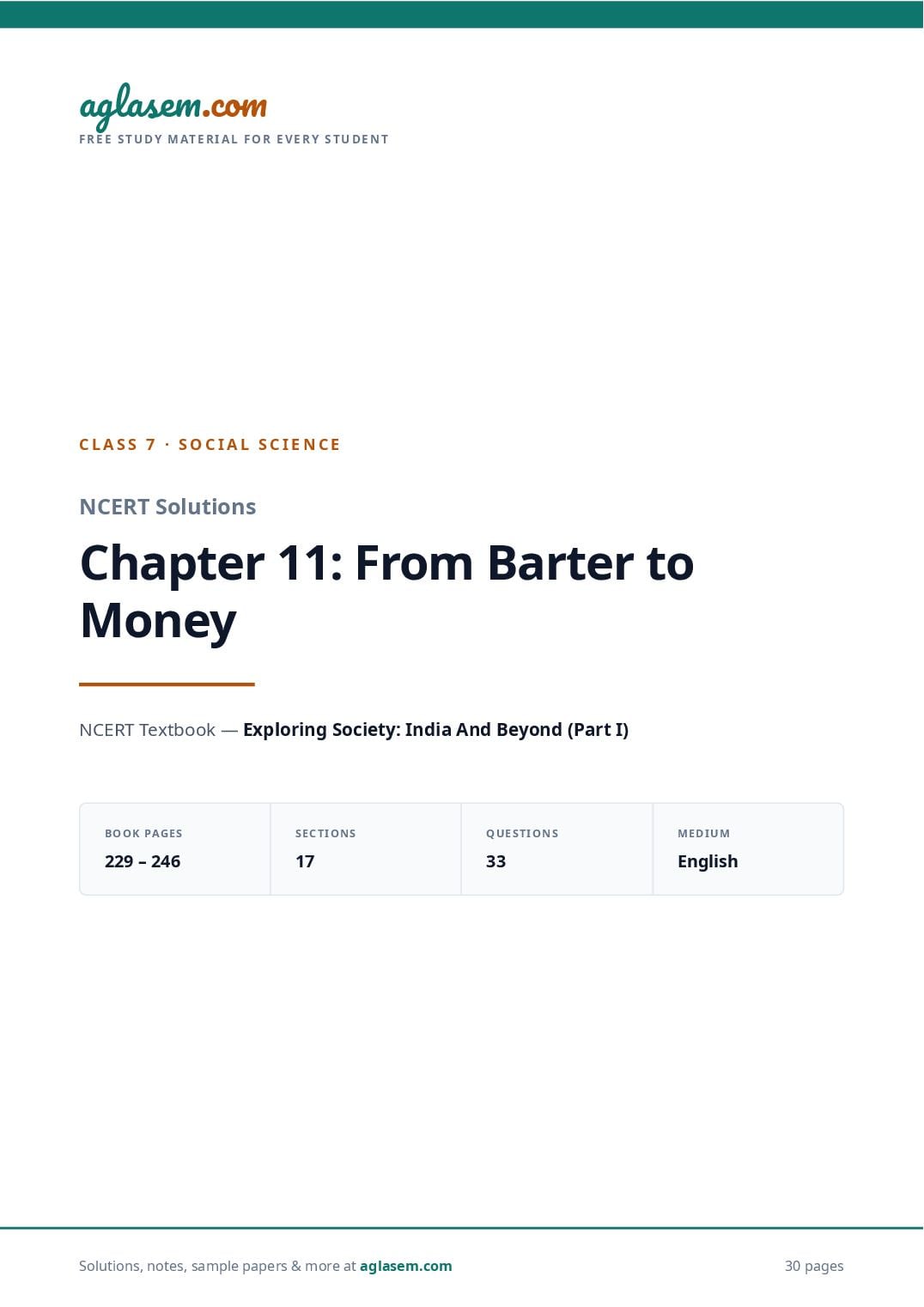
CLASS 7 · SOCIAL SCIENCE
NCERT Solutions
Chapter 11: From Barter to
Money
NCERT Textbook — Exploring Society: India And Beyond (Part I)
BOOK PAGES SECTIONS QUESTIONS MEDIUM
229 – 246 17 33 English
Solutions, notes, sample papers & more at 30 pages
Page 2
CLASS 7 · SOCIAL SCIENCE · EXPLORING SOCIETY: INDIA AND BEYOND (PART I)
NCERT Solutions — Chapter 11: From Barter to Money
The first chapter of the theme Economic Life Around Us traces how exchange grew from the barter system —
goods swapped directly for goods — to money in its many forms: cowries, punch-marked kārṣhāpaṇas, paper
currency and today's digital payments.
TEXTBOOK BOOK PAGES
Exploring Society: India and Beyond (Part I) (Class 229 – 246
7)
SECTIONS QUESTIONS
17 33
MEDIUM
English
The Big Questions — Page 229
Chapter opener · Theme E: Economic Life Around Us
THE BIG QUESTIONS
Q1 How did exchange take place before money?
Before money existed, people exchanged goods and services directly for other goods and
services. This system is called the barter system.
It worked like this: a person who had a surplus of one thing looked for another person who had
a surplus of what the first person needed, and the two swapped. The book's classroom example
is the simplest one — you have a spare eraser and need a pencil; your classmate has a spare
pencil and needs an eraser; you swap, and both needs are met.
People bartered whatever was useful and valued in their region:
Cowrie shells — small, countable and hard to fake
Salt, tea, tobacco — always in demand
Cloth and seeds
Cattle — cows, goats, horses, sheep
Elsewhere in the world people used still stranger things — giant Rai stone discs on Yap Island in
Micronesia, the Aztec copper Tajadero (a chopping-knife shape) in Central Mexico, and Tevau red-
feather coils on the Solomon Islands.
Page 1 of 30
Page 3
Why it happens: in a small village where everybody grows or makes something,
direct swapping is enough. Barter only breaks down when trade grows large and
travels far — and that is exactly when money appears.
Q2 Why did money come into existence?
Money came into existence because barter could not keep up once more kinds of goods were
being exchanged over longer distances. As the book puts it, “necessity is the mother of
invention.”
Barter has five specific weaknesses, all of which money removes:
PROBLEM WITH WHAT GOES WRONG HOW MONEY FIXES IT
BARTER
Double coincidence of You must find someone who wants your Sell the ox to anyone for money,
wants ox and has the shoes you want then buy shoes from anyone
No common standard How many bags of wheat equal one Every good carries a price in the
measure of value sweater? Nobody can say same unit
Divisibility You cannot exchange a part of an ox for a Money splits into ₹1, ₹2, ₹5, ₹10 …
sweater
Portability Taking an ox or sacks of wheat Notes and coins fit in a pocket
everywhere is hard
Durability Stored wheat rots or is eaten by rats Money keeps its value over time
So money became a common medium of exchange — a single thing everybody accepts. Once
enough people used it for buying and selling, it became the accepted method of payment.
Q3 How has money transformed into various forms over time?
Money in India has moved through five broad stages, shown in the timeline of Fig. 11.10.
Page 2 of 30
Page 4
ROUGHLY WHEN FORM OF MONEY WHAT IT WAS
6000 BCE Barter Goods swapped straight for goods
From about 1000 BCE Cowrie Shells used as counted money
From about 600 BCE Metal coinage Iron, silver, gold and copper coins — the kārṣhāpaṇas
1861 Official paper money Government-issued currency notes
1980 Digital money Debit cards and credit cards
2016 UPI Unified Payments Interface — pay by phone
The direction of change is clear: money has become steadily lighter, more divisible and easier
to move. Shells and cattle gave way to metal, metal to paper, and paper to something you
cannot touch at all.
Did you know? The two ends of that timeline can sit side by side. A fruit-seller like
Krishnappa in the chapter keeps a printed QR code next to his cart — the money
never takes any physical form; it simply moves from one bank account to another.
In-text Questions — Page 229
Chapter opening text
Q1 In the theme “Tapestry of the Past”, you read about the crops that people grew,
such as food grains or goods they made like carnelian beads. How do you think they
exchanged these goods for things that they needed?
They exchanged them directly, good for good — by barter. There were no coins and no notes,
so a farmer with surplus grain simply found a bead-maker who wanted grain, and the two
agreed on how much grain a string of carnelian beads was worth.
The chapter's opening picture (Fig. 11.1) shows exactly this: two people pouring grain from a
basket into each other's sacks in a field.
Three things made such exchanges possible in the past:
Surplus. A family grew or made more than it needed, so it had something to give away.
Fairs and markets. People gathered at one place on fixed days, which made it easier to find
a matching partner.
Commonly accepted goods. Things like grain, cattle, salt and cowrie shells were wanted by
almost everyone, so they were easy to trade on.
Page 3 of 30
Page 5
Class 7 Social Science Chapter 11 From Barter to Money
a g l AglaSem · NCERT Solutions
co m
m.
Why it happens: a bead-maker cannot eat beads. Exchange is what turns a
as e
omswap for the rest. l
specialised skill into a full life — the potter, the weaver and the farmer each do one
thing well.cand a g
a s em
agl
co m
ag
LET’S EXPLORE — Page 231
m .
Why Do we Need Money?
as e
LET’S EXPLORE a g l
co m
se m.
Q1 Imagine that you are a farmer and that people use a barter system where you live.
o m l a
You need a whole variety of things — a pair of new shoes, a sweater, and medicines
g spare. How would you
for.cyour grandmother. But you only have an ox that you can
a
m
se be able to exchange the ox for all the different things you need from different
a
agl people or places?
m a s
m .co agl
l a se
g
I would have to break the single big exchange into a chain of smaller exchanges, because no
a
one person is likely to have shoes, a sweater and medicines all together and want an ox in
return.
co m
m .
m as e
.co
Step 1 — Find someone who actually needs an ox.
a g l
se m
a
Step 2 — Since one pair of shoes is nowhere near the value of an ox, swap the ox for several
a g l bags of wheat instead.
se m
com
Step 3 — Carry the wheat to the cobbler; bargain over how many bags equal one pair of
g l a
m . a
ase
shoes.
agl
Step 4 — Carry the remaining wheat to a second person for the sweater.
o m
Step 5 — Carry what is still left to a third person for the medicines.
. c
s e
Step 6 — Take the leftover bags home and store them safely for nextmtime.
. com a gla
asem
l
So the ox is first turned into a good that is divisible — wheat — and only then spent in parts.
a g
.c
Tip: notice that wheat is here doing the job of money. It is acting as a rough medium
s e m
m a
. co
of exchange. That is precisely how real money began.
e m agl
g l as
a
co m
m .
m ase
.co
a g l Page 4 of 30
Page 6
Q2 What difficulties are you likely to face?
Every step of that chain has a difficulty built into it.
DIFFICULTY WHAT IT LOOKS LIKE IN THE FARMER'S STORY
Finding a match You must first find a person who wants an ox at all
Unequal value An ox for one pair of shoes is not a fair swap
A long chain Ox → wheat → shoes, sweater, medicines: three separate deals with three people
Bargaining every time A fresh discussion at each stall about how much wheat equals the item
Transport Sacks of wheat must be carried to several places
Storage Leftover wheat must be kept safe — and it may rot or be eaten by rats
Carrying it again Next time you want something, out come the sacks once more
In the language the chapter uses a page later, these are the problems of the double coincidence
of wants, no common standard measure of value, divisibility, portability and durability.
THINK ABOUT IT — Page 232
Why Do we Need Money?
THINK ABOUT IT
Q1 What are the different types of difficulties you encountered in the situation above?
Five distinct kinds of difficulty, each of which the chapter later gives a name.
1. Matching two sets of wants. The person who has shoes must also want exactly what you
are offering. This is the double coincidence of wants.
2. Deciding a fair rate. Is a sweater worth two bags of wheat or five? There is no agreed
answer, because there is no common standard measure of value.
3. Splitting the goods. An ox cannot be cut into a shoe-sized portion — the problem of
divisibility.
4. Moving the goods. An ox and sacks of wheat must be led or carried from place to place —
the problem of portability.
Page 5 of 30
Page 7
5. Keeping the goods. Wheat rots or is eaten by rats, so wealth cannot be stored — the
problem of durability.
On top of these come the plain costs of time and effort: several journeys, several rounds of
bargaining, and a safe store to build.
Why it happens: each difficulty comes from the same root — in barter, the thing
being exchanged has to do two jobs at once. It has to be useful in itself and serve as
payment. Money separates the two jobs, and every difficulty dissolves.
In-text Questions — Page 232
Why Do we Need Money?
Q1 In the farmer’s story, imagine he finds someone who is willing to trade a pair of
new shoes, a sweater, and medicines — all in exchange for his ox. Do you think it
would be easy to come across such a situation?
No — such a situation would be very rare. It asks for a great deal of luck all at once.
Three separate conditions would have to be true of the same person on the same day:
They must own shoes, a sweater and medicines — three quite different trades in one pair of
hands.
They must actually want an ox, and want it badly enough to give up all three.
Both sides must agree that one ox is a fair price for the whole bundle.
In real life the shoes come from a cobbler, the sweater from a weaver and the medicines from a
healer. Each of them wants something different, and probably none of them needs an ox. That is
why the farmer in the story ends up going through a chain of exchanges instead.
Why it happens: this is the double coincidence of wants in its hardest form. A single
coincidence is already unlikely; here the farmer needs three coincidences to line up
together.
THINK ABOUT IT — Page 233
Page 6 of 30
Page 8
Why Do we Need Money?
THINK ABOUT IT
Q1 What are the instances of double coincidence of wants in the above example?
Every single swap in the farmer's chain needs a double coincidence of wants. There are four of
them in the example.
# THE EXCHANGE WHAT MUST COINCIDE
1 Ox → bags of wheat The wheat-owner must want an ox, and the farmer must want wheat
2 Wheat → shoes The cobbler must want wheat, and the farmer must want those shoes
3 Wheat → sweater The sweater-seller must want wheat, and the farmer must want the sweater
4 Wheat → medicines The medicine-seller must want wheat, and the farmer must want the medicines
And the imagined easy case on page 232 — one person offering shoes, sweater and medicines
together for the ox — would be a fifth, and by far the least likely, instance.
Check it yourself: if the cobbler had wanted milk instead of wheat, the farmer
would have had to insert yet another exchange (wheat → milk → shoes). Every
mismatch adds a link to the chain.
Q2 In the situation given above, what are the cases where you could encounter the
lack of a common standard measure of value?
Wherever the two sides have to argue about the rate, there is no common standard measure
of value. In the farmer's story that happens at every deal.
Ox for wheat. How many bags of wheat is one ox worth — ten, twenty, thirty? Nothing
settles it except bargaining.
Wheat for shoes. The book says plainly that “a discussion would take place to arrive at the
fair amount of wheat that you could exchange for shoes”.
Wheat for the sweater. The same argument all over again with a different person.
Wheat for the medicines. And again with a third person — who may value wheat quite
differently from the first two.
Page 7 of 30
Page 9
Ox for shoes directly. Swapping an ox for one pair of shoes “would hardly be a fair
exchange” — but with no common unit, neither side can prove how unfair it is.
Why it happens: without a shared unit, value is only an opinion. The cobbler may
think wheat is plentiful and cheap; the farmer, who worked all season for it, thinks it
is precious. If either feels the exchange is disadvantageous, the deal simply
collapses. Money ends the argument by giving every good a price in the same unit.
THINK ABOUT IT — Page 234
Why Do we Need Money?
THINK ABOUT IT
Q1 What are the different ways in which money would make the above situation easier
for the farmer?
Money would replace the farmer's whole chain of swaps with one sale and three purchases.
With barter: ox → wheat → shoes, and → sweater, and → medicines (4 exchanges, 3
journeys with sacks)
With money: ox → ₹ → shoes, sweater, medicines (1 sale, then simple buying)
It helps in five distinct ways, one for each weakness of barter:
FUNCTION OF WHAT IT DOES FOR THE FARMER
MONEY
Medium of exchange He sells the ox to anyone who wants it and buys from anyone who sells shoes — no
double coincidence of wants needed
Common measure of Shoes, sweater and medicines all carry a price in rupees, so he can compare them and
value no bargaining battle is needed
Divisibility The ox becomes a sum of money that can be split exactly — some for shoes, some for
the sweater, the rest for medicines
Portability Notes and coins go in his pocket; no sacks to haul from village to village
Store of value Whatever is left over keeps its value. It will not rot and rats will not eat it, so he can
spend it months later
Page 8 of 30
Page 10
Class 7 Social Science Chapter 11 From Barter to Money
a g l AglaSem · NCERT Solutions
Money also lets him buy today and settle later, because it is accepted as a standard of deferred
co m
payment.
e m.
m l as
m .co a g
l a se
g
a EXPLORE — Page 236
LET’S
m
Barter today · after the Junbeel Mela, book exchange and utensils-for-clothes boxes
. co ag
LET’S EXPLORE
e m
g l as
Q1
a
The illustrations above show you some of the ways in which people practise barter
today. Have you observed similar practices in your locality?
co m
em.
m l as
.co a g
a s em
Yes — barter has not disappeared. It survives wherever people trust each other or where cash is
a l Look around your own locality for these:
gscarce.
s
Bartan-wale / old clothes for utensils. A vendor comes door to door and gives steel
m a
.co agl
utensils in return for used clothes — exactly the practice in Fig. 11.7.
se m
a
Kabaadiwala exchanges. Old newspapers and scrap traded for buckets, mugs or plastic
ware rather than cash.
a g l
Book and toy swaps in schools and housing societies, like the book exchange club in Fig.
11.6.
co m
m .
as e
Village-level help. A farmer lends his bullocks or tractor for a day's ploughing and receives a
m l
.co g
share of the harvest or a day's labour back.
em a
s
Skill for skill. A neighbour teaches your brother mathematics while your mother stitches
a
l clothes for her family.
ag
m
Fairs. The Junbeel Mela in Morigaon district, Assam is the best-known surviving barter fair —
a se
com l
hill people bring roots, vegetables, fruit, herbs and spices and exchange them with plains
. a g
m
ase
people for rice cakes.
agl
Try This: keep a one-week diary of every exchange you see in your street. Mark each
m
one “money” or “barter”. You will usually find two or three barters hiding among the
. co
m
cash payments.
m as e
.co a g l
a s em
agl What are the types of experiences people have in this process?
.c
Q2
s e m
m a
e m . co agl
l as
People report a mix — warm on the human side, awkward on the arithmetic side.
g
a
co m
m .
m ase
.co
a g l Page 9 of 30
Page 11
WHAT PEOPLE LIKE WHAT PEOPLE FIND HARD
No cash needed, so it works even when Deciding the rate — how many old sarees make one bucket?
money is short
Useless things at home become useful things Long bargaining; either side may feel cheated afterwards
It builds friendship and trust between The vendor may not come again for months — you cannot
neighbours buy when you want
Nothing is wasted: cloth is resold, No fixed prices means no way to compare two vendors'
repurposed or recycled offers
At a fair like Junbeel it becomes a social and Goods must be carried to the place of exchange
cultural event
Why it happens: the pleasant experiences come from barter being personal; the
difficult ones come from it having no common standard measure of value. Both sides
of the experience are visible in a single doorstep exchange.
Sample answer: “In my colony a vendor calls out for old clothes twice a month. My mother gave
four old shirts and two sarees and received one steel bucket and two glasses. She said the deal
felt fair because the utensils were of good quality, but she also said she had to argue for ten
minutes, and that with money she would simply have known the price.”
THINK ABOUT IT — Page 237
Basic Functions of Money
THINK ABOUT IT
Q1 Suppose you need to buy a book. You have ₹50 in your pocket. You visit the
bookshop in your neighbourhood where the shopkeeper tells you that the book is
worth ₹100. What options do you have to buy the book today?
The gap has to be closed somehow.
Price of the book = ₹100
Money in my pocket = ₹50
Shortfall = ₹100 − ₹50 = ₹50
Page 10 of 30
Page 12
The realistic options are:
1. Pay ₹50 now and the remaining ₹50 later — if the shopkeeper agrees. This is a deferred
payment.
2. Borrow ₹50 from a parent, an elder sibling or a friend and pay the full amount today.
3. Ask the shopkeeper to keep the book aside and come back tomorrow with the balance.
4. Buy a cheaper book today that costs ₹50 or less.
5. Wait and save the other ₹50 out of pocket money before buying.
6. Pay digitally — if there is money in a family bank account, a UPI transfer settles the ₹100 at
once.
Tip: notice that option 1 is only possible because money exists. Under barter you
could not hand over “half an ox now and half an ox next month”.
Q2 Will you request the shopkeeper to allow you to make the rest of the payment
later?
Yes, that is a reasonable thing to ask — and the chapter uses this very request to introduce an
important idea.
The request works only if two conditions hold:
Trust. A neighbourhood shopkeeper who knows my family is likely to agree; a stranger in a
big store will not.
A promise I can keep. I must be sure I will actually have ₹50 by the date I name, and I must
go back and pay on that date.
If he agrees, I take the book home today and pay ₹50 later. The shopkeeper accepts a promise of
money in place of money itself.
Why it happens: the fact that money is accepted as a way of making payments later
makes money a standard of deferred payment — the fourth basic function of money,
alongside medium of exchange, measure of value and store of value. It works
because everybody is confident that ₹50 will still buy roughly the same amount next
month.
Did you know? Shopkeepers in India have kept such credit in a khata or bahi — a
running account book — for centuries. Buying on credit and settling at the end of
the month is deferred payment in daily life.
Page 11 of 30
Page 13
LET’S EXPLORE — Page 238
The Journey of Money · Fig. 11.10
LET’S EXPLORE
Q1 Look at the timeline given below. What are the changes in money that you observe?
Reading Fig. 11.10 from left to right, money changes six times — and each change makes it
easier to use.
DATE ON THE FORM OF MONEY WHAT CHANGED
TIMELINE
6000 BCE Barter Goods exchanged straight for goods — no
money at all
1000 BCE onward Cowrie A shell becomes money: countable, light, hard
to imitate
600 BCE onward Metal coinage — iron, silver, Money now carries a stamped, guaranteed
gold, copper value
1861 Official paper money Value is separated from the material; paper is
far lighter than metal
1980 Digital money — debit and Money moves without being carried
credit cards
2016 UPI A phone and a QR code are enough; the money
is purely electronic
Four patterns stand out:
From bulky to weightless. Cattle and grain → shells → metal → paper → nothing you can
hold.
From natural to man-made. A shell is found; a coin is minted; a UPI payment is created by
software.
From private to official. Anybody could barter; kings minted coins; today only the RBI may
issue currency.
The pace speeds up. Barter to coins took thousands of years; cards to UPI took about 36.
Page 12 of 30
Page 14
Check it yourself: the timeline does not say old forms died out. Cowries were still
used in parts of India long after coins appeared, and coins, notes and UPI are all in
use together today.
In-text Questions — Page 239
Coinage
Q1 Does this word sound familiar to a word we use for money today in India?
Yes. The word in question is rūpa — the symbol punched on to ancient coins — and it is the
ancestor of the word we use every day: rupee (rupaya).
rūpa (a punched symbol / form) → rūpya (stamped silver) → rupaya / rupee
The other coin word in the same paragraph has survived too. The ancient coins were called
kārṣhāpaṇas or paṇas, and:
Tamil, Telugu and Malayalam still say paṇaṁ for money;
Kannada says haṇa.
Why it happens: words for money outlive the money itself. The coins vanished
centuries ago, but because people kept using the name in daily speech, it passed
from one generation of currency to the next.
LET’S EXPLORE — Page 239
Coinage · Fig. 11.12
LET’S EXPLORE
Q1 The coins shown in Fig. 11.12 were found during excavations in Pudukkottai in Tamil
Nadu. Their heads embossed are those of Roman kings. What conclusions can we
draw from such a finding?
Roman gold coins lying in the soil of Tamil Nadu are hard evidence of long-distance trade
between southern India and the Roman world.
Page 13 of 30
Page 15
Class 7 Social Science Chapter 11 From Barter to Money
a g l AglaSem · NCERT Solutions
c om
Four conclusions follow from the find:
.
m a s
1. Contact existed. Southern India was not isolated; it was in regular touch withemlands across
.
the ArabiancoSea and the Mediterranean. a gl
em was by sea. Coinage “helped boost India's maritime trade with the world”, and
2. Thestrade
a
l coins turn up in parts of Kerala and Tamil Nadu — the coastal trading belt.
agsimilar
3. The balance of trade favoured India. This is the conclusion the chapter itself draws. Roman
o m
. c ag
gold flowed into India, which means Indians were selling more to Rome (pepper, spices,
s e m back.
textiles, beads, pearls) than they were buying
a g
4. Coins of a strong power were acceptedla far away. The chapter has just explained that “the
coins of powerful rulers were accepted across various kingdoms and not just their own”.
m
Roman gold coins clearly were.
co
se m.
o m l a
ga Roman emperor to
.cstamp. A merchant in Pudukkottai did not need to obey
Why it happens: gold coins were valued for the metal in them as much as for the
m a
se his gold — the gold itself was the guarantee.
ruler's
g l a
a
accept
m a s
.co agl
Tip: when a question asks what a finding tells us, look at three things — what the
se m
a
object is, where it was found, and which direction it travelled. Here: gold, found far
ag l
from home, moving into India.
com
m .
m — Page 241 as e
.co
LET’S EXPLORE
a g l
a s em
Coinage today · group project
agl LET’S EXPLORE
se m
coofmfive students each. Take up a group project to g l a
. a
emmembers, neighbours, shopkeepers, and so on.
Q1 Organise yourselves into groups
a s
agl features — what are they made of, what is the year
collect old coins from family
Document their various
inscribed on the coins, what do you observe on the obverse and reverse sides of the
co
coins. What can you guess from your observations? How would you know if your m
m .
as e
guesses are true?
m l
.co a g
a s emANSWER
agl How to run the project. Split the five jobs: two collectors, one photographer, one record-
.c
keeper, one presenter. Never clean or scrub a coin — cleaning destroys exactly the evidence you
s e m
m a
. co agl
are collecting. Return every borrowed coin.
a s em
Record each coin in a table like this:
agl
co m
m .
m ase
.co
a g l Page 14 of 30
Page 16
SL. DENOMINATION YEAR METAL / SHAPE OBVERSE REVERSE SCRIPT /
COLOUR & SIZE (HEAD) (TAIL) LANGUAGE
1 1 quarter anna 1918 Copper, Round, Ruler's “ONE English +
brown thick head QUARTER Urdu
ANNA INDIA”
2 1 paisa 1945 Bronze Round “INDIA” Value English +
with a Urdu
hole
3 ₹1 2002 Steel, Round Ashoka Value + grain Hindi +
silvery Lion motif English
Capital
4 ₹20 2021 Bimetallic Twelve- Lion 75th Year of Hindi +
commemorative sided Capital Independence English
emblem
What good guesses look like. A guess must be tied to something you actually saw:
“The oldest coins carry only English and Urdu, the newer ones Hindi and English — so the
languages on money changed after Independence.”
“Older coins are heavier and made of copper or bronze; today's are light steel — so cheaper
metals replaced costly ones.”
“All modern coins carry the Ashoka Lion Capital — so one national authority, the RBI, now
issues them all, unlike the many kingdoms of ancient times.”
“The ₹20 coin of 2021 shows the 75-years-of-Independence emblem — so special coins are
minted to mark national events.”
How to test whether the guesses are true. A guess becomes knowledge only when it is
checked:
1. Compare with the coin photographs in the chapter (Fig. 11.13 and Fig. 11.14).
2. Check the official RBI and India Government Mint coin lists in the school library or on their
websites.
3. Visit or write to a local museum or a numismatics (coin-study) club.
4. Interview grandparents about what each coin could buy in their childhood.
5. Enlarge your sample — a pattern seen in 30 coins is far more reliable than one seen in 4.
Tip: a single odd coin proves nothing. Historians trust a pattern that repeats across
many finds — which is exactly why archaeologists count coins rather than admire
them one by one.
LET’S EXPLORE — Page 241
Page 15 of 30
Page 17
Paper Money
LET’S EXPLORE
Q1 What do you think happened as coins began to be used for all types of exchanges,
whether to buy vegetables or to buy some land?
Coins worked beautifully for small purchases and badly for large ones, so the number of coins
needed exploded.
A bunch of spinach ≈ a few small coins — easy
A piece of land ≈ thousands of coins — sacks of metal
So: the bigger the deal, the heavier the payment
What followed:
Big payments had to be carried in bags or on carts, sometimes with guards.
Counting a large payment took a long time, and every coin had to be checked for weight and
purity.
Traders travelling between kingdoms had to carry heavy loads over long distances.
Storing wealth at home meant storing a great mass of metal.
The chapter's own summary: “it became difficult to carry a large number of coins. Storing the
coins also became a problem.” That search for something better ended in paper money.
Q2 What problems could have come up?
Four clear problems, and they are the old barter problems returning in a new shape.
PROBLEM WHAT IT MEANT IN PRACTICE
Portability A large sum in coins is heavy and bulky — hard to carry to a market or across a kingdom
Storage Keeping a fortune in metal at home needs space and a strong-room
Safety Visible sacks of metal attract thieves on the road
Counting and testing Thousands of coins must be counted, weighed and checked for fakes or clipped edges
Page 16 of 30
Page 18
The answer was to write the value on light paper instead of carrying the metal. Paper money
was first used in China and was introduced in India in the late 18th century; from then on
coins served the smaller denominations and paper currency the larger ones.
Why it happens: money must be both valuable and convenient. Metal gave value
but cost convenience. Paper gives up the value of the material entirely and relies
instead on trust in the issuer — which is why today only the RBI may issue it.
LET’S EXPLORE — Page 242
Paper Money · Fig. 11.16 and Fig. 11.17
LET’S EXPLORE
Q1 Look at a 50 and a 100-rupee note. Can you identify the motifs depicting India’s
cultural heritage on the reverse side of the notes? Find out more about them.
Both motifs are UNESCO World Heritage monuments, and both are printed on the reverse
(back) of the note.
NOTE MOTIF ON WHERE IT IS WHO BUILT IT, AND WHAT TO KNOW
THE REVERSE
₹50 The Stone Hampi, A shrine carved as a chariot in the Vittala temple
Chariot of Vijayanagara complex, built under the Vijayanagara rulers in the
Hampi district, Karnataka 16th century. Hampi was the capital of the
Vijayanagara Empire.
₹100 Rani ki Vav — Patan, on the An inverted, seven-storeyed stepwell built in the
“the Queen's Saraswati river, 11th century by Queen Udayamati in memory of
Stepwell” Gujarat King Bhima I of the Solanki dynasty; its walls carry
more than 500 major sculptures.
Other notes in the same series carry the same idea — the Sun Temple at Konark on the ₹10
note, the Ellora caves on the ₹20, the Sanchi Stupa on the ₹200, the Red Fort on the ₹500.
Why it happens: currency is the one printed object that reaches every person in the
country. Putting monuments on the reverse turns everyday money into a small,
portable lesson in India's cultural heritage.
Page 17 of 30
Page 19
Tip: hold your own ₹50 note beside Fig. 11.16 in the book. Read the words printed
under the picture — the note names the monument for you.
Q2 Feel the surface of the notes. What special features of currency notes help visually
impaired persons to identify the notes’ denominations?
Indian currency notes carry raised printing that can be felt with a fingertip, so the
denomination can be told by touch alone.
Intaglio (raised) printing. The Mahatma Gandhi portrait, the Ashoka Pillar emblem and the
RBI seal are printed so thickly that they stand above the paper surface.
Bleed lines. Groups of raised slanting lines at the left and right edges — different numbers
for different notes. For example ₹100 has 4 lines in each group and ₹500 has 5, so they can
be counted with a finger.
An identification mark. A raised geometric shape near the left edge, different for each
denomination — a triangle on the ₹500, a circle on the ₹200, and so on.
Different sizes. Each denomination is a different length and width, so notes can be
compared against one another or against a card.
Big, bold numerals and strongly contrasting colours help people with partial sight.
Did you know? The RBI has also released a mobile app, MANI (Mobile Aided Note
Identifier), which speaks the denomination aloud when the phone camera is pointed
at a note.
Why it happens: money is useless if a person cannot be sure what they are handing
over. Touch-based features let a visually impaired person pay and take change
independently, without having to trust a stranger's word.
In-text Questions — Page 243
New Forms of Money
Q1 Have you observed other people around you making or receiving payments without
using coins and notes?
Yes — cashless payment is now an everyday sight, and not only in big shops.
Page 18 of 30
Page 20
Class 7 Social Science Chapter 11 From Barter to Money
a g l AglaSem · NCERT Solutions
A fruit or vegetable seller with a printed QR code tied to his cart, exactly like Krishnappa in
co m
the chapter.
e m.
m l as
.co g
An auto-rickshaw driver holding up a QR card at the end of a ride.
em a
s
Someone tapping or swiping a debit or credit card at a medical store or supermarket.
a
gAlparent paying school fees or an electricity bill by net banking.
a Friends splitting a bill by UPI on their phones in seconds.
. c om
In each case no coin or note changes hands. The money is digital money — money in electronic
ag
a s em or felt. It simply moves from the payer's bank
form, which is intangible: it cannot be touched
agl
account into the receiver's bank account.
c o m
Why it happens: a QR code holds the receiver's bank-account information. Scanning
.
m no card
e
it tells your bank exactly where to send the money, so a small seller needs
s
c m no cash box — only a phone.
machineoand
. a gla
a s em
agl Try This: count how many QR codes you can spot between your home and your
school. The number will tell you how far digital money has reached in your own
m a s
neighbourhood.
m.co agl
l a se
a g
Questions and activities — Page 244
co m
m .
End-of-chapter exercise
as e
. com a g l
se m
QUESTIONS AND ACTIVITIES
g l a
a
m
How does the barter system take place and what kinds of commodities were used
se
Q1
com l a
for exchange under the system?
. a g
m
ase
agl
In the barter system people exchange goods and services directly for other goods and
m
services, without using money at all.
. co
se m
How it takes place. Two people meet, each holding something the other wants. They agree on
o m l a
.c have a spare eraser and need a pencil; your classmate hasaga spare pencil and needs an
how much of one thing equals how much of the other, and they swap. The chapter's example:
m
se eraser — one swap satisfies both.
you
a
agl c
Commodities that were used. The things chosen were always ones that many people wanted
m .
m a s e
agl
and that were reasonably easy to handle:
. co
e m
g l as
a
co m
m .
m ase
.co
a g l Page 19 of 30
Page 21
IN INDIA AND AROUND EXAMPLES FROM THE CHAPTER
THE WORLD
Shells Cowrie shells
Food and stimulants Salt, tea, tobacco
Cloth and seeds Woven cloth, seed grain
Livestock Cows, goats, horses, sheep
Unusual regional money Rai stone discs (Yap Island, Micronesia); the Aztec copper Tajadero (Central
Mexico); Tevau red-feather coils (Solomon Islands)
Barter has not vanished. The Junbeel Mela in Morigaon district of Assam is still a three-day
barter fair, and old clothes are still exchanged for new utensils at people's doorsteps.
Q2 What were the limitations of the barter system?
Five limitations, and every one of them is a reason money was invented.
1. Double coincidence of wants. You must find a person who wants exactly what you are
offering and is offering exactly what you want. Such a match is rare.
2. No common standard measure of value. In what proportion should two goods be
exchanged? There is no agreed unit, so the value of one good cannot be compared with
another, and if either side feels the deal is disadvantageous the exchange fails.
3. Divisibility. You cannot exchange only a part of an ox for a sweater. Many valuable goods
cannot be split.
4. Portability. An ox — or a heap of wheat sacks — has to be taken everywhere you might
want to buy something.
5. Durability. Wealth held as grain cannot be stored for long; it rots or the rats get it. Value
cannot be saved for the future.
Why it happens: under barter one object must be both a useful good and a means
of payment. Because a useful good is bulky, perishable and wanted only by some
people, it makes a poor payment. Money is deliberately designed to do nothing
except be payment — and so it does that job perfectly.
Page 20 of 30
Page 22
Q3 What were the salient features of ancient Indian coins?
The chapter gives six main features.
Precious metals. They were made from gold, silver and copper, or from alloys of these,
which made the coins strong.
Their names. They were called kārṣhāpaṇas or paṇas.
Punched symbols. They carried marks punched on to them called rūpas — very probably the
ancestor of the word rupee.
Royal control. The minting and issue of coins was controlled entirely by the rulers, so each
kingdom had its own coinage.
Two decorated faces. The obverse (head) and reverse (tail) carried different symbols and
motifs — animals, trees and hills, kings and queens, and deities. Chalukya coins of Kalyana
show a Varaha (an avatar of Viṣhṇu) on one side and a decorated three-tiered royal parasol
on the other; Chola silver coins (850–1279 CE) show the tiger emblem.
Wide acceptance. Over time the coins of powerful rulers were accepted well beyond their
own kingdoms, which made trade across regions — and across the sea — much easier.
Did you know? The word paṇa is still alive: paṇaṁ means money in Tamil, Telugu
and Malayalam, and haṇa in Kannada.
Q4 How has money as a medium of exchange transformed over time?
It has moved from things you can eat or wear, to metal, to paper, to nothing you can touch
at all.
Page 21 of 30
Page 23
STAGE FORM WHAT MADE IT BETTER THAN
THE STAGE BEFORE
1. Barter (from about 6000 BCE) Cattle, grain, salt, —
cloth
2. Commodity money (from about 1000 Cowrie shells Light, countable, durable, hard to fake
BCE)
3. Metal coinage (from about 600 BCE) Iron, silver, gold and A stamped, guaranteed value; divisible
copper coins into denominations
4. Paper currency (India, from the late 18th Bank notes Far lighter than metal; large sums
century; official paper money 1861) become easy to carry and store
5. Digital money (1980 onward) Debit and credit Money moves without being carried at
cards, net banking all
6. UPI (2016 onward) Phone payments, QR Instant, free of cash, usable by the
codes smallest street seller
Alongside the form, the authority behind money changed too. Ancient coins were issued by
individual rulers; today the Reserve Bank of India alone may issue currency, and it is not legal
for anybody else to do so.
Q5 What steps might have been taken in ancient times so that Indian coins could
become the medium of exchange across countries?
For a coin to be trusted by a stranger in a distant port, the ruler had to make it reliable,
recognisable and welcome. The likely steps:
1. Keep the metal content constant. Every paṇa had to hold the same weight and purity of
silver or gold, so that a foreign merchant could accept it without testing each coin.
2. Control minting strictly. Because minting was controlled entirely by the ruler, fakes could
be punished and the coin's reputation protected.
3. Use a clear, well-known stamp. The punched rūpas — the royal emblem, a Varaha, a tiger
— acted like a signature that any trader could learn to recognise.
4. Use durable alloys. Alloying made coins hard enough to survive years of travel without
wearing away.
5. Issue standard denominations. A family of small and large coins let both a spice sale and a
shipload be paid for in the same currency.
6. Back the coins with real trade. Coins are accepted abroad only if the issuing country has
goods people want. India's pepper, spices, textiles, beads and pearls gave its coins their pull.
Page 22 of 30
Page 24
7. Protect the trade routes and ports. Safe harbours, and treaties or friendly ties with other
kingdoms, kept merchants coming.
8. Accept foreign coins in return. Roman gold coins circulating in Pudukkottai show that
exchange ran both ways — mutual acceptance is what makes cross-border currency work.
Why it happens: a coin is a promise. A promise travels only as far as the reputation
of the one who makes it. Powerful rulers with stable, honest coinage found their
money accepted “across various kingdoms and not just their own”.
Q6 Read the following lines from the Arthaśhāstra. “An annual salary of 60 paṇas could
be substituted by an āḍhaka of grain per day, enough for four meals…” (One āḍhaka
is equal to about 3 kg) What does this indicate about the value of one paṇa? The
fine for failing to help a neighbour was 100 paṇas. Compare this with the annual
salary. What conclusion can you draw about the human values being encouraged
through this?
Part 1 — the value of one paṇa. Work out how much grain the year's salary was worth, then
divide.
Grain for one year = 1 āḍhaka × 365 days = 365 āḍhakas
365 āḍhakas × 3 kg = 1,095 kg of grain a year
This equals 60 paṇas.
So 1 paṇa = 365 ÷ 60 = ≈ 6.08 āḍhakas
= 6.08 × 3 kg = ≈ 18.25 kg of grain
So one paṇa was worth about 18 kg of grain — roughly six days' food for a person (an
āḍhaka fed one person for four meals, that is a full day). A paṇa was clearly not small change; it
was a substantial coin.
Part 2 — the fine compared with the salary.
Page 23 of 30
Page 25
Class 7 Social Science Chapter 11 From Barter to Money
a g l AglaSem · NCERT Solutions
co m
e m.
Fine for failing to help a neighbour = 100 paṇas
m l as
.co
Annual salary = 60 paṇas
m a g
l a se
g
Ratio = 100 ÷ 60 = ≈ 1.67
aSo the fine ≈ 1 year and 8 months of full salary
co m
. ag
In grain: 100 × 18.25 kg ≈ 1,825 kg — nearly two tonnes
se m
l a
Conclusion about human values.aAgfine almost twice a year's earnings is crushing — it would
ruin a household. Setting it that high says something deliberate about the society the
co m
m.
Arthaśhāstra describes:
o m l a se
Helping a neighbour was a duty, not a favour. It was enforceable by law, like a tax or a
debt. .c
a g
se m
g l aCommunity came before the individual. In a world without police, hospitals or insurance, a
a neighbour's help was the only safety net; refusing it endangered everyone.
s
The size of a punishment shows the size of the value. The State chose to make
m a
.co agl
indifference more costly than most crimes against property.
sem
a
Compassion, cooperation and social responsibility were treated as the foundations of an
orderly kingdom.
a g l
c om
Check it yourself: the same idea survives in modern Indian law — refusing to help
.
s e m
an accident victim, or a doctor refusing emergency treatment, is punishable. The
c m outlasted the coin.
valueohas
. a gla
a s em
agl
se m
comas the medium of exchange. l a
Q7 Write and enact a skit to show how people may have persuaded each other to use
. a g
em
cowrie shells (or other such items)
a s
ANSWER agl
m
What a good skit must contain. Show the problem first, then the idea, then the objection, then
. co
m
the agreement. The audience should be able to name at least three limitations of barter from
o m l a se
what they see. Five or six speaking parts, five to seven minutes, one narrator to set the scene.
g · Old Gopal (village elder) ·
.c Narrator · Meera (potter) · Kanha (fisherman) · Devi (weaver)
a
m
se Sailor from the coast.
Cast:
a
agl c
Sample skit — “The Shell that Everyone Wanted”
m .
s e
om la
Scene 1 — the market, morning. Barter fails.
. c a g
s e m by the river, there were no coins. Whatever you needed, you
Narrator: Long ago, in a village
had to swap for.
a gla
Meera: Fish for a pot, Kanha! One good pot for two fish.
com
m .
m ase
.co
a g l Page 24 of 30
Page 26
Kanha: But I don't need a pot, Meera. I need cloth. My shirt is torn.
Meera: Then take my pot to Devi and bring me back her cloth!
Devi: I have cloth, but I don't want a pot either. I want grain — and no one here has grain
until the harvest.
Kanha (to the audience): So my fish will rot by evening, and I will still have a torn shirt.
Scene 2 — the sailor arrives with an idea.
Sailor: In the port towns nobody argues like this. We use cowrie shells. (holds up a handful)
Whatever you sell, take shells. Whatever you buy, give shells.
Devi: But a shell cannot be eaten or worn. What use is it?
Sailor: That is exactly its use. It is small, so you can carry a hundred in one hand. It does not
rot, so you can keep it a year. And they are all alike, so we can count them instead of arguing.
Scene 3 — the objection, and the answer.
Old Gopal: And if I take shells for my grain and nobody accepts them tomorrow? I will have
sold my harvest for a bag of pebbles.
Sailor: Then let us all promise together, today, before the whole village. Once everyone
accepts them, no one loses.
Meera: I agree. Ten shells for a pot.
Kanha: Three shells for a fish.
Devi: Twenty shells for a length of cloth.
Old Gopal: Then it is settled. From today, this village trades in shells. (He gives Kanha shells
for fish; Kanha gives Devi shells for cloth; Devi keeps the shells for grain after the harvest.)
Narrator: Nothing had changed in the market — the same fish, the same pots, the same
cloth. Only now there was one thing that everybody would take. That is how money begins.
Tip: the strongest line in the whole skit is Old Gopal's objection. Money works only
because everyone agrees to accept it — so the turning point of your skit should be
the moment the village agrees together, not the moment the shells appear.
Q8 The RBI is the only legal source that prints and distributes paper currency in India.
To prevent illegal printing of notes and their misuse, the RBI has introduced many
security features. Find out what some of these measures are and discuss them in
class.
How to find out: hold a genuine note against the light and tilt it; compare it with the RBI's
“Know Your Banknotes” chart (also printed on the back of many bank passbooks); ask a bank
cashier to demonstrate.
Main security features of an Indian banknote:
Page 25 of 30
Page 27
FEATURE HOW YOU CHECK IT WHY IT STOPS A
COUNTERFEITER
Watermark Hold to the light — the Mahatma Gandhi It is made in the paper, not printed on
portrait and an electrotype numeral appear it
inside the paper
Security thread A metallic strip running through the note; it Cannot be reproduced by a printer or
reads “भारत” and “RBI” and changes colour photocopier
when tilted
Colour-shifting ink Tilt the note — the numeral changes from A scanned copy keeps a single flat
green to blue colour
Latent image Hold the note flat at eye level — a hidden Needs specialised intaglio printing
numeral appears
Micro-lettering Under a magnifying glass, tiny “RBI” and Blurs into a smudge when copied
the denomination appear
Intaglio (raised) Run a finger over the portrait and the Ordinary printing is flat
printing emblem — they feel raised
Fluorescence Under ultraviolet light the number panel and Requires special ink and paper
fibres glow
See-through Half the numeral is on the front and half on Demands exact front-and-back
register the back; they line up perfectly against the alignment
light
Special paper and Cotton-based paper; every note has a unique The paper is not sold commercially;
serial numbers ascending serial number duplicate numbers are easily caught
Points for the class discussion: Why is a fake note a crime against everybody, not just against
the person who receives it? What should you do if you suspect a note is fake? Why does the law
allow only one body — the RBI — to issue currency?
Why it happens: paper is nearly worthless in itself; a ₹500 note is valuable only
because people trust the RBI's promise. Counterfeiting attacks that trust, so the note
is loaded with features that are cheap for you to check and very expensive for a
criminal to copy.
Page 26 of 30
Page 28
Q9 Interview a few of your family members and local shopkeepers, and ask them their
preferences in making and receiving payments — do they prefer cash or UPI? Why?
How to do the interview well. Choose six to eight people of different ages and occupations —
a grandparent, a parent, a vegetable vendor, a tea-stall owner, a medical shop, an auto driver.
Ask permission first, take notes, and ask the same questions to everyone so the answers can be
compared. Use open questions (“Why do you prefer that?”), not leading ones.
A record sheet you can use:
PERSON AGE PREFERS MAIN REASON MAIN WORRY
GROUP GIVEN
Grandmother 70+ Cash Can see and count it; Afraid of pressing the
used to it wrong button
Vegetable 40s Both UPI saves hunting for Poor network at the mandi
vendor change
Medical shop 30s UPI Automatic record; no Server down at peak hours
fake notes
Auto driver 50s Cash Needs money in hand Bank transfer takes time to
for fuel withdraw
What people usually say:
REASONS FOR PREFERRING UPI REASONS FOR PREFERRING CASH
No problem of change for odd amounts Works without a phone, network or electricity
Safe — no large sums kept in the shop Easy for elderly people and those not comfortable with phones
Every payment is automatically recorded No risk of a wrong transfer or a failed transaction
Instant, and works even for ₹10 Money is available immediately for the next purchase
No risk of fake notes Spending feels more visible, so it is easier to control
Sample answer: “I interviewed six people. Four of them — all under forty — said they prefer
UPI, mainly because it removes the change problem and leaves a record. The two older people
preferred cash; my grandmother said she likes to see her money, and the auto driver said he
needs cash in hand for petrol. Almost everyone used both. The commonest complaint about UPI
was network failure, and the commonest complaint about cash was change.”
Page 27 of 30
Page 29
Tip: when you present your findings, group the answers by age. The clearest pattern
in most classrooms is that preference shifts with age and with whether the person
owns a smartphone — not with how much money they earn.
Chapter at a glance
Before money existed, people exchanged goods and services directly for other goods and
services. This is the barter system, and cowrie shells, salt, tea, tobacco, cloth, cattle and
seeds were among the commodities used.
Barter runs into five problems: the double coincidence of wants, the lack of a common
standard measure of value, divisibility, portability and durability.
Money solves all five. It works as a medium of exchange, a common denomination that
measures value, a store of value, and a standard of deferred payment.
Ancient Indian coins of gold, silver and copper (or their alloys) were called kārṣhāpaṇas or
paṇas and carried punched symbols called rūpas. Rulers alone controlled minting.
Paper money was first used in China and came to India in the late 18th century. Today only
the Reserve Bank of India may issue currency.
The journey continues: debit and credit cards from about 1980 and UPI from 2016 have
made money intangible — digital money you cannot touch.
Page 28 of 30
Page 30
Class 7 Social Science Chapter 11 From Barter to Money
a g l AglaSem · NCERT Solutions
co m
m.
Quick revision
m l a se
m .co g
aEXAMPLE
ase
TERM WHAT IT MEANS WHERE IT
agl
APPEARS IN THE
CHAPTER
m
.co first system of ag
Barter system Exchanging goods and services Page 230, the very Your extra eraser for a
sem
without using money classmate's extra pencil
a
agl
exchange
Commodities Products or goods that can be Page 230, list of Cowrie shells, salt, tea,
traded, bought and sold things used before
co m
tobacco, cloth, cattle, seeds
m.
seox-owner must find a
money
m l a
m .co
Double coincidence Two people each have exactly Page 233, the
ag The
l a se
of wants what the other wants and can farmer's difficulty shoemaker who wants an
a g exchange directly ox
a s
com deals break down
Common standard An agreed-upon worth that lets Page 233, why barter How many bags of wheat
. agl
measure of value values be compared equal one sweater?
e m
s to be
g l aobject
a or portions
Divisibility The capacity of an Page 233, the ox You cannot exchange one
split into pieces problem leg of an ox for a sweater
co m
.
Portability The ability of an object to be Page 233, taking the Carrying sacks of wheat to
carried from place to place ox everywhere
se m
three different sellers
com l a
g Grain spoils; a coin does
. Page 234, wheatarots
em
Durability
s
The ability to withstand damage
gl a and be stored for a long time or is eaten by rats not
a
Minting The process of producing coins; Page 238, Coinage Rulers alone controlled
se m
com
a mint is the facility that makes minting in ancient India
g l a
m . a
ase
them
Alloy
a gl
A metal made by combining two Page 238, what coins Today's coins are largely
or more metallic elements are made of iron with chromium, silicon
om
and carbon
. cSurvives
em
com as
kārṣhāpaṇa / paṇa Page 238, Coinage as paṇaṁ in Tamil,
l
Ancient Indian coins of gold,
g
m. a
silver, copper or their alloys Telugu, Malayalam and
e
las
haṇa in Kannada
ag c
.
rūpa The symbol punched on an Page 238 The likely ancestor of the
s e m
a
word rupee
m
ancient coin
em . co agl
as
Obverse / Reverse The head side and the tail side Page 239 Chalukya coins: Varaha on
a g l
of a coin one side, three-tiered
parasol on the other
co m
m .
m as e
.co
a g l Page 29 of 30
Page 31
TERM WHAT IT MEANS WHERE IT EXAMPLE
APPEARS IN THE
CHAPTER
Currency The system of money used in a Page 242 Indian rupee coins and
particular country notes
Denominations Units in which coins and notes Page 242 50 paisa, ₹1, ₹2, ₹5, ₹10,
are classified ₹20 coins; ₹10 to ₹1000
notes
QR Code A 'quick-response' code of black Page 243, Scan and pay straight into
and white squares holding bank- Krishnappa's fruit the seller's bank account
account information cart
Page 30 of 30
Document Details
| Board / Org | NCERT |
| Exam | Class 7 |
| Type | Solution |
| Pages | 40 |
| Language | english |
| Updated | 13 Oct 2026 |