MAHA SET 2015 Question Paper 3 Social Work
Finished viewing? Save it for later —
Download MAHA SET 2015 Question Paper 3 Social Work (PDF · 40 pages)About MAHA SET 2015 Question Paper 3 Social Work
MAHA SET 2015 Question Paper 3 Social Work is available here for free download. Published by Maharashtra Exams for MAHA SET, this question paper can be viewed online or downloaded as a PDF (40 pages). Candidates preparing for MAHA SET can use MAHA SET 2015 Question Paper 3 Social Work to understand the exam pattern, the type of questions asked, and the overall difficulty level.
Frequently Asked Questions
How can I download MAHA SET 2015 Question Paper 3 Social Work?
Open this page and click the Download button to save MAHA SET 2015 Question Paper 3 Social Work as a PDF. It is completely free on AglaSem Docs.
Is MAHA SET 2015 Question Paper 3 Social Work free to download?
Yes. MAHA SET 2015 Question Paper 3 Social Work can be viewed online and downloaded as a PDF free of cost on AglaSem Docs.
How many pages does MAHA SET 2015 Question Paper 3 Social Work have?
MAHA SET 2015 Question Paper 3 Social Work contains 40 pages, which you can read online or download together as a single PDF.
Where can I find more MAHA SET study material?
You can find more MAHA SET question papers, sample papers, syllabus, and answer keys on AglaSem Docs.
MAHA SET 2015 Question Paper 3 Social Work – Text
Read the full text of this question paper below — useful to quickly search, copy and reference the content online without downloading the PDF.
📄 View text version (40 pages)
Page 1
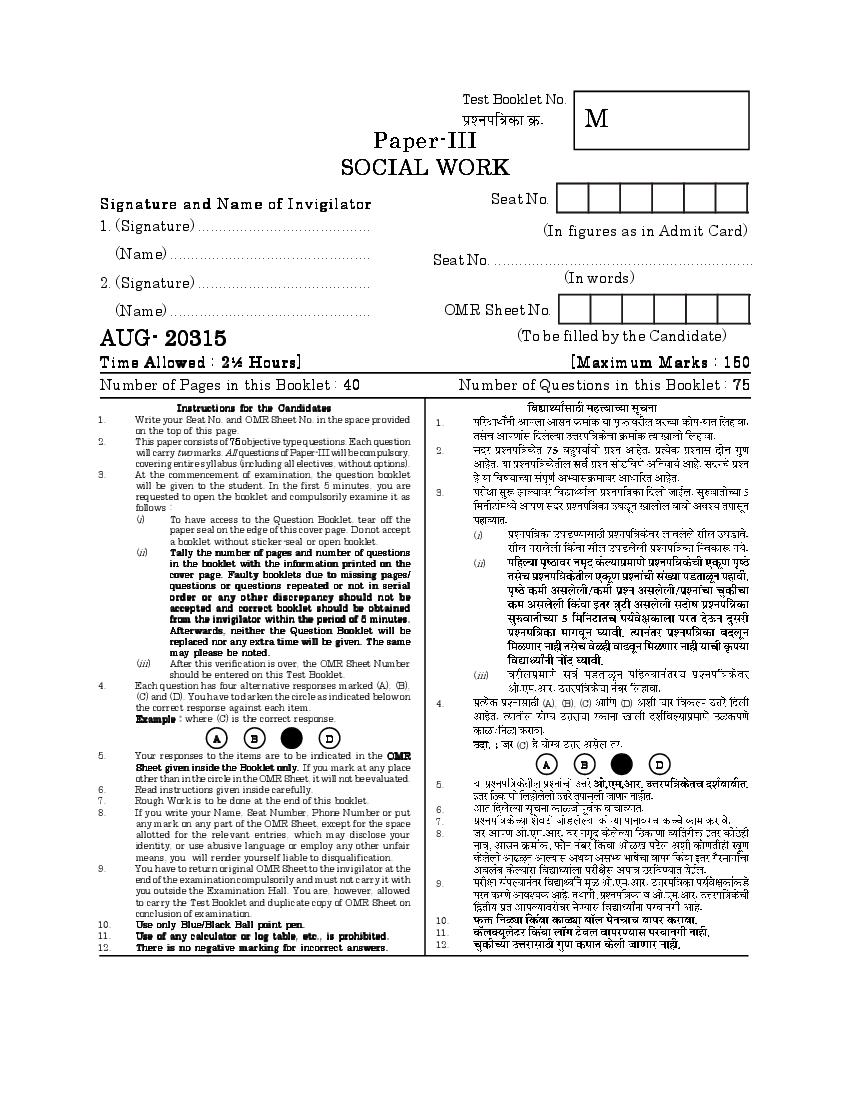
M
SOCIAL WORK
Signature and Name of Invigilator Seat No.
1. (Signature) ......................................... (In figures as in Admit Card)
(Name) ................................................ Seat No. ..............................................................
2. (Signature) ......................................... (In words)
(Name) ................................................ OMR Sheet No.
AUG- 20315 (To be filled by the Candidate)
Time Allowed : 2½ Hours] [Maximum Marks : 150
Number of Pages in this Booklet : 40 Number of Questions in this Booklet : 75
Instructions for the Candidates
1. Write your Seat No. and OMR Sheet No. in the space provided 1.
on the top of this page.
2. This paper consists of 75 objective type questions. Each question
will carry two marks. All questions of Paper-III will be compulsory, 2.
covering entire syllabus (including all electives, without options).
3. At the commencement of examination, the question booklet
will be given to the student. In the first 5 minutes, you are
requested to open the booklet and compulsorily examine it as 3.
follows :
(i) To have access to the Question Booklet, tear off the
paper seal on the edge of this cover page. Do not accept
(i)
a booklet without sticker-seal or open booklet.
(ii) Tally the number of pages and number of questions
in the booklet with the information printed on the (ii)
cover page. Faulty booklets due to missing pages/
questions or questions repeated or not in serial
o rder or any other discre pancy should not be
accepted and correct booklet should be obtained
from the invigilator within the period of 5 minutes.
Afterwards, neither the Question Booklet will be
replaced nor any extra time will be given. The same
may please be noted.
(iii) After this verification is over, the OMR Sheet Number
should be entered on this Test Booklet. (iii)
4. Each question has four alternative responses marked (A), (B),
(C) and (D). You have to darken the circle as indicated below on
the correct response against each item. 4. (A), (B), (C) (D)
Example : where (C) is the correct response.
A B D
(C)
5. Your responses to the items are to be indicated in the OMR
Sheet given inside the Booklet only. If you mark at any place A B D
other than in the circle in the OMR Sheet, it will not be evaluated.
5.
6. Read instructions given inside carefully.
7. Rough Work is to be done at the end of this booklet.
8. If you write your Name, Seat Number, Phone Number or put 6.
any mark on any part of the OMR Sheet, except for the space 7.
allotted for the relevant entries, which may disclose your 8.
identity, or use abusive language or employ any other unfair
means, you will render yourself liable to disqualification.
9. You have to return original OMR Sheet to the invigilator at the
end of the examination compulsorily and must not carry it with 9.
you outside the Examination Hall. You are, however, allowed
to carry the Test Booklet and duplicate copy of OMR Sheet on
conclusion of examination.
10. Use only Blue/Black Ball point pen. 10.
11. Use of any calculator or log table, etc., is prohibited. 11.
12. There is no negative marking for incorrect answers. 12.
Page 2
Page 3
Paper III
III
Time Allowed : 2½ Hours] [Maximum Marks : 150
Note : This paper contains Seventy Five (75) multiple choice questions. Each
question carries Two (2) marks. Attempt All questions.
(75) (2)
1. M.S. Gore wrote a book titled
1.
as :
(A) Social Development
(A)
(B) Some Aspects of Social
Development
(B)
(C) Poverty and Social Develop-
ment (C)
(D) Sustainable Development
2. Modernism perspective in social (D)
work is generally regarded as .......... .
2.
(A) Modern approach and methods
(B) Ideas and values of the (A)
enlightenment (B)
(C) Modern integrated methods (C)
(D) Feminism (D)
3 [P.T.O.
Page 4
of which one is Assertion (A) and (A) (R)
second is Reason (R) :
Assertion (A) : Gandhiji’s Ideology
(A)
of self-reliance was for local
development.
Reason (R) : He was the ardent (R)
follower of Panchayat Raj.
Select the correct answer from the
following :
(A) (A) (R)
(A) Both (A) and (R) are true and
(R) (A)
(R) is the correct explanation
of (A) (B) (A) (R)
(B) Both (A) and (R) are true and (R) (A)
(R) is not the correct
(C) (A) (R)
explanation of (A)
(C) (A) is true but (R) is false
(D) (A) (R)
(D) (A) is false but (R) is true
4. Which one of the following
4.
principles is not related to social
work ?
(A) Principle of Confidentiality (A)
(B) Principle of Planning (B)
(C) Principle of Self-determination (C)
(D) Principle of Acceptance (D)
4
Page 5
in social work is ....................... .
(A) Minimum government
(A)
interference
(B) No government (B)
(C) Community based (C)
consciousness
(D)
(D) Recognition of NGO’s
6.
6. Life-span approach recognises that
(A)
human beings :
(A) Develop throughout their life
(B)
(B) Develop till adulthood and then
there is stagnation
(C) Live longer in today’s times (C)
(D) Are influenced by their life
(D)
experiences
5 [P.T.O.
Page 6
7.
the following to change a person’s
behaviour ?
(A) Awards
(A)
(B) Rewards
(B)
(C) Rewards and punishments
(C)
(D) Feedback
(D)
8. Social learning theory emphasises
on : 8.
(A) Classical conditioning
(A)
(B) Observational learning (B)
(C) Vicarious learning (C)
(D) Operant conditioning (D)
9. Which of the following is a stage of 9.
development as proposed by Piaget ?
(A) Latency stage
(A)
(B) Adolescence stage
(B)
(C) Ego integrity versus Despair
(C)
stage
(D)
(D) Concrete operations stage
6
Page 7
developmental theorists see the
primary motive force for
developmental change as :
(A)
(A) Extrinsic motivation
(B)
(B) Internal
(C)
(C) Environmental
(D)
(D) Social
11.
11. According to whom, human
behaviour is purposeful and
determined .................... . (A)
(A) William Glasser
(B)
(B) Sigmund Freud
(C)
(C) Rollo May
(D)
(D) Yalom Irvin
7 [P.T.O.
Page 8
is ........... .
(1)
(1) Problem solving
(2)
(2) Counselling
(3)
(3) Helping
(4) Arbitrator (4)
(A) (1) and (2) (A) (1) (2)
(B) (1), (2) and (3) (B) (1), (2) (3)
(C) (1) and (3) (C) (1) (3)
(D) (1), (2), (3) and (4) (D) (1), (2), (3) (4)
13. Application of knowledge, tools and 13.
techniques of social work for problem
solving is ....................... .
(A)
(A) Social work intervention
(B)
(B) Social case work
(C) Social group work (C)
(D) Social counselling (D)
8
Page 9
14. Karl Jung has developed ................. .
(A)
(A) Need Achievement theory
(B) Need Hierarchy theory (B)
(C) Shadow personality theory (C)
(D) Learning theory (D)
15. The father of Transactional Analysis 15.
(TA) theory is :
(A) Eric Berne (A)
(B) Eric Ericson (B)
(C)
(C) Eric Pavlov
(D)
(D) Eric Freud
16.
16. Which of these is a philosophical
assumption of case work ?
(A) Individualisation (A)
(B) Worth and dignity of every (B)
human being
(C)
(C) Acceptance
(D)
(D) Right to self-determination
9 [P.T.O.
Page 10
of which one is Assertion (A) and (A) (R)
second is Reason (R) :
Assertion (A) : An individual’s
(A)
behaviour is conditioned by his/her
environment and life experiences.
Reason (R) : It is possible to explain
a person’s problem and behaviour, (R)
at least partially, by probing into
his/her environment and life
experiences.
Select the correct answer from the
following :
(A) Both (A) and (R) are true and
(R) is the correct explanation of (A) (A) (R)
(A) (R) (A)
(B) Both (A) and (R) are true but (B) (A) (R)
(R) is not the correct
(R) (A)
explanation of (A)
(C) (A) is true but (R) is false (C) (A) (R)
(D) (A) is false but (R) is true (D) (A) (R)
18. Which of the following is not a 18.
defense mechanism ?
(A) Repression (A)
(B) Denial (B)
(C) Displacement (C)
(D) Dealing with anxiety (D)
10
Page 11
work tool ?
(A) Listening
(A)
(B) Home visits
(B)
(C) Interview
(C)
(D) Assurance
(D)
20. Two Statements are given below out
of which one is Assertion (A) and 20.
second is Reason (R) : (A) (R)
Assertion (A) : According to recent
epidemiological studies depression is
(A)
more common among women than
men.
Reason (R) : Depression in women
is due to the high prevalence of (R)
domestic violence.
Select the correct answer from the
following :
(A) Both (A) and (R) are true and
(A) (A) (R)
(R) is the correct explanation
(R) (A)
of (A)
(B) Both (A) and (R) are true and (B) (A) (R)
(R) is the only a partial (R) (A)
explanation of (A)
(C) (A) is true but (R) is false (C) (A) (R)
(D) (A) is false but (R) is true (D) (A) (R)
11 [P.T.O.
Page 12
21. Which one of the following is a
principle of social group work ?
(A)
(A) Planned group formation
(B)
(B) Group dynamics
(C)
(C) Group norm
(D)
(D) Specific programme
22.
22. Programme planning in social group
work should grow out of :
(A) Needs and interests of group
(A)
members
(B)
(B) Needs of group leader
(C) Consultation with government (C)
officials
(D)
(D) Needs of autocratic leaders
12
Page 13
principle of social group work ?
(A) Recognition of unique
(A)
differences of each individual
(B) Appropriate modification of the
(B)
group process
(C)
(C) Enabling group members to
involve themselves in the
process of problem solving
(D)
(D) Principle of indifference towards
non-co-operative members
24.
24. Which of the following is the model
of social group work ? (A)
(A) Clinical model (B)
(B) Developmental model
(C)
(C) Reformative model
(D)
(D) Deterrent model
13 [P.T.O.
Page 14
of which one is Assertion (A) and
(A) (R)
second is Reason (R) :
Assertion (A) : The social worker’s
(A)
responsibility is to assist the group
and the individual members to do
the problem-solving process to the
greatest extent possible.
Reason (R) : The social worker (R)
should not intrude upon problem-
solving that the group and
individuals are able to do on their
own.
Select the correct answer from the
following : (A) (A) (R)
(A) Both (A) and (R) are correct and (R) (A)
(R) is the correct explanation
of (A)
(B) (A) (R)
(B) Both (A) and (R) are correct but
(R) (A)
(R) is not the correct
explanation of (A)
(C) (A) is true but (R) is false (C) (A) (R)
(D) (A) is false but (R) is true (D) (A) (R)
14
Page 15
was started by :
(A) Mysore Resettlement and
(A)
Development Agency
(B)
(B) Chaitanya, Maharashtra
(C) NABARD, India (C)
(D) Madras Upliftment Society (D)
27. Simplifying the conditions to 27.
establish the primary health centres
and subcentres in scheduled area is :
(A) Solution to solve the health
(A)
problem of women in tribal area
(B) Solution to solve the health
problems of tribals (B)
(C) Solution to solve the health
problems of rural area
(C)
(D) Solution to solve the health
problems of particularly
(D)
vulnerable tribals (primitive
tribes) only
15 [P.T.O.
Page 16
28.
appointed to assess the performance
of the schemes :
(A) Community Development
(A)
Projects and National
Extension Service
(B) Minimum Need Programme (B)
and Employment Guarantee
Scheme
(C)
(C) Integrated Rural Development
Programme and Integrated
Child Development Scheme
(D)
(D) Jawahar Rojgar Yojana and
Indira Awas Yojana
16
Page 17
following scheme for women and
child development in rural area :
(A) IRDP (A)
(B) ICDS (B)
(C) DWACRA (C)
(D) TRYSEM
(D)
30. In order to improve the basic
30.
facilities in primary schools which
programme is initiated ?
(A) Cash incentives for students
(A)
(B) Operation Blackboard
(B)
(C) Sarva Shiksha Abhiyan
(C)
(D) Mid-Day Meal
(D)
17 [P.T.O.
Page 18
31.
parameter and sample statistic is
called :
(A)
(A) Sampling error
(B)
(B) Non-sampling error
(C) Type–I error (C)
(D) Type–II error (D)
32. Which one of the following is the
32.
characteristic of ratio level of
measurement ?
(A)
(A) Absolute zero
(B)
(B) Equal spacing
(C) Mutually exclusive (C)
(D) Order (D)
18
Page 19
characteristic feature of
experimental research design ?
(A)
(A) Control of extraneous variable
(B)
(B) Control of dependent variable
(C)
(C) Control of independent variable
(D) Control of intervening variable (D)
34. Arrange the following stages of 34.
formulation and testing of
hypothesis in correct sequence :
(i)
(i) Selection of Statistical test
(ii) Setting up level of significance (ii)
(iii) Formulation of hypothesis (iii)
(iv) Research questions
(iv)
(v) Application of a statistical test
(v)
(vi) Drawing of Inference
(vi)
(vii) Interpretation of results
Select the correct code from the (vii)
following :
(A) (v), (iv), (iii), (ii), (i), (vi), (vii) (A) (v), (iv), (iii), (ii), (i), (vi), (vii)
(B) (i), (ii), (iii), (v), (iv), (vii), (vi) (B) (i), (ii), (iii), (v), (iv), (vii), (vi)
(C) (i), (iv), (v), (ii), (iii), (vi), (vii) (C) (i), (iv), (v), (ii), (iii), (vi), (vii)
(D) (iv), (iii), (ii), (i), (v), (vii), (vi) (D) (iv), (iii), (ii), (i), (v), (vii), (vi)
19 [P.T.O.
Page 20
characteristic of nominal level of
measurement ?
(A)
(A) Absolute zero
(B)
(B) Equal spacing
(C)
(C) Mutually exclusive
(D)
(D) Order
36.
36. Social advocacy is not :
(A) Lobbying with the government
(A)
(B) Mobilizing grass root
(B)
organisations
(C)
(C) Working with media
(D)
(D) Organising welfare programs
20
Page 21
the following. Identify the correct
sequence :
(A)
(A) Sender, Medium, Recipient,
Feedback
(B)
(B) Sender, Feedback, Medium,
Recipient
(C) Recipient, Medium, Sender, (C)
Feedback
(D) Sender, Medium, Feedback, (D)
Recipient
38. Two Statements are given below out
38.
of which one is Assertion (A) and
(A) (R)
second is Reason (R) :
Assertion (A) : Civil society
organization promotes local self (A)
governance.
Reason (R) : It leads to single party
(R)
governance.
Select the correct answer from the
following :
(A) Both (A) and (R) are true and (A) (A) (R)
(R) is the correct explanation of
(R) (A)
(A)
(B) Both (A) and (R) are true and (B) (A) (R)
(R) is not the correct (R) (A)
explanation of (A)
(C) (A) (R)
(C) (A) is true but (R) is false
(D) (A) (R)
(D) (A) is false but (R) is true
21 [P.T.O.
Page 22
of which one is Assertion (A) and (A) (R)
second is Reason (R) :
Assertion (A) : ‘Lokpal’ can control
(A)
corruption.
Reason (R) : It means robust
political and bureaucratic control. (R)
Select the correct answer from the
following :
(A) Both (A) and (R) are true and
(R) is the correct explanation (A) (A) (R) (R)
of (A) (A)
(B) Both (A) and (R) are true and
(B) (A) (R) (R)
(R) is not the correct
(A)
explanation of (A)
(C) (A) is true but (R) is false (C) (A) (R)
(D) (A) is false but (R) is true (D) (A) (R)
40. Child-line is for : 40.
(A) Protection of all child rights
(A)
(B) Railway support system
(B)
(C) Only for neglected slum children
(D) Only for neglected begging (C)
children (D)
22
Page 23
Social Security Act ?
(A) The Employees’ State Insurance
(A)
Act, 1948
(B) The Employees Provident Fund (B)
and Miscellaneous Provision
Act, 1952
(C)
(C) The Maternity Benefit Act, 1952
(D) The Mines Act, 1952 (D)
42. The Juvenile Justice (Care and 42.
Protection of Children) Act, 2000 has
vested the Child Welfare Committee
members the powers equivalent
to .................... .
(A)
(A) a Supreme Court Judge
(B)
(B) Inspector General of Police
(C) Chief Secretary (C)
(D) Judicial Magistrate of the First (D)
Class
23 [P.T.O.
Page 24
Convention on the Rights of Persons
with Disabilities ratified by India ?
(A) 2012 (A) 2012
(B) 2004
(B) 2004
(C) 2006
(C) 2006
(D) 2007
(D) 2007
44. Arrange the following in sequence
of their year of enactment (starting 44.
from the earliest to the latest) :
(1) Protection of Women from
Domestic Violence Act (1)
(2) The Sexual Harassment of
Women at Workplace (2)
(Prevention, Prohibition and
Redressal) Act
(3)
(3) The Dowry Prohibition Act
(4)
(4) The Prenatal Diagnostic
Techniques (Regulation and
Promotion of Misuse) Act
Select the correct option from the
following : (A) (2), (1), (4) (3)
(A) (2), (1), (4) and (3)
(B) (3), (4), (1) (2)
(B) (3), (4), (1) and (2)
(C) (1), (2), (3) (4)
(C) (1), (2), (3) and (4)
(D) (3), (4), (1) and (2) (D) (3), (4), (1) (2)
24
Page 25
benefit under the Employees’ State
Insurance Act, 1948 ?
(A) Sickness
(A)
(B) Funeral
(B)
(C) Dependent
(C)
(D) Maternity benefit
46. Some generally accepted major (D)
indicators of social development are :
46.
(i) Positive change in the levels of
living
(i)
(ii) Elimination of poverty
(iii) Expansion of education (ii)
(iv) Increase in the level of (iii)
employment
(iv)
Select the correct option from the
following :
(A) (i) and (ii) only (A) (i) (ii)
(B) (i) and (iii) only (B) (i) (iii)
(C) (i), (ii) and (iii) only
(C) (i), (ii) (iii)
(D) (i), (ii), (iii) and (iv)
(D) (i), (ii), (iii) (iv)
25 [P.T.O.
Page 26
development was :
(A) Rural Development
(A)
(B) Sarvodaya
(B)
(C) Swadeshi
(C)
(D) Development of Cottage
Industries (D)
48. As per the Human Development
48. 2014
Report, 2014 prepared by UNDP,
India ranks ........................ .
(A) 134 (A) 134
(B) 135 (B) 135
(C) 138 (C) 138
(D) 140 (D) 140
49. Social Development does not mean : 49.
(A)
(A) Change in social attitudes
(B)
(B) Change in infrastructure
(C)
(C) Change in social structure
(D)
(D) Change in social values
26
Page 27
characteristic of NGOs providing
social welfare services ?
(A) Ample scope for working in
(A)
emerging areas of social
problems
(B) Opportunity for innovation and (B)
experimentation
(C) Exercise of discretion in
(C)
accordance with the
requirements of the situation
(D)
(D) Strict adherence to rule and
regulation
51. Who brought out the 14 Principles 51.
of Management ? (A)
(A) F.W. Taylor
(B)
(B) Peter Drucker
(C)
(C) Henry Fayol
(D) Elton Mayo (D)
27 [P.T.O.
Page 28
of which one is Assertion (A) and (A)
second is Reason (R) :
(R)
Assertion (A) : The labour welfare
(A)
officer cannot be an enquiry officer
in the domestic enquiry proceedings
against any workman
Reason (R) : As a guardian of (R)
workmen’s development, a welfare
officer has to always support the
worker whatever his misconduct.
Select the correct answer from the
(A) (A) (R)
following :
(R) (A)
(A) Both (A) and (R) are true and
(R) is the correct explanation
of (A) (B) (A) (R)
(B) Both (A) and (R) are not true (R) (A)
but (R) is not the correct
explanation of (A)
(C) (A) (R)
(C) (A) is true but (R) is false
(D) (A) (R)
(D) (A) is false but (R) is true
28
Page 29
53.
extend to the whole of India ?
(i) The Payment of Bonus Act,
(i) 1965
1965
(ii) Employee Compensation Act (ii)
(iii) The Mines Act (iii)
(iv) The Plantation Labour Act (iv)
Select the correct option from the
following :
(A) (i), (ii), (iii) (iv)
(A) (i), (ii), (iii) and (iv)
(B) (i) and (ii) (B) (i) (ii)
(C) (i), (ii) and (iii) (C) (i), (ii) (iii)
(D) Only (iii) (D) (iii)
54. Under the Industrial Disputes Act, 54. (JMC)
the Joint Management Council is to
be constituted where there are
............ workmen.
(A) 150 or more (A) 150
(B) 250 or more (B) 250
(C) 500 or more (C) 500
(D) 1000 or more (D) 1000
29 [P.T.O.
Page 30
child shall be permitted to work in
any factory for :
(A) More than five hours in any day
(A)
(B) More than four and half hours
in any day (B)
(C) More than four hours in any
(C)
day
(D)
(D) More than five and half hours
in any day 56.
56. Obsessive compulsive disorder is a
form of :
(A)
(A) Anxiety disorder
(B)
(B) Personality disorder
(C)
(C) Mood disorder
(D)
(D) Schizo-affective disorder
30
Page 31
of the medical and psychiatric social
worker in the health care delivery
system ?
(A) Undertaking a detailed psycho-
(A)
social history
(B) Making home visits
(B)
(C) Being part of a
(C)
multidisciplinary team to arrive
at a diagnosis and intervention
plan
(D) Administering psychological (D)
and personality tests
58. Which of the following is not a skill 58.
included in life skills as proposed by
WHO ?
(A) Empathy (A)
(B) Problem solving (B)
(C) Public speaking (C)
(D) Critical thinking (D)
31 [P.T.O.
Page 32
gaudy dressing and lowering of
inhibitions are characteristic
symptoms of : (A)
(B)
(A) Narcissism
(C)
(B) Bipolar disorder (D)
(C) Personality disorder
(D) Substance use disorder
60.
60. Two statements are given below out
of which one is Assertion (A) and (A) (R)
second is Reason (R) :
Assertion (A) : Recent reports
(A)
indicate that the recreational use of
drugs has substantially increased
among young people.
Reason (R) : Media is responsible (R)
for the increase in substance abuse
among young people.
Select the correct answer from the
following :
(A) (A) (R)
(A) Both (A) and (R) are true and
(R) (A)
(R) is the correct explanation of
(A) (B) (A) (R) (R)
(B) Both (A) and (R) are true but
(A)
(R) is not the correct
explanation of (A)
(C) (A) (R)
(C) (A) is true but (R) is false
(D) (A) (R)
(D) (A) is false but (R) is true
32
Page 33
Process gave birth to :
(A) Extension services (A)
(B) Rural Development Ministry (B)
(C) Panchayati Raj (C)
(D) Co-operation (D)
62. Which of the following is not 62.
included in Rothman’s model ?
(A) Locality Development (A)
(B) Social Planning (B)
(C)
(C) Social Action
(D)
(D) Social Interaction
63. People’s participation can be secured 63.
through the following :
(A) Propaganda through mass
(A)
media
(B) Organising cultural (B)
programmes
(C)
(C) Distributing free food
(D) Involving people in programme (D)
planning, formulation and
implementation
33 [P.T.O.
Page 34
community work. Arrange them
with logical sequence :
(1)
(1) Resource mobilization
(2)
(2) Programme planning
(3)
(3) People participation
(4)
(4) Identification of needs
(5)
(5) Evaluation
(6)
(6) Programme management
Select the correct option from the
following : (A) (4), (3), (1), (2), (6) (5)
(A) (4), (3), (1), (2), (6) and (5) (B) (1), (2), (3), (4), (5) (6)
(B) (1), (2), (3), (4), (5) and (6) (C) (2), (1), (3), (5), (4) (6)
(C) (2), (1), (3), (5), (4) and (6)
(D) (3), (4), (5), (6), (1) (2)
(D) (3), (4), (5), (6), (1) and (2)
65.
65. In community work recording,
research, time management and
teamwork are :
(A)
(A) Political skills
(B)
(B) Relationship skills
(C)
(C) Problem solving skills
(D)
(D) Professional skills
34
Page 35
Policy come into force ?
(A) 1970
(A) 1970
(B) 1984
(B) 1984
(C) 2013
(C) 2013
(D) 1979
67. Which one of the following is social (D) 1979
legislation for children ?
67.
(A) Medical Termination of
Pregnancy Act (A) (MTP)
(B) Juvenile Justice Act (B)
(C) Domestic Violence Act (C)
(D) Societies Registration Act (D)
68. This is a youth programme in the 68.
Indian Universities :
(A) Nehru Yuvak Kendra
(A)
(B) National Service Scheme
(B)
(C) National Rural Development
(C)
Programme
(D) Physical Education (D)
35 [P.T.O.
Page 36
69.
Harassment of Women at Workplace
primarily deals with :
(A) Prevention, Prohibition and
(A)
Redressal
(B)
(B) Only Redressal
(C)
(C) Only Protection
(D)
(D) Only Police Intervention
70.
70. World Elder’s Day is celebrated
every year on ...................... .:
(A) 1st May (A) 1
(B) 1st October (B) 1
(C) 1st January (C) 1
(D) 1st December
(D) 1
36
Page 37
detention, subject to a period of good
behaviour under supervision :
(A) Probation (A)
(B) Parole (B)
(C) Earned leave (C)
(D) Petition (D)
72. ....................... punishment is a legal 72.
process whereby a person is put to
death by the state as a punishment
for a crime.
(A)
(A) Corporal
(B)
(B) Capital
(C)
(C) Suicidal
(D)
(D) Custody
37 [P.T.O.
Page 38
characteristics as features of
criminal tendencies ?
(A) Zawitz (A)
(B) C. Lombroso
(B)
(C) Sheldon
(D) Popple, P.R. (C)
74. Corruption is offence which includes (D)
................... by public servant.
74.
(1) Taking gratification
(2) Abetment (1)
(3) Taking valuable things without (2)
consideration (3)
(4) Personal influence (4)
Select the correct option from the
following : (A) (1) (2)
(A) (1) and (2) (B) (1), (2) (3)
(B) (1), (2) and (3) (C) (1) (4)
(C) (1) and (4)
(D) (1), (2), (3) (4)
(D) (1), (2), (3) and (4)
38
Page 39
of which one is Assertion (A) and
(A) (R)
second is Reason (R) :
Assertion (A) : ‘Mercy-killing’ is not
(A)
permissible in India.
Reason (R) : It may lead to more
(R)
killing or murder.
Select the correct option from the
following :
(A) Both (A) and (R) are true and
(A) (A) (R)
(R) is the correct explanation
(R) (A)
of (A)
(B) Both (A) and (R) are true and
(B) (A) (R)
(R) is not the correct
(R) (A)
explanation of (A)
(C) (A) is true but (R) is false (C) (A) (R)
(D) (A) is false but (R) is true (D) (A) (R)
39 [P.T.O.
Page 40
40
Document Details
| Board / Org | Maharashtra Exams |
| Exam | MAHA SET |
| Type | Question Paper |
| Pages | 40 |
| Updated | 30 Apr 2026 |