MAHA SET 2015 Question Paper 3 Physics
Finished viewing? Save it for later —
Download MAHA SET 2015 Question Paper 3 Physics (PDF · 28 pages)About MAHA SET 2015 Question Paper 3 Physics
MAHA SET 2015 Question Paper 3 Physics is available here for free download. Published by Maharashtra Exams for MAHA SET, this question paper can be viewed online or downloaded as a PDF (28 pages). Candidates preparing for MAHA SET can use MAHA SET 2015 Question Paper 3 Physics to understand the exam pattern, the type of questions asked, and the overall difficulty level.
Frequently Asked Questions
How can I download MAHA SET 2015 Question Paper 3 Physics?
Open this page and click the Download button to save MAHA SET 2015 Question Paper 3 Physics as a PDF. It is completely free on AglaSem Docs.
Is MAHA SET 2015 Question Paper 3 Physics free to download?
Yes. MAHA SET 2015 Question Paper 3 Physics can be viewed online and downloaded as a PDF free of cost on AglaSem Docs.
How many pages does MAHA SET 2015 Question Paper 3 Physics have?
MAHA SET 2015 Question Paper 3 Physics contains 28 pages, which you can read online or download together as a single PDF.
Where can I find more MAHA SET study material?
You can find more MAHA SET question papers, sample papers, syllabus, and answer keys on AglaSem Docs.
MAHA SET 2015 Question Paper 3 Physics – Text
Read the full text of this question paper below — useful to quickly search, copy and reference the content online without downloading the PDF.
📄 View text version (28 pages)
Page 1
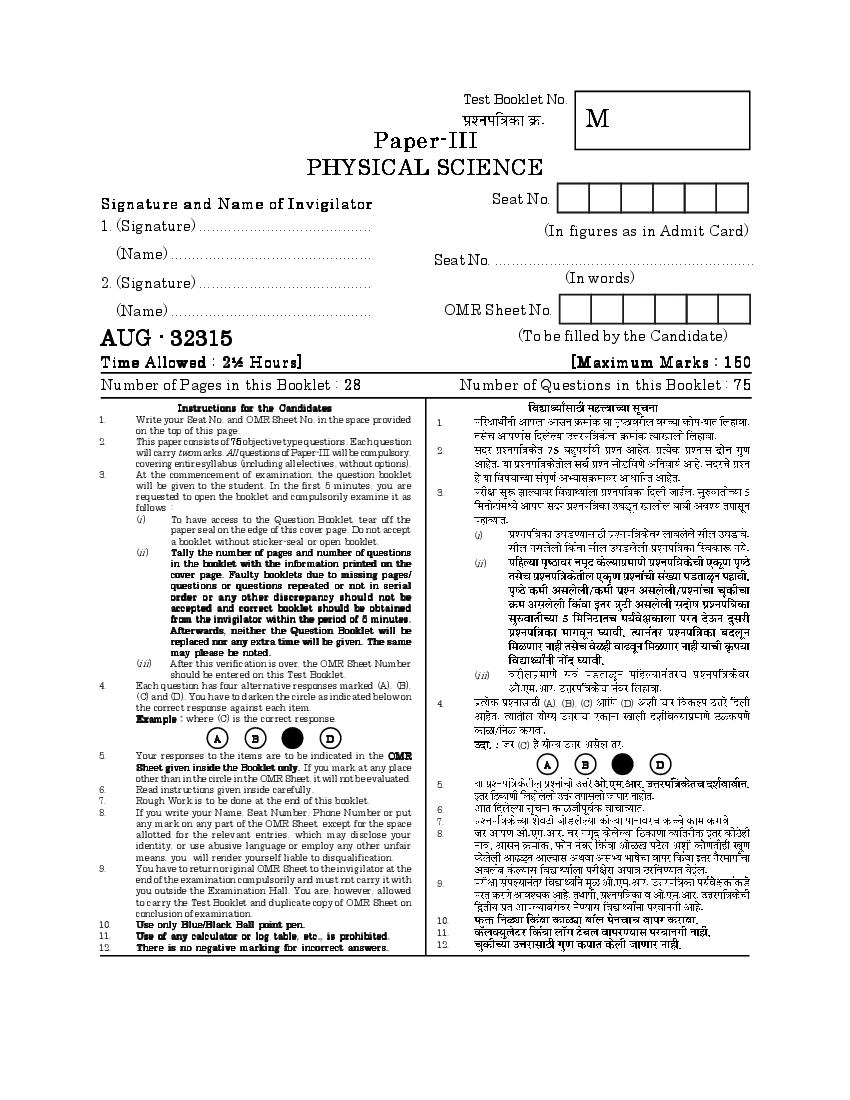
M
PHYSICAL SCIENCE
Signature and Name of Invigilator Seat No.
1. (Signature) ......................................... (In figures as in Admit Card)
(Name) ................................................ Seat No. ..............................................................
2. (Signature) ......................................... (In words)
(Name) ................................................ OMR Sheet No.
AUG - 32315 (To be filled by the Candidate)
Time Allowed : 2½ Hours] [Maximum Marks : 150
Number of Pages in this Booklet : 28 Number of Questions in this Booklet : 75
Instructions for the Candidates
1. Write your Seat No. and OMR Sheet No. in the space provided 1.
on the top of this page.
2. This paper consists of 75 objective type questions. Each question
will carry two marks. All questions of Paper-III will be compulsory, 2.
covering entire syllabus (including all electives, without options).
3. At the commencement of examination, the question booklet
will be given to the student. In the first 5 minutes, you are
requested to open the booklet and compulsorily examine it as 3.
follows :
(i) To have access to the Question Booklet, tear off the
paper seal on the edge of this cover page. Do not accept
(i)
a booklet without sticker-seal or open booklet.
(ii) Tally the number of pages and number of questions
in the booklet with the information printed on the (ii)
cover page. Faulty booklets due to missing pages/
questions or questions repeated or not in serial
o rder or any other discre pancy should not be
accepted and correct booklet should be obtained
from the invigilator within the period of 5 minutes.
Afterwards, neither the Question Booklet will be
replaced nor any extra time will be given. The same
may please be noted.
(iii) After this verification is over, the OMR Sheet Number
should be entered on this Test Booklet. (iii)
4. Each question has four alternative responses marked (A), (B),
(C) and (D). You have to darken the circle as indicated below on
the correct response against each item. 4. (A), (B), (C) (D)
Example : where (C) is the correct response.
A B D
(C)
5. Your responses to the items are to be indicated in the OMR
Sheet given inside the Booklet only. If you mark at any place A B D
other than in the circle in the OMR Sheet, it will not be evaluated.
5.
6. Read instructions given inside carefully.
7. Rough Work is to be done at the end of this booklet.
8. If you write your Name, Seat Number, Phone Number or put 6.
any mark on any part of the OMR Sheet, except for the space 7.
allotted for the relevant entries, which may disclose your 8.
identity, or use abusive language or employ any other unfair
means, you will render yourself liable to disqualification.
9. You have to return original OMR Sheet to the invigilator at the
end of the examination compulsorily and must not carry it with 9.
you outside the Examination Hall. You are, however, allowed
to carry the Test Booklet and duplicate copy of OMR Sheet on
conclusion of examination.
10. Use only Blue/Black Ball point pen. 10.
11. Use of any calculator or log table, etc., is prohibited. 11.
12. There is no negative marking for incorrect answers. 12.
Page 2
Page 3
Paper III
Time Allowed : 2½ Hours] [Maximum Marks : 150
Note : This Paper contains Seventy Five (75) multiple choice questions, each
question carrying Two (2) marks. Attempt All questions.
1. The area of the triangle whose base 3. The eigenvalues of the matrix :
is given by a 5 iˆ 3 ˆj 4 kˆ and
1 2 3
b ˆj kˆ is another side is :
0 4 7
(A) 50 / 2
0 0 3
(B) 61 / 2
are :
(C) 14 / 2
(A) 1, 4, 3
(D) 51 / 2
(B) 3, 7, 3
2. The value of the integral (C) 7, 3, 2
x2 (D) 1, 2, 3
e
dx
x
2
a
2 4. Linearly independent solution of the
0
differential equation
is :
d2y dy
2 2
3 2y 0
(A) ea dx dx
2a
are :
2
a
(B) e (A) e x , e 2 x
2a
2 2 (B) e x , e2 x
(C) e a
a
(C) e 2 x , e x
2 a
(D) e (D) e2 x , e x
a
3 [P.T.O.
Page 4
5. The centre of the circle
of gyration 40 cm is rotating at 300
zz (2 3 i) z (2 3i) z 1 0 rpm. Its kinetic energy is :
(A) 470 J
is :
(B) 47 J
(A) (2, 3)
(C) 4.7 J
(B) (3, 2) (D) 0.47 J
(C) (–2, –3) 8. Ideal Atwood machine is nothing but
an inextensible string of negligible
(D) (4, 0) mass going around the fixed pulley
with masses m1 and m2 attached to
6. Fourier transform of the function
the ends of the string. If m1 > m2,
f (x) exp ( | x | ) then the magnitude of acceleration
of mass m1 is............... .
is :
m1 g
1 2 (A) (m
(A) 1 m2 )
2 1 k2
m2g
(B) 0 (B) (m m2 )
1
1 1 (m 1 m 2 ) g
(C) 2 (C)
k (m 1 m 2 )
1 1 (D) g
(D)
2 1 k2
4
Page 5
an elliptic orbit with length of major
oscillator with generalised
axis equal to 1.524 times that of the
coordinate q is subjected to an
Earth. The time of revolution of the
additional potential energy of the
planet about the Sun is................. .
form (A) 1 year
(B) 10.24 year
2 2
V(t ) q t qqt
(C) 0.5315 year
The Lagrange’s equation of motion (D) 1.8814 year
of the oscillator due to the extra 11. A particle is released from a large
height h, at a location with latitude
potential will contain :
. At the time of striking the ground,
(A) an extra term proportional to t
the horizontal deflection that occurs
due to Coriolis force, is proportional
(B) an extra term proportional to t2
to................. .
(C) an extra term proportional to
(A) sin
(t + t2) (B) cos
(C) sec
(D) no extra term
(D) cosec
5 [P.T.O.
Page 6
accelerated. Its relativistic mass is magnitude ‘q’ are kept ‘d’ distance
2m0 when its speed is.................. . apart along X-axis. Now, the electric
(A) c field at a distance z(z >> d) above
c 3 the midpoint between two charges
(B)
2
is given by :
(C) c 3
(D) 2c | E|
13. Twelve equal charges of magnitude
q are kept at the corners of a regular
12-sided polygon one at each of the
corner. What is the net force on a
test charge Q at the center of the
polygon at distance r ?
1 2q
(A) Ez = 4 .
(A) Zero 0 z2
2
1 12 q Q 1 q
(B) 4 (B) Ez = 2
r2 4 0 z
0
1 6 qQ 1 2q
(C) 4 2 (C) Ez = 4 3 /2
0 r 0 r
1 qQ 1 2q
(D) Ez = 4 .
(D) 4 r )2
0 r2 0 (2
6
Page 7
15. Poynting’s vector represents which
magnetic fields E 0 , B0 and
of the following quantities ?
frequency enters in a conducting
(A) Current density vector bar of conductivity along z-axis.
Which of the following pairs of
producing electrostatic field
equations best represents the
(B) Power density vector producing propagating wave ? ( k wave
number)
electromagnetic field
(A) E( z, t ) E 0 e ik z · ei ( k z t ) . x̂ and
(C) Current density vector k
B( z, t ) E 0 e ik z . ei ( k z t )
yˆ
producing electromagnetic (B) E( z, t ) E 0 . e k z ei ( k z t)
x̂ and
k
B( z, t ) E 0 e k z xˆ ei ( k z t )
. yˆ
field
k kz i ( kz t)
(C) E( z , t ) E0 e e xˆ and
(D) Power density vector producing
k
B( z, t ) E 0 e ik z ei ( k z t )
yˆ
electrostatic and magnetostatic k
(D) E( z, t ) E 0 e k z e i( k z t)
xˆ and
fields
B( z, t ) E 0 e k z e i ( kz t )
yˆ
7 [P.T.O.
Page 8
17. The magnetic field due to the TE11
length l aligned along the z-axis is
mode in a rectangular wave guide
used to generate electromagnetic
aligned along Z-axis is given by
waves. Initially it was operated at
frequency 10 MHz and its power
Hz = H1cos(0.5 x) cos (0.6 y)
along the equatorial plane at certain
where x and y are in cm. Then
distance d (d >> l) was measured as
dimensions of the rectangular wave P 1. Later, the same dipole was
operated at frequency 40 MHz and
guide a and b , respectively,
power P2 was measured at the same
are :
point. How do you compare the two
powers ?
(A) 2.00 cm and 1.66 cm
(A) P2 = 256 P1
(B) 1.66 cm and 2.66 cm
(B) P2 = 64 P1
(C) 2.54 cm and 1.66 cm
(C) P2 = 128 P1
(D) 1.66 cm and 1.25 cm (D) P2 = 16 P1
8
Page 9
observed in gases is well represented potential situated at x = 0, the wave
function of the bound state is given
by the Cauchy’s formula. The
by :
refractive index of the medium in
(A) (x) = e– x
such case is given as n =
(B) (x) = e– |x|
AB
1 A+ . ( wavelength of 2
(x) = e– x
2
(C)
light in air) (D) (x) = sin x
What does the terms A and B where is positive constant of
respectively represent ? appropriate dimensions.
21. The spin part of two electron wave
(A) Coefficients of refraction and
function is described as a triplet
dispersion
state. The space part of the wave
(B) Coefficients of dispersion and
fu n ct i on i s gi ven by ( 1 and 2 are
refraction
two different functions) :
(C) Coefficients of dispersion and
(A) 1(r1) 2(r2)
polarization
(B) 1(r1) 2(r2) – 2(r1) 1(r1)
(D) Coefficients of refraction and (C) 1(r1) 2(r2) + 2(r1) 1(r2)
scattering (D) 1(r1) 1(r2) + 2(r1) 1(r2)
9 [P.T.O.
Page 10
23. The wave function for identical
symmetric potential has zero
fermions is antisymmetric under
uncertainty in simultaneous
particle exchange. Which of the
measurement of operators Lx and
L y. Which of the following following is a consequence of this
statements is true ?
property ?
(A) The state must be l = 0 state
(A) Heisenberg’s uncertainty
(B) Such a state can never exist as
principle
operators L x and Ly do not
commute (B) Bohr correspondence principle
(C) The state has l = 1 with m = 0
(C) Bose-Einstein condensation
(D) The state cannot be an
(D) Pauli exclusion principle
eigenstate of L2 operator
10
Page 11
is radiated by an electron in an
described by the wave function
Hydrogen atom, when the electron
wave function changes from 1 to
1 0 0 3
( , ) = {5 Y4 Y6 2Y6 }
30
2, is forbidden if 1 and 2 :
(A) have opposite parity
where Ylm are spherical harmonics.
(B) are both spherically symmetric
The probability of finding the system (C) are orthogonal to one another
(D) are zero at the center of the
in a state with m = 0 is :
atom
26. In 3S state of the Helium atom, the
(A) zero
possible values of the total electronic
6 angular momentum quantum
(B)
30
numbers are :
6 (A) 0(zero) only
(C)
30
(B) 1 only
13
(D) (C) 0, 1 and 2
15
(D) 0 and 1 only
11 [P.T.O.
Page 12
29. In a counting experiment to
1/2 ) are kept in a one-dimensional
infinite potential well with width a.
determine the statistics obeyed by
(Ground state energy of single
2 2
electron in well = 2 ) the particles emitted by a
2ma
The first absorption line corresponds
to energy : radioactive substance, the number
2 2 2 2
5
(A) (B) of particles counted in 50 seconds
2m a 2 2m a 2
7 2 2 11
2 2
(C) (D) time interval was repeatedly
2 m a2 2m a 2
28. Using the Clausius-Clapeyron
measured 100 times. The statistical
equation, the change in melting
point of ice for 1 atmosphere rise in ensemble in this case consists of the
pressure is :
following number of members :
(Given : The latent heat of fusion
for water at 0°C is 3·35 × 10 5 J/kg,
(A) 50
the volume of ice is 1.09070 cc/g and
the volume of water is 1.00013
(B) 100
cc/gm) :
(A) –0·0075°C
(C) 5000
(B) 0·0075°C
(C) 0·075°C
(D) 2
(D) –0·075°C
12
Page 13
quantum mechanical harmonic
polyatomic molecules. Each molecule
oscillator in thermal equilibrium
consists of n atoms. At high
with a heat reservoir at temperature
temperatures the vibrational
T is given by :
contribution to the specific heat
e
is : (A)
1 e
e
(A) (3 n 5) k N (B)
1 e
kN /2
e
(B) (3 n 5) (C)
2 1 e
/2
(C) (3 n 6) k N e
(D)
1 e
kN
(D) (3 n 6)
2 where kT
13 [P.T.O.
Page 14
are placed in 3 energy states such structure the following diffraction
that 2 particles are in the first state, peaks may be observed in the X-ray
diffraction experiment :
12 in the second state and 1 in the
third state. The number of district (A) (110), (330)
arrangements are : (B) (111), (321)
(A) 1365 (C) (100), (321)
(B) 15 (D) (111), (331)
(C) 455 35. NaI(Tl) scintillation detector is used
only for the detection of gamma
(D) 3 15
radiation because :
33. The critical temperature for the
(A) it has large scattering cross-
Bose-Einstein condensation depends
section
on the density of particles as :
(B) it has small Compton scattering
(A) n 1/3
(C) it has small absorption cross-
(B) n 2/3
section
(C) n
(D) it has large absorption cross-
(D) n 1/2 section
14
Page 15
36. The output of a laser has a pulse
crystal planes having ‘d’ equal to
0.18 nm, a first order reflection is
width of 30 ms and average output
found to be at an angle of 12°. The
power of 0.6 watt per pulse. If the wavelength of X-ray used is [Given :
sin 12° = 0.2079]
wavelength of the laser light is 640
(A) 0·1543 nm
(B) 0·0749 nm
nm. How many photon does each
(C) 0·0374 nm
(D) 0·749 nm
pulse contain ?
38. Load regulation is determined by :
(A) Changes in load current and
(A) 2.9 × 10¹⁸
output voltage
(B) Changes in load current and
(B) 3.5 × 10¹⁸
input voltage
(C) Changes in load resistance and
(C) 5.8 × 10¹⁵
input voltage
(D) Changes in zener current and
(D) 6.5 × 10¹⁶
load current
15 [P.T.O.
Page 16
39. In the circuit given below what is
appear as output from :
(A) A 3-input NAND gate followed
the approximate ac voltage across
by an inverter
the output resistor : (B) A 3-input XOR gate followed by
an inverter
(C) A 3-input NOR gate followed by
an inverter
(D) An inverter followed by 3-input
NOR gate
41. In the following circuit the current
through the load resistance is :
(A) 15 mV
(B) 150 mV
(A) 10 mA
(C) 150 µV (B) 1 mA
(C) 5 mA
(D) 15 V
(D) 0.5 mA
16
Page 17
clipping level is :
defined as :
(A) I mVm/IscVoc
(B) ImVoc/VmIsc
(C) IscVoc/ImVm
(A) + 25 V
(D) IscVm/ImVoc
(B) – 25 V
(C) – 5 V
43. The resonant frequency of a Hartley
(D) + 5 V
oscillator with L1 = 12 µH, L2 = 45. In an open loop differential
operational amplifier having a gain
8 µH and C = 1000 PF is :
of A = 2 × 10⁵ receives inputs as
(A) 1.12 MHz at non-inverting terminal 5 µV and
at inverting terminal –7 µV, then
(B) 11.2 MHz the output is :
(A) 2.4 V
(C) 11.2 kHz
(B) 0.24 V
(C) 2.4 mV
(D) 112 kHz
(D) 2.4 µV
17 [P.T.O.
Page 18
corresponding to the ground state
adders required to add 16-bit
electronic configuration of Boron
numbers is :
(z = 5) are :
(A) 1 HA and 15 FA
(A) L = 1, S = 1/2, J = 3/2
(B) 8 HA and 08 FA (B) L = 1, S = 1/2, J = 1/2
(C) 16 HA and 0 FA (C) L = 1, S = 3/2, J = 1/2
(D) L = 0, S = 3/2, J = 3/2
(D) 4 HA and 12 FA
49. The number of fundamental
47. A carrier is simultaneously
vibrational modes of CO2 molecule
modulated by two sine waves with
is :
modulation indices of 0.3 and 0.4;
(A) 4 : 2 Raman active and 2 IR
then the total modulation index active
is :
(B) 4 : 1 Raman active and 3 IR
(A) 1 active
(C) 3 : 1 Raman active and 2 IR
(B) 0.1
active
(C) 0.5
(D) 3 : 2 Raman active and 1 IR
(D) 0.35 active
18
Page 19
divalent Manganese ion is 3d54s0.
placed in a magnetic field of 1.0 tesla,
The ground state of this ion is
the resonance frequency (in units of
characterized by the spectroscopic
MHz) of the signal observed for this term :
nucleus in the NMR spectrometer (A) 6S 5/2
(B) 2D5/2
is :
(C) 2F 5/2
(Given : gN = 5.256, µN = 5.0504 ×
(D) 6H5/2
10–27 J/T; the subscript N refers to
52. The 623.8 nm radiation emitted by
the nuclear factors)
a He-Ne laser is due to the transition
between :
(A) 30 MHz
(A) 3s and 2p levels of Ne
(B) 90 MHz
(B) 3s and 3p levels of Ne
(C) 40 MHz
(C) 2p and 2s levels of Ne
(D) 5.0 MHz (D) 2p and 1s levels of Ne
19 [P.T.O.
Page 20
53. In the Stern-Gerlach experiment,
second from a 1 watt Ar-ion laser
the number of components in which
operating at 488 nm is
the atomic beam splits depends upon
approximately :
the value of :
(A) 10.23 × 10¹⁹
(A) l (B) 2.46 × 10¹⁸
(B) s (C) 10.23 × 10¹⁷
(D) 2.46 × 10¹⁵
(C) j
56. The “Normal” and “Anomalous”
(D) m l
Zeeman effects are observed when
54. The Lande’s splitting factor for the (here S' is the total spin angular
momentum due to the coupling of
atomic state 2P3/2 is :
individual spin angular momenta).
(A) 1/3
(A) S' = 0 and S' 0, respectively
(B) 2/3
(B) S' = 0 and S' 0, respectively
(C) 1 (C) S' 0 and S' 0, respectively
(D) 4/3 (D) S' 0 and S' 0, respectively
20
Page 21
57. Metallic nickel crystallizes in fcc-
between inert gas atoms varies with
type structure with lattice
interatomic separation (R) as :
1
(A) 2
R
constant a. The interplanar
1
(B)
R3
distance between the diffracting 1
(C)
R6
1
(D)
R 12
planes (220) in this material is :
59. If the concentration of Schottky
(A)
a defects in a fcc crystal is 1 in 1010
2 2
at 300°K, the energy of formation in
a eV of Schottky defects will be :
(B)
2
(A) 0.60
3
(C) .a
2 (B) 0.50
(C) 0.40
a
(D)
2
(D) 1.0
21 [P.T.O.
Page 22
60. Consider the elastic vibrations of a
frequency for copper is 6.55 × 10¹²
crystal with two atoms per primitive Hz, the Debye temperature for
copper is :
cell having masses m and M (M > m). (A) 200 K
(B) 314.5 K
Using dispersion relation between
(C) 405 K
the angular frequency ( ) and wave
(D) 150 K
vector (K), find the frequency for 62. The energy of an electron in an
energy band as a function of its wave
acoustic branch at K = 0 : vector k is given by
1 /2
E( k ) E0 B(cos k x a cos k y a cos k z a );
2C
(A) Ka
m M where E0, B and a are constants.
The effective mass of the electron
1 /2
2C
(B) 2K a near the bottom of the band is :
m M
(A) 2 2 / 3Ba 2
1 /2
1 2C
(C) Ka (B) 2
2 m M / 3Ba 2
(C) 2
/ 2Ba 2
1/2
1 2C
(D) Ka
2 M (D) 2
/ Ba 2
22
Page 23
dielectric constant = 12 and it aluminium is 7.9 × 10³ A/m, the
contains 5 × 10¹⁸ atoms/m3. Its critical current which can flow
electronic polarizability in units of through long thin superconducting
FM2 is : wire of aluminium of diameter
(A) 4.17 × 10⁻³⁰ is :
(B) 8.34 × 10⁻³⁰ (A) 5.1 A
(C) 6.32 × 10⁻³⁰ (B) 1.6 A
(D) 12.64 × 10⁻³⁰ (C) 4.0 A
64. Magnetite (Fe 3 O 4 ) has a cubic (D) 2.48 A
structure with a lattice constant of
66. Deviation from Rutherford
8.4 Å. The saturation magnetization
scattering formula for -particle
in this material in units of A/m
scattering gives an estimate of :
is :
(A) size of an atom
(A) 6.2 × 10⁵
(B) thickness of target
(B) 6.2 × 10⁶
(C) size of a nucleus
(C) 12.4 × 10⁶
(D) half life of -emitter
(D) 12.4 × 10⁵
23 [P.T.O.
Page 24
nuclei can be understood using
tube must have the following
Coulomb energy difference. This
property :
indicates that :
(A) Nuclear force is spin dependent (A) Ionisation potential should be
(B) Nuclear force is strong force equal to the main counting gas
(C) Nuclear force is as strong as in the tube
Coulomb force
(B) Ionisation potential should be
(D) Nuclear force is charge
higher than that of the main
independent
counting gas in the tube
68. Find the half value thickness in
aluminium for beta particle of (C) It must have very narrow
energy 1.17 MeV : ultraviolet absorption bands
(A) 0.014 m
(D) When in an excited state it
(B) 0.016 m
must prefer to dissociate rather
(C) 0.020 m
than to de-excite by the
(D) 0.025 m
emission of photon
24
Page 25
70. State the following decay mode in
gamma ray transitions between the
the category of allowed, forbidden following states of odd ‘A’ nuclei :
and Fermi or Gammow-Teller g9 /2 P1/ 2
(A) M4 and E5
transition :
(B) M1 and E2
(C) M3 and E4
(D) M6 and E7
72. According to the liquid drop model,
the occurrence of fission is due to
competition between :
(A) Fermi transition and allowed (A) Surface energy term and
symmetry energy term
(B) Fermi transition and second
(B) Surface energy term and
forbidden
Coulomb energy term
(C) G-T transition and allowed (C) Volume energy term and
surface energy term
(D) G-T transition and third
(D) Volume energy term and
forbidden Coulomb energy term
25 [P.T.O.
Page 26
73. Based on the additive quantum
corresponding lifetimes of hadronic
numbers such as Lepton number,
decay, electromagnetic decay and
Baryon number, charge of the weak decay :
(A) 10–9 sec, 10–6 sec, 10–3 sec
Particle and Isospin, indicate the
(B) 10–12 sec, 10–9 sec, 10–6 sec
following nuclear reaction cannot be
(C) 10–15 sec, 10–13 sec, 10–6 sec
induced with the following
(D) 10–23 sec, 10–18 sec, 10–10 sec
combination :
75. Parity non-conservation was
n p e !e established in -decay when it was
observed that from polarised Co60
(A) Q, B are conserved, but I3, L nuclei :
are not conserved (A) Electrons were emitted equally
in all directions
(B) Q, B, L are conserved, but I 3
(B) More electrons were emitted in
is not conserved direction opposite to that of
magnetic field
(C) Q, B, I3 are conserved, but L
(C) Electrons were not emitted in
is not conserved
any direction
(D) B, I3, L are conserved, but Q (D) More electrons were emitted
perpendicular to the direction of
is not conserved
magnetic field
26
Page 27
27 [P.T.O.
Page 28
28
Document Details
| Board / Org | Maharashtra Exams |
| Exam | MAHA SET |
| Type | Question Paper |
| Pages | 28 |
| Updated | 30 Apr 2026 |