Page 1
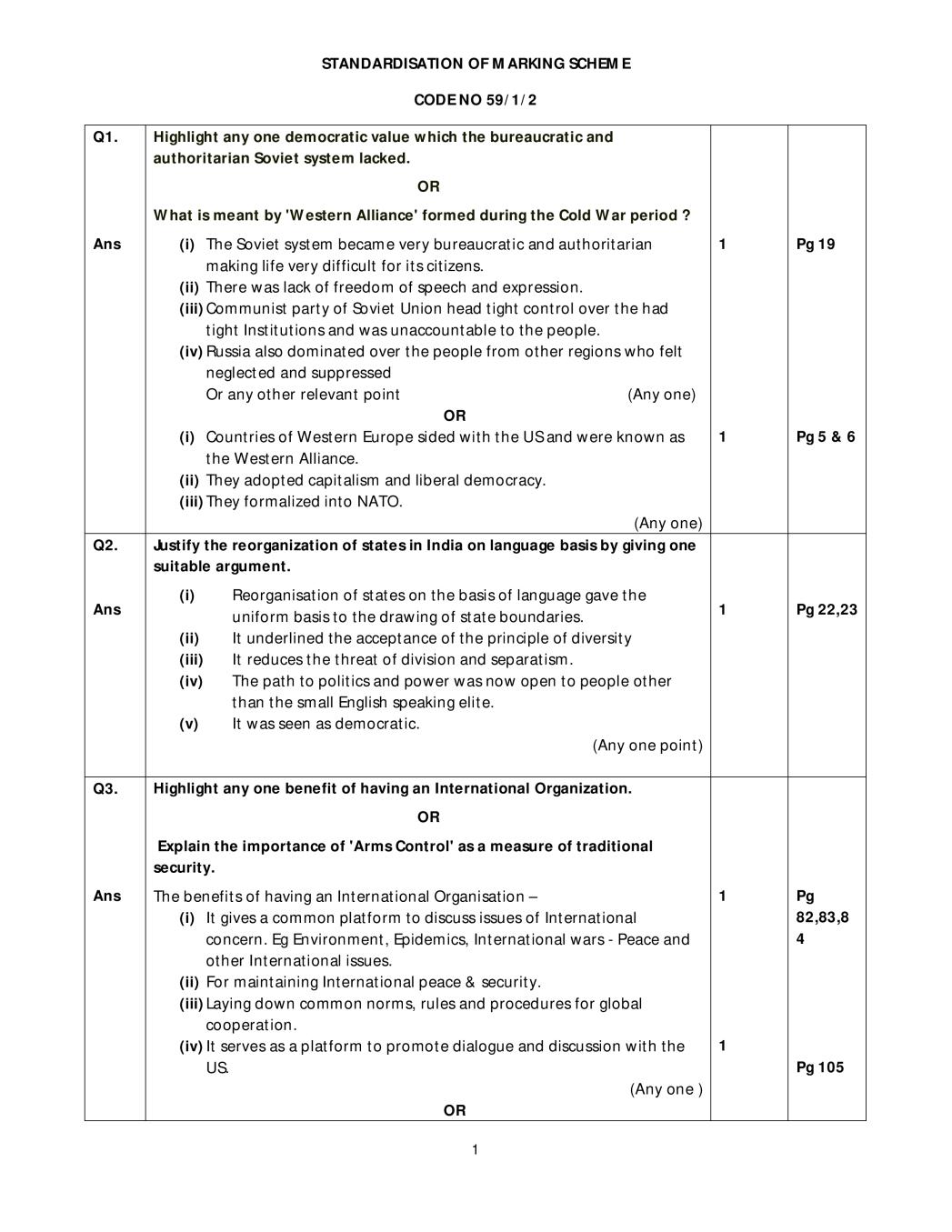
Q1. Highlight any one democratic value which the bureaucratic and
authoritarian Soviet system lacked.
OR
What is meant by 'Western Alliance' formed during the Cold War period ?
Ans (i) The Soviet system became very bureaucratic and authoritarian 1 Pg 19
making life very difficult for its citizens.
(ii) There was lack of freedom of speech and expression.
(iii) Communist party of Soviet Union head tight control over the had
tight Institutions and was unaccountable to the people.
(iv) Russia also dominated over the people from other regions who felt
neglected and suppressed
Or any other relevant point (Any one)
OR
(i) Countries of Western Europe sided with the US and were known as 1 Pg 5 & 6
the Western Alliance.
(ii) They adopted capitalism and liberal democracy.
(iii) They formalized into NATO.
(Any one)
Q2. Justify the reorganization of states in India on language basis by giving one
suitable argument.
(i) Reorganisation of states on the basis of language gave the
Ans uniform basis to the drawing of state boundaries. 1 Pg 22,23
(ii) It underlined the acceptance of the principle of diversity
(iii) It reduces the threat of division and separatism.
(iv) The path to politics and power was now open to people other
than the small English speaking elite.
(v) It was seen as democratic.
(Any one point)
Q3. Highlight any one benefit of having an International Organization.
OR
Explain the importance of 'Arms Control' as a measure of traditional
security.
Ans The benefits of having an International Organisation – 1 Pg
(i) It gives a common platform to discuss issues of International 82,83,8
concern. Eg Environment, Epidemics, International wars - Peace and 4
other International issues.
(ii) For maintaining International peace & security.
(iii) Laying down common norms, rules and procedures for global
cooperation.
(iv) It serves as a platform to promote dialogue and discussion with the 1
US. Pg 105
(Any one )
OR
1
Page 2
Arms control regulates the acquisition or development of weapons.
Eg : ABM (Anti- Ballistic Missile Treaty), NPT(Nuclear Non -
Proliferation Treaty) etc
Or any other relevant treaty.
Q4. Which one of the following statements related to the Iraq invasion by the
US is incorrect ?
(a) More than forty other countries were involved in this invasion.
(b) The UN had given consent to invade Iraq.
(c) The invasion was to prevent Iraq from developing weapons of mass
destruction.
(d) The US lost over 3000 military personnel in this war.
Ans b) The UN had given consent to invade Iraq. 1 Pg 37
Q5. Identify any one similarity between the United Front Government of 1996
and the National Front Government of 1989.
(i) Both were coalition governments.
Ans
(ii) In 1989 both the left and the BJP supported the National Front 1
Government as they wanted to keep the Congress out of power. In Pg 177
1996 left continued to support the Non- Congress Government but
this time the Congress, supported it, both the Congress and the left
wanted to keep the BJP out of power.
Or any other relevant point. ( Any One)
SECTION – B
Q6. Mention any two reasons for the disintegration of the Soviet Union.
Ans
Two reasons for the disintergration of the USSR were – 1X2=2 Pg 20 &
(i) Internal weaknesses of the Soviet political and economic Institutions. 21
(ii) Economic stagnation leading to consumer shortages.
(iii) Rampant corruption and inability of the system to correct mistakes.
(iv) Communist party has become very authoritarian and bureaucratic.
(v) Rise of nationalism and desire for sovereignty within various
republics including Russia and the Baltic republics Gorbachev's role in
producing reforms.
(Any two points)
Q7. Match the following in 'Column A' with those in 'Column B’ in a meaningful
way.
Column 'A' Column 'B'
(I) Chipko Movement (a) Maharashtra
(II) Narmada Bachao Aandolan (b) Uttarakhand
2
Page 3
(III) Dalit Panthers Movement (c) Andhra Pradesh
(IV) Anti-Arrack Movement (d) Gujarat
4X ½ =2 Pg 152
Ans Match column A with Column B
Column A Column B
1. Chipko Movement b) Uttarkhand
2. Narmada Bachao Aandolan d) Gujarat
3. Dalit Panthers Movement a) Maharashtra
4. Anti – Arrack Movement c) Andhra Pradesh
Q8. Suggest any two measures to improve relations between India and
Pakistan.
OR
How did the Sino - Indian conflict of 1962 affect the Communist Party of
India?
Ans Measures to improve relations with Pakistan : 2X1=2 Pg 78
(i) People to people contact can be encouraged.
(ii) Trade should be encouraged.
(iii) Negotiations to be held to resolve various issues of conflict.
(iv) Visas to be given more freely.
(v) Confidence building measures should be undertaken to reduce the
risk of war.
(vi) Social activists and prominent personalities must collaborate to
create an atmosphere of friendship.
(vii) More bus and rail routes be opened between the two countries to
develop a better transport & communication.
(Or any other relevant point) (Any Two)
OR
It created irreconcilable differences between the Communist Party of 2 Pg 73
India(CPI)
Pro – USSR faction remained within the CPI.The other faction wanted
closer ties with China and was against any ties with Congress.
The party split in 1964 and the Communist Party of India (Marxist)
was created.
Many leaders of CPI (M) were arrested for being Pro – China.
Q9. Analyse the thesis propounded by E.V. Ramaswami Naicker popularly
known as Periyar.
EV Ramaswamy Naicker propounded the thesis that north Indians and
Ans Brahmins are Aryans. He was opposed to Hindi and domination of North 2 Pg 152
India.
He opposed the Brahmin dominance and asserted regional Pride against the
political economic and cultural domination of the north.
Or any other relevant point.
Q10. Evaluate the impact of national emergency declared in June, 1975.
OR
3
Page 4
Assess the role played by 'defections' on Indian politics.
Impact of National Emergency
Ans (i) Fundamental Rights of the citizens were suspended.
(ii) It led to the censorship of Press. 2 X1=2 Pg 112,
(iii) It restricted the freedom of speech & expressions. 113 &
(iv) It led to misuse of Preventive Detention and arrest of leaders of the 117
opposition.
(v) Misuse of power by bureaucracy and police officials.
(vi) It also led to controversial amendments to the Constitutional
provisions.
(vii) Misuse of power by people not in authority.
(viii) Brought out the weakness & strengths of India’s democracy.
(ix) It highlighted the ambiguities regarding the emergency provisions
within the constitution.
Or any other relevant point (Any two points)
OR
(i) This leads to political instability and fall of government.
(ii) Larger Ministries to appease leaders for support. 2 X1=2 Pg 91
(iii) lack of support to party ideology for personal benefits.
(iv) ‘Aya Ram Gaya Ram’ may be given as an example.
(Or any other relevant point)
(Any two points )
SECTION – C
Q11. Analyse the Nuclear policy of India.
OR
Analyse any two causes of conflict between India and China
Ans The Nuclear Policy of India 2X2=4 Pg 78,79
(i) India was in favour of using atomic energy for peaceful purposes.
(ii) India refused to sign CTBT & NPT as it considers NPT as
discriminatory.
(iii) India’s nuclear policy was to protect its boundaries and there was
consensus among political parties on it.
(iv) India would like complete elimination of Nuclear weapons
(v) India has declared a unilateral no first use of Nuclear weapons.
(vi) India conducted the first Nuclear Test at Pokhran and declared it
for peaceful purposes
(vii) While the second Pokhran Test was for increasing India’s military
capabilities.
(Any Two)
OR Pg 72
Any two causes of conflict between India and China: 2X2=4 Book2
(i) Border issue especially in Arunachal Pradesh and Aksai Chin.
(ii) Tension over India providing asylum to Dalai Lama
(iii) China’s close relations with Pakistan and helping them with their
Nuclear programme.
4
Page 5
(iv) China’s support to Pakistan in the UN.
(Any Two)
Q12. Explain any two constraints on the American hegemony.
OR
Explain any two factors that have contributed to Pakistan's failure in
building a stable democracy.
Ans Constraints on the American hegemony : 2X2=4 Pg 44
(i) Institutional architecture of the American state itself.
(ii) Open nature of the American society and free press and mass
media
(iii) Organisation of NATO
(Any two points to be explained)
OR
Factors that contributed to Pakistan is failure in building a stable
democracy – 2x 2= 4 Pg 69
(i) The social dominance of the military, clergy and land- owning
aristocracy has led to the frequent overthrow of elected
governments and the establishment of military government.
(ii) Pakistan conflict with India has made the pro- military groups
more powerful and has justified the army’s stay in power.
(iii) The United States and other Western countries have encouraged
the military’s authoritarian rule due to fear of ‘ Global Islamic
Terrorism’ and fear that Pakistan’s nuclear arsenal might fall into
the hands of the terrorist groups.
(Any Two)
Q13. Explain any two arguments given by the advocates of economic
globalization.
Ans Advocates of economic globalisation argue :
2X2=4 Pg 142
(i) Globalisation involves greater economic flows among different
countries of the world.
(ii) This flow or exchange can take various forms: flow of commodities, Book 1
Capital ,people and ideas.
(iii) It generates greater economic growth and well-being.
(iv) Greater trade allows each economy to do what it does best.
(v) They also say that economic globalisation is inevitable and it is not
wise to reset the march of history.
(vi) Society benefits when there is De- regulations.
Or any other Relevant points. (Any two)
Q14. Describe any four features of the ideology followed by Swatantra Party
founded in 1959.
Features of the ideology of Swatantra Party :
Ans
5
Page 6
(i) It wanted less government control in the economy. 4X1=4 Pg 41
(ii) Prosperity would come only from individual freedom.
(iii) It was critical of centralised planning and Nationalisation of public
sector.
(iv) They wanted a free private sector.
(v) They were against land ceiling, Cooperative farming and States
trading.
(vi) They were against license regime.
(vii) They were against NAM and wanted close ties with the US.
(Any Four Points)
Q15. Describe any four criteria that have been proposed in recent years for new
permanent and non-permanent members of the U.N. Security Council.
OR
Describe any four new sources of threats to non-traditional security
Criteria proposed for new permanent and non permanent members of the 4X1=4 Pg 89
Ans UN Security Council.
(i) A major Economic Power
(ii) A major Military Power
(iii) A substantial contributor to the UN budget
(iv) A big nation in terms of its population
(v) A nation that respects democracy and human rights.
(vi) A country that would make the Council more representative of
the World’s diversity in terms of geography, economic systems &
culture. (Any Four
points)
OR
New Sources of threat to Non – traditional security – 4X1=4 Pg 107-
(i) Terrorism 111
(ii) Human Rights violation
(iii) Global Poverty
(iv) Migration
(v) Health Epidemics
Or any other relevant point (Any four points to be explained)
Q16. What is meant by ‘Privy Purse ? Evaluate the role played by Indira Gandhi
in the abolition of privy purses.
Ans Meaning of Privy Purse
1+3=4
At the time of integration of the princely states with the Indian Union an Pg 94
assurance was given to the ruler’s families that they would be allowed to Book II
retain certain private property and given a grant in hereditary or
government allowance measured on the basis of the extent of revenue and
potential of the merging State. This grant was the Privy Purse.
Role of Indira Gandhi in abolition of Privy Purse
6
Page 7
(i) Following the 1967 elections Indira Gandhi supported the demand
for abolishing the privy purses .
(ii) Indira Gandhi made it a major election issue and got a lot of public
support.
(iii) Finally after her massive victory in the 1971 election the Constitution
was amended to remove legal obstacles for the abolition of Privy
Purses.
SECTION - D
Q17. Study the cartoon given above carefully and answer the following
questions :
(i) Which part of this cartoon is related to China ?
(ii) Assess the strength of China on the basis of the cartoon.
(iii) "China may be the next superpower in the world." Justify the
statement with two arguments.
1X2=2 Pg 56
1X2=2
Pg 60
Ans (i) The Great Wall of China and the Dragon.
(ii)
a) China has been the fastest growing economy since reforms
started.
b) It is projected to overtake the US as the world's largest economy
by 2040 1+2+2
c) The strength of its economy, its population, land mass, political
resources ,regional location and political influence adds to its
power significantly. (Any two)
(iii) Arguments
a) China is becoming a great economic power projected to
overtake the US in 2040.
b) It is engine of East Asian growth thereby giving it enormous
influence in regional affairs
c) China has become the most important destination for foreign
direct investment FDI
d) It has the largest Foreign Exchange Reserves that allow it to
7
Page 8
make big investments in other countries and develop an
outward looking role.
e) Its entry in the WTO further helps to shape the future
economic order.
Or any other relevant point
(Any two)
For Visually Impaired Candidates : 1+2+2
17.1 In your opinion, where does China stand as an economic power?
17.2 Assess any two conditions which make the United States of America, a
super power.
17.3 “China may be the next superpower in the world.”.Justify the
statement with two arguments.
For Visually Impaired Candidates :
17.1 a)China has been the fastest growing economy since reforms started.
b) It is projected to overtake the US as the world's largest economy by
2040. (Any
one)
17.2 The United States of America has emerged as a super power due to its
a) Hard power hegemony – military domination
b) structural power hegemony – Economic power
c) Soft power hegemony – in the political and ideological spheres.
(Any two to be briefly explained)
17.3
a) China is becoming a great economic power projected to
overtake the US in 2040.
b) It is engine of East Asian growth thereby giving it enormous
influence in regional affairs
c) China has become the most important destination for foreign
direct investment FDI
d) It has the largest Foreign Exchange Reserves that allow it to
make big investments in other countries and develop an
outward looking role.
e) Its entry in the WTO further helps to shape the future
economic order .
Or Any other relevant point
(Any two)
Q18. Read the passage given below carefully and answer the questions that
follow:
India did not follow any of the two known paths to development......
Elements from both these models were taken and mixed together in India.
That is why Indian economy was described as 'mixed economy.
(i) Name the two models / paths to development.
(ii) Why was either of the two models not fully accepted by India ? Give
at least one major reason for each.
8
Page 9
(iii) Highlight any two features of India's mixed economy based on the
above said two models.
OR
Read the following passage and answer the questions given below :
India is not the only country to have experienced the dominance of one
party. If we look around the world, we find many other examples of one-
party dominance. But there is a crucial difference between these and the
Indian experience. In the rest of the cases the dominance of one party was
ensured by compromising democracy. In some countries like China, Cuba
and Syria the constitution permits only a single party to rule the country.
(i) Which political party dominated the political scene of India after
independence and how long ?
(ii) How did the one-party dominance in India differ from that of
China ?
Ans (iii) Highlight any two drawbacks of a single party rule. 1+2+2 Pg 49,50
(i) The two models/ paths of development were : the liberal Book –
capitalist model used in much of Europe and the Socialist model II
as used in the USSR.
(ii) a) Many in India were against the U.S system as there was a
consensus that development could not be left to private actors.
b) The government had to develop a design or plan for
development and alleviation of Poverty.
c) The socialist model was also not fully acceptable as India was a
developing nation, industrialist would have resisted.
d) Foreign aid was required for development
e) Non Aligned India wanted to balanced USA and USSR.
(Any Two)
(iii) Two features of India’s mixed economy were :
a) Big industries were under government control. Pg 35
b) Small industries were allowed in the Private Sector.
c) There was a public, private and joint sector.
d) Railways, airlines , steel and other heavy industries were 1+2+2
under public sector Agriculture trade and industrialist ware in
the Private Sector.
OR
1+2+2
(i) The Congress Party from 1947 till 1977
(ii) The one party dominance in India happened under democratic
conditions and elections that were held were free and fair where
as in China the Constitution only permits the presence of a single
party.
9
Page 10
(iii) One party rule can lead to
a) violation of rights
b) corruption and nepotism
c) lack of freedom of expression and political choice
d) Cabinet dictatorship
Or any other relevant Point
(Any Two)
Q19. Read the passage given below carefully and answer the question that
follow :
It is important to remember that India chose to involve other members of
the non-aligned group in this mission of reducing tension. During the Cold
War, India repeatedly tried to activate those regional and international
organizations, which were not a part of alliances led by the US and the
USSR. Nehru reposed great faith in ‘a genuine commonwealth of free and
co-operating nations' that would play a positive role in softening, if not
ending, the Cold War'.
(i) Explain the meaning of Cold War.
(ii) Explain India's response to then ongoing Cold War.
(iii) Highlight any two features of India's policy of Non-alignment.
OR
Read the following passage and answer the following questions : India has
maintained good relations with all the post-communist countries. But the
strongest relations are still those between Russia and India. India's
relations with Russia are an important aspect of India's foreign policy.
Indo-Russian relations are embedded in a history of trust and common
interests and are matched by popular perceptions. Indian heroes from Raj
Kapoor to Amitabh Bachchan are household names in Russia and many
post-Soviet countries. One can hear Hindi film songs all over the region,
and India is part of the popular memory.
(i) What is meant by the post-communist countries ?
(ii) Explain any two factors responsible for strong relations between
India and Russia.
(iii) How are India's relations with Russia an important aspect of
India's foreign policy? Pg 3
Ans
(i) Cold War referred to the competition, tension and a series of
confrontation between the United States and the Soviet Union
backed by their respective allies. It never escalated into a ‘hot
war’ ie a full scale war between these two super powers.
(ii) India’s response to the ongoing Cold war was two fold: Pg 12
a) At one level, it took care in staying away from the two
alliances.
b) On the other, It raised its voice against the newly
10
Page 11
decolonized countries becoming part of these alliances.
c) India adopted the policy of Non alignment which means it
did not join any military alliance and spoke on the basis of
merit of the issue. Pg 12
(Any two)
(iii) Features of India’s policy of Non- alignment :
a) India chose to stay away from the two military alliances led
by the USA and the USSR.
b) India chose to involve other members of the non- aligned
group in this mission of reducing tensions.
c) India repeatedly tried to activate those regional and
international organization which were not a part of alliances
led by the USA and the USSR.
d) Nehru reposed great faith in’ a genuine commonwealth of
free and cooperating nations’ that would play a positive role
in softening Cold War tensions.
e) India’s policy was neither negative nor passive .It was not a
policy of ‘fleeing away’ but actively participating in world
affairs to soften Cold War rivalries. Eg India mediated 1+2+2=
between the Cold War rivals such as in Korea War in the 5
early 1950’s.
f) India pursued as independent foreign policy and tried to Pg
serve its own national interest. 27,28,2
(Any two points) 9
OR
Ans (i) The Post Communist countries were the former Soviet republics
which gave up communism after undergoing the shock therapy.
(ii) Factors responsible for strong relations between India and Russia.
a) Russia and India share a vision of a multipolar World.
b) Bilateral agreements have been signed between Russia and
India as a part of the Indo – Russian strategic Agreement of
2001.
c) Russia supports India on issues like Kashmir, terrorism.
d) India is the second largest arms market for Russia.
e) Russia has come to India’s help during its oil crisis.
f) Russia is important for India’s nuclear energy plans and Pg 27
assisted India’s space Industry.
g) Russia and India have collaborated on various Scientific
projects.
(Any two points)
(iii) India’s relations with Russia are an important aspect of India’s
foreign policy because:
a) Indo – Russian relations are embedded in a history of trust, 1+2+2=
culture and common interests and are matched by popular 5
perceptions.
b) India is part of popular memory of the region.
11
Page 12
Or any other relevant point
(Any two points)
Q20. Read the passage given below carefully and answer the questions that
follow:
All proponents of human security agree that its primary goal is the
protection of individuals. However, there are differences about precisely
what threats individuals should be protected from. Proponents of the
‘narrow' concept of human security focus on violent threats to individuals.
(i) Which type of security is the main concern of 'human security?
(ii) What would you like to include under the 'broad' concept of human
security? Explain.
(iii) Identify any four threats from which individuals should be
protected.
Pg 106
Ans (i) Protection of Individuals
(ii) Protection of the life of individual from hunger, disease and Pg 107
natural disasters.
(iii) Threats from which individuals should be protected Pg 107-
110
Global warming
International Terrorism
Aids
Health Epidemics
Human Right Violations 1+2+2
Poverty and Hunger (Any four to be mentioned)
Q21. In the political outline map of India given above, five states have been
marked as (A), (B), (C), (D) and (E).
Identify these states on the basis of information given below and write
their correct names in your answer book along with the respective serial
number of the information used and the concerned alphabet in the Map as
per the following format.
(i) The state where a violent incident took place at Godhara in 2002.
(ii) The state which was earlier known as Madras.
(iii) The state which has the maximum number of seats in India in its
Legislative Assembly.
(iv) The state to which Laldenga belonged.
(v) The state which integrated with India in 1975 as 22nd State of India. 1X5=5
12
Page 13
Sr. No of the Concerned alphabet in Name of the state
information used the Map
1x5=5
(i) C Gujarat
(ii) E Tamil Nadu
Ans (iii) D Uttar Pradesh
(iv) A Mizoram
(v) B Sikkim
Note : the following questions are for Visually Impaired Candidates only in
lieu of Q 21.
21.1 Name the state where a violent incident took place in 2002 at
Godhara.
21.2 Which state was earlier known as Madras?
21.3 Which state integrated with India in 1975 as the 22nd state ?
21.4 To which state did Laldenga belong?
21.5 Name the state which has maximum number of seats in India in its
Legislative Assembly.
21.1 Gujarat
21.2 Tamil Nadu
21.3 Sikkim
21.4 Mizoram
21.5 Uttar Pradesh
SECTION – E
Q22. Describe any six features of the erstwhile Soviet System.
OR
Describe briefly the Cuban Missile Crisis.
Features of Soviet system:
(i) It was based on socialism and opposed capitalism. 1X6=6 Pg 18
13
Page 14
(ii) It abolished private property and the society was based on the
principles of equality.
(iii) It give primacy to the state and the institutions of the party.
(iv) Soviet political system centred around the Communist Party and no
other political party or opposition was allowed.
(v) The economy was planned and controlled by the state.
(vi) There was no unemployment.
(vii) Land and productive assets were owned and controlled by Soviet
state.
(viii) The Soviet state ensured a minimum standard of living to all citizens.
(ix) Government subsidized the basic necessities for all citizens
(Any six points)
OR
Cuban Missile Crisis
(i) The USSR was worried that the USA would invade communist ruled
Cuba and overthrow Fidel Castro, President of Cuba.
(ii) Nikita Khrushchev, the leader of the Soviet Union decided to convert
Cuba into a Russian base by placing nuclear missiles.
1X6=6
(iii) After three weeks, the US became aware of the placement of
missiles. This was a security threat for the USA.
(iv) The US President John F Kennedy and his advisors were reluctant to
do anything that might lead to a full scale nuclear war with the USSR
but wanted the removal of missiles and nuclear weapons from Cuba.
(v) The US President ordered American warships to intercept any Soviet
ships heading to Cuba.
(vi) A Clash seemed imminent and is known as the Cuban missile crisis.
(vii) Eventually both sides decided to avoid war the Soviet ships slowed
down and turned back.
To be assessed as a whole
Q23. Explain the circumstances that led to the creation of Bangladesh. How did
Bangladesh succeed in establishing representative democracy based on
multiparty system ?
OR
Explain any six reasons for the rise of the Chinese economy.
Circumstances that led to creation of Bangladesh 3+3 =6 Pg 69-
Ans (i) The people of Bangladesh resented the domination of Western 71
Pakistan and the imposition of Urdu language.
(ii) They protested against unfair treatment to Bengali culture and
14
Page 15
language and demanded more autonomy for East Pakistan.
(iii) In 1970 elections the Awami League won all the seats in East Pakistan
and secured a majority in the proposed Constituent assembly for the
whole of Pakistan.
(iv) But the government refused to convene the Assembly. The
supression of mass movement of Bengali people by the Pakistani
army lead to large scale migration into India.
(v) The Indo Pak war of 1971 led to the creation of Bangladesh.
Establishment of Representative Democracy in Bangladesh
(i) Bangladesh drafted its constitution, declaring faith in Secularism,
democracy ,Socialism.However, in 1975 , Sheikh Mujib got the
constitution amended to shift from the parliamentary to the
presidential form of Government.
(ii) He was assassinated in a military uprising in 1975.The new
Military ruler Ziaur Rehman, formed its own Bangladesh National
Party and one election in 1975.
(iii) He was assassinated another military takeover followed under
the leadership of Lt. Gen H.M Ershad.
(iv) Ershad was forced to allowed political activity on a limited scale.
He stepped down in 1990.
(v) Elections were held in 1991.
(vi) Since then representative democracy based on multi party
elections has been working in Bangladesh.
Answer to be assessed as a whole
OR
Reasons for rise of Chinese economy:
(i) China ended its political and economic isolation with the
1X6=6
establishment of relations with US in 1972.
(ii) Premier Zhou Eulai proposed the “four modernizations “in the fields
of agriculture, Industries, science and technology and military in 1973
(iii) It adopted the “open door policy “and economic reforms under Deng
Xiaoping in 1978.
(iv) Privatization of agriculture (In 1982)was followed by privatisation of
industry(in 1998)
(v) Creation of special economic zones led to rise in foreign trade.
(vi) China has become a most important destination for a foreign direct
investment (FDI) anywhere in the world.
(vii) China's accession to the WTO in 2001 has been a further step in its
opening to the outside world.
Or any other relevant point. (Any six points)
Q24. Assess any three benefits of the coalition governments in India since 1989.
15
Page 16
OR
Analyse any three main causes of unrest in Jammu and Kashmir.
The benefits of coalition governments were-
(i) To provide an alternative in case no party won clear majority.
(ii) Representation of diverse views. 3X2=6
Ans (iii) Regional parties and leaders got the opportunity to be in the Union Pg 117 -
Government . 180
(iv) Regional Expectations and aspirations were taken care of and
accommodated.
(v) There was an emergence of consensus on some issues eg :
upliftment of the underprivileged and the new economic reforms.
(vi) This also shows the emergence of pragmatic politics.
(vii) It eliminates the possibility of party dictatorship / Cabinet
dictatorship.
Or any other relevant point (Any three points to be explained)
OR
Three causes of unrest in Jammu & Kashmir
(i) External factors – Claims by Pakistan
(ii) Internal factors
(a) Article 370 – Plebiscite, autonomy, democracy
(b) Military due to inefficient Administration. Pg 155
3X2=6 & 156
(c) Dismissal of Government by the Union Government.
(d) Support to separatists from Pakistan.
(e) Violence by militants & army ; led to loss of faith in
democracy, institutions.
Or any other relevant point. (Any three
points)
Q25. Describe any three important events that led to the split in the Congress
Party in 1969.
OR
Describe any three events that led to the imposition of emergency in 1975.
The three events were:
(i) Indira Gandhi v/s the Syndicate : Indira Gandhi attempts to assert her
Ans position within the government and the party. She chose her advisors 3X2=6 Pg 93-
from outside the party and slowly sidelined the Syndicate. Her left 94
wing Programme (ten point programme) not appreciated by the
Syndicates.
(ii) Her policy measures like the nationalization of banks, abolition of
‘privy purse’ and led to serious differences between her and Morarji
Desai.
(iii) The main reason was the Presidential election of 1969 when Ms.
Gandhi supported V.V.Giri , and independent candidate as opposed
16
Page 17
to N.Sanjeeva Reddy, the official Congress candidate. The defeat of
the official Congress candidate formalized the split in the party. The
Congress group led by the Syndicate came to be called as Congress
(organization) and the group led by Indira Gandhi came to be called
Congress (Resquisitionists). Indira Gandhi projected the split as an
ideological divide between socialist and conservatives between the
Pro- poor and pro – rich.
OR 3X2=6 Pg 104-
The various reasons that led to the imposition of emergency in 1975 were – 108
(i) The various public agitations and students’ unrest (Gujarat and Bihar)
(ii) The railway strike.
(iii) The conflict with the Judiciary.
(iv) Jai Prakash Narayan’s call to disobey the illegal and unconstitutional
orders of the government at the Ramlila Ground rally.
(v) The decision of the Allahabad High Court.
(vi) Ill-advise by some people to Indira Gandhi – not to resign
(vii) Economic problems facing the country and general unrest.
(Any three of the above)
Q26. Explain any six consequences of the partition of India in 1947.
OR
Highlight any three major reasons for the dominance of Congress Party in
the first three general elections after independence.
Ans Consequences of the Partition of India
(i) Killings and atrocities on both sides.
1X6=6 Pg 9-11
(ii) Hatred spread in the name of religion , formation of communal
zones.
(iii) Political and administrative division led to financial strain and
administrative problems.
(iv) Some Princely States resisted their merger with Union of India.
(v) Partition was almost abrupt and unplanned – families separated,
children orphaned.
(vi) Minorities on both sides of the border fled their home and often
secured temporary shelter in Refugee camps.
(vii) Women dishonored, leading to abduction, honour killings
(viii) Issue of Minority Community- Ideals of Secular nation
(ix) Trauma of Partition is described as a ‘division of hearts’
Or any other relevant point (Any six)
3X2=6
OR
Major reasons for the dominance of Congress party
(i) Congress party inherited the Legacy of the national movement.
(ii) Off the bloc advantage – a well organized party
17
Page 18
(iii) The party had the most popular and charismatic leader in Indian
politics.
(iv) Token representation of opposition parties.
(v) Social and ideological coalition of the Congress party.
(vi) Tolerance of factions
Or any other relevant point (Any three)
Q27. Analyse India's stand on environmental issues discussed at the
international level
OR
Ans Evaluate the cultural consequences of globalization.
India’s stand on environmental issues
1X6=6 Pg 124-
(i) Developed countries are responsible for Greenhouse gas emissions. 126
(ii) India accepts the Principle of ‘common but differentiated
responsibility’.
(iii) India emphasizes that economic and social development are the first
and overriding priorities of the developing countries.Thus it relies on
the principle of Historical responsibility.
(iv) Review of the implementation of the agreements at the Earth
summit in Rio
(v) India has signed the Kyoto Protocol.
(vi) Developed countries must provide financial resources and clean
Technologies to enable developing countries to meet their existing Pg 142-
commitments under UNFCCC. 144
1X6=6
(vii) India supports environment conservation project for SAARC Nations.
(viii) Initiatives taken by the Indian government Eg : National Auto- fuel
Policy, Energy Conservation Act, Electricity Act , Use of Renewable
energy and Bio diesels etc.
Or any other relevant point (Any six)
OR
Cultural consequences of globalization
(i) Rise of Cultural homogenization.
(ii) Imposition of western culture on the rest of the world.
(iii) The culture of the politically and economically dominant society
leaves its imprints on a less powerful society.
(iv) Cultutral homogenization leads to shrinking of the rich cultural
heritage of the world.
(v) Globalization also leads to cultural hetrogenisation.
18
Page 19
(vi) External influence adds to our choices
(vii) Sometimes outcomes off outside influence is a new combination eg :
Khadi Kurta worn with blue jeans or any other examples
(viii) Consequently each culture is becoming more different and
distinctive.
Or any other relevant point. (Any six)
19