CBSE Class 12 Mathematics Question Paper 2020 Set 65-1-1
Finished viewing? Save it for later —
Download CBSE Class 12 Mathematics Question Paper 2020 Set 65-1-1 (PDF · 15 pages)About CBSE Class 12 Mathematics Question Paper 2020 Set 65-1-1
CBSE Class 12 Mathematics Question Paper 2020 Set 65-1-1 is available here for free download. Published by CBSE for Class 12, this question paper can be viewed online or downloaded as a PDF (15 pages). Candidates preparing for Class 12 can use CBSE Class 12 Mathematics Question Paper 2020 Set 65-1-1 to understand the exam pattern, the type of questions asked, and the overall difficulty level.
Frequently Asked Questions
How can I download CBSE Class 12 Mathematics Question Paper 2020 Set 65-1-1?
Open this page and click the Download button to save CBSE Class 12 Mathematics Question Paper 2020 Set 65-1-1 as a PDF. It is completely free on AglaSem Docs.
Is CBSE Class 12 Mathematics Question Paper 2020 Set 65-1-1 free to download?
Yes. CBSE Class 12 Mathematics Question Paper 2020 Set 65-1-1 can be viewed online and downloaded as a PDF free of cost on AglaSem Docs.
How many pages does CBSE Class 12 Mathematics Question Paper 2020 Set 65-1-1 have?
CBSE Class 12 Mathematics Question Paper 2020 Set 65-1-1 contains 15 pages, which you can read online or download together as a single PDF.
Where can I find more Class 12 study material?
You can find more Class 12 question papers, sample papers, syllabus, and answer keys on AglaSem Docs.
CBSE Class 12 Mathematics Question Paper 2020 Set 65-1-1 – Text
Read the full text of this question paper below — useful to quickly search, copy and reference the content online without downloading the PDF.
📄 View text version (15 pages)
Page 1
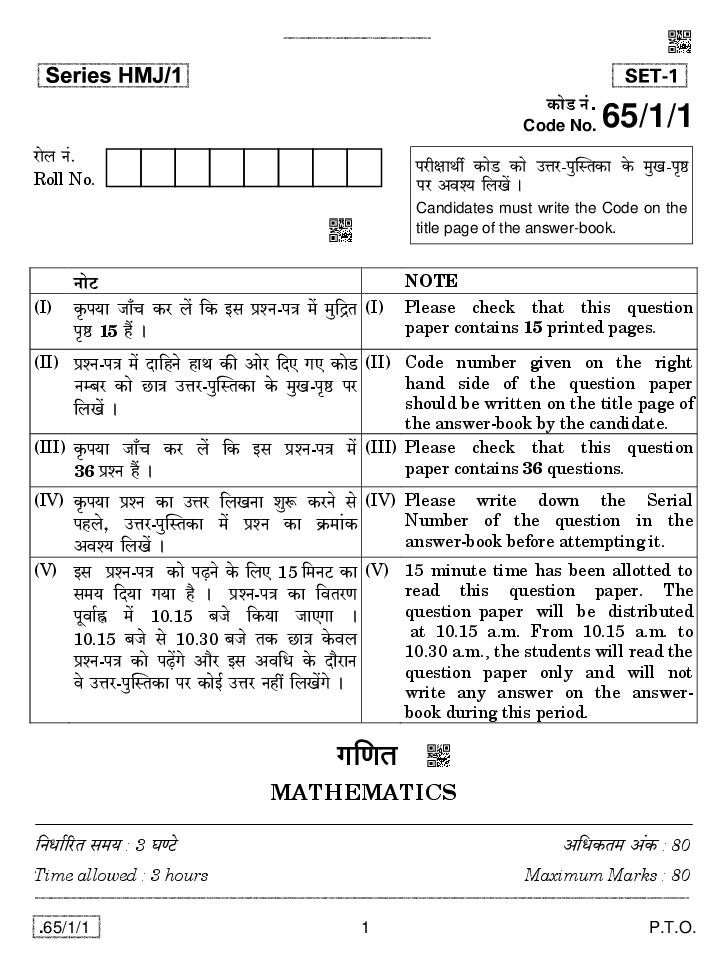
Code No. 65/1/1
amob Z§. narjmWu H$moS> H$mo CÎma-nwpñVH$m Ho$ _wI-n¥ð
Roll No. >na Adí` {bIo§ &
Candidates must write the Code on the
title page of the answer-book.
ZmoQ> NOTE
(I) H¥$n`m Om±M H$a b| {H$ Bg àíZ-nÌ _o§ _w{ÐV (I) Please check that this question
n¥ð> 15 h¢ & paper contains 15 printed pages.
(II) àíZ-nÌ _| Xm{hZo hmW H$s Amoa {XE JE H$moS (II) Code number given on the right
>Zå~a H$mo N>mÌ CÎma-nwpñVH$m Ho$ _wI-n¥ð> na hand side of the question paper
{bI| & should be written on the title page of
the answer-book by the candidate.
(III) H¥$n`m Om±M H$a b| {H$ Bg àíZ-nÌ _| (III) Please check that this question
>36 àíZ h¢ & paper contains 36 questions.
(IV) H¥$n`m àíZ H$m CÎma {bIZm ewê$ H$aZo go (IV) Please write down the Serial
nhbo, CÎma-nwpñVH$m _| àíZ H$m H«$_m§H$ Number of the question in the
Adí` {bI| & answer-book before attempting it.
(V) Bg àíZ-nÌ H$mo n‹T>Zo Ho$ {bE 15 {_ZQ >H$m (V) 15 minute time has been allotted to
g_` {X`m J`m h¡ & àíZ-nÌ H$m {dVaU read this question paper. The
nydm©• _| 10.15 ~Oo {H$`m OmEJm & question paper will be distributed
10.15 ~Oo go 10.30 ~Oo VH$ N>mÌ Ho$db at 10.15 a.m. From 10.15 a.m. to
10.30 a.m., the students will read the
àíZ-nÌ H$mo n‹T>|Jo Am¡a Bg Ad{Y Ho$ Xm¡amZ question paper only and will not
do CÎma-nwpñVH$m na H$moB© CÎma Zht {bI|Jo & write any answer on the answer-
book during this period.
J{UV
MATHEMATICS
{ZYm©[aV g_` : 3 KÊQ>o A{YH$V_ A§H$ : 80
Time allowed : 3 hours Maximum Marks : 80
.65/1/1 1 P.T.O.
Page 2
{ZåZ{b{IV {ZX}em| H$mo ~hþV gmdYmZr go n{‹T>E Am¡a CZH$m g™Vr go nmbZ H$s{OE :
(i) `h àíZ-nÌ Mma IÊS>m| _| {d^m{OV {H$`m J`m h¡ – H$, I, J Ed§ K & Bg àíZ-nÌ _| 36 àíZ
h¢ & g^r àíZ A{Zdm`© h¢ &
(ii) IÊS> H$ _| àíZ g§»`m 1 go 20 VH$ 20 àíZ h¢ Ed§ àË`oH$ àíZ 1 A§H$ H$m h¡ &
(iii) IÊS> I _| àíZ g§»`m 21 go 26 VH$ 6 àíZ h¢ Ed§ àË`oH$ àíZ 2 A§H$m| H$m h¡ &
(iv) IÊS> J _| àíZ g§»`m 27 go 32 VH$ 6 àíZ h¢ Ed§ àË`oH$ àíZ 4 A§H$m| H$m h¡ &
(v) IÊS> K _| àíZ g§»`m 33 go 36 VH$ 4 àíZ h¢ Ed§ àË`oH$ àíZ 6 A§H$m| H$m h¡ &
(vi) àíZ-nÌ _| g_J« na H$moB© {dH$ën Zht h¡ & VWm{n EH$-EH$ A§H$ dmbo VrZ àíZm| _|, Xmo-Xmo A§H$m|
dmbo Xmo àíZm| _|, Mma-Mma A§H$m| dmbo Xmo àíZm| _| Am¡a N :-N : A§H$m| dmbo Xmo àíZm| _| Am§V[aH$
{dH$ën {XE JE h¢ & Eogo àíZm| _| go Ho$db EH$ hr {dH$ën H$m CÎma {b{IE &
(vii) BgHo$ A{V[aº$, Amdí`H$VmZwgma, àË`oH$ IÊS> Am¡a àíZ Ho$ gmW `Wmo{MV {ZX}e {XE JE h¢ &
(viii) Ho$bHw$boQ>am| Ho$ à`moJ H$s AZw_{V Zht h¡ &
IÊS> H$
àíZ g§»`m 1 go 20 VH$ àË`oH$ àíZ 1 A§H$ H$m h¡ &
àíZ g§»`m 1 go 10 VH$ ~hþ{dH$ënr` àíZ h¢ & ghr {dH$ën Mw{ZE &
1. `{X A H$mo{Q> 3 H$m EH$ dJ© Amì`yh h¡ VWm |A| = 5 h¡, Vmo |2A| H$m _mZ hmoJm >
(A) – 10
(B) 10
(C) – 40
(D) 40
2. `{X A EH$ dJ© Amì`yh h¡ VWm A2 = A hmo, Vmo (I – A)3 + A ~am~a h¡
(A) I
(B) 0
(C) I–A
(D) I+A
3
3. tan–1 (tan ) H$m _w»` _mZ h¡
5
2π
(A)
5
– 2π
(B)
5
3π
(C)
5
– 3π
(D)
5
.65/1/1 2
Page 3
Read the following instructions very carefully and strictly follow them :
(i) This question paper comprises four Sections A, B, C and D. This question
paper carries 36 questions. All questions are compulsory.
(ii) Section A – Questions no. 1 to 20 comprises of 20 questions of 1 mark each.
(iii) Section B – Questions no. 21 to 26 comprises of 6 questions of 2 marks each.
(iv) Section C – Questions no. 27 to 32 comprises of 6 questions of 4 marks each.
(v) Section D – Questions no. 33 to 36 comprises of 4 questions of 6 marks each.
(vi) There is no overall choice in the question paper. However, an internal choice
has been provided in 3 questions of one mark, 2 questions of two marks,
2 questions of four marks and 2 questions of six marks. Only one of the choices
in such questions have to be attempted.
(vii) In addition to this, separate instructions are given with each section and
question, wherever necessary.
(viii) Use of calculators is not permitted.
SECTION A
Question numbers 1 to 20 carry 1 mark each.
Question numbers 1 to 10 are multiple choice type questions. Select the correct option.
1. If A is a square matrix of order 3 and |A| = 5, then the value of |2A| is
(A) – 10
(B) 10
(C) – 40
(D) 40
2. If A is a square matrix such that A2 = A, then (I – A)3 + A is equal to
(A) I
(B) 0
(C) I–A
(D) I+A
3π
3. The principal value of tan–1 (tan ) is
5
2π
(A)
5
– 2π
(B)
5
3π
(C)
5
– 3π
(D)
5
.65/1/1 3 P.T.O.
Page 4
4. `{X g{Xe a = ^i – 2 ^j + 3 k^ H$m g{Xe b = 2 ^i + k^ na àjon eyÝ` h¡, Vmo H$m
_mZ hmoJm
(A) 0
(B) 1
–2
(C)
3
–3
(D)
2
5. g_Vb z = 0 Ho$ b§~dV² VWm {~ÝXþ (– 1, 5, 4) go JwµOaZo dmbr aoIm H$m g{Xe g_rH$aU
hmoJm
^ ^ ^ ^ ^
(A) r = – i + 5 j + 4k + (i + j )
^ ^ ^
(B) r = – i + 5 j + (4 + ) k
^ ^ ^ ^
(C) r = i – 5 j – 4k + k
^
(D) r = k
6. H$mo{Q> 2 dmbo AdH$b g_rH$aU Ho$ {deof hb _| ñdoÀN> AMam| H$s g§»`m hmoJr
(A) 0
(B) 1
(C) 2
(D) 3
4
7.
–
π
sec 2 x dx ~am~a h¡
4
(A) –1
(B) 0
(C) 1
(D) 2
.65/1/1 4
Page 5
4. If the projection of a = i – 2 j + 3 k on b = 2 i + k is zero, then the
value of is
(A) 0
(B) 1
–2
(C)
3
–3
(D)
2
5. The vector equation of the line passing through the point (–1, 5, 4) and
perpendicular to the plane z = 0 is
^ ^ ^ ^ ^
(A) r = – i + 5 j + 4k + (i + j )
^ ^ ^
(B) r = – i + 5 j + (4 + ) k
^ ^ ^ ^
(C) r = i – 5 j – 4k + k
^
(D) r = k
6. The number of arbitrary constants in the particular solution of a
differential equation of second order is (are)
(A) 0
(B) 1
(C) 2
(D) 3
4
7.
–
π
sec 2 x dx is equal to
4
(A) –1
(B) 0
(C) 1
(D) 2
.65/1/1 5 P.T.O.
Page 6
(A) 3 BH$mB©
(B) 4 BH$mB©
(C) 5 BH$mB©
(D) 7 BH$mB©
9. `{X A Am¡a B Xmo ñdV§Ì KQ>ZmE± h¢, Ohm± P(A) = 1 d P(B) = 1 h¡, Vmo P(B|A)
3 4
~am~a h¡
1
(A)
4
1
(B)
3
3
(C)
4
(D) 1
10. a¡{IH$ Ag{_H$mAm| Ho$ {ZH$m` go {Z`V gwg§JV joÌ Ho$ H$moZr` q~Xþ (0, 0), (4, 0), (2, 4)
VWm (0, 5) h¢ & `{X z = ax + by, Ohm± a, b > 0 H$m A{YH$V_ _mZ {~ÝXþAmo§ (2, 4) VWm
(4, 0) XmoZm| na hmo, Vmo
(A) a = 2b
(B) 2a = b
(C) a=b
(D) 3a = b
àíZ g§»`m 11 go 15 VH$ Ho$ g^r àíZm| Ho$ Imbr ñWmZ ^[aE &
11. `{X g_ñV a1, a2 A Ho$ {bE (a1, a2) R go (a2, a1) R àmßV hmo, Vmo g_wƒ` A
na n[a^m{fV g§~§Y R H$hbmVm h¡ _________ & $
12. f(x) = [x], 0 < x < 2 Ûmam n[a^m{fV _hÎm_ nyUmªH$ \$bZ x = __________ na
AdH$bZr` Zht hmoVm h¡ &
13. `{X Amì`yh A H$s H$mo{Q> 3 2 h¡, Vmo Amì`yh A H$s H$mo{Q> hmoJr __________ &
AWdm
EH$ dJ© Amì`yh A {df_-g_{_V Amì`yh hmoJm, `{X __________ &
.65/1/1 6
Page 7
y-axis is
(A) 3 units
(B) 4 units
(C) 5 units
(D) 7 units
1 1
9. If A and B are two independent events with P(A) = and P(B) = , then
3 4
P(B | A) is equal to
1
(A)
4
1
(B)
3
3
(C)
4
(D) 1
10. The corner points of the feasible region determined by the system of
linear inequalities are (0, 0), (4, 0), (2, 4) and (0, 5). If the maximum value
of z = ax + by, where a, b > 0 occurs at both (2, 4) and (4, 0), then
(A) a = 2b
(B) 2a = b
(C) a=b
(D) 3a = b
Fill in the blanks in question numbers 11 to 15.
11. A relation R in a set A is called __________, if (a1, a2) R implies
(a2, a1) R, for all a1, a2 A.
12. The greatest integer function defined by f(x) = [x], 0 < x < 2 is not
differentiable at x = ___________ .
13. If A is a matrix of order 3 2, then the order of the matrix A is
___________ .
OR
A square matrix A is said to be skew-symmetric, if ___________ .
.65/1/1 7 P.T.O.
Page 8
AWdm
EH$ d¥Îm H$s {ÌÁ`m g_mZ ê$n go 3 cm/s H$s Xa go ~‹T> ahr h¡ & Cg jU na O~{H$ d¥Îm
H$s {ÌÁ`m 2 cm h¡, d¥Îm Ho$ joÌ\$b _| __________ cm2/s H$s Xa go ~‹T>moVar hmoJr &
^ ^ ^
15. Xmo {~ÝXþAm|A VWm B Ho$ pñW{V g{Xe H«$_e: OA = 2 i – j – k Am¡a
^ ^ ^
OB = 2 i – j + 2 k h¢ & {~ÝXþ P, Omo aoImIÊS> AB H$mo 2 : 1 Ho$ AZwnmV _| {d^m{OV
H$aVm h¡, H$m pñW{V g{Xe h¡ ___________ &
àíZ g§»`m 16 go 20 A{V g§{já CÎma dmbo àíZ h¢ &
2 0 0
16. `{X A = – 1 2 3 h¡, Vmo A (adj A) kmV H$s{OE &
3 3 5
17. kmV H$s{OE :
x 4 log x dx
AWdm
kmV H$s{OE :
x 1 dx
2x
3 2
18. _mZ kmV H$s{OE :
3
1
| 2x – 1| dx
19. Vme H$s 52 nÎmm| dmbr AÀN>r àH$ma go \|$Q>r JB© JS²>S>r _| go `mÑÀN>`m VWm {~Zm
à{VñWmnZm Ho$ EH$-EH$ H$a Ho$ Xmo nÎmo {ZH$mbo JE & EH$ nÎmm bmb VWm Xÿgam H$mbo a§J H$m
AmZo H$s àm{`H$Vm kmV H$s{OE &
20. kmV H$s{OE :
9 – 4x
dx
2
.65/1/1 8
Page 9
____________ .
OR
The radius of a circle is increasing at the uniform rate of 3 cm/sec. At the
instant when the radius of the circle is 2 cm, its area increases at the rate
of _____________ cm2/s.
^ ^ ^
15. The position vectors of two points A and B are OA = 2 i – j – k and
^ ^ ^
OB = 2 i – j + 2 k , respectively. The position vector of a point P which
divides the line segment joining A and B in the ratio 2 : 1 is ___________ .
Question numbers 16 to 20 are very short answer type questions.
2 0 0
16. If A = – 1 2 3 , then find A (adj A).
3 3 5
17. Find :
x 4 log x dx
OR
Find :
x 1 dx
2x
3 2
18. Evaluate :
3
1
| 2x – 1| dx
19. Two cards are drawn at random and one-by-one without replacement
from a well-shuffled pack of 52 playing cards. Find the probability that
one card is red and the other is black.
20. Find :
9 – 4x
dx
2
.65/1/1 9 P.T.O.
Page 10
àíZ g§»`m 21 go 26 VH$ àË`oH$ àíZ 2 A§H$m| H$m h¡ &
21. {gÕ H$s{OE {H$ :
1
sin–1 (2x 1 – x 2 ) = 2 cos–1 x, x 1.
2
AWdm
f : R+ (7, ), f(x) = 16x2 + 24x + 7 Ûmam n[a^m{fV EH¡$H$s Am¡a AmÀN>mXH$ \$bZ
na {dMma H$s{OE, Ohm± R+ g^r YZmË_H$ dmñV{dH$ g§»`mAm| H$m g_wƒ` h¡ & \$bZ f H$m
à{Vbmo_ \$bZ kmV H$s{OE &
2
22. `{X x = at2, y = 2at hmo, Vmo d y2 kmV H$s{OE &
dx
23. dH«$ y = x3 – 3x2 – 4x Ho$ do {~ÝXþ kmV H$s{OE {OZ na ñne©-aoImE±, aoIm
4x + y – 3 = 0 Ho$ g_m§Va h¢ &
24. EH$ _mÌH$ g{Xe kmV H$s{OE Omo àË`oH$ g{Xe a Am¡a b Ho$ bå~dV² hmo, Ohm±
^ ^ ^ ^ ^ ^
a = 5 i + 6 j – 2 k Am¡a b = 7 i + 6 j + 2 k .
AWdm
Cg g_m§Va fQ²>\$bH$ H$m Am`VZ kmV H$s{OE {OgH$s g§b½Z ^wOmE± 2 a , – b VWm 3 c
Ûmam {Zê${nV h¢, Ohm±
^ ^ ^
a = i – j + 2k ,
^ ^ ^
b = 3 i + 4 j – 5 k VWm
^ ^ ^
c = 2 i – j + 3 k h¢ &
25. k H$m dh _mZ kmV H$s{OE {OgHo$ {bE aoImE± x = – y = kz VWm
x – 2 = 2y + 1 = – z + 1 EH$-Xÿgao na bå~ h¢ &
26. EH$ ì`ñV Mm¡amho X na, har ~Îmr {_bZo H$s àm{`H$Vm 30% h¡ & Bg Mm¡amho X na VrZ _|
go bJmVma Xmo {XZ har ~Îmr Ho$ {_bZo H$s àm{`H$Vm Š`m h¡ ?
.65/1/1 10
Page 11
Question numbers 21 to 26 carry 2 marks each.
1
21. Prove that sin–1 (2x 1 – x 2 ) = 2 cos–1 x, x 1.
2
OR
Consider a bijective function f : R+ (7, ) given by f(x) = 16x2 + 24x + 7,
where R+ is the set of all positive real numbers. Find the inverse function
of f.
2 d 2y
22. If x = at , y = 2at, then find .
2
dx
23. Find the points on the curve y = x3 – 3x2 – 4x at which the tangent lines
are parallel to the line 4x + y – 3 = 0.
24. Find a unit vector perpendicular to each of the vectors a and b where
^ ^ ^ ^ ^ ^
a = 5 i + 6 j – 2 k and b = 7 i + 6 j + 2 k .
OR
Find the volume of the parallelopiped whose adjacent edges are
represented by 2 a , – b and 3 c , where
^ ^ ^
a = i – j + 2k ,
^ ^ ^
b = 3 i + 4 j – 5 k , and
^ ^ ^
c = 2i – j + 3k .
25. Find the value of k so that the lines x = – y = kz and
x – 2 = 2y + 1 = – z + 1 are perpendicular to each other.
26. The probability of finding a green signal on a busy crossing X is 30%.
What is the probability of finding a green signal on X on two consecutive
days out of three ?
.65/1/1 11 P.T.O.
Page 12
àíZ g§»`m 27 go 32 VH$ àË`oH$ àíZ 4 A§H$m| H$m h¡ &
27. _mZm N àmH¥$V g§»`mAm| H$m g_wƒ` h¡ & g§~§Y R, N N na ‘‘(a, b) R (c, d) `{X Am¡a
Ho$db `{X ad = bc, g^r a, b, c, d N Ho$ {bE’’ Ûmam n[a^m{fV h¡ & {XImBE {H$ g§~§Y
R EH$ Vwë`Vm g§~§Y h¡ &
`{X y = ex cos x + (cos x)x h¡, Vmo dy kmV H$s{OE &
2
28.
dx
29. kmV H$s{OE :
sec3 x dx
30. AdH$b g_rH$aU y ey dx = (y3 + 2x ey) dy H$m ì`mnH$ hb kmV H$s{OE &
AWdm
AdH$b g_rH$aU x dy = y – x tan y , Ohm± x = 1 na y = π h¡, H$m {d{eîQ> hb
dx x 4
kmV H$s{OE &
31. EH$ \$ZuMa ì`mnmar AnZr YZam{e H$mo _oµOm| `m Hw${g©`m| `m XmoZm| Ho$ g§`moOZm| _| {Zdoe
H$aVm h¡ & {Zdoe Ho$ {bE CgHo$ nmg < 50,000 h¢ Am¡a CgHo$ nmg A{YH$V_ 35 dñVwAm|
H$mo aIZo Ho$ {bE ñWmZ CnbãY h¡ & EH$ Hw$gu H$m H«$` _yë` < 1,000 d EH$ _oµO H$m
H«$` _yë` < 2,000 h¡ & Bg ì`mnmar H$mo EH$ Hw$gu ~oMH$a < 150 d EH$ _oµO H$mo ~oMH$a
< 250 H$m bm^ A{O©V hmoVm h¡ & Cn`w©º$ g_ñ`m Ho$ {bE A{YH$V_ bm^ A{O©V H$aZo Ho$
{bE EH$ a¡{IH$ àmoJ«m_Z g_ñ`m ~ZmBE Am¡a AmboIr` {d{Y go g_ñ`m H$mo hb H$s{OE &
32. Xmo W¡bo I Am¡a II {XE JE h¢ & W¡bo I _| 3 bmb VWm 5 H$mbr J|X| h¢ O~{H$ W¡bo II _|
4 bmb VWm 3 H$mbr J|X| h¢ & W¡bo I go W¡bo II _| EH$ J|X `mÑÀN>`m ñWmZm§V[aV H$s OmVr
h¡ Am¡a VËníMmV² W¡bo II _| go EH$ J|X `mÑÀN>`m {ZH$mbr OmVr h¡ & `{X `h {ZH$mbr JB©
J|X H$mbr J|X h¡, Vmo ñWmZm§V[aV H$s JB© J|X Ho$ H$mbo a§J Ho$ hmoZo H$s àm{`H$Vm kmV
H$s{OE &
AWdm
EH$ H$be _| 5 bmb, 2 g\o$X VWm 3 H$mbr J|X| h¢ & EH$-EH$ H$aHo$, {~Zm à{VñWmnZm Ho$,
Bg H$be go 3 J|Xo§ `mÑÀN>`m {ZH$mbr OmVr h¢ & g\o$X J|Xm| H$s g§»`m H$m àm{`H$Vm ~§Q>Z
kmV H$s{OE & {ZH$mbr JB© g\o$X J|Xm| H$s g§»`m H$m _mÜ` d àgaU ^r kmV H$s{OE &
.65/1/1 12
Page 13
Question numbers 27 to 32 carry 4 marks each.
27. Let N be the set of natural numbers and R be the relation on N N
defined by (a, b) R (c, d) iff ad = bc for all a, b, c, d N. Show that R is an
equivalence relation.
2 dy
28. If y = ex cos x + (cos x)x, then find .
dx
29. Find :
sec3 x dx
30. Find the general solution of the differential equation
y ey dx = (y3 + 2x ey) dy.
OR
Find the particular solution of the differential equation
dy y π
x = y – x tan , given that y = at x = 1.
dx x 4
31. A furniture trader deals in only two items chairs and tables. He has
< 50,000 to invest and a space to store at most 35 items. A chair costs
him < 1,000 and a table costs him < 2,000. The trader earns a profit of
< 150 and < 250 on a chair and table, respectively. Formulate the above
problem as an LPP to maximise the profit and solve it graphically.
32. There are two bags, I and II. Bag I contains 3 red and 5 black balls and
Bag II contains 4 red and 3 black balls. One ball is transferred randomly
from Bag I to Bag II and then a ball is drawn randomly from Bag II. If
the ball so drawn is found to be black in colour, then find the probability
that the transferred ball is also black.
OR
An urn contains 5 red, 2 white and 3 black balls. Three balls are drawn,
one-by-one, at random without replacement. Find the probability
distribution of the number of white balls. Also, find the mean and the
variance of the number of white balls drawn.
.65/1/1 13 P.T.O.
Page 14
àíZ g§»`m 33 go 36 VH$ àË`oH$ àíZ 6 A§H$m| H$m h¡ &
1 2 – 3
33. `{X A = 3 2 – 2 h¡, Vmo A–1 kmV H$s{OE Am¡a BgH$m à`moJ H$aHo$
2 –1 1
{ZåZ{b{IV g_rH$aU {ZH$m` H$m hb kmV H$s{OE :
x + 2y – 3z = 6
3x + 2y – 2z = 3
2x – y + z = 2
AWdm
gma{UH$m| Ho$ JwUY_m] H$m à`moJ H$aHo$, {gÕ H$s{OE {H$
(b c) 2 a2 bc
(c a) 2 b2 ca = (a – b) (b – c) (c – a) (a + b + c) (a2 + b2 + c2)
(a b) 2 c2 ab
34. g_mH$bZ {d{Y go, {Ì^wO {OgHo$ erf© (2, – 2), (4, 5) VWm (6, 2) h¢, go {Kao joÌ H$m
joÌ\$b kmV H$s{OE &
35. {XImBE {H$ {ÌÁ`m r d D±$MmB© h Ho$ bå~-d¥Îmr` e§Hw$ Ho$ AÝVJ©V A{YH$V_ Am`VZ Ho$
bå~-d¥Îmr` ~obZ H$s D±$MmB©, e§Hw$ H$s D±$MmB© H$s EH$-{VhmB© h¡ Am¡a ~obZ H$m A{YH$V_
Am`VZ, e§Hw$ Ho$ Am`VZ H$m 4 dm± ^mJ h¡ &
9
36. Cg g_Vb H$m g_rH$aU kmV H$s{OE, {Og_| {~ÝXþ A(2, 1, – 1) pñWV h¡ VWm Omo g_Vbm|
2x + y – z = 3 Am¡a x + 2y + z = 2 H$s à{VÀN>oXZ aoIm Ho$ bå~dV² h¡ & àmßV g_Vb
d y-Aj Ho$ ~rM H$m H$moU ^r kmV H$s{OE &
AWdm
aoIm r = (3 ^i – 2 ^j + 6 k^ ) + (2 ^i – ^j + 2 k^ ) VWm g_Vb r . ( ^i – ^j + k^ ) = 6
Ho$ à{VÀN>oXZ {~ÝXþ Q H$s {~ÝXþ P(– 2, – 4, 7) go Xÿar kmV H$s{OE & aoIm PQ H$m g{Xe
g_rH$aU ^r {b{IE &
.65/1/1 14
Page 15
Question numbers 33 to 36 carry 6 marks each.
1 2 –3
33. If A = 3 2 – 2 , then find A–1 and use it to solve the following
2 –1 1
system of the equations :
x + 2y – 3z = 6
3x + 2y – 2z = 3
2x – y + z = 2
OR
Using properties of determinants, prove that
(b c) 2 a2 bc
(c a) 2 b2 ca = (a – b) (b – c) (c – a) (a + b + c) (a2 + b2 + c2).
(a b) 2 c2 ab
34. Using integration, find the area of the region bounded by the triangle
whose vertices are (2, – 2), (4, 5) and (6, 2).
35. Show that the height of the right circular cylinder of greatest volume
which can be inscribed in a right circular cone of height h and radius r is
one-third of the height of the cone, and the greatest volume of the
4
cylinder is times the volume of the cone.
9
36. Find the equation of the plane that contains the point A(2, 1, – 1) and is
perpendicular to the line of intersection of the planes 2x + y – z = 3 and
x + 2y + z = 2. Also find the angle between the plane thus obtained and
the y-axis.
OR
Find the distance of the point P(– 2, – 4, 7) from the point of intersection
^ ^ ^ ^ ^ ^
Q of the line r = (3 i – 2 j + 6 k ) + (2 i – j + 2 k ) and the plane
^ ^ ^
r . ( i – j + k ) = 6. Also write the vector equation of the line PQ.
.65/1/1 15 P.T.O.
Document Details
| Board / Org | CBSE |
| Exam | Class 12 |
| Type | Question Paper |
| Pages | 15 |
| Updated | 22 Jul 2026 |