CBSE Class 12 Mathematics Question Paper 2020 Set 65-2-3
Finished viewing? Save it for later —
Download CBSE Class 12 Mathematics Question Paper 2020 Set 65-2-3 (PDF · 15 pages)About CBSE Class 12 Mathematics Question Paper 2020 Set 65-2-3
CBSE Class 12 Mathematics Question Paper 2020 Set 65-2-3 is available here for free download. Published by CBSE for Class 12, this question paper can be viewed online or downloaded as a PDF (15 pages). Candidates preparing for Class 12 can use CBSE Class 12 Mathematics Question Paper 2020 Set 65-2-3 to understand the exam pattern, the type of questions asked, and the overall difficulty level.
Frequently Asked Questions
How can I download CBSE Class 12 Mathematics Question Paper 2020 Set 65-2-3?
Open this page and click the Download button to save CBSE Class 12 Mathematics Question Paper 2020 Set 65-2-3 as a PDF. It is completely free on AglaSem Docs.
Is CBSE Class 12 Mathematics Question Paper 2020 Set 65-2-3 free to download?
Yes. CBSE Class 12 Mathematics Question Paper 2020 Set 65-2-3 can be viewed online and downloaded as a PDF free of cost on AglaSem Docs.
How many pages does CBSE Class 12 Mathematics Question Paper 2020 Set 65-2-3 have?
CBSE Class 12 Mathematics Question Paper 2020 Set 65-2-3 contains 15 pages, which you can read online or download together as a single PDF.
Where can I find more Class 12 study material?
You can find more Class 12 question papers, sample papers, syllabus, and answer keys on AglaSem Docs.
CBSE Class 12 Mathematics Question Paper 2020 Set 65-2-3 – Text
Read the full text of this question paper below — useful to quickly search, copy and reference the content online without downloading the PDF.
📄 View text version (15 pages)
Page 1
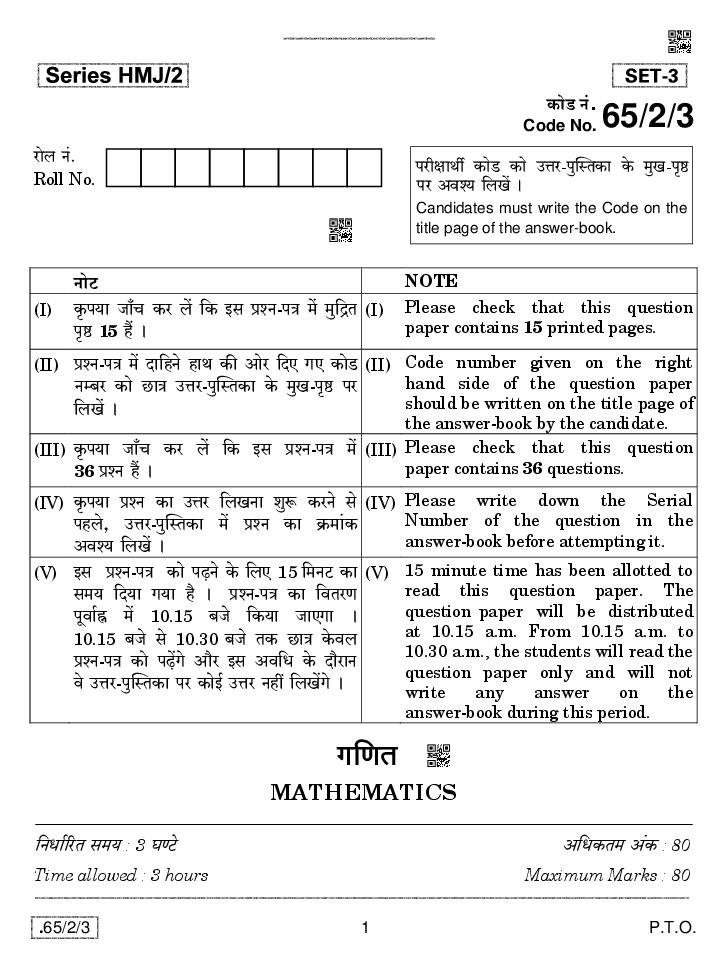
Code No. 65/2/3
amob Z§. narjmWu H$moS >H$mo CÎma-nwpñVH$m Ho$ _wI-n¥ð
Roll No. >na Adí` {bIo§ &
Candidates must write the Code on the
title page of the answer-book.
ZmoQ> NOTE
(I) H¥$n`m Om±M H$a b| {H$ Bg àíZ-nÌ _o§ _w{ÐV (I) Please check that this question
n¥ð> 15 h¢ & paper contains 15 printed pages.
(II) àíZ-nÌ _| Xm{hZo hmW H$s Amoa {XE JE H$moS (II) Code number given on the right
>Zå~a H$mo N>mÌ CÎma-nwpñVH$m Ho$ _wI-n¥ð> na hand side of the question paper
{bI| & should be written on the title page of
the answer-book by the candidate.
(III) H¥$n`m Om±M H$a b| {H$ Bg àíZ-nÌ _| (III) Please check that this question
>36 àíZ h¢ & paper contains 36 questions.
(IV) H¥$n`m àíZ H$m CÎma {bIZm ewê$ H$aZo go (IV) Please write down the Serial
nhbo, CÎma-nwpñVH$m _| àíZ H$m H«$_m§H$ Number of the question in the
Adí` {bI| & answer-book before attempting it.
(V) Bg àíZ-nÌ H$mo n‹T>Zo Ho$ {bE 15 {_ZQ >H$m (V) 15 minute time has been allotted to
g_` {X`m J`m h¡ & àíZ-nÌ H$m {dVaU read this question paper. The
nydm©• _| 10.15 ~Oo {H$`m OmEJm & question paper will be distributed
10.15 ~Oo go 10.30 ~Oo VH$ N>mÌ Ho$db at 10.15 a.m. From 10.15 a.m. to
10.30 a.m., the students will read the
àíZ-nÌ H$mo n‹T>|Jo Am¡a Bg Ad{Y Ho$ Xm¡amZ question paper only and will not
do CÎma-nwpñVH$m na H$moB© CÎma Zht {bI|Jo & write any answer on the
answer-book during this period.
J{UV
MATHEMATICS
{ZYm©[aV g_` : 3 KÊQ>o A{YH$V_ A§H$ : 80
Time allowed : 3 hours Maximum Marks : 80
.65/2/3 1 P.T.O.
Page 2
{ZåZ{b{IV {ZX}em| H$mo ~hþV gmdYmZr go n{‹T>E Am¡a CZH$m g™Vr go nmbZ H$s{OE :
(i) `h àíZ-nÌ Mma IÊS>m| _| {d^m{OV {H$`m J`m h¡ – H$, I, J Ed§ K & Bg àíZ-nÌ _| 36 àíZ
h¢ & g^r àíZ A{Zdm`© h¢ &
(ii) IÊS> H$ _| àíZ g§»`m 1 go 20 VH$ 20 àíZ h¢ Ed§ àË`oH$ àíZ 1 A§H$ H$m h¡ &
(iii) IÊS> I _| àíZ g§»`m 21 go 26 VH$ 6 àíZ h¢ Ed§ àË`oH$ àíZ 2 A§H$m| H$m h¡ &
(iv) IÊS> J _| àíZ g§»`m 27 go 32 VH$ 6 àíZ h¢ Ed§ àË`oH$ àíZ 4 A§H$m| H$m h¡ &
(v) IÊS> K _| àíZ g§»`m 33 go 36 VH$ 4 àíZ h¢ Ed§ àË`oH$ àíZ 6 A§H$m| H$m h¡ &
(vi) àíZ-nÌ _| g_J« na H$moB© {dH$ën Zht h¡ & VWm{n EH$ -EH$ A§H$ dmbo VrZ àíZm| _|, Xmo-Xmo A§H$m|
dmbo Xmo àíZm| _|, Mma-Mma A§H$m| dmbo Xmo àíZm| _| Am¡a N :-N : A§H$m| dmbo Xmo àíZm| _| Am§V[aH$
{dH$ën {XE JE h¢ & Eogo àíZm| _| go Ho$db EH$ hr {dH$ën H$m CÎma {b{IE &
(vii) BgHo$ A{V[aº$, Amdí`H$VmZwgma, àË`oH$ IÊS> Am¡a àíZ Ho$ gmW `Wmo{MV {ZX}e {XE JE h¢ &
(viii) Ho$bHw$boQ>am| Ho$ à`moJ H$s AZw_{V Zht h¡ &
IÊS> H$
àíZ g§»`m 1 go 20 VH$ àË`oH$ àíZ 1 A§H$ H$m h¡ &
àíZ g§»`m 1 go 10 VH$ ~hþ{dH$ënr` àíZ h¢ & ghr {dH$ën Mw{ZE &
1. {Ì^wO {OgHo$ erf© O, A VWm B h¢, Ohm± OA = ^i + 2 ^j + 3 k^ Am¡a
^ ^ ^
OB = – 3 i – 2 j + k , H$m joÌ\$b hmoJm
(A) 3 5 dJ© BH$mB©
(B) 5 5 dJ© BH$mB©
(C) 6 5 dJ© BH$mB©
(D) 4 dJ© BH$mB©
2. \$bZ f(x) = sin–1 (2x) H$m àm§V h¡ >
(A) [0, 1]
(B) [– 1, 1]
1 1
(C) – 2 , 2
(D) [– 2, 2]
.65/2/3 2
Page 3
Read the following instructions very carefully and strictly follow them :
(i) This question paper comprises four Sections A, B, C and D. This question
paper carries 36 questions. All questions are compulsory.
(ii) Section A – Questions no. 1 to 20 comprises of 20 questions of 1 mark each.
(iii) Section B – Questions no. 21 to 26 comprises of 6 questions of 2 marks each.
(iv) Section C – Questions no. 27 to 32 comprises of 6 questions of 4 marks each.
(v) Section D – Questions no. 33 to 36 comprises of 4 questions of 6 marks each.
(vi) There is no overall choice in the question paper. However, an internal choice
has been provided in 3 questions of one mark, 2 questions of two marks,
2 questions of four marks and 2 questions of six marks. Only one of the choices
in such questions have to be attempted.
(vii) In addition to this, separate instructions are given with each section and
question, wherever necessary.
(viii) Use of calculators is not permitted.
SECTION A
Question numbers 1 to 20 carry 1 mark each.
Question numbers 1 to 10 are multiple choice type questions. Select the correct option.
1. The area of a triangle formed by vertices O, A and B, where
^ ^ ^ ^ ^ ^
OA = i + 2 j + 3 k and OB = – 3 i – 2 j + k is
(A) 3 5 sq. units
(B) 5 5 sq. units
(C) 6 5 sq. units
(D) 4 sq. units
2. The domain of the function f(x) = sin–1 (2x) is
(A) [0, 1]
(B) [– 1, 1]
1 1
(C) – 2 , 2
(D) [– 2, 2]
.65/2/3 3 P.T.O.
Page 4
(A) (– , )
(B) (– , 0)
(C) (2, )
(D) (0, 2)
2 1
x sin `{X x0
4. `{X f(x) = x
k `{X x0
Ûmam n[a^m{fV \$bZ f, x = 0 na g§VV h¡, Vmo k H$m _mZ h¡
(A) 0
1
(B)
2
(C) 1
(D) 2
1
5. Ho$ gmnoj log x H$m AdH$bO h¡
x
1
(A) –
x3
1
(B) –
x
(C) –x
1
(D)
x
6. y-Aj na {~ÝXþ (2, – 3, 4) go S>mbo JE bå~ Ho$ nmX Ho$ {ZX}em§H$ h¢
(A) (2, 3, 4)
(B) (– 2, – 3, – 4)
(C) (0, – 3, 0)
(D) (2, 0, 4)
7. g_wƒ` {1, 2, 3} _| R = {(1, 2), (2, 1), (1, 1)} Ûmam àXÎm g§~§Y R >
(A) g_{_V VWm g§H«$m_H$ h¡, naÝVw ñdVwë` Zht h¡
(B) ñdVwë` VWm g_{_V h¡, naÝVw g§H«$m_H$ Zht h¡
(C) g_{_V h¡, naÝVw Z hr ñdVwë` Am¡a Z hr g§H«$m_H$ h¡
(D) EH$ Vwë`Vm g§~§Y h¡
.65/2/3 4
Page 5
increasing, is
(A) (– , )
(B) (– , 0)
(C) (2, )
(D) (0, 2)
4. The value of k so that f defined by
2 1
x sin if x0
f(x) = x
k if x0
is continuous at x = 0 is
(A) 0
1
(B)
2
(C) 1
(D) 2
1
5. The derivative of log x with respect to is
x
1
(A) –
x3
1
(B) –
x
(C) –x
1
(D)
x
6. The coordinates of the foot of the perpendicular drawn from the point
(2, – 3, 4) on the y-axis is
(A) (2, 3, 4)
(B) (– 2, – 3, – 4)
(C) (0, – 3, 0)
(D) (2, 0, 4)
7. The relation R in the set {1, 2, 3} given by R = {(1, 2), (2, 1), (1, 1)} is
(A) symmetric and transitive, but not reflexive
(B) reflexive and symmetric, but not transitive
(C) symmetric, but neither reflexive nor transitive
(D) an equivalence relation
.65/2/3 5 P.T.O.
Page 6
8. `{X | a | = 3, | b | = 4 VWm | a b | = 6 h¡, Vmo a . b H$m _mZ h¡
(A) 12
(B) 6
(C) 3 3
(D) 6 3
9. `{X A H$mo{Q> 3 H$m EH$ ì`wËH«$_Ur` dJ© Amì`yh h¡ Am¡a A2 = 3A h¡, Vmo |A| H$m _mZ hmoJm
(A) –3
(B) 3
(C) 9
(D) 27
10. `{X | a | = 4 VWm – 3 2 h¡, Vmo | a | H$m _mZ {Og AÝVamb _| h¡, dh h¡
(A) [0, 12]
(B) [2, 3]
(C) [8, 12]
(D) [– 12, 8]
àíZ g§»`m 11 go 15 VH$ Ho$ àíZm| Ho$ Imbr ñWmZ ^[aE &
11. `{X EH$ d¥Îm H$s {ÌÁ`m 0·5 cm/s H$s Xa go ~‹T> ahr h¡, Vmo BgH$s n[a{Y H$s d¥{Õ Xa h¡
__________ &
2
12. `{X 3 – 2 0 k = O, Ohm± O EH$ eyÝ` Amì`yh h¡, Vmo k H$m _mZ h¡
– 5
____________ &
13. EH$ a¡{IH$ àmoJm« _Z g_ñ`m Ho$ gwg§JV joÌ Ho$ H$moZr` {~ÝXþ (0, 0), (0, 8), (2, 7), (5, 4)
VWm (6, 0) h¢ & A{YH$V_ bm^ P = 3x + 2y {~ÝXþ ___________ na hmoJm &
14. \$bZ y = sec–1 x H$s _w»` _mZr` emIm H$m n[aga h¡ _________ &
AWdm
1
cos–1 – H$m _w»` _mZ h¡ __________ &
2
.65/2/3 6
Page 7
8. If | a | = 3, | b | = 4 and | a b | = 6, then the value of a . b is
(A) 12
(B) 6
(C) 3 3
(D) 6 3
9. If A is a non-singular square matrix of order 3 such that A2 = 3A, then
value of |A| is
(A) –3
(B) 3
(C) 9
(D) 27
10. If | a | = 4 and – 3 2, then | a | lies in
(A) [0, 12]
(B) [2, 3]
(C) [8, 12]
(D) [– 12, 8]
Fill in the blanks in question numbers 11 to 15.
11. If the radius of the circle is increasing at the rate of 0·5 cm/s, then the
rate of increase of its circumference is _____________ .
2
12. If 3 – 2 0 k = O, where O is the null matrix, then the value of k is
– 5
____________ .
13. The corner points of the feasible region of an LPP are (0, 0), (0, 8), (2, 7),
(5, 4) and (6, 0). The maximum profit P = 3x + 2y occurs at the point
_____________ .
14. The range of the principal value branch of the function y = sec–1 x is
____________ .
OR
1
The principal value of cos–1 – is ___________ .
2
.65/2/3 7 P.T.O.
Page 8
___________ BH$mB© h¡ &
AWdm
`{X _yb-{~ÝXþ go EH$ g_Vb na S>mbo JE bå~ H$m nmX P(1, 0, – 3) h¡, Vmo Cg g_Vb
H$m H$mVu` g_rH$aU h¡ ___________ &
àíZ g§»`m 16 go 20 A{V g§{jßV CÎma dmbo àíZ h¢ &
16. _mZ kmV H$s{OE :
2
π
x cos 2 x dx
–
2
17. aoIm x – 1 y 4 z 4 Ohm± xy-Vb H$mo H$mQ>Vr h¡, Cg {~ÝXþ Ho$ {ZX}em§H$ kmV
3 7 2
H$s{OE &
18. k H$m _mZ kmV H$s{OE {OgHo$ {bE {ZåZ \$bZ x = 1 na g§VV h¡ :
2
kx 5 `{X x 1
f(x) =
2 `{X x 1
19. dH«$m| Ho$ Hw$b y = mx (Ohm± m EH$ ñdoÀN> AMa h¡) H$mo {Zê${nV H$aZo dmbm AdH$b
g_rH$aU kmV H$s{OE &
20. x2 Ho$ gmnoj, sec2 (x2) H$m AdH$bZ H$s{OE &
AWdm
`{X y = f(x2) Am¡a f (x) = e x h¡, Vmo dy kmV H$s{OE &
dx
.65/2/3 8
Page 9
4x + 2y – 4z = 0 is ___________ units.
OR
If P(1, 0, – 3) is the foot of the perpendicular from the origin to the plane,
then the cartesian equation of the plane is _____________ .
Question numbers 16 to 20 are very short answer type questions.
16. Evaluate :
2
x cos x dx
π
2
–
2
x –1 y 4 z4
17. Find the coordinates of the point where the line cuts
3 7 2
the xy-plane.
2
kx 5 if x 1
18. Find the value of k, so that the function f(x) =
2 if x 1
is continuous at x = 1.
19. Form the differential equation representing the family of curves y = mx,
where m is an arbitrary constant.
20. Differentiate sec2 (x2) with respect to x2.
OR
dy
If y = f(x2) and f (x) = e x , then find .
dx
.65/2/3 9 P.T.O.
Page 10
àíZ g§»`m 21 go 26 VH$ àË`oH$ àíZ 2 A§H$m| H$m h¡ &
21. 3 3 BH$mB© Ho$ n[a_mU H$m g{Xe r kmV H$s{OE {OgH$m VrZm| Ajm| na PwH$md
EH$g_mZ h¡ &
AWdm
Xmo _mÌH$ g{Xem| a Am¡a b , {OZHo$ {bE 3 a – b ^r EH$ _mÌH$ g{Xe h¡, Ho$
~rM H$m H$moU kmV H$s{OE &
–3 2 1 0
22. `{X A = VWm I = hmo, Vmo A{Xe k H$m _mZ kmV H$s{OE, {OgHo$
1 – 1 0 1
{bE A2 + I = kA h¡ &
sec x – 1
23. `{X f(x) = h¡, Vmo f π kmV H$s{OE &
sec x 1 3
AWdm
`{X f(x) = (tan x)tan x h¡, Vmo f (x) kmV H$s{OE &
24. kmV H$s{OE :
tan3 x
cos x dx
3
25. aoIm r = 2 ^i – 3 ^j + ( k^ ) VWm g_Vb r . ( ^j – k^ ) = 7 Ho$ ~rM H$m H$moU kmV
H$s{OE &
26. A Am¡a B ~mar-~mar go nmgm| Ho$ EH$ Omo‹S>o H$mo CN>mbVo h¢ O~ VH$ {H$ CZ_| go H$moB © EH$
nmgm| na AmE A§H$m| H$m `moJ\$b, 6 H$m JwUO àmßV H$a Iob H$mo OrV Zht boVm & `{X
A Iob H$mo nhbo ewê$ H$ao, Vmo B Ho$ OrVZo H$s àm{`H$Vm kmV H$s{OE &
IÊS> J
àíZ g§»`m 27 go 32 VH$ àË`oH$ àíZ 4 A§H$m| H$m h¡ &
27. {ZåZ{b{IV AdH$b g_rH$aU H$m hb kmV H$s{OE :
1 ey / x dy + ey / x 1 – yx dx = 0 (x 0)
.65/2/3 10
Page 11
Question numbers 21 to 26 carry 2 marks each.
21. Find a vector r equally inclined to the three axes and whose magnitude
is 3 3 units.
OR
Find the angle between unit vectors a and b so that 3 a – b is also
a unit vector.
– 3 2 1 0
22. If A = and I = , find scalar k so that A2 + I = kA.
1 – 1 0 1
sec x – 1 π
23. If f(x) = , find f .
sec x 1 3
OR
Find f (x) if f(x) = (tan x)tan x.
24. Find :
tan3 x
cos x dx
3
^ ^ ^
25. Find the angle between the line r = 2 i – 3 j + ( k ) and the plane
^ ^
r . ( j – k ) = 7.
26. A and B throw a pair of dice alternately till one of them gets the sum of
the numbers as multiples of 6 and wins the game. If A starts first, find
the probability of B winning the game.
SECTION C
Question numbers 27 to 32 carry 4 marks each.
27. Solve the following differential equation :
1 ey / x dy + ey / x 1 – yx dx = 0 (x 0).
.65/2/3 11 P.T.O.
Page 12
_erZ-g_` d H$marJa-g_` Mm{hE & àË`oH$ H$s 1 BH$mB© Ho$ CËnmXZ _| bJZo dmbo K§Q>m| H$s
g§»`m d g§JV bm^ {ZåZ{b{IV Vm{bH$m _| {X`m J`m h¡ :
dñVw _erZ-g_` H$marJa-g_` bm^ (< _|)
noS>oñQ>b b¢n 1·5 K§Q>o 3 K§Q>o 30
bH$‹S>r H$m 3 K§Q>o 1 K§Q>m 20
eoS>
\¡$ŠQ>ar Ho$ nmg à{V{XZ A{YH$-go-A{YH$ 42 K§Q>m| H$m _erZ-g_` d 24 K§Q>m| H$m
H$marJa-g_` CnbãY h¡ &
`h _mZVo hþE {H$ CËnm{XV BH$mB`m± g^r {~H$ OmVr h¢, A{YH$V_ bm^ H$_mZo hoVw, \¡$ŠQ>ar
CËnmXZ H$s à{V{XZ H¡$gr `moOZm ~ZmE ? EH$ a¡{IH$ àmoJ«m_Z g_ñ`m ~ZmBE VWm AmboI
{d{Y Ûmam hb H$s{OE &$
29. kmV H$s{OE :
1
cot x
cot x
dx
30. Om±M H$s{OE {H$ Š`m àmH¥$V g§»`mAm| Ho$ g_wƒ` N na {ZåZ g§~§Y R
R = {(a, b) : b ^mÁ` h¡ a go}
ñdVwë`, g_{_V `m g§H«$m_H$ h¡ & `h ^r kmV H$s{OE, Š`m g§~§Y R EH$ Vwë`Vm g§~§Y h¡ &
AWdm
{gÕ H$s{OE {H$ tan–1 1 + tan–1 2 = 1 sin–1 4 .
4 9 2 5
31. g_Vbm| x + 2y – 3 = 0 Am¡a 2x – y + z = 1 Ho$ à{VÀN>oXZ go d _yb-{~ÝXw (0, 0, 0) go
JwµOaZo dmbo g_Vb H$m H$mVu` g_rH$aU kmV H$s{OE & g_Vb H$m g{Xe g_rH$aU ^r
{b{IE &
dy xy
32. `{X tan–1 y = log x 2 y 2 h¡, Vmo {gÕ H$s{OE {H$ = .
x dx x–y
AWdm
–1 x
`{X y = ea cos , – 1 < x < 1 h¡, Vmo Xem©BE {H$
d 2y dy
(1 – x2) –x – a2y = 0
dx 2 dx
.65/2/3 12
Page 13
Both the products require machine time as well as craftsman time in the
making. The number of hour(s) required for producing 1 unit of each and
the corresponding profit is given in the following table :
Item Machine Time Craftsman time Profit (in <)
Pedestal
1·5 hours 3 hours 30
lamp
Wooden
3 hours 1 hour 20
shades
In a day, the factory has availability of not more than 42 hours of
machine time and 24 hours of craftsman time.
Assuming that all items manufactured are sold, how should the
manufacturer schedule his daily production in order to maximise the
profit ? Formulate it as an LPP and solve it graphically.
29. Find :
1
cot x
cot x
dx
30. Check whether the relation R in the set N of natural numbers given by
R = {(a, b) : a is divisor of b}
is reflexive, symmetric or transitive. Also determine whether R is an
equivalence relation.
OR
1 2 1 4
Prove that tan–1 + tan–1 = sin–1 .
4 9 2 5
31. Find the cartesian equation of the plane passing through the intersection
of the planes x + 2y – 3 = 0 and 2x – y + z = 1 and the origin i.e. (0, 0, 0).
Also write the equation of the plane so obtained in vector form.
y dy xy
32. If tan–1 = log x 2 y 2 , prove that = .
x dx x–y
OR
–1 x
If y = ea cos , – 1 < x < 1, then show that
d 2y dy
(1 – x2) –x – a2y = 0
2 dx
dx
.65/2/3 13 P.T.O.
Page 14
àíZ g§»`m 33 go 36 VH$ àË`oH$ àíZ 6 A§H$m| H$m h¡ &
33. 125 cm3 Am`VZ dmbo g^r D$na go Iwbo bå~-d¥Îmr` ~obZmH$ma {S>ã~m| _| go Ý`yZV_
n¥îR>r` joÌ\$b dmbo {S>ã~o H$s {d_mE± kmV H$s{OE &
34. g_mH$bZ {d{Y go x-Aj Ho$ D$na VWm d¥Îm x2 + y2 = 8x Ed§ nadb` y2 = 4x Ho$
_Ü`dVu joÌ H$m joÌ\$b kmV H$s{OE &
AWdm
g_mH$bZ {d{Y go, EH$ Eogo {Ì^wO ABC H$m joÌ\$b kmV H$s{OE {OgHo$ erfm] Ho$
{ZX}em§H$ A(2, 0), B(4, 5) VWm C(6, 3) h¢ &
5 – 1 4
35. `{X A = 2 3 5 h¡, Vmo A–1 kmV H$s{OE VWm BgH$m à`moJ H$aHo$ {ZåZ{b{IV
5 – 2 6
g_rH$aU {ZH$m` H$m hb kmV H$s{OE :
5x – y + 4z = 5
2x + 3y + 5z = 2
5x – 2y + 6z = – 1
AWdm
x x2 1 x3
`{X x, y, z {d{^Þ hm| Am¡a y y2 1 y 3 = 0 h¡, Vmo gma{UH$m| Ho$ JwUY_m] H$m
z z2 1 z3
à`moJ H$aHo$ Xem©BE {H$ 1 + xyz = 0. $
36. EH$ Ag§VV `mÑpÀN>H$ Ma X H$m àm{`H$Vm ~§Q>Z {ZåZ{b{IV h¡ :
X 0 1 2 3 4 5
P(X) 4C2 3C2 2C2 C2 C 2C
(a) C H$m _mZ kmV H$s{OE &
(b) ~§Q>Z H$m _mÜ` kmV H$s{OE &
(c) ~§Q>Z H$m àgaU kmV H$s{OE, {X`m J`m h¡ {H$ x 2i pi = 14.
.65/2/3 14
Page 15
Question numbers 33 to 36 carry 6 marks each.
33. Amongst all open (from the top) right circular cylindrical boxes of volume
125 cm3, find the dimensions of the box which has the least surface
area.
34. Using integration, find the area lying above x-axis and included between
the circle x2 + y2 = 8x and inside the parabola y2 = 4x.
OR
Using the method of integration, find the area of the triangle ABC,
coordinates of whose vertices are A(2, 0), B(4, 5) and C(6, 3).
5 – 1 4
35. If A = 2 3 5 , find A–1 and use it to solve the following system of
5 – 2 6
equations :
5x – y + 4z = 5
2x + 3y + 5z = 2
5x – 2y + 6z = – 1
OR
x x2 1 x3
If x, y, z are different and y y2 1 y 3 = 0, then using properties of
z z2 1 z3
determinants show that 1 + xyz = 0.
36. A discrete random variable X has the following probability distribution :
X 0 1 2 3 4 5
P(X) 4C2 3C2 2C2 C2 C 2C
(a) Find the value of C.
(b) Find the mean of the distribution.
(c) Given x 2i pi = 14, find the variance of the distribution.
.65/2/3 15 P.T.O.
Document Details
| Board / Org | CBSE |
| Exam | Class 12 |
| Type | Question Paper |
| Pages | 15 |
| Updated | 22 Jul 2026 |