CBSE Class 12 Mathematics Question Paper 2020 Set 65-5-2
Finished viewing? Save it for later —
Download CBSE Class 12 Mathematics Question Paper 2020 Set 65-5-2 (PDF · 16 pages)About CBSE Class 12 Mathematics Question Paper 2020 Set 65-5-2
CBSE Class 12 Mathematics Question Paper 2020 Set 65-5-2 is available here for free download. Published by CBSE for Class 12, this question paper can be viewed online or downloaded as a PDF (16 pages). Candidates preparing for Class 12 can use CBSE Class 12 Mathematics Question Paper 2020 Set 65-5-2 to understand the exam pattern, the type of questions asked, and the overall difficulty level.
Frequently Asked Questions
How can I download CBSE Class 12 Mathematics Question Paper 2020 Set 65-5-2?
Open this page and click the Download button to save CBSE Class 12 Mathematics Question Paper 2020 Set 65-5-2 as a PDF. It is completely free on AglaSem Docs.
Is CBSE Class 12 Mathematics Question Paper 2020 Set 65-5-2 free to download?
Yes. CBSE Class 12 Mathematics Question Paper 2020 Set 65-5-2 can be viewed online and downloaded as a PDF free of cost on AglaSem Docs.
How many pages does CBSE Class 12 Mathematics Question Paper 2020 Set 65-5-2 have?
CBSE Class 12 Mathematics Question Paper 2020 Set 65-5-2 contains 16 pages, which you can read online or download together as a single PDF.
Where can I find more Class 12 study material?
You can find more Class 12 question papers, sample papers, syllabus, and answer keys on AglaSem Docs.
CBSE Class 12 Mathematics Question Paper 2020 Set 65-5-2 – Text
Read the full text of this question paper below — useful to quickly search, copy and reference the content online without downloading the PDF.
📄 View text version (16 pages)
Page 1
.
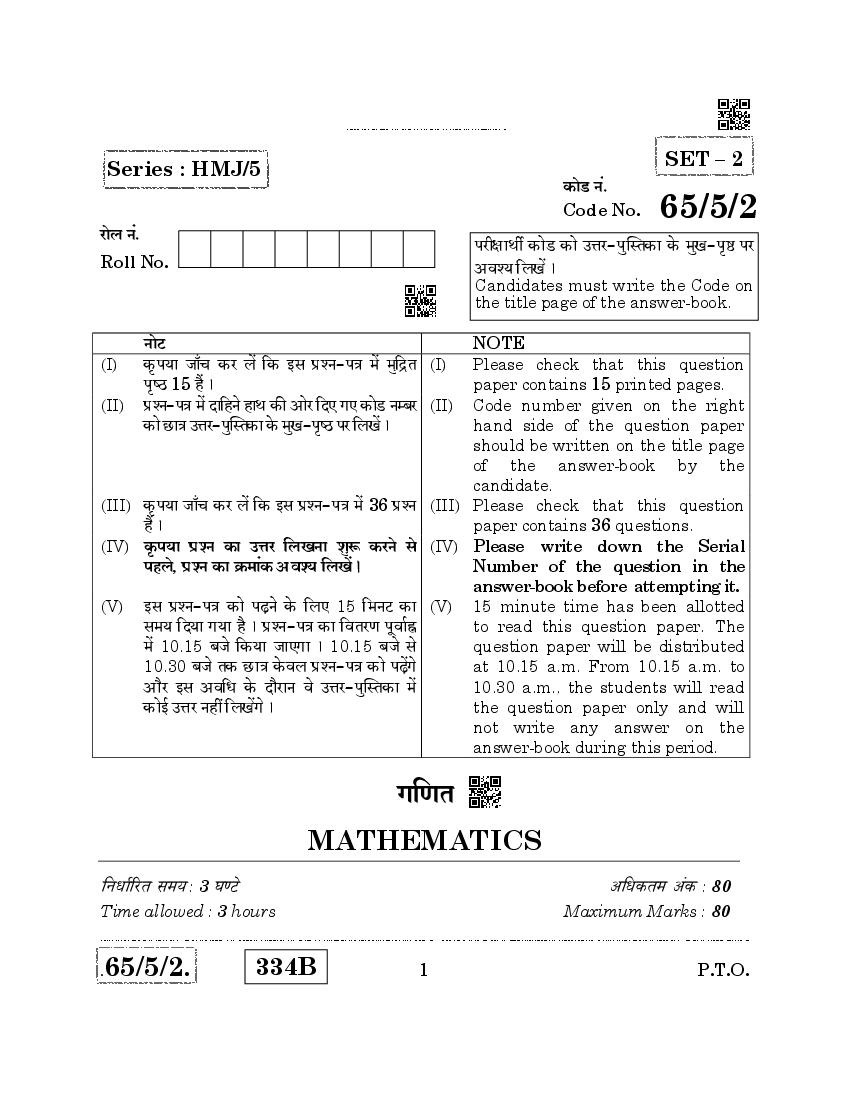
Code No. 65/5/2
.
- -
Roll No.
Candidates must write the Code on
the title page of the answer-book.
NOTE
(I) - (I) Please check that this question
15 paper contains 15 printed pages.
(II) - (II) Code number given on the right
- - hand side of the question paper
should be written on the title page
of the answer-book by the
candidate.
(III) - 36 (III) Please check that this question
paper contains 36 questions.
(IV) (IV) Please write down the Serial
, Number of the question in the
answer-book before attempting it.
(V) - 15 (V) 15 minute time has been allotted
- to read this question paper. The
10.15 10.15 question paper will be distributed
10.30 - at 10.15 a.m. From 10.15 a.m. to
- 10.30 a.m., the students will read
the question paper only and will
not write any answer on the
answer-book during this period.
MATHEMATICS
{ZYm©[aV g‘¶ : 3 KÊQ>o A{YH$V‘ A§H$ : 80
Time allowed : 3 hours Maximum Marks : 80
. 65/5/2. 334B 1 P.T.O.
Page 2
(i) - – , , 36
(ii) - 1 20 20
(iii) - 21 26 6
(iv) - 27 32 6
(v) - 33 36 4 :
(vi) - - , -
, - -
(vii) , ,
(viii)
–
1 10 :
1 0
1. [x 1] –2 0 = O , x
(a) 0 (b) –2 (c) –1 (d) 2
. x x
2. .4 3 dx
12x 4x
(a) +C (b) +C
log12 log4
4x 3x 3x
(c) +C (d) +C
log4 log3 log3
.65/5/2. 2
Page 3
Read the following instructions very carefully and strictly follow them :
(i) This question paper comprises four sections – A, B, C and D.
This question paper carries 36 questions. All questions are compulsory.
(ii) Section A – Question no. 1 to 20 comprises of 20 questions of one mark
each.
(iii) Section B – Question no. 21 to 26 comprises of 6 questions of two
marks each.
(iv) Section C – Question no. 27 to 32 comprises of 6 questions of four
marks each.
(v) Section D – Question no. 33 to 36 comprises of 4 questions of six
marks each.
(vi) There is no overall choice in the question paper. However, an internal
choice has been provided in 3 questions of one mark, 2 questions of two
marks, 2 questions of four marks and 2 questions of six marks. Only
one of the choices in such questions have to be attempted.
(vii) In addition to this, separate instructions are given with each section
and question, wherever necessary.
(viii) Use of calculators is not permitted.
Section – A
Question numbers 1 to 10 are multiple choice questions. Select the correct
option :
1 0
1. If [x 1] = O, then x equals
–2 0
(a) 0 (b) –2 (c) –1 (d) 2
. x x
2. .4 3 dx equals
12x 4x
(a) +C (b) +C
log12 log4
4x 3x 3x
(c) +C (d) +C
log4 log3 log3
.65/5/2. 3 P.T.O.
Page 4
2 3 7 9
(a) (b) (c) (d)
5 5 10 10
4. ABCD E
EA + EB + EC + ED
(a) 0 (b) AD (c) 2BC (d) 2AD
5. A 3 A (adj A) = 10 I , |adj A|
(a) 1 (b) 10 (c) 100 (d) 101
6. 52 , ,
1 4 1 1
(a) (b) (c) (d)
3 13 4 2
7. ^i, ^j, k^ ,
(a) ^i ^j = 1 (b) ^i ^j = 1 (c) ^i k^ = 0 (d) ^i k^ = 0
8. 2x + 3y > 6 :
(a)
(b) , 2x + 3y = 6
(c) XOY-, 2x + 3y = 6
(d) XOY-
x–2 y–3 4–z x–1 y–4 z–5
9. 1 =
1
=
k
k = 2 = –2 , k
2 2
(a) – (b) (c) – 2 (d) 2
3 3
.65/5/2. 4
Page 5
chosen number is a multiple of 2 or 5 is
2 3 7 9
(a) (b) (c) (d)
5 5 10 10
4. ABCD is a rhombus whose diagonals intersect at E. Then EA + EB + EC +
ED equals
(a) 0 (b) AD (c) 2BC (d) 2AD
5. If A is a square matrix of order 3, such that A (adj A) = 10 I, then |adj A|
is equal to
(a) 1 (b) 10 (c) 100 (d) 101
6. A card is picked at random from a pack of 52 playing cards. Given that the
picked card is a queen, the probability of this card to be a card of spade is
1 4 1 1
(a) (b) (c) (d)
3 13 4 2
7. If ^i, ^j, k^ are unit vectors along three mutually perpendicular directions, then
(a) ^i ^j = 1 (b) ^i ^j = 1 (c) ^i k^ = 0 (d) ^i k^ = 0
8. The graph of the inequality 2x + 3y > 6 is
(a) half plane that contains the origin.
(b) half plane that neither contains the origin nor the points of the line
2x + 3y = 6.
(c) whole XOY – plane excluding the points on the line 2x + 3y = 6.
(d) entire XOY plane.
x–2 y–3 4–z x–1 y–4 z–5
9. The lines = = and = = are mutually
1 1 k k 2 –2
perpendicular if the value of k is
2 2
(a) – (b) (c) – 2 (d) 2
3 3
.65/5/2. 5 P.T.O.
Page 6
10. y = Ae5x + Be–5x , dx2
(a) 25 y (b) 5 y (c) – 25 y (d) 15 y
11 15 ,
11. A ______ a1, a2 , a3 A
(a1, a2) R (a2, a3) R (a1, a3)R
dy
12. x dx + 2y = x2 _____.
dy 2
1 + dx = x ______
13. (3, 4, –7) (1, – 1, 6) _______.
_______
1 0 –1 1
14. A + B = 1 1 A – 2B = 0 –1 , A = _________
b
15. f(x) = ax + x (a > 0, b > 0, x > 0) _____.
16 20
1
16. : sin 3 – sin–1 –2.
17. , 36.6 2
y = 2 cos2(3x) x = 6
.65/5/2. 6
Page 7
10. If y = Ae5x + Be–5x, then is equal to
dx2
(a) 25 y (b) 5 y (c) –25 y (d) 15 y
Fill in the blanks in Questions from 11 to 15.
11. A relation R on a set A is called ______, if (a 1, a2) R and (a2, a3) R
implies that (a1, a3)R, for a1, a2, a3 A.
dy
12. The integrating factor of the differential equation x + 2y = x2 is _____.
dx
OR
2
dy
The degree of the differential equation 1 + = x is ______ .
dx
13. The vector equation of a line which passes through the points (3, 4, –7)
and (1, – 1, 6) is _______.
OR
The line of shortest distance between two skew lines is _______ to both the
lines.
1 0 –1 1
14. If A + B = and A – 2B = , then A = _________.
1 1 0 –1
b
15. The least value of the function f(x) = ax + (a > 0, b > 0, x > 0) is _____.
x
Q. Nos. 16 to 20 are of very short answer type questions.
1
16. Evaluate : sin – sin–1 – .
3 2
17. Using differential, find the approximate value of 36.6 upto 2 decimal
places.
OR
Find the slope of tangent to the curve y = 2 cos2(3x) at x =
6
.
.65/5/2. 7 P.T.O.
Page 8
.
18.
.
|x – 5|dx
1
19. f, , x = 3 , k
2
xx –– 39 , x 3
f(x) =
k ,x=3
3 –4
20. A = 1 A–1
–1
–
21 26 2
. x+1
21. :
.
x (1 – 2x)
dx
.x sin–1(x2)
22. : . dx
1 – x4
1
.
23. . x(1 – x)n dx
0
d2y
24. x = a cos ; y = b sin , dx2
ecosx sin2 x
25. A B , P(A) = 0.3 P(B) = 0.6, P(A B)
.65/5/2. 8
Page 9
.
18. Find the value of . |x – 5|dx.
1
19. If the function f defined as
2
xx –– 39 , x 3
f(x) =
k ,x=3
is continuous at x = 3, find k.
3 –4
20. For A = write A–1.
1 –1
Section – B
Q. Nos. 21 to 26 carry 2 marks each.
. x+1
21. Find . dx.
x (1 – 2x)
.x sin–1(x2)
22. Evaluate . dx.
1 – x4
1
.
23. Find the value of . x(1 – x)n dx.
0
d2y
24. If x = a cos ; y = b sin , then find .
dx2
OR
Find the differential of sin2 x w.r.t. ecosx.
25. Given two independent events A and B such that P(A) = 0.3 and
P(B) = 0.6, find P(A B)
.65/5/2. 9 P.T.O.
Page 10
26. f(x) = 6x – 4 , x 3 , x 3 (fof) (x) = x, f
ℝ R = {(a, b) : a < b} (i) ,
(ii)
–
27 32 4
1 9
27. tan 2 tan–1 2 – cot–13 = 13
dy
28. y = (cos x)x +tan–1 x , dx
a = ^i + 2^j + 3^k b = 2^i + 4^j – 5^k
29.
,
, ABC A (1, 2, 3), B(2, –1, 4) C (4, 5, – 1),
30. A
5 10 B 8
8 3 20
4 A ` 100 B
` 120
-
.65/5/2. 10
Page 11
26. If f(x) = , x , then show that (fof) (x) = x, for all x . Also, write
6x – 4 3 3
inverse of f.
OR
Check if the relation R in the set of real numbers defined as
R = {(a, b) : |a| < b} is (i) symmetric, (ii) transitive
Section – C
Q. Nos. 27 to 32 carry 4 marks each.
1 9 .
27. Prove that tan 2 tan–1 – cot–13 =
2 13
dy .
28. If y = (cos x)x +tan–1 x, find
dx
29. If a = ^i + 2^j + 3^
k and b = 2^i + 4^j – 5^
k represent two adjacent sides of a
parallelogram, find unit vectors parallel to the diagonals of the
parallelogram.
OR
Using vectors, find the area of the triangle ABC with vertices A (1, 2, 3),
B(2, –1, 4) and C (4, 5, – 1).
30. A company manufactures two types of novelty souvenirs made of plywood.
Souvenirs of type A requires 5 minutes each for cutting and 10 minutes each
for assembling. Souvenirs of type B require 8 minutes each for cutting and 8
minutes each for assembling. Given that total time for cutting is 3 hours 20
minutes and for assembling 4 hours. The profit for type A souvenir is ` 100
each and for type B souvenir, profit is ` 120 each. How many souvenirs of
each type should the company manufacture in order to maximize the profit ?
Formulate the problem as an LPP and solve it graphically.
.65/5/2. 11 P.T.O.
Page 12
X 30 A 40 B
Y , 50 A 60 B
B Y
32.
y dy y
x sin + x – y sin = 0
x dx x
x = 1 y = 2
–
33 36 6
33. a, b, c p, q, r ,
log a p 1
log b q 1
=0
log c r 1
2 –3 5
A = 3 2 –4 , A–1
1 1 –2
A–1 ,
2x – 3y + 5z = 11
3x + 2y – 4z = –5
x + y – 2z = – 3
.65/5/2. 12
Page 13
distribution of the number of rotten apples, if three apples are drawn one by
one with replacement. Find the mean of the number of rotten apples.
OR
In a shop X, 30 tins of ghee of type A and 40 tins of ghee of type B which
look alike, are kept for sale. While in shop Y, similar 50 tins of ghee of type
A and 60 tins of ghee of type B are there. One tin of ghee is purchased from
one of the randomly selected shop and is found to be of type B. Find the
probability that it is purchased from shop Y.
32. Solve the differential equation :
y dy y
x sin + x – y sin = 0
x dx x
.
Given that x = 1 when y =
2
Section – D
Q. 33 to 36, carry 6 marks each.
33. If a, b, c are pth, qth and rth terms respectively of a G.P, then prove that
log a p 1
log b q 1
=0
log c r 1
OR
2 –3 5
If A = 3 2 –4 , then find A–1.
1 1 –2
Using A–1, solve the following system of equations :
2x – 3y + 5z = 11
3x + 2y – 4z = –5
x + y – 2z = – 3
.65/5/2. 13 P.T.O.
Page 14
x+2 y–3 z+1 x–1 y–2 z–3
= = ; = =
1 2 4 2 3 4
35. x2 + y2 = 9 (x – 3)2 + y2 = 9
:
4
. 2
.(x – x) dx
1
36. y2 = 4x (2, 1)
________
.65/5/2. 14
Page 15
the lines with equations
x+2 y–3 z+1 x–1 y–2 z–3
= = and = =
1 2 4 2 3 4
and passes through the point (1, 1, 1). Also find the angle between the
given lines.
35. Using integration find the area of the region bounded between the two circles
x2 + y2 = 9 and (x – 3)2 + y2 = 9.
OR
4
.
Evaluate the following integral as the limit of sums .(x2 – x) dx.
1
36. Find the point on the curve y2 = 4x which is nearest to the point (2, 1).
________
.65/5/2. 15 P.T.O.
Page 16
Document Details
| Board / Org | CBSE |
| Exam | Class 12 |
| Type | Question Paper |
| Pages | 16 |
| Updated | 22 Jul 2026 |