CBSE Class 12 Sample Paper 2027 Solution (Marking Scheme) for Graphics
Finished viewing? Save it for later —
Download CBSE Class 12 Sample Paper 2027 Solution (Marking Scheme) for Graphics (PDF · 6 pages)About CBSE Class 12 Sample Paper 2027 Solution (Marking Scheme) for Graphics
CBSE Class 12 Sample Paper 2027 Solution (Marking Scheme) for Graphics is available here for free download. Published by CBSE for Class 12, this solution can be viewed online or downloaded as a PDF (6 pages). Candidates preparing for Class 12 can use CBSE Class 12 Sample Paper 2027 Solution (Marking Scheme) for Graphics to understand the exam pattern, the type of questions asked, and the overall difficulty level.
Frequently Asked Questions
How can I download CBSE Class 12 Sample Paper 2027 Solution (Marking Scheme) for Graphics?
Open this page and click the Download button to save CBSE Class 12 Sample Paper 2027 Solution (Marking Scheme) for Graphics as a PDF. It is completely free on AglaSem Docs.
Is CBSE Class 12 Sample Paper 2027 Solution (Marking Scheme) for Graphics free to download?
Yes. CBSE Class 12 Sample Paper 2027 Solution (Marking Scheme) for Graphics can be viewed online and downloaded as a PDF free of cost on AglaSem Docs.
How many pages does CBSE Class 12 Sample Paper 2027 Solution (Marking Scheme) for Graphics have?
CBSE Class 12 Sample Paper 2027 Solution (Marking Scheme) for Graphics contains 6 pages, which you can read online or download together as a single PDF.
Where can I find more Class 12 study material?
You can find more Class 12 question papers, sample papers, syllabus, and answer keys on AglaSem Docs.
CBSE Class 12 Sample Paper 2027 Solution (Marking Scheme) for Graphics – Text
Read the full text of this solution below — useful to quickly search, copy and reference the content online without downloading the PDF.
📄 View text version (7 pages)
Page 1
CBSE Class 12 Sample
Paper 2027 Solution
(Marking Scheme) for
Graphics
EXAM YEAR TYPE SUBJECT
CBSE Class 12 2027 Solutions Graphics
Notes · Sample Papers · Previous Year Papers · Mock Tests
Page 2
.co s e m
s em l a
a ag
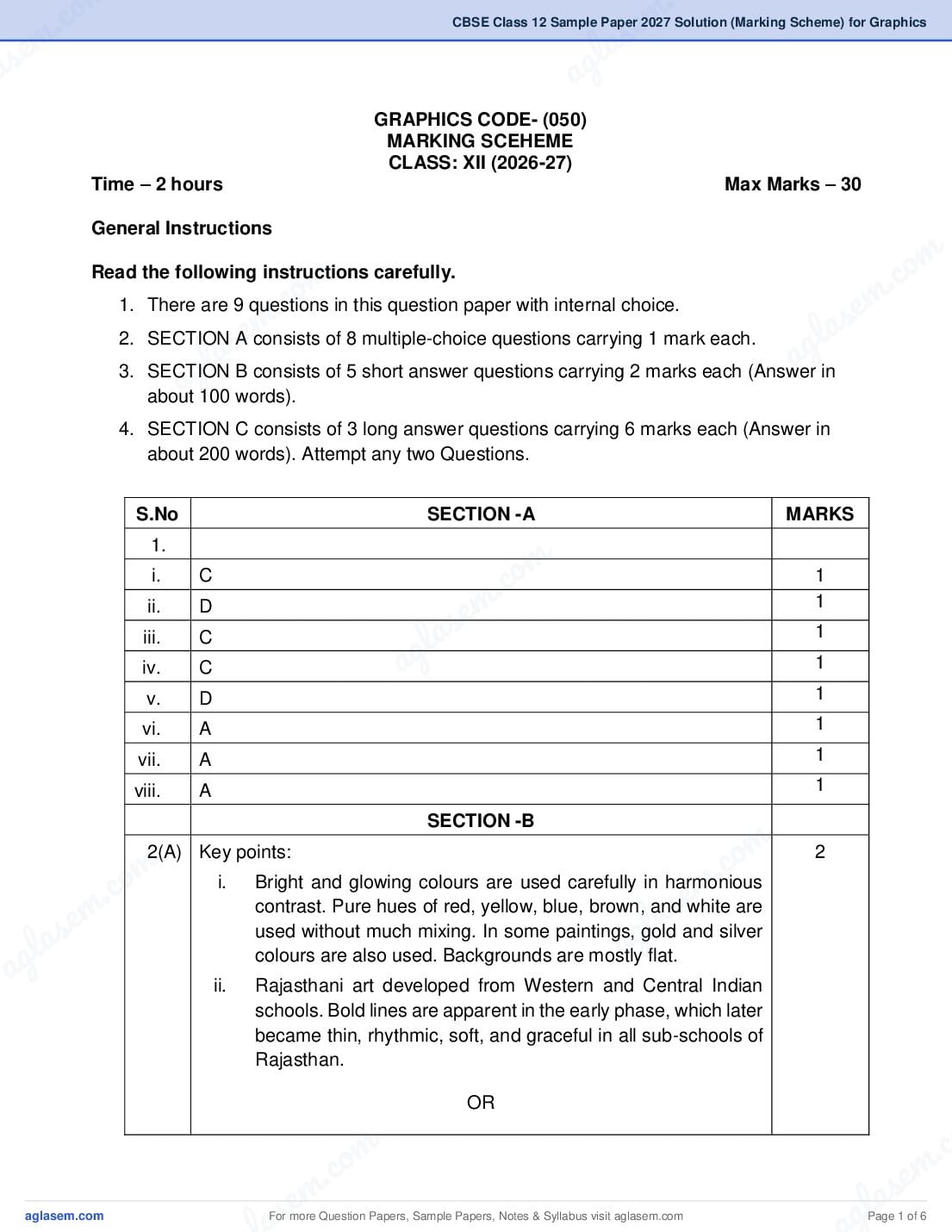
GRAPHICS CODE- (050)
MARKING SCEHEME
CLASS: XII (2026-27)
Time – 2 hours Max Marks – 30
General Instructions
m
om
Read the following instructions carefully.
. co
. c e m
1. There are 9 questions in this question paper with internal choice.
m
2. SECTION sAeconsists of 8 multiple-choice questions carrying 1 mark each. l as
a g
a in
l B consists of 5 short answer questions carrying 2 marks each (Answer
g
a 100 words).
3. SECTION
about
4. SECTION C consists of 3 long answer questions carrying 6 marks each (Answer in
about 200 words). Attempt any two Questions.
S.No SECTION -A MARKS
1.
m
i. C
m .co 1
ii. D
s e 1
l a 1
ag
iii. C
iv. C 1
v. D 1
vi. A 1
vii. A 1
viii. A 1
SECTION -B
o m
m
2(A) Key points:
. c 2
m .co i.
m
ewhite are
Bright and glowing colours are used carefully in harmonious
s
e la and silver
contrast. Pure hues of red, yellow, blue, brown, and
las used without much mixing. In some paintings,ggold
a flat.
ag colours are also used. Backgrounds are mostly
ii. Rajasthani art developed from Western and Central Indian
schools. Bold lines are apparent in the early phase, which later
became thin, rhythmic, soft, and graceful in all sub-schools of
Rajasthan.
OR
m . c
c. o s e m
s em
For more Question Papers, Sample Papers, Notes & Syllabus visit
gl a
Page 1 of 6
Page 3
Artist: Dana – ½ mark
ii. Interpretation / description of empowerment of women – 1
mark
(Key ideas may include: princess playing chaugan/polo, decorated
horses, confident posture, bell-shaped ghaghara, Rajasthani attire,
leadership qualities, individuality, dignity, equal rights, and women as
an integral part of society.)
3(A) Meghdoot 2
The painting is based on Kalidasa’s lyrical poem Meghdoot. It
narrates the story of a Yaksha exiled by King Kubera, who sends his
message of love to his wife through a passing cloud. The Yaksha is
shown seated on rocks in a forest, writing his emotions on a leaf. His
youthful features, sorrowful expression, soft colours, and sharp yet
delicate lines convey longing, separation, and poetic sensitivity.
OR
3(B) i. Explanation of the symbolic meaning of the National Flag 2
colours – 1 mark
ii. Justification of how these symbols promote unity, pride, and
commitment – 1 mark
(Key ideas: saffron, white, green, Ashoka Chakra with 24 spokes,
courage, peace, prosperity, duty, unity, nationalism.)
4(A) Painting and Artist: Kabir and Raidas by Ustad Faquirullah Khan. 2
Explain Medium and Technique: Tempera (watercolour) on paper.
Wash Technique.
The composition shows two simple human figures working in a
humble village setting. The use of light and shade, perspective, and
realistic portrayal reflects simplicity, secularism, friendship, devotion
to work, and peaceful coexistence.
OR
4(B) Bijapur School – Any four characteristics:
2
i. Mughal, Persian, European, and Turkish influences, including
high horizons and golden skies – ½ mark
ii. Tall, fair-complexioned, emotionally expressive figures – ½
mark
iii. Brilliant, rich colours with harmonious composition – ½ mark
For more Question Papers, Sample Papers, Notes & Syllabus visit Page 2 of 6
Page 4
.co s e m
s em l a
a ag
iv. Dominance of subject matter on women empowerment – ½
mark
** (Any other points from the syllabus can also be considered
apart from the ones mentioned)
5(A) Basohli artists had a tendency to show high horizon in their miniature 2
paintings:
m
The statement is true for Basohli School painting. The rich colors,
om . co
m
mastery of line and sensitive portrayal of nature compensated for
. c
it. The high horizon in Basohli is commonly seen with just an inch-
s e
e m l a
s
long strip of the sky in the upper part. At times, there is no horizon
l a but a simple plane background. Paintings are based on Folk Art:
ag
ag The symmetrical ornamentation of nature especially trees have a
typical folk influence.
Or
5(B) The Pahari miniatures in terms of human values that are shown in 2
them.
The sentiment of love and devotion as an inspiration and the central
theme is beautifully executed in Pahari painting.
i. Love, faith, devotion and surrender for the supreme power.
ii. Equal love for all followers.
m
.co
iii. This painting has its own distinct place in terms of delicate lines
and colour treatment.
iv. To be faithful to the master.
e m
v.
l as
To be a good member of the group / team for common interest.
ag
vi. All decide to move together and stay together.
(Any four)
6(A) i. Painting- Mother Teresa, Medium and Technique- Oil on 1+1
Canvas -1 Marks
ii. Compositional arrangement: -1 Marks
Social Worker-Mother Teresa, Abstract Figures, Hollow Face,
Compassion, Human Forms of Different Age, White Saree with Blue
Borders Symbolizing Mother Teresa, Central Figure on Mother’s Lap,
m
.co
Healing Hand, Selflessness, Noble, Kind, Helpful, Optimistic
m
.co
Approach, Etc.
Or
e m
em 6(B) Printmaker and technique of this print- Somnath Hore,
las 2
las Etching and Aquatant on Paper-1 Marks
ag
ag The print is a visualization of the artist’s emotional response to the
pain and suffering of the poor and deprived - the wounded humanity.
It is about the physical suffering of the victimized and the wounded,
with no hope of rescue in this world.
Symbolising the artist's protest against the injustice towards the
innocent poor people. It is a composition of five standing figures
m . c
c. o s e m
s em
For more Question Papers, Sample Papers, Notes & Syllabus visit
gl a
Page 3 of 6
Page 5
have bloated stomachs and thin rectangular ribcages showing the
effects of prolonged hunger. Heads are enormous skulls with small
bony faces resting on rickety torsos and limbs.
SECTION-C
Attempt any two questions from the given options
7. Elaboration of main sub schools: - 3 Marks 3+3
Mewar School: The whole of Rajasthan was affected by the attack of
the Mughals but Mewar did not come under their control till the end.
This was the reason that Rajasthani School flourished in its purest
form in Mewar and later on in Jaipur, Jodhpur, Amber, Kota, Bundi,
Kishan Garh, Bikaner and other places of Rajasthan. Mewar contains
elements of central Indian style which itself is a blend of Western
Indian Gujarat-Jain manuscript school with Persian influences.
Kishangarh School: The estate (Jagir) which was inherited by Kishan
Singh, the eighth son of Raja Udai Singh of Jodhpur is known as
Kishangarh. This small state surrounded by Jaipur, Jodhpur and
Ajmer saw a sudden spark of genius when the art of other states was
almost nearing the end during the reign of Raja Raj Singh and later
his son Raja Sawant Singh. Sawant Singh was a scholar and an
expert in Music, Poetry and Painting.
Jaipur School: The Jaipur School reached its peak in the 18th century
A.D. when Mughal influence weakened after the rule was ousted.
Before that, under Jai Singh I, the close alliance with Delhi and
patronage in art by Akbar remained deep-rooted. Though artists tried
to come out of the mughal influence with subjects from Hindu epics
and the romances of lord Krishna, the effect remained. Jai Singh II
shifted the capital to Jaipur from Amber. -3 Marks
Any three sub schools.
Main features:
i. Vibrant Colors – The paintings prominently use bright colors
like red, yellow, blue, and green, often derived from natural
sources. Gold and silver are also used for embellishment.
ii. Religious Themes – Most paintings depict themes from
Ramayana, Mahabharata, Bhagavata Purana, and the life of
Lord Krishna, especially his interactions with Radha and the
Gopis.
iii. Flat Backgrounds – The backgrounds are often plain or
decorated with floral designs, architecture, or landscapes to
highlight the main subject.
8. Appreciate the sculpture by the artist Ramkinkar Baij: 6
Sculpture & Medium: -1 Marks
For more Question Papers, Sample Papers, Notes & Syllabus visit Page 4 of 6
Page 6
.co s e m
s em l a
a ag
Santhal Family, Cement and Concrete on Metal Armature
Subject Matter: -2 Marks
Santhal Family is a round, free-standing outdoor sculpture. It is a
depiction of a tribal peasant family-a man, a woman, children and a
dog. It is regarded as the first public modernist sculpture in India.
o m
m . c
DESCRIPTION:
co textured sculptural group, comprising an adult male
This is a .rough
-3 Marks
s e m
m - obviously a couple, with the female holding a child
and aefemale l a
s
la thechild ag
g
onto left side of her body with her left arm. The male is carrying
a other side of the bamboo) hanging from a bamboo pole on his
another who is sitting on the front basket (one basket is on the
shoulder. A lively dog walks along happily.
Key points that can be used in the answer: (Ram Kinkar Baij,
Sculpture-Santhal Family, Cement, Concrete, Cement Mixed with
Pebbles, Metal Rods, Migration of Family, Poverty, Hunger, Financial
Crisis, Human Figure, Animal Figure, Rough Texture, Emotions,
Complex Composition, Together in Different Times.)
“This print given below depicts the figure of a lonely woman seated
9.
m 2+2+2
on the pavement before a dilapidated wall.”
c. o
e m
I.
s
Name of the printmaker, print, technique, subject matter:
l a
ag
Anupam Sud, OF WALLS, Etching on Paper
This print is a journey of the artist down her memory lane-
memoirs of childhood. The subject is unconsciously lost in the
mystery of time, with nothing in particular but a gliding image
that has found a place in her creation. This work is often
interpreted as a representation of poverty and loneliness.
However, for the artist it is more of a personal moment.
II. The glimpse of the lower part of a poor man sleeping on the
ground, contrasting with the clothed woman, add to the
m
m sadness of the print. The wall stayed in the subconscious
.co
m .co because it was very big for the child that lived there once, but
s e m
s e now it seems to have shrunk. The print is etched in brown
g la
g la colour and line drawings are in white. A poor faceless lady
a
a sitting on a pavilion of the wall on one side is clad in an untidy-
looking sari and has bare feet. In the foreground, two legs and
a foot are visible, of a man sleeping near the wall.
The artist's keen power of seeing the ordinary and then
transferring that realism without any beauty or glamour onto
the etchings is extraordinary. She could extract immense
emotive and visual details out of her medium.
m . c
c. o s e m
s em
For more Question Papers, Sample Papers, Notes & Syllabus visit
gl a
Page 5 of 6
Page 7
face: Anupam Sud exposed the hidden face of society and
presented it in a straight forward manner. She was always
interested in the feminine subjects, depicting women's
deprivation and exploitation and explored the nature of her
psyche. In this case, the faceless figure of the woman
represents her vulnerability and emptiness in continuous,
endless time. The work is thoughtful, haunting and indistinct
with the deep monochromes enhancing the overall effect.
Key Points that can be used in the Answer. (Situation In Indian
Society of a Widow Shown Through Black Face and White
Garments, Discrimination from Society, Wall Used as a
Blackboard Narating Life Situation of Women Before and After
Husband’s Death, Conservative Believes, Showing Man
Dominated Society and Helplessness of the Family.)
For more Question Papers, Sample Papers, Notes & Syllabus visit Page 6 of 6
Document Details
| Board / Org | CBSE |
| Exam | Class 12 |
| Type | Solution |
| Pages | 6 |
| Updated | 29 Oct 2026 |