CBSE Class 12 Question Paper 2025 Solution Legal Studies
Finished viewing? Save it for later —
Download CBSE Class 12 Question Paper 2025 Solution Legal Studies (PDF · 29 pages)About CBSE Class 12 Question Paper 2025 Solution Legal Studies
CBSE Class 12 Question Paper 2025 Solution Legal Studies is available here for free download. Published by CBSE for Class 12, this solution can be viewed online or downloaded as a PDF (29 pages). Candidates preparing for Class 12 can use CBSE Class 12 Question Paper 2025 Solution Legal Studies to understand the exam pattern, the type of questions asked, and the overall difficulty level.
Frequently Asked Questions
How can I download CBSE Class 12 Question Paper 2025 Solution Legal Studies?
Open this page and click the Download button to save CBSE Class 12 Question Paper 2025 Solution Legal Studies as a PDF. It is completely free on AglaSem Docs.
Is CBSE Class 12 Question Paper 2025 Solution Legal Studies free to download?
Yes. CBSE Class 12 Question Paper 2025 Solution Legal Studies can be viewed online and downloaded as a PDF free of cost on AglaSem Docs.
How many pages does CBSE Class 12 Question Paper 2025 Solution Legal Studies have?
CBSE Class 12 Question Paper 2025 Solution Legal Studies contains 29 pages, which you can read online or download together as a single PDF.
Where can I find more Class 12 study material?
You can find more Class 12 question papers, sample papers, syllabus, and answer keys on AglaSem Docs.
CBSE Class 12 Question Paper 2025 Solution Legal Studies – Text
Read the full text of this solution below — useful to quickly search, copy and reference the content online without downloading the PDF.
📄 View text version (29 pages)
Page 1
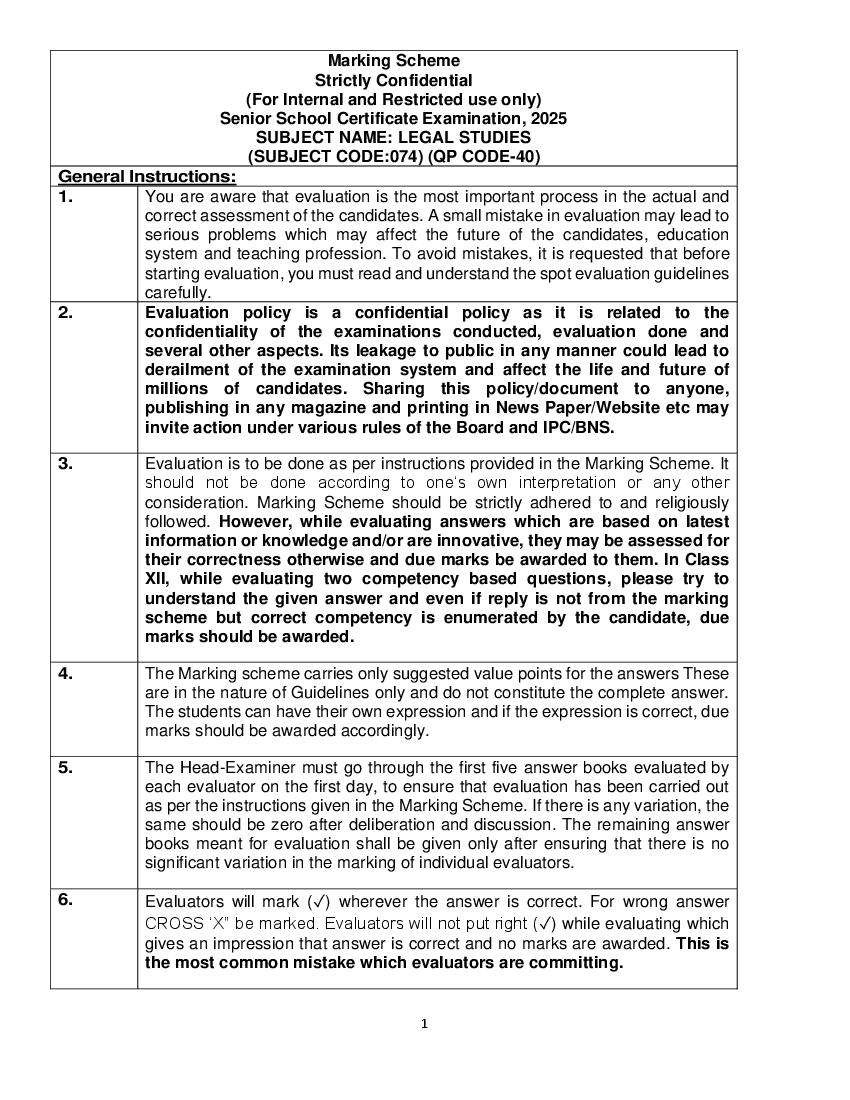
Strictly Confidential
(For Internal and Restricted use only)
Senior School Certificate Examination, 2025
SUBJECT NAME: LEGAL STUDIES
(SUBJECT CODE:074) (QP CODE-40)
General Instructions:
1. You are aware that evaluation is the most important process in the actual and
correct assessment of the candidates. A small mistake in evaluation may lead to
serious problems which may affect the future of the candidates, education
system and teaching profession. To avoid mistakes, it is requested that before
starting evaluation, you must read and understand the spot evaluation guidelines
carefully.
2. Evaluation policy is a confidential policy as it is related to the
confidentiality of the examinations conducted, evaluation done and
several other aspects. Its leakage to public in any manner could lead to
derailment of the examination system and affect the life and future of
millions of candidates. Sharing this policy/document to anyone,
publishing in any magazine and printing in News Paper/Website etc may
invite action under various rules of the Board and IPC/BNS.
3. Evaluation is to be done as per instructions provided in the Marking Scheme. It
should not be done according to one‘s own interpretation or any other
consideration. Marking Scheme should be strictly adhered to and religiously
followed. However, while evaluating answers which are based on latest
information or knowledge and/or are innovative, they may be assessed for
their correctness otherwise and due marks be awarded to them. In Class
XII, while evaluating two competency based questions, please try to
understand the given answer and even if reply is not from the marking
scheme but correct competency is enumerated by the candidate, due
marks should be awarded.
4. The Marking scheme carries only suggested value points for the answers These
are in the nature of Guidelines only and do not constitute the complete answer.
The students can have their own expression and if the expression is correct, due
marks should be awarded accordingly.
5. The Head-Examiner must go through the first five answer books evaluated by
each evaluator on the first day, to ensure that evaluation has been carried out
as per the instructions given in the Marking Scheme. If there is any variation, the
same should be zero after deliberation and discussion. The remaining answer
books meant for evaluation shall be given only after ensuring that there is no
significant variation in the marking of individual evaluators.
6. Evaluators will mark (✓) wherever the answer is correct. For wrong answer
CROSS ‘X” be marked. Evaluators will not put right (✓) while evaluating which
gives an impression that answer is correct and no marks are awarded. This is
the most common mistake which evaluators are committing.
1
Page 2
Marks awarded for different parts of the question should then be totalled up and
written in the left- hand margin and encircled. This may be followed strictly.
8. If a question does not have any parts, marks must be awarded in the left-hand
margin and encircled. This may also be followed strictly.
9. If a student has attempted an extra question, the answer of the question
deserving more marks should be retained and the other answer scored out with
a note ‘Extra Question’
10. No marks to be deducted for the cumulative effect of an error. It should be
penalized only once.
11. A full scale of marks 0 to 80 has to be used. Please do not hesitate to award full
marks if the answer deserves it.
12. Every examiner has to necessarily do evaluation work for full working
hours i.e., 8 hours every day and evaluate 20 answer books per day in
main subjects and 25 answer books per day in other subjects (Details are
given in Spot Guidelines).
13. Ensure that you do not make the following common types of errors committed
by the Examiner in the past: -
● Leaving the answer or part thereof unassessed in an answer book.
● Giving more marks for an answer than assigned to it.
● Wrong totalling of marks awarded on an answer.
● Wrong transfer of marks from the inside pages of the answer book to the title
page.
● Wrong question wise totalling on the title page.
● Wrong totalling of marks of the two columns on the title page.
● Wrong grand total.
● Marks in words and figures not tallying/not same.
● Wrong transfer of marks from the answer book to online award list.
● Answers marked as correct, but marks not awarded. (Ensure that the right tick
mark is correctly and clearly indicated. It should merely be a line. Same is with
the X for incorrect answers.)
● Half or a part of the answer marked correct and the rest as wrong, but no marks
awarded.
14. While evaluating the answer books if the answer is found to be totally incorrect,
it should be marked as cross (X) and awarded zero (0) Marks.
15. Any unassessed portion, non-carrying over of marks to the title page, or totalling
error detected by the candidate shall damage the prestige of all the personnel
engaged in the evaluation work and also of the Board. Hence, in order to uphold
the prestige of all concerned, it is again reiterated that the instructions be
followed meticulously and judiciously.
16. The Examiners should acquaint themselves with the guidelines given in the
‘Guidelines for Spot Evaluation’ before starting the actual evaluation.
2
Page 3
carried over to the title page, correctly totalled and written in figures and words.
18. The candidates are entitled to obtain a photocopy of the Answer Book on request
on payment of the prescribed processing fee. All Examiners/Additional Head
Examiners/Head Examiners are once again reminded that they must ensure that
evaluation is carried out strictly as per value points for each answer as given in
the Marking Scheme.
19. Please read the guidelines carefully and seek clarifications from the Head
Examiner in case of any doubt to reduce subjectivity and bias.
20. Every care has been taken to prepare the Marking Scheme. However, it is
important to keep in mind that it is neither exhaustive nor exclusive.
3
Page 4
LEGAL STUDIES
Q. QUESTION MARKS
NO.
SECTION – A
1 In a landmark case, the Supreme Court was handling a highly 1
technical environmental dispute involving multiple
stakeholders and scientific complexities. Given the intricate
details of environmental policies and scientific evidence, the
Court appointed an amicus curiae, an expert in environmental
law and science, to assist by providing impartial information and
insights on the matter. The amicus c u r i a e made
recommendations based on international standards, which
helped the Court in reaching its final decision.
Based on the concept of amicus curiae, which of the following
statements is correct?
(A) The amicus curiae advocates for the interests of
the public and acts as a representative for the
government.
(B) The amicus curiae serves as the legal advisor
to the party that requests their assistance in the
case.
(C) The amicus curiae assists the Court by providing
impartial expertise on complex issues, without
representing any party in the case.
(D) The amicus curiae is only allowed to assist in
cases related to constitutional matters.
ANS (C) The amicus curiae assists the Court by providing 1
impartial expertise on complex issues, without
representing any party in the case.
(Page no 13)
2 A High Court in India issues a verdict in a complex property 1
dispute, which left one party dissatisfied with the decision. The
aggrieved party now seeks to approach the Supreme Court
for special leave to appeal. Under Article 136, the Supreme
Court can grant special leave to appeal against any
judgement, decree or order in any matter passed by
(A) any court or tribunal in India (B) only High Court
(C) only subordinate court (D) only tribunals
ANS (A) any court or tribunal in India (Page no 9) 1
3 Assertion: (A): Any public-spirited person can file petition or 1
write letters to court on behalf of aggrieved persons.
4
Page 5
standi of the enforcement of fundamental rights through Public
Interest Litigations (PILs).
(A) Both (A) and (R) are true and (R) is the correct
explanation of (A).
(B) Both (A) and (R) are true, but (R) is not the correct
explanation of (A).
(C) (A) is true, but (R) is false.
(D) (A) is false, but (R) is true
ANS (A) Both (A) and (R) are true and (R) is the correct 1
explanation of (A). (Page no 10)
4 Arjun, at the request of the local community leader, builds a 1
playground for the children in his neighborhood, spending a
considerable amount of his own money. Later, Ravi, a local
snack vendor, sets up a stall near the playground to sell snacks
to children and promises to give Arjun 10% of his profits from
all sales as a token of appreciation for building the playground.
However, Ravi fails to pay Arjun the promised percentage, and
Arjun decides to take legal action to recover it. Based on
contract law principles, which of the following is correct?
(A) Arjun is entitled to the percentage of profits as Ravi
benefited from his efforts in building the
playground.
(B) Arjun cannot claim the percentage of profits, as the
playground was built at the request of the
community leader and not Ravi.
(C) Ravi must pay Arjun the promised percentage
since he made a verbal commitment to do so.
(D) Ravi has to pay Arjun only if Arjun can prove the
playground was built specifically for his benefit.
ANS (B) Arjun cannot claim the percentage of profits, as the 1
playground was built at the request of the
community leader and not Ravi. (Page no 55)
5 Ravi, at a local market, was involved in an argument with 1
Mohan over a disputed transaction. In the heat of the
argument, Ravi suddenly pushed Mohan forcefully, causing
Mohan to stumble backward and fall. Mohan suffered a
minor injury to his back as a result of the fall. Mohan believes
that Ravi’s action was an intentional physical contact that
resulted in harm, and he is considering suing Ravi for the tort
of battery.
Which of the following statements is correct regarding the tort
of battery in this case?
(A) Ravi’s action of pushing Mohan constitutes
battery, as it was an intentional and direct
application of physical force.
(B) Ravi is not liable for battery because the physical
contact was not severe enough to cause significant
5
Page 6
(C) The tort of battery requires that the defendant’s
action must cause permanent injury, which is not the
case here.
(D) Ravi is not liable for battery because his action was
a part of self- defense act, even if there was no
immediate threat to his safety.
ANS (A) Ravi’s action of pushing Mohan constitutes battery, as 1
it was an intentional and direct application of physical
force (Page no 64)
6 Raj signs a contract to perform at a music festival. A few days 1
before the festival, Raj develops a severe illness and doctors
advise him complete rest. He misses the performance.
Organisers of the event had to cut a sorry figure as Raj’s
performance was the highlight of the music festival.
Which of the given statements best describes Raj’s inability to
perform at the festival?
(A) It is breach of contract as Raj failed to fulfill his
obligation.
(B) It is discharge due to impossibility of performance
because the illness makes performance impossible.
(C) It is discharge by performance as Raj was willing
to perform if he hadn’t been ill.
(D) It is breach of contract as a health issue does not
discharge a contract.
ANS (B) It is discharge due to impossibility of performance because 1
the illness makes performance impossible. (Page no 60)
7 Neha, a photographer, takes a beautiful photograph of a sunset 1
and posts it on her personal blog. A local travel magazine uses
the image without Neha’s permission. The publishers credit Neha
as the photographer but do not pay her or seek her consent.
Neha considers taking legal action against the magazine. In
this context which of the following options is correct?
(A) Neha cannot take legal action because the
magazine credited her as the photographer.
(B) Neha can take legal action because her photograph
is protected by copyright and the magazine used it
without permission.
(C) Neha cannot take legal action because the
photograph was available for the general public on
her blog.
(D) Neha can only take legal action if she had
registered the photograph with a copyright office.
ANS (B)Neha can take legal action because her photograph is 1
protected by copyright and the magazine used it without
permission. (Page no 83,84)
8 A company, XYZ Corp., operates a large dam to generate 1
electricity. Due to an unforeseen design flaw the dam
suddenly bursts, causing massive flooding in a nearby town.
6
Page 7
no knowledge of the design flaw. The affected residents sue the
company for damages. Which of the following is applicable in
this instance?
(A) The company is not liable because the flaw was
unforeseen.
(B) The company is absolutely liable because the
operation of the dam is inherently dangerous and the
damages occurred regardless of the fault.
(C) The company is liable only if it is proven that they
ignored warning signs of the flaw.
(D) The company is not liable because it followed all
safety protocols.
ANS (B)The company is absolutely liable because the operation of the 1
dam is inherently dangerous and the damages occurred
regardless of the fault. (Page no 69)
9 Mohan lends his rare antique vase to his friend Sumit for a 1
week. Instead of returning it, Sumit accidentally drops and
shatters the vase while showing it to another friend. When
Mohan asks for his vase to be returned, Sumit apologizes but
says there is nothing he can do now that the vase is
destroyed. Mohan decides to take legal action. Identify the
legal claim he should pursue?
(A) He should file a claim for trespass to chattels because
Sumit damaged the vase while it was in his
possession.
(B) He should file a claim for trespass to chattels because
Sumit used the vase without permission.
(C) He should file a claim for conversion because
Sumit destroyed the vase, depriving him of its use
permanently.
(D) He should file a claim for conversion because
Sumit delayed returning the vase.
ANS (C)He should file a claim for conversion because 1
Sumit destroyed the vase, depriving him of its use
permanently. (Page no 65)
10 From the options given below, which statement accurately 1
describes the process of property registration in India?
(A) The buyer and seller exchange property documents
without involving any government authority.
(B) The property is officially transferred from the seller to
the buyer through a government-authorised deed,
affixed by a seal of the Registrar’s office.
(C) The buyer must pay property taxes before the sale is
completed – without the need for any legal
documentation.
7
Page 8
but no formal record is kept.
ANS (B) The property is officially transferred from the seller to the 1
buyer through a government-authorised deed, affixed by a seal
of the Registrar’s office. (Page no 75)
11 In a criminal trial in a country in continental Europe, the judge, 1
Judge Helena plays an active role in investigating the case.
She questions the witnesses, evaluates the evidences
presented by the parties and orders additional forensic test.
The defense lawyer, Mr. Jameson, expresses concern that the
judge’s active involvement in the investigation may undermine
the fairness of the trial. In the given content, identify the
probable disadvantage of the justice dispensation system that
is concerning for the defense lawyer.
(A) The active role of judge would prevent delays and
prolonged trials.
(B) Stronger party in the case, with more resources and
expert lawyers may not be able to influence the judges.
(C) The judge can no longer remain neutral to evaluate the
case with an open mind.
(D) Less reliance is placed on cross examination and other
techniques used by lawyers.
ANS (C)The judge can no longer remain neutral to evaluate the case 1
with an open mind. (Page no 35)
12 An advantage of is that there is no strict 1
application of the procedural laws and the disputing parties
can directly interact with the judges.
(A) Mediation (B) Lok Adalat
(B) Conciliation (D) Tribunal
ANS (B) Lok Adalat (Page no 45) 1
13 Omega Builders and Delta Constructions have a dispute 1
over project delays. The court suggest mediation, but
Omega Builders is unsure if their case qualifies. According
to the Afcons Infrastructure Ltd. vs. Cherian Varley
Construction Co. ruling, which disputes are generally
excluded from mediation?
(A) Commercial contracts
(B) Matrimonial and Custody issues
(C) Criminal offenses
(D) Consumer disputes
ANS (C) Criminal offenses (Page no 44) 1
14 Statement 1: Opinio juris prevents unwanted general 1
practice from becoming customary law.
Statement 2: Opinio juris is the belief that an action was
carried out as a legal obligation.
Choose the correct option:
8
Page 9
(B) Both statements are incorrect.
(C) Statement 1 is correct but Statement 2 is not
correct.
(D) Statement 2 is correct but Statement 1 is not
correct.
ANS (A) Both statements are correct. (Page no 171) 1
15 Assertion: (A): The Solicitor Regulation A ut hor it y (SRA) 1
does not Impose any formal experience requirement for
requalifying as solicitor in England and Wales.
Reasoning (R): It is not possible to be a barrister and solicitor.
(A) Both (A) and (R) are true and (R) is the correct
explanation of (A).
(B) Both (A) and (R) are true but (R) is not the correct
explanation of (A).
(C) (A) is true, (R) is false.
(D) (A) is false, (R) is true.
ANS (B)Both (A) and (R) are true but (R) is not the correct explanation 1
of (A).
(Page no 191)
16 Mei Ling is a practicing lawyer in Hong Kong. She is 1
considering launching a marketing campaign to attract more
clients. Which of the following is a feasible option for her?
(A) Proceed with the campaign on all media, since
lawyers are free to advertise without restrictions.
(B) Proceed with the campaign on print media.
(C) Launch the campaign but exclude testimonials,
success rates and any comparative statements.
(D) Avoid all forms of advertising as it is entirely
prohibited in Hong Kong.
ANS (B)Proceed with the campaign on print media. (Page no 187) 1
17 Assertion: (A):A Senior Advocate is not entitled to appear in 1
the Supreme Court without an Advocate-on-record.
Reasoning (R): Advocates-on-record are entitled to file an
appearance or act for a party in the Supreme Court.
(A) Both (A) and (R) are true and (R) is the correct
explanation of (A).
(B) Both (A) and (R) are true, but (R) is not the correct
explanation of (A).
(C) (A) is true, (R) is false.
(D) (A) is false, (R) is true.
ANS (A) Both (A) and (R) are true and (R) is the correct explanation 1
of (A). (Page no 184)
Q. 18 In light of the principles enshrined in Article 39A, which of the 1
following circumstances contradicts its core objective of equal
justice and free legal aid?
9
Page 10
citizens facing criminal prosecution.
(B) A wealthy individual is given legal aid despite having
adequate resources to access private legal counsel.
(C) A marginalized person is granted legal representation in
a civil matter by the state.
(D) The state facilities access to justice for those affected by
socio- economic disabilities
ANS (B) A wealthy individual is given legal aid despite having 1
adequate resources to access private legal counsel.
(Page no 198)
19 “Most accused persons do not lead defence evidence in India.” 1
Identify the reason for this from the options given below.
(A) The burden to prove the offence beyond reasonable doubt
is on the prosecution.
(B) The judge decides the case on its merit according to the
evidences presented by the defence.
(C) The assertion that the accused has committed offence is
sufficient to prove the guilt by prosecution.
(D) The accused is presumed guilty at the first instance when
the trial begins.
ANS (A) The burden to prove the offence beyond reasonable doubt 1
is on the prosecution. (Page no 119)
20 Statement 1: The Evidence Law helps the judges to separate 1
the ‘Wheat from the chaff’.
Statement 2 : The function of the law of evidence is to
provide a mechanism for the investigation and trial of
offenders.
Choose the correct option:
(A) Both statements are correct.
(B) Both statements are incorrect.
(C) Statement 1 is correct, but Statement 2 is not correct.
(D) Statement 2 is correct, but Statement 1 is not correct.
ANS (C)Statement 1 is correct, but Statement 2 is not correct. 1
(Page no 119)
SECTION – B
21 Explain the principle of judicial review. 2
ANS Judicial review is a principle or a legal doctrine or a practice whereby 2
a court can examine or review an executive or a legislative act, such
as law or some other governmental or administrative decision, and
determine if the act is incompatible with the constitution.
(Page no 22)
22 Sunil and Asha are co-founders of a tech-startup. Recently they 2
had a contractual disagreement with their software vendor
regarding the delivery timeline of a critical project. Sunil insisted
10
Page 11
appointing a neutral third party who could facilitate the parties
in achieving an acceptable, voluntary agreement. Sunil
agreed and their matter was resolved within two weeks.
(i) Identify the method of dispute resolution adopted by
Sunil and Asha.
(ii) Give any two advantages of adopting alternate
dispute resolution mechanism by the parties.
ANS
(i)The method of dispute resolution adopted by Sunil and Asha is
mediation. (Page no 42) 1(for
(ii) Advantages of adopting alternate dispute resolution identification)
mechanism by the parties are;
• It is less time consuming as people resolve their disputes +
expeditiously in a short period as compared to courts.
• It is less costly than litigation.
• It is free from technicalities of courts as informal ways are applied in
resolving disputes.
• It can be used at any time, even when a case is pending before a
court of law, though recourse to ADR as soon as the dispute arises
may confer maximum advantages on the parties. 1(for two
• It provides a more convenient forum to the parties who can choose advantages)
the time, place and procedure for conducting the preferred dispute
redressal process. =2 Marks
• If the dispute is technical in nature, parties have an opportunity to
select the expert who possesses the relevant legal and technical
expertise.
• It is interesting to note that ADR provides the flexibility to even refer
disputes to non-lawyers.
(Any two points) (Page no 37)
23 A nation engages in human rights violations within its own 2
borders, including acts of genocide against a specific ethnic
group. Under ergaomnes obligations, what are the legal
responsibilities of the international community, even if there
is no direct threat to neighbouring states ?
ANS Generally human rights violations are dealt with by the state/country 2
in which they occur. However, there are certain human rights,
established under treaty that may constitute ergaomnes obligations
for the state parties. This means that there are some violations that
are so grave, that any state/ country may take action against such
crimes, regardless of whether they occurred in their jurisdiction or
not.
All states have a shared interest in elimination of such grave
violations.
One of the most empowering features of international human rights
law is that it does away with the borders and limitations of a domestic
body and allows the international community to also seek an active
role to protect the rights of citizens of other countries.
(Page no. 174)
11
Page 12
advertising by lawyers differs from country to country.
OR
(b) During a court proceeding, an advocate finds out that their 2
client intends to provide false evidence. What should the
advocate do in this situation to adhere to their professional
duty toward the court and uphold ethical standards ?
ANS (a)The rules of advertising by lawyers in different countries are;
1.India: 1x2=2
a. In India advertising by lawyers has been strictly restricted by the
Bar Council of India.
b. An advocate is prohibited from promoting himself through circulars,
advertisements, touts, personal communications, interviews other
than through personal relations, furnishing or inspiring newspaper
comments or producing his photographs to be published in
connection with cases in which he has been engaged or concerned.
c. An advocate can furnish certain information on their websites after
intimating and taking approval from the Bar Council of India.
2. United States of America (USA):
a. In the USA lawyers have a right to advertise but subject to
reasonable restrictions.
b. There are different rules of professional ethics for different states
and there is also the Model Rules of Professional Conduct which
serves as an indicative reference point. Model Rules prohibits false
and misleading communication about services, The rules articulate
no- solicitation periods
c. Lawyers in the US can provide information about class actions,
can approach clients by handing out business cards and can
advertise on internet forums. For class actions, solicitation through
referrals is permissible, newspaper and magazine ads and even
mass emails are permitted as long as they are not misleading, and
no financial incentive is promised.
d. Ambulance chasers are personal injury lawyers who are robust in
their advertising.
3. United Kingdom(UK) :
They are flexible with granting permission for legal ads.
4. Malaysia:
a. In Malaysia, the Legal Profession (Publicity Rules), 2001, is a
simple, comprehensive code that regulates ads in legal and non-
legal directories,
b. The code controls publication of journals, magazines, brochures
and newsletters and interviews in the media,
c. The code bars publicity through clients
d. The code also regulates greeting cards.
5. Hong Kong:
12
Page 13
radio and in the cinemas
b. The lawyers are permitted to advertise in print media.
(Any one point each for any two countries) (Page no
187)
OR
2
(b)If an advocate finds out that their client intends to provide
false evidence, the advocate can refuse to represent those who
insist on adopting unfair means. The advocate is expected to uphold
and maintain the values of the profession.
(Page no 186)
25 (a)State the purpose of the Legal Services Authorities 2
(Amendment)Act2002.
OR
(b) E n l i s t any four legal services given to any beneficiary
under the provision of free legal aid. 2
ANS (a)The purpose of the Legal Services Authorities
(Amendment)Act, 2002 are; 2
• The establishment of permanent Lok Adalats to settle
disputes concerning public utility services at pre-litigation
state;
• pre-litigation conciliation and settlement pertaining to public
utility services (Page no 203)
OR
(b) T h e legal services given to any beneficiary under the
provision of free legal aid are:-
▪ Payment of court fee, process fees and all other charges
payable or incurred in connection with any legal 2
proceedings;
▪ Providing service of lawyers in legal proceedings;
▪ Obtaining and supply of certified copies of orders and other
documents in legal proceedings;
▪ Preparation of appeal, paper book including printing and
translation of documents in legal proceedings.
▪ Legal education
▪ Legal advice
▪ Legal awareness
▪ Pre-litigation settlement
(Any Four points) (Page no 200, 201)
26 Jai, a business owner, enters into an agreement with Sana, a 2
government official. Jai promises to pay Sana ₹10 lakhs in
exchange for her influence in securing a lucrative government
contract for his company. Both parties sign the agreement and
begin to execute it. Identify the nature of this agreement and
discuss the legal consequences for both parties involved.
13
Page 14
identification)
The agreements entered into for any unlawful or illegal object or +
consideration cannot be enforced under the law and are thus void. 1(for
(Page no 58) consequence)
=2 Marks
27 A group of citizens in a city regularly engages in public protests 2
against government policies. During one protest, some
individuals damage public property, disrupt traffic, and use
offensive language. The protestors claim that they are exercising
their right to freedom of speech and expression. Is the claim
by the protestors justified? How do the Fundamental Duties
under Article 51A of the Constitution of India apply in this
situation?
ANS No, the claim of the protestors is not justified. 1
(Page no 134)
+
The fundamental duty that should be adhered to by the citizens in
the above given situation is as follows: 1
• Fundamental duties remind citizens not to behave
irresponsibly but help build a free, democratic and strong =2 Marks
society.
• Citizens have a fundamental duty of safeguarding public
property and abjuring violence.
• Upholding and protecting the sovereignty, unity, and integrity
of India
(Any one fundamental duty) (Page no 143, 144)
28 (a)State any two key features of the Directive Principles of 2
State Policy in the Indian Constitution.
OR
(b) Give any two differences between fundamental rights and 2
human
Rights
ANS (a)The salient features of the directive principles are; 1+1=2 Marks
• DPSP’s are mentioned in Part IV, articles 36-51 0f the
Indian Constitution.
• It is the duty of the State to apply these principles in
making laws and policies on social and human
development.
• These principles are largely of the nature of economic
and social rights.
• The provisions of directive principles are not enforceable
by any court of law, but they provide guidance in carrying
out and drafting laws and policies regarding human and
social development.
• The Supreme Court has raised the status of many
provisions of directive principles to that of fundamental
right by suggesting they violate one’s right to life (Art. 21).
• Directive principles aim at promoting the welfare of the
14
Page 15
economic and political justice of its citizens.
• These principles endeavor to minimize income
inequalities and to eliminate inequalities based on status,
facilities, and opportunities amongst both individuals and
groups of people.
(Any two points) (Page no.141,142)
OR
(b)
Basis for Fundamental Human Rights 1+1=2 Marks
Difference Rights
Meaning Fundamental Human Rights
Rights are the are the basic
basic rights of rights that all
citizens of a human beings
country which can enjoy,
are stated in the regardless of
constitution and their nationality,
enforced by law. ethnicity and
These may religion etc
slightly vary from
country to
country.
Scope It is country It is universal.
specific.
(Page no 129)
SECTION – C
29 (a) “Independence of judiciary is vital for the respect of due 3
process of law.” Elaborate.
OR
(b) “Article 50 of the Constitution of India directs the State to 3
take steps to separate the judiciary from the executive.”
In light of Article 50, discuss the importance of the
separation of powers between the judiciary and the executive.
State any two provisions enumerated in Article 50 that contribute
to the independence of the judiciary in India.
ANS (a) Independence of judiciary is vital for the respect of due process 3
of law. Due process of law means that the State must respect all the
legal rights that are owed to a person and confirm to the norms of
fairness, liberty, fundamental rights etc. Only an independent
judiciary can make this concept operational.
(Page no 7)
OR
(b)Importance of separation of power between the judiciary and the
executive is:
▪ Independence of judiciary helps in the maintenance of rule 1(for reason)
15
Page 16
fair society. +
▪ Judiciary’s independence is linked to its role as the watch-
dog in a democracy. It monitors and maintains the checks 2(for
and balances over the other arms of the government. provisions)
▪ Judiciary acts as a guardian of fundamental rights which
are constitutionally granted to every citizen in India.
(Any one point) (Page no 6) =
Two provisions that contribute to the independence of judiciary in
India are: 3 Marks
• Once appointed, judges are provided with a security of tenure
till they reach a retirement age.
• Judges are not allowed to practice as advocates in the same
or equivalent courts, post their retirement.
• Judges cannot be easily removed from their office except for
proven misbehaviour and incapacity. The legal process is
kept stringent to ensure security of tenure of the judges.
• The salaries and allowances of judges are fixed and not
subject to vote of the legislature.
• Judges derive their salaries from the consolidated fund of
India (for the Supreme Court) and consolidated fund of state
(in case of High Courts).
• Their emoluments cannot be altered to their disadvantage
except in the event of financial emergency.
• Even the judicial conduct of the judges has been kept immune
from examination by other Constitutional organs.
• The conduct of judges of both the Supreme Court and High
Courts cannot be discussed in Parliament or state legislature,
except when a motion for removal of a judge is being
presented to the President.
• Supreme Court of India has been authorized to have its own
establishment and to have complete control over it. It is further
authorized to make appointments of officers and staff of the
court and determine their service conditions.
(Any two points) (Page no 7,8)
30 (a) How is an arbitral award both similar and different from 3
a court pronounced judgement or order?
OR
(b)State the features of ad-hoc arbitration. 3
ANS (a)Similar to a judgment given by a judge, the arbitral award is 3
binding on the disputing parties. Once an arbitral award is rendered,
it is recognised and enforced (given effect to) akin to a court
pronounced judgment or order. In addition to an arbitral award, the
arbitrator also holds power and authority to grant interim measures,
like a judge in the court.
However, unlike a judgment rendered by a judge in the court, the
award does not hold precedential value (doctrine of stare decisis
means “stand by the decision”) for future arbitrations. Arbitrators are
16
Page 17
and just. Thus, unlike judges, they are not strictly required to follow
the law or the reasoning of earlier case decisions.
(Page no 38,39)
Or
(b) Features of ad-hoc arbitration are: 3
• Ad-hoc arbitration is governed by the parties themselves
without recourse to a formal arbitral institution.
• It may be domestic or international in character,
• It should not be conducted according to the rules of an
arbitral institution.
• The parties are free to state their own rules of procedure.
(Page no 39)
31 Riya, a law graduate in India, is exploring career options in 3
Law beyond court room practice. Explain any three such
opportunities available to Riya. How can she apply her legal
skills in these fields ?
ANS Riya can apply her legal skills in the following fields: 1x3=3 Marks
• Law Firm Practice: Law firms vary in size and practice areas.
Law firms may range from boutique law firms specializing in
specific areas of law (such as Intellectual Property Rights and
Tax law), to mid- sized law firms as well as large law firms
which are full service law firms with different practice groups
such as general corporate, mergers and acquisitions,
employment law, taxation, international trade, insurance,
intellectual property, and project finance and infrastructure.
• Corporate Sector: Large corporations often have an in-
house legal practice. An inhouse counsel will give legal advice
to the company.
• Public Policy: Lawyers have an important role in formulating
and advising on public policy. Several organizations employ
law graduates for policy making and have institutionalized
fellowships where law graduates can be Research Assistants.
• Legal Research and Academia: Graduates may attach
themselves with Research Centres and think tanks. Law
graduates may take up teaching and research as a
profession.
• Non-Governmental Organizations: Not-for-profit
organizations, especially organizations with a social justice
orientation have positions for law graduates.
• Judicial Services/ clerkships: The court system provides
several avenues to law graduates. The higher judiciary, that
is judges of the High Courts and Supreme Courts have law
17
Page 18
researching for cases, maintaining paperwork etc.
• Judge Advocate General (JAG) Officer: The Judge
Advocate General’s (JAG) Department is the legal branch of
the Indian Army. It deals with military related disciplinary
cases and litigation and assists in providing legal assistance
to the army in human rights matters.
(Any three points) (Page no 191,193)
32 Mrs. Kapoor, an elderly landowner, verbally expressed her 3
wish to transfer her agricultural land worth₹ 20 Lakhs to her
son Raj without any legal documentation.
Her other son Aman, who has been managing the land
wants it to be transferred in his name as had been incharge
of the land.
Additionally, a neighbour, Mr. Sharma, offers Aman money
to buy the land directly.
In the given situations, who has the right to Transfer the
Property under the provisions of Transfer of Property Act
(TPA) 1882? State any two essentials for a valid transfer
based on the scenario given above.
ANS Mrs Kapoor has the right to transfer the property under the provisions 1(for
of TPA 1882 identification)
+
The following are the essentials for a valid transfer of property:
• In a transfer of property, the transfer should be between two 2(For any two
or more living persons. essentials)
• The property that is going to be transferred should be free
from encumbrances (hindrances of any form) and be of a =3 marks
transferable nature.
• The transfer should not be: - for an unlawful object or an
unlawful consideration (for a detailed understanding, refer the
chapter on Contracts);
- involving a person legally disqualified to be a transferor or
transferee.
• The transferor who transfers the property must:
- be competent to make the transfer;
- be entitled to the transferable property;
- be authorized to dispose off the property if the property is not his
own property.
• The transfer should be made according to the appropriate
mode of transfer. Necessary formalities like registration, attestation,
etc. should be complied with.
• In the case of a conditional transfer, where an interest is
created on the fulfillment of a condition, the condition should not be
illegal, immoral, impossible or opposed to public policy
(Page no 74)
18
Page 19
Water (Prevention and Control of Pollution) Act, 1974. State
the two principal functions to be performed by this body.
OR
(b)State the significance of the Stockholm Declaration, 1972.
Establish the relationship between Stockholm Declaration, 3
1972 and Earth Summit, 1992.
ANS (a)The Central Pollution Control Board or The State Pollution Control 1(for
Board are the statutory organisations constituted under the Water identification)
(Prevention and Control of Pollution) Act, 1974.
The functions of the Central Pollution Control Board are as follows:
• Advise the Central Government on any matter concerning prevention +
and control of water and air pollution and improvement of the quality
of air;
• Plan and cause to be executed a nation-wide program for the 2(for
prevention, control or abatement of water and air pollution; functions)
• Coordinate the activities of the State Board and resolve disputes
among them; =
• Provide technical assistance and guidance to the State Boards, carry
out and sponsor investigation and research relating to problems of 3 Marks
water and air pollution, and for their prevention, control or abatement;
• Plan and organise training of persons engaged in programme on
the prevention, control or abatement of water and air pollution;
• Organise through mass media, a comprehensive mass awareness
programme on the prevention, control or abatement of water and air
pollution;
• Collect, compile and publish technical and statistical data relating to
water and air pollution and the measures devised for their effective
prevention, control or abatement;
• Prepare manuals, codes and guidelines relating to treatment and
disposal of sewage and trade effluents as well as for stack gas
cleaning devices, stacks and ducts;
• Disseminate information in respect of matters relating to water and
air pollution and their prevention and control;
• Lay down, modify or annul, in consultation with the State
Governments concerned, the standards for stream or well, and lay
down standards for the quality of air;
• Perform such other functions as may be prescribed by the
Government of India.
The functions of the State Pollution Control Board can be detailed
as follows for further understanding:
• Issue NOC (No-Objection Certificates) from the perspective of the
environmental pollution, including the adequacy of the site from the
environmental angle
• Assessment of quality ambient air.
• Assessment of inland surface waters’ quality
• Issuance of the Consent under provisions of Section 21 of the Air
(Prevention and Control of Pollution) Act, 1981.
19
Page 20
(Prevention and Control of Pollution) Act, 1974.
• Collection and assessment of Water Cess, under the provision of
Water (Prevention and Control of Pollution) Cess Act, 1977.
• Assessment and Identification of municipal and industrial pollution
sources and control.
• Conducting Mass Awareness Programmes.
• Development of Pollution Control technologies.
• Notification of emission and effluent standards.
• Instituting legal action against defaulters.
• Implementing Biomedical Waste Rules, 1998.
• Issuance of Authorization under the Hazardous Waste Management
Rule, 1989.
• Identifying the onsite crisis management plans, isolated storage,
etc., under the Manufacture, Storage and Import of Hazardous
Chemicals Rules, 1989.
(Any two functions from either of the two bodies can be
considered) (Page no 98-100)
OR
(b) Significance of Stockholm Declaration, 1972- The Stockholm
Convention is a global treaty that aims to protect human health and
the environment from the effects of persistent organic pollutants 2(For
(POPs). It was the first convention to discuss environmental issues on explanation)
a global scale. The declaration proclaims truths relating to man and
the environment such as man is the creator and moulder of his +
surroundings. The declaration also reiterates the importance of
preservation of the environment 1(for
Relationship between Stockholm Declaration, 1972 and Earth relationship)
Summit 1992- The ‘Earth Summit’ marked the 20th anniversary of the
first ever International Human Environment Conference in Stockholm, =3 Marks
Sweden, 1972. / The declaration also reiterates the importance of
preservation of the environment / Emphasized on importance of
sustainable development.
(Page no 96)
34 What are the key principles outlined in the Universal 3
Declaration of Human Rights (UDHR) and how do they reflect
the foundational values of human dignity, freedom and
equality ?
ANS •In 1948, the United Nations General Assembly adopted Universal 3
Declaration of Human Rights (UDHR) as ´a common standard of
achievement for all peoples and nations.’
• The Universal Declaration of Human Rights provides and defines
various kinds of human rights that are applicable to all human
beings.
• These include the fundamental, civil, political, economic, social and
cultural rights, for example freedom of speech, assembly,
conscience and religion; right to education; right to livelihood and
decent standard of living; right to life, liberty and security of person;
20
Page 21
based on gender and race; and so on.
• The principle of universality of human rights is the cornerstone of
international human rights law.
• The Universal Declaration of Human Rights has been embraced by
almost all member States of the United Nations. All members states
have committed to respect and protect the basic human rights values
provided therein.
The Universal Declaration of Human Rights deals with various
provisions, a few of them being:
• liberty of a person (Article 3)
• equality before law (Article 7)
• prohibitions on torture (Article 5)
• socio-economic rights such as right to work and equal
pay (Article 23)
• right to social security (Article 25)
(Page no 129,173)
35 In a juveniles custodial home, several juveniles report being 1+2
subject to harsh disciplinary measures, including excessive
physical punishment and prolonged isolation. Some also
mentioned that their complaints about inadequate food and
unsanitary living conditions are being ignored by the school
administration. Identify the national body which can be
approached. How can this body address the violation of the
rights of juveniles?
ANS The National body which can be approached is The National 1(for
Commission for Protection of Child Rights (NCPCR). identification)
The body addresses the violation of the rights of juveniles in the +
following manner:
▪ Look into the matters relating to the children in need of 2(for any one
special care and protection including children in distress, action taken)
marginalized and disadvantaged children, children in
conflict with law, juveniles, children without family and
children of prisoners and recommend appropriate =3 Marks
remedial measures;
▪ Inspect or cause to be inspected any juveniles custodial
home, , or any other place of residence or institution meant
for children, under the control of the Central Government
or any State Government or any other authority, including
any institution run by a social organization; Where children
are detained or lodged for the purpose of treatment,
reformation or protection and take up with these
authorities for remedial action, if found necessary;
▪ Inquire into complaints regarding violation of child rights
▪ Take suo moto action in matters related to deprivation and
violation of child rights.
(Any one point) (Page no 157,158)
36 Sneha started a beauty care brand called “Glow Essence”, 3
offering organic skin care products. Within a year her brand
gained popularity for its quality and natural ingredients.
21
Page 22
low quality skin care products under the similar name leading
to confusion among customers. This damaged her brand’s
reputation.
On consulting a legal expert Sneha learned that “Glow
Essence” is a trade name and not a trade mark. She initiated
the registration process.
(i) Differentiate between a trade name and a trade
mark.
(ii) Explain, how registration of “Glow Essence” benefit
Sneha.
ANS (i)A trade name is the official name under which a company operates 2(for part (i))
and is also known as a “doing business as” name or assumed name.
On the other hand, a trademark is the name, symbol, logo, slogan or +
sound that a business uses to market its products and services. It is a
unique identifier that helps consumers differentiate the products and 1(for part (ii))
services of one company from those of another.
A trade name does not provide brand name protection on its own, but = 3 marks
registering it is an important step in protecting the name. On the other
hand, a trademark provides protection for a brand name and helps to
distinguish a company’s products and services from those of others.
(Any one point of difference)
(ii) The Registration of a trademark can create, establish and protect
the goodwill of the products or services, one can stop other traders
from unlawfully using his trademark, sue for damages and secure
destruction of infringing goods and or labels.
(Page no 87)
SECTION – D
37 (a) Explain the concept of ‘trade secrets’ in intellectual 5
property law. Discuss the legal protection provided to trade
secrets under Indian law. How do these protections differ from
patents and copyrights in terms of duration and scope?
OR
(b) All agreements per se are not contracts. They must meet
certain criteria to qualify as such. Elaborate.
ANS (a)Trade secrets can include a wide range of confidential information 2(for trade
that is important for the success and survival of a business. secret)
Trade secret can be in the form of strategies, designs, client
databases, formulas, programs, or any other confidential information +
that must be kept secret to maintain the competitive advantage of the
business. 1 (for
A trade secret is defined as any information with commercial value, protection)
which is not available in the public domain and the disclosure of which
would cause significant harm to the owner +
Any information which is kept secret, has a commercial value and the
owner of the information takes reasonable steps to keep it secret. 2(for patent
and copyright)
(Any one point) (Page no 88)
Protection of trade secret can be done in the following way: =5 marks
• There is no specific legislation that provides protection for trade
22
Page 23
different statutes, such as Section 272 of the Contract Act,
1872.
• Indian courts have also recognized trade secret protection
based on equity principles and common law remedies for
breach of confidence and breach of contract.
• To ensure the protection of trade secrets, it is important for
businesses to include restrictive clauses in their service
contracts. This helps to secure the confidentiality of the firm’s
trade secrets and prevent unauthorized disclosure.
(Any one point) (Page no 88)
Patent-
Scope- A patent is a legal document which is issued by the
government to the inventor. The patent grants an inventor absolute
and exclusive ownership right over the invention, the freedom to use
and sell the invention for a stipulated time period.
Duration-
The term of every patent granted in India is 20 years from the date of
filing of application. (Page no 86)
Copyright-
Scope- All subject matters protected by copyright are called protected 5
works. Section 2(y) of the Act defines ‘work’. It includes literary,
artistic, dramatical, musical, cinematography and sound recordings.
Duration-
The general rule is that copyright lasts for 60 years.
(Page no 83-84)
OR
(b)An agreement that is enforceable by law is a contract. This
implies, all agreements per se are not contracts. Agreements must
meet certain criteria stated as under-
• An agreement is the result of a proposal or an offer by one
party and its acceptance by the other.
• Competent parties: the parties to the agreement must be
competent to enter into a contract. (minor, person of unsound 1x5=5marks
mind, not disqualified by law, etc)
• Lawful consideration and lawful object: There must be lawful
object and lawful consideration in respect of the agreement.
• Free consent: there must be free consent of the parties that
is free from coercion, undue influence, fraud,
misrepresentation and mistake, when they enter into the
agreement.
• Not expressly declared as void by the law: the agreement
must not be the one, which has been declared as void by the
law in force at the time of entering into the agreement.
23
Page 24
and those agreements that do not intend to create legal
relationship are not contracts.(Balfour v Balfour might be cited
by the student)
• Consideration is an important element in a contract. A
contract without consideration is not valid. Consideration
means ‘something in return’ for the offer.
(Any five points) (Page no 53-58)
38 (a)With regards to the selection of panel lawyers under the (2+1+1+1)
NALSA Regulations, 2010, answer the questions given below; =5 Marks
(i) Mention the basic requirement an advocate must fulfil to
be considered for empanelment.
(ii)State the composition of the selection board for
empanelling advocates for High Court Legal Services
Committee.
(iii)Under what circumstances can a panel lawyer be removed
from any case?
(iv)When can the services of a Senior Advocate be availed
by the legal services authorities?
OR
(b) Explain the term ‘legal aid’. Why is it important for every
legal system to provide for legal aid? Discuss the provisions (1+1+3)
in the Indian Constitution that have paved way for the various =5 Marks
provisions of legal aid in India.
ANS (a)Under the NALSA Regulation: (2+1+1+1)
(i) The legal practitioner shall have three years or more of experience =5 Marks
at the bar for being considered for empanelment. Personal traits like
competence, integrity, suitability, and experience shall be
considered.
(ii) The panel shall be prepared by the Executive Chairman of the
legal service institution in consultation with the Advocate-General
(for High Courts), and the Bar Association President.
(iii) The panel lawyer may be withdrawn from a case or his name
removed from the panel on account of non-performance of duties
satisfactorily or for actions against the object and purpose of the Act
or Regulations. The panel lawyer is barred from taking any fee,
remuneration, or other valuable consideration from any person for
whom legal services are rendered under the Regulation or Act.
(iv) The services of senior advocates may be availed, if the Chairman
of the legal services institution forms an opinion to that effect in cases
of great public importance and where serious threat to the life and
liberty of the applicant exists.
(Page no 202)
OR
(b)‘Legal Aid’ is giving to persons of limited means, grants, or for
nominal fees, advice, or counsel to represent them in court for civil
and criminal matters.
It is important for a legal system to provide legal aid because:
24
Page 25
order to provide equality to seek justice in the court of law. marks
• Legal Aid is to ensure that no one is debarred from legal
advice and help because of lack of funds.
• The provision of legal aid to the poor is based on
humanitarian considerations and the main aim of these
provisions is to help those who are socially and
economically backward
• In a participatory democracy, it is essential that citizens
have faith in their judicial institution that ensures
appropriate representation in the court of law and settles
the need for equality principle.
• It is also the responsibility of the State to ensure that fair
and impartial justice is made available at the doorstep of
the poor and economically weaker sections irrespective of
their caste, creed, religion, or geographical position, free
of cost.
• Denying access to the courts, forces dispute resolution
into other arenas and results in vigilantism and violence.
• Human rights and human dignity form the premises for the
socio-legal foundations of free legal aid.
• As part of human rights it is important to recognize the
principle of equality and ensure access to justice.
• In an adversarial system, the poor are represented by the
advocates appointed by the government to ensure equal
representation in the court of law, which forms one of the
most important facets of a true democracy.
(Any one point)
The provisions in the Indian Constitution which paved way for legal
aid are:
Article 39-A:
Equal Justice and free legal aid - The State shall secure that the
operation of the legal system promotes justice, on a basis of equal
opportunity, and shall, in particular, provide free legal aid, by suitable
legislation or schemes or in any way, to ensure that opportunities for
securing justice are not denied to any citizen by reason of economic
or other disabilities.
Article 14 of the Constitution of India provides that the State shall
not deny to any person equality before the law or the equal protection
of the laws within the territory of India.
Article 15 of the Constitution of India-The State shall not
discriminate against any citizen on grounds of religion, race, caste,
sex, place of birth or any of them
25
Page 26
liberty except according to procedure established by law.’
(Any three points) (Page no 198)
39 The countries of Novara and Elderia are in a dispute over the 5
construction of a dam on the river Nelara – with Elderia bringing
the case to the International Court of Justice (ICJ). Novara
argues that past ICJ rulings in similar cases should guide the
decision, while Elderia insists on a fresh interpretation of the
law. Analyze how Articles 59, 38 and 38(1) of the Statute of
ICJ would influence the court’s decision-making in this case.
ANS • The most authoritative source of international law is Article 38(1) 5
of the Statute of the International Court of Justice which provides
that when a court which deals with disputes relating to
international law, it shall apply the following:
a. international conventions, whether general or particular,
establishing rules expressly recognized by the contesting states;
b. international custom, as evidence of a general practice accepted
as law;
c. the general principles of law recognized by civilized nations;
subject to the provisions of Article 59, judicial decisions and the
teachings of the most highly qualified publicists of the various
nations, as subsidiary means for the determination of rules of law.
• Article 38 of the Statute of the International Court of Justice (ICJ)
mentions Judicial decisions as a ‘subsidiary means for the
determination of rules’ or as ‘secondary sources’ of international
law.
• The court may have jurisdiction to decide cases in which the
parties agree to appear before the court, on their own behest,
and agree to be bound by the decision of the ICJ.
• Article 59 of the Statute of the ICJ states that decisions of the ICJ
have no binding force except on the parties to the dispute,
therefore, past decisions of the ICJ are not binding. However, ICJ
does refer to its past opinions when deciding new cases. The ICJ
tends to examine its previous decisions, determine which cases
should not be applied and rarely departs from the relevant case
law.
So keeping in view above provisions Elderia is justified in asking for
a fresh interpretation of the law as past decisions of ICJ are not
binding on the parties to dispute in International Law.
(Page no 168, 172)
40 Vikram, a skilled graphic designer, has been running his design 5
studio as a sole proprietorship. Over time, his business has
grown, and he started handling larger projects with higher risks.
While he enjoys the simplicity of managing his sole
proprietorship, he is worried about his personal liability if
something goes wrong. On the advice of his friend, Vikram is
26
Page 27
(OPC) to limit his liability and improve his business’s credibility.
Based on the above case, compare Sole proprietorship and
One Person Company (OPC). Which form of business entity
would be better for Vikram and why ?
ANS Comparison between sole proprietorship and one-person company: 3(for
Sole proprietorship: comparison)
▪ Sole proprietorship is a popular form of business organisation
and is the most suitable form for small businesses, especially in +
their initial years of operation.
▪ Sole proprietorship refers to a form of business organisation 2 (for
which is owned, managed and controlled by an individual who is suggestion
the recipient of all profits and bearer of all risks. with reason)
▪ The word “sole” implies “only”, and “proprietor” refers to “owner”.
Hence, a sole proprietor is the one who is the only owner of a =5 marks
business.
▪ It is the easiest type of business to establish or take apart, due
to a lack of government regulation.
▪ These types of businesses are very popular among sole owners
of businesses, individual self-contractors, and consultants.
▪ No separate entity -No difference in the eyes of the law between
the owner and business.
▪ Formation - No specific law
Business is owned by single person
No formal registration
▪ No. of members Minimum – 1 Maximum - 1
▪ Liability - Unlimited liability.Owner is responsible for all losses,
debts and liabilities.
▪ Profit -If the business is successful, the owner enjoys all the
profits.
▪ Control & decision making -The right to run the business and
make all decisions lies absolutely with the sole proprietor.
▪ Limited life of the business -As the business is owned and
controlled by one person, death, insanity, imprisonment, physical
/ mental incapacity or bankruptcy will have a direct impact on the
business and lead to its closure.
▪ Confidentiality- Sole decision making authority enables the
proprietor to keep all information related to business operations
confidential and maintain secrecy.
One Person Company-
• “one-person company” means a company that has only one
person as a member.
• This is a recent invention to facilitate entrepreneurs to own
and manage companies alone.
• Separate entity -The OPC receives a separate legal entity
status from the member. The separate legal entity of the OPC
gives protection to the single individual who has incorporated
it.
27
Page 28
shares, and he/she is not personally liable for the loss of the
company.
• Formation - Incorporated by a single person. Incorporated as
a private company under the Companies Act, 2013.
Compliance requirements are lesser than that of a private
company. An individual can form a company with one single
member and one director. The director and member can be
the same person.
• No. of members Minimum – 1 Maximum – 1
• Easy to obtain funds -Since OPC is a private company, it is
easy to go for fundraising through venture capitals, angel
investors, incubators etc.
• Perpetual succession -The OPC has the feature of perpetual
succession even when there is only one member. While
incorporating the OPC, the single-member needs to appoint
a nominee. Upon the member’s death, the nominee will run
the company in the member’s place.
• No minimum paid-up share capital Companies Act, 2013 has
not prescribed any amount as minimum paid up capital for
OPCs.
In a nutshell,
The main difference between the two is the nature of the liabilities
they carry. Since an OPC is a separate legal entity distinguished
from its promoter, it has its own assets and liabilities. The promoter
is not personally liable to repay the debts of the company. On the
other hand, sole proprietorships and their proprietors are the same
persons. So, the law allows attachment and sale of promoter’s own
assets in case of non-fulfilment of the business’ liabilities.
(Any form of comparison can be given by the student)
OPC would be better for Vikram because it offers the following
advantages:
• Limited liability
• Separate legal entity
• Easy to obtain funds
• Perpetual succession
(Any two points) (Page no 101-103;108-109)
28
Page 29
Document Details
| Board / Org | CBSE |
| Exam | Class 12 |
| Type | Solution |
| Pages | 29 |
| Updated | 24 Sep 2026 |