CBSE Class 12 Question Paper 2025 Solution Library and Information Science
Finished viewing? Save it for later —
Download CBSE Class 12 Question Paper 2025 Solution Library and Information Science (PDF · 14 pages)About CBSE Class 12 Question Paper 2025 Solution Library and Information Science
CBSE Class 12 Question Paper 2025 Solution Library and Information Science is available here for free download. Published by CBSE for Class 12, this solution can be viewed online or downloaded as a PDF (14 pages). Candidates preparing for Class 12 can use CBSE Class 12 Question Paper 2025 Solution Library and Information Science to understand the exam pattern, the type of questions asked, and the overall difficulty level.
Frequently Asked Questions
How can I download CBSE Class 12 Question Paper 2025 Solution Library and Information Science?
Open this page and click the Download button to save CBSE Class 12 Question Paper 2025 Solution Library and Information Science as a PDF. It is completely free on AglaSem Docs.
Is CBSE Class 12 Question Paper 2025 Solution Library and Information Science free to download?
Yes. CBSE Class 12 Question Paper 2025 Solution Library and Information Science can be viewed online and downloaded as a PDF free of cost on AglaSem Docs.
How many pages does CBSE Class 12 Question Paper 2025 Solution Library and Information Science have?
CBSE Class 12 Question Paper 2025 Solution Library and Information Science contains 14 pages, which you can read online or download together as a single PDF.
Where can I find more Class 12 study material?
You can find more Class 12 question papers, sample papers, syllabus, and answer keys on AglaSem Docs.
CBSE Class 12 Question Paper 2025 Solution Library and Information Science – Text
Read the full text of this solution below — useful to quickly search, copy and reference the content online without downloading the PDF.
📄 View text version (14 pages)
Page 1
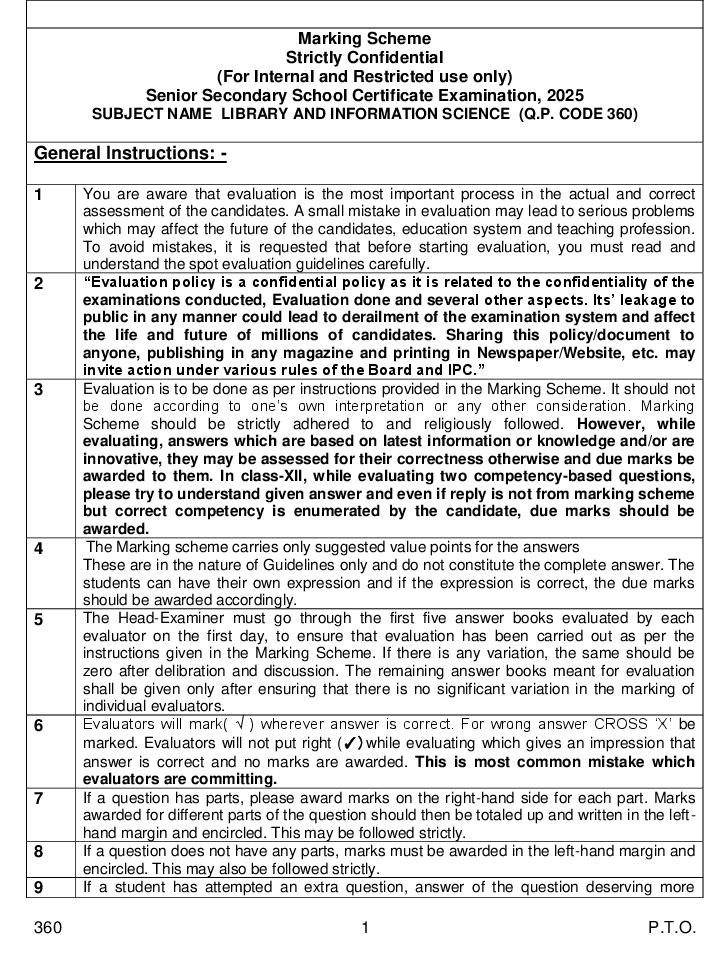
Strictly Confidential
(For Internal and Restricted use only)
Senior Secondary School Certificate Examination, 2025
SUBJECT NAME LIBRARY AND INFORMATION SCIENCE (Q.P. CODE 360)
General Instructions: -
1 You are aware that evaluation is the most important process in the actual and correct
assessment of the candidates. A small mistake in evaluation may lead to serious problems
which may affect the future of the candidates, education system and teaching profession.
To avoid mistakes, it is requested that before starting evaluation, you must read and
understand the spot evaluation guidelines carefully.
2 “Evaluation policy is a confidential policy as it is related to the confidentiality of the
examinations conducted, Evaluation done and several other aspects. Its’ leakage to
public in any manner could lead to derailment of the examination system and affect
the life and future of millions of candidates. Sharing this policy/document to
anyone, publishing in any magazine and printing in Newspaper/Website, etc. may
invite action under various rules of the Board and IPC.”
3 Evaluation is to be done as per instructions provided in the Marking Scheme. It should not
be done according to one’s own interpretation or any other consideration. Marking
Scheme should be strictly adhered to and religiously followed. However, while
evaluating, answers which are based on latest information or knowledge and/or are
innovative, they may be assessed for their correctness otherwise and due marks be
awarded to them. In class-XII, while evaluating two competency-based questions,
please try to understand given answer and even if reply is not from marking scheme
but correct competency is enumerated by the candidate, due marks should be
awarded.
4 The Marking scheme carries only suggested value points for the answers
These are in the nature of Guidelines only and do not constitute the complete answer. The
students can have their own expression and if the expression is correct, the due marks
should be awarded accordingly.
5 The Head-Examiner must go through the first five answer books evaluated by each
evaluator on the first day, to ensure that evaluation has been carried out as per the
instructions given in the Marking Scheme. If there is any variation, the same should be
zero after delibration and discussion. The remaining answer books meant for evaluation
shall be given only after ensuring that there is no significant variation in the marking of
individual evaluators.
6 Evaluators will mark( √ ) wherever answer is correct. For wrong answer CROSS ‘X’ be
marked. Evaluators will not put right (✓)while evaluating which gives an impression that
answer is correct and no marks are awarded. This is most common mistake which
evaluators are committing.
7 If a question has parts, please award marks on the right-hand side for each part. Marks
awarded for different parts of the question should then be totaled up and written in the left-
hand margin and encircled. This may be followed strictly.
8 If a question does not have any parts, marks must be awarded in the left-hand margin and
encircled. This may also be followed strictly.
9 If a student has attempted an extra question, answer of the question deserving more
360 1 P.T.O.
Page 2
10 No marks to be deducted for the cumulative effect of an error. It should be penalized only
once.
11 A full scale of marks __________(example 0 to 80/70/60/50/40/30 marks as given in
Question Paper) has to be used. Please do not hesitate to award full marks if the answer
deserves it.
12 Every examiner has to necessarily do evaluation work for full working hours i.e., 8 hours
every day and evaluate 20 answer books per day in main subjects and 25 answer books
per day in other subjects (Details are given in Spot Guidelines).This is in view of the
reduced syllabus and number of questions in question paper.
13 Ensure that you do not make the following common types of errors committed by the
Examiner in the past:-
● Leaving answer or part thereof unassessed in an answer book.
● Giving more marks for an answer than assigned to it.
● Wrong totaling of marks awarded on an answer.
● Wrong transfer of marks from the inside pages of the answer book to the title page.
● Wrong question wise totaling on the title page.
● Wrong totaling of marks of the two columns on the title page.
● Wrong grand total.
● Marks in words and figures not tallying/not same.
● Wrong transfer of marks from the answer book to online award list.
● Answers marked as correct, but marks not awarded. (Ensure that the right tick mark
is correctly and clearly indicated. It should merely be a line. Same is with the X for
incorrect answer.)
● Half or a part of answer marked correct and the rest as wrong, but no marks awarded.
14 While evaluating the answer books if the answer is found to be totally incorrect, it should
be marked as cross (X) and awarded zero (0)Marks.
15 Any unassessed portion, non-carrying over of marks to the title page, or totaling error
detected by the candidate shall damage the prestige of all the personnel engaged in the
evaluation work as also of the Board. Hence, in order to uphold the prestige of all
concerned, it is again reiterated that the instructions be followed meticulously and
judiciously.
16 The Examiners should acquaint themselves with the guidelines given in the “Guidelines
for Spot Evaluation” before starting the actual evaluation.
17 Every Examiner shall also ensure that all the answers are evaluated, marks carried over to
the title page, correctly totaled and written in figures and words.
18 The candidates are entitled to obtain photocopy of the Answer Book on request on
payment of the prescribed processing fee. All Examiners/Additional Head Examiners/Head
Examiners are once again reminded that they must ensure that evaluation is carried out
strictly as per value points for each answer as given in the Marking Scheme.
360 2
Page 3
$
MARKING SCHEME
LIBRARY AND INFORMATION SCIENCE
SECTION A
OBJECTIVE TYPE QUESTIONS
Q. No. Answer Source Material Unit/Ch Marks
(NCERT/CBSE Study ap. No.
Material)
1.
(i) (B) Two way Employability Skills Unit 1 1
(ii) (B) Measurable Employability Skills Unit 2 1
(iii) (A) Avoidant Personality Disorder Employability Skills Unit 2 1
(iv) (D) Data Employability Skills Unit 3 1
(v) wage employed person Employability Skills Unit 4 1
(vi) (C) Donate them Employability Skills Unit 5 1
2.
(i) (B) Acquisition policy Library Management Chap 1 1
Unit 1
(ii) (A) Subject Bibliography Library Management Chap 1 1
Unit 1
(iii) (A) job analysis Library Management Chap 1 1
Unit 1B
(iv) (D) Annual Financial Report Library Management Chap 1 1
Unit 1
(v) (B) Five Library Management Chap 1 1
Unit 1
(vi) (D) Cataloging of Documents Library Management Chap 1 1
Unit 2
(vii) (A) 5” x 3” Library Management Chap 1 1
Unit 2
3.
360 3 P.T.O.
Page 4
Library Resources Unit 1
(ii) (A) Energy Organization of Chap 2 1
Library Resources Unit 1
(iii) (D) Principle of Residue Organization of Chap 2 1
Library Resources Unit 1
(iv) (A) Raw Title Organization of Chap 2 1
Library Resources Unit 1
(v) (B) Library of Congress Subject Organization of Chap 2 1
Headings Library Resources Unit 2
(vi) (B) Library Tour Library and Chap 3 1
Information Services Unit 1
(vii) (D) Asking users to evaluate the Library and Chap 3 1
information Information Services Unit 1
4.
(i) (A) SDI Library and Chap 3 1
Information Services Unit 1
(ii) (C) Referral Library and Chap 3 1
Information Services Unit 1
(iii) (B) Quick reference Library and Chap 3 1
Information Services Unit 1
(iv) (A) British Library Automated Library and Chap 3 1
Information Service Information Services Unit 2
(v) (D) Webcasting Library and Chap 3 1
Information Services Unit 2
(vi) (A) NCERT Library and Chap 3 1
Information Services Unit 2
5.
(i) (C) Application Software Computer Application Chap 4 1
in Libraries Unit 1
(ii) (D) Open source Computer Application Chap 4 1
in Libraries Unit 1
(iii) (C) WebOPAC Computer Application Chap 4 1
in Libraries Unit 1
(iv) Open Source Computer Application Chap 4 1
in Libraries Unit 1
(v) (A) 2003 Computer Application Chap 4 1
in Libraries Unit 2
360 4
Page 5
in Libraries Unit 2
6.
(i) (C) premium account user Computer Application Chap 4 1
in Libraries Unit 2
(ii) (D) Not able to watch TV when Communication Skills Chap 5 1
there is no electricity Unit 1
(iii) (B) Intrapersonal Communication Skills Chap 5 1
Unit 1
(iv) (A) Non-Verbal Communication Skills Chap 5 1
Unit 1
(v) (D) vocal Communication Skills Chap 5 1
Unit 1
(vi) (C) vocal communication Communication Skills Chap 5 1
Unit 1
SECTION B
SUBJECTIVE TYPE QUESTIONS
Q. Answer Source Material Unit/C Marks
No. (NCERT/CBSE Study hap.
Material) No.
7. To learn a language, one needs to Employability Skills Unit 1 2
develop four key skills, namely
listening,
speaking,
reading and writing.
8. Intrinsic motivation includes activities Employability Skills Unit 2 2
for which there is no apparent reward
but one derives enjoyment and
satisfaction in doing them. It occurs
when people are internally motivated
to do something because it brings them
pleasure.
9. Advantages of Presentation software Employability Skills Unit 3 2
are as follows.
360 5 P.T.O.
Page 6
features like images, videos,
animation and music.
2. Making changes in digital
presentations is easy.
3. A digital presentation can be
shown to a much larger audience
by projecting on a screen.
4. can be printed and distributed to
the audience.
10. A wage employed person is someone, Employability Skills Unit 4 2
who works for an individual or
organisation and gets paid for the
same. An entrepreneur is a
self-employed person, who strives to
make the business better by taking
risks and trying new ideas.
11. Solar and wind power plants provide Employability Skills Unit 5 2
clean energy. Some common jobs in
this sector are roofer, solar panel
installation technician and field
technician.
12. Users’ analysis is the prime job in Library Management Chap 1 2
collection development, which can be Unit
received by floating a questionnaire, or 1A
holding a personal interaction
sessions or interview. Once the need of
the clientele is gauged, the library can
then focus on its selection policies.
13. The subject heading systems Organisation of Chap 3 2
commonly used by most of the libraries Library Resources Unit 1
and bibliographical publications are
Library of Congress Subject Headings
(LCSH) and Sears List of Subject
Headings (SLSH).
14. Reference and Information Services Library and Chap 3 2
may be categorized as : Information Services Unit 1
(i) Responsive services or services on
demand,
(ii) Anticipatory services
360 6
Page 7
known as passive information services,
are provided in response to the
requests from the library users.
Anticipatory information services, also
known as active information services,
are provided in anticipation of the
needs of the library users.
15. an E-book as “a book that is read on a Library and Chap 3 2
computer or other electronic devices. It Information Services Unit 2
is a book composed in or converted to
digital format for display on a
computer screen or a handheld device.
e-books may be downloaded or
accessed in a closed (proprietary)
system at a cost, or in an open system
for free.
16. Non vocal communication is such a Communication Skills Chap 5 2
process in which sign, symbols,
gesture, signals etc. are being used as
the mode of communication. We can
say in other words, as the
communications which uses anything
as a mode but not the sound. Written
communication also falls under this
category as it uses scripts, which
comes under the sign and symbol
category. We can take a few other
examples as, facial expression, socking
head in acceptance or denial, etc.
17. One of the important functions of Library Management Chap 1 3
Human Resource Management is Job Unit
Analysis. It is a process for 1B
determining the job requirement. It
involves the analysis of the contents of
each job to be performed is on
institution.
The job analysis provides the answers
of the following questions :
What are the tasks performed by the
360 7 P.T.O.
Page 8
How they are performed ?
What qualifications are required in a
worker, to perform the job effectively
and satisfactorily.
18. There are following two kinds of Organization of Chap 2 3
authorship : Library Resources Unit 2
1. Personal Authorship
2. Corporate Body as a Corporate
author
Personal Author :
A personal author is the person chiefly
responsible for the creation of the
intellectual or artistic content of a
work. For example, writers of books
and composers of music are the
authors of the work they create;
compilers of bibliographies are the
authors of those bibliographies;
cartographers are the authors of their
maps; and artists and photographers
are the authors of the works they
create. In addition, in certain cases
performers are the authors of sound
recordings, films and video recordings.
19. System requirements for Computer Application Chap 4 3
e-Granthalaya software are as follows : Libraries Unit 1
– Application is hosted in NIC
National Cloud and used online
by User Libraries for Data Entry
and member services.
– No component is installed and
nothing to maintain at user end
(Database and Application are
hosted in NIC National Cloud.
– User library needs to have
desktops with high-speed
Internet connectivity (with min
4 MBPS).
– Other Infrastructure required in
Library : Desktop Bar Code
360 8
Page 9
Printer.
20. The stock verification activity is Library Management Chap 1 4
undertaken by a Library according to Unit 1
guidelines provided in the General
Financial Rules, Government of India.
Rules 194 of GFR provides the
guidelines regarding the stock
verification of library books.
The Rule says that “complete physical
verification of books should be done
every year in case of libraries having
not more than 20000 volumes of books.
For libraries having more than 20000
volumes and up to 50000 volumes of
books, such verification should be done
at least once in three years.
Sample physical verification at
intervals of not more than three years
should be done in case of libraries
having more than 50000 volumes
books. In case such verification reveals
unusual or unreasonable shortages,
complete verification shall be done.”
21. There are five fundamental functions Library Management Chap 1 4
of HRM in any organization, which are Unit
also applicable to libraries. These 1B
functions are :
Human resource planning
Staffing
Communication
Employee development, and
Employee maintenance
Staffing
Staffing is the process of recruitment
and selection of human resources for
an organization. HR planning and
recruiting precedes the actual selection
of staff for any position in an
organization. Recruiting is the
personnel function that attracts
360 9 P.T.O.
Page 10
vacancies. In the selection process, the
most suitable candidates are selected
for hiring from amongst those persons
who are attracted to the organization.
HRM functionaries are involved in
developing and administering methods
which enable authorities to decide
which applicants should be selected
and which one is to be rejected for the
given jobs. After selection, certain
functions are performed to manage the
staff and get the job done for the
organization. Those functions include
orientation, training and development,
performance appraisal, career
planning, compensation, benefits, labor
relations and record keeping.
22. Dr. Ranganathan has prescribed a Organization of Chapt 4
procedure involving nine successive Library Resources er 2
steps for translating the title of the Unit 1
document: for analysing the title of a
specific subject into facets, and for
giving it an appropriate class number.
The steps are as given below.
Step 0 : Write down the Raw Title
(= Title as found in the document).
Step 1 : Full title (= Title expressing
each of the relevant basic and isolate
ideas in the subject of the document,
arrived at by filling up all the ellipses
in the Raw title).
Step 2 : Kernel Title (= Full title except
the auxiliary or apparatus words and
each composite term denotes a
composite idea replaced by the
fundamental constituent terms, which
denote its fundamental constituent
ideas)
Step 3 : Analysed title (= Kernel Title
with each kernel term marked by a
symbol, which denotes the
360 10
Page 11
ideas denoted by the term is a
manifestation and also the round and
the level to which it is assigned in
conformity to the postulates of
classification).
Step 4 : Transformed Title (=
Analytical title with the kernel terms
rearranged according to the symbols of
analysis attached to them).
Step 5 : Title in standard terms
(=Transformed title with the Kernal
terms replaced, wherever necessary by
their respective equivalents as given in
the appropriate schedules).
Step 6 : Title in Facet Numbers (=
Title in standard terms with the kernel
terms replaced by their equivalent
numbers).
Step 7 : Class number (got by removing
the symbols of analysis and inserting
the appropriate connecting symbols
between the facet numbers in
accordance with the Rules).
Step 8 : Translate the synthesized
class number into natural language by
way of verification. In this step, carry
out facet analysis of the Class Number,
giving a digit-by-digit interpretation
and verifying the correctness of the
number.
23. With the application of ICT tools and Library and Chap 3 4
technology, new concepts are emerging Information Services Unit 2
in the field of library and information
science. Mobile Applications for
Libraries is an important emerging
trend in the area of library and
information services.
i. Mobile Applications for Libraries
There is an exponential growth in the
number of users, particularly in
developing countries, who access
360 11 P.T.O.
Page 12
especially on smart phones. As in the
case of e-commerce and entertainment
industries, modern libraries are also
using mobile technologies to reach out
to these customers who are on the
move. For that, mobile/cellular
phone-based applications and services
are designed and incorporated by
libraries. Mobile services are “typically
(and often implicitly) understood as
services that make use of mobile
devices and/or mobile networks”.
Mobile based library services include :
(a) Mobile interface to library
website : Mobile optimized library
website homepages
(b) Mobile interface to library
catalogue
(c) Mobile reference service : Access
to mobile interfaces of important
reference sources like
Encyclopaedia Britannica
(d) Downloadable e-books and audio
books on mobile
(e) Mobile interfaces to e-journal and
other databases
(f) SMS notification services:
Circulation (reminder, renewal,
reservation), Current awareness,
SDI, Content alerts, catalogue
enquiries, SMS reference
services, etc. Some libraries also
developed Mobile Apps which
help the users to access library
services. These apps need to be
downloaded and installed in the
user’s mobile/handheld device.
E.g., mLibrary app of NITI Aayog
Library,
24. Use of LAS in Acquisition Section : Computer Application Chap 4 4
The LAS has the provisions to Libraries Unit 1
360 12
Page 13
acquisition with the wide range of
outputs, giving the librarian full
control over acquisition process and
budget. It supports in selection of
library materials, ordering, receiving,
accessioning, budgeting, fund
management and other works of the
section. The application of the LAS in
acquisition section can be understood
as follows :
(i) Collecting bibliographical
information through various
selection tools and managing the
recommendations given by the
members of the library.
(ii) Assuring the availability of
proposed materials within the
available or allotted budget.
(iii) Preparation of supply order to be
sent to the vendors.
(iv) Maintaining online records of all
materials, ordered, received,
accessioned, pending, etc.
(v) Maintaining database of vendors.
(vi) Detection of delay in supply and
sending reminders.
(vii) Checking in of item received,
processing of invoice, accessioning
of materials.
(viii) Accounting fund for payment of
bills and controlling the funds for
books and other materials.
All the tasks of acquisition section can
be done accurately and efficiently with
less human resources and in less time
compared to manual system.
360 13 P.T.O.
Page 14
Document Details
| Board / Org | CBSE |
| Exam | Class 12 |
| Type | Solution |
| Pages | 14 |
| Updated | 24 Sep 2026 |