CBSE Class 12 Sample Paper 2027 Solution (Marking Scheme) for History
Finished viewing? Save it for later —
Download CBSE Class 12 Sample Paper 2027 Solution (Marking Scheme) for History (PDF · 10 pages)About CBSE Class 12 Sample Paper 2027 Solution (Marking Scheme) for History
CBSE Class 12 Sample Paper 2027 Solution (Marking Scheme) for History is available here for free download. Published by CBSE for Class 12, this solution can be viewed online or downloaded as a PDF (10 pages). Candidates preparing for Class 12 can use CBSE Class 12 Sample Paper 2027 Solution (Marking Scheme) for History to understand the exam pattern, the type of questions asked, and the overall difficulty level.
Frequently Asked Questions
How can I download CBSE Class 12 Sample Paper 2027 Solution (Marking Scheme) for History?
Open this page and click the Download button to save CBSE Class 12 Sample Paper 2027 Solution (Marking Scheme) for History as a PDF. It is completely free on AglaSem Docs.
Is CBSE Class 12 Sample Paper 2027 Solution (Marking Scheme) for History free to download?
Yes. CBSE Class 12 Sample Paper 2027 Solution (Marking Scheme) for History can be viewed online and downloaded as a PDF free of cost on AglaSem Docs.
How many pages does CBSE Class 12 Sample Paper 2027 Solution (Marking Scheme) for History have?
CBSE Class 12 Sample Paper 2027 Solution (Marking Scheme) for History contains 10 pages, which you can read online or download together as a single PDF.
Where can I find more Class 12 study material?
You can find more Class 12 question papers, sample papers, syllabus, and answer keys on AglaSem Docs.
CBSE Class 12 Sample Paper 2027 Solution (Marking Scheme) for History – Text
Read the full text of this solution below — useful to quickly search, copy and reference the content online without downloading the PDF.
📄 View text version (11 pages)
Page 1
CBSE Class 12 Sample
Paper 2027 Solution
(Marking Scheme) for
History
EXAM YEAR TYPE SUBJECT
CBSE Class 12 2027 Solutions History
Notes · Sample Papers · Previous Year Papers · Mock Tests
Page 2
.co s e m
s em l a
a ag
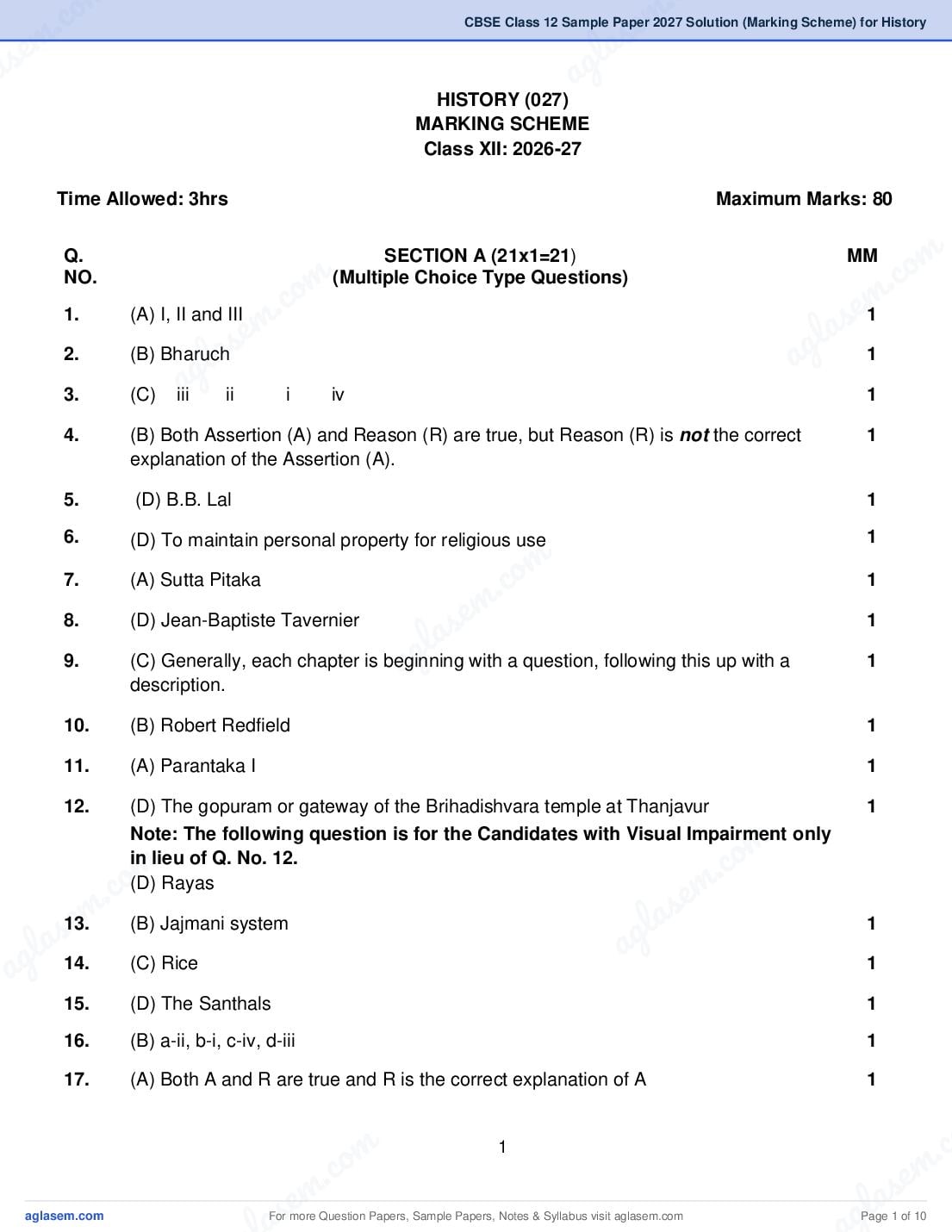
HISTORY (027)
MARKING SCHEME
Class XII: 2026-27
Time Allowed: 3hrs Maximum Marks: 80
m
co
Q. SECTION A (21x1=21) MM
om .
NO. (Multiple Choice Type Questions)
. c e1m
1. (A) I, II and III
e m as
l 1
2.
l
(B) Bharuch a s ag
3. (C) iiia
g ii i iv 1
4. (B) Both Assertion (A) and Reason (R) are true, but Reason (R) is not the correct 1
explanation of the Assertion (A).
5. (D) B.B. Lal 1
6. (D) To maintain personal property for religious use 1
m
7. (A) Sutta Pitaka
m .co 1
s e
a
8. (D) Jean-Baptiste Tavernier 1
l
g with a question, following this up with a
9. a
(C) Generally, each chapter is beginning
description.
1
10. (B) Robert Redfield 1
11. (A) Parantaka I 1
12. (D) The gopuram or gateway of the Brihadishvara temple at Thanjavur 1
Note: The following question is for the Candidates with Visual Impairment only
m
m
in lieu of Q. No. 12.
.co
.co
(D) Rayas
s e m
s em (B) Jajmani system
13.
g la 1
g la 14. (C) Rice a
a 1
15. (D) The Santhals 1
16. (B) a-ii, b-i, c-iv, d-iii 1
17. (A) Both A and R are true and R is the correct explanation of A 1
m . c
c. o
1
e m
em as
s
For more Question Papers, Sample Papers, Notes & Syllabus visit
gl
Page 1 of 10
Page 3
19. (C)- I and III 1
20. (A) The first meeting of the Constituent Assembly was held 1
21. (C) Sardar Patel 1
SECTION B (6x3=18)
SHORT ANSWER TYPE QUESTIONS
22. A Harappan town planning has many features like modern town planning. Followings 3
are some of them:
1) The most distinctive feature of the Harappan Civilisation was the development of
urban centres. Mohenjodaro is the most famous site of Harappan Civilisation.
2) The settlement was divided into two sections i.e. Citadel and the Lower Town.
Citadel was smaller but higher. It was walled part of the city which was separated
from the lower town. Here the buildings were constructed with mud and bricks
platform.
3) The second part of the city was called the Lower Town. The lower town was also
walled. Several buildings were built on platforms, which served as foundations
4) Mohenjodaro had a well-planned drainage system. The roads and the streets
were laid out along an approximate ‘grid’ pattern, intersecting at right angles.
5) Streets with drains were laid out first and then houses were built along them.
Every house had its own bathroom paved with bricks, with drains connected
through the walls to the street drains.
(Any three points)
OR
22. B 1) The weight system of Harappan civilisation was a great innovation.
2) The trade requires a regulation of exchange and of weights and measures.
3) Exchanges were regulated by a precise system of weights.
4) Weights were made of a stone called chert and generally cubical with no
markings. The lower denominations of weights were binary i.e.1, 2, 4, 8, 16, 32,
etc.
5) The decimal system was followed in higher denominations.
6) The smaller weights were used for weighing the jewellery and beads. Metal scale-
pans have also been found at various sites of Harappan civilisation.
(Any three points)
23. 1) Siddhartha, as the Buddha was named at birth, was the son of a chief of the Sakya 3
clan. He had a sheltered upbringing within the palace, insulated from the harsh
realities of life.
2) One day he persuaded his charioteer to take him into the city. His first journey into
the world outside was traumatic. He was deeply anguished when he saw an old
man, a sick man, and a corpse. He realised in that moment that the decay and
destruction of the human body was inevitable.
2
For more Question Papers, Sample Papers, Notes & Syllabus visit Page 2 of 10
Page 4
.co s e m
s em l a
a ag
3) He also saw a homeless mendicant, who, it seemed to him, had come to terms
with old age, disease and death, and found peace. Siddhartha decided that he too
would adopt the same path. Soon after, he left the palace and set out in search of
his own truth.
4) After attaining enlightenment, he came to be known as the Buddha or the
Enlightened One.
5) For the rest of his life, he taught dhamma or the path of righteous living. He
m
co
delivered his first sermon at Sarnath. He attained the nibbana at Kusinagara.
(Any three points)
. c om m
e3
.
24.
em
1) In the late fifteenth century, Shankaradeva emerged as one of the leading
l as
as
proponents of Vaishnavism in Assam.
l ag
ag
2) His teachings, often known as the Bhagavati dharma because they were based on
the Bhagavad Gita and the Bhagavata Purana, focused on absolute surrender to
the supreme deity, in this case Vishnu.
3) He emphasised the need for naam kirtan, recitation of the names of the lord in sat
sanga or congregations of pious devotees.
4) He also encouraged the establishment of satra or monasteries for the transmission
of spiritual knowledge, and naam ghar or prayer halls.
5) Many of these institutions and practices continue to flourish in the region. His major
compositions include the Kirtana-ghosha. (Any three points)
m
.co
em
25. The women played an important role in agrarian society in the sixteenth-seventeenth 3
l as
centuries. It is clear from the following points:
ag andwithwinnowed
1) Women worked shoulder to shoulder
2) Women sowed, weeded, threshed,
men in fields.
the harvest.
3) Artisanal tasks such as spinning yarn, sifting and kneading clay for pottery, and
embroidery were among the many aspects of production dependent on female
labour. The more commercialised the product, the greater the demand on
women’s labour to produce it.
4) Women were considered an important resource in agrarian society also because
they were child bearers in a society dependent on labour. (Any three points)
m
c. o
26. 1) In introducing the Permanent Settlement, British officials hoped to resolve the 3
m
c. o2)
problems they had been facing since the conquest of Bengal.
e m
s
By the 1770s, the rural economy in Bengal was in crisis, with recurrent famines
e m la
s
and declining agricultural output. Officials felt that agriculture, trade, and the
la ag
revenue resources of the state could all be developed by encouraging investment
ag in agriculture.
3) This could be done by securing rights of property and permanently fixing the rates
of revenue demand. If the revenue demand of the state was permanently fixed,
then the Company could look forward to a regular flow of revenue, while
entrepreneurs could feel sure of earning a profit from their investment, since the
state would not siphon it off by increasing its claim.
m . c
c. o
3
e m
em as
s
For more Question Papers, Sample Papers, Notes & Syllabus visit
gl
Page 3 of 10
Page 5
farmers and rich landowners who would have the capital and enterprise to
improve agriculture. Nurtured by the British, this class would also be loyal to the
Company. (Any three points)
27. A As victors, the British recorded their own trials and tribulations as well as their heroism. 3
They dismissed the rebels as a bunch of ungrateful and barbaric people.
1) The repression of the rebels also meant silencing of their voice. Few rebels had
the opportunity of recording their version of events.
2) Moreover, most of them were sepoys and ordinary people who were not literate.
Thus, other than a few proclamations and ishtahars (notifications) issued by rebel
leaders to propagate their ideas and persuade people to join the revolt, we do not
have much that throws light on the perspective of the rebels.
3) Attempts to reconstruct what happened in 1857 are thus heavily and inevitably
dependent on what the British wrote and so these sources reveal the minds of
officials, they tell us very little about what the rebels wanted.
OR
27 B 1) The rebel proclamations in 1857 repeatedly appealed to all sections of the
population, irrespective of their caste and creed.
2) Many of the proclamations were issued by Muslim princes or in their names but
even these took care to address the sentiments of Hindus.
3) The rebellion was seen as a war in which both Hindus and Muslims had equally to
lose or gain. The ishtahars harked back to the pre-British Hindu-Muslim past and
glorified the coexistence of different communities under the Mughal Empire. The
proclamation that was issued under the name of Bahadur Shah appealed to the
people to join the fight under the standards of both Muhammad and Mahavir.
4) In Bareilly in western Uttar Pradesh, in December 1857, the British spent Rs
50,000 to incite the Hindu population against the Muslims. The attempt failed.
It was thus remarkable that during the uprising religious divisions between Hindus
and Muslim were hardly noticeable despite British attempts to create such
divisions. (Any 3 points)
SECTION C (8x3=24)
LONG ANSWER TYPE QUESTIONS
28. A 1) From the early centuries of the Common Era, we find grants of land being made, 8
many of which were recorded in inscriptions. Some of these inscriptions were on
stone, but most were on copper plates which were probably given as a record of
the transaction to those who received the land.
2) The records that have survived are generally about grants to religious institutions
or to Brahmanas.
4
For more Question Papers, Sample Papers, Notes & Syllabus visit Page 4 of 10
Page 6
.co s e m
s em l a
a ag
3) Most inscriptions were in Sanskrit. In some cases, and especially from the seventh
century onwards, part of the inscription was in Sanskrit, while the rest was in a local
language such as Tamil or Telugu.
4) One such inscription provides detail about Prabhavati Gupta. She was the
daughter of Chandragupta II. She was married into another important ruling family,
that of the Vakatakas, who were powerful in the Deccan.
5) The inscription indicates that Prabhavati had access to land, which she then
m
co
granted. This may have been because she was a queen, and her situation was
. c om
therefore exceptional.
6) The inscription indicates that Prabhavati had access to land, which she then
em .
e m
granted. This may have been because she was a queen, and her situation was
l as
as
therefore exceptional.
l ag
ag
7) Land grants such as this one have been found in several parts of the country. There
were regional variations in the sizes of land donated – ranging from small plots to
vast stretches of uncultivated land – and the rights given to donees (the recipients
of the grant).
8) The impact of land grants is a subject of heated debate among historians. Some
feel that land grants were part of a strategy adopted by ruling lineages to extend
agriculture to new areas.
9) Others suggest that land grants were indicative of weakening political power: as
kings were losing control over their samantas, they tried to win allies by making
m
.co
grants of land.
So, we can say that land grants provide some insight into the relationship between
cultivators and the state.
e m
l as OR
ag including visual elements such as scripts and
28. B Numismatics is the study of coins,
images, metallurgical analysis, and the contexts in which they have been found.
The study of coins has helped the numismatists to reconstruct the possible
commercial networks in the following ways:
1) To some extent, exchanges were facilitated by the introduction of coinage. A wide
range of goods like salt, grain, cloth, metal ores and finished products, stone,
timber, medicinal plants, etc. were carried from one place to another. These
certainly required some kind of currency for exchange. Hence, these led to the
m
.co
development of coinage across the trading cultures.
m
.co
2) Punch-marked coins made of silver and copper (6th century BCE onwards) were
e m
s
amongst the earliest to be minted and used. These have been recovered from
e m excavations at a number of sites throughout the sub-continent. Numismatics have
la
las studied these and other coins to reconstruct possible commercial networks.
ag
ag 3) Attempts made to identify the symbols on punch-marked coins with specific ruling
dynasties, including the Mauryas, suggest that these were issued by kings. It is
also likely that merchants, bankers, and townspeople issued some of these coins.
4) The first gold coins were issued in the 1st century CE by the Kushanas. These
were virtually identical in weight with those issued by contemporary Roman
emperors and the Parthian rulers of Iran have been found from several sites in
North India and Central Asia.
m . c
c. o
5
e m
em as
s
For more Question Papers, Sample Papers, Notes & Syllabus visit
gl
Page 5 of 10
Page 7
that were taking place. Besides, hoards of Roman coins have been found from
archaeological sites in South India.
6) It is obvious that networks of trade were not confined within political boundaries.
South India was not a part of the Roman empire, but there were close connections
through trade.
7) Coins were also issued by tribal republics such as that of the Yaudheyas of Punjab
and Haryana (c. first century CE). Archaeologists have unearthed several thousand
copper coins issued by the Yaudheyas, pointing to the latter’s interest and
participation in economic exchanges.
8) Some of the most spectacular gold coins were issued by the Gupta rulers. The
earliest issues are remarkable for their purity. These coins facilitated long-distance
transactions from which kings also benefited.
29. A 1) Abdur Razzaq, an ambassador sent by the ruler of Persia to Calicut (present-day 8
Kozhikode) in the fifteenth century, was greatly impressed by the fortifications, and
mentioned seven lines of forts. These encircled not only the city but also its
agricultural hinterland and forests.
2) The outermost wall linked the hills surrounding the city. The massive masonry
construction was slightly tapered. No mortar or cementing agent was employed
anywhere in the construction.
3) The stone blocks were wedge shaped, which held them in place, and the inner
portion of the walls was of earth packed with rubble. Square or rectangular bastions
projected outwards.
4) What was most significant about this fortification is that it enclosed agricultural
tracts. Abdur Razzaq noted that “between the first, second and the third walls there
are cultivated fields, gardens and houses.”
5) The agricultural tracts were incorporated within the fortified area because the
objective of medieval sieges was to starve the defenders into submission. These
sieges could last for several months and sometimes even years.
6) Normally rulers tried to be prepared for such situations by building large granaries
within fortified areas. The rulers of Vijayanagara adopted a more expensive and
elaborate strategy of protecting the agricultural belt itself.
7) A second line of fortification went round the inner core of the urban complex, and
a third line surrounded the royal centre, within which each set of major buildings
was surrounded by its own high walls.
8) The fort was entered through well-guarded gates, which linked the city to the major
roads. Gateways were distinctive architectural features that often defined the
structures to which they regulated access.
OR
29. B 1) The “king’s palace” has two of the most impressive platforms, usually called the
“audience hall” and the “mahanavami dibba”. The entire complex is surrounded by
high double walls with a street running between them.
6
For more Question Papers, Sample Papers, Notes & Syllabus visit Page 6 of 10
Page 8
.co s e m
s em l a
a ag
2) The “mahanavami dibba” is located on one of the highest points in the city. It is a
massive platform rising from a base of about 11,000 sq. ft to a height of 40 ft.
3) There is evidence that it supported a wooden structure. The base of the platform is
covered with relief carvings.
4) Rituals associated with the structure probably coincided with Mahanavami (literally,
the great ninth day) of the ten-day Hindu festival during the autumn months of
m
co
September and October, known variously as Dusehra (northern India), Durga Puja
. c om
(in Bengal) and Navaratri or Mahanavami (in peninsular India).
e m .
5) The Vijayanagara kings displayed their prestige, power, and suzerainty on this
em l as
occasion
l as a g
of a
g
6) The ceremonies performed on the occasion included worship of the image, worship
the state horse, and the sacrifice of buffaloes and other animals. Dances,
wrestling matches, and processions of caparisoned horses, elephants and chariots
and soldiers, as well as ritual presentations before the king and his guests by the
chief nayakas and subordinate kings marked the occasion.
7) These ceremonies were imbued with deep symbolic meanings. On the last day of
the festival the king inspected his army and the armies of the nayakas in a grand
ceremony in an open field.
m
.co
8) On this occasion the nayakas brought rich gifts for the king as well as the stipulated
m
tribute.
e
las Indian
30. A 1) By 1922, Gandhiji had transformed
promise he made in his BHUgspeech
nationalism, thereby redeeming the 8
a intellectuals; now, hundreds of thousands of
movement of professionals and
of February 1916. It was no longer a
peasants, workers and artisans also participated in it. Many of them venerated
Gandhiji, referring to him as their “Mahatma.”
2) They appreciated the fact that he dressed like them, lived like them, and spoke
their language. Unlike other leaders he did not stand apart from the common folk,
but empathised and even identified with them.
3) This identification was strikingly reflected in his dress: while other nationalist
leaders dressed formally, wearing a Western suit or an Indian bandgala, Gandhiji
m
.co
went among the people in a simple dhoti or loincloth.
m
.co
4) Meanwhile, he spent part of each day working on the charkha (spinning wheel),
and encouraged other nationalists to do likewise. The act of spinning allowed
e m
e m las
Gandhiji to break the boundaries that prevailed within the traditional caste system,
las between mental labour and manual labour.
ag
ag 5) In a fascinating study, the historian Shahid Amin has traced the image of Mahatma
Gandhi among the peasants of eastern Uttar Pradesh, as conveyed by reports and
rumours in the local press. When he travelled through the region in February 1921,
Gandhiji was received by adoring crowds everywhere.
6) We can say thus that Gandhiji’s appeal among the poor, and peasants in particular,
was enhanced by his ascetic lifestyle, and by his shrewd use of symbols such as
the dhoti and the charkha.
m . c
c. o
7
e m
em as
s
For more Question Papers, Sample Papers, Notes & Syllabus visit
gl
Page 7 of 10
Page 9
simple lifestyle and love of working with his hands allowed him to empathise more
fully with the labouring poor and for them, in turn, to empathise with him.
8) Where most other politicians talked down to them, Gandhiji appeared not just to
look like them, but to understand them and relate to their lives. Mahatma Gandhi’s
mass appeal was undoubtedly genuine and in the context of Indian politics, without
precedent.
OR
30. B 1) Gandhiji hoped that by coupling non-cooperation with Khilafat, India’s two major
religious communities, Hindus and Muslims, could collectively bring an end to
colonial rule. These movements certainly unleashed a surge of popular action that
was altogether unprecedented in colonial India.
2) Students stopped going to schools and colleges run by the government. Lawyers
refused to attend court. The working class went on strike in many towns and cities:
according to official figures, there were 396 strikes in 1921, involving 600,000
workers and a loss of seven million workdays.
3) The countryside was seething with discontent too. Hill tribes in northern Andhra
violated the forest laws. Farmers in Awadh did not pay taxes. Peasants in Kumaun
refused to carry loads for colonial officials.
4) These protest movements were sometimes carried out in defiance of the local
nationalist leadership.
5) Peasants, workers, and others interpreted and acted upon the call to “non-
cooperate” with colonial rule in ways that best suited their interests, rather than
conform to the dictates laid down from above.
6) Due to the Non-Cooperation Movement the British Raj was shaken to its
foundations for the first time since the Revolt of 1857.
7) Then, in February 1922, a group of peasants attacked and torched a police station
in the hamlet of Chauri Chaura, in the United Provinces (now, Uttar Pradesh and
Uttaranchal).
8) Several constables perished in the conflagration. This act of violence prompted
Gandhiji to call off the movement altogether. “No provocation,” he insisted, “can
possibly justify (the) brutal murder of men who had been rendered defenceless and
who had virtually thrown themselves on the mercy of the mob.”
Yes, to an extent one does agree with the biographer. (Any other point)
SECTION D (4x3=12)
SOURCE BASED QUESTIONS
31. (31.1) Gandhari’s last appeal to her eldest son was not to set his mind to war. 1
(31.2) Greed and Anger are the two vices which a King should conquer as they drag
a man away from his profits.
(31.3) Ans.
1) Duryodhana did not listen to his mother’s advice so it had no impact. This shows 1
8
For more Question Papers, Sample Papers, Notes & Syllabus visit Page 8 of 10
Page 10
.co s e m
s em l a
a ag
that he was disrespectful, disobedient, lacked farsightedness, overconfident,
ambitious and had no control over greed and anger.
2) It also reveals his pride and hatred for Pandavas which ultimately led to destruction 2
of his entire lineage.
32. (32.1). Ibn Battuta was a traveller who came from Morocco, in northwestern Africa to 1
visit the Indian subcontinent.
m
co
(32.2) Palanquins were used as a mode of transport for wealthy and high -status
om .
individuals and for areas where wheeled vehicles were impractical. It also served 1
. c
ceremonial, religious, and military functions. (any 1 point). m
e
em
(32.3). Yes, there were class and gender discrimination in society. The price of slaves,
as
l 2
as
particularly female slaves required for domestic labour, was very low compared to men
l ag
ag
and most families who could afford to do so kept at least one or two of them. Since all
could not afford to have a slave. It was only for the affluent.
33. (33.1) Consensus means agreement among a group of people. 1
(33.2) Arguments held within the assembly were reported in newspapers and their
proposals were publicly debated. Criticisms and counter-criticisms in the press in turn
shaped the nature of the consensus that was ultimately reached on specific issues.
(33.3.) Ans.
1) Yes, the Constituent Assembly wanted to create a sense of collective participation. 1
m
In order to create a sense of collective participation the public was asked to send
in their views on what needed to be done.
m .co
e
2) Many of the linguistic minorities wanted the protection of their mother tongue,
s
l a
religious minorities asked for special safeguards, while dalits demanded an end to 2
ag
all caste oppression and reservation of seats in government bodies.
3) Important issues of cultural rights and social justice raised in these public
discussions were debated on the floor of the Assembly.
(Any 2 illustrations)
SECTION E (5X1=5)
MAP BASED QUESTIONS
om
34 34.2 Note: The following question is for the Candidates with Visual Impairment 5
m
only in lieu of Q. 34.1
. c
c. o
1. Dholavira, Lothal and Nageshwar (Any two).
s e m
em la
2. Lumbini
l as OR
ag
ag
1336
3. Lala lajpat Rai, Bal Gangadhar Tilak and Bipin Chandra Pal were famous as Lal-
Bal-Pal.
34.1 MAP BASED QUESTION 5 Marks
m . c
c. o
9
e m
em as
s
For more Question Papers, Sample Papers, Notes & Syllabus visit
gl
Page 9 of 10
Page 11
For more Question Papers, Sample Papers, Notes & Syllabus visit Page 10 of 10
Document Details
| Board / Org | CBSE |
| Exam | Class 12 |
| Type | Solution |
| Pages | 10 |
| Updated | 29 Oct 2026 |