Page 1
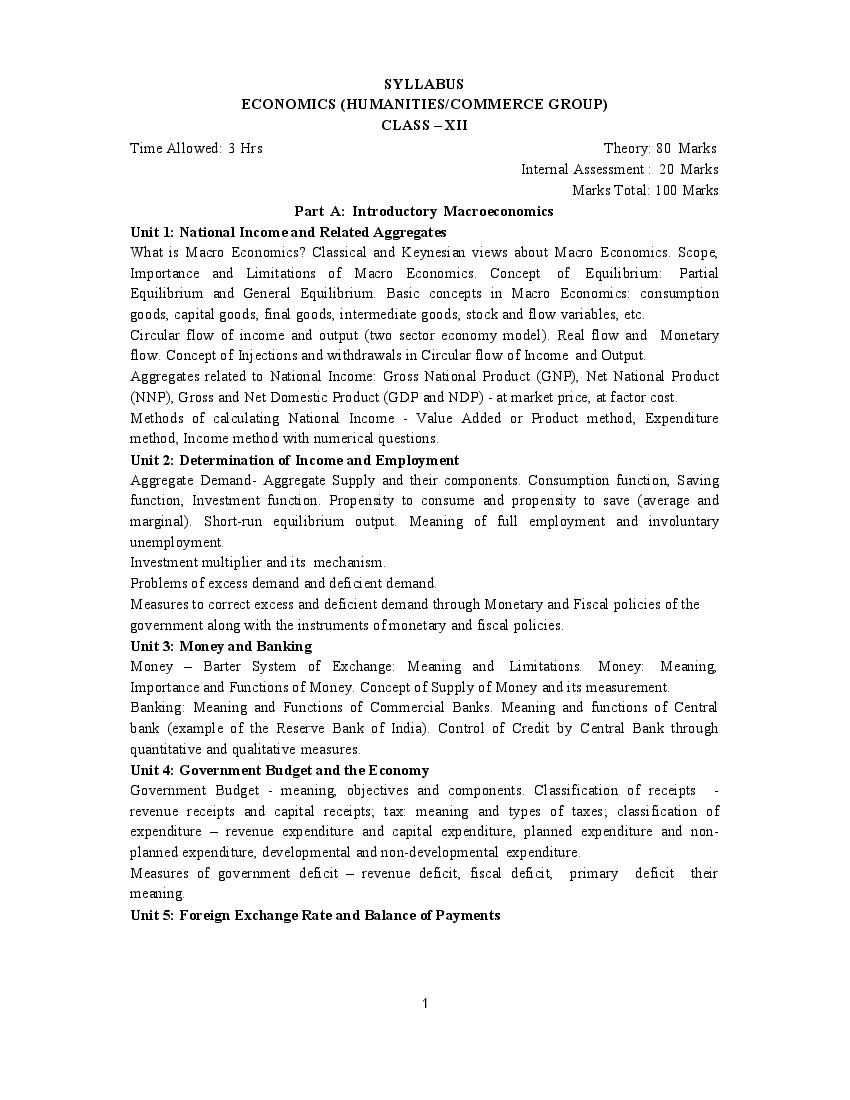
SYLLABUS ECONOMICS (HUMANITIES/COMMERCE GROUP) CLASS – XII Time Allowed: 3 Hrs Theory: 80 Marks Internal Assessment : 20 Marks Marks Total: 100 Marks Part A: Introductory Macroeconomics Unit 1: National Income and Related Aggregates What is Macro Economics? Classical and Keynesian views about Macro Economics. Scope, Importance and Limitations of Macro Economics. Concept of Equilibrium: Partial Equilibrium and General Equilibrium. Basic concepts in Macro Economics: consumption goods, capital goods, final goods, intermediate goods, stock and flow variables, etc. Circular flow of income and output (two sector economy model). Real flow and Monetary flow. Concept of Injections and withdrawals in Circular flow of Income and Output. Aggregates related to National Income: Gross National Product (GNP), Net National Product (NNP), Gross and Net Domestic Product (GDP and NDP) - at market price, at factor cost. Methods of calculating National Income - Value Added or Product method, Expenditure method, Income method with numerical questions. Unit 2: Determination of Income and Employment Aggregate Demand- Aggregate Supply and their components. Consumption function, Saving function, Investment function. Propensity to consume and propensity to save (average and marginal). Short-run equilibrium output. Meaning of full employment and involuntary unemployment. Investment multiplier and its mechanism. Problems of excess demand and deficient demand. Measures to correct excess and deficient demand through Monetary and Fiscal policies of the government along with the instruments of monetary and fiscal policies. Unit 3: Money and Banking Money – Barter System of Exchange: Meaning and Limitations. Money: Meaning, Importance and Functions of Money. Concept of Supply of Money and its measurement. Banking: Meaning and Functions of Commercial Banks. Meaning and functions of Central bank (example of the Reserve Bank of India). Control of Credit by Central Bank through quantitative and qualitative measures. Unit 4: Government Budget and the Economy Government Budget - meaning, objectives and components. Classification of receipts - revenue receipts and capital receipts; tax: meaning and types of taxes; classification of expenditure – revenue expenditure and capital expenditure, planned expenditure and non- planned expenditure, developmental and non-developmental expenditure. Measures of government deficit – revenue deficit, fiscal deficit, primary deficit their meaning. Unit 5: Foreign Exchange Rate and Balance of Payments 1
Page 2
Foreign exchange rate - Meaning of fixed and flexible rates and methods of their determination along with their advantages and limitations. Foreign Exchange market- Meaning and Functions. Balance of Payments- Meaning and components. Various types of accounts in Balance of Payment. Deficit in Balance of Payment: Meaning and measures to correct it. Part B: Indian Economic Development Unit 6: Development Experience (1947-90) and Economic Reforms since 1991 A brief introduction of the state of Indian economy on the eve of independence. Five Year Plans and NITI Aayog; Rational behind the adoption of five years economic plans, common goals of five-year economic plans with their success and failures. NITI AAYOG; A brief introduction, structure, objectives and its working. Agriculture: Meaning, Importance, main features, problems and policies of agriculture (institutional aspects and new agricultural strategy). Industry: Meaning, Importance, problems and policies for industrial development (industrial licensing, etc.). Economic Reforms since 1991: Features of Liberalisation, Privatization and Globalisation (LPG policy) and measures adopted in this policy of LPG. A critical evaluation of LPG Policy. Unit 7: Current challenges faced by Indian Economy Poverty- absolute and relative. Causes of Poverty, suggestions to solve the problem of poverty from India and main programmes for poverty alleviation: A critical assessment. Unemployment: Meaning, types and causes, suggestions to solve the problem of unemployment from India. Main programmes for the solution of the problem of unemployment from India. Rural development: Key issues - credit and marketing - role of cooperatives; agricultural diversification; - organic farming Human Capital Formation: How people become resource; Role of human capital in economic development; Growth of Education Sector in India. Infrastructure: Meaning and Types: Energy and Health: Problems and Policies: A critical assessment. Sustainable Economic Development: Meaning, Effects of Economic Development on Resources and Environment, including global warming. Concept of Pollution: Types and suggestions to solve the problem of pollution. Part C: Statistics in Economics Unit 8: Correlation and Index Numbers Coefficient of Correlation – meaning and properties. Methods for the measurement of coefficient of correlation: scatter diagram method, Karl Pearson's method (only by direct method) (two variables ungrouped data) Spearman's rank correlation (in case of untied ranks only). Index Numbers - Meaning, methods of constructing; Unweighted Index (Simple aggregative and simple average of price relative method). Weighted Index Numbers (Weighted aggregative methods including only Laspeyre's, Pasche's and Fisher's Index Numbers). Wholesale price index, Consumer price index and index of industrial production. Uses of index numbers; Inflation and index numbers. 2