ISC Class 11 Specimen Paper for Accounts
Finished viewing? Save it for later —
Download ISC Class 11 Specimen Paper for Accounts (PDF · 7 pages)About ISC Class 11 Specimen Paper for Accounts
ISC Class 11 Specimen Paper for Accounts is available here for free download. Published by CISCE for Class 11, this sample paper can be viewed online or downloaded as a PDF (7 pages). Candidates preparing for Class 11 can use ISC Class 11 Specimen Paper for Accounts to understand the exam pattern, the type of questions asked, and the overall difficulty level.
Frequently Asked Questions
How can I download ISC Class 11 Specimen Paper for Accounts?
Open this page and click the Download button to save ISC Class 11 Specimen Paper for Accounts as a PDF. It is completely free on AglaSem Docs.
Is ISC Class 11 Specimen Paper for Accounts free to download?
Yes. ISC Class 11 Specimen Paper for Accounts can be viewed online and downloaded as a PDF free of cost on AglaSem Docs.
How many pages does ISC Class 11 Specimen Paper for Accounts have?
ISC Class 11 Specimen Paper for Accounts contains 7 pages, which you can read online or download together as a single PDF.
Where can I find more Class 11 study material?
You can find more Class 11 question papers, sample papers, syllabus, and answer keys on AglaSem Docs.
ISC Class 11 Specimen Paper for Accounts – Text
Read the full text of this sample paper below — useful to quickly search, copy and reference the content online without downloading the PDF.
📄 View text version (7 pages)
Page 1
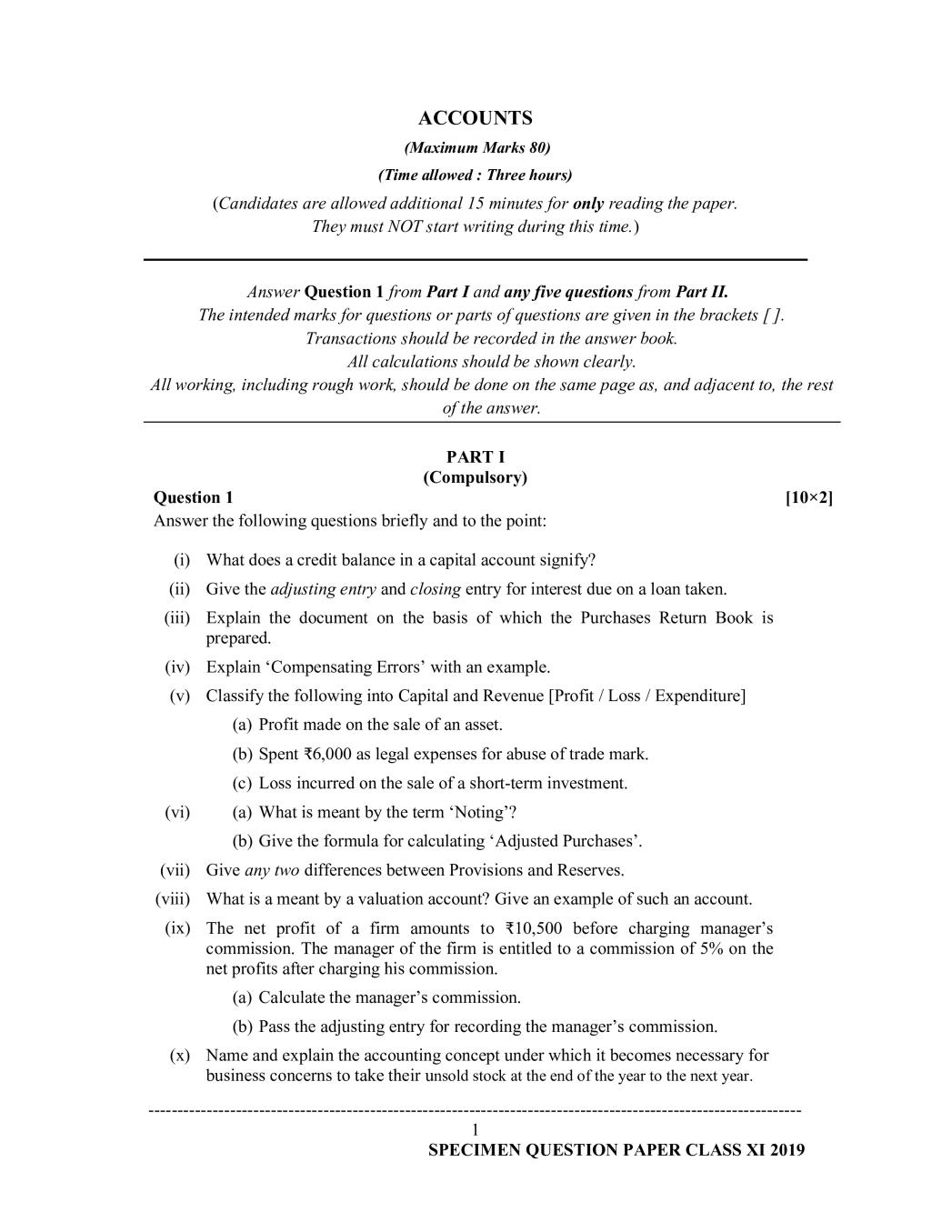
(Maximum Marks 80)
(Time allowed : Three hours)
(Candidates are allowed additional 15 minutes for only reading the paper.
They must NOT start writing during this time.)
Answer Question 1 from Part I and any five questions from Part II.
The intended marks for questions or parts of questions are given in the brackets [ ].
Transactions should be recorded in the answer book.
All calculations should be shown clearly.
All working, including rough work, should be done on the same page as, and adjacent to, the rest
of the answer.
PART I
(Compulsory)
Question 1 [10×2]
Answer the following questions briefly and to the point:
(i) What does a credit balance in a capital account signify?
(ii) Give the adjusting entry and closing entry for interest due on a loan taken.
(iii) Explain the document on the basis of which the Purchases Return Book is
prepared.
(iv) Explain ‘Compensating Errors’ with an example.
(v) Classify the following into Capital and Revenue [Profit / Loss / Expenditure]
(a) Profit made on the sale of an asset.
(b) Spent ₹6,000 as legal expenses for abuse of trade mark.
(c) Loss incurred on the sale of a short-term investment.
(vi) (a) What is meant by the term ‘Noting’?
(b) Give the formula for calculating ‘Adjusted Purchases’.
(vii) Give any two differences between Provisions and Reserves.
(viii) What is a meant by a valuation account? Give an example of such an account.
(ix) The net profit of a firm amounts to ₹10,500 before charging manager’s
commission. The manager of the firm is entitled to a commission of 5% on the
net profits after charging his commission.
(a) Calculate the manager’s commission.
(b) Pass the adjusting entry for recording the manager’s commission.
(x) Name and explain the accounting concept under which it becomes necessary for
business concerns to take their unsold stock at the end of the year to the next year.
1
Page 2
(Answer any five questions)
Question 2
(A) From the following particulars taken from the books of Arun Textiles, you are [8]
required to prepare in their books for the month of March,2017:
(i) Return Inwards Book
(ii) Return Inwards Account
(iii) M/s Tapan Cloth House Account
(iv) M/s Shovan Cloth House
2017
15/3/2107 Returns from M/s Tapan Cloth House, 20 pieces of printed sarees
@ ₹300 each sold at a trade discount of 10%, being defective.
23/3/2017 Returns from M/s Shovan Cloth House, 100 pieces of shirts @ ₹50 each
sold at a trade discount of 10%, being not up to specification.
Arun Textiles had sold 200 pieces of sarees to M/s Tapan Cloth House in February,
2017. Payment of 150 sarees at a cash discount of 5% had been received from them on
3rd March, 2017.
M/s Shovan Cloth House had been sold 500 pieces of shirts on 4th March,2017. They
cleared their account on 31st March,2017.
Note: Arun Textiles balance / close their accounts at the end of every month.
(B) You are required to journalise the following transactions: [4]
Balances in the books of Rahul, a computer dealer on 1st April, 2017:
Cash ₹500; Bank overdraft ₹1,000; Stock ₹7,000; Building ₹6,500;
Computers ₹3,500.
On the same day, he sold a computer, the book value of which was ₹2,000 was for
₹1,950.
Question 3
(A) From the following information of Walter Ltd., you are required to prepare: [10]
(i) Machinery account for the two years ending 31 March,2017. st
(ii) Depreciation Account for the year ending 31st March,2017.
The company charges depreciation @ 20 % per annum by the written down value
method.
Date Transactions
01.04.2015 Purchased machineries for ₹60,000
01.10.2015 Purchased a second-hand machinery for ₹1,08,000
01.10.2015 Spent ₹12,000 on its repairs to make it serviceable.
01.04.2016 Spent ₹1,200 on repairs of the machinery purchased on
01.04.2015.
30.09.2016 Sold one of the machines costing ₹20,000, out of the lot
purchased on 01.04.2015, for ₹13,000 and purchased a new
machine for ₹28,000.
2
Page 3
Gross Profit
Gross Purchases
Particulars ₹
Net Sales 2,00,000
Opening Stock 32,000
Purchases returns 12,000
Wages 3,000
Closing Stock 14,000
Rent 1,000
Gross profit is 25% on cost
Question 4
(A) You are required to pass journal entries for the following transactions in the [2]
books of Rajiv:
(i) Purchased goods for ₹ 15,000 from Vinay at a trade discount of 10%. The
purchase is subject to a levy of CGST and SGST @ 9% each. 40% of the amount
is paid immediately made by cheque.
(ii) Goods of the value of ₹ 2,000 are distributed from the stock as free samples. These
goods had been purchased paying CGST and SGST @ 9% each.
(B) On 1st October, 2017, Amit draws on Bijoy, who owed him ₹4,000, two bills one for [10]
₹1,600 and another for ₹2,400, the term for both the bills being two months. Bijoy
accepts these bills.
On 3rd October, Amit endorses the first bill to his creditor Chintan in full settlement of
his account of ₹1,650 and on 4th November, he discounts the second bill with his bank
@ 6% per annum.
Both the bills are dishonoured on the due dates with noting charges being ₹15 and ₹20
respectively. On 5th December, Amit draws and Bijoy accepts a third bill for 3 months
for ₹4,500 in lieu of the dishonoured bills. On the due date of this bill, Bijoy is
declared insolvent and only 60% of the amount could be recovered from his official
receiver.
You are required to, in the books of Amit, prepare the following ledger accounts:
(i) Bijoy’s Account.
(ii) Chintan’s Account.
(iii) Interest Account.
(iv) Bad debts Account.
Note: Amit balances/closes his accounts at the end of the financial year.
3
SPECIMEN QUESTION PAPERS CLASS XI - 2019
Page 4
From the following balances as at 31st March, 2017, you are required to prepare:
(i) A Trading and Profit & Loss Account.
(ii) A Balance Sheet.
Trial Balance
As at 31st March, 2017
Particulars L.F. Debit Bal (₹) Credit Bal (₹)
Furniture & Fittings 640
Land & Building 13,750
Capital 13,500
Bad Debts 125
Provision for Doubtful Debts 200
S. Debtors & S. Creditors 3,800 5,350
Stock as on 1st April 2016 3,460
Purchases and Sales 5,475 15,450
Sales & Purchases returns 200 125
Commission 375
Cash 918
Taxes and Insurance 1,250
Depreciation on Building 982
Depreciation on Furniture 100
Salaries 3,300
Patents 2,000
5% Loan 2,000
Input IGST 5,000
Output IGST 4,000
Total 41,000 41,000
The following adjustments are to be made:
(a) ₹500 purchases returns included in sales.
(b) Stock in hand on 31st March,2017 at cost price was ₹3,250 and at market price
was ₹3,000.
(c) Insurance includes annual premium of ₹500 which will expire on
30th June,2017.
(d) Increase bad debts to ₹225.
(e) Stock costing ₹1,000 was destroyed by fire. The insurance company admitted
to a claim of 40% of the loss.
4
Page 5
Unable to find the difference in the Trial Balance in the year 2016-17, Ajoy entered the
difference in the Suspense Account. He was able to locate the following errors in April 2017:
(a) Discount allowed ₹55 had been posted to the credit of Discount Received Account.
(b) A credit purchase of goods of ₹642 from Parth was posted as ₹426.
(c) A cheque of ₹400 from a customer has been dishonoured but no record of this had been
made.
(d) Equipment bought during the year for ₹4,400 had been debited to Purchases Account.
(e) During the year, Ajoy had taken goods for resale costing ₹800 for his personal use but
made no entry for it.
(f) ₹90, being an amount paid out of the business bank account for one of Ajoy’s private
expenses was not recorded.
(g) A cheque of ₹870 received from Sachin, deposited in the bank the same day was
recorded in the cash column of the Cash Book as ₹780.
(h) The closing stock was undercast by ₹1,000.
(i) Goods purchased on credit ₹1,200 from Joshi had been correctly entered in the
Purchase Day Book but wrongly posted to Bimal’s Account as ₹2,100.
(j) Cash sales of ₹3,350 was posted as ₹3,530.
You are required to:
(i) Pass journal entries to correct the errors.
(ii) Pass the journal entry to show the effect of the errors on the profit of the year
2016-17.
(iii) Prepare the Suspense Account to show the difference in the Trial Balance.
Question 7
(A) On the basis of the following information, calculate the amount that will appear [4]
against the item ‘Stationery Account’ in the Income and Expenditure Account for
the year ending 31st March, 2018:
Particulars (₹)
Stock of stationery on 1st April, 2017 400
Creditors for stationery on 1st April, 2017 450
Amount paid for stationery during 2017 2,000
Stock of stationery on 31st March,2018 300
st
Creditors for stationery 31 March,2018 500
5
SPECIMEN QUESTION PAPERS CLASS XI - 2019
Page 6
His position on 1st April, 2017, was as follows:
Particulars 1st April, 2017
(₹)
Plant and Machinery 40,000
Stock 6,000
Cash in hand 600
Debtors 15,000
Loan from Haroon @6 % per annum
interest 1,000
Bank overdraft 1,100
Creditors 12,120
On 31st March,2018, he owed to his creditors ₹10,170, the cash and bank balance was
₹5,100 and stock was valued at ₹3,500. His debtors owed him ₹23,000 out of which
out of which he got to know that ₹1,900 would be bad.
On 1st October, 2017 he paid to Haroon ₹500 in lieu of his loan, but did not pay any
interest.
During the year, Asim:
(i) Bought additional plant and machinery which cost ₹14,000
(ii) Withdrew ₹8,000 for domestic purposes.
(iii) Introduced further capital of ₹10,000.
From the above information, you are required to ascertain the profit made or loss
incurred by Asim for the year ending 31st March,2018.
Question 8 [12]
From the following particulars:
(i) Compile a Triple-column Cash Book for January, 2017.
(ii) Prepare (a) Discount Allowed Account (b) Discount Received Account.
Jan 1 Cash in hand ₹5,200; Bank Balance (Cr) ₹500
2 Paid into bank out of office cash ₹300.
3 Cash sales ₹1,000, deposited into bank.
5 Drew cheque for private use ₹300; paid rent of residential house by cash ₹1,200
8 Discounted a bill of exchange ₹3,000 with the bank @1%.
9 Received a cheque of ₹440 from Pearl Bros, in full settlement of their account of
₹470.
6
Page 7
11 Received a cheque from Bashir & Co., value ₹290, in settlement of their account
of ₹300.
12 Paid into the bank the two cheques received from Pearl Bros. and Bashir & Co.
14 Pearl Bros. cheque returned by the bank dishonoured.
31 Interest and bank charges for the month ₹30.
31 Deposited into bank any cash in excess of ₹800.
Question 9 [12]
On 31st January, 2018, Sethi’s cash book showed a bank overdraft of ₹1,25,000. On
comparing it with the pass book, the following differences were noted.
(a) Cash and cheques amounting to ₹13,400 were sent to the bank on 27th January, but
cheques worth ₹2,300 were credited on 2nd February and one cheque for
₹450 was returned by them as dishonoured on 4th February.
(b) During the month of January, Sethi issued cheques worth ₹16,700 to his creditors.
Out of these, cheques worth ₹13,700 were presented for payment on
5th February.
(c) According to Sethi’s standing orders, the bankers have made the following
payments during the month of January:
(a) Life insurance premium ₹1,920.
(b) Television license fee ₹1,200.
(d) Sethi’s bankers have collected ₹1,500 as dividend on his shares.
(e) Interest charged by the bank ₹1,250.
(f) A bill receivable of ₹1,000 discounted with the bank in December, 2017, was
dishonoured on 31st January, 2018.
You are required to
(i) Ascertain the amended cash book balance as on 31st January, 2018.
(ii) Prepare a Bank Reconciliation Statement from the amended cash book as at
31st January, 2018.
7
SPECIMEN QUESTION PAPERS CLASS XI - 2019