ISC Class 11 Specimen Paper for Biology
Finished viewing? Save it for later —
Download ISC Class 11 Specimen Paper for Biology (PDF · 6 pages)About ISC Class 11 Specimen Paper for Biology
ISC Class 11 Specimen Paper for Biology is available here for free download. Published by CISCE for Class 11, this sample paper can be viewed online or downloaded as a PDF (6 pages). Candidates preparing for Class 11 can use ISC Class 11 Specimen Paper for Biology to understand the exam pattern, the type of questions asked, and the overall difficulty level.
Frequently Asked Questions
How can I download ISC Class 11 Specimen Paper for Biology?
Open this page and click the Download button to save ISC Class 11 Specimen Paper for Biology as a PDF. It is completely free on AglaSem Docs.
Is ISC Class 11 Specimen Paper for Biology free to download?
Yes. ISC Class 11 Specimen Paper for Biology can be viewed online and downloaded as a PDF free of cost on AglaSem Docs.
How many pages does ISC Class 11 Specimen Paper for Biology have?
ISC Class 11 Specimen Paper for Biology contains 6 pages, which you can read online or download together as a single PDF.
Where can I find more Class 11 study material?
You can find more Class 11 question papers, sample papers, syllabus, and answer keys on AglaSem Docs.
ISC Class 11 Specimen Paper for Biology – Text
Read the full text of this sample paper below — useful to quickly search, copy and reference the content online without downloading the PDF.
📄 View text version (6 pages)
Page 1
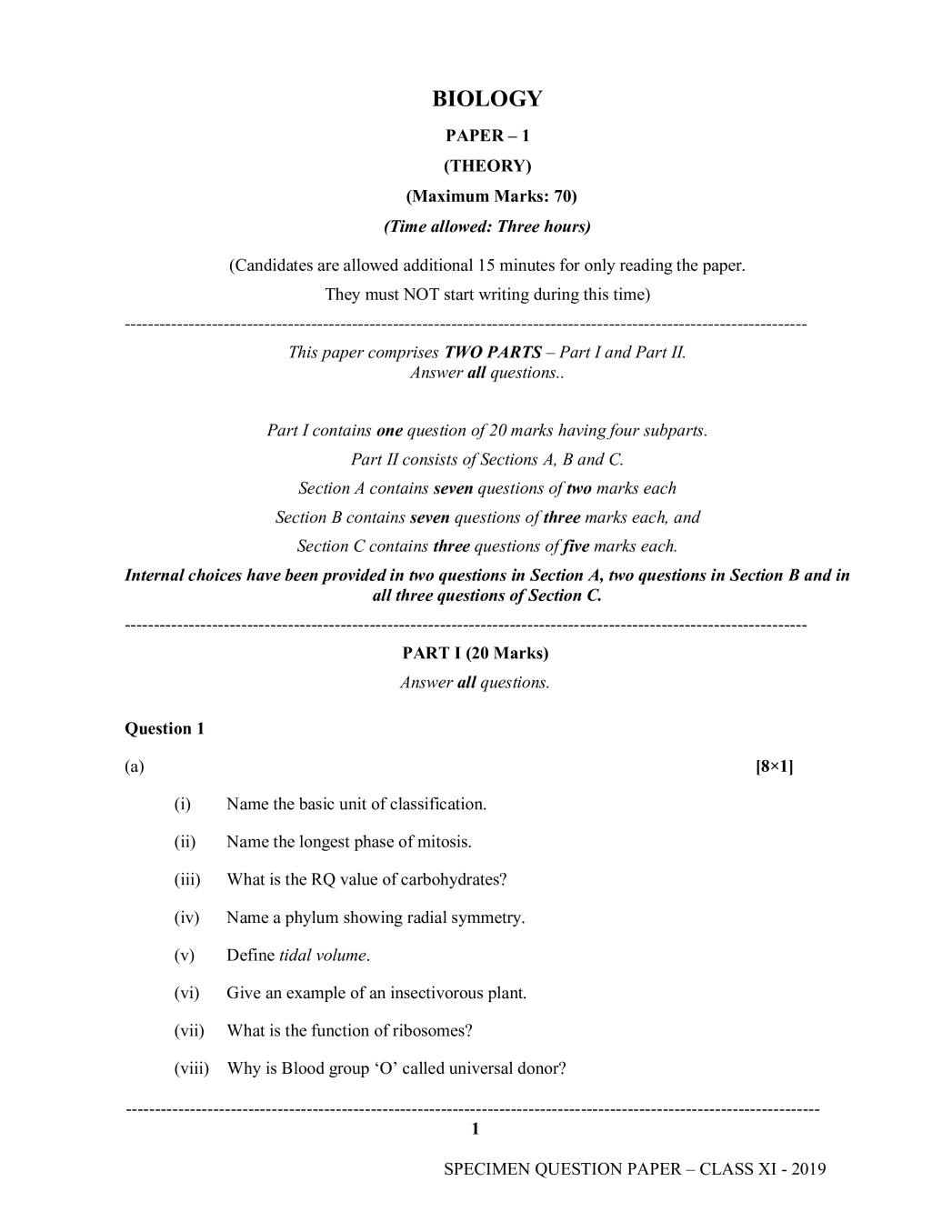
PAPER – 1
(THEORY)
(Maximum Marks: 70)
(Time allowed: Three hours)
(Candidates are allowed additional 15 minutes for only reading the paper.
They must NOT start writing during this time)
---------------------------------------------------------------------------------------------------------------------
This paper comprises TWO PARTS – Part I and Part II.
Answer all questions..
Part I contains one question of 20 marks having four subparts.
Part II consists of Sections A, B and C.
Section A contains seven questions of two marks each
Section B contains seven questions of three marks each, and
Section C contains three questions of five marks each.
Internal choices have been provided in two questions in Section A, two questions in Section B and in
all three questions of Section C.
---------------------------------------------------------------------------------------------------------------------
PART I (20 Marks)
Answer all questions.
Question 1
(a) [8×1]
(i) Name the basic unit of classification.
(ii) Name the longest phase of mitosis.
(iii) What is the RQ value of carbohydrates?
(iv) Name a phylum showing radial symmetry.
(v) Define tidal volume.
(vi) Give an example of an insectivorous plant.
(vii) What is the function of ribosomes?
(viii) Why is Blood group ‘O’ called universal donor?
1
Page 2
(b) each case:
(i) Adenosine is a:
(1) Nucleoside
(2) Nucleotide
(3) Protein
(4) Derived lipid
(ii) The pressure applied by the cell contents on the cell wall is:
(1) Wall pressure
(2) Root pressure
(3) Turgor pressure
(4) Osmotic pressure
(iii) Which of the following hormones regulate basal metabolic rate?
(1) Growth hormone
(2) Insulin
(3) Glucocorticoids
(4) Thyroxine
(iv) When calyx and corolla cannot be differentiated from each other, they
are collectively known as:
(1) Syncarpous
(2) Perianth
(3) Gamopetalous
(4) None of these
(c) Give one significant contribution of each of the following scientists: [2×1]
(i) W. M. Stanley
(ii) Engelmann in the field of photosynthesis
2
Page 3
(i) Oogamy
(ii) Perispem
(iii) Emphysema
(e) Answer the following: [3×1]
(i) Under what clinical conditions does a patient need haemodialysis?
(ii) What is the role of Azospirillum in nitrogen cycle?
(iii) Give one difference between metacentric chromosomes and
sub-metacentric chromosomes.
PART II
SECTION A (14 Marks)
Question 2 [2]
(a) Draw a labelled diagram of TS of mammalian gut.
OR
(b) Draw a labelled diagram of LS of mammalian kidney.
Question 3 [2]
Differentiate between monocots and dicots, with reference to their root system and venation in the
leaves.
Question 4 [2]
Define cell theory. Who proposed the cell theory?
Question 5 [2]
State four physiological functions of auxins.
3
Page 4
Write a short note on double circulation.
Question 7 [2]
Define:
(a) Hydroponics
(b) Guttation
Question 8 [2]
(a) Give four differences between prokaryotic cells and eukaryotic cells.
OR
(b) Give four differences between mitosis and meiosis.
SECTION B (21 Marks)
Question 9 [3]
Name the three systems of classification of living organisms. Give one salient feature of each of
the three systems.
Question 10 [3]
(a) Describe different types of gynoecia on the basis of position of ovary with respect to other
floral whorls.
OR
(b) Describe different types of neurons on the basis of their polarity.
Question 11 [3×1]
Define the following:
(a) Plasmodesmata
(b) Plasmolysis
(c) Gustatoreceptor
4
Page 5
Draw a well labelled diagram of electron microscopic structure of TS of cilia.
Question 13 [3]
(a) Describe any three factors affecting the process of imbibitions.
OR
(b) Describe any three external factors affecting the process of photosynthesis.
Question 14 [3]
Give the function of the following in a cockroach:
(a) Hepatic caeca
(b) Spiracles
(c) Mushroom gland
Question 15 [3]
Give the cause and one symptom of the following diseases:
(i) Angina pectoris
(ii) Gout
(iii) Constipation
SECTION C (15 Marks)
Question 16 [5]
(a) Draw a well labelled diagram of electron microscopic structure of the chloroplast.
OR
(b) Draw a well labelled diagram of electron microscopic structure of a eukaryotic cell.
5
Page 6
(a) Describe an experiment to show the downwards transport of organic solutes through
phloem.
OR
(b) (i) What are the criteria of essentiality of minerals in plants?
(ii) Give the characteristic role of nitrogen and phosphorus in plant.
Question 18 [5]
(a) Explain the chemical events occurring during muscle contraction.
OR
(b) Describe the physiology of urine formation.
6