MAHA SET 2015 Question Paper 2 History
Finished viewing? Save it for later —
Download MAHA SET 2015 Question Paper 2 History (PDF · 28 pages)About MAHA SET 2015 Question Paper 2 History
MAHA SET 2015 Question Paper 2 History is available here for free download. Published by Maharashtra Exams for MAHA SET, this question paper can be viewed online or downloaded as a PDF (28 pages). Candidates preparing for MAHA SET can use MAHA SET 2015 Question Paper 2 History to understand the exam pattern, the type of questions asked, and the overall difficulty level.
Frequently Asked Questions
How can I download MAHA SET 2015 Question Paper 2 History?
Open this page and click the Download button to save MAHA SET 2015 Question Paper 2 History as a PDF. It is completely free on AglaSem Docs.
Is MAHA SET 2015 Question Paper 2 History free to download?
Yes. MAHA SET 2015 Question Paper 2 History can be viewed online and downloaded as a PDF free of cost on AglaSem Docs.
How many pages does MAHA SET 2015 Question Paper 2 History have?
MAHA SET 2015 Question Paper 2 History contains 28 pages, which you can read online or download together as a single PDF.
Where can I find more MAHA SET study material?
You can find more MAHA SET question papers, sample papers, syllabus, and answer keys on AglaSem Docs.
MAHA SET 2015 Question Paper 2 History – Text
Read the full text of this question paper below — useful to quickly search, copy and reference the content online without downloading the PDF.
📄 View text version (28 pages)
Page 1
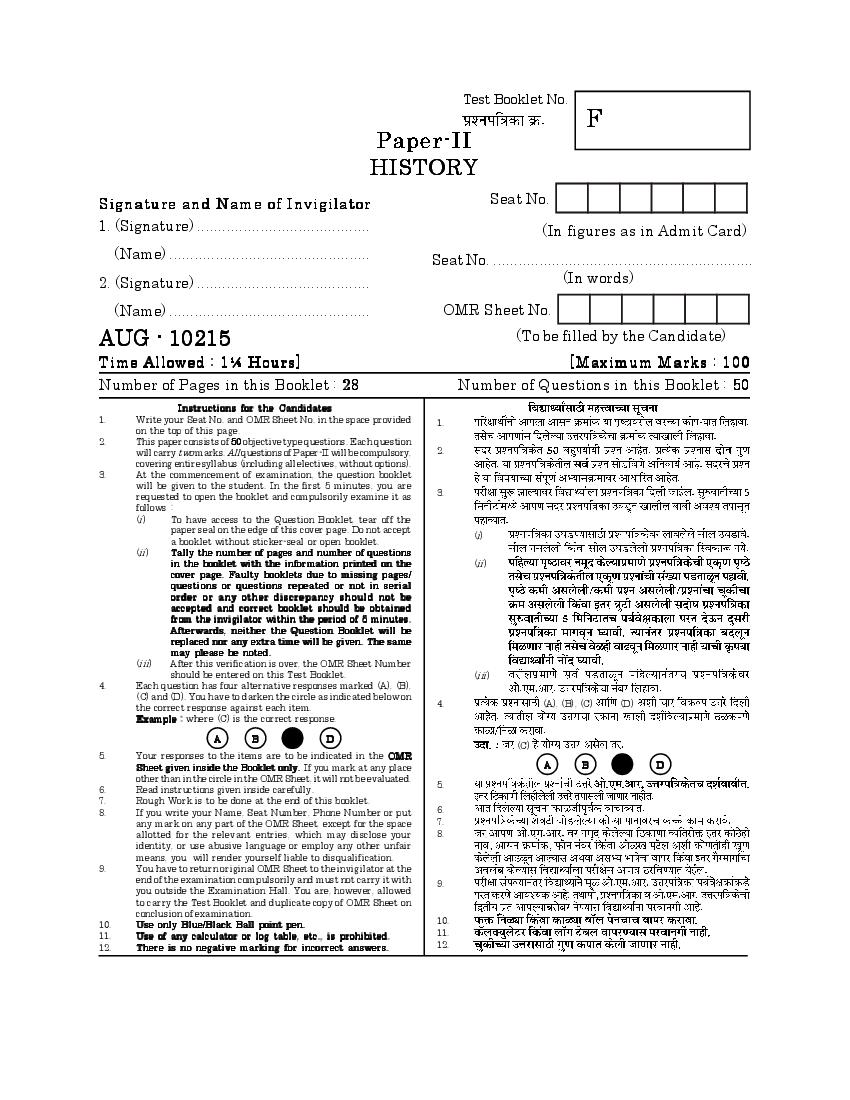
F
HISTORY
Signature and Name of Invigilator Seat No.
1. (Signature) ......................................... (In figures as in Admit Card)
(Name) ................................................ Seat No. ..............................................................
2. (Signature) ......................................... (In words)
(Name) ................................................ OMR Sheet No.
AUG - 10215 (To be filled by the Candidate)
Time Allowed : 1¼ Hours] [Maximum Marks : 100
Number of Pages in this Booklet : 28 Number of Questions in this Booklet : 50
Instructions for the Candidates
1. Write your Seat No. and OMR Sheet No. in the space provided 1.
on the top of this page.
2. This paper consists of 50 objective type questions. Each question
will carry two marks. All questions of Paper-II will be compulsory, 2.
covering entire syllabus (including all electives, without options).
3. At the commencement of examination, the question booklet
will be given to the student. In the first 5 minutes, you are
requested to open the booklet and compulsorily examine it as 3.
follows :
(i) To have access to the Question Booklet, tear off the
paper seal on the edge of this cover page. Do not accept
(i)
a booklet without sticker-seal or open booklet.
(ii) Tally the number of pages and number of questions
in the booklet with the information printed on the (ii)
cover page. Faulty booklets due to missing pages/
questions or questions repeated or not in serial
o rder or any other discre pancy should not be
accepted and correct booklet should be obtained
from the invigilator within the period of 5 minutes.
Afterwards, neither the Question Booklet will be
replaced nor any extra time will be given. The same
may please be noted.
(iii) After this verification is over, the OMR Sheet Number
should be entered on this Test Booklet. (iii)
4. Each question has four alternative responses marked (A), (B),
(C) and (D). You have to darken the circle as indicated below on
the correct response against each item. 4. (A), (B), (C) (D)
Example : where (C) is the correct response.
A B D
(C)
5. Your responses to the items are to be indicated in the OMR
Sheet given inside the Booklet only. If you mark at any place A B D
other than in the circle in the OMR Sheet, it will not be evaluated.
5.
6. Read instructions given inside carefully.
7. Rough Work is to be done at the end of this booklet.
8. If you write your Name, Seat Number, Phone Number or put 6.
any mark on any part of the OMR Sheet, except for the space 7.
allotted for the relevant entries, which may disclose your 8.
identity, or use abusive language or employ any other unfair
means, you will render yourself liable to disqualification.
9. You have to return original OMR Sheet to the invigilator at the
end of the examination compulsorily and must not carry it with 9.
you outside the Examination Hall. You are, however, allowed
to carry the Test Booklet and duplicate copy of OMR Sheet on
conclusion of examination.
10. Use only Blue/Black Ball point pen. 10.
11. Use of any calculator or log table, etc., is prohibited. 11.
12. There is no negative marking for incorrect answers. 12.
Page 2
Page 3
Paper II
II
Time Allowed : 75 Minutes] [Maximum Marks : 100
Note : This Paper contains Fifty (50) multiple choice questions. Each question
carries Two (2) marks. Attempt All questions.
(50) (2)
1. The earliest evidence of Homo- 1.
erectus appeared in :
(A) East Africa
(A)
(B) West Africa
(B)
(C) North Africa (C)
(D) South Africa (D)
2. The lower palaeolithic stone 2.
industry of the South India was also
called as :
(A)
(A) Hyderabadi
(B)
(B) Bangalori
(C)
(C) Madrasian
(D) Trichian (D)
3 [P.T.O.
Page 4
richest palaeolithic sites in Tamil
Nadu ?
(A) Pudukottai
(A)
(B) Madurai
(B)
(C) Tanjor
(C)
(D) Attirampakkam
(D)
4. Pieces of Ostrich eggshell have been
4.
found at which place in
Maharashtra ?
(A)
(A) Newase
(B) Patane (B)
(C) Inamgaon (C)
(D) Prakashe (D)
4
Page 5
5. ‘Dasyu’ corresponds to ‘dahyu’ in
ancient :
(A)
(A) Japanese language
(B)
(B) Sinhali language
(C)
(C) Iranian language
(D)
(D) English language
6.
6. Which of the following Sanskrit
terms is understood to mean
architect in early medieval times ?
(A) Sutragrahi (A)
(B) Shilpakar (B)
(C) Sthapati (C)
(D) Muhandi (D)
5 [P.T.O.
Page 6
used for battle in Rigveda ?
(A) Gojit (A)
(B) Gavishthi (B)
(C) Goshati (C)
(D) Goghna (D)
8. Which of the following literary 8.
works mentioned the expounders of
Rajashastra (theory of statecraft)
namely—Brihaspati, Bharadvaja,
Gaurasiras, Kavya, Mahendra,
Manu Prachetasa and Vishalaksha ?
(A)
(A) Mahabharata
(B)
(B) Manusmriti
(C) Mitakshara (C)
(D) Amuktamalyada (D)
6
Page 7
was established during Pallava
times ?
(A)
(A) Nagapattinam
(B)
(B) Kaveripattinam
(C) Mamallapuram (C)
(D) Devanamapattinam
(D)
10. Into how many classes
10.
did Megasthenes divide Indian
society ?
(A)
(A) Four
(B)
(B) Five
(C)
(C) Six
(D)
(D) Seven
7 [P.T.O.
Page 8
................... Mahajanapada.
(A) Southern Avanti (A)
(B) Northern Avanti (B)
(C) Kosala (C)
(D) Anga (D)
12. During the time of which King 12.
was the Fourth Buddhist Council
held ?
(A)
(A) Ashoka
(B)
(B) Kanishka
(C)
(C) Skandagupta
(D)
(D) Harshavardhana
8
Page 9
sultanate capture Goa from the
Vijayanagar Empire ?
(A) 1487 (A) 1487
(B) 1489 (B) 1489
(C) 1490 (C) 1490
(D) 1491 (D) 1491
14. Which rulers were described as 14.
“Lords of the Jewelled throne of
Karnataka ?
(A) The Chalukyas of Badami
(A)
(B) The Cholas
(B)
(C) The Rashtrakutas of
(C)
Manyakheda
(D) The Wodeyars of Mysore (D)
9 [P.T.O.
Page 10
Department during the Mughal
empire was ......................... .
(A) Diwan-i-Kul
(A)
(B) Mir Bakshi
(B)
(C) Khan-i-Saman
(C)
(D) Mushrif-i-Mumalik
(D)
16. The maximum share of the Chouth
16.
collected during the period of the
Maratha confederacy went to :
(A) Peshwa
(A)
(B) Chhatrapati
(B)
(C) Sardars
(C)
(D) Pant Sachiv
(D)
10
Page 11
Upanishads undertaken by Dara
Shukoh was entitled :
(A) Seirrul Asrar (A)
(B) Ain-i-Akbari (B)
(C) Rehla (C)
(D) Tuzuk-i-Jahangiri (D)
18. The theory of Wahdat-ash-Shuhud 18.
is associated with :
(A) Sirhindi (A)
(B) Isami (B)
(C) Minhaj Siraj (C)
(D) Nizamuddin Auliya (D)
11 [P.T.O.
Page 12
us-Salatin was :
(A) Isami (A)
(B) Shamsuddin Siraj Afif
(B)
(C) Ziauddin Barani
(C)
(D) Minhaj-us-Siraj
(D)
20. The Sufi order which was
20.
popularised in India by the Mughal
Emperor Babur was :
(A)
(A) Naqshbandiya
(B)
(B) Qadiriya
(C)
(C) Suhrawardi
(D)
(D) Chishti
12
Page 13
in India, was built by the Bijapur
Sultans in the year :
(A) 1660
(A) 1660
(B) 1665
(B) 1665
(C) 1670
(C) 1670
(D) 1680
(D) 1680
22.
22. In which battle did the Deccani
Sultans defeat the Vijayanagar
ruler ? (A)
(A) The Battle of Talikota (B)
(B) The Battle of Lakkundi
(C)
(C) The Battle of Haldighati
(D)
(D) The Battle of Takkolam
13 [P.T.O.
Page 14
whose verses were incorporated in
the Guru Granth Sahib ?
(A) Eknath
(A)
(B) Namdev
(B)
(C) Tukaram
(C)
(D) Ramdas
(D)
24. The Huzur Daftar was :
24.
(A) The office of the Nyayadhisha
(A)
(B) The King’s Court at Satara
(B)
(C) The Peshwa’s Secretariat at
(C)
Pune
(D)
(D) The office of the Mamlatdar
14
Page 15
was introduced by :
(A) Warren Hastings
(A)
(B) Arthur Wellesley
(B)
(C) John Malcolm
(C)
(D) Lord Dalhousie
(D)
26. Who among the following depicted
26.
Vishnubuwa Brahmachari’s
“Vedokta Dharmaprakash” as
‘Utopian Socialism’ ?
(A) S.D. Jawadekar (A)
(B) Acharya P.K. Atre (B)
(C) A.S. Altekar (C)
(D) S.G. Bhagwat (D)
15 [P.T.O.
Page 16
(1893) was held at .................... .
(A) New York
(A)
(B) Pennsylvania
(B)
(C) Chicago
(C)
(D) New Jersey
(D)
28. Which one of the following gives the
28.
correct chronological sequence of the
events ?
(I) Royal visit of the King Emperor (I)
George V (II)
(II) Partition of Bengal (III)
(III) Simla Deputation
(IV)
(IV) Birth of Muslim League
(A) (II), (IV), (III), (I)
(A) (II), (IV), (III), (I)
(B) (III), (II), (I), (IV)
(B) (III), (II), (I), (IV)
(C) (II), (III), (IV), (I)
(C) (II), (III), (IV), (I)
(D) (IV), (II), (I), (III)
(D) (IV), (II), (I), (III)
16
Page 17
laid in the year ....................... .
(A) 1842
(A) 1842
(B) 1853
(B) 1853
(C) 1863
(C) 1863
(D) 1873
(D) 1873
30. The First Railway in the world was
opened in England in the year 30.
................... .
(A) 1825 (A) 1825
(B) 1853 (B) 1853
(C) 1854
(C) 1854
(D) 1855
(D) 1855
31. The General Service Enlistment Act
31.
was passed under the Governor
Generalship of .................... .
(A)
(A) Lord Canning
(B)
(B) Lord Auckland
(C)
(C) Lord Ellenborough
(D)
(D) Lord Amherst
17 [P.T.O.
Page 18
basis of Dadabhai Naoroji’s
calculation of the drain ?
(A)
(A) Difference between Import and
Export (B)
(B) Difference between Revenue
(C)
Surplus
(D)
(C) Difference between Income and
Expenditure 33.
(D) Extravagant expenditure
33. Who wrote ‘Jatibhed Viveksar’ ?
(A)
(A) Dinkarrao Jawalkar
(B)
(B) Bhaskarrao Jadhav
(C)
(C) Krishnarao Bhalekar
(D)
(D) Tukaram Tatya Padval
18
Page 19
“Protestant Hinduism’ ?
(A) Mahatma Jyotirao Phule (A)
(B) Lokhitawadi Gopal Hari
(B)
Deshmukh
(C)
(C) R.G. Bhandarkar
(D)
(D) Justice M.G. Ranade
35.
35. Who among the following historians
argued that social trajectory of
Indian history is tribe-peasants-
caste ?
(A)
(A) Dharmanand Kosambi
(B)
(B) Damodar D. Kosambi
(C)
(C) A.S. Altekar
(D)
(D) K.P. Jayaswal
19 [P.T.O.
Page 20
ushered its motto “Educate, Agitate
and Organise” ?
(A) Bahishkrit Hitakarini Sabha
(A)
(B) Independent Labour Party
(C) Depressed Classes Association (B)
(D) Republican Party of India (C)
37. What is “Apartheid’ ?
(D)
(A) A system of segregation and
37.
discrimination on the basis of
race (A)
(B) System of European caste
hierarchy
(B)
(C) Religious segregation
(C)
(D) Segregation on the basis of
(D)
culture
20
Page 21
38.
related to .................... .
(A)
(A) The Latin American countries
(B)
(B) The former British Empire
(C) Association of European (C)
Community
(D)
(D) Membership of United Nations
39.
39. What is Confucianism ?
(A)
(A) A theory of politics
(B) A theory of economics (B)
(C) A system of education (C)
(D) A philosophy of morality and
(D)
ethics
21 [P.T.O.
Page 22
associated with early socialism ?
(A) Robert Owen (A)
(B) Emile Durkheim (B)
(C) Charles Fourier (C)
(D) Henri de Saint-Simon (D)
41. The Ninety-Five Theses were 41.
related to :
(A) Jeremy Bentham (A)
(B) James Mill (B)
(C) Martin Luther (C)
(D) Herbert Spencer (D)
22
Page 23
42.
their works and choose the correct
codes given below :
(a) J.A. Hobson (i) Accumulation (a) (i)
of Capital
(b) Rosa Luxembourg (ii) Imperialism :
(b) (ii)
a Study
(c) V.I. Lenin (iii) I m p e ri a l i s m (c) (iii)
and the World
Economy
(d) (iv)
(d) Nikolai Bukharin (iv) Impe rialism,
the highest
stage of capi-
talism
Codes : (a) (b) (c) (d)
(a) (b) (c) (d)
(A) (iv) (iii) (ii) (i)
(A) (iv) (iii) (ii) (i)
(B) (iii) (i) (iv) (ii)
(B) (iii) (i) (iv) (ii)
(C) (i) (iv) (ii) (iii)
(C) (i) (iv) (ii) (iii)
(D) (ii) (iii) (iv) (i) (D) (ii) (iii) (iv) (i)
23 [P.T.O.
Page 24
43.
to work’ in the Nineteenth
century ?
(A)
(A) Joseph Mazzini
(B)
(B) Louis Blanc
(C)
(C) T.H. Green
(D)
(D) Karl Marx
44.
44. Which historian argued that caste
is an innovation of the colonial
mind ?
(A) Nicholas Dirks (A)
(B) Ranajit Guha (B)
(C) Dipesh Chakravarti (C)
(D) B.D. Chattopadhyay (D)
24
Page 25
(A) To believe that there is no (A)
causality in history
(B) To believe that there are
(B)
inclusive, demonstrable and
determining patterns in the
process of historical change
(C)
(C) To believe in the intervention
of God in history
(D) To believe in fatalism (D)
46. Annale’s Historiography originated 46.
in which country ?
(A) France (A)
(B) Britain (B)
(C) America (C)
(D)
(D) Germany
25 [P.T.O.
Page 26
47.
the defining feature of orientalism ?
(A) Western imperialism
(A)
(B) Eastern reaction to western
(B)
domination
(C) East-west as ontological divide
(D) South-North as epistemological (C)
divide
(D)
48. Among the following historians, who
48.
employed structural-linguistics to
unravel colonial documents ?
(A) Ranajit Guha
(A)
(B) David Hardiman
(B)
(C) Rosalind O’ Hanlon
(C)
(D) David Washbrook (D)
26
Page 27
49. Which historian explained Maratha
politics through ‘Fitna Theory’ ?
(A) Stewart Gordon
(A)
(B) André Wink
(B)
(C) Hiroyuki Kotani
(C)
(D) A.R. Kulkarni
(D)
50. According to historian V.K. Rajwade
50.
what is ‘Maharashtra Dharma’ ?
(A) Valiant Hinduism (A)
(B) Valiant Maratha Dharma (B)
(C) Ideology of Varkari Sect (C)
(D) Ideology of Bhakti Cult (D)
27 [P.T.O.
Page 28
28
Document Details
| Board / Org | Maharashtra Exams |
| Exam | MAHA SET |
| Type | Question Paper |
| Pages | 28 |
| Updated | 30 Apr 2026 |