CBSE Class 12 Question Paper 2025 Solution Marketing
Finished viewing? Save it for later —
Download CBSE Class 12 Question Paper 2025 Solution Marketing (PDF · 10 pages)About CBSE Class 12 Question Paper 2025 Solution Marketing
CBSE Class 12 Question Paper 2025 Solution Marketing is available here for free download. Published by CBSE for Class 12, this solution can be viewed online or downloaded as a PDF (10 pages). Candidates preparing for Class 12 can use CBSE Class 12 Question Paper 2025 Solution Marketing to understand the exam pattern, the type of questions asked, and the overall difficulty level.
Frequently Asked Questions
How can I download CBSE Class 12 Question Paper 2025 Solution Marketing?
Open this page and click the Download button to save CBSE Class 12 Question Paper 2025 Solution Marketing as a PDF. It is completely free on AglaSem Docs.
Is CBSE Class 12 Question Paper 2025 Solution Marketing free to download?
Yes. CBSE Class 12 Question Paper 2025 Solution Marketing can be viewed online and downloaded as a PDF free of cost on AglaSem Docs.
How many pages does CBSE Class 12 Question Paper 2025 Solution Marketing have?
CBSE Class 12 Question Paper 2025 Solution Marketing contains 10 pages, which you can read online or download together as a single PDF.
Where can I find more Class 12 study material?
You can find more Class 12 question papers, sample papers, syllabus, and answer keys on AglaSem Docs.
CBSE Class 12 Question Paper 2025 Solution Marketing – Text
Read the full text of this solution below — useful to quickly search, copy and reference the content online without downloading the PDF.
📄 View text version (10 pages)
Page 1
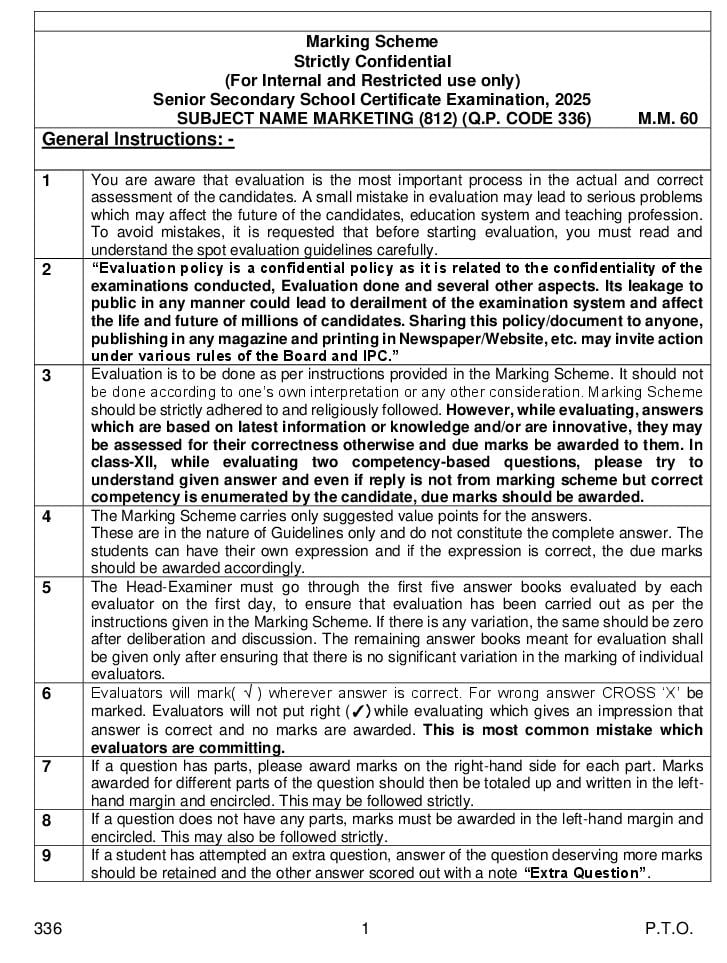
Strictly Confidential
(For Internal and Restricted use only)
Senior Secondary School Certificate Examination, 2025
SUBJECT NAME MARKETING (812) (Q.P. CODE 336) M.M. 60
General Instructions: -
1 You are aware that evaluation is the most important process in the actual and correct
assessment of the candidates. A small mistake in evaluation may lead to serious problems
which may affect the future of the candidates, education system and teaching profession.
To avoid mistakes, it is requested that before starting evaluation, you must read and
understand the spot evaluation guidelines carefully.
2 “Evaluation policy is a confidential policy as it is related to the confidentiality of the
examinations conducted, Evaluation done and several other aspects. Its leakage to
public in any manner could lead to derailment of the examination system and affect
the life and future of millions of candidates. Sharing this policy/document to anyone,
publishing in any magazine and printing in Newspaper/Website, etc. may invite action
under various rules of the Board and IPC.”
3 Evaluation is to be done as per instructions provided in the Marking Scheme. It should not
be done according to one’s own interpretation or any other consideration. Marking Scheme
should be strictly adhered to and religiously followed. However, while evaluating, answers
which are based on latest information or knowledge and/or are innovative, they may
be assessed for their correctness otherwise and due marks be awarded to them. In
class-XII, while evaluating two competency-based questions, please try to
understand given answer and even if reply is not from marking scheme but correct
competency is enumerated by the candidate, due marks should be awarded.
4 The Marking Scheme carries only suggested value points for the answers.
These are in the nature of Guidelines only and do not constitute the complete answer. The
students can have their own expression and if the expression is correct, the due marks
should be awarded accordingly.
5 The Head-Examiner must go through the first five answer books evaluated by each
evaluator on the first day, to ensure that evaluation has been carried out as per the
instructions given in the Marking Scheme. If there is any variation, the same should be zero
after deliberation and discussion. The remaining answer books meant for evaluation shall
be given only after ensuring that there is no significant variation in the marking of individual
evaluators.
6 Evaluators will mark( √ ) wherever answer is correct. For wrong answer CROSS ‘X’ be
marked. Evaluators will not put right (✓)while evaluating which gives an impression that
answer is correct and no marks are awarded. This is most common mistake which
evaluators are committing.
7 If a question has parts, please award marks on the right-hand side for each part. Marks
awarded for different parts of the question should then be totaled up and written in the left-
hand margin and encircled. This may be followed strictly.
8 If a question does not have any parts, marks must be awarded in the left-hand margin and
encircled. This may also be followed strictly.
9 If a student has attempted an extra question, answer of the question deserving more marks
should be retained and the other answer scored out with a note “Extra Question”.
336 1 P.T.O.
Page 2
once.
11 A full scale of 60 marks as given in Question Paper has to be used. Please do not hesitate
to award full marks if the answer deserves it.
12 Every examiner has to necessarily do evaluation work for full working hours i.e., 8 hours
every day and evaluate 20 answer books per day in main subjects and 25 answer books
per day in other subjects (Details are given in Spot Guidelines).This is in view of the reduced
syllabus and number of questions in question paper.
13 Ensure that you do not make the following common types of errors committed by the
Examiner in the past:-
● Leaving answer or part thereof unassessed in an answer book.
● Giving more marks for an answer than assigned to it.
● Wrong totaling of marks awarded on an answer.
● Wrong transfer of marks from the inside pages of the answer book to the title page.
● Wrong question wise totaling on the title page.
● Wrong totaling of marks of the two columns on the title page.
● Wrong grand total.
● Marks in words and figures not tallying/not same.
● Wrong transfer of marks from the answer book to online award list.
● Answers marked as correct, but marks not awarded. (Ensure that the right tick mark is
correctly and clearly indicated. It should merely be a line. Same is with the X for
incorrect answer.)
● Half or a part of answer marked correct and the rest as wrong, but no marks awarded.
14 While evaluating the answer books if the answer is found to be totally incorrect, it should be
marked as cross (X) and awarded zero (0)Marks.
15 Any unassessed portion, non-carrying over of marks to the title page, or totaling error
detected by the candidate shall damage the prestige of all the personnel engaged in the
evaluation work as also of the Board. Hence, in order to uphold the prestige of all concerned,
it is again reiterated that the instructions be followed meticulously and judiciously.
16 The Examiners should acquaint themselves with the guidelines given in the “Guidelines for
Spot Evaluation” before starting the actual evaluation.
17 Every Examiner shall also ensure that all the answers are evaluated, marks carried over to
the title page, correctly totaled and written in figures and words.
18 The candidates are entitled to obtain photocopy of the Answer Book on request on payment
of the prescribed processing fee. All Examiners/Additional Head Examiners/Head
Examiners are once again reminded that they must ensure that evaluation is carried out
strictly as per value points for each answer as given in the Marking Scheme.
336 2
Page 3
MARKING SCHEME
MARKETING (812) M.M. 60
SECTION A
OBJECTIVE-TYPE QUESTIONS
Q.No. Question Source Unit/ Marks
Material Chap.
(NCERT/ No.
PSSCIVE/
CBSE
study
material)
Q. 1 Answer any 4 out of the given 6 questions on Employability Skills. (41=4)
i. (D) Range of cells NCERT Unit 3 1
ii. (D) Ctrl + Shift + End NCERT Unit 3 1
A
(Full Marks to be given if question has been
N attempted)
Y iii. (A) Self-awareness NCERT Unit 2 1
iv. (D) Working in MNC NCERT Unit 5 1
4
v. (B) Yoga NCERT Unit 2 1
vi (D) An entrepreneur NCERT Unit 4 1
Q. 2 Answer any 5 out of the given 7 questions (51=5)
i. (C) Product differentiation CBSE Unit-1 1
ii. (C) Selling price CBSE Unit-2 1
A iii. (A) Importance of Distribution CBSE Unit-3 1
N (B) Channel of Distribution
(Both (A) & (B) are Correct Options)
Y
iv. Availability CBSE Unit-3 1
5 v. (B) Service based on service delivery and CBSE Unit-5 1
processing focus
vi. (A) Middleman CBSE Unit-3 1
vii. (B) Breadth CBSE Unit-1 1
(D) Consistency
(Both (B) & (D) are Correct Options)
336 3 P.T.O.
Page 4
i. (B) Trademark CBSE Unit-1 1
ii. (C) Retailer CBSE Unit-3 1
A iii. (A) Personal selling CBSE Unit-4 1
N iv. Premium/Prestige pricing CBSE Unit-2 1
Y v. (B) Family brand CBSE Unit-1 1
(Full Marks to be given if attempted)
6
vi. (A) 10,800 units CBSE Unit-2 1
vii. (A) Distributors CBSE Unit-3 1
(C)Retailers.
(Both (A) & (C) are Correct)
Q.4 Answer any 5 out of the given 6 questions (51=5)
A i. (C) Augmented product CBSE Unit-1 1
N ii. (D) Skimming pricing CBSE Unit-2 1
Y iii. (A) Three-level channel CBSE Unit-3 1
iv. (D) Intangibility CBSE Unit-5 1
5
v. (C) Facilitating agency CBSE Unit-3 1
vi. (B) BTL CBSE Unit-4 1
Q.5 Answer any 5 out of the given 6 questions (51=5)
i. Product / Product Mix CBSE Unit-1 1
A
ii. (B) Going rate pricing CBSE Unit-2 1
N iii. (A) Level of production CBSE Unit-3 1
Y iv. (A) Place CBSE Unit-4 1
5 v. (A) Agriculture CBSE Unit-5 1
vi. (C) Everyday low pricing CBSE Unit-2 1
Q. 6 Answer any 5 out of the given 6 questions (51=5)
i. (A) Convenience products CBSE Unit-1 1
ii. (B) Competitive pricing CBSE Unit-2 1
A iii. (D) The process of persuading prospective CBSE Unit-4 1
N buyers to buy a product
Y iv. (A) Distributor CBSE Unit-3 1
5 v. Canon / Google + / Google Ad words/ SEO CBSE Unit-5 1
vi. The company and the various CBSE Unit-4 1
Stakeholders / Consumer / government /
Media / suppliers.
(or any other relevant answer)
336 4
Page 5
Answer any 3 out of the gives 5 questions on Employability Skills.
Answer each question in 20 – 30 words. (32=6)
Q. 7 Narcissistic personality disorder: People with NCERT Unit 2
narcissistic personality disorder believe that they are 2
more important than others. They lack empathy for other
people and tend to exaggerate their own achievements.
1 mark
Avoidant personality disorder: People with this type of
disorder are socially inept, unappealing or inferior, and
constantly fear being embarrassed, criticised or rejected.
They avoid meeting others and often experience feelings
of inadequacy, inferiority or unattractiveness.
1 mark
Q. 8 Here is a tabular differentiation between formal and NCERT Unit 2
informal communication: 1
Formal Informal
Basis
Communication Communication
Casual and
Communication that
spontaneous
follows established
Definition communication
protocols, hierarchy,
without strict rules
and structure.
or structure.
Utilizes casual
Uses official
channels such as
channels like emails,
Channels chats, casual
reports, memos, or
conversations, or
meetings.
social media.
(Full Marks to be given if attempted)
Q.9 Select that worksheet and then, on the home tab, NCERT Unit- 2
in the cells group, click Insert and then click Insert Sheet 3
(Full Marks to be given if attempted)
Q.10 The two ways to fund a startup are: NCERT Unit 2
(i) Angel Investor 4
(ii) Venture Capital Firms
(iii) Funding from Global Investors
(iv) Loans and Grants
(v) Boot strapping
(vi) Crowdfunding
(Any 2 headings, 1 mark each)
336 5 P.T.O.
Page 6
(ii) Finding less polluting energy sources such as CNG 5
(iii) Drive Less and drive smart
(iv) Using electric vehicles
(v) Use less hot water.
(Or any other relevant point, 1 mark each)
Answer any 3 out of the given 5 questions in 20 – 30 words each (3 2 = 6)
Q.12 Online Marketing: It is using of Internet-based channels CBSE Unit- 2
to spread a message about a company’s brand, products, 5
or services to its potential customers.
(or any other meaningful explanation)
Q.13 Yes, we can buy a book without going to shop via Internet CBSE Unit- 2
through online platforms like Amazon, Flipkart, E-bay 5
and other E-Commerce websites and Online bookstores.
Q.14 Simultaneity 1 mark CBSE Unit- 2
5
In most of the cases production and consumption goes in
simultaneously. A consumer has always to be present in
the service factory, either the service provider comes or
he/she goes to service provider. This simultaneity
develops much more close contact with the customer. In-
service production and consumption can’t be separated.
1 mark
Q.15 ROLE OF PROMOTION CBSE Unit- 2
1.Information 4
2.Persuasion
3.Remind
4.Relationship
5.Adds value
6.Assists other company efforts
(any two points) (answer to be marked as a whole)
Q.16 Advertising: Any paid form of non-personal CBSE Unit- 2
presentation and promotion of ideas, goods or services 4
by an identified sponsor. (by American marketing
association) 2 marks
Answer any 2 out of the given 3 questions in 30 – 50 words each (23 = 6)
Q.17 CBSE Unit- 3
(1) Limited number of buyers in comparison to 1
consumer goods.
336 6
Page 7
Demand for the product is concentrated in certain
(3)
geographical locations and is derived from the
demand of consumer goods.
(4) Product purchase is based on fulfilment of
technical considerations.
(5) Reciprocal buying is involved i.e. a company may
purchase the raw material from a company and
may sell the finished product to the same company.
(6) In certain cases the companies may lease out the
products rather than purchasing them due to high
cost.
(Any 3 points, 1 mark each)
Q.18 Government Regulations: If Government policies exert CBSE Unit- 3
regulatory pressures, promote anti-price rise sentiment 2
etc., then the companies cannot fix a higher price to
capture the market. On the other hand, if government
policies are supportive and promote business through
healthy competition in the market, then firms can fix
higher prices.
(to be marked as a whole)
Q.19 Agent. 1 mark CBSE Unit- 3
3
An independent individual who takes possession of
products but does not actually own them.
Usually makes profits from commissions.
1 mark each
Answer any 3 out of the given 5 questions in 50 – 80 words each (34 = 12)
Q.20 1 1 CBSE Unit- 4
Maturity stage. mark, Explanation mark 1
2 2
Characteristics :
(1) Costs would be decreased as a result of increase in
production volumes
(2) The Sales volumes peak and market saturation is
visible.
(3) Competitors entering the market increase
(4) There is drop in prices due to entry of competing
products
Advertising spend incurred on brand
(5)
differentiation
336 7 P.T.O.
Page 8
maintain or enhance market share.
(7) The industrial profits decrease during this period.
(Any three points, 1 mark each)
Q.21 Discriminatory pricing 1 mark CBSE Unit- 4
Forms in which this pricing strategy can be applied: 2
Discrimination on the basis of customer segment-the
product / service is sold at different prices to different
customer groups, e.g. Indian Railway charges lower fare
for students.
Discrimination on the basis of product form-different
version of the same product are sold at different places.
Based on image differences, e.g. a company may sell two
varieties of a bathing soap @ Rs.20 and Rs 50
respectively, though the difference in their cost is of Rs
10 only.
Locational discrimination-the product is sold at
different prices at two places even though the cost is the
same at both the places, e. g. a cinema theatre charges
different prices for seats close to the screen and higher
for the seats located far off i.e. different for ground floor
and balcony seats.
Time discrimination-Prices differ according to the
season or time of the day. Public utilities like taxi charge
higher rate at night. Similarly, 5 star hotels charge a
lower price for their rooms during off-season
Image discrimination-the same product is priced at
different levels on the basis of difference in image, e.g. a
perfume company may price its perfume @ 500 Rs each
in an ordinary bottle and Rs 1000 in a fancy bottle with a
different name and image.
(½ mark for heading and ½ mark for explanation)
(Any 3 points with explanation)
Q.22 Wholesaler 1 mark CBSE Unit- 4
(i)Buying and Selling: The wholesaler make an estimate 3
of demand for the goods, and then purchase and
assemble different varieties of goods from different
manufacturers spread throughout the country. They also
undertake import of goods from different countries.
(ii)Storage: Wholesaler keep the goods assembled by
them in their warehouse to supply them to retailers
336 8
Page 9
retailers by making storage arrangement.
(iii)Transportation: Wholesalers make transportation
arrangement from the premises of manufacturers to
their godowns and from their godowns to the retail
stores. They often maintain their own fleet of vehicles for
this purpose.
(iv)Grading and Packing: Wholesalers grade the goods
according to certain standards which they have
purchased from different manufacturers. Some
manufacturers also give brand names to graded products
to convince the consumers or industrial users about the
quality of the products they deal in. They also undertake
the packaging of goods in convenient lots.
(v)Financing: Wholesalers provide financial
accommodation to both the manufactures and the
retailers. They generally purchase goods on cash basis
from the manufactures and sometimes also give advance
to the manufactures. Thus, the manufactures need not
wait till product are sold. The wholesalers help the
retailers by selling the goods on credit.
(vi)Risk-taking: Wholesalers assumes a large number of
risks in the process of distribution of goods. These risks
may occur on account of charges in prices and demands,
spoilage of goods, and bad debts. Thus, they undertake
many marketing risks which would have been
undertaken by the manufacturers and retailers.
(vii)Promotion: The wholesalers’ job does not end with
the selling of goods to the retailers. They also assist in the
dispersal of goods by the retailers situated in various
markets. They perform advertising and other sales
promotion activities in order to promote the sale of their
product.
(½ mark for heading and ½ mark for explanation)
(Any 3 points with explanation)
Q.23 Word of mouth communication 1 mark CBSE Unit- 4
“Word of mouth communication has always been 4
popular in penetrating markets. Opinion leaders or
influencers are now becoming important element in
marketing strategies of new product developers as well
as existing products. Presently, there is a whole lot of
communication between a potential customer and the
other existing customers. Today, the truth about the
product is discussed by people who have experienced it
themselves. 3 marks
336 9 P.T.O.
Page 10
5
1. Brand Awareness: There are a number of ways
brands can use online marketing to benefit their
marketing efforts. The use of online marketing in the
digital era not only allows brands to market their
products and services and creates brand awareness. It
also allows for online customer support through 24/7
services to make customer feel supported and valued.
2. Feedback: The use of social media interaction allows
brands to receive both positive and negative feedback
from their customers as well as determining what media
platforms work well for them and has become an
increased advantage for brands and businesses. It is now
common for consumers to post feedback online through
social media sources, blogs and websites feedback on
their experience with a product or brand.
3. Competitive advantage: By using Internet platforms,
businesses can create competitive advantage through
various means. To reach the maximum potential of
online marketing, firms use social media as its main tool
to create a channel of information. Through this a
business can create a system in which they are able to
pinpoint behavioural patterns of clients and feedback on
their needs.
4. Impact: Word of mouth communications and peer-to-
peer dialogue often have a greater effect on customers,
since they are not sent directly from the company and are
therefore not planned. Customers are more likely to trust
other customers’ experiences. It is increasingly
advantageous for companies to utilise social media
platforms to connect with their customers and create
these dialogues and discussions.
(½ mark for heading and ½ mark for explanation)
336 10
Document Details
| Board / Org | CBSE |
| Exam | Class 12 |
| Type | Solution |
| Pages | 10 |
| Updated | 24 Sep 2026 |