PSEB 12th Class Syllabus 2023 Environment
Finished viewing? Save it for later —
Download PSEB 12th Class Syllabus 2023 Environment (PDF · 3 pages)About PSEB 12th Class Syllabus 2023 Environment
PSEB 12th Class Syllabus 2023 Environment is available here for free download. Published by Punjab Board for Class 12, this syllabus can be viewed online or downloaded as a PDF (3 pages). Candidates preparing for Class 12 can use PSEB 12th Class Syllabus 2023 Environment to understand the exam pattern, the type of questions asked, and the overall difficulty level.
Frequently Asked Questions
How can I download PSEB 12th Class Syllabus 2023 Environment?
Open this page and click the Download button to save PSEB 12th Class Syllabus 2023 Environment as a PDF. It is completely free on AglaSem Docs.
Is PSEB 12th Class Syllabus 2023 Environment free to download?
Yes. PSEB 12th Class Syllabus 2023 Environment can be viewed online and downloaded as a PDF free of cost on AglaSem Docs.
How many pages does PSEB 12th Class Syllabus 2023 Environment have?
PSEB 12th Class Syllabus 2023 Environment contains 3 pages, which you can read online or download together as a single PDF.
Where can I find more Class 12 study material?
You can find more Class 12 question papers, sample papers, syllabus, and answer keys on AglaSem Docs.
PSEB 12th Class Syllabus 2023 Environment – Text
Read the full text of this syllabus below — useful to quickly search, copy and reference the content online without downloading the PDF.
📄 View text version (3 pages)
Page 1
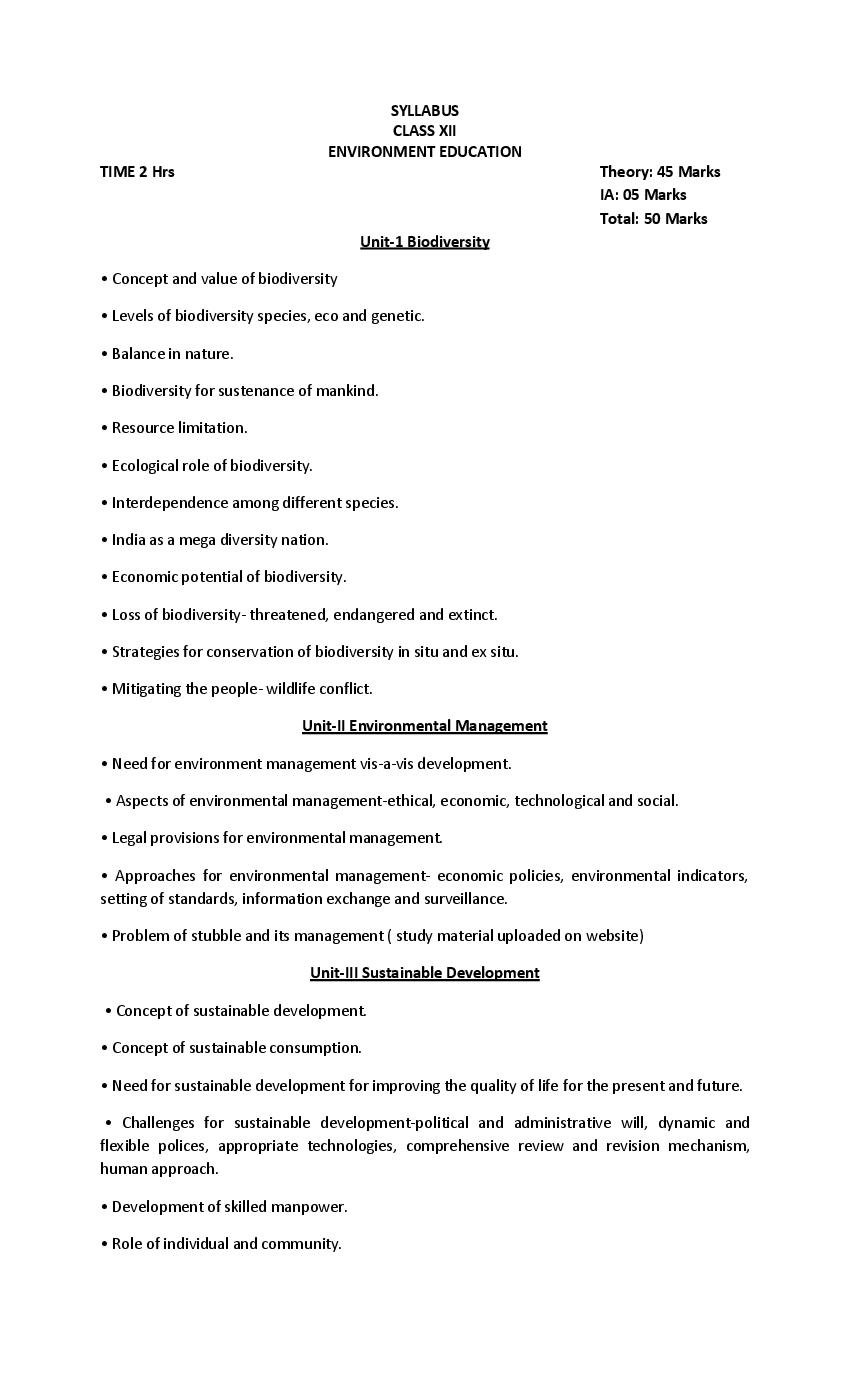
CLASS XII
ENVIRONMENT EDUCATION
TIME 2 Hrs Theory: 45 Marks
IA: 05 Marks
Total: 50 Marks
Unit-1 Biodiversity
• Concept and value of biodiversity
• Levels of biodiversity species, eco and genetic.
• Balance in nature.
• Biodiversity for sustenance of mankind.
• Resource limitation.
• Ecological role of biodiversity.
• Interdependence among different species.
• India as a mega diversity nation.
• Economic potential of biodiversity.
• Loss of biodiversity- threatened, endangered and extinct.
• Strategies for conservation of biodiversity in situ and ex situ.
• Mitigating the people- wildlife conflict.
Unit-II Environmental Management
• Need for environment management vis-a-vis development.
• Aspects of environmental management-ethical, economic, technological and social.
• Legal provisions for environmental management.
• Approaches for environmental management- economic policies, environmental indicators,
setting of standards, information exchange and surveillance.
• Problem of stubble and its management ( study material uploaded on website)
Unit-III Sustainable Development
• Concept of sustainable development.
• Concept of sustainable consumption.
• Need for sustainable development for improving the quality of life for the present and future.
• Challenges for sustainable development-political and administrative will, dynamic and
flexible polices, appropriate technologies, comprehensive review and revision mechanism,
human approach.
• Development of skilled manpower.
• Role of individual and community.
Page 2
Unit-IV Sustainable Agriculture
• Need for sustainable agriculture.
• Green revolution-impact on environment.
• Importance of soil for crops, Irrigation systems, use of manure and fertilizers.
• Crop protection-major plant pests and diseases (wheat, rice, cotton, sugarcane, potato),
measures for their controlagrochemicals.
• Impact of agrochemicals on environment.
• Elements of sustainable agriculture-mixed farming, mixed cropping, crop rotation, biological
and economic consideration, use of biofertilizers and bio pesticides, biological pest control,
integrated pest management.
• Application of biotechnology in crop improvement.
• Management of agricultural produces- storage, preservation, transportation and processing.
Unit-V Environmental Actions
• Meeting basic human need, food, water, shelter and fuel for all.
• Population control
• Changing consumption patterns.
• Prevention and control of environmental pollution.
• Waste management- reduce, reuse and recycle;
• Community movement for ecological restoration and conservation of environment like joint
forest Management (JFM),student's participation in tree rearing, social and agro- forestry.
• Drugs-ill effects(Part-II) Consequences of use of different dugs, The narcotic drugs and
psychotropic substances Act-1985 offences as penalties.(study material uploaded on website)
Internal Assessment
Example projects and Activities: It is expected that student will undertake two projects or
activities. These projects should be undertaken individually and student will prepare a report in
each case. Teacher may plan and design projects and activities depending upon the local
situations, available resources and environmental issues of concern. The projects and activities
given below are only suggestive and not prescriptive.
• To study the status of an endangered species listed for region by collecting information
through different sources and observation and to assess the reasons for its diminishing number.
Suggest ways and means to protect the species.
• To conduct a survery of plants and trees in the locality and collect information about their
cultural, economic and medicinal values from the local people and available literature. To
prepare an action plan for afforestation and planting of trees as trees are most valuable in
terms of their cultural, economic importance and medicinal use.
Page 3
processing of perishable or non perishable farm products and to assess the extent of their
wastage due to faulty practices.
• To make a list of raw materials used by the family for preparing different types of dishes. To
identify the plants and their parts from which food material is obtained. To make a list of plants
on which the animals depend for their food. To prepare a report supported by
diagrams/photographs/pictures/graphs to focus on the importance of biodiversity in providing
food to human population.
• To study the impact of changes in agricultural practices of animal husbandry including poultry,
piggery, fishery and apiculture over a period of time in the local environment or in a given
locality or village. The components for analysis may include; types of crop, land area under
cultivation, mechanization, use of electricity, mode of irrigation and agrochemicals, agro wastes
and their disposal, types of animal breed and their feed, types of shelter and health care,
method of preservation and processing of products and animal wastes and their disposal. To
suggest an action plan for modifying the prevailing practices so as to make them environment
friendly and sustainable.
Document Details
| Board / Org | Punjab Board |
| Exam | Class 12 |
| Type | Syllabus |
| Pages | 3 |
| Updated | 22 Jul 2026 |