CBSE Class 12 Sample Paper 2027 Solution (Marking Scheme) for Kathakali
Finished viewing? Save it for later —
Download CBSE Class 12 Sample Paper 2027 Solution (Marking Scheme) for Kathakali (PDF · 5 pages)About CBSE Class 12 Sample Paper 2027 Solution (Marking Scheme) for Kathakali
CBSE Class 12 Sample Paper 2027 Solution (Marking Scheme) for Kathakali is available here for free download. Published by CBSE for Class 12, this solution can be viewed online or downloaded as a PDF (5 pages). Candidates preparing for Class 12 can use CBSE Class 12 Sample Paper 2027 Solution (Marking Scheme) for Kathakali to understand the exam pattern, the type of questions asked, and the overall difficulty level.
Frequently Asked Questions
How can I download CBSE Class 12 Sample Paper 2027 Solution (Marking Scheme) for Kathakali?
Open this page and click the Download button to save CBSE Class 12 Sample Paper 2027 Solution (Marking Scheme) for Kathakali as a PDF. It is completely free on AglaSem Docs.
Is CBSE Class 12 Sample Paper 2027 Solution (Marking Scheme) for Kathakali free to download?
Yes. CBSE Class 12 Sample Paper 2027 Solution (Marking Scheme) for Kathakali can be viewed online and downloaded as a PDF free of cost on AglaSem Docs.
How many pages does CBSE Class 12 Sample Paper 2027 Solution (Marking Scheme) for Kathakali have?
CBSE Class 12 Sample Paper 2027 Solution (Marking Scheme) for Kathakali contains 5 pages, which you can read online or download together as a single PDF.
Where can I find more Class 12 study material?
You can find more Class 12 question papers, sample papers, syllabus, and answer keys on AglaSem Docs.
CBSE Class 12 Sample Paper 2027 Solution (Marking Scheme) for Kathakali – Text
Read the full text of this solution below — useful to quickly search, copy and reference the content online without downloading the PDF.
📄 View text version (6 pages)
Page 1
CBSE Class 12 Sample
Paper 2027 Solution
(Marking Scheme) for
Kathakali
EXAM YEAR TYPE SUBJECT
CBSE Class 12 2027 Solutions Kathakali
Notes · Sample Papers · Previous Year Papers · Mock Tests
Page 2
.co s e m
s em l a
a ag
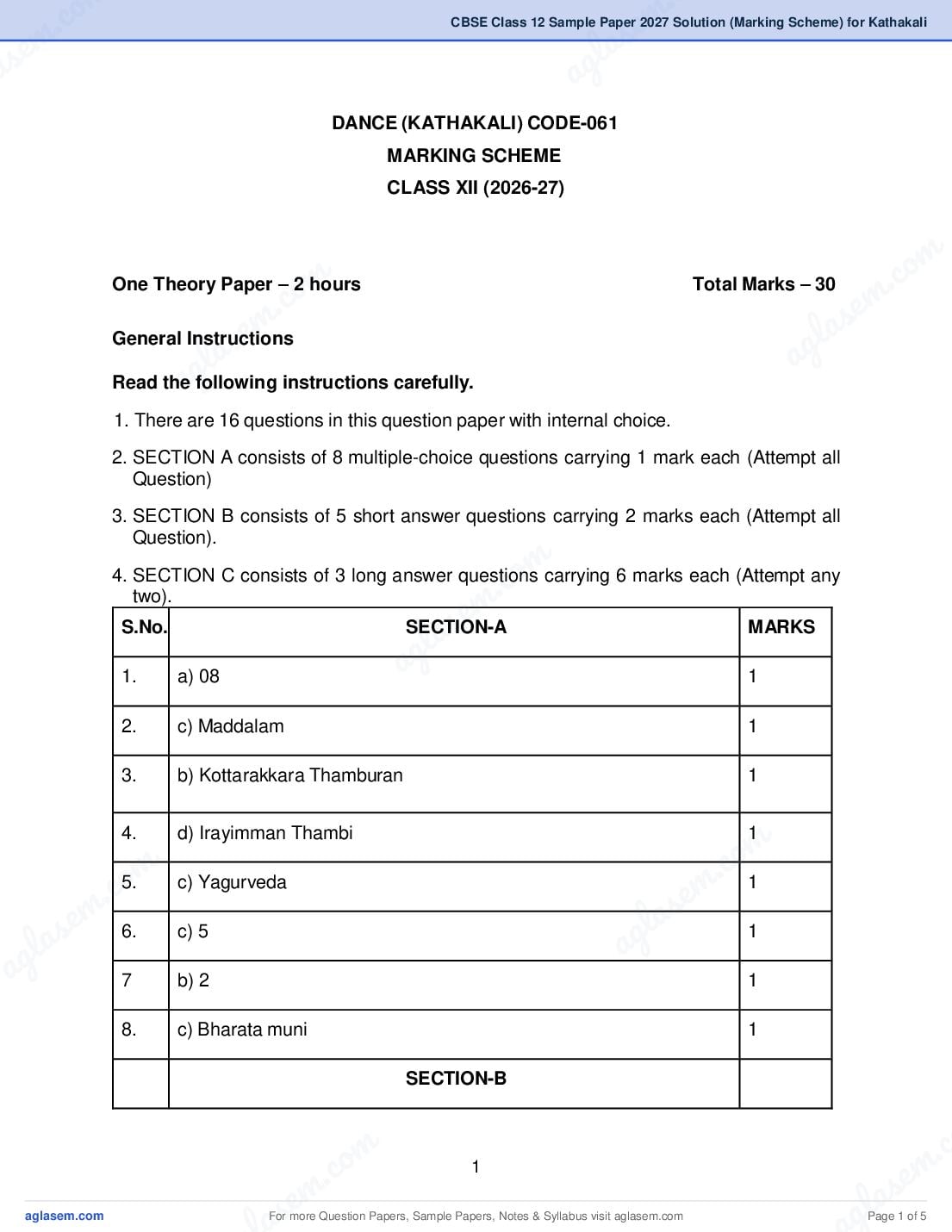
DANCE (KATHAKALI) CODE-061
MARKING SCHEME
CLASS XII (2026-27)
m
om
One Theory Paper – 2 hours Total Marks – 30 . co
. c em
e m l as
as
General Instructions
l ag
a
Read the g
following instructions carefully.
1. There are 16 questions in this question paper with internal choice.
2. SECTION A consists of 8 multiple-choice questions carrying 1 mark each (Attempt all
Question)
3. SECTION B consists of 5 short answer questions carrying 2 marks each (Attempt all
Question).
m
two).
m .co
4. SECTION C consists of 3 long answer questions carrying 6 marks each (Attempt any
s e
S.No.
l a
SECTION-A MARKS
1. a) 08 ag 1
2. c) Maddalam 1
3. b) Kottarakkara Thamburan 1
4. d) Irayimman Thambi
m
1
m c) Yagurveda c. o1
m 6. .c5.o s e m
s e g la
la a
c) 5 1
ag 7 b) 2 1
8. c) Bharata muni 1
SECTION-B
m . c
c. o 1
s em
Page 1 of 5
Page 3
Bhayanakam, Bheelvalsam, Roudram and Santham
OR
(B) Guru Chengannur Raman Pillai was a legendary exponent of
Kathakali, specifically renowned for his mastery of the Kaplingadu
(Southern) style of this classical dance-drama.He was celebrated for
his portrayal of "Kathi" (villainous yet noble) and "Vellathadi"
(Hanuman/White Beard) characters, bringing a unique blend of
physical vigor and emotional depth to the stage.For his immense
contribution to the arts, he was honored with the Sangeet Natak
Akademi Award and the Padma Shri by the Government of India.
10. (A) The Aattakathas authored by Kottarakkara Thaburan. 2
Putrakameshti, Sita Swayamvaram, Vichinnabhishekam,
Kharavadham, Balivadham, Toranayuddham,
Sethubandhanam and Yuddham
OR
(B) Pathaka, mudrakyam, Khadakam, Musthi, Karthari mukham,
sukhathundam, Kapithakam, Hamsa paksham, sikharam
Hamsasyam, Anchali, Ardha chandram, Mukhuram,
brahmaram,Soochikamugham, Pallavam, Tripathaka,
Mrugaseersham, Sarpasiras, Vardhamanakam, Aralam,
Oornanabham, Mugulam and Kadakamugam
11. (A) Chembada, Champa, Adantha, Thripuda, Panchari, Muri 2
Adantha
OR
(B) Keli, Arangu Keli, Thodayam, Vandana Slokam, Purappadu,
Melappadam,Thiranokku and Dhanasi
12. (A) The four prominent art forms of Kerala, apart from Kathakali, are 2
Mohiniyattam, Koodiyattam, Theyyam, and Ottanthullal.
OR
(B) (A) Hastha pathako mudrakya
Khadako mustti rityapi
Karthari mugha sapnascha
Suka thunda kapithaka:
Hamsa pakshacha sikharo
Hamsasya punaranjali
Ardha chandrascha mukhuro
Brahmara soochika mukha:
Pallava tripathakascha
Mriga sheersha hoyasthatha
Puna sarpa sira sapnascha
Vardhamanaka rityathe
2
For more Question Papers, Sample Papers, Notes & Syllabus visit Page 2 of 5
Page 4
.co s e m
s em l a
a ag
Araalam oornanabascha
Mukulo khadaka mugha
m
co
13. (A) The four primary characters in the Keechakavatham Aattakatha 2
om .
are Keechakan, Sairandhri, Valalan, and Sudheshna.
. c OR
em
em
(B) The primary Puranas and epics from which themes are taken for
l as
as
Kathakali are the Mahabharata, the Ramayana, the Bhagavata
l ag
g
Purana, and the Siva Purana.
a
SECTION-C
Attempt any two questions from the given options
Indian classical dance is a profound synthesis of music, mythology, 6
and rhythm. According to the Natya Shastra, dance is a "Fifth
14
Veda," created to provide spiritual and ethical enlightenment
m
through aesthetic pleasure. Nritta: Focuses on technical mastery,
m .co
rhythm, and speed. It involves precise footwork and body
movements without any specific theme or story. Nritya : The
s e
"language" of the dance. It uses Mudras and Abhinaya to convey
l a
ag
the meaning of the lyrics. Natya: The theatrical aspect where
dancers portray specific characters from a story or epic.
The Eight Recognized Classical Forms in India
● Bharatanatyam (Tamil Nadu)
● Kathak (North India)
● Kathakali and Mohiniyattam (Keralam)
● Odissi (Odisha)
● Kuchipudi (Andhra Pradesh)
● Manipuri (Manipur)
● Sattriya (Assam
m
m .co
Most classical dances balance two contrasting energies: Tandava
.co m
and Lasya
m
Abhinaya is the art of expression in classical dance, categorized
s e
s e into four types:
g la
g la ● Angika: Expression through body movements, including
a
a the limbs (Angas), face (Upangas), and gestures (Mudras).
● Vachika: Expression through speech or song. In
Kathakali, the actors are silent, and this is performed by the
background singers.
● Aharya: Expression through external aids like elaborate
makeup, costumes, ornaments, and props.
● Sattvika: Expression of inner emotions. It involves
m . c
c. o 3
s em
Page 3 of 5
Page 5
tears, trembling, or the Navarasas (nine facial emotions).
15. Kathakali: The Celestial Dance-Drama of Keralam 6
Kathakali, which literally translates to "story-play" (Katha means
story and Kali means play), is a highly stylized classical dance-
drama from Kerala. It originated in the 17th century and is renowned
for its combination of literature, music, painting, acting, and dance.
Kathakali is traditionally performed in the open air, often in temple
premises, starting at dusk and continuing until dawn. The
performance begins with the Kelilkottu, a formal announcement
using drums like the Chenda and Maddalam. The stories are mostly
drawn from the Hindu epics—the Ramayana, the Mahabharata, the
Bhagavata Purana and the Shiva Purana.
Kathakali is a silent art form for the actor. The communication
happens through four types of Abhinaya:
● Angika: Complex body movements and 24 basic hand
gestures (Mudras) from the Hastalakshanadeepika.
● Vachika: Provided by background singers who chant the
Attakkatha (script).
● Aharya: Elaborate costumes and specialized makeup.
● Sattvika: Intense facial expressions, particularly the use of
the eyes and the Navarasas (nine emotions).
Character and Makeup
● Pacha (Green): Noble and divine characters like Krishna or
Arjuna.
● Kathi (Knife): Characters who are brave but have a streak of
evil or pride, like Ravana.
● Thadi (Beard): Includes Chuvanna Thadi (Red Beard) for
vicious characters, Vellathadi (White Beard) for divine
beings like Hanuman, and Karuthathadi (Black Beard) for
primitive characters.
● Kari (Black): Represents demonic female characters.
● Minukku (Radiant): Simple makeup for women, sages, and
messengers.
Kathakali is not merely a dance but a "Total Theater" experience. Its
unique blend of rhythmic footwork, intricate finger movements, and
powerful facial expressions makes it one of the most visually
stunning and spiritually profound art forms in the world.
4
For more Question Papers, Sample Papers, Notes & Syllabus visit Page 4 of 5
Page 6
.co s e m
s em l a
a ag
16. The story of Poothanamoksham (The Salvation of Poothana) is a 6
poignant episode from the Bhagavata Purana, chronicling the
encounter between the demoness Poothana and the infant Krishna.
The narrative begins with King Kamsa, haunted by the prophecy that
his eighth nephew would kill him, sending the fierce demoness
Poothana to the village of Ambadi. Her mission was to slaughter
m
co
every newborn in the region. To avoid suspicion, Poothana used her
. c om
magical powers to transform her terrifying demonic form into that of
em .
s
a breathtakingly beautiful woman.
em
Adorned in elegant clothes and flowers, she entered the home of
l a
l as
Nanda and Yashoda while the villagers were distracted. Upon
ag
ag
seeing the infant Krishna in his cradle, an unexpected wave of
maternal affection momentarily washed over her dark heart due to
the child's divine radiance. However, driven by her duty to Kamsa
and her own demonic nature, she suppressed these feelings. She
had smeared her breasts with a deadly poison and took the child in
her lap, offering him her milk with the intent to kill him instantly.
The divine child, aware of her true identity and her hidden malice,
began to suckle. He drew not only the poisoned milk but also her
very life force. As her life began to ebb away, Poothana’s disguise
m
.co
shattered, and she reverted to her massive, hideous demonic form,
crying out in agony. In her final moments, the touch of the Supreme
e m
Being purified her soul; because she had approached him in the
as
guise of a mother, Krishna accepted her as such. By taking her life,
l
ag
he granted her Moksha (eternal liberation), proving that even the
most wicked being can find salvation through contact with the
Divine.
m
m .co
m .co s e m
s e g la
g la a
a
m . c
c. o 5
s em
Page 5 of 5
Document Details
| Board / Org | CBSE |
| Exam | Class 12 |
| Type | Solution |
| Pages | 5 |
| Updated | 29 Oct 2026 |