MAHA SET 2018 Question Paper 2 Economics
Finished viewing? Save it for later —
Download MAHA SET 2018 Question Paper 2 Economics (PDF · 24 pages)About MAHA SET 2018 Question Paper 2 Economics
MAHA SET 2018 Question Paper 2 Economics is available here for free download. Published by Maharashtra Exams for MAHA SET, this question paper can be viewed online or downloaded as a PDF (24 pages). Candidates preparing for MAHA SET can use MAHA SET 2018 Question Paper 2 Economics to understand the exam pattern, the type of questions asked, and the overall difficulty level.
Frequently Asked Questions
How can I download MAHA SET 2018 Question Paper 2 Economics?
Open this page and click the Download button to save MAHA SET 2018 Question Paper 2 Economics as a PDF. It is completely free on AglaSem Docs.
Is MAHA SET 2018 Question Paper 2 Economics free to download?
Yes. MAHA SET 2018 Question Paper 2 Economics can be viewed online and downloaded as a PDF free of cost on AglaSem Docs.
How many pages does MAHA SET 2018 Question Paper 2 Economics have?
MAHA SET 2018 Question Paper 2 Economics contains 24 pages, which you can read online or download together as a single PDF.
Where can I find more MAHA SET study material?
You can find more MAHA SET question papers, sample papers, syllabus, and answer keys on AglaSem Docs.
MAHA SET 2018 Question Paper 2 Economics – Text
Read the full text of this question paper below — useful to quickly search, copy and reference the content online without downloading the PDF.
📄 View text version (24 pages)
Page 1
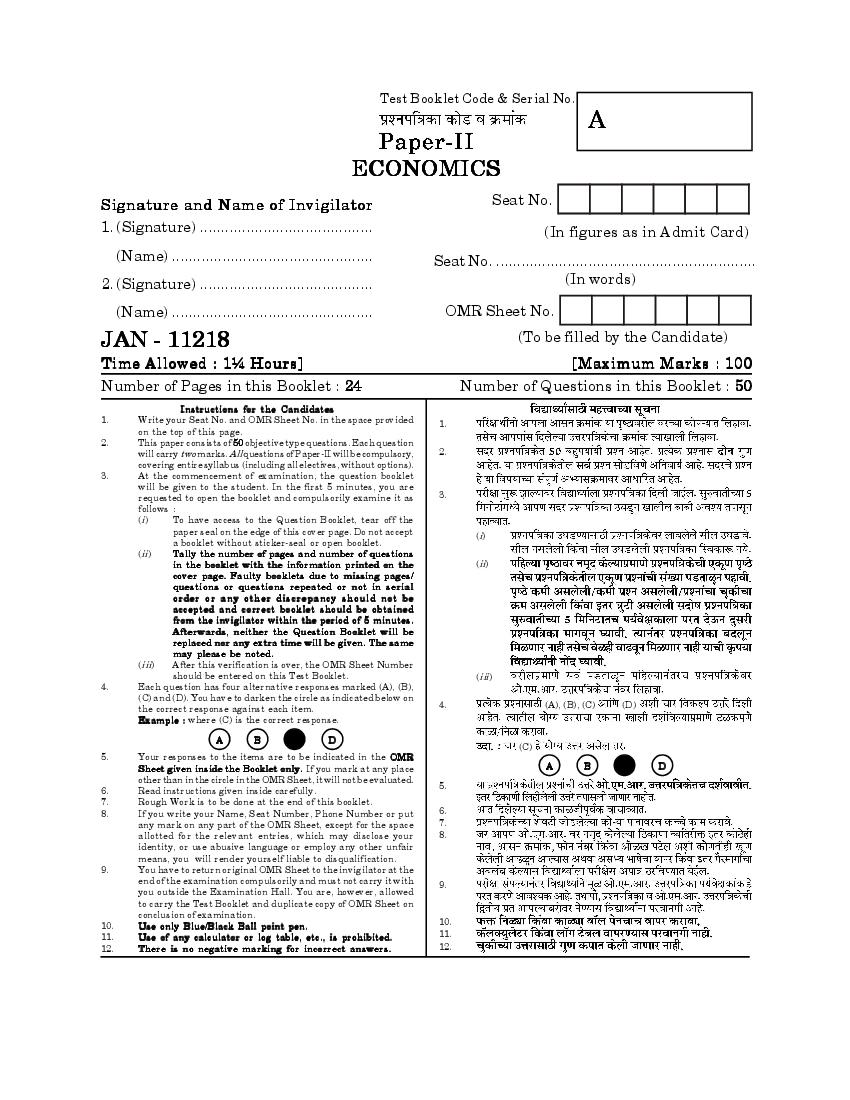
A
ECONOMICS
Signature and Name of Invigilator Seat No.
1. (Signature) ......................................... (In figures as in Admit Card)
(Name) ................................................ Seat No. ..............................................................
2. (Signature) ......................................... (In words)
(Name) ................................................ OMR Sheet No.
JAN - 11218 (To be filled by the Candidate)
Time Allowed : 1¼ Hours] [Maximum Marks : 100
Number of Pages in this Booklet : 24 Number of Questions in this Booklet : 50
Instructions for the Candidates
1. Write your Seat No. and OMR Sheet No. in the space provided 1.
on the top of this page.
2. This paper consists of 50 objective type questions. Each question
will carry two marks. All questions of Paper-II will be compulsory, 2.
covering entire syllabus (including all electives, without options).
3. At the commencement of examination, the question booklet
will be given to the student. In the first 5 minutes, you are
requested to open the booklet and compulsorily examine it as 3.
follows :
(i) To have access to the Question Booklet, tear off the
paper seal on the edge of this cover page. Do not accept (i)
a booklet without sticker-seal or open booklet.
(ii) Tally the number of pages and number of questions
in the booklet with the information printed on the (ii)
cover page. Faulty booklets due to missing pages/
questions or questions repeated or not in serial
o rder or any other discre pancy should not be
accepted and correct booklet should be obtained
from the invigilator within the period of 5 minutes.
Afterwards, neither the Question Booklet will be
replaced nor any extra time will be given. The same
may please be noted.
(iii) After this verification is over, the OMR Sheet Number
should be entered on this Test Booklet. (iii)
4. Each question has four alternative responses marked (A), (B),
(C) and (D). You have to darken the circle as indicated below on
the correct response against each item. 4. (A), (B), (C) (D)
Example : where (C) is the correct response.
A B D
(C)
5. Your responses to the items are to be indicated in the OMR
Sheet given inside the Booklet only. If you mark at any place A B D
other than in the circle in the OMR Sheet, it will not be evaluated.
5.
6. Read instructions given inside carefully.
7. Rough Work is to be done at the end of this booklet.
8. If you write your Name, Seat Number, Phone Number or put 6.
any mark on any part of the OMR Sheet, except for the space 7.
allotted for the relevant entries, which may disclose your 8.
identity, or use abusive language or employ any other unfair
means, you will render yourself liable to disqualification.
9. You have to return original OMR Sheet to the invigilator at the
end of the examination compulsorily and must not carry it with 9.
you outside the Examination Hall. You are, however, allowed
to carry the Test Booklet and duplicate copy of OMR Sheet on
conclusion of examination.
10. Use only Blue/Black Ball point pen. 10.
11. Use of any calculator or log table, etc., is prohibited. 11.
12. There is no negative marking for incorrect answers. 12.
Page 2
Page 3
Paper II
II
Time Allowed : 75 Minutes] [Maximum Marks : 100
Note : This paper contains Fifty (50) multiple choice questions, each question
carrying Two (2) marks. Attempt All questions.
(50) (2)
1. Autonomous Demand indicates 1.
that .......................... .
(A)
(A) Commodity is used both for the
export and direct domestic
consumption
(B) Commodity is used both for the (B)
direct domestic consumption
and as an input to produce
another commodity
(C)
(C) Commodity is needed for direct
use but not as an input to
produce another commodity
(D) Commodity is needed as an (D)
input to produce another
commodity but not for the direct
use
3 [P.T.O.
Page 4
.................. .
(A)
(A) Helps the firm to ascertain the
maximum possible price it can
charge from its consumers
(B) Helps the firm to ascertain the (B)
minimum possible price it can
charge from its consumers
(C) Helps the firm to ascertain the
(C)
maximum price it can pay to its
vendors
(D) Helps the firm to ascertain the
minimum price it can pay to its (D)
vendors
3. Profit maximising amount of inputs
occurs when .................. .
3.
(A) The slope of the Iso-profit line
equals the slope of the
production function (A)
(B) The slope of the Iso-profit line
exceeds the slope of the
(B)
production function
(C) The slope of the production
function exceeds the slope of the (C)
Iso-profit line
(D) The slope of the Iso-profit line
(D)
exceeds the slope of the Iso-
quant
4
Page 5
the third stage of production because
in that stage ................ .
(A) The total product is negative (A)
(B) The marginal product is
(B)
negative
(C) The average product is
(C)
stagnant
(D) The marginal product is falling (D)
5. If the commodities are perfect 5.
substitutes, the corresponding
indifference curves would be
................... . (A)
(A) Negatively sloping curves
(B)
(B) Positively sloping straight lines
(C) Negatively sloping straight (C)
lines
(D) L
(D) L-shaped straight lines
5 [P.T.O.
Page 6
the social welfare function was put
forward by .................... .
(A) Hicks and Samuelson (A)
(B) Pigou and Samuelson (B)
(C) Robbins and Scitovszky (C)
(D) Samuelson and Bergson (D)
7. The average fixed cost (AFC) of 7.
production curve is denoted by
............................ .
(A)
(A) Rectangular hyperbola
(B)
(B) U-shaped curve
(C)
(C) L-shaped curve
(D) J-shaped curve (D)
8. In the context of demand theory, the 8.
expression ‘Choice reveals
preference’ is ascribed to .................. .
(A) Paul Samuelson (A)
(B) J.R. Hicks (B)
(C) F. Machlup (C)
(D) Robert Dorfman
(D)
6
Page 7
9. Risk-return trade off plays an
important role in whose theory of
money demand ?
(A) Tobin’s Portfolio Choice
(B) Friedman’s restated quantity (A)
theory
(B)
(C) Baumol’s inventory theoretic
choice
(C)
(D) Cambridge money demand
theory (D)
10. Ratchet effect relates to : 10.
(A) Life-cycle hypothesis
(A)
(B) Permanent income hypothesis
(B)
(C) Relative income hypothesis (C)
(D) Absolute income hypothesis (D)
7 [P.T.O.
Page 8
cycle models will show stability as
well as cyclical fluctuations only :
(A) Income movement equation (A)
shows complex roots whose
magnitudes are less than one
(B)
(B) Income movement equation
shows real roots whose
magnitudes are less than one
(C)
(C) Income movement equation
shows complex roots whose
magnitudes are more than one
(D)
(D) Income movement equation
shows real roots whose
magnitudes are more than one
12. In simple Keynesian model of output 12.
determination, government
expenditure will have a bigger
impact if :
(A) Marginal propensity to consume
is lower
(A)
(B) Marginal propensity to consume
is higher (B)
(C) Marginal propensity to save is
constant (C)
(D) Marginal propensity to consume
is zero (D)
8
Page 9
Statement 1 Statement 2 1 2
(a) Inventory (i) Edmund (a) (i)
approach to Phelps
money demand
(b) (ii)
(b) Adaptive (ii) William
expectation Baumol
(c) (iii)
(c) Upper turning (iii) John Hicks
point
(d) (iv)
(d) Permanent (iv) Milton
income Friedman
:
Codes :
(a) (b) (c) (d)
(a) (b) (c) (d)
(A) (i) (ii) (iii) (iv)
(A) (i) (ii) (iii) (iv)
(B) (ii) (iii) (i) (iv)
(B) (ii) (iii) (i) (iv)
(C) (ii) (i) (iii) (iv) (C) (ii) (i) (iii) (iv)
(D) (ii) (i) (iv) (iii) (D) (ii) (i) (iv) (iii)
9 [P.T.O.
Page 10
demand for money, money demand
will increase if :
(A)
(A) Velocity of money increases
(B)
alone
(B) GDP in the economy decreases
(C)
alone
(C) GDP in the economy and velocity
increase at the same rate
(D) Velocity in the economy (D)
decreases alone
15. If investment becomes totally 15.
interest insensitive, then :
(A) Fiscal policy is ineffective (A)
(B) Fiscal policy is effective (B)
(C) Monetary policy is effective (C)
(D) Both fiscal and monetary policy (D)
are ineffective
10
Page 11
vertical if :
(A) Price inflation partially takes
(A)
into account expected price
inflation
(B) Price inflation fully takes into
(B)
account expected price inflation
(C) Price inflation does not take into
account expected price inflation (C)
at all
(D) Expected price inflation is
always zero (D)
17. Prof. Mahalanobis developed ........... 17.
model in 1955 which was later used
in Five Year Plans of India.
(A) Four sector (A)
(B) Two sector (B)
(C) Single sector (C)
(D) Three sector (D)
18. World Bank has indicated GDP 18.
growth rate in India is 7.6 percent GDP
in 2016 and will be .................. in
2017.
(A) 7.8% (A) 7.8
(B) 7.7% (B) 7.7
(C) 7.9% (C) 7.9
(D) 8.0% (D) 8.0
11 [P.T.O.
Page 12
Economy hundred percent Foreign
Direct Investment (FDI) is allowed
recently ?
(A)
(A) Science and technology
(B)
(B) Space
(C) Defence sector (C)
(D) Critical medicines (D)
20. Which one of the following has 20.
propounded the modern theory of
distribution ?
(A)
(A) Nicholas Kaldor
(B)
(B) David Ricardo
(C)
(C) Mrs. Joan Robbinson
(D) J.S. Mill (D)
21. Cost-Benefit Analysis was developed 21.
in USA for appraisal of investments
in ..................... .
(A) Agriculture and Health projects
(A)
(B) Health and Garden projects
(B)
(C) Irrigation and Transportation
(C)
project
(D) Technology and Health project (D)
12
Page 13
.................. .
(A) Research and development (A)
(B) Provision of services (B)
(C) Industry and manufacturing (C)
(D) Agricultural services (D)
23. Match the following : 23.
Theory
(a) Theory of stages of economic
(a)
growth
(b)
(b) Theory of unlimited supplies of
labour (c)
(c) The Big Push Theory (d)
(d) Theory of unbalanced growth
P ropounder (i)
(i) Arthur Lewis (ii)
(ii) W.W. Rostow (iii)
(iii) A.O. Hirschman
(iv)
(iv) Rosenstein Rodan
:
Codes :
(a) (b) (c) (d) (a) (b) (c) (d)
(A) (iv) (iii) (i) (ii) (A) (iv) (iii) (i) (ii)
(B) (iii) (iv) (ii) (i) (B) (iii) (iv) (ii) (i)
(C) (ii) (i) (iv) (iii) (C) (ii) (i) (iv) (iii)
(D) (i) (ii) (iii) (iv) (D) (i) (ii) (iii) (iv)
13 [P.T.O.
Page 14
14th Finance Commission
recommended to increase its share
from :
(A) 32% 42%
(A) 32% to 42%
(B) 30% to 42% (B) 30% 42%
(C) 30% to 40% (C) 30% 40%
(D) 35% to 40% (D) 35% 40%
25. An Integrated Goods and Services
25.
Tax (IGST) would be collected by :
(A) State Governments
(A)
(B) Central Government
(B)
(C) Municipal Corporations
(C)
(D) Finance Commission
(D)
26. Who is not the member of 14th
26.
Finance Commission ?
(A)
(A) Sushma Nath
(B)
(B) Sudipto Mundle
(C) M. Govind Rao (C)
(D) C.H. Hanumanta Rao (D)
14
Page 15
Non-Debt Capital Receipts ?
(A) Disintvestment receipts (A)
(B) Dividend receipts (B)
(C) Short-term borrowing (C)
(D) Tax Revenue (D)
28. A public good is ..................... . 28.
(A) A good that the public must pay
(A)
for
(B)
(B) Non-rival in consumption
(C) More costly than a private good (C)
(D) Paid for by a government (D)
29. Reduction in consumer’s welfare as 29.
a result of tax is referred to :
(A) Equity in taxation (A)
(B) Dead weight loss (B)
(C) Efficiency in taxation (C)
(D) Incidence of tax (D)
30. Which one of the following is the 30.
major component of revenue
expenditure of Central Government ?
(A)
(A) Pensions
(B) Interest payments (B)
(C) Defence expenditure (C)
(D) Expenditure on education (D)
15 [P.T.O.
Page 16
are included in the current account
of Balance of Payments.
(A) Stock (A)
(B) Volatile (B)
(C) Flow (C)
(D) Fluctuating (D)
32. The commodity in which a nation 32.
has the least absolute disadvantage
represents its area of :
(A) Comparative disadvantage (A)
(B) Comparative advantage (B)
(C) Absolute advantage (C)
(D) Cannot say without additional (D)
information
33. Ricardo’s theory of comparative 33.
advantage is based on :
(A) The opportunity cost theory (A)
(B) The labour theory of value
(B)
(C) The law of diminishing returns
(C)
(D) The psychological law of
(D)
consumption
16
Page 17
views on trade if we regard them as
a reaction to :
(A) The law of comparative
(A)
advantage
(B)
(B) The mercantilist view on trade
(C) Ricardo’s views on trade (C)
(D) The law of absolute advantage (D)
35. Uniformity in exchange rate occurs 35.
due to :
(A) Foreign exchange arbitrage (A)
(B) Devaluation (B)
(C) Hedging (C)
(D) Speculation (D)
36. If a country can produce 10 units 36.
of good x or 4 units of good y, the
opportunity cost of 1 y is :
(A) 1 x
(A)
(B) 0.4 x (B)
(C) 2.5 x (C)
(D) 10 x (D)
17 [P.T.O.
Page 18
(a) Infant industry argument (a)
(b) Import substituting industrial-
(b)
ization
(c)
(c) Reduction in the rates of
protection for manufacturing by
developing countries (d)
(d) Industrialization of high
performance Asian economies
(i)
(i) Domestic industries are
established under the protection
(ii)
of tariffs or import quotas
(ii) New industries need a temporary
period of protection (iii)
(iii) Not via import substitution but
via export of manufactured goods (iv)
(iv) Rapid growth of trade
:
Codes :
(a) (b) (c) (d)
(a) (b) (c) (d)
(A) (iii) (i) (iv) (ii)
(A) (iii) (i) (iv) (ii)
(B) (iv) (i) (ii) (iii) (B) (iv) (i) (ii) (iii)
(C) (iii) (iv) (i) (ii) (C) (iii) (iv) (i) (ii)
(D) (ii) (i) (iv) (iii) (D) (ii) (i) (iv) (iii)
18
Page 19
following statements pertaining to
Foreign Direct Investment in India ?
(i)
(i) FDI through automatic route
does not require prior govt.
approval.
(ii) FDI through government route
(ii)
requires approval of the
government through Foreign
Investment Promotion Board.
(A) Both statement ( i ) and (A) (i) (ii)
statement (ii) are incorrect
(B) Statement (i) is incorrect and
statement (ii) is correct (B) (i) (ii)
(C) Both statement ( i ) and (C) (i) (ii)
statement (ii) are correct
(D) Statement (i) is correct and
(D) (i) (ii)
statement (ii) is incorrect
39. Which of the following is not a tool 39.
used by RBI for regulating money
supply in India ?
(i) Open market operations (i)
(ii) Repo rate (ii)
(iii) Statutory Liquidity Ratio (iii)
(iv) Disinvestment (iv)
(A) (iv) (A) (iv)
(B) (i) (B) (i)
(C) (iii) (C) (iii)
(D) (ii) (D) (ii)
19 [P.T.O.
Page 20
of a direct tax in India ?
(i) Excise duty (i)
(ii) Service tax (ii)
(iii) Income tax (iii)
(A) (i), (ii), (iii) (A) (i), (ii), (iii)
(B) Only (iii) (B) (iii)
(C) (i) and (iii) (C) (i) (iii)
(D) (ii) and (iii) (D) (ii) (iii)
41. In the year 1966, the exchange 41.
value of rupee against American
dollar was devalued by ................ .
(A) 75% (A) 75%
(B) 65%
(B) 65%
(C) 48%
(C) 48%
(D) 57%
(D) 57%
42. The All India Rural Credit Survey 42.
Committee, 1954 was chaired by :
(A) D.R. Gadgil (A)
(B) V.K.R.V. Rao (B)
(C) A.D. Gorawala (C)
(D) Vaikunthlal Mehta (D)
20
Page 21
service sector countries ........... share
of services in its total GDP is less GDP
than 50 percentage.
(A) France (A)
(B) Germany (B)
(C) China (C)
(D) Australia (D)
44. Which is the correct descending 44.
order of India’s software export
destination in recent times ?
(i) Asia Pacific, North America,
Europe (i)
(ii) Europe, Asia Pacific, North
(ii)
America
(iii) Europe, North America, Asia (iii)
Pacific
(iv)
(iv) North America, Europe, Asia
Pacific (A) (iv)
(A) (iv)
(B) (iii)
(B) (iii)
(C) (i)
(C) (i)
(D) (ii) (D) (ii)
21 [P.T.O.
Page 22
(A) International Credit Output
(A)
Ratio
(B) Incremental Capital Output
(B)
Ratio
(C) Incremental Capital Output (C)
Range
(D) Indian Capital Output Rules (D)
46. Statistic is a numerical quantity 46.
which is calculated from :
(A) Population (A)
(B) Sample (B)
(C) Universe (C)
(D) Hypothesis (D)
47. Which of the following is used in 47.
chain indices ?
pn pn
(A) p0
100 (A) 100
p0
pn pn
(B) 100 100
pn 1 (B)
pn 1
pn pn
(C) 100 (C) 100
p0 p0
pn q n pn q n
(D) 100 (D) 100
p0 q0 p0 q0
22
Page 23
qualitative measurements is
..................... .
(A)
(A) Arithmetic mean
(B)
(B) Median
(C) Correlation coefficient (C)
(D) Geometric mean (D)
49. The strength (degree) of the 49. (x)
relationship between a set of
(y)
independent variable x and
dependent variable y is measured
by : (A)
(A) Coefficient of correlation
(B)
(B) Coefficient of determination
(C)
(C) Standard Error of estimate
(D)
(D) All of the above
50. Consumer Price Index number is 50.
also known as :
(A) Wholesale Price Index number (A)
(B) Cost of Living Index (B)
(C) Sensitive (C)
(D) Composite
(D)
23 [P.T.O.
Page 24
24
Document Details
| Board / Org | Maharashtra Exams |
| Exam | MAHA SET |
| Type | Question Paper |
| Pages | 24 |
| Updated | 30 Apr 2026 |