NCERT Solutions for Class 12 Chemistry Chapter 8 Aldehydes, Ketones and Carboxylic Acids
Finished viewing? Save it for later —
Download NCERT Solutions for Class 12 Chemistry Chapter 8 Aldehydes, Ketones and Carboxylic Acids (PDF · 36 pages)About NCERT Solutions for Class 12 Chemistry Chapter 8 Aldehydes, Ketones and Carboxylic Acids
NCERT Solutions for Class 12 Chemistry Chapter 8 Aldehydes, Ketones and Carboxylic Acids is available here for free download. Published by NCERT for Class 12, this solution can be viewed online or downloaded as a PDF (36 pages). Candidates preparing for Class 12 can use NCERT Solutions for Class 12 Chemistry Chapter 8 Aldehydes, Ketones and Carboxylic Acids to understand the exam pattern, the type of questions asked, and the overall difficulty level.
Frequently Asked Questions
How can I download NCERT Solutions for Class 12 Chemistry Chapter 8 Aldehydes, Ketones and Carboxylic Acids?
Open this page and click the Download button to save NCERT Solutions for Class 12 Chemistry Chapter 8 Aldehydes, Ketones and Carboxylic Acids as a PDF. It is completely free on AglaSem Docs.
Is NCERT Solutions for Class 12 Chemistry Chapter 8 Aldehydes, Ketones and Carboxylic Acids free to download?
Yes. NCERT Solutions for Class 12 Chemistry Chapter 8 Aldehydes, Ketones and Carboxylic Acids can be viewed online and downloaded as a PDF free of cost on AglaSem Docs.
How many pages does NCERT Solutions for Class 12 Chemistry Chapter 8 Aldehydes, Ketones and Carboxylic Acids have?
NCERT Solutions for Class 12 Chemistry Chapter 8 Aldehydes, Ketones and Carboxylic Acids contains 36 pages, which you can read online or download together as a single PDF.
Where can I find more Class 12 study material?
You can find more Class 12 question papers, sample papers, syllabus, and answer keys on AglaSem Docs.
NCERT Solutions for Class 12 Chemistry Chapter 8 Aldehydes, Ketones and Carboxylic Acids – Text
Read the full text of this solution below — useful to quickly search, copy and reference the content online without downloading the PDF.
📄 View text version (25 pages)
Page 1
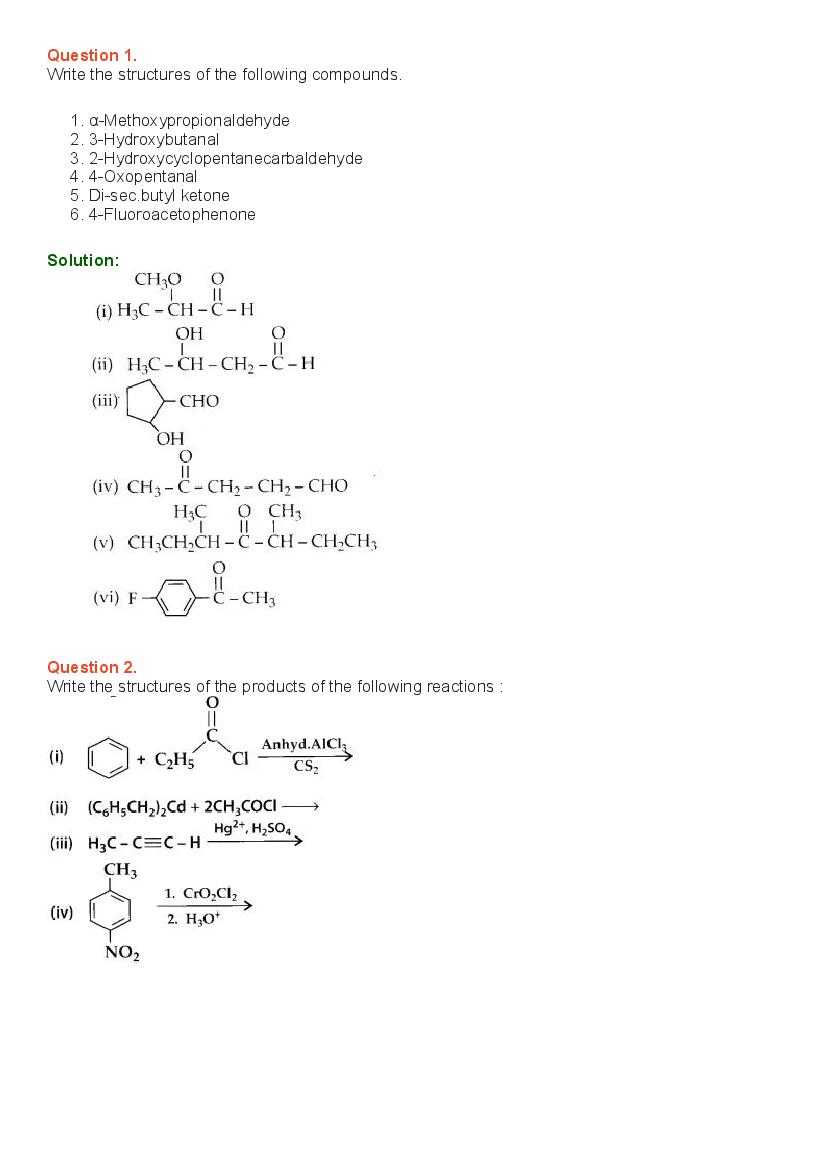
Write the structures of the following compounds.
1. α-Methoxypropionaldehyde
2. 3-Hydroxybutanal
3. 2-Hydroxycyclopentanecarbaldehyde
4. 4-Oxopentanal
5. Di-sec.butyl ketone
6. 4-Fluoroacetophenone
Question 2.
Write the structures of the products of the following reactions :
Page 2
Arrange the following compounds in increasing order of their boiling points.
CH3CHO, CH3CH2OH, CH3OCH3, CH3CH2CH3
CH3CH2CH3 < CH3OCH3 < CH3CHO < CH3CH2OH
Question 4.
Arrange the following compounds in increasing order of their reactivity in nucleophilic addition
reactions.
1. Ethanal, Propanal, Propanone, Butanone.
2. Benzaldehyde, p-Tolualdehyde,
p – Nitrobenzaldehyde, Acetophenone. Hint: Consider steric effect and electronic effect.
1. Butanone < Propanone < Propanal < Ethanal
2. Acetophenone < p-Tolualdehyde, Benzaldehyde < p-Nitrobenzaldehyde
Question 5.
Predict the products of the following reactions :
Page 3
Give the IUPAC names of the following compounds :
1. 3-Phenylpropanoic acid
2. 3-Methylbut-2-enoic acid
3. 2-Methylcyclopentanecarboxylic acid
4. 2,4,6-Trinitrobenzoic acid
Page 4
Show how each of the following compounds can be converted to benzoic acid.
1. Ethylbenzene
2. Acetophenone
3. Bromobenzene
4. Phenylethene (Styrene)
Question 8.
Which acid of each pair shown here would you expect to be stronger ?
(i) CH3CO2H or CH2FCO2H
(ii) CH2FCO2H or CH2ClCO2H
(iii) CH2FCH2CH2CO2H or CH3CHFCH2CO2H
Page 5
causes electron withdrawal from the COOH and facilitates the release of H+.
(ii) CH2FCO2H is a stronger acid for the same reason as stated above. F is more electronegative
than Cl, so it withdraws electrons from the carboxyl group to a greater extent.
(iii) CH3CHFCH2COOH is stronger. Although both the givenacidshaveFatomin them, it is the
proximity of F in CH3CHFCH2COOH to the COOH group which makes it more acidic.
NCERT Exercises
Question 1.
What is meant by the following terms? Give an example of the reaction in each case.
1. Cyanohydrin
2. Acetal
3. Semicarbazone
4. Aldol
5. Hemiacetal
6. Oxime
7. Ketal
8. Imine
9. 2,4-DNP derivative
10. Schiff’s base
Page 8
Name the following compounds according to IUPAC system of nomenclature :
1. CH3CH(CH3)CH2CH2CHO
2. CH3CH2COCH(C2H5)CH2CH2Cl
3. CH3CH=CHCHO
4. CH3COCH2COCH3
5. CH3CH(CH3)CH2C(CH3)2COCH3
6. (CH3)3CCH2COOH
7. OHCC6H4CHO-p
1. 4-Methylpentanal
2. 6-Chloro-4-ethylhexan-3-one
3. But-2-en-1-al
4. Pentane-2, 4-dione
5. 3, 3, 5-Trimethylhexan-2-one
6. 3, 3-Dimethylbutanoic acid
7. Benzene-1, 4-dicarbaldehyde
Question 3.
Draw the structures of the following compounds.
1. 3-Methylbutanal
2. p-Nitropropiophenone
Page 9
4. 4-Methylpent-3-en-2-one
5. 4-Chloropentan-2-one
6. 3-Bromo-4-phenylpentanoic acid
7. p, p’-Dihydroxybenzophenone
8. Hex-2-en-4-ynoic acid
Question 4.
Write the IUPAC names of the following ketones and aldehydes. Wherever possible, give also
common names.
Page 10
Draw structures of the following derivatives.
1. The 2,4-dinitrophenylhydrazone of benz- aldehyde
2. Cyclopropanone oxime
3. Acetaldehydedimethylacetal
4. The semicarbazone of cyclobutanone
5. The ethylene ketal of hexan-3-one
6. The methyl hemiacetal of formaldehyde
Page 11
Predict the products formed when cyclohexanecarbaldehyde reacts with following reagents.
1. PhMgBr and then H3O+
2. Tollens’reagent
3. Semicarbazide and weak acid
4. Excess ethanol and acid
5. Zinc amalgam and dilute hydrochloric acid
Page 12
Which of the following compounds would undergo aldol condensation, which the Cannizzaro
reaction and which neither? Write the structures of the expected products of aldol condensation
and Cannizzaro reaction.
1. Methanal
2. 2-Methylpentanal
3. Benzaldehyde
4. Benzophenone
5. Cyclohexanone
6. 1-Phenylpropanone
7. Phenylacetaldehyde
8. Butan-1-ol
9. 2,2-Dimethylbutanal
Page 13
while Cannizzaro reaction is undergone by aldehydes that have no α-H atom.
Page 14
How will you convert ethanal into the following compounds?
1. Butane-1,3-diol
2. But-2-enal
3. But-2-enoic acid
Page 15
Write structural formulas and names of four possible aldol condensation products from propanal
and butanal. In each case, indicate which aldehyde acts as nucleophile and which as an
electrophile
The possible products of aldol condensation from propanal and butanal are
Page 16
An organic compound with the molecular formula C9H10O forms 2,4-DNP derivative, reduces
Tollens’ reagent and undergoes Cannizzaro reaction. On vigorous oxidation, it gives 1, 2-
benzenedicarboxylic acid. Identify the compound.
(i) It is given that the compound reduces Tollens’ reagent. This proves that the compound is an
aldehyde. Further, the fact that it undergoes Cannizzaro reaction shows that it lacks an α-H atom.
(ii) On oxidation it yields 1,2-benzenedicarboxylic acid. This shows that it is an o-substituted
benzaldehyde. The only possible structure for the compound is :
Page 17
An organic compound (A) (molecular formula C8H16O2) was hydrolysed with dilute sulphuric acid to
give a carboxylic acid (B) and an alcohol (C). Oxidation of (C) with chromic acid produced (8). (C)
on dehydration gives but-1-ene. Write equations for the reactions involved.
Page 18
Arrange thefollowing compounds in increasing order of their property as indicated :
1. Acetaldehyde, Acetone, Di-tert-butyl ketone, Methyl fert-butyl ketone (reactivity towards HCN)
2. CH3CH2CH(Br)COOH,CH3CH(Br)CH2COOH, (CH3)2CHCOOH, CH3CH2CH2COOH (acid
strength)
3. Benzoic acid, 4-Nitrobenzoic acid, 3,4-Dinitrobenzoic acid, 4-Methoxybenzoic acid (acid
strength)
Page 20
Give simple chemical tests to distinguish between the following pairs of compounds.
1. Propanal and Propanone
2. Acetophenone and Benzophenone
3. Phenol and Benzoic acid
4. Benzoic acid and Ethyl benzoate
5. Pentan-2-one and Pentan-3-one
6. Benzaldehyde and Acetophenone
7. Ethanal and Propanal
The given set of compounds may be distinguish by the following reaction.
Page 22
How will you prepare the following compounds from benzene? You may use any inorganic reagent
and any organic reagent having not more than one carbon atom
1. Methyl benzoate
2. m-Nitrobenzoic acid
3. p-Nitrobenzoic acid
4. Phenylacetic acid
5. p-Nitrobenzaldehyde
Page 24
How will you bring about the following conversions in not more than two steps?
1. Propanone to Propene
2. Benzoic acid to Benzaldehyde
3. Ethanol to 3-Hydroxybutanal
4. Benzene to m-Nitroacetophenone
5. Benzaldehyde to Benzophenone
6. Bromobenzene to 1 -Phenylethanol
7. Benzaldehyde to 3-Phenyipropan-1 -ol
8. Benzaldehyde to a-Hydroxyphenylacetic acid
9. Benzoic acid to m-Nitrobenzyl alcohol
Page 27
Describe the following :
1. Acetylation
2. Cannizzaro reaction
3. Cross-aldol condensation
4. Decarboxylation
Page 30
Complete each synthesis by giving missing starting material, reagents or products
Page 33
Give plausible explanation for each of the following :
1. Cyclohexanone forms cyanohydrin in good yield but 2, 2,6 trimethylcyclohexa- none does not.
2. There are two – NH2 groups in semicarbazide. However, only one is involved in the formation
of semicarbazones.
3. During the preparation of esters from a carboxylic acid and an alcohol in the presence of an
acid catalyst, the water or the ester should be removed as soon as it is formed.
Page 34
An organic compound contains 69.77% carbon, 11.63% hydrogen and rest, oxygen. The molecular
mass of the compound is 86. It does not reduce Tollens’ reagent but forms an addition compound
with sodium hydrogensulphite and give positive iodoform test. On vigorous oxidation it gives
ethanoic and propanoic acid. Write the possible structure of the compound.
(a) The given compound does not reduce Tollens’ reagent which implies that it is not an aldehyde.
Page 35
Although phenoxide ion has more number of resonating structures than carboxylate ion, carboxylic
acid is a stronger acid than phenol. Why?
(i) Phenoxide ion has the following resonating structures :
Page 36
the presence of negative charge on an electronegative atom makes the ion more stable. For the
same reason RCOO– is more stable than the phenoxide ion where the oxygen has no negative
charge on it. For the above two reasons carboxylate ion is more stable and has higher acidity than
phenol.
Document Details
| Board / Org | NCERT |
| Exam | Class 12 |
| Type | Solution |
| Pages | 36 |
| Updated | 30 Apr 2026 |