CBSE Class 12 Sample Paper 2027 Solution (Marking Scheme) for Kuchipudi
Finished viewing? Save it for later —
Download CBSE Class 12 Sample Paper 2027 Solution (Marking Scheme) for Kuchipudi (PDF · 4 pages)About CBSE Class 12 Sample Paper 2027 Solution (Marking Scheme) for Kuchipudi
CBSE Class 12 Sample Paper 2027 Solution (Marking Scheme) for Kuchipudi is available here for free download. Published by CBSE for Class 12, this solution can be viewed online or downloaded as a PDF (4 pages). Candidates preparing for Class 12 can use CBSE Class 12 Sample Paper 2027 Solution (Marking Scheme) for Kuchipudi to understand the exam pattern, the type of questions asked, and the overall difficulty level.
Frequently Asked Questions
How can I download CBSE Class 12 Sample Paper 2027 Solution (Marking Scheme) for Kuchipudi?
Open this page and click the Download button to save CBSE Class 12 Sample Paper 2027 Solution (Marking Scheme) for Kuchipudi as a PDF. It is completely free on AglaSem Docs.
Is CBSE Class 12 Sample Paper 2027 Solution (Marking Scheme) for Kuchipudi free to download?
Yes. CBSE Class 12 Sample Paper 2027 Solution (Marking Scheme) for Kuchipudi can be viewed online and downloaded as a PDF free of cost on AglaSem Docs.
How many pages does CBSE Class 12 Sample Paper 2027 Solution (Marking Scheme) for Kuchipudi have?
CBSE Class 12 Sample Paper 2027 Solution (Marking Scheme) for Kuchipudi contains 4 pages, which you can read online or download together as a single PDF.
Where can I find more Class 12 study material?
You can find more Class 12 question papers, sample papers, syllabus, and answer keys on AglaSem Docs.
CBSE Class 12 Sample Paper 2027 Solution (Marking Scheme) for Kuchipudi – Text
Read the full text of this solution below — useful to quickly search, copy and reference the content online without downloading the PDF.
📄 View text version (5 pages)
Page 1
CBSE Class 12 Sample
Paper 2027 Solution
(Marking Scheme) for
Kuchipudi
EXAM YEAR TYPE SUBJECT
CBSE Class 12 2027 Solutions Dance
Notes · Sample Papers · Previous Year Papers · Mock Tests
Page 2
.co s e m
s em l a
a ag
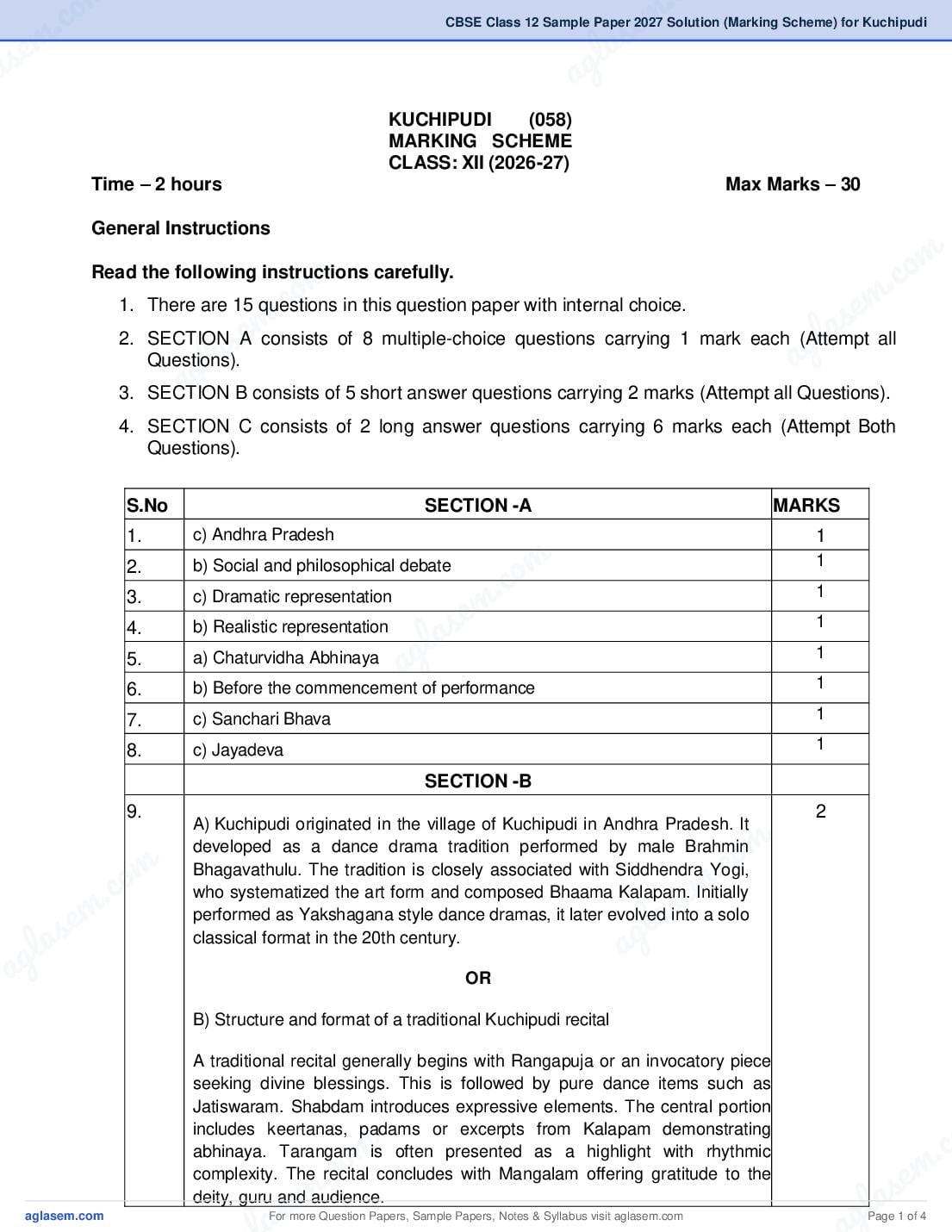
KUCHIPUDI (058)
MARKING SCHEME
CLASS: XII (2026-27)
Time – 2 hours Max Marks – 30
General Instructions
m
om
Read the following instructions carefully.
. co
. c e m
1. There are 15 questions in this question paper with internal choice.
m as
2. SECTION sAe consists of 8 multiple-choice questions carrying 1 mark each (Attempt
l all
l a a g
g
Questions).
a B consists of 5 short answer questions carrying 2 marks (Attempt all Questions).
3. SECTION
4. SECTION C consists of 2 long answer questions carrying 6 marks each (Attempt Both
Questions).
S.No SECTION -A MARKS
1. c) Andhra Pradesh 1
m
c. o
2. b) Social and philosophical debate 1
em
3. c) Dramatic representation 1
4. b) Realistic representation
l as 1
5. a) Chaturvidha Abhinaya
ag 1
1
6. b) Before the commencement of performance
7. c) Sanchari Bhava 1
8. c) Jayadeva 1
SECTION -B
9. 2
A) Kuchipudi originated in the village of Kuchipudi in Andhra Pradesh. It
m
.co
developed as a dance drama tradition performed by male Brahmin
m
.co
Bhagavathulu. The tradition is closely associated with Siddhendra Yogi,
e m
s
who systematized the art form and composed Bhaama Kalapam. Initially
e m la
s
performed as Yakshagana style dance dramas, it later evolved into a solo
la classical format in the 20th century.
ag
ag OR
B) Structure and format of a traditional Kuchipudi recital
A traditional recital generally begins with Rangapuja or an invocatory piece
seeking divine blessings. This is followed by pure dance items such as
Jatiswaram. Shabdam introduces expressive elements. The central portion
c
includes keertanas, padams or excerpts from Kalapam demonstrating
m .
c. o
abhinaya. Tarangam is often presented as a highlight with rhythmic
e m
s
complexity. The recital concludes with Mangalam offering gratitude to the
s em
deity, guru and audience.
For more Question Papers, Sample Papers, Notes & Syllabus visit
gl a
Page 1 of 4
Page 3
A) Sanchari Bhava and Sattvika Bhava
Sanchari Bhavas are transitory emotions that support and enhance the
dominant emotion. They are also called Vyabhichari Bhavas.
Sattvika Bhavas are involuntary emotional expressions such as tears,
horripilation and trembling arising from deep inner feelings.
OR
B) Angika and Vachika Abhinaya
Angika Abhinaya is expression through body movements including head,
eyes, hands and torso.
Vachika Abhinaya is expression through speech, song and dialogue
11. 2
A) Kalaapam
Kalaapam is a dance–drama format in Kuchipudi that combines music,
dialogue, expressive dance and character portrayal. It is a semi-classical
theatrical presentation rooted in the Bhagavata Mela tradition.
A Kalaapam usually centers around a single main character and develops
through narrative conversation, philosophical debate, songs and abhinaya.
It integrates Nritta, Nritya and Natya, with strong emphasis on Vachika
Abhinaya along with Angika and Sattvika elements.
Well-known examples include Bhaama Kalapam and Golla Kalapam.
OR
B) Shabdam
Shabdam is an expressive dance item combining nritta and abhinaya. It
usually praises a deity or king. It contains simple rhythmic patterns and
expressive sahitya.
12. 2
A) Difference between Nritta and Nritya
Nritta is pure dance without expression, consisting of rhythmic footwork and
patterns.
Nritya is expressional dance combining rhythm with abhinaya to convey
meaning.
OR
B)Tandava and Lasya
Tandava represents vigorous and masculine energy associated with Lord
Shiva.
For more Question Papers, Sample Papers, Notes & Syllabus visit Page 2 of 4
Page 4
.co s e m
s em l a
a ag
Lasya represents graceful and delicate movements associated with Goddess
Parvati. In Kuchipudi both aspects are blended.
13. 2
A) Rangapuja and Mangalam
m
Rangapuja is the ritual worship of the stage before the performance seeking
om . co
c m
divine blessings.
m .
Mangalam is the concluding item offering gratitude to the deity, guru and
s e
s e
audience.
g l a
g l a a
a OR
B) Ashthapadi
Ashthapadi refers to a lyrical composition consisting of eight stanzas. It is
part of the Gita Govinda composed by Jayadeva. The theme primarily
describes the divine love between Radha and Lord Krishna, expressing
Madhura Bhakti through poetic imagery and deep emotional content.
m
.co
SECTION-C
14.
e m 6
l as
A) Life and contributions of Siddhendra Yogi
g as the architect of the Kuchipudi dance
tradition. He lived in thea 15th–16th century and is believed to have
Siddhendra Yogi is regarded
systematized the art form. He composed Bhaama Kalapam, which became
the foundational text of Kuchipudi repertoire.
He trained young Brahmin boys of Kuchipudi village, who later became
known as Bhagavathulu, and established a hereditary performance
tradition. His work emphasized Madhura Bhakti through the character of
Satyabhama, presenting devotion through human emotion.
o m
m Siddhendra Yogi transformed Kuchipudi from a ritualistic performance c
c. o a structured dance drama tradition with defined technique,semusic m. and
into
e m l a
character portrayal. His contribution laid the foundation for the growth and
las classical recognition of Kuchipudi.
a g
ag OR
B) Distinctive Features of Kuchipudi
Kuchipudi is a classical dance form of Andhra Pradesh with strong dance–
drama roots. It combines Nritta, Nritya and Natya in a balanced manner.
The style includes spoken dialogue, making it more theatrical than many
other classical forms.
m . c
c. o
It is known for brisk footwork, rounded and graceful torso movements, and
s e m
em a
expressive abhinaya. Tarangam, where the dancer performs rhythmic
s
For more Question Papers, Sample Papers, Notes & Syllabus visit
glPage 3 of 4
Page 5
The style blends Tandava and Lasya elements and mainly uses Telugu
compositions, especially from works like Bhaama Kalapam. Strong
characterization and dramatic presentation distinguish it from other classical
dance forms.
15. 6
A) Chaturvidha Abhinaya
Chaturvidha Abhinaya consists of Angika, Vachika, Aharya and Sattvika.
Angika uses body movements for expression.
Vachika uses speech and music.
Aharya includes costume, ornaments and stage décor.
Sattvika represents inner emotional states such as tears or trembling.
In Kuchipudi all four are used effectively, especially in dance dramas like
Bhaama Kalapam.
OR
B) Bhaama Kalapam
Bhaama Kalapam was written by Siddhendra Yogi. It portrays the story of
Satyabhama and her love for Lord Krishna. The theme reflects Madhura
Bhakti. The message emphasizes devotion, surrender of ego and spiritual
realization. It is a landmark work in Kuchipudi tradition and forms the
foundation of its dance drama heritage.
For more Question Papers, Sample Papers, Notes & Syllabus visit Page 4 of 4
Document Details
| Board / Org | CBSE |
| Exam | Class 12 |
| Type | Solution |
| Pages | 4 |
| Updated | 29 Oct 2026 |