MAHA SET 2018 Question Paper 2 Education
Finished viewing? Save it for later —
Download MAHA SET 2018 Question Paper 2 Education (PDF · 24 pages)About MAHA SET 2018 Question Paper 2 Education
MAHA SET 2018 Question Paper 2 Education is available here for free download. Published by Maharashtra Exams for Maharashtra State Eligibility Test, this question paper can be viewed online or downloaded as a PDF (24 pages). Candidates preparing for Maharashtra State Eligibility Test can use MAHA SET 2018 Question Paper 2 Education to understand the exam pattern, the type of questions asked, and the overall difficulty level.
Frequently Asked Questions
How can I download MAHA SET 2018 Question Paper 2 Education?
Open this page and click the Download button to save MAHA SET 2018 Question Paper 2 Education as a PDF. It is completely free on AglaSem Docs.
Is MAHA SET 2018 Question Paper 2 Education free to download?
Yes. MAHA SET 2018 Question Paper 2 Education can be viewed online and downloaded as a PDF free of cost on AglaSem Docs.
How many pages does MAHA SET 2018 Question Paper 2 Education have?
MAHA SET 2018 Question Paper 2 Education contains 24 pages, which you can read online or download together as a single PDF.
Where can I find more Maharashtra State Eligibility Test study material?
You can find more Maharashtra State Eligibility Test question papers, sample papers, syllabus, and answer keys on AglaSem Docs.
MAHA SET 2018 Question Paper 2 Education – Text
Read the full text of this question paper below — useful to quickly search, copy and reference the content online without downloading the PDF.
📄 View text version (24 pages)
Page 1
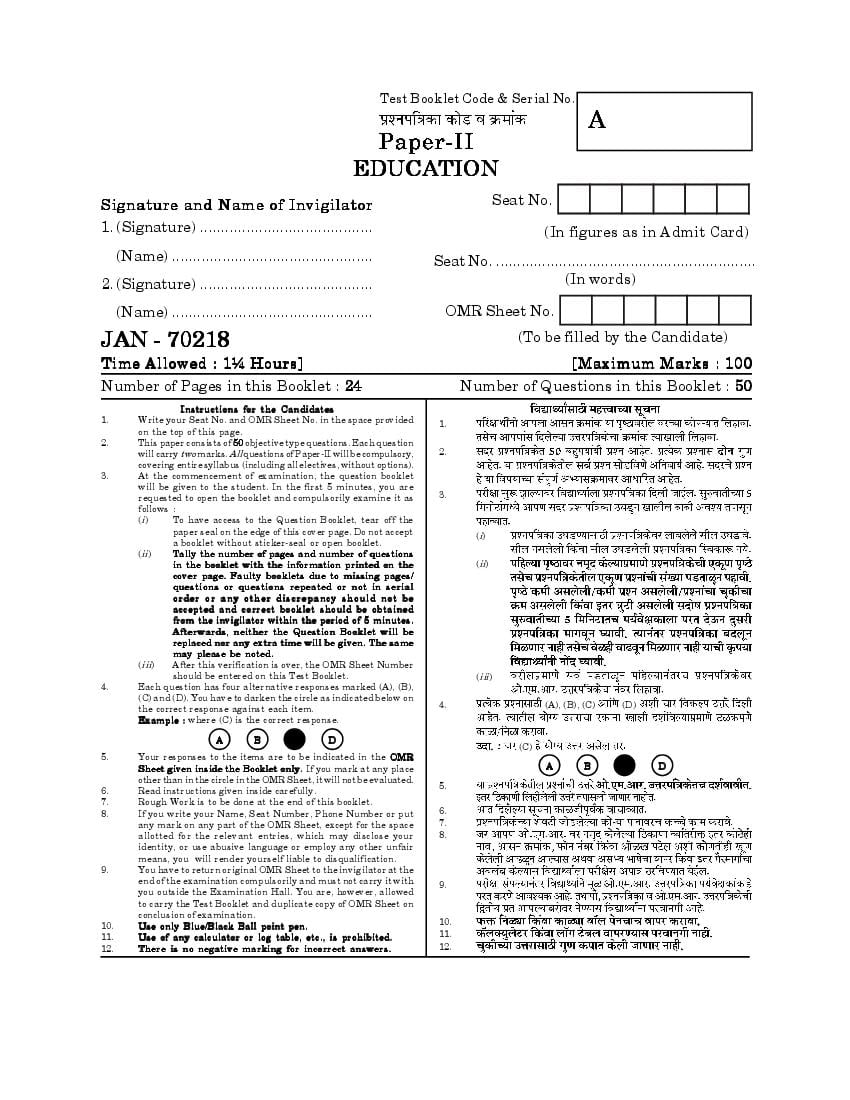
A
EDUCATION
Signature and Name of Invigilator Seat No.
1. (Signature) ......................................... (In figures as in Admit Card)
(Name) ................................................ Seat No. ..............................................................
2. (Signature) ......................................... (In words)
(Name) ................................................ OMR Sheet No.
JAN - 70218 (To be filled by the Candidate)
Time Allowed : 1¼ Hours] [Maximum Marks : 100
Number of Pages in this Booklet : 24 Number of Questions in this Booklet : 50
Instructions for the Candidates
1. Write your Seat No. and OMR Sheet No. in the space provided 1.
on the top of this page.
2. This paper consists of 50 objective type questions. Each question
will carry two marks. All questions of Paper-II will be compulsory, 2.
covering entire syllabus (including all electives, without options).
3. At the commencement of examination, the question booklet
will be given to the student. In the first 5 minutes, you are
requested to open the booklet and compulsorily examine it as 3.
follows :
(i) To have access to the Question Booklet, tear off the
paper seal on the edge of this cover page. Do not accept (i)
a booklet without sticker-seal or open booklet.
(ii) Tally the number of pages and number of questions
in the booklet with the information printed on the (ii)
cover page. Faulty booklets due to missing pages/
questions or questions repeated or not in serial
o rder or any other discre pancy should not be
accepted and correct booklet should be obtained
from the invigilator within the period of 5 minutes.
Afterwards, neither the Question Booklet will be
replaced nor any extra time will be given. The same
may please be noted.
(iii) After this verification is over, the OMR Sheet Number
should be entered on this Test Booklet. (iii)
4. Each question has four alternative responses marked (A), (B),
(C) and (D). You have to darken the circle as indicated below on
the correct response against each item. 4. (A), (B), (C) (D)
Example : where (C) is the correct response.
A B D
(C)
5. Your responses to the items are to be indicated in the OMR
Sheet given inside the Booklet only. If you mark at any place A B D
other than in the circle in the OMR Sheet, it will not be evaluated.
5.
6. Read instructions given inside carefully.
7. Rough Work is to be done at the end of this booklet.
8. If you write your Name, Seat Number, Phone Number or put 6.
any mark on any part of the OMR Sheet, except for the space 7.
allotted for the relevant entries, which may disclose your 8.
identity, or use abusive language or employ any other unfair
means, you will render yourself liable to disqualification.
9. You have to return original OMR Sheet to the invigilator at the
end of the examination compulsorily and must not carry it with 9.
you outside the Examination Hall. You are, however, allowed
to carry the Test Booklet and duplicate copy of OMR Sheet on
conclusion of examination.
10. Use only Blue/Black Ball point pen. 10.
11. Use of any calculator or log table, etc., is prohibited. 11.
12. There is no negative marking for incorrect answers. 12.
Page 2
Page 3
Paper II
II
Time Allowed : 75 Minutes] [Maximum Marks : 100
Note : This paper contains Fifty (50) multiple choice questions, each question
carrying Two (2) marks. Attempt All questions.
(50) (2)
1. Modernization leads to ................. . 1.
(A) Democratization
(A)
(B) Globalization
(B)
(C) Industrialization
(C)
(D) Urbanization
(D)
2. Gandhiji’s basic principle of his life- 2.
philosophy was ................. .
(A) Truth (A)
(B) Non-violence (B)
(C) Renunciation (C)
(D) Truth, non-violence (D)
3 [P.T.O.
Page 4
of upasna.” This thought is related
to ........... philosophy.
(A)
(A) Buddhism
(B)
(B) Jainism
(C)
(C) Spiritualism
(D) Naturalism (D)
4. How was the relation of a teacher 4.
with his student according to Swami
Vivekananda ?
(A)
(A) Philosopher
(B)
(B) Friend
(C)
(C) Guide
(D) Parent (D)
5. ‘Knowledge is Virtue’, this 5.
statement with reference to .......... .
(A) Spiritualism (A)
(B) Idealism (B)
(C) Naturalism (C)
(D) Pragmatism
(D)
4
Page 5
associated with ................. .
(A) Vishwabharti (A)
(B) National Anthem (B)
(C) Nobel Prize (C)
(D) Vande Matram (D)
7. One of the main truths of Buddhism 7.
is ...................... .
(A) Freedom from Sin (A)
(B) Freedom from Suffering (B)
(C) Freedom from Karma (C)
(D) Freedom from Anger (D)
8. Importance of physical environment 8.
is given in ....................... .
(A) Realism (A)
(B) Naturalism (B)
(C) Spiritualism (C)
(D) Idealism (D)
5 [P.T.O.
Page 6
science in education was propounded
by ......................... .
(A)
(A) Sri Aurobindo
(B)
(B) Swami Vivekananda
(C)
(C) J. Krishnamurthy
(D) Mahatma Gandhi (D)
10. ‘I think, therefore, I am’, is the basic 10.
principle of ....................... .
(A) Realism (A)
(B) Marxism (B)
(C) Existentialism (C)
(D) Logical empiricism (D)
11. In 1921 ‘Viswabharti’ was 11.
established by ........................... .
(A) Mahatma Gandhi (A)
(B) Vinoba Bhave (B)
(C) Rabindranath Tagore
(C)
(D) Vivekananda
(D)
6
Page 7
(A) Learning by doing (A)
(B) Inductive-deductive method (B)
(C) Lecture method (C)
(D) Problem solving method (D)
13. Women Education was discouraged 13.
by ...................... .
(A) Plato (A)
(B) Dewey (B)
(C) Rousseau (C)
(D) Erasmus (D)
14. Socialization is the main aim of 14.
education at .................... level.
(A) Primary (A)
(B) Pre-primary (B)
(C) Secondary (C)
(D) Higher-Secondary (D)
7 [P.T.O.
Page 8
child .................... .
(A) Formally (A)
(B) Informally (B)
(C)
(C) Deliberately
(D) Regularly (D)
16. Socialisation is a process of 16.
.................... .
(A) Participation in the school
(A)
ceremonies
(B) Challenging the rules and (B)
norms of social life
(C) Learning social habits, attitude
(C)
and values
(D) Knowing the achivements of
fore-fathers (D)
17. The role of education with reference 17.
to culture is ..................... .
(A) Preservation
(A)
(B) Conservation
(B)
(C) Both preservation and
promotion (C)
(D) Modernisation (D)
8
Page 9
interaction.
(A) Communication among
(A)
members of a social group
(B) Communication between two or
more social groups (B)
(C) Communication between two
individuals
(C)
(D) Analysis of social process in
groups (D)
19. Which of the following is an informal 19.
agency of education ?
(A) Religious institution (A)
(B) Anganwadi (B)
(C) Adult education centre (C)
(D) Night school (D)
9 [P.T.O.
Page 10
different communities to his
students, here he is performing the
role as a ......................... .
(A)
(A) Promoter
(B)
(B) Conservator
(C)
(C) Communicator
(D) Creator (D)
21. Who wrote the book “School and 21.
Society” ?
(A) Auguste Comte (A)
(B) John Dewey (B)
(C) Emil Durkheim (C)
(D) Robert Merton (D)
22. Urbanization does not lead 22.
to ............................. .
(A) Development of industries (A)
(B) Increased opportunities for
(B)
varied job
(C) Increase in thinking level of
(C)
individual
(D) Increase in economic status of
(D)
individual
10
Page 11
modernisation is ........................ .
(A) The caste system (A)
(B) The religious system (B)
(C) The family system (C)
(D) The marriage system (D)
24. The main constraint to social change 24.
in India is ....................... .
(A) Non-flexibility (A)
(B) International policy (B)
(C) Non-acceptance of novelty (C)
(D) Democracy (D)
25. Promotion of an employee to 25.
higher post due to acquisition
of qualification is an example of
................... .
(A)
(A) Vertical mobility
(B)
(B) Diagonal mobility
(C) Horizontal mobility (C) (Horizontal)
(D) Circular mobility (D)
11 [P.T.O.
Page 12
psychological base for education.
(A) Stanley Hall (A)
(B) Alfred Binnet (B)
(C) John Locke (C)
(D) Johan Herbert (D)
27. According to Jean Piaget, the 27.
process of cognitive development is
............... .
(A) assimilation accommodation (A)
equilibration reproductive
assimilation unequilibration
(B) accommodation equilibration (B)
assimilation reproductive
assimilation unequilibration
(C) assimilation reproductive (C)
assimilation accommodation
equilibration unequilibration
(D) equilibration assimilation (D)
accommodation reproductive
assimilation unequilibration
12
Page 13
some months or years writes the
poem regarding this incidence. This
period may be called ................ stage
of creativity.
(A)
(A) Preparation
(B)
(B) Incubation
(C) Illumination (C)
(D) Verification (D)
29. According to Gardner’s multiple 29.
intelligence theory, art of
photography is the example of
............. type of intelligence.
(A)
(A) Visual
(B)
(B) Bodily
(C) Logical (C)
(D) Musical (D)
13 [P.T.O.
Page 14
30.
steps for information processing
theory of intelligence.
(A) encoding inferring (A)
mapping application
response justification
(B)
(B) encoding inferring
mapping application
justification response
(C)
(C) encoding mapping
inferring application
response justification (D)
(D) encoding mapping
application inferring
response justification
14
Page 15
between two or more concepts and
directed the relations continuously.
According to Gagne’s hierarchical
theory of learning, this activity
belongs to ....................... stage.
(A)
(A) Multiple discrimination
(B)
(B) Concept learning
(C)
(C) Learning of principles
(D) Problem solving (D)
32. Kurt Lewin used the concept of 32.
................... to explain person’s life
space.
(A) Geometry (A)
(B) Topology (B)
(C) Psychology (C)
(D) Vector (D)
15 [P.T.O.
Page 16
personality, sincerity trait is related
to ............................ .
(A) Primary traits (A)
(B) Secondary traits (B)
(C) Cardinal traits (C)
(D) Central traits (D)
34. The characteristics of personality of 34.
sonal is pessimistic, unsociable and
reserved. Then according to
Sheldon’s classification she is
included in ................ personality
type.
(A)
(A) Endomorphic
(B)
(B) Mesomorphic
(C) Ectomorphic (C)
(D) Asthenic (D)
16
Page 17
According to Eyesenck’s view of
personality Anita’s behaviour falls
in ............. .
(A) introversion (type) (A)
(B) trait (B)
(C) habitual response (C)
(D) specific response (D)
36. When Anil get failure in sport 36.
competition and says ‘i could not get
sufficient time’, He is satisfying
himself. This is an example of
.............. defence mechanism.
(A)
(A) Repression
(B)
(B) Regression
(C)
(C) Projection
(D) Rationalization (D)
17 [P.T.O.
Page 18
37. ................... is not a characteristic of
integrated personality.
(A) Good health (A)
(B) Co-operative nature (B)
(C) Endearing behaviour (C)
(D) Aggression (D)
38. In experimental research before 38.
starting the data analysis the
researcher should ensure the data
with ........................ .
(A) Graphical presentation (A)
(B) F-
(B) ‘F’ test
(C)
(C) ‘t’-test
(D) (data)
(D) Normality of data
18
Page 19
is appropriate when ................... .
(A) one variable is having natural
(A)
dichotomy and other is not
continuous
(B) both the variables are having (B)
artificial dichotomy
(C) one variable is having natural
(C)
dichotomy and other is
continuous
(D) one variable is having natural (D)
dichotomy and other is having
artificial dichotomy
40. In experimental research .................
40.
variable is an outcome.
(A) Independent (A)
(B) Dependent (B)
(C) Extraneous (C)
(D) Controlled (D)
19 [P.T.O.
Page 20
techniques is non-probabilistic ?
(A) Stratified (A)
(B) Cluster (B)
(C) Snowball (C)
(D) Systematic (D)
42. Data collection by visiting places like
42.
Red Fort, Shalimar Garden,
Industries and historical places is
referred to be .................. data. (data)
(A) Secondary (A)
(B) Industrial (B)
(C) Historical (C)
(D) Primary (D)
43. A sample unit is said to be good if 43.
the sample is ....................... .
(A) Well educated to provide (A) (data)
enough data
(B) Listed in the programmes of (B)
educational institutions
(C) Drawn from a target group as (C)
represented in the objectives of
the study
(D) (data)
(D) Easily accessible to collect data
20
Page 21
and girls perform equally well in
mechanical aptitude test. This is (performance)
................. hypothesis.
(A) Statistical (A)
(B) Research (B)
(C) Null (C)
(D) Operational (D)
2
45. The formula of Chi-square test is 45.
............................ .
(fo f e) 2 2 (fo f e) 2
(A)
2 (A)
fo fo
2
2 fe fo
2 fe fo (B) 2
(B) fe
fe
2
2 fe fo
2
fe fo (C) 2
(C) fe
fe
(fo f e) 2 2 (fo f e) 2
(D) 2 (D)
fe fe
21 [P.T.O.
Page 22
research establishes ................ of (data)
data.
(A)
(A) Accuracy
(B)
(B) Trustworthiness
(C) Utility (C)
(D) Authenticity (D)
47. A researcher was interested in 47.
collecting data from teacher (data)
educators. He visited the teacher
education conference and collected
(data)
the data from those who were
present. This sampling technique is
............... sampling.
(A)
(A) Purposive
(B)
(B) Instant
(C)
(C) Quota
(D)
(D) Incidental
22
Page 23
discipline are enquired through
.................. type of research.
(A) Applied (A)
(B) Fundamental (B)
(C) Action (C)
(D) Historical (D)
49. Student ‘A’ has achieved twice that 49. ‘A’ ‘B’
of student ‘B’ and thrice that of
‘C’
student ‘C’. The measurement
presented in this case is on
(scale)
....................... scale.
(A)
(A) Nominal
(B)
(B) Ordinal
(C)
(C) Interval
(D) Ratio (D)
50. ‘A’ group has M = 5 and N = 20 50. ‘A’ M = 5 N = 20
‘B’ group has M = 20 and N = 5 ‘B’ M = 20 N = 5
The combined mean for A and B A B
groups will be .................. .
(A) 12.5 (A) 12.5
(B) 25 (B) 25
(C) 8 (C) 8
(D) 1.8 (D) 1.8
23 [P.T.O.
Page 24
24
Document Details
| Board / Org | Maharashtra Exams |
| Exam | Maharashtra State Eligibility Test |
| Type | Question Paper |
| Pages | 24 |
| Updated | 30 Apr 2026 |