CBSE Class 12 Sample Paper 2027 Solution (Marking Scheme) for Legal Studies
Finished viewing? Save it for later —
Download CBSE Class 12 Sample Paper 2027 Solution (Marking Scheme) for Legal Studies (PDF · 12 pages)About CBSE Class 12 Sample Paper 2027 Solution (Marking Scheme) for Legal Studies
CBSE Class 12 Sample Paper 2027 Solution (Marking Scheme) for Legal Studies is available here for free download. Published by CBSE for Class 12, this solution can be viewed online or downloaded as a PDF (12 pages). Candidates preparing for Class 12 can use CBSE Class 12 Sample Paper 2027 Solution (Marking Scheme) for Legal Studies to understand the exam pattern, the type of questions asked, and the overall difficulty level.
Frequently Asked Questions
How can I download CBSE Class 12 Sample Paper 2027 Solution (Marking Scheme) for Legal Studies?
Open this page and click the Download button to save CBSE Class 12 Sample Paper 2027 Solution (Marking Scheme) for Legal Studies as a PDF. It is completely free on AglaSem Docs.
Is CBSE Class 12 Sample Paper 2027 Solution (Marking Scheme) for Legal Studies free to download?
Yes. CBSE Class 12 Sample Paper 2027 Solution (Marking Scheme) for Legal Studies can be viewed online and downloaded as a PDF free of cost on AglaSem Docs.
How many pages does CBSE Class 12 Sample Paper 2027 Solution (Marking Scheme) for Legal Studies have?
CBSE Class 12 Sample Paper 2027 Solution (Marking Scheme) for Legal Studies contains 12 pages, which you can read online or download together as a single PDF.
Where can I find more Class 12 study material?
You can find more Class 12 question papers, sample papers, syllabus, and answer keys on AglaSem Docs.
CBSE Class 12 Sample Paper 2027 Solution (Marking Scheme) for Legal Studies – Text
Read the full text of this solution below — useful to quickly search, copy and reference the content online without downloading the PDF.
📄 View text version (13 pages)
Page 1
CBSE Class 12 Sample
Paper 2027 Solution
(Marking Scheme) for
Legal Studies
EXAM YEAR TYPE SUBJECT
CBSE Class 12 2027 Solutions Legal Studies
Notes · Sample Papers · Previous Year Papers · Mock Tests
Page 2
.co s e m
s em l a
a ag
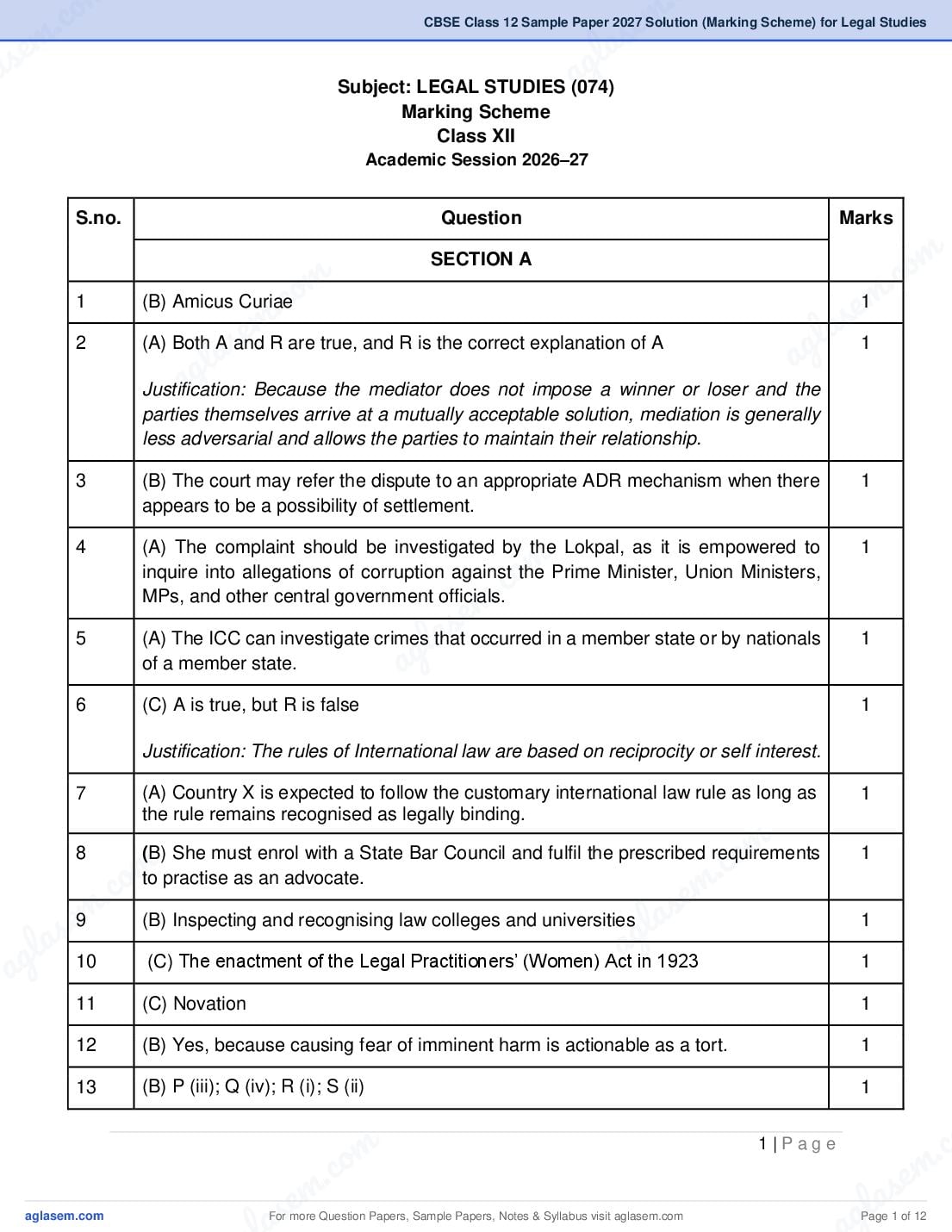
Subject: LEGAL STUDIES (074)
Marking Scheme
Class XII
Academic Session 2026–27
S.no. Question Marks
o m
c
SECTION A
(B) Amicus Curiaeco
m 1m
.
1
. s e
(A) Both A s emR are true, and R is the correct explanation of A g l a 1
la a
2 and
a g
Justification: Because the mediator does not impose a winner or loser and the
parties themselves arrive at a mutually acceptable solution, mediation is generally
less adversarial and allows the parties to maintain their relationship.
3 (B) The court may refer the dispute to an appropriate ADR mechanism when there 1
appears to be a possibility of settlement.
m
4 (A) The complaint should be investigated by the Lokpal, as it is empowered to 1
.co
inquire into allegations of corruption against the Prime Minister, Union Ministers,
m
MPs, and other central government officials.
e
as occurred in a member state or by nationals
(A) The ICC can investigate crimeslthat
ag
5 1
of a member state.
6 (C) A is true, but R is false 1
Justification: The rules of International law are based on reciprocity or self interest.
7 (A) Country X is expected to follow the customary international law rule as long as 1
the rule remains recognised as legally binding.
m
.co
8 (B) She must enrol with a State Bar Council and fulfil the prescribed requirements 1
. c om
to practise as an advocate.
em
e9 m (B) Inspecting and recognising law colleges and universities las
s
la 10 ag
1
ag (C) The enactment of the Legal Practitioners’ (Women) Act in 1923 1
11 (C) Novation 1
12 (B) Yes, because causing fear of imminent harm is actionable as a tort. 1
13 (B) P (iii); Q (iv); R (i); S (ii) 1
om
1|Page
. c
. c e m
m as
se
For more Question Papers, Sample Papers, Notes & Syllabus visit
gl
Page 1 of 12
Page 3
protecting and improving the environment
15 (B) Limited Liability Partnership, because it protects partners’ personal assets 1
while also offering operational flexibility.
16 (D) A is false, R is true 1
Justification: Sand art is temporary and copyright is granted to a work which is in a
tangible and fixed form.
17 (A) Both Statement I and Statement II are true. 1
18 (A) Ignorantia Juris Non Excusat 1
19 (D) Friendly relations with foreign States 1
20 A) Both persons can approach an Indian court for enforcement of their right to life, 1
as Article 21 protects every person.
SECTION B
21A Justice Verma as Chief Justice of India is appointed on the basis of seniority in 2
the Supreme Court, not age. Seniority is determined primarily by the date of
appointment to the Supreme Court.
OR
21B Judicial Review: The courts have the power to examine whether the State’s action 2
is constitutional. In this case, the journalist can invoke judicial review to challenge
the State’s order as violating freedom of speech and expression (Article 19(1)(a)).
Remedy by Court: The court can strike down or quash the unconstitutional
order, declaring it invalid. It may also restore the newspaper’s publication and
provide relief to ensure the journalist’s rights are protected.
22 Aspect Advocate-on-Record (AOR) Senior Advocate 2
A lawyer recognized for
A lawyer entitled to file and
Definition / expertise and experience,
act in cases in the Supreme
Role designated by the Supreme
Court on behalf of clients.
Court or High Court.
Cannot file cases directly;
Can file cases directly in the
Filing Cases works through an Advocate-on-
Supreme Court.
Record.
2|Page
For more Question Papers, Sample Papers, Notes & Syllabus visit Page 2 of 12
Page 4
.co s e m
s em l a
a ag
Any qualified advocate can Appointed based on merit,
Designation become AOR by passing a experience, and reputation; no
special exam. exam required.
Can argue and appear, but
Court Can appear and conduct
must be instructed through
Appearance cases independently.
another advocate.
m
23A
om
The Legal Services Authorities (Amendment) Act, 2002 brought important 2
. co
. c em
s
changes to the Legal Services Authorities Act, 1987, particularly regarding Lok
e m l a
s
Adalats:
a
l Recognition of Permanent Lok Adalats (PLAs): ag
1. g
a o The amendment introduced the concept of Permanent Lok
Formal
Adalats for pre-litigation conciliation in cases related to public
utility services (like transport, postal, water supply, etc.).
o These PLAs are continuous bodies, unlike earlier ad-hoc Lok
Adalats which were organized occasionally.
2. Authority to Decide Cases:
o Under the amendment, Lok Adalats were empowered to pass
m
.co
binding awards on disputes referred to them, which have the status
of a civil court decree.
e m
as
o In cases where parties do not reach a settlement, Permanent Lok
l
ag
Adalats are empowered to decide the dispute on merits, specifically
for pre-litigation matters in public utility services
OR
23B 1. Empanelment Process: 2
Eligibility: Advocates enrolled with a State Bar Council and having the
required minimum experience of 3 years
m
.co
Application: Advocates apply to the State or District Legal Services
m
.co m
Authority for empanelment.
m
Screening: Applications are reviewed, and advocates are shortlisted
s e
s e based on experience, specialization, and credentials.
g la
g la Approval: The final list of empanelled advocates is maintained by the a
a State or District Legal Services Authority.
These advocates are authorized to provide free legal aid to eligible persons
under the Legal Services Authorities Act, 1987.
om
3|Page
. c
. c e m
m as
se
For more Question Papers, Sample Papers, Notes & Syllabus visit
gl
Page 3 of 12
Page 5
Provide free legal assistance to eligible persons, including
representation, drafting, and advice. Maintain professional conduct and
ethics, ensuring honesty and diligence.
Not to accept fee or any kind of payment in cash or kind
24 The principle of innocent until proven guilty is not absolute in Indian criminal law 2
because, in certain situations, the law reverses the burden of proof to effectively
address serious offences and prevent misuse of the principle.
The burden of proof is reversed in the following situations:
1. When a statute expressly provides for a reverse onus, such as in dowry
death cases where the accused is presumed guilty.
2. When the accused files an appeal against a conviction by a lower court,
where the presumption shifts from innocence to guilt until the conviction is
set aside.
25 The company should form a Public Limited Company in India. 2
Key Characteristics:
It can issue shares to the public to raise funds.
It has limited liability, meaning shareholders are liable only up to the extent
of their shareholding.
It is a separate legal entity from its owners.
26 The National Commission for Minorities could refuse to admit the woman’s 2
complaint on the following grounds:
Matter is sub judice.
Complaint relates to events more than one year old.
Complaint does not relate to minority rights or minority status, hence
outside the Commission’s jurisdiction.
27 The transfer made by Piya is invalid because of the following reasons: 2
1. Entitlement to Property: Piya attempted to transfer part of the shop that
legally belongs to her brother, so she is not entitled to transfer the entire
property. A valid transfer requires the transferor to be entitled to the
transferable property.
2. Authorization: Piya is not authorized to transfer property that is not fully
hers, violating the essential requirement that the transferor must be
competent and authorized to dispose of the property.
3. Free from Encumbrances: The property is subject to a legal dispute, so it
is not free from encumbrances, which is an essential condition for a valid
transfer.
4|Page
For more Question Papers, Sample Papers, Notes & Syllabus visit Page 4 of 12
Page 6
.co s e m
s em g l a
a a
28A Article 20. Protection in respect of conviction for offences 2
1. No person shall be convicted of any offence except for violation of the law in
force at the time of the commission of the act charged as an offence, nor be
subjected to a penalty greater than that which might have been inflicted
under the law in force at the time of the commission of the offence.
2. No person shall be prosecuted and punished for the same offence more than
once.
3. No person accused of any offence shall be compelled to be a witness against
m
himself.
om . co
. c e m
m
e of the Preamble are:
OR
as
l 2
28B as g
l Preamble affirms the aims, objectives, and guiding principles of athe
The two functions
- g
a Constitution.
The
- The principles in the Preamble are used to interpret vague and
ambiguous provisions of the Constitution.
SECTION C
29A (a) No. The two jurisdictions may treat the proposed activities differently. In India, 3
the communication of limited professional information is permitted subject to the
m
.co
Bar Council rules, but direct solicitation and personal approaches to prospective
clients are restricted. In the United States, lawyer advertising is generally permitted,
e m
subject to rules against misleading communications and restrictions on solicitation.
l as of the legal profession and to prevent
ag solicitation of clients.
(b) To maintain the dignity and credibility
misleading publicity and improper
OR
29B (a) No. An advocate cannot defend such conduct on the ground of client interest. 3
An advocate owes a higher duty to the court and the administration of justice and
must act with honesty. Suppression of material facts and unnecessary delay
undermine the advocate’s role as an officer of the court.
m
.co
(b) Advocate Sachin should have declined to follow the client’s improper
m
.co m
instructions and either placed the document on record or withdrawn from the case
s e
em (c) The State Bar Council is the authority competent gtolainitiate disciplinary
in accordance with professional ethics.
las a
ag proceedings for professional misconduct.
30 (i) Four categories under which Leena is eligible to receive free legal aid: 3
1. Women – She is a female citizen.
2. Scheduled Tribe (Tribal woman) – She belongs to a marginalized
community.
om
5|Page
. c
. c e m
m as
se
For more Question Papers, Sample Papers, Notes & Syllabus visit
gl
Page 5 of 12
Page 7
restricting movement.
4. Victims of disaster or displaced persons – She lost her home and
farmland due to floods and migrated.
(ii) Statutory Act giving effect to Article 39A and its objectives:
Act: Legal Services Authorities Act, 1987
Objectives:
1. To provide free legal aid and advice to persons who cannot afford it.
2. To ensure access to justice for all citizens, especially marginalized and
disadvantaged groups.
3. To promote equality of opportunity in legal matters, as envisaged under
Article 39A of the Constitution.
To establish legal services authorities at national, state, and district levels to
implement legal aid programs effectively.
31A The following Articles/ Rights are enforced by providing legal aid; 3
1. Article 14 – Right to Equality:
o Guarantees equality before the law and equal protection of laws.
o Legal aid ensures that persons who cannot afford a lawyer are not
discriminated against, making equality meaningful in legal proceedings.
2. Article 15 – Prohibition of Discrimination:
o Prohibits discrimination on grounds of religion, race, caste, sex, or place of
birth.
o Legal aid ensures that marginalized groups like Scheduled Castes,
Scheduled Tribes, women, and minority communities can effectively access
courts and protect their rights.
3. Article 39A – Directive for Free Legal Aid:
o Directs the State to provide free legal aid to ensure justice is not denied due
to economic or social disability.
Operationalized through the Legal Services Authorities Act, 1987, establishing
legal services authorities at national, state, and district levels.
OR
31B ICCPR: 3
An explicit provision for legal services is incorporated in the International Covenant
on Civil and Political Rights (ICCPR). India has ratified the International Covenant
on Civil and Political Rights, which came into force in 1976 and is bound by the
6|Page
For more Question Papers, Sample Papers, Notes & Syllabus visit Page 6 of 12
Page 8
.co s e m
s em g l a
a a
international obligation to provide free legal assistance as per the requirements of
the Covenant.
UDHR:
Article 8 of the Universal Declaration of Human Rights (UDHR) provides that
everyone has the right to an effective remedy by the competent national tribunals
m
for acts violating the fundamental rights granted by the Constitution or by the law.
om . co
c
UDHR creates right-centric obligations of norm creating a character for the
. e m
m
members of the international community.
e step in the formation of a contract is the offer (proposal). as
l 3
32
l s
1. (a) Theafirst a g
In thisgcase, Rohan’s email to Meera stating his willingness to sell the laptop for
a
₹40,000 is an offer.
(b) The proposal made by Rohan to all students is a general or public offer).
2. Two points of difference:
Difference between Offer and General Offer
Basis Offer General Offer
An offer made to a
m
.co
specific person or a An offer made to the
Meaning
specific group of public at large
persons
e m
To whom it is
l as
To a definite person or To anyone who fulfils the
made persons
ag conditions of the offer
Any person who has
Only the person to
knowledge of the offer and
Acceptance whom the offer is made
fulfils its conditions can
can accept it
accept it
om
33A (a) Riya can register her creation under the Patents Act, 1970 to protect her 3
Intellectual Property Rights.
m . c
c. o (b) Two basic requirements for patent registration: s e m
s em 1. Novelty: The invention must be new and not known to the public anywhere
g la
l a in the world.
a
ag 2. Industrial Applicability / Usefulness: The invention must be capable of
being made or used in some kind of industry.
The invention should also be non-obvious, meaning it should not be an obvious
improvement over existing knowledge.
OR
om
7|Page
. c
. c e m
m as
se
For more Question Papers, Sample Papers, Notes & Syllabus visit
gl
Page 7 of 12
Page 9
the lease agreement, the lessee (Kabir) cannot sub-let the property or transfer
possession to another person without the consent of the lessor (Neha), unless
expressly permitted in the lease.
(b) The duty violated by Kabir is the duty to return the property in the same condition
in which it was leased. Allowing Rohan to make structural changes amounts to
committing waste, which reduces the value of the property.
(c) One remedy available to Neha is to sue Kabir for compensation or damages for
any loss or depreciation caused to the property due to Rohan’s alterations.
34 (a) Identification of theories: 3
Image A: Incapacitation
Image B: Rehabilitation
(b) Objective behind each theory:
Incapacitation (Image A): To segregate the criminal from society and prevent
them from committing further offenses. This is achieved through
imprisonment or, in some cases, capital punishment.
Rehabilitation (Image B): To reform the offender and transform them into a
valuable member of society, preventing future crimes by making the offender
understand that their conduct was wrong.
Question for the visually impaired: 3
Objectives of Criminal Laws in India:
1. Deterrence
Criminal law aims to discourage individuals from committing offences by
creating fear of punishment. The punishment serves as a warning to both
the offender and society at large.
2. Retribution
Retribution is based on the principle that a wrongdoer deserves punishment
for the harm caused. It reflects society’s moral condemnation of criminal acts
and ensures that justice is seen to be done.
3. Rehabilitation
Criminal law also focuses on reforming offenders by helping them reintegrate
into society as law-abiding citizens through corrective and rehabilitative
measures rather
35A (a) The action taken against Gulli is Detention, as he is temporarily kept for 3
questioning without being formally charged with any offense.
(b) The action taken against Timpi is Arrest, as she is formally taken into custody,
informed of the charges, and her statement is recorded.
(c) Two rights of a person who is arrested:
1. The right to be informed of the reasons for arrest immediately.
2. The right to consult a legal practitioner of their choice.
8|Page
For more Question Papers, Sample Papers, Notes & Syllabus visit Page 8 of 12
Page 10
.co s e m
s em g l a
a a
Protection against Arrest and Detention (Article 22)
No person can be detained in custody without being informed of the grounds
for arrest.
The arrested or detained person has the right to consult and be defended by
a legal practitioner of their choice.
A person arrested or detained must be produced before the nearest
magistrate within 24 hours (travel time excluded).
m
om
No person can be kept in custody beyond 24 hours without the authority of
. co
. c
a magistrate.
e m
m
e l as
a s OR
g
a 3
l 29(2) – Prohibits State-aided educational institutions from denying
35B
ag
I. (a) Article
admission to any citizen on the ground of language.
(b) Article 30(2) – Prohibits the State from discriminating against minority
educational institutions while granting aid on grounds of religion or language.
II. Both actions are unconstitutional as they infringe the cultural and educational
rights guaranteed under Articles 29 and 30.
36 A trade name identifies a business but does not, on its own, provide brand 3
m
-
.co
protection.
A trademark protects a brand name and distinguishes a company’s
-
e m
products or services from others.
l as
ag
- Example: Google, where the trade name has become a trademark.
SECTION D
37A 1. Impeachment/Removal of a High Court judge by Parliament under the 5
Constitution.
2. The removal of High Court judges is governed by the Constitution, not by internal
court authority.
o m
m . c
c. o 3. Role of Members of Parliament in the early stage of this process.
s e m
e m MPs receive complaints, examine allegations, and draftla
las a g a motion specifying
ag
charges against the judge.
They present the motion to the Speaker/Chairperson to initiate the
constitutional procedure for removal.
4. The next step after the motion is admitted by the Speaker/Chairperson.
om
9|Page
. c
. c e m
m as
se
For more Question Papers, Sample Papers, Notes & Syllabus visit
gl
Page 9 of 12
Page 11
committee (usually comprising judges or senior members) to investigate the
allegations.
The committee examines evidence, conducts hearings, and prepares a
report for Parliament before any vote is taken.
5. To protect judicial independence, ensuring judges are free from political or
executive influence, and can make decisions without fear of removal.
Or
37B 1. Legal Mechanism: Public Interest Litigation (PIL) – allows a concerned citizen to 5
seek judicial intervention on behalf of groups whose fundamental rights are being
denied, even if they are not directly affected.
2. Relaxed Locus Standi- Courts permit any concerned citizen to file a PIL when
vulnerable individuals cannot approach the court themselves, ensuring enforceable
rights are protected.
3. Protection of Rights and Accountability:
Provides remedy to disadvantaged individuals (students, employees,
commuters) who are otherwise unable to exercise their legal rights.
Holds public authorities accountable for denying access and creating
barriers.
Enables judicial directives to correct systemic violations, ensuring long-term
compliance.
Ensures the rights to equality, access, and non-discrimination are upheld in
practice.
38 1. Arbitration – a process where a neutral third party (arbitrator) gives a binding 5
decision on the dispute.
2. No. Since the contract specifies arbitration, Sunrise must first initiate arbitration.
3. Filing a notice of arbitration with the arbitrator or mutually agreed arbitration
institution, stating the nature of the dispute and relief sought.
4. Two advantages of resolving disputes through this method.
Faster resolution: Arbitration is generally quicker than court litigation.
10 | P a g e
For more Question Papers, Sample Papers, Notes & Syllabus visit Page 10 of 12
Page 12
.co s e m
s em g l a
a a
Expert decision-making: Arbitrators are often experts in the subject matter
of the dispute.
(Other acceptable points: confidentiality of proceedings, flexibility in procedure,
binding and enforceable award)
39 1. Principle of International Law: Erga Omnes Obligations – obligations owed by 5
m
co
every state to the international community as a whole, especially regarding
om
fundamental human rights and prohibitions against gross violations.
. c e m .
e m
2. Why Aravon’s argument is invalid:
l as
l as a g
g
a empower any state to act when core international norms (e.g., prohibition of
Even though Lumeria is not directly affected, erga omnes obligations
genocide, slavery, racial discrimination) are violated.
Lumeria’s standing arises from the fact that the obligation is owed to all
states collectively, not just those directly affected.
3. Strengthening global responsibility: Reinforces the idea that serious breaches
concern the international community as a whole, creating accountability beyond
m
.co
borders.
e m
40 A (i) Type of Liability:
l as
(a) AgroGas Ltd. case: Absolute Liability (Indian law – M.C. Mehta v. Union of
5
India)
ag
(b) Pannu’s reservoir case: Strict Liability (Rylands v. Fletcher – English law)
(ii) Differences between Absolute and Strict Liability:
Basis Absolute Liability Strict Liability
Nature of Liability is absolute; no Liability is strict, but
Liability exceptions allowed exceptions are allowed
m
.co
Defenses such as act of God,
m
Defenses /
plaintiff’s consent, or third-party act
.co
None
Exceptions
are valid
e m
e m las
s
Applies to hazardous or Applies to keeping
la
Scope /
inherently dangerous dangerous substances
ag
ag Application
industrial activities or things on land
OR
om
11 | P a g e
. c
. c e m
m as
se
For more Question Papers, Sample Papers, Notes & Syllabus visit
gl
Page 11 of 12
Page 13
physical contact.
(b) Battery – Intentional and direct physical contact without consent.
(c) Assault – Intent to cause harm and reasonable apprehension, though no
physical contact occurs.
(d) Battery – Intentional application of force (pouring water amounts to physical
contact).
(e) Assault – Reasonable fear of imminent harm, even though the gun is
unloaded.
12 | P a g e
For more Question Papers, Sample Papers, Notes & Syllabus visit Page 12 of 12
Document Details
| Board / Org | CBSE |
| Exam | Class 12 |
| Type | Solution |
| Pages | 12 |
| Updated | 29 Oct 2026 |