PSEB 12th Class Syllabus 2023 Maths
Finished viewing? Save it for later —
Download PSEB 12th Class Syllabus 2023 Maths (PDF · 8 pages)About PSEB 12th Class Syllabus 2023 Maths
PSEB 12th Class Syllabus 2023 Maths is available here for free download. Published by Punjab Board for Class 12, this syllabus can be viewed online or downloaded as a PDF (8 pages). Candidates preparing for Class 12 can use PSEB 12th Class Syllabus 2023 Maths to understand the exam pattern, the type of questions asked, and the overall difficulty level.
Frequently Asked Questions
How can I download PSEB 12th Class Syllabus 2023 Maths?
Open this page and click the Download button to save PSEB 12th Class Syllabus 2023 Maths as a PDF. It is completely free on AglaSem Docs.
Is PSEB 12th Class Syllabus 2023 Maths free to download?
Yes. PSEB 12th Class Syllabus 2023 Maths can be viewed online and downloaded as a PDF free of cost on AglaSem Docs.
How many pages does PSEB 12th Class Syllabus 2023 Maths have?
PSEB 12th Class Syllabus 2023 Maths contains 8 pages, which you can read online or download together as a single PDF.
Where can I find more Class 12 study material?
You can find more Class 12 question papers, sample papers, syllabus, and answer keys on AglaSem Docs.
PSEB 12th Class Syllabus 2023 Maths – Text
Read the full text of this syllabus below — useful to quickly search, copy and reference the content online without downloading the PDF.
📄 View text version (8 pages)
Page 1
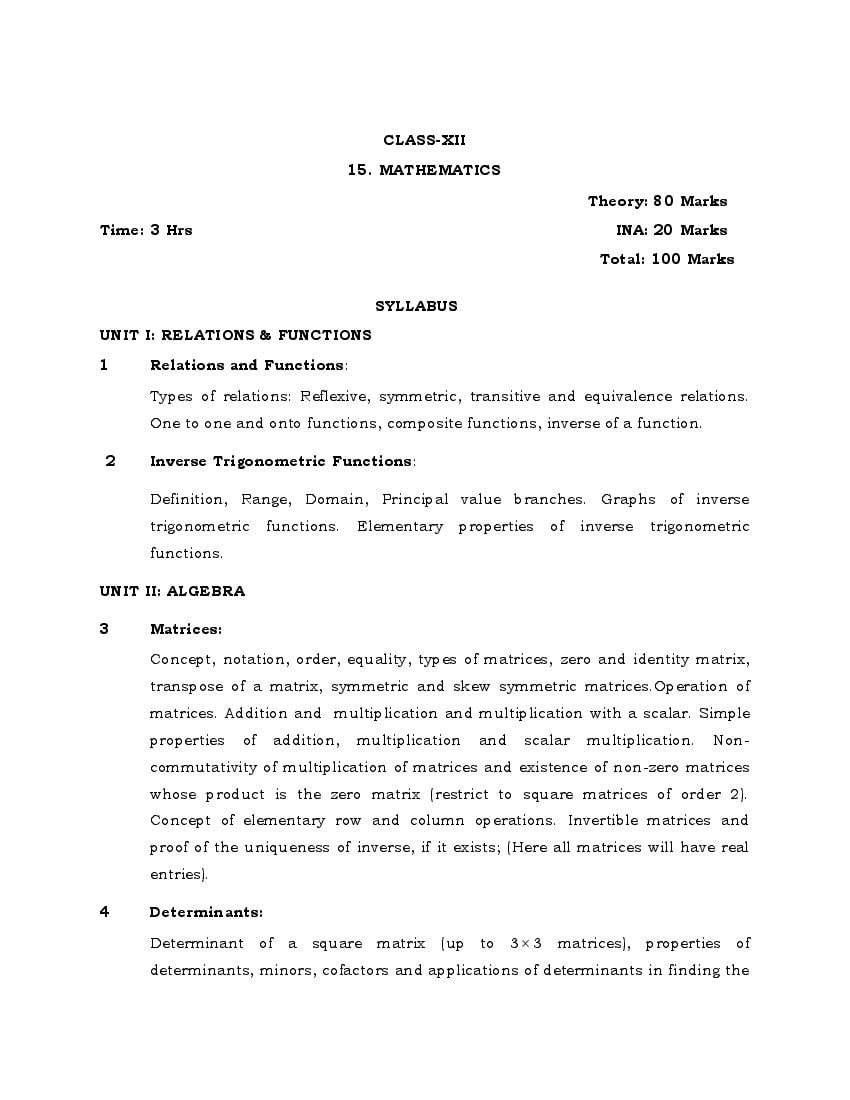
15. MATHEMATICS
Theory: 80 Marks
Time: 3 Hrs INA: 20 Marks
Total: 100 Marks
SYLLABUS
UNIT I: RELATIONS & FUNCTIONS
1 Relations and Functions:
Types of relations: Reflexive, symmetric, transitive and equivalence relations.
One to one and onto functions, composite functions, inverse of a function.
2 Inverse Trigonometric Functions:
Definition, Range, Domain, Principal value branches. Graphs of inverse
trigonometric functions. Elementary properties of inverse trigonometric
functions.
UNIT II: ALGEBRA
3 Matrices:
Concept, notation, order, equality, types of matrices, zero and identity matrix,
transpose of a matrix, symmetric and skew symmetric matrices.Operation of
matrices. Addition and multiplication and multiplication with a scalar. Simple
properties of addition, multiplication and scalar multiplication. Non-
commutativity of multiplication of matrices and existence of non-zero matrices
whose product is the zero matrix (restrict to square matrices of order 2).
Concept of elementary row and column operations. Invertible matrices and
proof of the uniqueness of inverse, if it exists; (Here all matrices will have real
entries).
4 Determinants:
Determinant of a square matrix (up to 3 3 matrices), properties of
determinants, minors, cofactors and applications of determinants in finding the
Page 2
inconsistency and number of solutions of system of linear equation by
examples, solving system of linear equations in two or three variables (having
unique solution) using inverse of a matrix.
UNIT III: CALCULUS
5 Continuity and Differentiability:
Continuity and Differentiability, derivative of composite functions, chain rule,
derivative of inverse trigonometric functions, derivative of implicit function.
Concepts of exponential and logarithmic functions.
Derivatives of logrithmic and exponential functions. Logarithmic
differentiation,derivative of functions expressed in parametric forms. Second
order derivatives. Rolle’s and Lagrange’s Mean Value Theorems (without proof)
and their geometric interpretations.
6 Applications of Derivatives
Applications of derivatives: rate of change, increasing/decreasing functions,
tangents and normal, use of derivative in approximation, maxima and minima
(first derivative test motivated geometrically and second derivative test given as
a provable tool). Simple problems (that illustrate basic principles and
understanding of the subject as well as real life situations).
7 Integrals:
Integration as inverse process of differentiation. Integration of a variety of
functions by substitution, by partial fractions and by parts, Evaluation of
simple integrals of the following types and problems based on them:
dx dx dx dx dx
x a , x a , a x , ax bx c , ax bx c
2 2 2 2 2 2 2 2
( px q ) ( px q )
ax bx c dx, ax bx c dx, a x dx and x a dx
2 2 2 2
2 2
ax bx c dx and ( px q) ax bx c dx
2 2
Page 3
(without proof). Basic properties of definite integrals and evaluation of definite
integrals. .
8 Applications of the Integrals:
Applications in finding the area under simple curves, especially lines,
circles/parabolas/ellipses (in standard form only), area between any of the two
above said curves (the region should be clearly identifiable).
9 Differential Equations:
Definition, order and degree, general and particular solutions of a differential
equation. Formation of differential equation whose general solution is given.
Solution of differential equations by method of separation of variables, solutions
of homogeneous differential equations of first order and first degree. Solutions
of linear differential equation of the type:
+ = where p and q are functions of or constant
+ = where p and q are functions of or constant
UNIT IV: VECTORS AND THREE DIMENSIONAL GEOMETRY
10 Vectors:
Vectors and scalars, magnitude and direction of a vector. Direction cosines and
direction ratios of vectors. Types of vectors (equal, unit, zero, parallel and
collinear vectors), position vector of a point, negative of a vector, components of
a vector, addition of vectors, multiplication of a vector by a scalar, position
vector of a point dividing a line segment in a given ratio. Definition, Geometrical
interpretation, properties and application of scalar (dot) product of vectors,
vector (cross) product of vectors, scalar triple product of vectors.
11 Three-dimensional Geometry:
Direction cosines and direction ratios of a line joining two points. Cartesian
equations and vector equation of a line, coplanar and skew lines, shortest
distance between two lines. Cartesian and vector equation of a plane. Angle
Page 4
from a plane.
UNIT V: LINEAR PROGRAMMING
12 Linear Programming:
Introduction related terminology such as constraints, objectives function,
optimization, different types of linear programming (L.P.) problems,
mathematical formulation of L.P problems, graphical method of solution for
problems in two variables, feasible and infeasible regions (bounded or
unbounded) feasible and infeasible solutions, optimal feasible solutions (up to
three non-trivial constrains)
UNIT VI: PROBABILITY
13 Probability:
Conditional probability, multiplication theorem on probability, independent
events; total probability, Baye's theorem. Random variable and its probability
distribution, mean and variance of random variable.Binomial probability
distribution.
INTERNAL ASSESSMENT 20 Marks
Mathematics Activities 10 Marks
Periodic Tests (Best 2 out of 3 tests coducted) 08 Marks
Book Bank 02 Marks
Note : For activities NCERT Lab Manual may be referred.
Conduct of Periodic Tests
1. Periodic Test is a Pen and Paper assessment which is to be conducted by the
subject teacher.
2. In the entire Academic year, three periodic Tests in each subject may be
conducted.
3. Once schools complete the conduct of all three periodic tests, they will convert
the weightage of each of the three tests into ten marks each for identifying best
Page 5
two shall be taken as the final marks for PT.
4. The school will ensure simple documentation to keep a record of performance.
Assessment of Activity work:
Time : 2hrs 10 Marks
Throughtout the year any 10 activities shall be performed be the student from
the activities given in the NCERT Laboratory Manual for the respective class (XI or XII)
which is available on the link: http//www.ncert.nic.in/exemplar/labmanuals.html. A
record of the same may be kept by the student. An year end test on the activity may be
conducted at the School Level. The weightage are as under:
The activities and one of the projects performed by the
student through out the year and recordkeeping: 5 marks
Assessment of the activity performed during the year
end test: 3 marks
Viva-voce: 2 marks
ACTIVITIES
1. To verify that the relation R in the set L of all lines in a plane, defined by
= {( , ): ⊥ } symmetric but neither reflxive nor transitive.
2. To verify that the relation R in the set L of all lines in a plane, defined by
= {( , ): ∥ } an equivalence relation.
3. To demonstrate a function which is not one-one but is onto.
4. To demonstrate a function which is one-one but not onto.
5. To draw the graph of , using the graph of sin and demonstrate the
concept of mirror reflection (about the line y = x).
6. To explore the principal value of the function using a unit circle.
7. To sketch the graph of and >0 ≠ 1 and to examine that they
are mirror images of each other.
8. To establish a relationship between common logarithm (to the base 10)
and natural logarithm (to the base e ) of the number x.
Page 6
the continuity of the function at that point.
10. To verify that for a function f to be continuous at given point
.∆ = ( + ∆ )− ( ) is arbitrarily small provided ∆ is sufficiently
small.
11. To verify Rolle's Theorem.
12. To verify Lagrange's Mean Value Theroram.
13. To understand the concept of decreasing and increasing functions.
14. To understand the concepts of local maxima, local minima and point of
inflection.
15. To understand the concepts of absolute maximum and minimum values
of a function in a given closed interval throuth its graph.
16. To construct an open box of maximum volume from a given rectangular
sheet by cutting equal squares from each corner.
17. To find the time when the area of a rectangle of given dimension become
maximum, if the length is decreasing and the breadth is increasing at
given rates.
18. To verify that amongst all the rectangle of the same perimeter, the square
has the maximum area.
19. To evalute the definite integal ∫ √1 − dx as the limit of the sum and
verify it by actual integration.
20. To verify geometrically that ⃗ × ⃗ + ⃗ = ⃗ × ⃗ + ⃗ × ⃗
21. To verify that angle in a semi-circle is a right angle, using vector method.
22. To locate the points to given coordinates in space, measure the distance
between two points in space and then to verify the distance using
distance formula.
23. To demonstrate the equation of a plane in normal form.
24. To verify that the angle between two planes is the same as the angle
between their normals.
Page 7
through three non-collinear points) by actual measurement and also
analytically.
26. To measure the shortest distance between two skew lines and verify it
analytically.
27. To explain the computation of conditional probability of a given event A,
when event B has already occurred, through an example of throwing a
pair of dice.
Projects
Project work in mathematics may be performed individually by a student
or jointly by a group of students. These projects may be in the form of
costruction such as curve sketching or drawing of graphs etc. It may
offer a discussion of a topic from history of mathematics involving the
historical development of particular subject in mathematics/ topics on
concepts. Students may be allowed to select the topics of their own
choice for projects in mathematics. The teacher may act as a facilitator
by creating interest in various topics. Once the topic has been selected,
the student should read as much about the topic as is available and
finally prepare the project.
1. To minimise the cost of the food, meeting the dietary requirements of the
staple food of the adolesent students of your school.
2. Estimation of the population of a particular region/country under the
assumption that there is no migration in or out of the existing
population in a particular year.
3. Finding the coordinates of different points identified in your classroom
using the concepts of three dimensional geometry and also find the
distance between the identified points.
4. Formation of differental equation to explain the process of cooling of
boiled water to a given room temperature.
5. Project on histroy of Mathematicians: It may include history of Indian
mathematicians such as Aryabhata, Brahmgupta, Varahamihir,
Page 8
mathematicians such as Cantor, Pythagoras, Thales, Euclid,Appollonius,
Descartes, Fermat, Leibnitz, Euler, Fibonac, Gauss, Newotn etc.
6. On linear Programming problems related to day-to-day life like collecting
data from families of their expenditures and requirements from the
factories to maximum output.
7. Collect data from dieticians, transporters, agents and formulate linear
programming problems.
8. Make a chart of the formulae of applications of calculus.
9. Applications of conic sections, vectors, three dimansinonal geometry,
calculus, etc., in Mathematics and Physics.
10. Mathematics and Chemistry: Study structure of organic compounds.
11. Mathematics and Biology: Study of science of heredity etc.
12. Mathematics and Music
13. Mathematics and Environment
14. Mathematics and Arts: Construction of shapes using curves
15. Mathematics and Information and Communication Technology: Writing
of Mathematical Programmes, flow charts, algorithm, circuit diagrams
etc.
16. Collection of statistical data and analysing it for standard deviation and
mean deviation.
17. Observbe the various patterns and properties in Pascal's triangle and
make a project.
18. Prepare a project based on the Fibonacci sequence, their properties and
similar pattern found in nature.
19. Form a differential equation for the growth of bacteria in different
environments.
20. Study the nature of mathematics and make a project showing where
three aspects of nature of mathemetics- formalism, logic, intuition is
applied in the development of mathematics.
Document Details
| Board / Org | Punjab Board |
| Exam | Class 12 |
| Type | Syllabus |
| Pages | 8 |
| Updated | 09 Jun 2026 |